Divided We Stand:
   Why inequality keeps rising


December 14, 2011   OECD, Directorate for Employment, Labour and Social Affairs
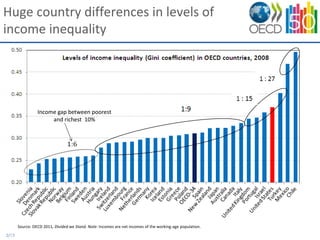
Huge country differences in levels of
income inequality


                 Income gap between poorest
                      and richest 10%


       Source: OECD 2011, Divided we Stand. Note: Incomes are net incomes of the working-age population.
2/13
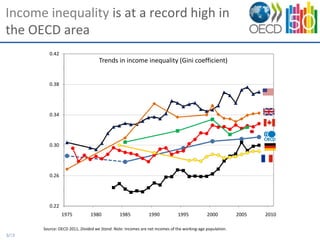
Income inequality is at a record high in
the OECD area
          0.42
                                    Trends in income inequality (Gini coefficient)


          0.38


          0.34


          0.30


          0.26


          0.22
                 1975          1980            1985           1990            1995           2000          2005   2010

       Source: OECD 2011, Divided we Stand. Note: Incomes are net incomes of the working-age population.
3/13
Some surprising facts

       • Income inequality increased in both high- and
         low-inequality countries alike;
       • Income inequality increased during both
         recession and boom periods;
       • Income inequality increased despite
         employment growth.
       So what happened?
       • Developments in labour earnings and labour
         markets are the main driver.
4/13
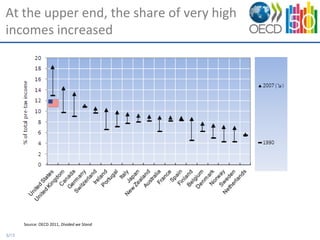
At the upper end, the share of very high
incomes increased


       Source: OECD 2011, Divided we Stand

5/13
At the lower end, lower-skilled people
tended to fall behind

 • Changes in working conditions: part-time work
   and non-standard labour contracts increased;
 • Changes in technology: technical progress was
   more beneficial for high-skilled workers;
 • Changes in working hours: many countries saw an
   increasing divide in hours worked between high-
   and low-wage workers.


6/13
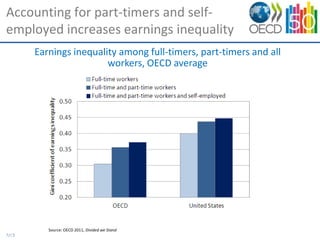
Accounting for part-timers and self-
employed increases earnings inequality
       Earnings inequality among full-timers, part-timers and all
                        workers, OECD average


          Source: OECD 2011, Divided we Stand
7/13
What were the main drivers of
               rising inequality?
 • Globalization had little impact on wage inequality trends per se but
   put pressure on policies and institutional reforms;
 • Trends in globalization and policies affect wages but also
   employment and unemployment.
 • A number of regulatory reforms aimed at promoting growth and
   productivity…
       …also had a positive impact on employment…
       …but at the same time have been associated with increased wage inequality;

 • Skill-based technical progress is a source of rising wage inequality
 • Upskilling was the most important counterweight, reducing
   inequality and increasing employment

8/13
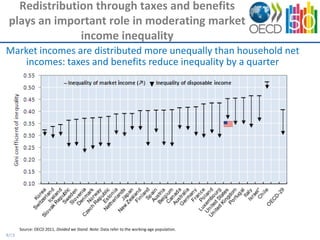
Redistribution through taxes and benefits
 plays an important role in moderating market
               income inequality
Market incomes are distributed more unequally than household net
    incomes: taxes and benefits reduce inequality by a quarter


       Source: OECD 2011, Divided we Stand. Note: Data refer to the working-age population.
9/13
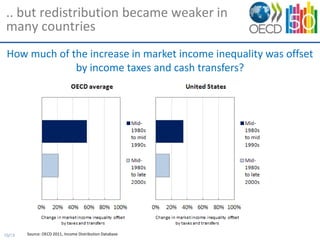
.. but redistribution became weaker in
 many countries
 How much of the increase in market income inequality was offset
              by income taxes and cash transfers?


10/13   Source: OECD 2011, Income Distribution Database
Why have tax/benefit systems become
   less successful at reducing inequality?

        • While overall redistribution has increased, this was not
          enough to offset growing market-income inequality;
        • Changes in overall redistribution were mainly driven by
          benefits: those became more redistributive during the
          1990s but less effective since then;
        • Spending levels have been a more important driver of
          these changes than tighter targeting;
        • Spending shifted towards “inactive” benefits, leading
          to reduced activity rates and higher market-income
          inequality.
11/13
Policy lessons for OECD countries

  • Government transfers (cash and in-kind) have an important
    role to play to safeguard low-income households;
  • Scope for reviewing some existing tax provisions in light of
    increased “tax capacity" among top-income households;
  • “More and better jobs”: Increasing employment may
    contribute to sustainable cuts in income inequality, provided
    employment gains occur in jobs that offer career prospects;
  • Facilitate and encourage access to employment for under-
    represented groups: address labour market segmentation;
  • Promote up-skilling of the workforce: better training and
    education for the low-skilled;
   Both redistribution and inclusive employment policies matter.
12/13
More Information…


13/13
        www.oecd.org/els/social/inequality

Why Income Inequality Keeps Rising

  • 1.
    Divided We Stand: Why inequality keeps rising December 14, 2011 OECD, Directorate for Employment, Labour and Social Affairs
  • 2.
    Huge country differencesin levels of income inequality Income gap between poorest and richest 10% Source: OECD 2011, Divided we Stand. Note: Incomes are net incomes of the working-age population. 2/13
  • 3.
    Income inequality isat a record high in the OECD area 0.42 Trends in income inequality (Gini coefficient) 0.38 0.34 0.30 0.26 0.22 1975 1980 1985 1990 1995 2000 2005 2010 Source: OECD 2011, Divided we Stand. Note: Incomes are net incomes of the working-age population. 3/13
  • 4.
    Some surprising facts • Income inequality increased in both high- and low-inequality countries alike; • Income inequality increased during both recession and boom periods; • Income inequality increased despite employment growth. So what happened? • Developments in labour earnings and labour markets are the main driver. 4/13
  • 5.
    At the upperend, the share of very high incomes increased Source: OECD 2011, Divided we Stand 5/13
  • 6.
    At the lowerend, lower-skilled people tended to fall behind • Changes in working conditions: part-time work and non-standard labour contracts increased; • Changes in technology: technical progress was more beneficial for high-skilled workers; • Changes in working hours: many countries saw an increasing divide in hours worked between high- and low-wage workers. 6/13
  • 7.
    Accounting for part-timersand self- employed increases earnings inequality Earnings inequality among full-timers, part-timers and all workers, OECD average Source: OECD 2011, Divided we Stand 7/13
  • 8.
    What were themain drivers of rising inequality? • Globalization had little impact on wage inequality trends per se but put pressure on policies and institutional reforms; • Trends in globalization and policies affect wages but also employment and unemployment. • A number of regulatory reforms aimed at promoting growth and productivity… …also had a positive impact on employment… …but at the same time have been associated with increased wage inequality; • Skill-based technical progress is a source of rising wage inequality • Upskilling was the most important counterweight, reducing inequality and increasing employment 8/13
  • 9.
    Redistribution through taxesand benefits plays an important role in moderating market income inequality Market incomes are distributed more unequally than household net incomes: taxes and benefits reduce inequality by a quarter Source: OECD 2011, Divided we Stand. Note: Data refer to the working-age population. 9/13
  • 10.
    .. but redistributionbecame weaker in many countries How much of the increase in market income inequality was offset by income taxes and cash transfers? 10/13 Source: OECD 2011, Income Distribution Database
  • 11.
    Why have tax/benefitsystems become less successful at reducing inequality? • While overall redistribution has increased, this was not enough to offset growing market-income inequality; • Changes in overall redistribution were mainly driven by benefits: those became more redistributive during the 1990s but less effective since then; • Spending levels have been a more important driver of these changes than tighter targeting; • Spending shifted towards “inactive” benefits, leading to reduced activity rates and higher market-income inequality. 11/13
  • 12.
    Policy lessons forOECD countries • Government transfers (cash and in-kind) have an important role to play to safeguard low-income households; • Scope for reviewing some existing tax provisions in light of increased “tax capacity" among top-income households; • “More and better jobs”: Increasing employment may contribute to sustainable cuts in income inequality, provided employment gains occur in jobs that offer career prospects; • Facilitate and encourage access to employment for under- represented groups: address labour market segmentation; • Promote up-skilling of the workforce: better training and education for the low-skilled;  Both redistribution and inclusive employment policies matter. 12/13
  • 13.
    More Information… 13/13 www.oecd.org/els/social/inequality

Editor's Notes

  • #3 Incomes refer to net incomes (disposable equivalised net incomes) of the working-age population (18-64).The chart shows a standard measure of inequality – the Gini coefficient which ranges between O (when everyone has the same income) and 1 (when all the income is held by 1 person). It also shows a measure of the income gap between the rich and the poor, i.e., the ratio of average income in the top decile of earners to that in the bottom decile.
  • #5 It is well-known that income inequality has increased in the English-speaking OECD countries over the past three decades. But it is less well-known that income inequality increased in all Nordic countries, notably in Sweden (+ 6 point Gini increase since 1990), which have traditionally been low-inequality countries.
  • #9 The cross-country econometric evidence in our report does not single out globalisation as a major driver of growing inequality among OECD countries. We tested the “globalisation” effect suing measures of exports, imports and FDI.The econometric results seem to bear out the Tinbergen dictum that trends in income distribution represent the outcome of a race between supply and demand. In this case, “supply” refers to the increased human capital content of the labour force and “demand” refers to skill-biased technical change.
  • #13 -