 Define Seizures and Epilepsy
 Recognize common seizure types
 Describe types of seizure emergencies
 Describe side effects and risks of seizures,
medicines and other treatments for
epilepsy
 Seizure is a symptom of a disturbance in the
electrical activity of the brain
 Epilepsy is a disorder characterized by tendency to
recurrent, unprovoked seizures
◦ Recurrent - 2 or more
◦ Unprovoked - not caused by other known
medical problems
 EPILEPSY = SEIZURE DISORDER
 Almost 3 million Americans have epilepsy, > 65
million worldwide
 1 in 10 people will have a single seizure in their
lifetime
 1 in 26 people will develop epilepsy in their
lifetime
 200,000 people with newly diagnosed epilepsy
each year
 Epilepsy is the 4th most common neurological
disorder after stroke, Alzheimer’s and migraine
 For approximately 70% of people who are
diagnosed with epilepsy the cause is unknown
 For the remaining 30%, the seizures are symptoms
of a known cause (i.e., lesions, trauma)
 Brain trauma
 Brain lesions (i.e. tubers, tumors)
 Poisoning (lead, alcohol, drugs)
 Infections of the brain (i.e. meningitis, encephalitis)
 High fever
 Brain injury at birth
 Congenital malformations
 Seizures at an early age (starting before age 1
is highest)
 Neurodevelopmental delays
 Intellectual disabilities and cerebral palsy
 Children can outgrow epilepsy – may be seizure free and
off medications as adults
 Some children have more than one type of seizure
 About 2/3 of children have complete or almost complete
seizure control when they take medication as prescribed
 Missed or late medication
 Change in medication
 Sleep deprivation
 Hormonal changes
 Alcohol, recreational
drugs
 Drug interaction
 Fever or illness
 Specific stimuli
◦ Flashing lights
Hyperventilation
◦ Sudden loud noises
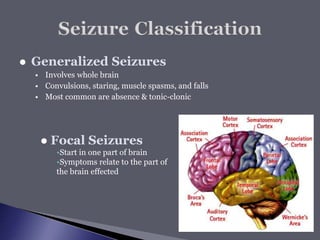
 Generalized Seizures
 Involves whole brain
 Convulsions, staring, muscle spasms, and falls
 Most common are absence & tonic-clonic
 Focal Seizures
•Start in one part of brain
•Symptoms relate to the part of
the brain effected
 Aura – First symptom of a seizure, often called a
‘warning’.
◦ Most commonly seen with focal seizures.
 Ictus- What is seen/felt during a seizure
 Postictal- What is seen/felt after the seizure,
until the brain recovers to baseline
 A sudden hoarse cry
 Loss of consciousness
 May fall if standing
 Muscles become tonic or stiff
 Convulsions (stiffening of arms and legs followed by
rhythmic jerking)
 Shallow breathing and drooling may occur
 Possible loss of bowel or bladder control
 Occasionally skin, nails, lips may turn blue
 Generally lasts 1 to 3 minutes
 Usually followed by confusion, headache, tiredness,
soreness, speech difficulty
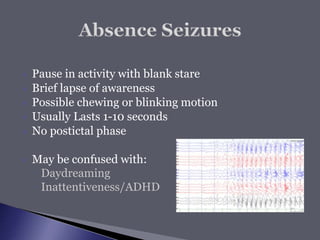
 Pause in activity with blank stare
 Brief lapse of awareness
 Possible chewing or blinking motion
 Usually Lasts 1-10 seconds
 No postictal phase
 May be confused with:
◦ Daydreaming
◦ Inattentiveness/ADHD
 Myoclonic – brief muscle contractions, may occur singly or
in clusters, affect certain muscle groups, or one or both
sides of body
 Tonic - stiffening or posturing of body
 Atonic (drop attack) – loss of tone, may result in drop of
head, trunk, or whole body
 Consciousness is not impaired
 Involuntary movements (isolated twitching of arms, face,
legs)
 Sensory symptoms (tingling, weakness, sounds, smells,
tastes, visual distortions)
 Psychic symptoms (déjà vu, hallucinations, fear, anxiety,
“a feeling they can’t explain”)
 Duration is usually less than 1 minute
 May be confused with:
 acting out, mental illness or psychosomatic illness
 Altered awareness
 Blank stare/dazed look
 AUTOMATISMS (picking
at clothes, lip smacking,
chewing)
 Nonsensical speech or
lip smacking
 Clumsy or disoriented
movements
 Aimless walking
 Picking things up
 Often lasts 1 to 3 minutes
 Often followed by tiredness,
headache or nausea
 May be confused with:
◦ Drunkenness or drug
abuse
◦ Aggressive behavior
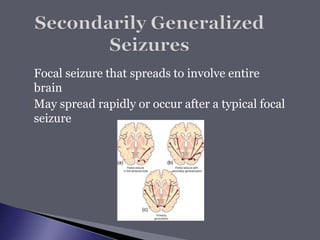
 Focal seizure that spreads to involve entire
brain
 May spread rapidly or occur after a typical focal
seizure
MOST SEIZURES ARE NOT MEDICAL EMERGENCIES
Basic first aid may vary depending on whether there is a
change in awareness or consciousness
No first aid may be needed for absence seizures or seizures
with no loss of awareness
Do not give anything by mouth until the student is back to
normal state and able to swallow normally
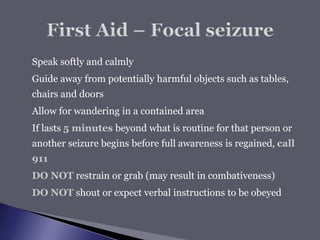
 Speak softly and calmly
 Guide away from potentially harmful objects such as tables,
chairs and doors
 Allow for wandering in a contained area
 If lasts 5 minutes beyond what is routine for that person or
another seizure begins before full awareness is regained, call
911
 DO NOT restrain or grab (may result in combativeness)
 DO NOT shout or expect verbal instructions to be obeyed
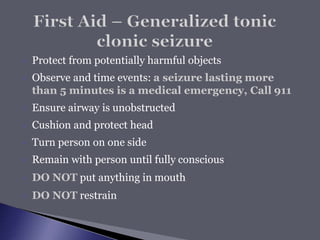
 Protect from potentially harmful objects
 Observe and time events: a seizure lasting more
than 5 minutes is a medical emergency, Call 911
 Ensure airway is unobstructed
 Cushion and protect head
 Turn person on one side
 Remain with person until fully conscious
 DO NOT put anything in mouth
 DO NOT restrain
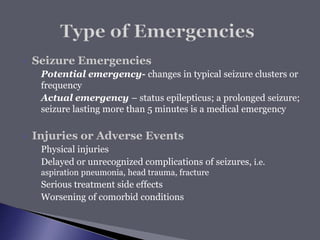
 Seizure Emergencies
◦ Potential emergency- changes in typical seizure clusters or
frequency
◦ Actual emergency – status epilepticus; a prolonged seizure;
seizure lasting more than 5 minutes is a medical emergency
 Injuries or Adverse Events
◦ Physical injuries
◦ Delayed or unrecognized complications of seizures, i.e.
aspiration pneumonia, head trauma, fracture
◦ Serious treatment side effects
◦ Worsening of comorbid conditions
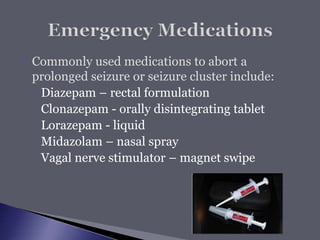
 Commonly used medications to abort a
prolonged seizure or seizure cluster include:
◦ Diazepam – rectal formulation
◦ Clonazepam - orally disintegrating tablet
◦ Lorazepam - liquid
◦ Midazolam – nasal spray
◦ Vagal nerve stimulator – magnet swipe
 Definitions may vary, most commonly considered
to occur with:
◦ One tonic-clonic seizure lasting 5 minutes or
longer
◦ Multiple seizures without recovery to baseline
between events
 Death can occur during a seizure or due to
complications from a seizure
 The most common form of death in epilepsy is
SUDEP (Sudden Unexplained Death in Epilepsy)
◦ Occurs in someone known to have epilepsy, in
the absence of an obvious cause for the death
◦ 1/1000 people with epilepsy per year die from
SUDEP – less common in children
◦ Risk factors include convulsive seizures, multiple
medications, early age at epilepsy onset
 Events that look like seizures but on EEG
monitoring have no association with abnormal
electrical discharges
 EEG monitoring can be the most effective way of
diagnosing events
 Can be caused by a variety of physical or
psychological factors
 ANTIEPILEPTIC MEDICATIONS
(antiseizure medications)
 SURGERY
 DIETS
 VAGUS NERVE STIMULATOR
 Before 1993, drug choices for epilepsy were limited
 Since 1993, many new products
 Approximately 60-70 % of those with newly-
diagnosed epilepsy become seizure free on
medication
 About 1/3 of people with epilepsy have seizures that
are not controlled by medication
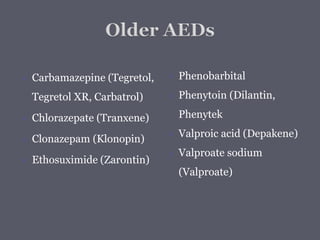
 Carbamazepine (Tegretol,
Tegretol XR, Carbatrol)
 Chlorazepate (Tranxene)
 Clonazepam (Klonopin)
 Ethosuximide (Zarontin)
 Phenobarbital
 Phenytoin (Dilantin,
Phenytek
 Valproic acid (Depakene)
 Valproate sodium
(Valproate)
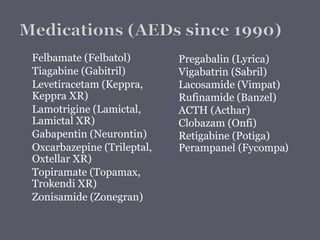
 Felbamate (Felbatol)
 Tiagabine (Gabitril)
 Levetiracetam (Keppra,
Keppra XR)
 Lamotrigine (Lamictal,
Lamictal XR)
 Gabapentin (Neurontin)
 Oxcarbazepine (Trileptal,
Oxtellar XR)
 Topiramate (Topamax,
Trokendi XR)
 Zonisamide (Zonegran)
 Pregabalin (Lyrica)
 Vigabatrin (Sabril)
 Lacosamide (Vimpat)
 Rufinamide (Banzel)
 ACTH (Acthar)
 Clobazam (Onfi)
 Retigabine (Potiga)
 Perampanel (Fycompa)
 Side effects can be unpredictable. Some are dose
dependent, others occur regardless of dose
 Newer medications generally have fewer cognitive
effects
 Behavior and mood changes are often difficult to
sort out and are not necessarily dose-related
 Long term effects are unclear, but even mild side
effects can have a significant impact
 Report any physical, cognitive, mood or behavioral
changes to student’s family and to health care
provider as requested
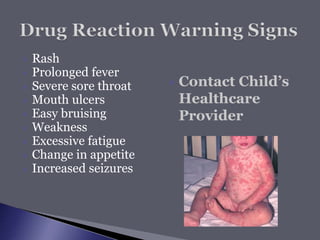
Dose-related/toxic:
 Blurry vision
 Dizziness
 Lightheadedness
 Sedation
 Slowed thinking
 Feeling disoriented
 Coordination problems
 Unsteady walking
Drug-related:
 Cognitive problems
 Fatigue
 Weight gain or loss
 Cosmetic – acne,
excessive hair growth or
hair loss
 Hyperactivity
 Slowed movements
 Personality or mood
changes
 Rash
 Prolonged fever
 Severe sore throat
 Mouth ulcers
 Easy bruising
 Weakness
 Excessive fatigue
 Change in appetite
 Increased seizures
 Contact Child’s
Healthcare
Provider
 In most situations, generic forms of AEDs are
appropriate
 Change in seizures or side effects may occur
Switching between formulations is the major
concern
◦ From brand to generic or generic to brand
◦ From one generic manufacturer to another
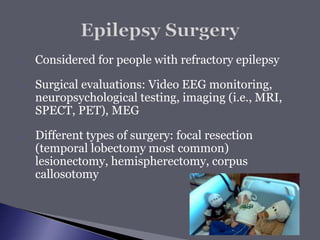
 Considered for people with refractory epilepsy
 Surgical evaluations: Video EEG monitoring,
neuropsychological testing, imaging (i.e., MRI,
SPECT, PET), MEG
 Different types of surgery: focal resection
(temporal lobectomy most common)
lesionectomy, hemispherectomy, corpus
callosotomy
 Produces ketotic state using diet high in fat, low in
carbohydrate, adequate protein
 Easiest to use in children with control of food choices
 Effective for all seizure types
 May require hospitalization to start strict diet
 Compliance may be problematic
 Side effects can include constipation, metabolic acidosis,
weight changes, kidney stones
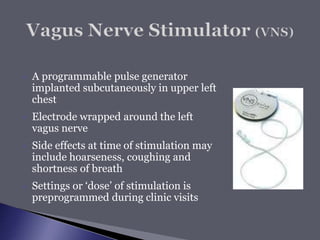
 A programmable pulse generator
implanted subcutaneously in upper left
chest
 Electrode wrapped around the left
vagus nerve
 Side effects at time of stimulation may
include hoarseness, coughing and
shortness of breath
 Settings or ‘dose’ of stimulation is
preprogrammed during clinic visits
 The Epilepsy Foundation Eastern PA is a non-profit
501(c)(3) voluntary health agency whose mission is
to lead the fight to stop seizures, find a cure and
overcome challenges created by epilepsy. We
choose to fulfill that mission by meeting the non-
medical needs for people affected by
epilepsy/seizure disorder to enhance their lives and
build supportive communities.
 The EFEPA provides education, support and
advocacy for people with epilepsy and their families
across 18 counties in eastern PA.
 The Epilepsy Foundation Western/Central
Pennsylvania (EFWCP) is a private, non-profit
service organization providing public education
and supportive services to individuals and families
affected by epilepsy/seizure disorders. Our mission
is to lead the fight to stop seizures, find a cure and
overcome challenges created by epilepsy.
 With offices in Pittsburg, Harrisburg and
Johnstown, the EFWCP offers services to residents
in 49 counties throughout western and central PA.
The EFEPA and EFWCP offer additional on-site training
programs for School Personnel and Students on First Aid &
Seizure Recognition. We also offer assistance in IEP/504
Planning. Check out our website or contact us to set up your
school’s next session today!
• Eastern PA: http://www.efepa.org/programs-and-
resources/school-information/
• Western/Central PA:
http://efwp.org/programs/ProgramsPSA.xml
Sue Livingston
Education Coordinator
Epilepsy Foundation Eastern PA
919 Walnut Street, Suite 700
Philadelphia PA 19107
www.efepa.org 215-629-5003
Andrea Zonneveld
Community Educator &
Events Coordinator
Epilepsy Foundation
Western/Central PA
1501 Reedsdale Street, Suite 3002
Pittsburgh, PA 15233
www.efwp.org 412-322-5880
Thank you for attending!
You will now be prompted to
complete a brief post-webinar
survey. If you do not have time to
complete the survey now one will also
be emailed to you.
Your input is vital to developing and
improving educational programs.
This is required for obtaining CE
Credits.

2014 school nurse webinar 2

  • 2.
     Define Seizuresand Epilepsy  Recognize common seizure types  Describe types of seizure emergencies  Describe side effects and risks of seizures, medicines and other treatments for epilepsy
  • 3.
     Seizure isa symptom of a disturbance in the electrical activity of the brain  Epilepsy is a disorder characterized by tendency to recurrent, unprovoked seizures ◦ Recurrent - 2 or more ◦ Unprovoked - not caused by other known medical problems  EPILEPSY = SEIZURE DISORDER
  • 4.
     Almost 3million Americans have epilepsy, > 65 million worldwide  1 in 10 people will have a single seizure in their lifetime  1 in 26 people will develop epilepsy in their lifetime  200,000 people with newly diagnosed epilepsy each year  Epilepsy is the 4th most common neurological disorder after stroke, Alzheimer’s and migraine
  • 5.
     For approximately70% of people who are diagnosed with epilepsy the cause is unknown  For the remaining 30%, the seizures are symptoms of a known cause (i.e., lesions, trauma)
  • 6.
     Brain trauma Brain lesions (i.e. tubers, tumors)  Poisoning (lead, alcohol, drugs)  Infections of the brain (i.e. meningitis, encephalitis)  High fever  Brain injury at birth  Congenital malformations
  • 7.
     Seizures atan early age (starting before age 1 is highest)  Neurodevelopmental delays  Intellectual disabilities and cerebral palsy  Children can outgrow epilepsy – may be seizure free and off medications as adults  Some children have more than one type of seizure  About 2/3 of children have complete or almost complete seizure control when they take medication as prescribed
  • 8.
     Missed orlate medication  Change in medication  Sleep deprivation  Hormonal changes  Alcohol, recreational drugs  Drug interaction  Fever or illness  Specific stimuli ◦ Flashing lights Hyperventilation ◦ Sudden loud noises
  • 9.
     Generalized Seizures Involves whole brain  Convulsions, staring, muscle spasms, and falls  Most common are absence & tonic-clonic  Focal Seizures •Start in one part of brain •Symptoms relate to the part of the brain effected
  • 10.
     Aura –First symptom of a seizure, often called a ‘warning’. ◦ Most commonly seen with focal seizures.  Ictus- What is seen/felt during a seizure  Postictal- What is seen/felt after the seizure, until the brain recovers to baseline
  • 11.
     A suddenhoarse cry  Loss of consciousness  May fall if standing  Muscles become tonic or stiff  Convulsions (stiffening of arms and legs followed by rhythmic jerking)  Shallow breathing and drooling may occur  Possible loss of bowel or bladder control  Occasionally skin, nails, lips may turn blue  Generally lasts 1 to 3 minutes  Usually followed by confusion, headache, tiredness, soreness, speech difficulty
  • 12.
     Pause inactivity with blank stare  Brief lapse of awareness  Possible chewing or blinking motion  Usually Lasts 1-10 seconds  No postictal phase  May be confused with: ◦ Daydreaming ◦ Inattentiveness/ADHD
  • 13.
     Myoclonic –brief muscle contractions, may occur singly or in clusters, affect certain muscle groups, or one or both sides of body  Tonic - stiffening or posturing of body  Atonic (drop attack) – loss of tone, may result in drop of head, trunk, or whole body
  • 14.
     Consciousness isnot impaired  Involuntary movements (isolated twitching of arms, face, legs)  Sensory symptoms (tingling, weakness, sounds, smells, tastes, visual distortions)  Psychic symptoms (déjà vu, hallucinations, fear, anxiety, “a feeling they can’t explain”)  Duration is usually less than 1 minute  May be confused with:  acting out, mental illness or psychosomatic illness
  • 15.
     Altered awareness Blank stare/dazed look  AUTOMATISMS (picking at clothes, lip smacking, chewing)  Nonsensical speech or lip smacking  Clumsy or disoriented movements  Aimless walking  Picking things up  Often lasts 1 to 3 minutes  Often followed by tiredness, headache or nausea  May be confused with: ◦ Drunkenness or drug abuse ◦ Aggressive behavior
  • 16.
     Focal seizurethat spreads to involve entire brain  May spread rapidly or occur after a typical focal seizure
  • 17.
    MOST SEIZURES ARENOT MEDICAL EMERGENCIES Basic first aid may vary depending on whether there is a change in awareness or consciousness No first aid may be needed for absence seizures or seizures with no loss of awareness Do not give anything by mouth until the student is back to normal state and able to swallow normally
  • 18.
     Speak softlyand calmly  Guide away from potentially harmful objects such as tables, chairs and doors  Allow for wandering in a contained area  If lasts 5 minutes beyond what is routine for that person or another seizure begins before full awareness is regained, call 911  DO NOT restrain or grab (may result in combativeness)  DO NOT shout or expect verbal instructions to be obeyed
  • 19.
     Protect frompotentially harmful objects  Observe and time events: a seizure lasting more than 5 minutes is a medical emergency, Call 911  Ensure airway is unobstructed  Cushion and protect head  Turn person on one side  Remain with person until fully conscious  DO NOT put anything in mouth  DO NOT restrain
  • 20.
     Seizure Emergencies ◦Potential emergency- changes in typical seizure clusters or frequency ◦ Actual emergency – status epilepticus; a prolonged seizure; seizure lasting more than 5 minutes is a medical emergency  Injuries or Adverse Events ◦ Physical injuries ◦ Delayed or unrecognized complications of seizures, i.e. aspiration pneumonia, head trauma, fracture ◦ Serious treatment side effects ◦ Worsening of comorbid conditions
  • 21.
     Commonly usedmedications to abort a prolonged seizure or seizure cluster include: ◦ Diazepam – rectal formulation ◦ Clonazepam - orally disintegrating tablet ◦ Lorazepam - liquid ◦ Midazolam – nasal spray ◦ Vagal nerve stimulator – magnet swipe
  • 22.
     Definitions mayvary, most commonly considered to occur with: ◦ One tonic-clonic seizure lasting 5 minutes or longer ◦ Multiple seizures without recovery to baseline between events
  • 23.
     Death canoccur during a seizure or due to complications from a seizure  The most common form of death in epilepsy is SUDEP (Sudden Unexplained Death in Epilepsy) ◦ Occurs in someone known to have epilepsy, in the absence of an obvious cause for the death ◦ 1/1000 people with epilepsy per year die from SUDEP – less common in children ◦ Risk factors include convulsive seizures, multiple medications, early age at epilepsy onset
  • 24.
     Events thatlook like seizures but on EEG monitoring have no association with abnormal electrical discharges  EEG monitoring can be the most effective way of diagnosing events  Can be caused by a variety of physical or psychological factors
  • 25.
     ANTIEPILEPTIC MEDICATIONS (antiseizuremedications)  SURGERY  DIETS  VAGUS NERVE STIMULATOR
  • 26.
     Before 1993,drug choices for epilepsy were limited  Since 1993, many new products  Approximately 60-70 % of those with newly- diagnosed epilepsy become seizure free on medication  About 1/3 of people with epilepsy have seizures that are not controlled by medication
  • 27.
     Carbamazepine (Tegretol, TegretolXR, Carbatrol)  Chlorazepate (Tranxene)  Clonazepam (Klonopin)  Ethosuximide (Zarontin)  Phenobarbital  Phenytoin (Dilantin, Phenytek  Valproic acid (Depakene)  Valproate sodium (Valproate)
  • 28.
     Felbamate (Felbatol) Tiagabine (Gabitril)  Levetiracetam (Keppra, Keppra XR)  Lamotrigine (Lamictal, Lamictal XR)  Gabapentin (Neurontin)  Oxcarbazepine (Trileptal, Oxtellar XR)  Topiramate (Topamax, Trokendi XR)  Zonisamide (Zonegran)  Pregabalin (Lyrica)  Vigabatrin (Sabril)  Lacosamide (Vimpat)  Rufinamide (Banzel)  ACTH (Acthar)  Clobazam (Onfi)  Retigabine (Potiga)  Perampanel (Fycompa)
  • 29.
     Side effectscan be unpredictable. Some are dose dependent, others occur regardless of dose  Newer medications generally have fewer cognitive effects  Behavior and mood changes are often difficult to sort out and are not necessarily dose-related  Long term effects are unclear, but even mild side effects can have a significant impact  Report any physical, cognitive, mood or behavioral changes to student’s family and to health care provider as requested
  • 30.
    Dose-related/toxic:  Blurry vision Dizziness  Lightheadedness  Sedation  Slowed thinking  Feeling disoriented  Coordination problems  Unsteady walking Drug-related:  Cognitive problems  Fatigue  Weight gain or loss  Cosmetic – acne, excessive hair growth or hair loss  Hyperactivity  Slowed movements  Personality or mood changes
  • 31.
     Rash  Prolongedfever  Severe sore throat  Mouth ulcers  Easy bruising  Weakness  Excessive fatigue  Change in appetite  Increased seizures  Contact Child’s Healthcare Provider
  • 32.
     In mostsituations, generic forms of AEDs are appropriate  Change in seizures or side effects may occur Switching between formulations is the major concern ◦ From brand to generic or generic to brand ◦ From one generic manufacturer to another
  • 33.
     Considered forpeople with refractory epilepsy  Surgical evaluations: Video EEG monitoring, neuropsychological testing, imaging (i.e., MRI, SPECT, PET), MEG  Different types of surgery: focal resection (temporal lobectomy most common) lesionectomy, hemispherectomy, corpus callosotomy
  • 34.
     Produces ketoticstate using diet high in fat, low in carbohydrate, adequate protein  Easiest to use in children with control of food choices  Effective for all seizure types  May require hospitalization to start strict diet  Compliance may be problematic  Side effects can include constipation, metabolic acidosis, weight changes, kidney stones
  • 35.
     A programmablepulse generator implanted subcutaneously in upper left chest  Electrode wrapped around the left vagus nerve  Side effects at time of stimulation may include hoarseness, coughing and shortness of breath  Settings or ‘dose’ of stimulation is preprogrammed during clinic visits
  • 37.
     The EpilepsyFoundation Eastern PA is a non-profit 501(c)(3) voluntary health agency whose mission is to lead the fight to stop seizures, find a cure and overcome challenges created by epilepsy. We choose to fulfill that mission by meeting the non- medical needs for people affected by epilepsy/seizure disorder to enhance their lives and build supportive communities.  The EFEPA provides education, support and advocacy for people with epilepsy and their families across 18 counties in eastern PA.
  • 38.
     The EpilepsyFoundation Western/Central Pennsylvania (EFWCP) is a private, non-profit service organization providing public education and supportive services to individuals and families affected by epilepsy/seizure disorders. Our mission is to lead the fight to stop seizures, find a cure and overcome challenges created by epilepsy.  With offices in Pittsburg, Harrisburg and Johnstown, the EFWCP offers services to residents in 49 counties throughout western and central PA.
  • 39.
    The EFEPA andEFWCP offer additional on-site training programs for School Personnel and Students on First Aid & Seizure Recognition. We also offer assistance in IEP/504 Planning. Check out our website or contact us to set up your school’s next session today! • Eastern PA: http://www.efepa.org/programs-and- resources/school-information/ • Western/Central PA: http://efwp.org/programs/ProgramsPSA.xml
  • 40.
    Sue Livingston Education Coordinator EpilepsyFoundation Eastern PA 919 Walnut Street, Suite 700 Philadelphia PA 19107 www.efepa.org 215-629-5003 Andrea Zonneveld Community Educator & Events Coordinator Epilepsy Foundation Western/Central PA 1501 Reedsdale Street, Suite 3002 Pittsburgh, PA 15233 www.efwp.org 412-322-5880
  • 41.
    Thank you forattending! You will now be prompted to complete a brief post-webinar survey. If you do not have time to complete the survey now one will also be emailed to you. Your input is vital to developing and improving educational programs. This is required for obtaining CE Credits.