What Is Feedback,
and Why Is it So Important?


SPRING 2013 OPEN CAMPUS VIRTUAL CONVOCATION
Let’s Start with a
Scenario…
A student submits her
work and doesn’t receive
a grade or comments for
two weeks.
In This Scenario…
What could this delay in feedback
mean for the student?

   Could this mean making the same
    mistakes on future assignments?

   Could this make for a bad
    impression of the online
    experience?

   Could this even make the
    difference between persisting and
    giving up?
Thankfully, there’s a better
   way…
This presentation will
examine research to show
why and how feedback
can help our students
avoid such issues and be
more successful.
So, Student Feedback:

What Is It?
feed • back (noun)

evaluative information derived from
a particular process or activity: as in, “He got
great feedback from his speech and was thus
able to improve enough to deliver a knockout
commencement address.”
stu•dent feed • back
Student feedback can include a variety of helpful one-on-
one responses from an instructor. Some examples:
   a phone call to follow-up on a student’s absence in the LMS

   a set of suggestions sent along with a paper grade

   a positive “pat on the head” message for a job well done

   a personalized response to a discussion post

   a class-wide message focusing on areas of improvement in a
    particular concept
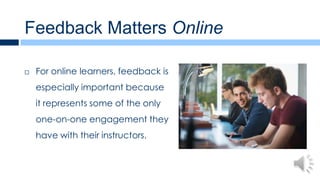
Feedback Matters Online

   For online learners, feedback is
    especially important because
    it represents some of the only
    one-on-one engagement they
    have with their instructors.
One-on-One Interaction Is
Essential…
   “the online classroom might be the only
    educational outlet in which the one-to-one
    interaction between the instructor and the student
    is more important than the textbook, assignments or
    lectures. . . students have no other gauge of their
    ability than targeted, specific feedback from the
    instructor.”
The Journal of Educators Online, Volume 3, Number 2, July 2006
…And Students Crave That
Interaction
Interviews with 100 online learners
at Kent State found that students
crave interaction with their instructors.


Five Pedagogical Practices to Improve Your Online Course,
Feb 2013, Vol. 13, Num. 2, Online Classroom
Why Are Students Looking for
Interaction?
   Challenges for online students

       Asynchronous learning

       Lack of personal contact

       Potential disengagement can
        lead to a failure to persist
So How Can We Be of the Most
    Help?
Employ Helpful Feedback to Help
Students Grow and Improve.
Feedback Should:
Be Timely
Be Personalized
Be Engaging
Model Critical Thinking
Personal Feedback

“If you give them feedback directed
to them personally, it reduces some
barriers that … naturally develop in
the online classroom.”
“Using Audio to Provide Timely Feedback,” Rob Kelly, May 2012, Vol. 12, Num. 5, Online Classroom
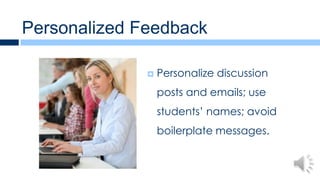
Personalized Feedback

                 Personalize discussion
                  posts and emails; use
                  students’ names; avoid
                  boilerplate messages.
Timely Feedback
“If you give them good feedback
at the beginning that’s … personal,
constructive, and helpful, the quality
of their work [will be better] for the
whole semester.”
Reciprocal Feedback in the Online Classroom, Rob Kelly, May 2012, Vol. 12, Num. 5, Online Classroom
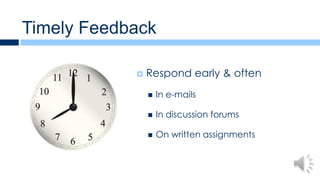
Timely Feedback

               Respond early & often
                   In e-mails

                   In discussion forums

                   On written assignments
Engaging Feedback

One recent study of online students
found that when comments were
communicated respectfully,
“Students felt agency. They felt
more involved in the class.”
Five Pedagogical Practices to Improve Your Online Course, Feb 2013, Vol. 13, Num. 2, Online Classroom
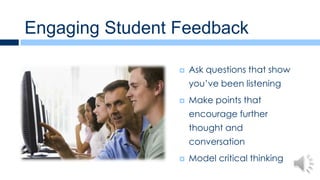
Engaging Student Feedback

                    Ask questions that show
                     you’ve been listening
                    Make points that
                     encourage further
                     thought and
                     conversation
                    Model critical thinking
Model Critical Thinking

“Ask a yes-or-no question followed
by why or why not? It balances
quantitative and qualitative feedback.”

Five Pedagogical Practices to Improve Your Online Course,
Feb 2013, Vol. 13, Num. 2, Online Classroom
What Impact Might These Practices
Have on Student Success?
Feedback and Student Success
   “Monitoring and feedback is a condition for
    student success. Students are more likely to
    succeed in settings that provide faculty, staff,
    and students frequent feedback about their
    performance.”


“Taking Student Success Seriously: Rethinking the First Year of College”

V. Tinto, Syracuse University. 2005.
Feedback and Student Success
   In one study of online students classified as
    persisters and nonpersisters, “results indicated that
    approximately 66% of the nonpersisters mentioned
    communication with faculty as a barrier to
    persistence. Both persisters and nonpersisters cited
    insufficient and unsatisfactory communication with
    academicians as a barrier to persistence.”
(Morgan & Tam, 1999)
Feedback and Student Success
   The role of the instructor is magnified due to
    the lack of informal peer-to-peer interaction
    and the absence of typical non-verbal cues
    and spontaneous discussions in a face-to-face
    classroom.
The Journal of Educators Online, Volume 3, Number 2, July 2006
Good Feedback = Persistence and
Success

In a recent Open Campus pilot program,
Professor Jerry Shawver and his team of math
instructors led a cohort of developmental
math students to a 23.5% increase in student
success by communicating often, offering
ample feedback, and refusing to allow
students to “fall off the map.”
Good Feedback = Critical Thinking

As we’ve all seen in discussion forums
and writing assignments, the better the
feedback students get, the stronger and
sharper their subsequent work becomes.
Think about that!
Let’s Return to the Student in Our
    Scenario…

With helpful feedback, our student (and her
classmates) will be more persistent, more
successful, and have a better experience, so
remember:

   Be Timely

   Personalize Feedback

   Model Critical Thinking

   Engage and Encourage
Want to start using better feedback
now?
For in-depth tips and real-life examples on using these
practices in your Open Campus classroom, please view the
following Convocation modules on Student Feedback:

   Announcements

   Grading

   Discussions
crc@fscj.edu
904.633.8496
THANK YOU!

Spring 2013 Convocation - Student Feedback

  • 1.
    What Is Feedback, andWhy Is it So Important? SPRING 2013 OPEN CAMPUS VIRTUAL CONVOCATION
  • 2.
    Let’s Start witha Scenario… A student submits her work and doesn’t receive a grade or comments for two weeks.
  • 3.
    In This Scenario… Whatcould this delay in feedback mean for the student?  Could this mean making the same mistakes on future assignments?  Could this make for a bad impression of the online experience?  Could this even make the difference between persisting and giving up?
  • 4.
    Thankfully, there’s abetter way… This presentation will examine research to show why and how feedback can help our students avoid such issues and be more successful.
  • 5.
  • 6.
    feed • back(noun) evaluative information derived from a particular process or activity: as in, “He got great feedback from his speech and was thus able to improve enough to deliver a knockout commencement address.”
  • 7.
    stu•dent feed •back Student feedback can include a variety of helpful one-on- one responses from an instructor. Some examples:  a phone call to follow-up on a student’s absence in the LMS  a set of suggestions sent along with a paper grade  a positive “pat on the head” message for a job well done  a personalized response to a discussion post  a class-wide message focusing on areas of improvement in a particular concept
  • 8.
    Feedback Matters Online  For online learners, feedback is especially important because it represents some of the only one-on-one engagement they have with their instructors.
  • 9.
    One-on-One Interaction Is Essential…  “the online classroom might be the only educational outlet in which the one-to-one interaction between the instructor and the student is more important than the textbook, assignments or lectures. . . students have no other gauge of their ability than targeted, specific feedback from the instructor.” The Journal of Educators Online, Volume 3, Number 2, July 2006
  • 10.
    …And Students CraveThat Interaction Interviews with 100 online learners at Kent State found that students crave interaction with their instructors. Five Pedagogical Practices to Improve Your Online Course, Feb 2013, Vol. 13, Num. 2, Online Classroom
  • 11.
    Why Are StudentsLooking for Interaction?  Challenges for online students  Asynchronous learning  Lack of personal contact  Potential disengagement can lead to a failure to persist
  • 12.
    So How CanWe Be of the Most Help? Employ Helpful Feedback to Help Students Grow and Improve. Feedback Should: Be Timely Be Personalized Be Engaging Model Critical Thinking
  • 13.
    Personal Feedback “If yougive them feedback directed to them personally, it reduces some barriers that … naturally develop in the online classroom.” “Using Audio to Provide Timely Feedback,” Rob Kelly, May 2012, Vol. 12, Num. 5, Online Classroom
  • 14.
    Personalized Feedback  Personalize discussion posts and emails; use students’ names; avoid boilerplate messages.
  • 15.
    Timely Feedback “If yougive them good feedback at the beginning that’s … personal, constructive, and helpful, the quality of their work [will be better] for the whole semester.” Reciprocal Feedback in the Online Classroom, Rob Kelly, May 2012, Vol. 12, Num. 5, Online Classroom
  • 16.
    Timely Feedback  Respond early & often  In e-mails  In discussion forums  On written assignments
  • 17.
    Engaging Feedback One recentstudy of online students found that when comments were communicated respectfully, “Students felt agency. They felt more involved in the class.” Five Pedagogical Practices to Improve Your Online Course, Feb 2013, Vol. 13, Num. 2, Online Classroom
  • 18.
    Engaging Student Feedback  Ask questions that show you’ve been listening  Make points that encourage further thought and conversation  Model critical thinking
  • 19.
    Model Critical Thinking “Aska yes-or-no question followed by why or why not? It balances quantitative and qualitative feedback.” Five Pedagogical Practices to Improve Your Online Course, Feb 2013, Vol. 13, Num. 2, Online Classroom
  • 20.
    What Impact MightThese Practices Have on Student Success?
  • 21.
    Feedback and StudentSuccess  “Monitoring and feedback is a condition for student success. Students are more likely to succeed in settings that provide faculty, staff, and students frequent feedback about their performance.” “Taking Student Success Seriously: Rethinking the First Year of College” V. Tinto, Syracuse University. 2005.
  • 22.
    Feedback and StudentSuccess  In one study of online students classified as persisters and nonpersisters, “results indicated that approximately 66% of the nonpersisters mentioned communication with faculty as a barrier to persistence. Both persisters and nonpersisters cited insufficient and unsatisfactory communication with academicians as a barrier to persistence.” (Morgan & Tam, 1999)
  • 23.
    Feedback and StudentSuccess  The role of the instructor is magnified due to the lack of informal peer-to-peer interaction and the absence of typical non-verbal cues and spontaneous discussions in a face-to-face classroom. The Journal of Educators Online, Volume 3, Number 2, July 2006
  • 24.
    Good Feedback =Persistence and Success In a recent Open Campus pilot program, Professor Jerry Shawver and his team of math instructors led a cohort of developmental math students to a 23.5% increase in student success by communicating often, offering ample feedback, and refusing to allow students to “fall off the map.”
  • 25.
    Good Feedback =Critical Thinking As we’ve all seen in discussion forums and writing assignments, the better the feedback students get, the stronger and sharper their subsequent work becomes. Think about that!
  • 26.
    Let’s Return tothe Student in Our Scenario… With helpful feedback, our student (and her classmates) will be more persistent, more successful, and have a better experience, so remember:  Be Timely  Personalize Feedback  Model Critical Thinking  Engage and Encourage
  • 27.
    Want to startusing better feedback now? For in-depth tips and real-life examples on using these practices in your Open Campus classroom, please view the following Convocation modules on Student Feedback:  Announcements  Grading  Discussions
  • 28.
  • 29.

Editor's Notes

  • #7 III. Student Feedback: What is it?Definitionhttp://dictionary.reference.com/browse/feedback?s=t
  • #8 III. Student Feedback: What is it?Definitionhttp://dictionary.reference.com/browse/feedback?s=t
  • #10 Full Quote:“I always make sure to ask a yes-or-no question followed by why or why not? It balances quantitative and qualitative feedback. At the very least, students will answer that quantitative question. You’ll get some feedback, and the vast majority will also follow up with responses.”Five Pedagogical Practices to Improve Your Online Course, Feb 2013, Vol. 13, Num. 2, Online Classroom
  • #11 “In interviews with approximately 100 online learners at Kent State, Simunich and her colleagues havefound that students crave interaction with their instructors, particularly personal interaction, such as emails thanking the student for submitting an assignment, acknowledging their performance, and offering additional help.“Five Pedagogical Practices to Improve Your Online Course, Feb 2013, Vol. 13, Num. 2, Online Classroom
  • #12 IV. Student Feedback: Why is it important in the online classroom?a. Challenges for online students… the anonymity which is so advantageous in the online course becomes a detriment as these students may feel isolated as faceless entities to college personnel who deal with them on an impersonal level. They may feel ignored or less important than the traditional students whose mere presence on campus commands attention.
  • #14 Using Audio to Provide Personal­ized, Timely Feedback, Rob Kelly, May 1, 2012 issue of Online Classroom
  • #16 Full Quote:“If you don’t start off at the beginning giving them feedback that has meaning for them, the quality oftheir work slips. If you give them good, strong feedback at the beginning that’s very personal, constructive, and helpful, the quality of their work [will be better] for the whole semester. If they know that somebody really cares about what they’re doing and [makes] that personal connection, they will work to that expectation. If they don’t think the instructor is spending time with their work and simply says, ‘Oh, you did a great job’ but doesn’t make anything personal, they figure, ‘Oh well, the instructor skimmed the information,’” Cleveland said.Reciprocal Feedback in the Online Classroom, Rob Kelly, May 2012, Vol. 12, Num. 5, Online Classroom
  • #18 Full Quote:“I was initially scared by what type of feedback would come back to me. I didn’t want to open a Pandora’s Box when I started this. What I found … was that the comments I received from students, both positive and negative, were communicated respectfully. Students felt agency. They felt more involved in the class.” Reciprocal Feedback in the Online Classroom, Rob Kelly, May 2012, Vol. 12, Num. 5, Online Classroom
  • #20 Full Quote:“I always make sure to ask a yes-or-no question followed by why or why not? It balances quantitative and qualitative feedback. At the very least, students will answer that quantitative question. You’ll get some feedback, and the vast majority will also follow up with responses.”Five Pedagogical Practices to Improve Your Online Course, Feb 2013, Vol. 13, Num. 2, Online Classroom
  • #22 Full Quote:“I always make sure to ask a yes-or-no question followed by why or why not? It balances quantitative and qualitative feedback. At the very least, students will answer that quantitative question. You’ll get some feedback, and the vast majority will also follow up with responses.”Five Pedagogical Practices to Improve Your Online Course, Feb 2013, Vol. 13, Num. 2, Online Classroom
  • #23 Full Quote:“I always make sure to ask a yes-or-no question followed by why or why not? It balances quantitative and qualitative feedback. At the very least, students will answer that quantitative question. You’ll get some feedback, and the vast majority will also follow up with responses.”Five Pedagogical Practices to Improve Your Online Course, Feb 2013, Vol. 13, Num. 2, Online Classroom
  • #24 Full Quote:“I always make sure to ask a yes-or-no question followed by why or why not? It balances quantitative and qualitative feedback. At the very least, students will answer that quantitative question. You’ll get some feedback, and the vast majority will also follow up with responses.”Five Pedagogical Practices to Improve Your Online Course, Feb 2013, Vol. 13, Num. 2, Online Classroom
  • #25 IV. b. ii.Retention rates directly relate to how well the courses and facilitators meet the needs of the learners enrolled in these courses (Paloff and Pratt 2003). If learners are satisfied with the results of their online experience, they are more likely to stay in the course. Community colleges fall victim to overall student attrition at a higher rate than 4-year institutions (Tinto, 1993) and distance education courses see a larger number of students who fail to persist than traditional courses (Bather, 2001; Moore et al., 2002; Stover, 2005)Studies also indicate that a lack of personal interaction and support are major reasons for online student attrition (Moore & Kearsley, 1996; Moore et al., 2002)
  • #26 IV. b. iii.