A Comparison of Kinesiology blended/online 
course deliveries 
Greg Bawden, BV/T Ed 
Daysha Shuya, PT, MSc 
Katherine McLeod, PhD 
Centre for Continuing Education 
Jadi Engele 
COHERE 2014
Study Background 
• Two different courses share one classroom space 
– KIN 260 (Anatomy) and 268 (Physiology II) in Fall 2013 
– KIN 170 (Lifestyle & Health) and 275 (Into to Nutrition) in 
Winter 2014 
– Online versions of course already developed 
• Purpose: To compare the effectiveness of same course offered 
blended and fully online 
– Qualitative and quantitative research methods 
Centre for Continuing Education
Research Data 
Quantitative Data 
• Not anonymous 
• Student success 
• Student grades 
• Student retention 
• Student demographics and 
correlation between 
retention , grades, etc. 
Centre for Continuing Education 
Qualitative Data 
• Anonymous 
• Students likes/dislikes 
about each delivery mode. 
• Reasons for enrolling in a 
particular course mode
Flipped learning 
“A flipped classroom inverts the traditional structure of a classroom. In a 
typical traditional classroom, students listen to lectures in class and perform 
other learning activities, such as solving practice problems after class. In this 
traditional structure, students are exposed to material in class via lectures, and 
they attain deeper knowledge after class via various forms of homework. In a 
typical flipped classroom, students listen to pre-recorded video lectures before 
class and perform other learning activities in class. In this flipped structure, 
students are exposed to material before class via videos and readings, and 
they attain deeper knowledge in class via activities.” (Bogost, 2013) 
http://bawdeng.wordpress.com/flipped-learning-2/ 
Centre for Continuing Education
KIN 260 - Human Anatomy 
Sample chapter for f2f, online and 
blended formats 
Daysha Shuya 
Centre for Continuing Education
Arthrology 
• Face to face 
– Lecture format, supplemented with ppt 
– Lab component- activities and models 
Centre for Continuing Education 
• Online 
• Blended
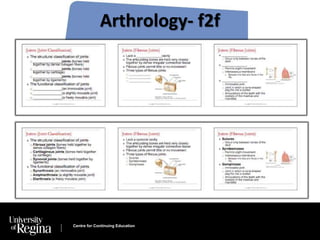
Arthrology- f2f 
Centre for Continuing Education
Arthrology- f2f (lab) 
Centre for Continuing Education
Arthrology 
• Face to face 
• Online 
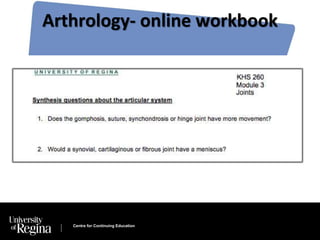
– Video lectures with assigned readings from the 
textbook 
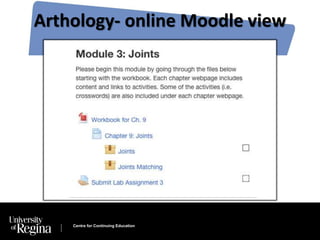
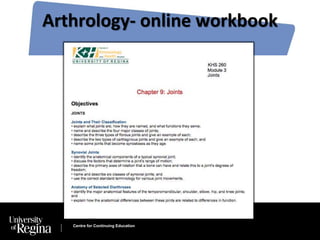
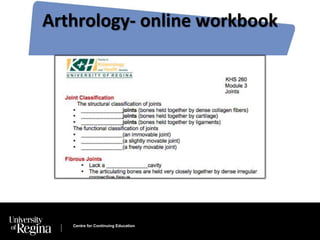
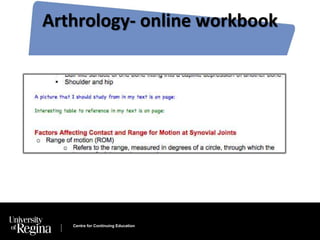
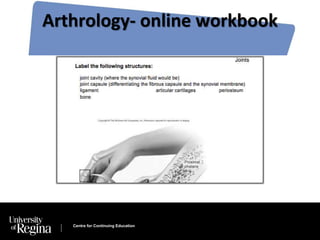
– Workbook as a guide, listing objectives 
– Online cadaver lab software 
– ‘Knowledge reinforcement activities’ (games) 
Centre for Continuing Education 
• Blended
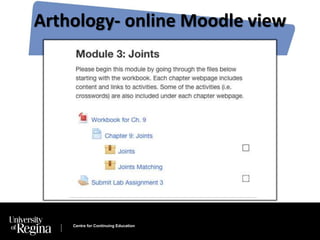
Arthology- online Moodle view 
Centre for Continuing Education
Arthrology- online workbook 
Centre for Continuing Education
Arthrology- online workbook 
Centre for Continuing Education
Arthrology- online workbook 
Centre for Continuing Education
Arthrology- online workbook 
Centre for Continuing Education
Arthrology- online workbook 
Centre for Continuing Education
Arthrology- online workbook 
Centre for Continuing Education
Arthology- online Moodle view 
Centre for Continuing Education
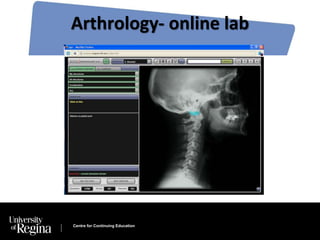
Arthrology- online lab 
Centre for Continuing Education
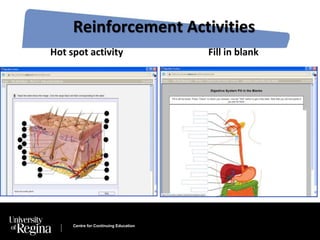
Reinforcement Activities 
Hot spot activity Fill in blank 
Centre for Continuing Education
Arthrology 
• Face to face 
• Online 
• Blended 
– The best of both offerings 
Centre for Continuing Education
Arthrology- Blended 
f2f 
• Student interaction 
• Immediate student 
Centre for Continuing Education 
feedback 
• Use of models in lab 
Online 
• Self-directed freedom 
• Consistent content delivery 
• Student- guided learning 
options
Arthrology- Blended 
• F2f: Introduced content at the end of the previous module 
• Online: workbook and cadaver lab 
• F2f: 
– Access to lab models 
– Reviewed joint motions and worked through a handout 
– Previous ‘trainer’ activity small group comparisons 
– Review workbook questions 
– “Simon says” 
Centre for Continuing Education
KIN 170 and 275 
Katherine McLeod 
Centre for Continuing Education
KIN 170 and 275 blended 
Outside of class (LMS) 
– Textbook reading 
–Read online units (includes 
graded quizzes, videos, polls, 
reflections, quick facts, 
pictures, links) 
– Small group discussions - 
videos 
– Links to food 
– portions 
Centre for Continuing Education 
In class 
– Goal to reinforce concepts 
learned online and outline new 
concepts to focus on 
– Q&A, review concepts 
– Practical case studies 
– Guest speakers 
– Individual reflection writing or 
small group activities (videos, 
dissecting/discussing research 
papers 
– Food labels & food models
Instructor Reflections 
• Online/blended instruction is a lot of work! 
• Having online course developed + teaching f2f made 
developing/delivering blended easier 
• Learning curves 
• Stay true to successes of f2f delivery (what worked well) and 
augment 
– ID is critical source of useful ideas for online delivery 
• Blended provides best-of-both worlds 
• Student preference in course delivery (online/blended/f2f) 
depends largely on learning style/environment preference 
Centre for Continuing Education
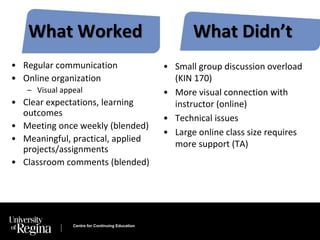
What Worked What Didn’t 
• Regular communication 
• Online organization 
– Visual appeal 
• Clear expectations, learning 
Centre for Continuing Education 
outcomes 
• Meeting once weekly (blended) 
• Meaningful, practical, applied 
projects/assignments 
• Classroom comments (blended) 
• Small group discussion overload 
(KIN 170) 
• More visual connection with 
instructor (online) 
• Technical issues 
• Large online class size requires 
more support (TA)
Student perspective 
Jadi Engele 
Centre for Continuing Education
Comparing 4 Courses 
Centre for Continuing Education
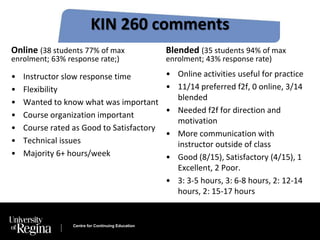
KIN 260 comments 
Online (38 students 77% of max 
enrolment; 63% response rate;) 
• Instructor slow response time 
• Flexibility 
• Wanted to know what was important 
• Course organization important 
• Course rated as Good to Satisfactory 
• Technical issues 
• Majority 6+ hours/week 
Centre for Continuing Education 
Blended (35 students 94% of max 
enrolment; 43% response rate) 
• Online activities useful for practice 
• 11/14 preferred f2f, 0 online, 3/14 
blended 
• Needed f2f for direction and 
motivation 
• More communication with 
instructor outside of class 
• Good (8/15), Satisfactory (4/15), 1 
Excellent, 2 Poor. 
• 3: 3-5 hours, 3: 6-8 hours, 2: 12-14 
hours, 2: 15-17 hours
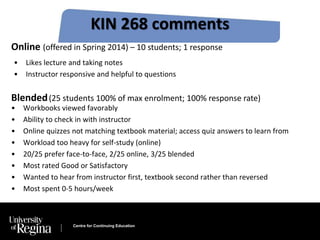
KIN 268 comments 
Online (offered in Spring 2014) – 10 students; 1 response 
• Likes lecture and taking notes 
• Instructor responsive and helpful to questions 
Blended(25 students 100% of max enrolment; 100% response rate) 
• Workbooks viewed favorably 
• Ability to check in with instructor 
• Online quizzes not matching textbook material; access quiz answers to learn from 
• Workload too heavy for self-study (online) 
• 20/25 prefer face-to-face, 2/25 online, 3/25 blended 
• Most rated Good or Satisfactory 
• Wanted to hear from instructor first, textbook second rather than reversed 
• Most spent 0-5 hours/week 
Centre for Continuing Education
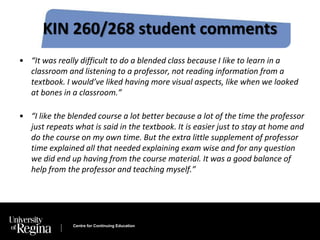
KIN 260/268 student comments 
• “It was really difficult to do a blended class because I like to learn in a 
classroom and listening to a professor, not reading information from a 
textbook. I would’ve liked having more visual aspects, like when we looked 
at bones in a classroom.” 
• “I like the blended course a lot better because a lot of the time the professor 
just repeats what is said in the textbook. It is easier just to stay at home and 
do the course on my own time. But the extra little supplement of professor 
time explained all that needed explaining exam wise and for any question 
we did end up having from the course material. It was a good balance of 
help from the professor and teaching myself.” 
Centre for Continuing Education
KIN 170 and 275 blended 
• Outside of class (LMS) 
– Textbook reading 
– Read units (graded quizzes, videos, polls, reflections) 
– Small group discussions-videos 
– Link to food portions 
• In class - Goal to reinforce concepts learned online 
– Q&A, review concepts 
– Case studies 
– Guest speakers 
– Individual or small group activities 
– Food labels 
Centre for Continuing Education
KIN 275 comments 
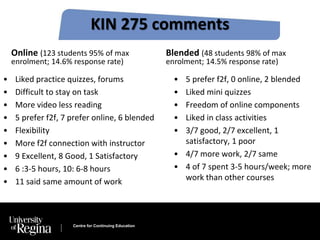
Online (123 students 95% of max 
enrolment; 14.6% response rate) 
• Liked practice quizzes, forums 
• Difficult to stay on task 
• More video less reading 
• 5 prefer f2f, 7 prefer online, 6 blended 
• Flexibility 
• More f2f connection with instructor 
• 9 Excellent, 8 Good, 1 Satisfactory 
• 6 :3-5 hours, 10: 6-8 hours 
• 11 said same amount of work 
Centre for Continuing Education 
Blended (48 students 98% of max 
enrolment; 14.5% response rate) 
• 5 prefer f2f, 0 online, 2 blended 
• Liked mini quizzes 
• Freedom of online components 
• Liked in class activities 
• 3/7 good, 2/7 excellent, 1 
satisfactory, 1 poor 
• 4/7 more work, 2/7 same 
• 4 of 7 spent 3-5 hours/week; more 
work than other courses
KIN 170 comments 
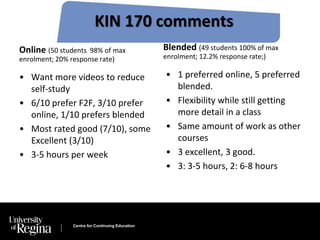
Online (50 students 98% of max 
enrolment; 20% response rate) 
• Want more videos to reduce 
Centre for Continuing Education 
self-study 
• 6/10 prefer F2F, 3/10 prefer 
online, 1/10 prefers blended 
• Most rated good (7/10), some 
Excellent (3/10) 
• 3-5 hours per week 
Blended (49 students 100% of max 
enrolment; 12.2% response rate;) 
• 1 preferred online, 5 preferred 
blended. 
• Flexibility while still getting 
more detail in a class 
• Same amount of work as other 
courses 
• 3 excellent, 3 good. 
• 3: 3-5 hours, 2: 6-8 hours
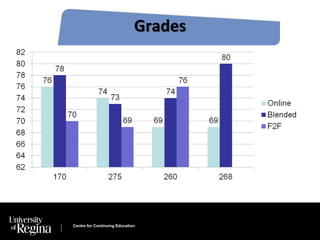
Grades 
Centre for Continuing Education
Centre for Continuing Education 
Student 
Demographics 
Online Blended 
Gender 
F 85% 74% 
M 15% 26% 
Faculty 
ARTS 20% 22% 
BUSINESS 6% 4% 
CCE 3% 1% 
EDUCATION 4% 9% 
FINE ARTS 1% 1% 
KINESIOLOGY 17% 33% 
NURSING 27% 7% 
SCIENCE 20% 23% 
SOCIAL WORK 2% 0% 
Citizenship 
Canadian 98% 95% 
International 2% 5% 
Age 
18-24 80% 91% 
25-44 18% 9% 
45+ 2% 0%
Considerations/Unanswered Questions 
• Unaware or not prepared for 
what a blended course meant 
• Pre-med students-want high 
marks, fed information to pass 
exams 
• Personalities and presence 
• Volume of content 
• Culture of Faculty 
Centre for Continuing Education 
• How it was in high school 
• Exam based assessment 
• Generally online students put 
in more hours than blended 
• Registration process 
• Online lack of community 
building 
• Class size
Next steps 
• Student focus groups 
• More analysis of information especially quantitative data 
• Not sure if these blended courses will be offered again 
Centre for Continuing Education
Acknowledgements 
• Daysha Shuya – KIN 260 and 268 instructor 
• Katherine McLeod – KIN 170 and 275 instructor 
• Jadi Engele – KIN 170 blended and KIN 275 online student 
• Greg Bawden – Instructional Designer 
Centre for Continuing Education
Questions/Comments 
Centre for Continuing Education

Cohere 2014 comparing kinesiology-blended, online courses

  • 1.
    A Comparison ofKinesiology blended/online course deliveries Greg Bawden, BV/T Ed Daysha Shuya, PT, MSc Katherine McLeod, PhD Centre for Continuing Education Jadi Engele COHERE 2014
  • 2.
    Study Background •Two different courses share one classroom space – KIN 260 (Anatomy) and 268 (Physiology II) in Fall 2013 – KIN 170 (Lifestyle & Health) and 275 (Into to Nutrition) in Winter 2014 – Online versions of course already developed • Purpose: To compare the effectiveness of same course offered blended and fully online – Qualitative and quantitative research methods Centre for Continuing Education
  • 3.
    Research Data QuantitativeData • Not anonymous • Student success • Student grades • Student retention • Student demographics and correlation between retention , grades, etc. Centre for Continuing Education Qualitative Data • Anonymous • Students likes/dislikes about each delivery mode. • Reasons for enrolling in a particular course mode
  • 4.
    Flipped learning “Aflipped classroom inverts the traditional structure of a classroom. In a typical traditional classroom, students listen to lectures in class and perform other learning activities, such as solving practice problems after class. In this traditional structure, students are exposed to material in class via lectures, and they attain deeper knowledge after class via various forms of homework. In a typical flipped classroom, students listen to pre-recorded video lectures before class and perform other learning activities in class. In this flipped structure, students are exposed to material before class via videos and readings, and they attain deeper knowledge in class via activities.” (Bogost, 2013) http://bawdeng.wordpress.com/flipped-learning-2/ Centre for Continuing Education
  • 5.
    KIN 260 -Human Anatomy Sample chapter for f2f, online and blended formats Daysha Shuya Centre for Continuing Education
  • 6.
    Arthrology • Faceto face – Lecture format, supplemented with ppt – Lab component- activities and models Centre for Continuing Education • Online • Blended
  • 7.
    Arthrology- f2f Centrefor Continuing Education
  • 8.
    Arthrology- f2f (lab) Centre for Continuing Education
  • 9.
    Arthrology • Faceto face • Online – Video lectures with assigned readings from the textbook – Workbook as a guide, listing objectives – Online cadaver lab software – ‘Knowledge reinforcement activities’ (games) Centre for Continuing Education • Blended
  • 10.
    Arthology- online Moodleview Centre for Continuing Education
  • 11.
    Arthrology- online workbook Centre for Continuing Education
  • 12.
    Arthrology- online workbook Centre for Continuing Education
  • 13.
    Arthrology- online workbook Centre for Continuing Education
  • 14.
    Arthrology- online workbook Centre for Continuing Education
  • 15.
    Arthrology- online workbook Centre for Continuing Education
  • 16.
    Arthrology- online workbook Centre for Continuing Education
  • 17.
    Arthology- online Moodleview Centre for Continuing Education
  • 18.
    Arthrology- online lab Centre for Continuing Education
  • 19.
    Reinforcement Activities Hotspot activity Fill in blank Centre for Continuing Education
  • 20.
    Arthrology • Faceto face • Online • Blended – The best of both offerings Centre for Continuing Education
  • 21.
    Arthrology- Blended f2f • Student interaction • Immediate student Centre for Continuing Education feedback • Use of models in lab Online • Self-directed freedom • Consistent content delivery • Student- guided learning options
  • 22.
    Arthrology- Blended •F2f: Introduced content at the end of the previous module • Online: workbook and cadaver lab • F2f: – Access to lab models – Reviewed joint motions and worked through a handout – Previous ‘trainer’ activity small group comparisons – Review workbook questions – “Simon says” Centre for Continuing Education
  • 23.
    KIN 170 and275 Katherine McLeod Centre for Continuing Education
  • 24.
    KIN 170 and275 blended Outside of class (LMS) – Textbook reading –Read online units (includes graded quizzes, videos, polls, reflections, quick facts, pictures, links) – Small group discussions - videos – Links to food – portions Centre for Continuing Education In class – Goal to reinforce concepts learned online and outline new concepts to focus on – Q&A, review concepts – Practical case studies – Guest speakers – Individual reflection writing or small group activities (videos, dissecting/discussing research papers – Food labels & food models
  • 25.
    Instructor Reflections •Online/blended instruction is a lot of work! • Having online course developed + teaching f2f made developing/delivering blended easier • Learning curves • Stay true to successes of f2f delivery (what worked well) and augment – ID is critical source of useful ideas for online delivery • Blended provides best-of-both worlds • Student preference in course delivery (online/blended/f2f) depends largely on learning style/environment preference Centre for Continuing Education
  • 26.
    What Worked WhatDidn’t • Regular communication • Online organization – Visual appeal • Clear expectations, learning Centre for Continuing Education outcomes • Meeting once weekly (blended) • Meaningful, practical, applied projects/assignments • Classroom comments (blended) • Small group discussion overload (KIN 170) • More visual connection with instructor (online) • Technical issues • Large online class size requires more support (TA)
  • 27.
    Student perspective JadiEngele Centre for Continuing Education
  • 28.
    Comparing 4 Courses Centre for Continuing Education
  • 29.
    KIN 260 comments Online (38 students 77% of max enrolment; 63% response rate;) • Instructor slow response time • Flexibility • Wanted to know what was important • Course organization important • Course rated as Good to Satisfactory • Technical issues • Majority 6+ hours/week Centre for Continuing Education Blended (35 students 94% of max enrolment; 43% response rate) • Online activities useful for practice • 11/14 preferred f2f, 0 online, 3/14 blended • Needed f2f for direction and motivation • More communication with instructor outside of class • Good (8/15), Satisfactory (4/15), 1 Excellent, 2 Poor. • 3: 3-5 hours, 3: 6-8 hours, 2: 12-14 hours, 2: 15-17 hours
  • 30.
    KIN 268 comments Online (offered in Spring 2014) – 10 students; 1 response • Likes lecture and taking notes • Instructor responsive and helpful to questions Blended(25 students 100% of max enrolment; 100% response rate) • Workbooks viewed favorably • Ability to check in with instructor • Online quizzes not matching textbook material; access quiz answers to learn from • Workload too heavy for self-study (online) • 20/25 prefer face-to-face, 2/25 online, 3/25 blended • Most rated Good or Satisfactory • Wanted to hear from instructor first, textbook second rather than reversed • Most spent 0-5 hours/week Centre for Continuing Education
  • 31.
    KIN 260/268 studentcomments • “It was really difficult to do a blended class because I like to learn in a classroom and listening to a professor, not reading information from a textbook. I would’ve liked having more visual aspects, like when we looked at bones in a classroom.” • “I like the blended course a lot better because a lot of the time the professor just repeats what is said in the textbook. It is easier just to stay at home and do the course on my own time. But the extra little supplement of professor time explained all that needed explaining exam wise and for any question we did end up having from the course material. It was a good balance of help from the professor and teaching myself.” Centre for Continuing Education
  • 32.
    KIN 170 and275 blended • Outside of class (LMS) – Textbook reading – Read units (graded quizzes, videos, polls, reflections) – Small group discussions-videos – Link to food portions • In class - Goal to reinforce concepts learned online – Q&A, review concepts – Case studies – Guest speakers – Individual or small group activities – Food labels Centre for Continuing Education
  • 33.
    KIN 275 comments Online (123 students 95% of max enrolment; 14.6% response rate) • Liked practice quizzes, forums • Difficult to stay on task • More video less reading • 5 prefer f2f, 7 prefer online, 6 blended • Flexibility • More f2f connection with instructor • 9 Excellent, 8 Good, 1 Satisfactory • 6 :3-5 hours, 10: 6-8 hours • 11 said same amount of work Centre for Continuing Education Blended (48 students 98% of max enrolment; 14.5% response rate) • 5 prefer f2f, 0 online, 2 blended • Liked mini quizzes • Freedom of online components • Liked in class activities • 3/7 good, 2/7 excellent, 1 satisfactory, 1 poor • 4/7 more work, 2/7 same • 4 of 7 spent 3-5 hours/week; more work than other courses
  • 34.
    KIN 170 comments Online (50 students 98% of max enrolment; 20% response rate) • Want more videos to reduce Centre for Continuing Education self-study • 6/10 prefer F2F, 3/10 prefer online, 1/10 prefers blended • Most rated good (7/10), some Excellent (3/10) • 3-5 hours per week Blended (49 students 100% of max enrolment; 12.2% response rate;) • 1 preferred online, 5 preferred blended. • Flexibility while still getting more detail in a class • Same amount of work as other courses • 3 excellent, 3 good. • 3: 3-5 hours, 2: 6-8 hours
  • 35.
    Grades Centre forContinuing Education
  • 36.
    Centre for ContinuingEducation Student Demographics Online Blended Gender F 85% 74% M 15% 26% Faculty ARTS 20% 22% BUSINESS 6% 4% CCE 3% 1% EDUCATION 4% 9% FINE ARTS 1% 1% KINESIOLOGY 17% 33% NURSING 27% 7% SCIENCE 20% 23% SOCIAL WORK 2% 0% Citizenship Canadian 98% 95% International 2% 5% Age 18-24 80% 91% 25-44 18% 9% 45+ 2% 0%
  • 37.
    Considerations/Unanswered Questions •Unaware or not prepared for what a blended course meant • Pre-med students-want high marks, fed information to pass exams • Personalities and presence • Volume of content • Culture of Faculty Centre for Continuing Education • How it was in high school • Exam based assessment • Generally online students put in more hours than blended • Registration process • Online lack of community building • Class size
  • 38.
    Next steps •Student focus groups • More analysis of information especially quantitative data • Not sure if these blended courses will be offered again Centre for Continuing Education
  • 39.
    Acknowledgements • DayshaShuya – KIN 260 and 268 instructor • Katherine McLeod – KIN 170 and 275 instructor • Jadi Engele – KIN 170 blended and KIN 275 online student • Greg Bawden – Instructional Designer Centre for Continuing Education
  • 40.
    Questions/Comments Centre forContinuing Education

Editor's Notes

  • #3 Due to space constraints on campus, original goal was to see if 2 courses could share one classroom essentially saving space
  • #5 http://bawdeng.wordpress.com/flipped-learning-2/
  • #25 Outside of class: Practice quizzes (graded), online Units that cover course curriculum for studying. These Units included class polls, short videos, reflection boxes, and quiz activities to complement the Unit and assist with learning (and to break-up the reading!).  Small group discussions Yes, articles (not from textbook), videos, a personal story from the Public Health Agency of Canada that describes someone's experience with social determinants of health . Did students watch videos online? Yes, in the blended courses videos were used within the online Units to reinforce and put content into context (e.g. to show the path of food through the gastrointestinal tract, or a Participation video showcasing the concept of "health promotion"). Videos for small group activities were shown in class. For strictly online course, videos used for some discussion forum questions and in Units as described above. In class Practical case studies critical thinking/case study approach to making decisions and solving problems related to nutrition. The case study presents a nutrition-related problem in an individual/patient then asks a series of questions that lead the student through the logical progression of though processes needed to solve the problem. They focus on modifying an individual/patient's diet based on a number of factors in order to reduce their risk of a particular disease or deficiency.  Small group activities - watching a CBC video as a class (e.g., misleading food labels - "Lousy Labels: Health Hype"; hospital acquired infections - "Dirty Hospitals") and ponder/discuss/answer a series of questions (e.g., related to food labels: whether they eat these foods on a regular basis, based on what they learned in class and the video, what improvements they would suggest as a consumer, what should consumers take into consideration when making food purchases, other misleading food labels they have encountered). In the strictly online class, we do the same, except they are placed in small group discussion forums. We also have small group activity on ageism awareness, after explaining the concept in class/online, they read an article and reflect/discuss/answer a series of questions in their small group. We talk/share about small group outcomes as an entire class at the end. Reflection writing - after learning about chronic diseases (risk factors, prevention, treatment, etc.) they learn that lowering one's risk requires awareness and knowledge, commitment, time, and self-motivation. They are asked to read several famous quotes related to health and disease (e.g. "“The only way to keep your health is to eat what you don’t want, drink what you don’t like, and do what you’d rather not” – Mark Twain) and reflect on which quote they relate to most and why, what inspires them to live healthy, and where they fall on the continuum of Stages of Change when it comes to their own self-care and health motivation.
  • #26 ID plays important role, particularly with 1st deliveries **Majority of my students for both classes had no idea they were registered in a blended course when we began the course. If there is a way in registration to make this known more clearly, it would be helpful to students. I know a few of my students, especially based on their accommodations, did not like blended due to the online, independent/flexible learning component and prefer face-to-face learning.** You don't have to include this! Just FYI. F2f portion of blended well received Goal to reinforce concepts learned online Need clear expectations, cheating Instructor presence crucial - open door policy, interact with students Liked class time in blended to review concepts learned online Completion of case studies useful in all delivery modes Discussion forum overload in online compared to f2f Easier to facilitate further discussion in blended, f2f not online Mix of individual and small group activities; more group in blended Online quizzing issue Meeting once week motivated students to attend and participate.
  • #27 Once weekly – consistency and better attendance Keeping students “task oriented” with clear expectations, learning outcomes
  • #30 KIN 260 online  38 students, 24 responders = 63% response KIN 260 blended 35 students, 15 responders = 43% response KIN 260 ONLINE (1st day=48; end of 50%=38; end of semester=37) KIN 260 BLENDED  (1st day=35; end of 50%=35; end of semester=33)
  • #31 KIN 275 online 123 students, 18 responders = 14.6% response KIN 275 blended 48 students, 7 responders = 14.5% response   KIN 268 BLENDED  (1st day=25; end of 50%=25; end of semester=25)
  • #32 http://bawdeng.wordpress.com/flipped-learning-2/examples-of-how-it-is-being-used/u-of-r-kinesiology/
  • #33 Outside of class: Practice quizzes (graded), online Units that cover course curriculum for studying. These Units included class polls, short videos, reflection boxes, and quiz activities to complement the Unit and assist with learning (and to break-up the reading!).  Small group discussions Yes, articles (not from textbook), videos, a personal story from the Public Health Agency of Canada that describes someone's experience with social determinants of health . Did students watch videos online? Yes, in the blended courses videos were used within the online Units to reinforce and put content into context (e.g. to show the path of food through the gastrointestinal tract, or a Participation video showcasing the concept of "health promotion"). Videos for small group activities were shown in class. For strictly online course, videos used for some discussion forum questions and in Units as described above. In class Practical case studies critical thinking/case study approach to making decisions and solving problems related to nutrition. The case study presents a nutrition-related problem in an individual/patient then asks a series of questions that lead the student through the logical progression of though processes needed to solve the problem. They focus on modifying an individual/patient's diet based on a number of factors in order to reduce their risk of a particular disease or deficiency.  Small group activities - watching a CBC video as a class (e.g., misleading food labels - "Lousy Labels: Health Hype"; hospital acquired infections - "Dirty Hospitals") and ponder/discuss/answer a series of questions (e.g., related to food labels: whether they eat these foods on a regular basis, based on what they learned in class and the video, what improvements they would suggest as a consumer, what should consumers take into consideration when making food purchases, other misleading food labels they have encountered). In the strictly online class, we do the same, except they are placed in small group discussion forums. We also have small group activity on ageism awareness, after explaining the concept in class/online, they read an article and reflect/discuss/answer a series of questions in their small group. We talk/share about small group outcomes as an entire class at the end. Reflection writing - after learning about chronic diseases (risk factors, prevention, treatment, etc.) they learn that lowering one's risk requires awareness and knowledge, commitment, time, and self-motivation. They are asked to read several famous quotes related to health and disease (e.g. "“The only way to keep your health is to eat what you don’t want, drink what you don’t like, and do what you’d rather not” – Mark Twain) and reflect on which quote they relate to most and why, what inspires them to live healthy, and where they fall on the continuum of Stages of Change when it comes to their own self-care and health motivation.
  • #34 KIN 275 online 123 students, 18 responders = 14.6% response KIN 275 blended 48 students, 7 responders = 14.5% response #13138 KIN 275 - blended (1st day=49; 50% day=49; last day 48) #11677 KIN 275 - online (1st day=125; 50% day=124; last day 119)
  • #35 Online (50 students - 10 responders = 20% response) KIN 170 Blended 49 students, 6 responders = 12.2% response #13137 KIN 170 - blended (1st day=48; 50% day=50; last day 49) KIN 170 ONLINE (1st day=50; end of 50%=50; end of semester=49)
  • #36 KIN 170 f2f Fall 2012 (last time I taught f2f) - 70% (n = 69, night class, many non-KIN students) KIN 170 Blended Winter 2014 - 78% (n = 50) KIN 170 Online Fall 2013 - 76% (n = 49)   KIN 275 f2f Fall 2013 - 69% (n=144) - note this is a 7:30 am class!! KIN 275 Blended Winter 2014 - 72% (n = 49) KIN 275 Online Winter 2014 - 74% (n=120) - this was one of the most intelligent online classes I've had. Very engaged, great work by all. Generally in previous semesters class avg is ~72%.
  • #38 Students want to be fed information, guided, have structure Personality Volume of content Culture of Faculty or Higher ed in general Lecture based (fed information) Exam based assessment
  • #39 1. student academic performance, completion rates, and retention 2. student and instructor satisfaction 3. level of student and instructor support 4. student profiles in each mode of delivery 5. costs and time spent on designing and delivering/teaching each delivery mode 6. how each course is designed and taught