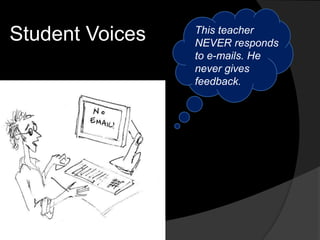
Student Voices This teacher
NEVER responds
to e-mails. He
never gives
feedback.
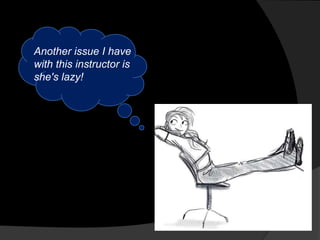
Another issue I have
with this instructor is
she's lazy!
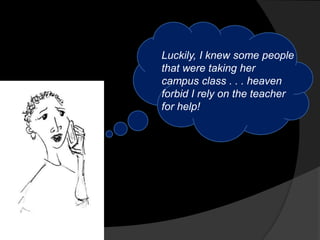
Luckily, I knew some people
that were taking her
campus class . . . heaven
forbid I rely on the teacher
for help!
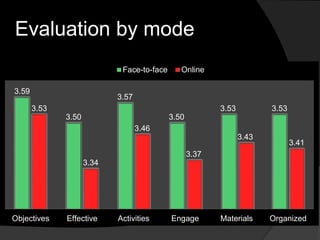
Evaluation by mode
3.59
3.50
3.57
3.50
3.53 3.533.53
3.34
3.46
3.37
3.43
3.41
Objectives Effective Activities Engage Materials Organized
Face-to-face Online
Instructor Voices
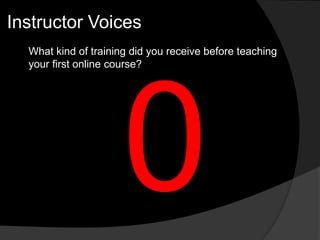
What kind of training did you receive before teaching
your first online course?
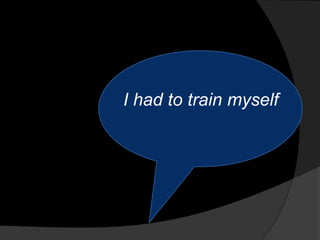
I had to train myself
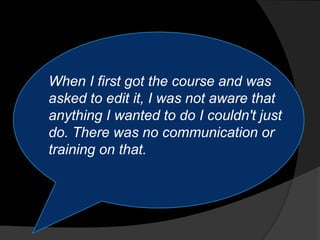
When I first got the course and was
asked to edit it, I was not aware that
anything I wanted to do I couldn't just
do. There was no communication or
training on that.
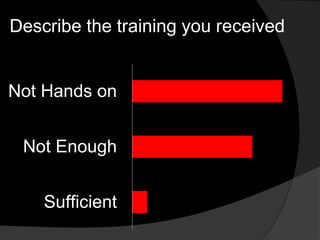
Describe the training you received
Sufficient
Not Enough
Not Hands on
Orientation for new instructors is
really a good idea. In fact, maybe
it’s a critical idea.
Teacher as Student
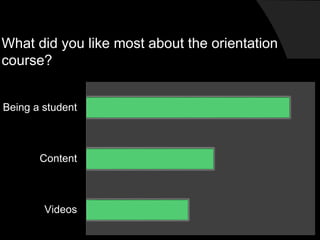
Videos
Content
Being a student
What did you like most about the orientation
course?
I don't think I've ever
approached the system
from a student point of
view. . . . I think that
should be part of our
training; I really do.
Familiarize
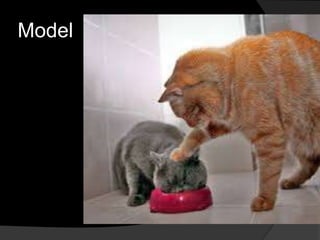
Model
Prepare
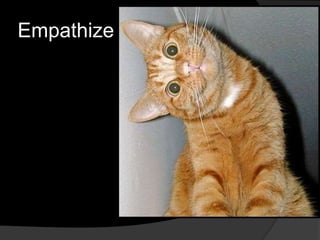
Empathize
It's engaging. It's engaging. I can
see people sitting down and saying,
"Yeah, this stuff is not boring as all
get out." It's interesting.
You never feel afraid to
ask a question. I cannot
say too much good
about them. They are
amazing.
Videos can set the tone for the
class. I really want to do more
video. . . . I think videos can
be very powerful.
Get faculty & admin buy-in
Begin with a face-to-face session
Use a cohort model, if possible
Model best practices
Get regular
feedback
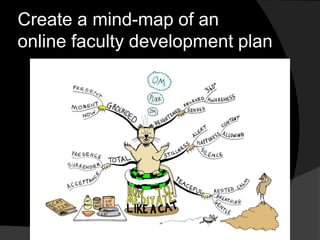
Create a mind-map of an
online faculty development plan
Gallery Walk
Questions?
Rosemary Tyrrell
rtyrrell@fidm.edu
@rosemarytyrrell

The Teacher as Student: Faculty Development for Online Instructors

Editor's Notes

  • #2 Introduce myself. Say your name!!!! 20+ year classroom veteran. I teach both online and face-to-face. Instructional Specialist for the SD campus of the Fashion Institute of Design and Merchandising. 8+ years eLearning Instructional Specialist for the institution. ~3 years. I am also extremely privileged to be working on my doctorate at UCLA which is where I conducted the research study I’m going to be referring to today. Please feel free to ask a question or make a comment at any time.
  • #3 As the demand for online courses grows, the urgency to improve programs increases. Researchers generally disagree on the best ways to accomplish faculty development for online educators (Reilly, Vandenhouten, Gallagher-Lepak, & Ralston-Berg, 2012). It really is a new area and there is limited research available. The most common method of faculty development is a short-term workshop; however, short-term workshops are not effective in improving pedagogy. So, is there a problem? In my action research study, I looked at data from three years worth of student evaluations. I coded the comments into categories such as technology, content, feedback, and so forth. Let’s hear what students say. . . .
  • #4 Here is a small sample of some of the representative comments.
  • #6 Ouch! The results from my action research study demonstrated the need for improvement in teaching of online courses.
  • #7 Face-to-face classes scored below online in every category of student satisfaction. But it’s not only students who had something to say. When I asked faculty . . .
  • #8 100% of the instructors surveyed or interviewed stated that the training they received before teaching online had been insufficient. Several of them said they had no training at all.
  • #10 Even a simple matter of what can be changed in a course, and what required department approval was not being made clear to instructors.
  • #11 In fact, only one person interviewed said the training he had received was sufficient for his needs, but that was because he was an expert in computers and felt confident in how to use the technology. Unfortunately, his students don’t necessarily agree that he doesn’t need training on pedagogy! So, what did we do?
  • #12 We decided to start by creating an orientation program for new instructors. We felt that if you want to shift organizational culture, you need to begin with new people coming in, so they don’t pick up bad habits.
  • #13 100% of those interviewed thought the orientation was good. No one said they thought it was impractical or a waste of time. All the negatives were minor “beta phase” issues. We decided the best way to orient new instructors was to put them in the shoes of a student. By establishing a learner-centered approach, we encouraged instructors to use a similar approach in their own teaching.
  • #14 For this basic concept I had to fight. There was a concern that instructors would be offended by being asked to be students – as if we were disrespecting them by asking them to complete quizzes, do assignments, etc. However, when I surveyed the instructors who had participated in the course. . .
  • #15 It was the number one thing they liked about the course. . Not one person was offended by being asked to be a student in the course. For some, it was a real eye-opener.
  • #16 This seemed to be a big breakthrough for many instructors. There is nothing that so informs our teaching as being a student. Some instructors even said that they didn’t realize that students were seeing things differently than the way they saw them when posting. Even though the opportunity exists to view the course in “student view” few instructors had ever done that. After completing the course, many said they would regularly view the course in “student view” to see it from the students’ point of view.
  • #17 What are some of the advantages of having the new instructor engage in the orientation materials as a student? Ask audience to provide a few examples. Here is what I found to be the main advantages of our program.
  • #18 You can familiarize the new instructor with the LMS and get them comfortable with using all the tools you want them to use. Some instructors had never used the quizzing tool because they didn’t know how it worked. Others didn’t know how to make changes in the weekly discussion board prompts and were clinging to old prompts from previous instructors. In the orientation course we created, the new instructors must view modules, do reading, take quizzes, participate in the discussion board, and complete assignments – every week, just like students do.
  • #19 Can model for the instructors the kind of “Best practices” that you want them to practice. For example: Creating a visually interesting and interactive syllabus Providing Tutorials Giving them a choice of assignments Using video announcements Using video prompts in the discussion board Providing ample student support Giving many opportunities for student engagement Returning messages in a timely manner. Show syllabus and click through to the tutorial on using the discussion board.
  • #20 All the assignments in the course were designed to help instructors prepare for teaching their online course. For example: Writing a friendly bio Creating a welcome message. Creating a video announcement or tutorial. Developing a list of useful links. And so on.
  • #21 New online instructors can get a better idea of how it feels to engage with the LMS and materials for the first time. In my first online course, I accidentally submitted the assignment without attaching the file. Whenever a student makes a mistake like this in my class, I always tell them that story. It gives them confidence to know that you understand what they may be going through. It also helps you create resources that will help a first-time distance learner navigate through the system. I created a handout called “Where to Start” because I found that some students did not understand what a “module” was. That’s teacher talk, for heavens sake! They understand “Week One” and “Start Here.”
  • #22 So, what were the results? It’s too early to tell anything longitudinally, but here are some of what the instructors said.
  • #23 100% of the instructors surveyed said they were satisfied with the course.
  • #24 They also expressed that they were more likely to seek out help when they wanted to try something new in the course.
  • #25 Instructors expressed an interest in creating new content for their online courses based on what they experienced in the eLearning orientation course.
  • #26 So, here are some recommendations I would make if you are considering creating such an online orientation course.
  • #27 Get faculty & administration buy-in We “grandfathered” in current faculty. We got the administration to require orientation for all new faculty Begin to shift organizational culture by working on new instructors.
  • #28 Add a face-to-face introductory session This helps establish a little rapport and can be a great motivator in getting instructors to complete the course. It’s harder to ignore you when they know you!
  • #29 Use a cohort model If you have enough new online instructors to make up a small cohort, that can greatly enhance the value of the participation in the discussion board, etc. They then become support systems even after the orientation has been completed.
  • #30 Model the kind of course you want the instructors to provide. This means the orientation course can’t be an afterthought. It must occupy the same level of importance as any other course.
  • #31 Get regular feedback. This also goes along with modeling the kind of practices you want to see. In addition to any summative “course evaluation” try to get formative evaluation as you are going along. Be prepared to shift and make changes in the course as necessary.
  • #35 As we wrap up, are there any last minute questions? If you think of anything, please do not hesitate to contact me. I’m always happy to share any resources.