Feedback is more than a score
         or letter grade

    Dr. Rosemary Cleveland – GVSU Faculty
             College of Education
Kimberly Kenward – GVSU Instructional Designer
            Academic Computing
Setting the Stage

• Successful online/hybrid faculty are well
  organized and have a genuine interest in
  helping their students learn.
• Successful online students are self-motivated
  and independent learners.
• Written and oral feedback is even more critical
  in the success of an online/hybrid student
Setting the Stage
• Give frequent, early, positive feedback that
  supports students' beliefs that they can do well.
• Ensure opportunities for students' success by
  assigning tasks that are neither too easy nor too
  difficult (scaffold assignments)
• Help students find personal meaning/value in
  the material and connecting that meaning to real-
  life application
• Create an atmosphere that is open and positive.
• Help students feel that they are valued members
  of a learning community.
Setting the Stage continued…

• Make feedback another part of the learning process.
• Ask students to provide feedback. Students can monitor
  and provide feedback to other students, as well as
  compare their work to criteria.
• Engage students in review of their own work and
  others. This can be very effective using the wiki tool, the
  group pages discussion board, and the file exchange.
• Use rubrics. Rubrics provide criteria against which
  students can compare their learning. Even better, involve
  students in developing rubrics. Rubrics help students
  focus their effort.
Objectives

• Although there are many tools that can be
  used to provide feedback, this
  presentation, will showcase how Blackboard
  allows for a variety of personal/private
  feedback using the Wimba Voice tool, journal
  entries, and detailed “personal” feedback in
  the Grade Center.
Background Information
• Course Development History for EDG633 &
  EDG638 (Dr. Cleveland)
   – Constructivist approach (feedback is used to help the
     student take control and find success in their
     learning)
   – Piloting of Wimba Voice (2010)
   – Journals vs. Discussion Board (scaffolding of
     assignments)
   – Feedback mid-semester surveys
• The role of the instructional designer & faculty
  member (Kim Kenward)
   – Support and technical considerations for Wimba
Wimba Voice Announcements
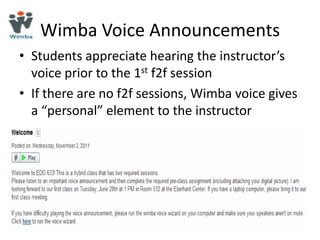
• Students appreciate hearing the instructor’s
  voice prior to the 1st f2f session
• If there are no f2f sessions, Wimba voice gives
  a “personal” element to the instructor
Wimba Voice
• Wimba Voice allows for quick audio feedback. It's
  like sitting down and having a conversation with a
  student.
• Wimba reduces the amount of time that it takes
  to respond to students. Most faculty can talk
  faster than they can type.
• It allows for more constructive feedback. The
  feedback comes so much easier and more
  complete when I'm speaking rather than writing.
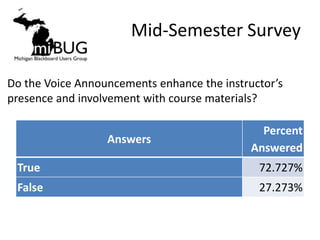
Mid-Semester Survey

Do the Voice Announcements enhance the instructor’s
presence and involvement with course materials?

                                               Percent
                  Answers
                                             Answered
 True                                         72.727%
 False                                        27.273%
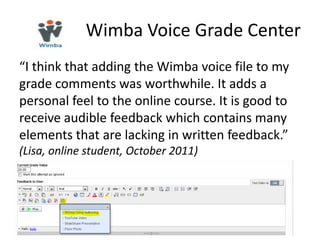
Wimba Voice Grade Center
“I think that adding the Wimba voice file to my
grade comments was worthwhile. It adds a
personal feel to the online course. It is good to
receive audible feedback which contains many
elements that are lacking in written feedback.”
(Lisa, online student, October 2011)
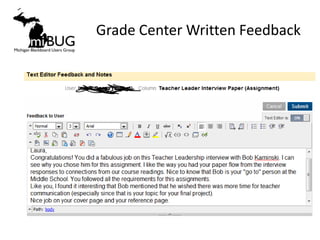
Grade Center Written Feedback
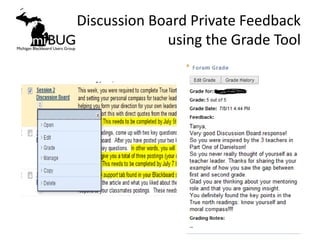
Discussion Board Private Feedback
             using the Grade Tool
The role of the Journal
• Journaling often remains an underused
  learning tool in an online/hybrid course.
• Journaling is an excellent tool to supplement
  the discussion board and encourages
  students’ personal and professional growth
  and development.
• Journaling promotes individual self-discovery
  in a confidential manner (sometimes students
  may often include personal information).
Additional Journal Purposes

• Maps, charts & graphs
• Hyperlinks to web resources
• File attachments
Mid-Semester Survey

 How has private journal entries assisted your
 mastery of course content?
-The private journals offer great reflection and connection to
own personal teaching experiences in conjunction with the
authors and the readings.


-The private journal has caused me to reflect on my readings
and has helped me to comprehend the content.
Mid-Semester Survey


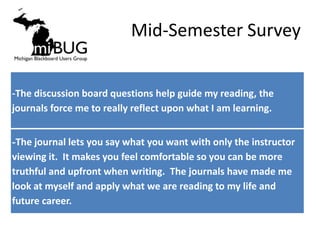
-The discussion board questions help guide my reading, the
journals force me to really reflect upon what I am learning.


-The journal lets you say what you want with only the instructor
viewing it. It makes you feel comfortable so you can be more
truthful and upfront when writing. The journals have made me
look at myself and apply what we are reading to my life and
future career.
Journal Feedback Tips
• Don't delay feedback. The longer students
  have to wait for feedback, the weaker the
  connection to their effort becomes, and the
  less likely they are to benefit.
• Be encouraging and appreciative of their
  views.
• Quality responses in the part of the instructor
  tend to increase the quality of the journal
  responses from the students.
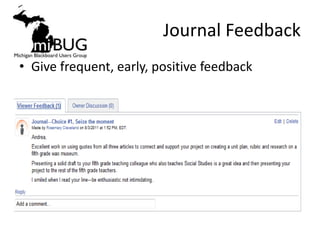
Journal Feedback
• Give frequent, early, positive feedback
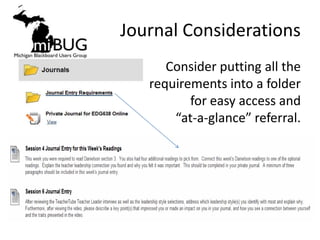
Journal Considerations
      Consider putting all the
   requirements into a folder
          for easy access and
       “at-a-glance” referral.
Additional thoughts…
• Help students get it right. If students know you want to
  see them succeed, and you're willing to help explain
  how, their learning improves.

• Give students opportunities to improve, try again, and
  get it right. This might not be appropriate with every
  assignment, but allowing resubmissions goes a long way
  in helping student’s master course content.

• In addition to detailed feedback, providing exemplar
  work also goes a long way in helping students understand
  what's a "A" paper or project.
Questions

Feedback is more than a score or letter grade

  • 1.
    Feedback is morethan a score or letter grade Dr. Rosemary Cleveland – GVSU Faculty College of Education Kimberly Kenward – GVSU Instructional Designer Academic Computing
  • 2.
    Setting the Stage •Successful online/hybrid faculty are well organized and have a genuine interest in helping their students learn. • Successful online students are self-motivated and independent learners. • Written and oral feedback is even more critical in the success of an online/hybrid student
  • 3.
    Setting the Stage •Give frequent, early, positive feedback that supports students' beliefs that they can do well. • Ensure opportunities for students' success by assigning tasks that are neither too easy nor too difficult (scaffold assignments) • Help students find personal meaning/value in the material and connecting that meaning to real- life application • Create an atmosphere that is open and positive. • Help students feel that they are valued members of a learning community.
  • 4.
    Setting the Stagecontinued… • Make feedback another part of the learning process. • Ask students to provide feedback. Students can monitor and provide feedback to other students, as well as compare their work to criteria. • Engage students in review of their own work and others. This can be very effective using the wiki tool, the group pages discussion board, and the file exchange. • Use rubrics. Rubrics provide criteria against which students can compare their learning. Even better, involve students in developing rubrics. Rubrics help students focus their effort.
  • 5.
    Objectives • Although thereare many tools that can be used to provide feedback, this presentation, will showcase how Blackboard allows for a variety of personal/private feedback using the Wimba Voice tool, journal entries, and detailed “personal” feedback in the Grade Center.
  • 6.
    Background Information • CourseDevelopment History for EDG633 & EDG638 (Dr. Cleveland) – Constructivist approach (feedback is used to help the student take control and find success in their learning) – Piloting of Wimba Voice (2010) – Journals vs. Discussion Board (scaffolding of assignments) – Feedback mid-semester surveys • The role of the instructional designer & faculty member (Kim Kenward) – Support and technical considerations for Wimba
  • 7.
    Wimba Voice Announcements •Students appreciate hearing the instructor’s voice prior to the 1st f2f session • If there are no f2f sessions, Wimba voice gives a “personal” element to the instructor
  • 8.
    Wimba Voice • WimbaVoice allows for quick audio feedback. It's like sitting down and having a conversation with a student. • Wimba reduces the amount of time that it takes to respond to students. Most faculty can talk faster than they can type. • It allows for more constructive feedback. The feedback comes so much easier and more complete when I'm speaking rather than writing.
  • 9.
    Mid-Semester Survey Do theVoice Announcements enhance the instructor’s presence and involvement with course materials? Percent Answers Answered True 72.727% False 27.273%
  • 10.
    Wimba Voice GradeCenter “I think that adding the Wimba voice file to my grade comments was worthwhile. It adds a personal feel to the online course. It is good to receive audible feedback which contains many elements that are lacking in written feedback.” (Lisa, online student, October 2011)
  • 11.
  • 12.
    Discussion Board PrivateFeedback using the Grade Tool
  • 13.
    The role ofthe Journal • Journaling often remains an underused learning tool in an online/hybrid course. • Journaling is an excellent tool to supplement the discussion board and encourages students’ personal and professional growth and development. • Journaling promotes individual self-discovery in a confidential manner (sometimes students may often include personal information).
  • 14.
    Additional Journal Purposes •Maps, charts & graphs • Hyperlinks to web resources • File attachments
  • 15.
    Mid-Semester Survey Howhas private journal entries assisted your mastery of course content? -The private journals offer great reflection and connection to own personal teaching experiences in conjunction with the authors and the readings. -The private journal has caused me to reflect on my readings and has helped me to comprehend the content.
  • 16.
    Mid-Semester Survey -The discussionboard questions help guide my reading, the journals force me to really reflect upon what I am learning. -The journal lets you say what you want with only the instructor viewing it. It makes you feel comfortable so you can be more truthful and upfront when writing. The journals have made me look at myself and apply what we are reading to my life and future career.
  • 17.
    Journal Feedback Tips •Don't delay feedback. The longer students have to wait for feedback, the weaker the connection to their effort becomes, and the less likely they are to benefit. • Be encouraging and appreciative of their views. • Quality responses in the part of the instructor tend to increase the quality of the journal responses from the students.
  • 18.
    Journal Feedback • Givefrequent, early, positive feedback
  • 19.
    Journal Considerations Consider putting all the requirements into a folder for easy access and “at-a-glance” referral.
  • 20.
    Additional thoughts… • Helpstudents get it right. If students know you want to see them succeed, and you're willing to help explain how, their learning improves. • Give students opportunities to improve, try again, and get it right. This might not be appropriate with every assignment, but allowing resubmissions goes a long way in helping student’s master course content. • In addition to detailed feedback, providing exemplar work also goes a long way in helping students understand what's a "A" paper or project.
  • 21.

Editor's Notes