Feedback Practices for Effective
Teaching and Learning
MICHAEL L. RAMILO
Session Facilitator
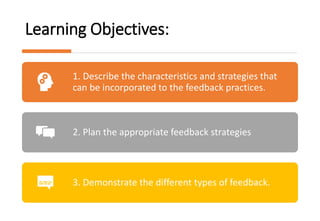
Learning Objectives:
1. Describe the characteristics and strategies that
can be incorporated to the feedback practices.
2. Plan the appropriate feedback strategies
3. Demonstrate the different types of feedback.
Priming Activity:
State whether you
agree or disagree
from the statement
below and explain
your reasons.
1. Feedforward
happened when
learners make
modifications, set goals,
and own the learning
process.
Priming
Activity:
State whether
you agree or
disagree from
the statement
below and
explain your
reasons.
2. A student’s work is not
ready for feedback when
the work doesn’t
demonstrate any
understanding, reteach
instead.
Priming
Activity:
3. Focus on feedback
that encourages students to
think.
Priming
Activity:
4. Always focus on the
elements of - presentation,
quantity, surface features
(such as spelling and
punctuation) and effort at the
expense of the learning
intention and success
criteria.
Priming
Activity:
• Feedback is about
corrections of mistakes that
teachers observed from
their outputs.
Priming
Activity:
Feedback modes
may be a written,
verbal, and digital.
Priming
Activity:
Corrective feedback focus on
the errors and mistakes of
students.
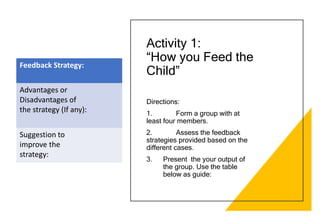
Activity 1:
“How you Feed the
Child”
Directions:
1. Form a group with at
least four members.
2. Assess the feedback
strategies provided based on the
different cases.
3. Present the your output of
the group. Use the table
below as guide:
Feedback Strategy:
Advantages or
Disadvantages of
the strategy (If any):
Suggestion to
improve the
strategy:
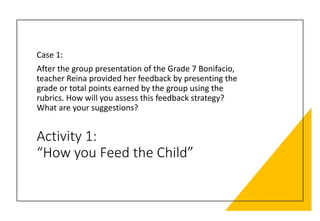
Activity 1:
“How you Feed the Child”
Case 1:
After the group presentation of the Grade 7 Bonifacio,
teacher Reina provided her feedback by presenting the
grade or total points earned by the group using the
rubrics. How will you assess this feedback strategy?
What are your suggestions?
Activity 1:
“How you Feed the Child”
Case 2:
During a math problem-solving activity, teacher
Joan permits her students to present and consult to
her about the problems and suggestions. She even
allows the learners, to have time to revise their
answers. In this case, what are the advantages of
these feedback strategies?
Activity 1:
“How you Feed the Child”
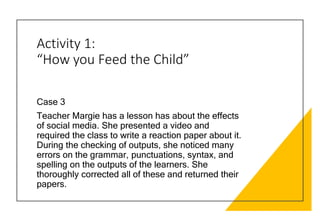
Case 3
Teacher Margie has a lesson has about the effects
of social media. She presented a video and
required the class to write a reaction paper about it.
During the checking of outputs, she noticed many
errors on the grammar, punctuations, syntax, and
spelling on the outputs of the learners. She
thoroughly corrected all of these and returned their
papers.
Activity 1:
“How you
Feed the
Child”
Case 4:
Teacher Dane wrote these
on the outputs of the
students: “You’ve missed
something here.' or 'What
should you have put there?'
or 'What about these?
Activity 1:
“How you
Feed the
Child”
Case 5:
Teacher Jen returns the
student’s paper with the
detailed corrections of the
mistakes and errors she has
observed from the output. She
attached a written sheet of
paper which longer than the
written output of the student.
Activity 1:
“How you
Feed the
Child”
Case 6:
Teacher Jomar always
explains to the students
the reasons for them
having the low
academic performance
at the end of the lesson
or grading period.
How do you find the activity?
What are the feedback strategies we apply in our
everyday teaching?
What are your suggestions to improve the
feedback practices?
• Analysis
What is Feedback?
“An information given to students about their
performance that guide future behavior” (Ambrose et
al., 2010)
Characteristics
of Feedback
Improves learning
Characteristics of
Feedback
•Starts with learning
intentions
Characteristics
of Feedback
• Is timely
Characteristics
of Feedback
• Is clear and focuses on improvement
strategies
Levels of
Feedback:
• Feed Up
Where am I going? What are my
learning intentions?
Levels of
Feedback:
• Feed Back
How am I going (what
does the evidence tell me?
Levels of
Feedback:
•Feed Forward
Where to next
(What learning
activities should I
do to make better
progress?)
Types of Feedback
•Corrective
Highlights areas where the learners
met assignment goals and expectations.
Ex:
You do a great job of ____.
However, the assignment also asked for
x, but x is not present. How might you
address (assignment component/goal)?
Types of
Feedback
• Epistemic
Prompts students to
think more deeply about their
work. For example, can you say
more about …
Types of
Feedback
• Suggestive
Gives students advice for
how to improve their work. For
example, giving an example of
(this concept) would make your
description clearer.
Types of
Feedback
• Epistemic + Suggestive
-Prompts students to
offer further clarification, while
also offering specific
suggestions. For example, “how
did you reach this conclusion?
Think about the point you
made on page x”
Feedback
Strategies/
Practices:
A. Feedback Timing
- for students to get feedback while they
are still mindful of the learning target.
-For students to get feedback while
there are still time for them to ack on it.
Good Feedback Timing
Returning a test assignment the next
day
Bad Feedback Timing
Returning a test or assignment two
weeks after it is completed
Good Feedback Timing
Giving immediate oral response to
questions of fact
Bad Feedback Timing
Ignoring errors or misconceptions
(thereby implying acceptance)
Good Feedback Timing
Giving immediate oral response to
questions of fact
Bad Feedback Timing
Ignoring errors or misconceptions
(thereby implying acceptance)
Feedback Timing Strategy
-Allow time of time of interaction and student talk
-Talk frequently with students about the work
B. Amount of Feedback
- Get enough feedback so that they
understand what to do but bit so much
that the work has been done for them..
-To get feedback on “teachable
moment” points but not an
overwhelming number.
Good Amount of Feedback
Select two or three main points
about a paper for a comment
Bad Amount of Feedback
Returning a student’s paper with
every error in mechanics
Good Amount of Feedback
Giving feedback on important
learning targets
Bad Amount of Feedback
Writing comments on a paper that are
more voluminous than the paper itself
Good Amount of Feedback
Commenting on at least as many
strengths as weaknesses
Bad Amount of Feedback
Writing voluminous comments on poor-
quality paper and almost nothing on good
quality paper.
B. Feedback Mode
-communicate in the most
appropriate way.
Good Feedback Mode
Using written feedback for comments that
students need to be able to save and look
over
Bad Feedback Mode
Speaking to students to save yourself
the trouble of writing
Good Feedback Mode
Using oral feedback for students who
don’t read well
Bad Feedback Mode
Writing students who don’t read well
Feedback Mode of Delivery
Audi/video feedback
Meeting
Small grou meeting
Electronic publishing
Audio capture
Image+ audio
Computer-assisted assessment
Live Polling
blogs./ other peer activities
Bad Feedback Mode
Writing students who don’t read well
Good Feedback Audience
Communicating with an individual, giving information specific to the individual performance
Bad Feedback Audience
Using the same comments for all
students
Giving group or class feedback when
the same mini lesson or re-teaching
session is required for a number of
students.
Bad Feedback Audience
Never giving individual feedback
because it takes too much time
Good
Feedback
Audience
Feedback
strategies
• Use the following feedback strategies with students:
• Use feedback sandwiches:
• positive comment
• constructive criticism with explanation of how to
improve
• positive comment or contextual comment: X was
good … because …. now/next time …
• Build reflection time into each lesson for feedback –
teacher to student, student to student, student to teacher.
• Use catchy abbreviations:
• EBI: Even Better If
• HTI: How to Improve
• YNS: Your Next Steps
• WWW: What Went Well.
• Use a feedback sheet for students to record ‘What I did
well’ and ‘What I need to do to improve’.
Feedback
strategies
• Give students the opportunity at the feedback stage to
write 1 or 2 questions they would like answered to support
them in making the identified improvements.
• Record comments in a Learning Log - students can then
refer to these comments before they complete similar
exercises.
• Use symbols instead of writing too much.
• Use a feedback structure such as:
• find 2 successes against the success criteria: what
students have achieved in relation to the learning
intention/success criteria
• find the part of the work that has most scope for an
immediate ‘jump’ (not simply the worst part)
• write a short prompt telling the student exactly what
to do to this part of their work
• provide time for them to read, process and respond to
your prompt.
Application
From outputs of the students, provide a feedback and present them
in front:
Type of Feedback
Mode of Delivery
Feedback Strategy
Learner’s output
Sample teachers feedback
Feedback Plan
Feedback Strategies
Feedback Timing Learners Co-teachers
Feedback Timing
Amount of Feedback
Feedback Mode
Feedback Audience
Thank you!

Feedback Practices for Effective Teaching and Learning.pptx

  • 1.
    Feedback Practices forEffective Teaching and Learning MICHAEL L. RAMILO Session Facilitator
  • 2.
    Learning Objectives: 1. Describethe characteristics and strategies that can be incorporated to the feedback practices. 2. Plan the appropriate feedback strategies 3. Demonstrate the different types of feedback.
  • 4.
    Priming Activity: State whetheryou agree or disagree from the statement below and explain your reasons. 1. Feedforward happened when learners make modifications, set goals, and own the learning process.
  • 5.
    Priming Activity: State whether you agreeor disagree from the statement below and explain your reasons. 2. A student’s work is not ready for feedback when the work doesn’t demonstrate any understanding, reteach instead.
  • 6.
    Priming Activity: 3. Focus onfeedback that encourages students to think.
  • 7.
    Priming Activity: 4. Always focuson the elements of - presentation, quantity, surface features (such as spelling and punctuation) and effort at the expense of the learning intention and success criteria.
  • 8.
    Priming Activity: • Feedback isabout corrections of mistakes that teachers observed from their outputs.
  • 9.
    Priming Activity: Feedback modes may bea written, verbal, and digital.
  • 10.
    Priming Activity: Corrective feedback focuson the errors and mistakes of students.
  • 11.
    Activity 1: “How youFeed the Child” Directions: 1. Form a group with at least four members. 2. Assess the feedback strategies provided based on the different cases. 3. Present the your output of the group. Use the table below as guide: Feedback Strategy: Advantages or Disadvantages of the strategy (If any): Suggestion to improve the strategy:
  • 12.
    Activity 1: “How youFeed the Child” Case 1: After the group presentation of the Grade 7 Bonifacio, teacher Reina provided her feedback by presenting the grade or total points earned by the group using the rubrics. How will you assess this feedback strategy? What are your suggestions?
  • 13.
    Activity 1: “How youFeed the Child” Case 2: During a math problem-solving activity, teacher Joan permits her students to present and consult to her about the problems and suggestions. She even allows the learners, to have time to revise their answers. In this case, what are the advantages of these feedback strategies?
  • 14.
    Activity 1: “How youFeed the Child” Case 3 Teacher Margie has a lesson has about the effects of social media. She presented a video and required the class to write a reaction paper about it. During the checking of outputs, she noticed many errors on the grammar, punctuations, syntax, and spelling on the outputs of the learners. She thoroughly corrected all of these and returned their papers.
  • 15.
    Activity 1: “How you Feedthe Child” Case 4: Teacher Dane wrote these on the outputs of the students: “You’ve missed something here.' or 'What should you have put there?' or 'What about these?
  • 16.
    Activity 1: “How you Feedthe Child” Case 5: Teacher Jen returns the student’s paper with the detailed corrections of the mistakes and errors she has observed from the output. She attached a written sheet of paper which longer than the written output of the student.
  • 17.
    Activity 1: “How you Feedthe Child” Case 6: Teacher Jomar always explains to the students the reasons for them having the low academic performance at the end of the lesson or grading period.
  • 18.
    How do youfind the activity? What are the feedback strategies we apply in our everyday teaching? What are your suggestions to improve the feedback practices? • Analysis
  • 19.
    What is Feedback? “Aninformation given to students about their performance that guide future behavior” (Ambrose et al., 2010)
  • 20.
  • 21.
  • 22.
  • 23.
    Characteristics of Feedback • Isclear and focuses on improvement strategies
  • 24.
    Levels of Feedback: • FeedUp Where am I going? What are my learning intentions?
  • 25.
    Levels of Feedback: • FeedBack How am I going (what does the evidence tell me?
  • 26.
    Levels of Feedback: •Feed Forward Whereto next (What learning activities should I do to make better progress?)
  • 27.
    Types of Feedback •Corrective Highlightsareas where the learners met assignment goals and expectations. Ex: You do a great job of ____. However, the assignment also asked for x, but x is not present. How might you address (assignment component/goal)?
  • 28.
    Types of Feedback • Epistemic Promptsstudents to think more deeply about their work. For example, can you say more about …
  • 29.
    Types of Feedback • Suggestive Givesstudents advice for how to improve their work. For example, giving an example of (this concept) would make your description clearer.
  • 30.
    Types of Feedback • Epistemic+ Suggestive -Prompts students to offer further clarification, while also offering specific suggestions. For example, “how did you reach this conclusion? Think about the point you made on page x”
  • 31.
  • 32.
    A. Feedback Timing -for students to get feedback while they are still mindful of the learning target. -For students to get feedback while there are still time for them to ack on it.
  • 33.
    Good Feedback Timing Returninga test assignment the next day Bad Feedback Timing Returning a test or assignment two weeks after it is completed
  • 34.
    Good Feedback Timing Givingimmediate oral response to questions of fact Bad Feedback Timing Ignoring errors or misconceptions (thereby implying acceptance)
  • 35.
    Good Feedback Timing Givingimmediate oral response to questions of fact Bad Feedback Timing Ignoring errors or misconceptions (thereby implying acceptance)
  • 36.
    Feedback Timing Strategy -Allowtime of time of interaction and student talk -Talk frequently with students about the work
  • 37.
    B. Amount ofFeedback - Get enough feedback so that they understand what to do but bit so much that the work has been done for them.. -To get feedback on “teachable moment” points but not an overwhelming number.
  • 38.
    Good Amount ofFeedback Select two or three main points about a paper for a comment Bad Amount of Feedback Returning a student’s paper with every error in mechanics
  • 39.
    Good Amount ofFeedback Giving feedback on important learning targets Bad Amount of Feedback Writing comments on a paper that are more voluminous than the paper itself
  • 40.
    Good Amount ofFeedback Commenting on at least as many strengths as weaknesses Bad Amount of Feedback Writing voluminous comments on poor- quality paper and almost nothing on good quality paper.
  • 41.
    B. Feedback Mode -communicatein the most appropriate way.
  • 42.
    Good Feedback Mode Usingwritten feedback for comments that students need to be able to save and look over Bad Feedback Mode Speaking to students to save yourself the trouble of writing
  • 43.
    Good Feedback Mode Usingoral feedback for students who don’t read well Bad Feedback Mode Writing students who don’t read well
  • 44.
    Feedback Mode ofDelivery Audi/video feedback Meeting Small grou meeting Electronic publishing Audio capture Image+ audio Computer-assisted assessment Live Polling blogs./ other peer activities Bad Feedback Mode Writing students who don’t read well
  • 45.
    Good Feedback Audience Communicatingwith an individual, giving information specific to the individual performance Bad Feedback Audience Using the same comments for all students
  • 46.
    Giving group orclass feedback when the same mini lesson or re-teaching session is required for a number of students. Bad Feedback Audience Never giving individual feedback because it takes too much time Good Feedback Audience
  • 47.
    Feedback strategies • Use thefollowing feedback strategies with students: • Use feedback sandwiches: • positive comment • constructive criticism with explanation of how to improve • positive comment or contextual comment: X was good … because …. now/next time … • Build reflection time into each lesson for feedback – teacher to student, student to student, student to teacher. • Use catchy abbreviations: • EBI: Even Better If • HTI: How to Improve • YNS: Your Next Steps • WWW: What Went Well. • Use a feedback sheet for students to record ‘What I did well’ and ‘What I need to do to improve’.
  • 48.
    Feedback strategies • Give studentsthe opportunity at the feedback stage to write 1 or 2 questions they would like answered to support them in making the identified improvements. • Record comments in a Learning Log - students can then refer to these comments before they complete similar exercises. • Use symbols instead of writing too much. • Use a feedback structure such as: • find 2 successes against the success criteria: what students have achieved in relation to the learning intention/success criteria • find the part of the work that has most scope for an immediate ‘jump’ (not simply the worst part) • write a short prompt telling the student exactly what to do to this part of their work • provide time for them to read, process and respond to your prompt.
  • 49.
    Application From outputs ofthe students, provide a feedback and present them in front: Type of Feedback Mode of Delivery Feedback Strategy Learner’s output Sample teachers feedback
  • 50.
    Feedback Plan Feedback Strategies FeedbackTiming Learners Co-teachers Feedback Timing Amount of Feedback Feedback Mode Feedback Audience
  • 51.

Editor's Notes

  • #4 Do you believe in this statement that “words have power”? Why?