Improving
Outcomes While
Saving Time
Image Credit: Nile – Retrieved from Pixabay
Exploring Strategies for
Effective and Efficient
Feedback
There is no magic
bullet for feedback.
In order to improve
feedback and reduce
time, we must evaluate
multiple aspects
Image Credit: stevepb – Retrieved from Pixabay
Overview
Image Credit: Hans: – Retrieved from Pixabay
End of semester grades
tell us about the
destination, not the
journey.
Grades Don’t Tell
the Story of Learning
Image Credit: Larisa-K – Retrieved from Pixabay 4
• Justify to students how their mark or
grade was derived
• Identify and reward specific qualities in
student work
• Guide students on what steps to take to
improve
• Motivate them to act on their
assessment
• Develop their capability to monitor,
evaluate, and regulate their own learning
Feedback
Main Objectives
Image Credit: skeeze: – Retrieved from Pixabay 5
Thought Exercise
Image Credit: The Met Museum – Retrieved from Wikimedia Commons
1. Identify the important feedback
2. Decrease amount of feedback
3. Focus on the right feedback
4. Increase quality of feedback
5. Increase the engagement with
feedback
The Big 5
Image Credit: 422737: – Retrieved from Pixabay 7
Preparation
Image Credit: wetwebwork – Retrieved from Flickr
• The first step in feedback success is
to plan
• Build assignments that lend
themselves to feedback
• Develop quality rubrics
• Plan for formative assessment
• Sometimes you have to revisit the
drawing board
Setup for Success
Image Credit: Pexels: – Retrieved from Pixabay 9
• Proper alignment helps keep the
class moving in the right direction.
• If objectives, activities and
assessments are NOT aligned:
• The course could be fragmented
• Students are unsure what they
need to learn
• Activities do not lead to intended
goals
• Over/underestimate the
effectiveness of instruction
Align Objectives
with Assessments
Image Credit: Wokandapix: – Retrieved from Pixabay 10
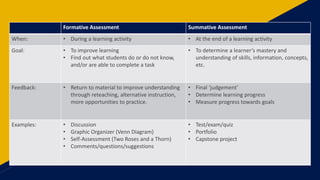
Formative Assessment Summative Assessment
When: • During a learning activity • At the end of a learning activity
Goal: • To improve learning
• Find out what students do or do not know,
and/or are able to complete a task
• To determine a learner’s mastery and
understanding of skills, information, concepts,
etc.
Feedback: • Return to material to improve understanding
through reteaching, alternative instruction,
more opportunities to practice.
• Final ‘judgement’
• Determine learning progress
• Measure progress towards goals
Examples: • Discussion
• Graphic Organizer (Venn Diagram)
• Self-Assessment (Two Roses and a Thorn)
• Comments/questions/suggestions
• Test/exam/quiz
• Portfolio
• Capstone project
"When the cook tastes
the soup, that's
formative assessment;
when the customer tastes
the soup, that's
summative."
Black (1998, as cited by Brookhart, 1999)
Image Credit: RitaE: – Retrieved from Pixabay
12
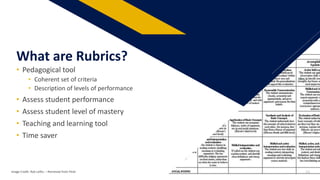
• Pedagogical tool
• Coherent set of criteria
• Description of levels of performance
• Assess student performance
• Assess student level of mastery
• Teaching and learning tool
• Time saver
What are Rubrics?
Image Credit: Rob Loftis: – Retrieved from Flickr 13
• Objective Tests
• Assess remembering and
understanding
• Can assess applying, analyzing, and
evaluating
• Essays
• Demonstrate ability to understand,
apply, analyze, evaluate, and create
Choose an
Appropriate Assessment
Image Credit: tjevans: – Retrieved from Pixabay 14
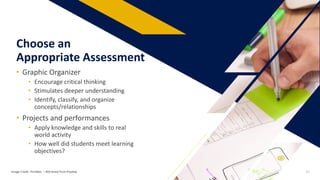
• Graphic Organizer
• Encourage critical thinking
• Stimulates deeper understanding
• Identify, classify, and organize
concepts/relationships
• Projects and performances
• Apply knowledge and skills to real
world activity
• How well did students meet learning
objectives?
Choose an
Appropriate Assessment
Image Credit: FirmBee: – Retrieved from Pixabay 15
• Encourage critical thinking
• Facilitate communication
• Refine teaching skills
• Level the playing field
• Provide timely feedback
• Prepare students to use detailed
feedback
Rubrics Help to:
Image Credit: TeroVesalainen: – Retrieved from Pixabay 16
Stay with me…
The objective of feedback is to make
students think about their learning. It
is not necessary to provide copious
amounts of feedback. We can create
the illusion of quantity while providing
actual quality.
Smoke and Mirrors
Add a footer 17
When planning for
instruction, look for
patterns of overuse and
repetition to reduce
student and faculty
workload.
Image Credit: kaboompics: – Retrieved from Pixabay 18
Feedback Strategies
Image Credit: klimkin – Retrieved from Pixabay
20
Quality Feedback is…
• Goal-Oriented
• Prioritized
• Actionable
• Student-Friendly
• Timely
• Should be tied to measurable outcomes and
objectives in the class
• Should focus on areas that will give the greatest
impact on their learning
• Should show students how to immediately take
action
• Should be personalized and engaging to ensure it
reaches the student
• Should be returned as soon as possible
21
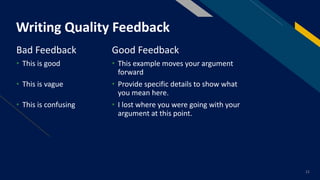
Writing Quality Feedback
Bad Feedback
• This is good
• This is vague
• This is confusing
Good Feedback
• This example moves your argument
forward
• Provide specific details to show what
you mean here.
• I lost where you were going with your
argument at this point.
• Provide feedback when necessary
• Promote thinking, don’t think for
them
• Reduce feedback on summative
assessments
• Provide feedback requests
• Don’t wait for the end
• Use generalized feedback
Reducing
Feedback Workload
Image Credit: JerzyGorecki: – Retrieved from Pixabay 22
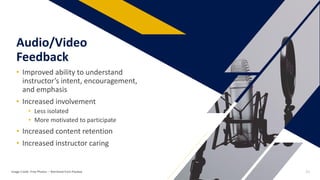
• Improved ability to understand
instructor’s intent, encouragement,
and emphasis
• Increased involvement
• Less isolated
• More motivated to participate
• Increased content retention
• Increased instructor caring
Audio/Video
Feedback
Image Credit: Free-Photos: – Retrieved from Pixabay 23
• Repository for commonly used
feedback statements
• Save time
• Robust comments
• Where to ‘invest’:
• Excel
• Word
• Canvas
• Don’t forget to personalize
Feedback Banks
Image Credit: RL0919: – Retrieved from Wikimedia Commons 24
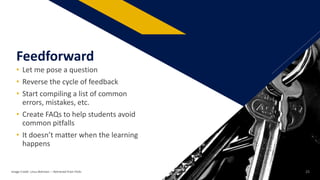
• Let me pose a question
• Reverse the cycle of feedback
• Start compiling a list of common
errors, mistakes, etc.
• Create FAQs to help students avoid
common pitfalls
• It doesn’t matter when the learning
happens
Feedforward
Image Credit: Linus Bohman: – Retrieved from Flickr 25
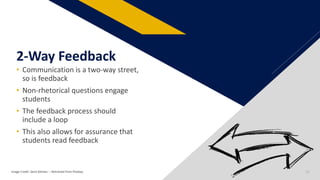
• Communication is a two-way street,
so is feedback
• Non-rhetorical questions engage
students
• The feedback process should
include a loop
• This also allows for assurance that
students read feedback
2-Way Feedback
Image Credit: Gerd Altman: – Retrieved from Pixabay 26
• It isn’t necessary to rewrite/redo
whole assignments
• Target one skill or criteria to focus
on for student revision
• This ties well to the 2-Way Feedback
concept as well
Micro-Rewrites
Image Credit: kelly taylor: – Retrieved from Flickr 27
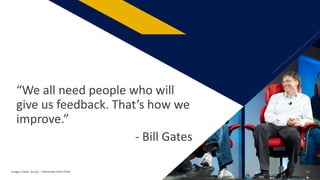
“We all need people who will
give us feedback. That’s how we
improve.”
- Bill Gates
Image Credit: Joi Ito: – Retrieved from Flickr 28
Thank You
S teven Mc Gah an
mc gah an sj@u n k.ed u
Karen Premer
premerk@unk.edu
Image Credit: TeroVesalainen – Retrieved from Pixabay

Improving Outcomes While Saving Time - Effective Feedback

  • 1.
    Improving Outcomes While Saving Time ImageCredit: Nile – Retrieved from Pixabay Exploring Strategies for Effective and Efficient Feedback
  • 2.
    There is nomagic bullet for feedback. In order to improve feedback and reduce time, we must evaluate multiple aspects Image Credit: stevepb – Retrieved from Pixabay
  • 3.
    Overview Image Credit: Hans:– Retrieved from Pixabay
  • 4.
    End of semestergrades tell us about the destination, not the journey. Grades Don’t Tell the Story of Learning Image Credit: Larisa-K – Retrieved from Pixabay 4
  • 5.
    • Justify tostudents how their mark or grade was derived • Identify and reward specific qualities in student work • Guide students on what steps to take to improve • Motivate them to act on their assessment • Develop their capability to monitor, evaluate, and regulate their own learning Feedback Main Objectives Image Credit: skeeze: – Retrieved from Pixabay 5
  • 6.
    Thought Exercise Image Credit:The Met Museum – Retrieved from Wikimedia Commons
  • 7.
    1. Identify theimportant feedback 2. Decrease amount of feedback 3. Focus on the right feedback 4. Increase quality of feedback 5. Increase the engagement with feedback The Big 5 Image Credit: 422737: – Retrieved from Pixabay 7
  • 8.
    Preparation Image Credit: wetwebwork– Retrieved from Flickr
  • 9.
    • The firststep in feedback success is to plan • Build assignments that lend themselves to feedback • Develop quality rubrics • Plan for formative assessment • Sometimes you have to revisit the drawing board Setup for Success Image Credit: Pexels: – Retrieved from Pixabay 9
  • 10.
    • Proper alignmenthelps keep the class moving in the right direction. • If objectives, activities and assessments are NOT aligned: • The course could be fragmented • Students are unsure what they need to learn • Activities do not lead to intended goals • Over/underestimate the effectiveness of instruction Align Objectives with Assessments Image Credit: Wokandapix: – Retrieved from Pixabay 10
  • 11.
    Formative Assessment SummativeAssessment When: • During a learning activity • At the end of a learning activity Goal: • To improve learning • Find out what students do or do not know, and/or are able to complete a task • To determine a learner’s mastery and understanding of skills, information, concepts, etc. Feedback: • Return to material to improve understanding through reteaching, alternative instruction, more opportunities to practice. • Final ‘judgement’ • Determine learning progress • Measure progress towards goals Examples: • Discussion • Graphic Organizer (Venn Diagram) • Self-Assessment (Two Roses and a Thorn) • Comments/questions/suggestions • Test/exam/quiz • Portfolio • Capstone project
  • 12.
    "When the cooktastes the soup, that's formative assessment; when the customer tastes the soup, that's summative." Black (1998, as cited by Brookhart, 1999) Image Credit: RitaE: – Retrieved from Pixabay 12
  • 13.
    • Pedagogical tool •Coherent set of criteria • Description of levels of performance • Assess student performance • Assess student level of mastery • Teaching and learning tool • Time saver What are Rubrics? Image Credit: Rob Loftis: – Retrieved from Flickr 13
  • 14.
    • Objective Tests •Assess remembering and understanding • Can assess applying, analyzing, and evaluating • Essays • Demonstrate ability to understand, apply, analyze, evaluate, and create Choose an Appropriate Assessment Image Credit: tjevans: – Retrieved from Pixabay 14
  • 15.
    • Graphic Organizer •Encourage critical thinking • Stimulates deeper understanding • Identify, classify, and organize concepts/relationships • Projects and performances • Apply knowledge and skills to real world activity • How well did students meet learning objectives? Choose an Appropriate Assessment Image Credit: FirmBee: – Retrieved from Pixabay 15
  • 16.
    • Encourage criticalthinking • Facilitate communication • Refine teaching skills • Level the playing field • Provide timely feedback • Prepare students to use detailed feedback Rubrics Help to: Image Credit: TeroVesalainen: – Retrieved from Pixabay 16
  • 17.
    Stay with me… Theobjective of feedback is to make students think about their learning. It is not necessary to provide copious amounts of feedback. We can create the illusion of quantity while providing actual quality. Smoke and Mirrors Add a footer 17
  • 18.
    When planning for instruction,look for patterns of overuse and repetition to reduce student and faculty workload. Image Credit: kaboompics: – Retrieved from Pixabay 18
  • 19.
    Feedback Strategies Image Credit:klimkin – Retrieved from Pixabay
  • 20.
    20 Quality Feedback is… •Goal-Oriented • Prioritized • Actionable • Student-Friendly • Timely • Should be tied to measurable outcomes and objectives in the class • Should focus on areas that will give the greatest impact on their learning • Should show students how to immediately take action • Should be personalized and engaging to ensure it reaches the student • Should be returned as soon as possible
  • 21.
    21 Writing Quality Feedback BadFeedback • This is good • This is vague • This is confusing Good Feedback • This example moves your argument forward • Provide specific details to show what you mean here. • I lost where you were going with your argument at this point.
  • 22.
    • Provide feedbackwhen necessary • Promote thinking, don’t think for them • Reduce feedback on summative assessments • Provide feedback requests • Don’t wait for the end • Use generalized feedback Reducing Feedback Workload Image Credit: JerzyGorecki: – Retrieved from Pixabay 22
  • 23.
    • Improved abilityto understand instructor’s intent, encouragement, and emphasis • Increased involvement • Less isolated • More motivated to participate • Increased content retention • Increased instructor caring Audio/Video Feedback Image Credit: Free-Photos: – Retrieved from Pixabay 23
  • 24.
    • Repository forcommonly used feedback statements • Save time • Robust comments • Where to ‘invest’: • Excel • Word • Canvas • Don’t forget to personalize Feedback Banks Image Credit: RL0919: – Retrieved from Wikimedia Commons 24
  • 25.
    • Let mepose a question • Reverse the cycle of feedback • Start compiling a list of common errors, mistakes, etc. • Create FAQs to help students avoid common pitfalls • It doesn’t matter when the learning happens Feedforward Image Credit: Linus Bohman: – Retrieved from Flickr 25
  • 26.
    • Communication isa two-way street, so is feedback • Non-rhetorical questions engage students • The feedback process should include a loop • This also allows for assurance that students read feedback 2-Way Feedback Image Credit: Gerd Altman: – Retrieved from Pixabay 26
  • 27.
    • It isn’tnecessary to rewrite/redo whole assignments • Target one skill or criteria to focus on for student revision • This ties well to the 2-Way Feedback concept as well Micro-Rewrites Image Credit: kelly taylor: – Retrieved from Flickr 27
  • 28.
    “We all needpeople who will give us feedback. That’s how we improve.” - Bill Gates Image Credit: Joi Ito: – Retrieved from Flickr 28
  • 29.
    Thank You S tevenMc Gah an mc gah an sj@u n k.ed u Karen Premer premerk@unk.edu Image Credit: TeroVesalainen – Retrieved from Pixabay