®

Open Standards Role
in EarthCube
George Percivall, OGC Chief Engineer
AGU Session IN43B
Emerging Concepts for Cyberinfrastructure in the Geosciences
12 December 2013
Copyright © 2013, Open Geospatial Consortium
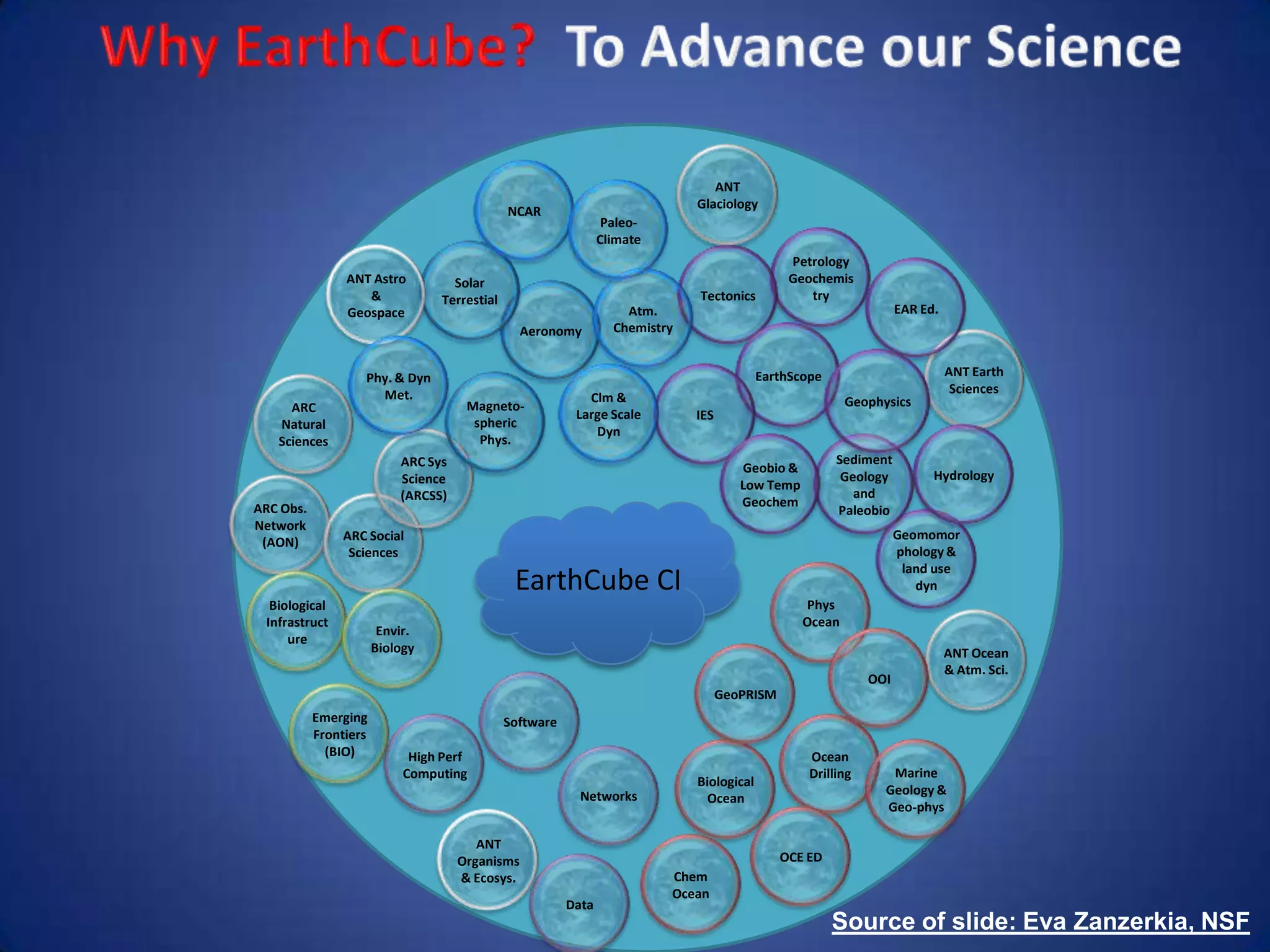
ANT
Glaciology

NCAR

ANT Astro
&
Geospace

PaleoClimate

Solar
Terrestial

Tectonics
Aeronomy

ARC
Natural
Sciences

Phy. & Dyn
Met.

EAR Ed.

Atm.
Chemistry
EarthScope

Magnetospheric
Phys.

Clm &
Large Scale
Dyn

Geophysics

IES

ARC Sys
Science
(ARCSS)

ARC Obs.
Network
(AON)

Petrology
Geochemis
try

Sediment
Geology
and
Paleobio

Geobio &
Low Temp
Geochem

Hydrology

Geomomor
phology &
land use
dyn

ARC Social
Sciences

EarthCube CI
Biological
Infrastruct
ure

ANT Earth
Sciences

Phys
Ocean

Envir.
Biology

OOI

ANT Ocean
& Atm. Sci.

GeoPRISM
Emerging
Frontiers
(BIO)

Software
High Perf
Computing
Networks
ANT
Organisms
& Ecosys.

Biological
Ocean

Ocean
Drilling

Marine
Geology &
Geo-phys

OCE ED
Data

Chem
Ocean

Source of slide: Eva Zanzerkia, NSF
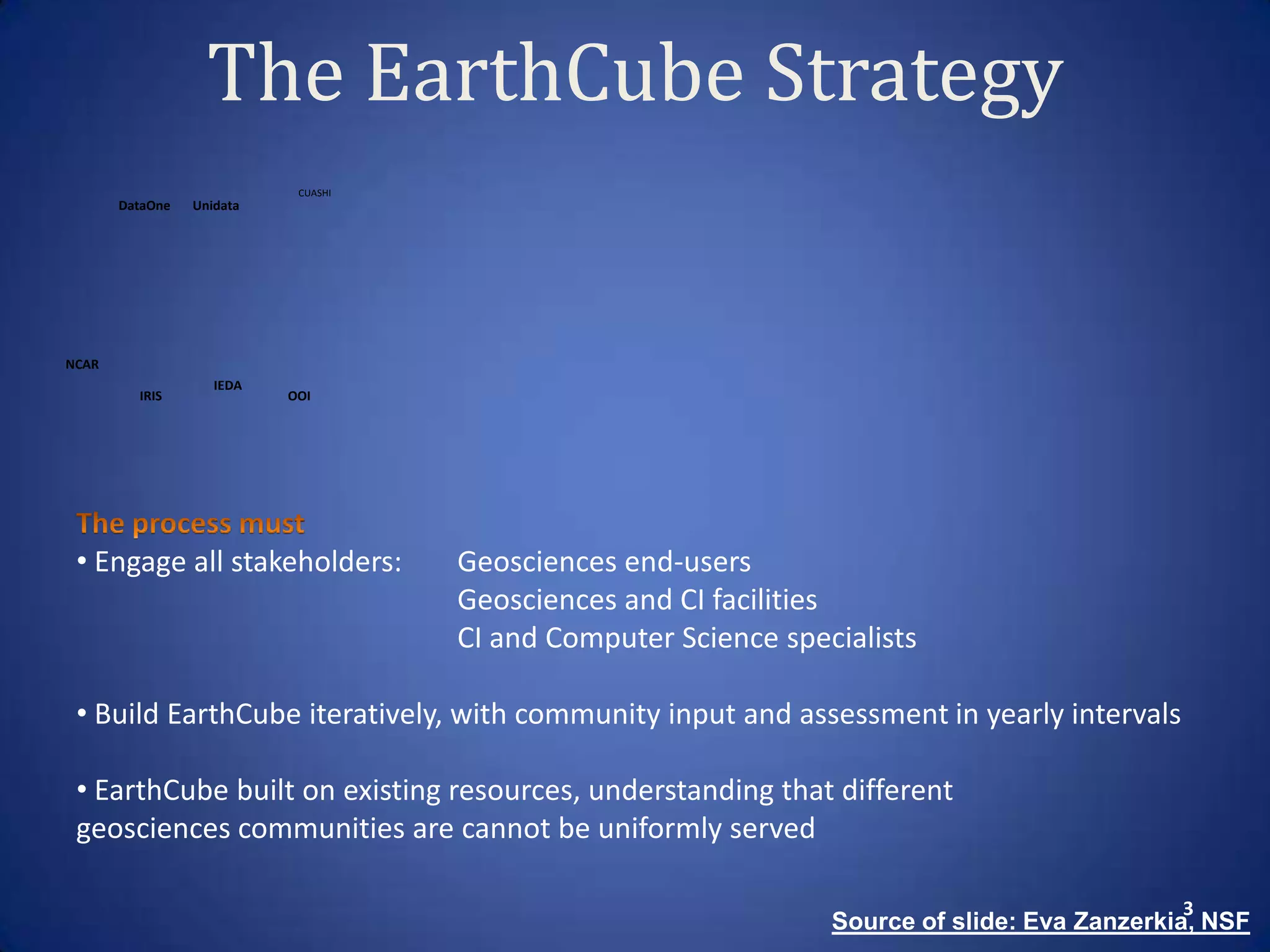
The EarthCube Strategy
CUASHI

DataOne

Unidata

NCAR
IRIS

IEDA

OOI

• Engage all stakeholders:

Geosciences end-users
Geosciences and CI facilities
CI and Computer Science specialists

• Build EarthCube iteratively, with community input and assessment in yearly intervals
• EarthCube built on existing resources, understanding that different
geosciences communities are cannot be uniformly served
3

Source of slide: Eva Zanzerkia, NSF
What are the Goals of EarthCube?
EarthCube aims to:
• Transform research and data management practices within
the geosciences community over the next decade
• Provide unprecedented new capabilities, including access
to data and visualization tools, to researchers and
educators
• Vastly improve the productivity of the geosciences
community
• Accelerate research on the Earth system
• Provide a knowledge management framework for the
geosciences
http://earthcube.org/page/about

OGC

®
Copyright © 2013, Open Geospatial Consortium
Open Data and a Culture of Cooperation
• EarthCube is based on a network of enthusiasts willing to
make the sharing of data a reality. But is just having open
data enough?
– Open data will not accelerate the process a scientist team needs to
go through to understand, reformat and use the data.

• Letter to Editor response by 44 persons in EarthCube
– “Although the question of who pays for open data is important…
– A greater challenge lies in implementing institutional and cultural
changes required before data from government-sponsored research
can be openly shared”
– Science 29 November 2013: V. 342 pp. 1041-4042

OGC

®
© GEO Secretariat
Cyberinfrastructure for Geosciences
• Cyberinfrastructure depends upon agreements for open
interfaces and open encodings
• Development of cyberinfrastructure for Geosciences need
to take into account these open agreements, including
open interfaces and open encodings.
• Once open agreements are in place, it is essential to have
in place policy and procedures, and a governance body for
maintaining those agreements.

OGC

®
Copyright © 2013, Open Geospatial Consortium
EarthCube Stakeholder
Alignment Data and
Principles for Test
Governance Meeting

Joel Cutcher-Gershenfeld,

University of Illinois, Urbana-Champaign
Nick Berente, University of Georgia
Burcu Bolukbasi, UIUC
Leslie DeChurch, Georgia Tech University
Courtney Flint, Utah State University
Michael Haberman, UIUC
John L. King, University of Michigan
Eric Knight, University of Sydney
Barbara Lawrence, UCLA
Ethan Masella, Brandeis Uniersity
Charles Mcelroy, Case Western
Reserve University
Support from the National Science Foundation is deeply appreciated:
Barbara Mittleman, Nodality, Inc.
NSF-VOSS EAGER 0956472, “Stakeholder Alignment in Socio-Technical Systems,”
Mark Nolan, UIUC
NSF OCI RAPID 1229928, “Stakeholder Alignment for EarthCube,”
Melanie Radik, Brandeis University
NSF GEO-SciSIP-STS-OCI-INSPIRE 1249607, “Enabling Transformation in the Social
Namchul Shin, Pace University
Sciences, Geosciences, and Cyberinfrastructure,”
Susan Winter, University of Maryland
NSF I-CORPS 1313562 “Stakeholder Alignment for Public-Private Partnerships”
Ilya Zaslavsky, UCSD
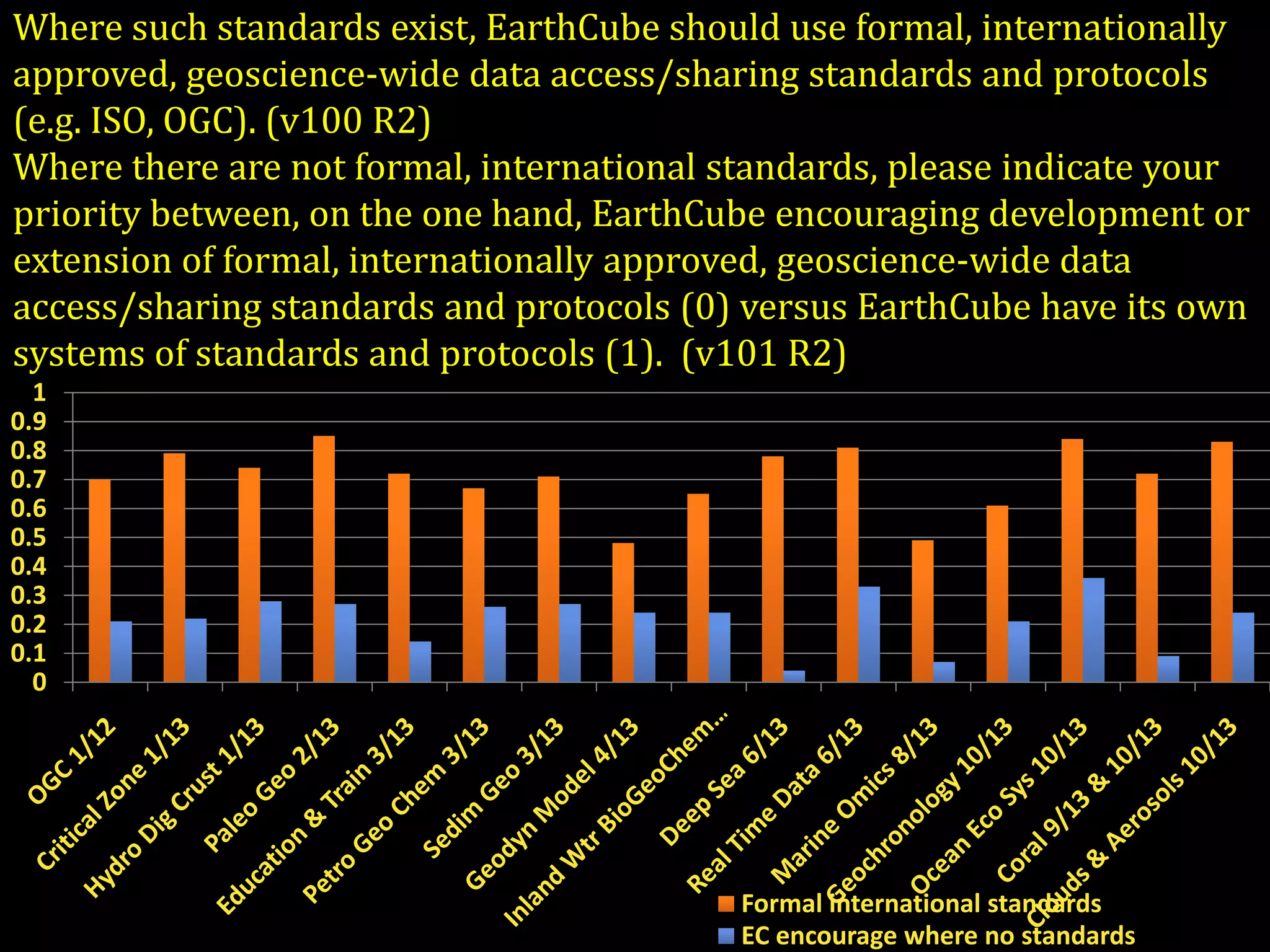
Where such standards exist, EarthCube should use formal, internationally
approved, geoscience-wide data access/sharing standards and protocols
(e.g. ISO, OGC). (v100 R2)
Where there are not formal, international standards, please indicate your
priority between, on the one hand, EarthCube encouraging development or
extension of formal, internationally approved, geoscience-wide data
access/sharing standards and protocols (0) versus EarthCube have its own
systems of standards and protocols (1). (v101 R2)
1
0.9
0.8
0.7
0.6
0.5
0.4
0.3
0.2
0.1
0

Formal international standards
EC encourage where no standards
Recent EarthCube awards by NSF
•
•
•
•

Building Blocks
Conceptual Architecture
Research Networks
Test Governance – an Agile approach

OGC

®
© GEO Secretariat
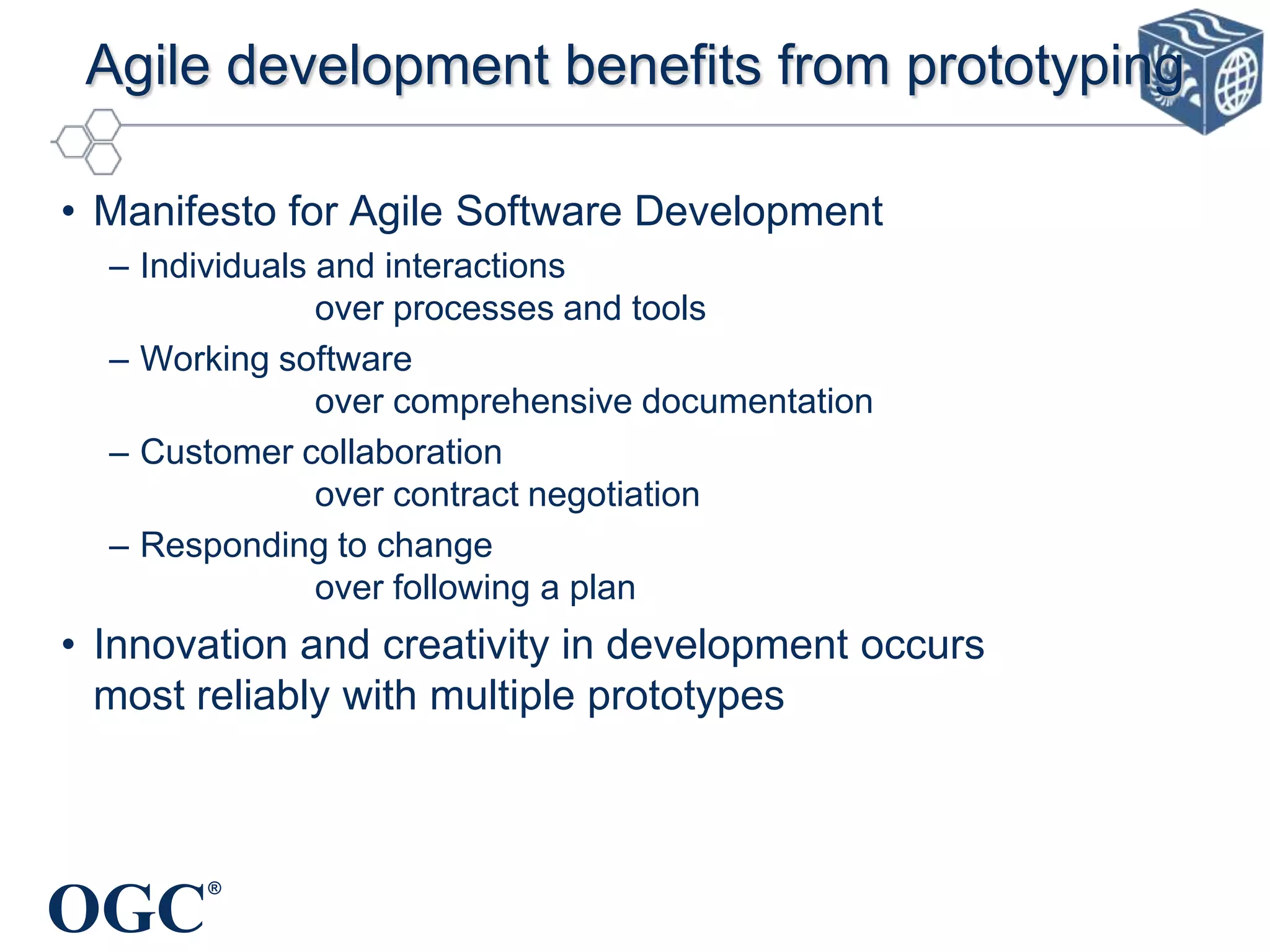
Agile development benefits from prototyping
• Manifesto for Agile Software Development
– Individuals and interactions
over processes and tools
– Working software
over comprehensive documentation
– Customer collaboration
over contract negotiation
– Responding to change
over following a plan

• Innovation and creativity in development occurs
most reliably with multiple prototypes

OGC

®
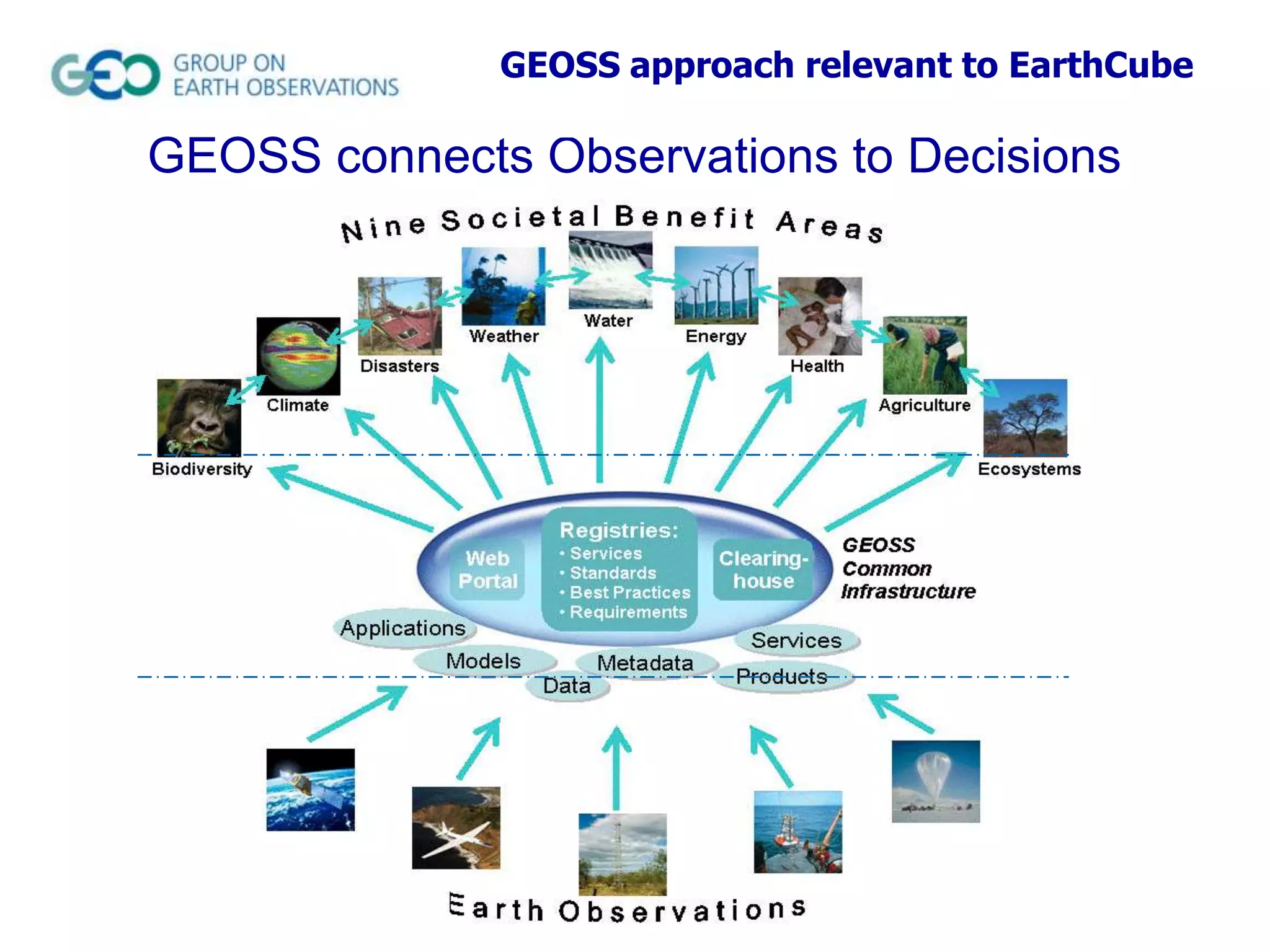
GEOSS approach relevant to EarthCube

GEOSS connects Observations to Decisions
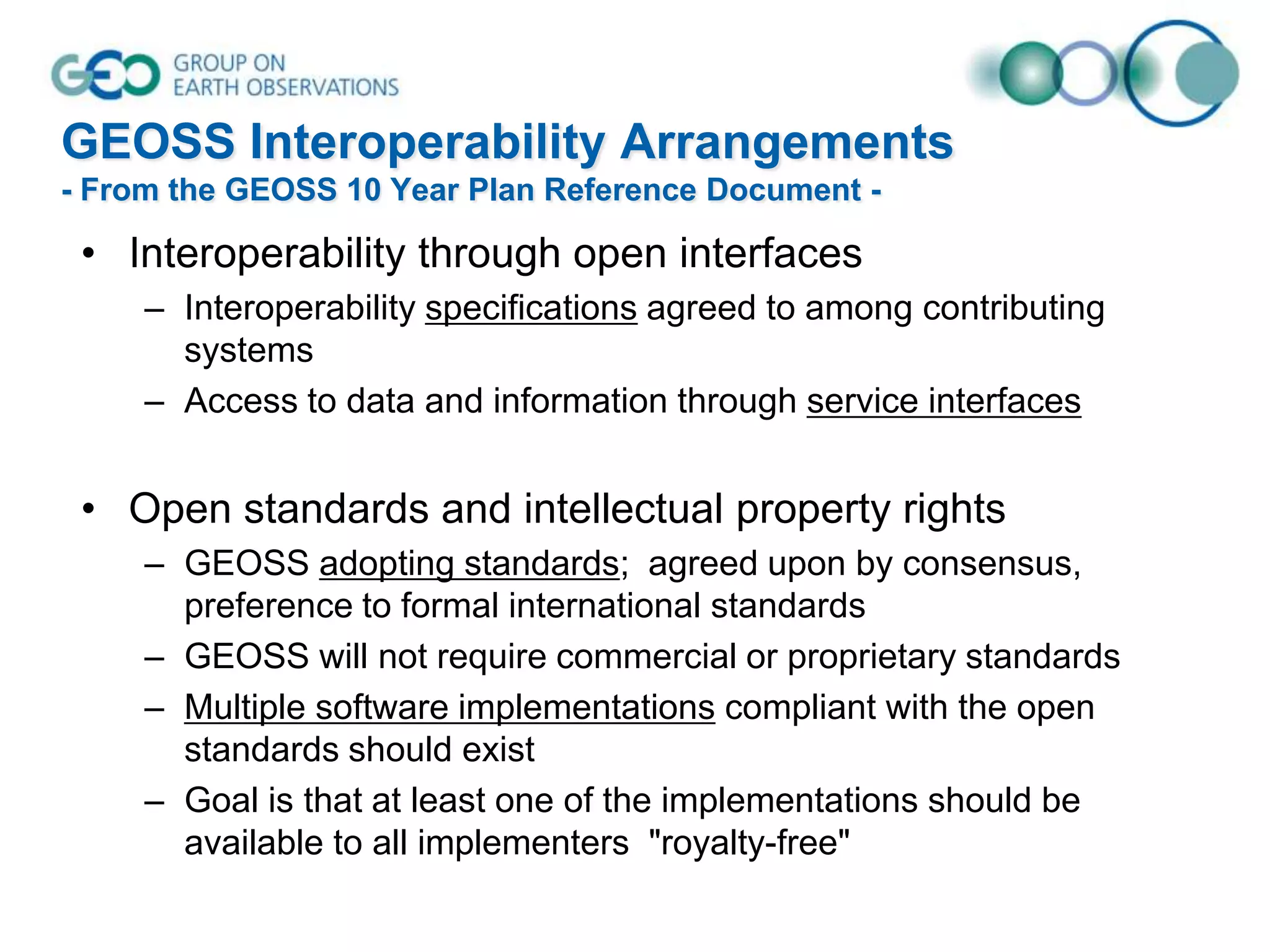
GEOSS Interoperability Arrangements
- From the GEOSS 10 Year Plan Reference Document -

• Interoperability through open interfaces
– Interoperability specifications agreed to among contributing
systems
– Access to data and information through service interfaces

• Open standards and intellectual property rights
– GEOSS adopting standards; agreed upon by consensus,
preference to formal international standards
– GEOSS will not require commercial or proprietary standards
– Multiple software implementations compliant with the open
standards should exist
– Goal is that at least one of the implementations should be
available to all implementers "royalty-free"
GEOSS Data Sharing Principles
• Full and Open Exchange of Data
• Data and Products at Minimum Time delay and
Minimum Cost
• Free of Charge or Cost of Reproduction
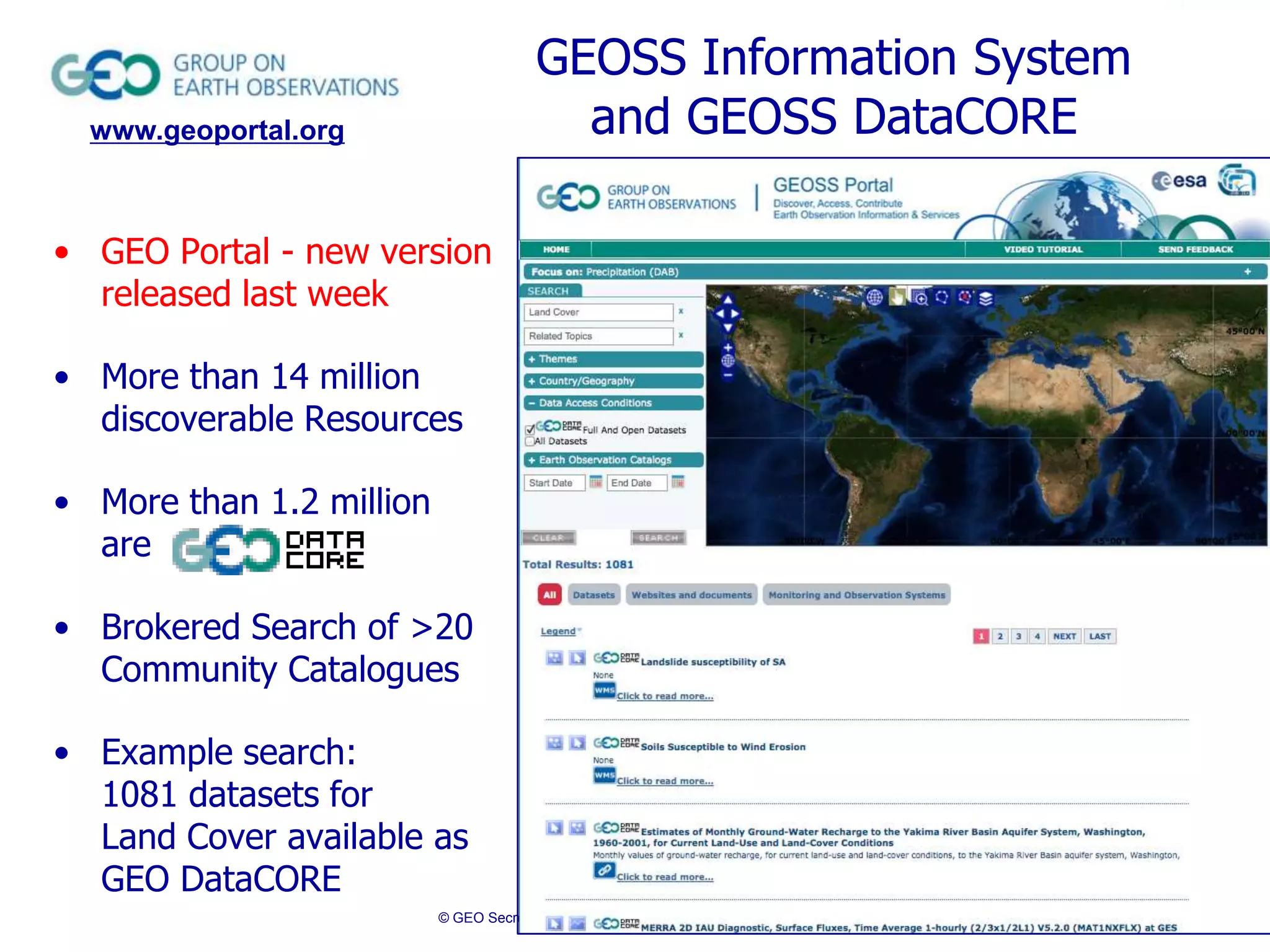
GEOSS Information System
and GEOSS DataCORE

www.geoportal.org

• GEO Portal - new version
released last week

• More than 14 million
discoverable Resources
• More than 1.2 million
are
• Brokered Search of >20
Community Catalogues
• Example search:
1081 datasets for
Land Cover available as
GEO DataCORE
© GEO Secretariat
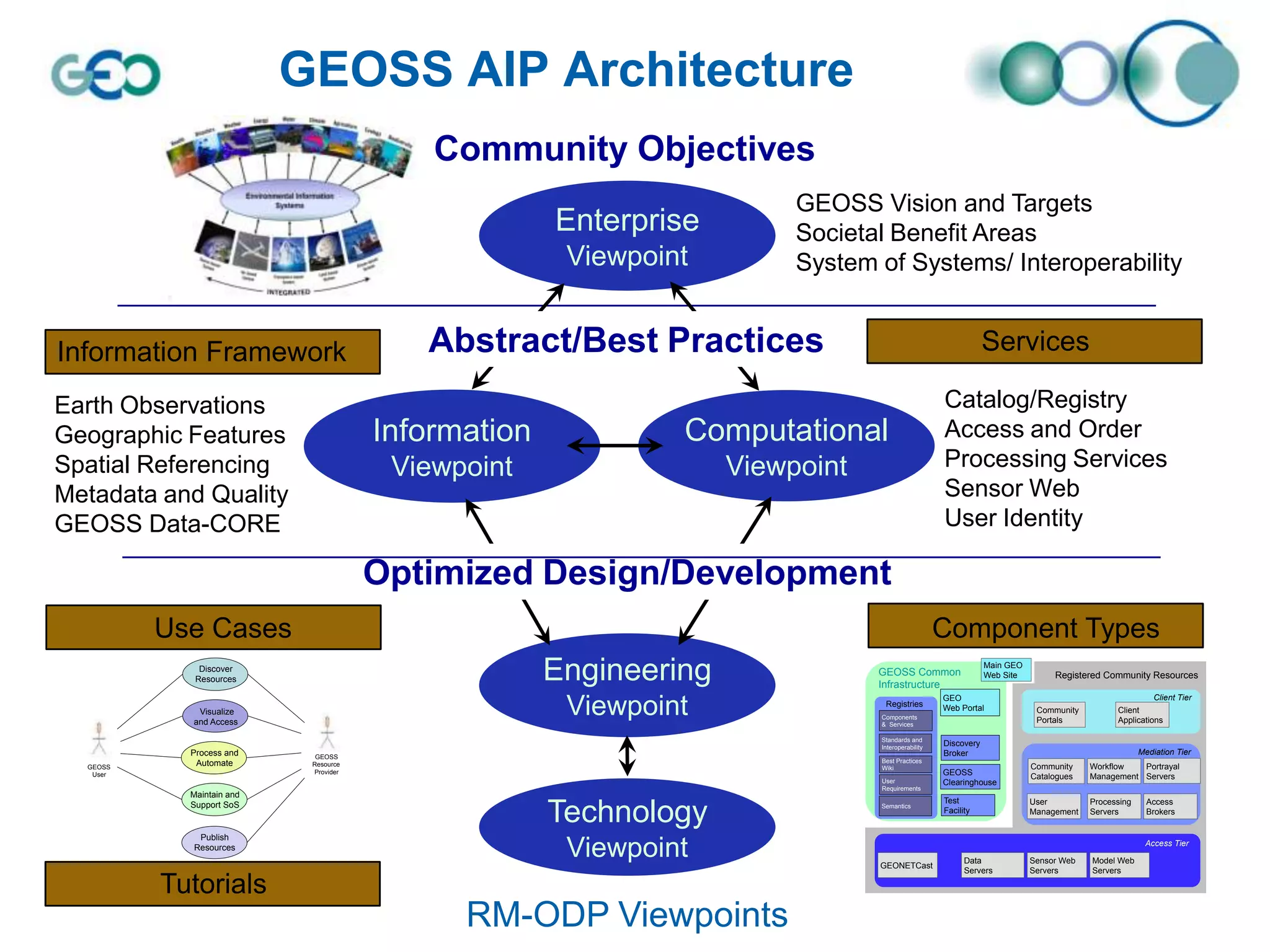
GEOSS AIP Architecture
Community Objectives
GEOSS Vision and Targets
Societal Benefit Areas
System of Systems/ Interoperability

Enterprise
Viewpoint
Information Framework
Earth Observations
Geographic Features
Spatial Referencing
Metadata and Quality
GEOSS Data-CORE

Abstract/Best Practices

Services

Information

Computational

Viewpoint

Catalog/Registry
Access and Order
Processing Services
Sensor Web
User Identity

Viewpoint

Optimized Design/Development
Use Cases

Component Types

Engineering

Discover
Resources

Viewpoint

Visualize
and Access

GEOSS
User

Process and
Automate

Maintain and
Support SoS

Publish
Resources

Registries

Best Practices
Wiki
User
Requirements

Technology
Viewpoint

Tutorials

RM-ODP Viewpoints

GEO
Web Portal

Components
& Services
Standards and
Interoperability

GEOSS
Resource
Provider

Main GEO
Web Site

GEOSS Common
Infrastructure

Semantics

Registered Community Resources
Client Tier
Community
Portals

Client
Applications

Discovery
Broker
GEOSS
Clearinghouse
Test
Facility

Mediation Tier
Community
Catalogues

Portrayal
Workflow
Management Servers

User
Management

Processing
Servers

Sensor Web
Servers

Model Web
Servers

Access
Brokers

Access Tier
GEONETCast

Data
Servers
EarthCube Cyberinfrastructure
• Agile development and governance
• Open Data and a Culture of Cooperation
• Building blocks and architecture simultaneously and
iteratively
• Coordinating organizations
– ESIP, RDA, Belmont Forum, OGC and many others

• An open community with many opportunities and benefits
– http://earthcube.org/

OGC

®
Copyright © 2013, Open Geospatial Consortium
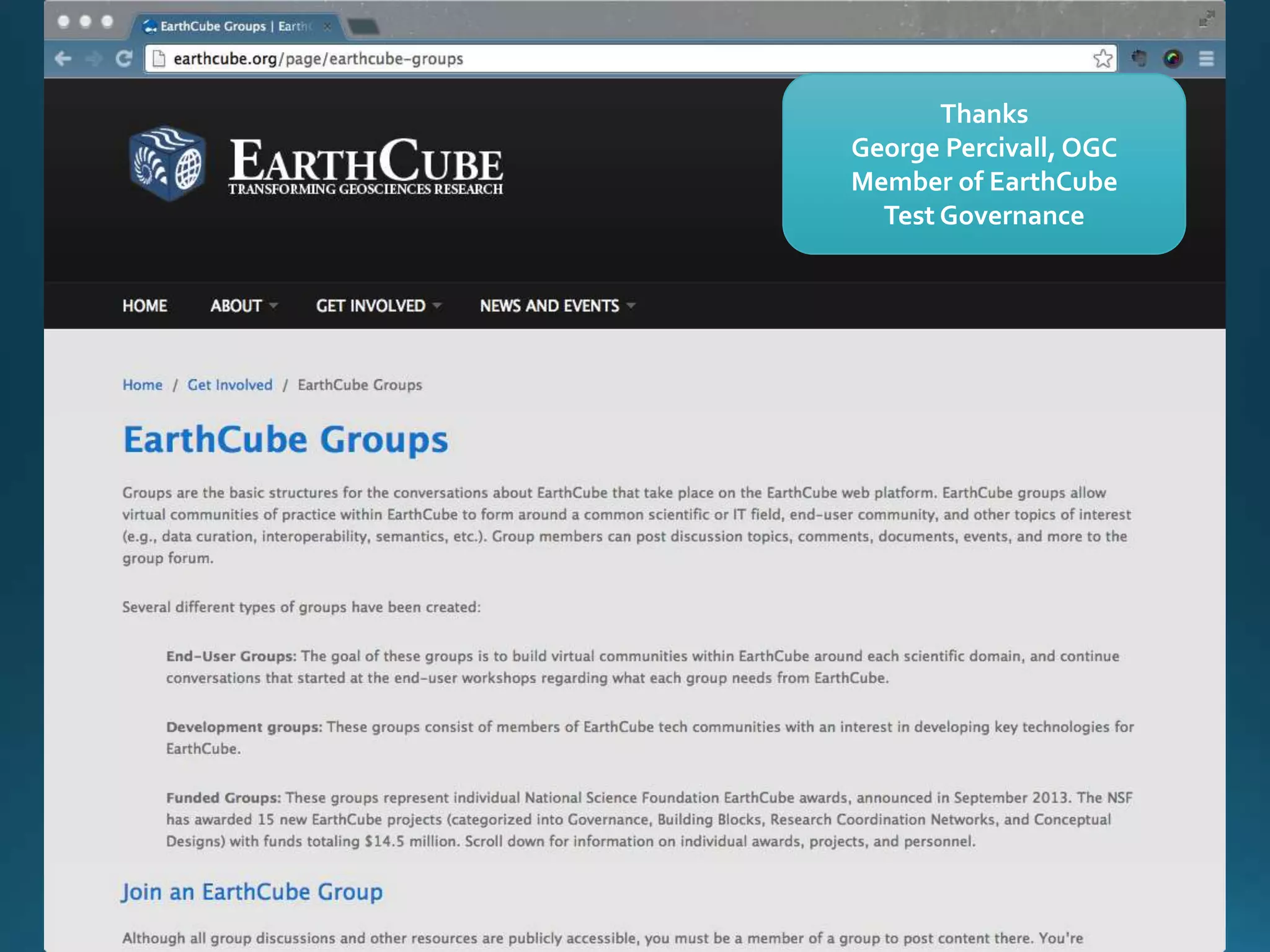
Thanks
George Percivall, OGC
Member of EarthCube
Test Governance

Open Standards Role in EarthCube (AGU 2013)

  • 1.
    ® Open Standards Role inEarthCube George Percivall, OGC Chief Engineer AGU Session IN43B Emerging Concepts for Cyberinfrastructure in the Geosciences 12 December 2013 Copyright © 2013, Open Geospatial Consortium
  • 2.
    ANT Glaciology NCAR ANT Astro & Geospace PaleoClimate Solar Terrestial Tectonics Aeronomy ARC Natural Sciences Phy. &Dyn Met. EAR Ed. Atm. Chemistry EarthScope Magnetospheric Phys. Clm & Large Scale Dyn Geophysics IES ARC Sys Science (ARCSS) ARC Obs. Network (AON) Petrology Geochemis try Sediment Geology and Paleobio Geobio & Low Temp Geochem Hydrology Geomomor phology & land use dyn ARC Social Sciences EarthCube CI Biological Infrastruct ure ANT Earth Sciences Phys Ocean Envir. Biology OOI ANT Ocean & Atm. Sci. GeoPRISM Emerging Frontiers (BIO) Software High Perf Computing Networks ANT Organisms & Ecosys. Biological Ocean Ocean Drilling Marine Geology & Geo-phys OCE ED Data Chem Ocean Source of slide: Eva Zanzerkia, NSF
  • 3.
    The EarthCube Strategy CUASHI DataOne Unidata NCAR IRIS IEDA OOI •Engage all stakeholders: Geosciences end-users Geosciences and CI facilities CI and Computer Science specialists • Build EarthCube iteratively, with community input and assessment in yearly intervals • EarthCube built on existing resources, understanding that different geosciences communities are cannot be uniformly served 3 Source of slide: Eva Zanzerkia, NSF
  • 4.
    What are theGoals of EarthCube? EarthCube aims to: • Transform research and data management practices within the geosciences community over the next decade • Provide unprecedented new capabilities, including access to data and visualization tools, to researchers and educators • Vastly improve the productivity of the geosciences community • Accelerate research on the Earth system • Provide a knowledge management framework for the geosciences http://earthcube.org/page/about OGC ® Copyright © 2013, Open Geospatial Consortium
  • 5.
    Open Data anda Culture of Cooperation • EarthCube is based on a network of enthusiasts willing to make the sharing of data a reality. But is just having open data enough? – Open data will not accelerate the process a scientist team needs to go through to understand, reformat and use the data. • Letter to Editor response by 44 persons in EarthCube – “Although the question of who pays for open data is important… – A greater challenge lies in implementing institutional and cultural changes required before data from government-sponsored research can be openly shared” – Science 29 November 2013: V. 342 pp. 1041-4042 OGC ® © GEO Secretariat
  • 6.
    Cyberinfrastructure for Geosciences •Cyberinfrastructure depends upon agreements for open interfaces and open encodings • Development of cyberinfrastructure for Geosciences need to take into account these open agreements, including open interfaces and open encodings. • Once open agreements are in place, it is essential to have in place policy and procedures, and a governance body for maintaining those agreements. OGC ® Copyright © 2013, Open Geospatial Consortium
  • 7.
    EarthCube Stakeholder Alignment Dataand Principles for Test Governance Meeting Joel Cutcher-Gershenfeld, University of Illinois, Urbana-Champaign Nick Berente, University of Georgia Burcu Bolukbasi, UIUC Leslie DeChurch, Georgia Tech University Courtney Flint, Utah State University Michael Haberman, UIUC John L. King, University of Michigan Eric Knight, University of Sydney Barbara Lawrence, UCLA Ethan Masella, Brandeis Uniersity Charles Mcelroy, Case Western Reserve University Support from the National Science Foundation is deeply appreciated: Barbara Mittleman, Nodality, Inc. NSF-VOSS EAGER 0956472, “Stakeholder Alignment in Socio-Technical Systems,” Mark Nolan, UIUC NSF OCI RAPID 1229928, “Stakeholder Alignment for EarthCube,” Melanie Radik, Brandeis University NSF GEO-SciSIP-STS-OCI-INSPIRE 1249607, “Enabling Transformation in the Social Namchul Shin, Pace University Sciences, Geosciences, and Cyberinfrastructure,” Susan Winter, University of Maryland NSF I-CORPS 1313562 “Stakeholder Alignment for Public-Private Partnerships” Ilya Zaslavsky, UCSD
  • 8.
    Where such standardsexist, EarthCube should use formal, internationally approved, geoscience-wide data access/sharing standards and protocols (e.g. ISO, OGC). (v100 R2) Where there are not formal, international standards, please indicate your priority between, on the one hand, EarthCube encouraging development or extension of formal, internationally approved, geoscience-wide data access/sharing standards and protocols (0) versus EarthCube have its own systems of standards and protocols (1). (v101 R2) 1 0.9 0.8 0.7 0.6 0.5 0.4 0.3 0.2 0.1 0 Formal international standards EC encourage where no standards
  • 9.
    Recent EarthCube awardsby NSF • • • • Building Blocks Conceptual Architecture Research Networks Test Governance – an Agile approach OGC ® © GEO Secretariat
  • 10.
    Agile development benefitsfrom prototyping • Manifesto for Agile Software Development – Individuals and interactions over processes and tools – Working software over comprehensive documentation – Customer collaboration over contract negotiation – Responding to change over following a plan • Innovation and creativity in development occurs most reliably with multiple prototypes OGC ®
  • 11.
    GEOSS approach relevantto EarthCube GEOSS connects Observations to Decisions
  • 12.
    GEOSS Interoperability Arrangements -From the GEOSS 10 Year Plan Reference Document - • Interoperability through open interfaces – Interoperability specifications agreed to among contributing systems – Access to data and information through service interfaces • Open standards and intellectual property rights – GEOSS adopting standards; agreed upon by consensus, preference to formal international standards – GEOSS will not require commercial or proprietary standards – Multiple software implementations compliant with the open standards should exist – Goal is that at least one of the implementations should be available to all implementers "royalty-free"
  • 13.
    GEOSS Data SharingPrinciples • Full and Open Exchange of Data • Data and Products at Minimum Time delay and Minimum Cost • Free of Charge or Cost of Reproduction
  • 14.
    GEOSS Information System andGEOSS DataCORE www.geoportal.org • GEO Portal - new version released last week • More than 14 million discoverable Resources • More than 1.2 million are • Brokered Search of >20 Community Catalogues • Example search: 1081 datasets for Land Cover available as GEO DataCORE © GEO Secretariat
  • 15.
    GEOSS AIP Architecture CommunityObjectives GEOSS Vision and Targets Societal Benefit Areas System of Systems/ Interoperability Enterprise Viewpoint Information Framework Earth Observations Geographic Features Spatial Referencing Metadata and Quality GEOSS Data-CORE Abstract/Best Practices Services Information Computational Viewpoint Catalog/Registry Access and Order Processing Services Sensor Web User Identity Viewpoint Optimized Design/Development Use Cases Component Types Engineering Discover Resources Viewpoint Visualize and Access GEOSS User Process and Automate Maintain and Support SoS Publish Resources Registries Best Practices Wiki User Requirements Technology Viewpoint Tutorials RM-ODP Viewpoints GEO Web Portal Components & Services Standards and Interoperability GEOSS Resource Provider Main GEO Web Site GEOSS Common Infrastructure Semantics Registered Community Resources Client Tier Community Portals Client Applications Discovery Broker GEOSS Clearinghouse Test Facility Mediation Tier Community Catalogues Portrayal Workflow Management Servers User Management Processing Servers Sensor Web Servers Model Web Servers Access Brokers Access Tier GEONETCast Data Servers
  • 16.
    EarthCube Cyberinfrastructure • Agiledevelopment and governance • Open Data and a Culture of Cooperation • Building blocks and architecture simultaneously and iteratively • Coordinating organizations – ESIP, RDA, Belmont Forum, OGC and many others • An open community with many opportunities and benefits – http://earthcube.org/ OGC ® Copyright © 2013, Open Geospatial Consortium
  • 17.
    Thanks George Percivall, OGC Memberof EarthCube Test Governance