®
IoT Meets Geospatial
Geoweb Summit #8
Raj Singh
Open Geospatial Consortium
May 22, 2014
© 2014 Open Geospatial Consortium
OGC
®
2
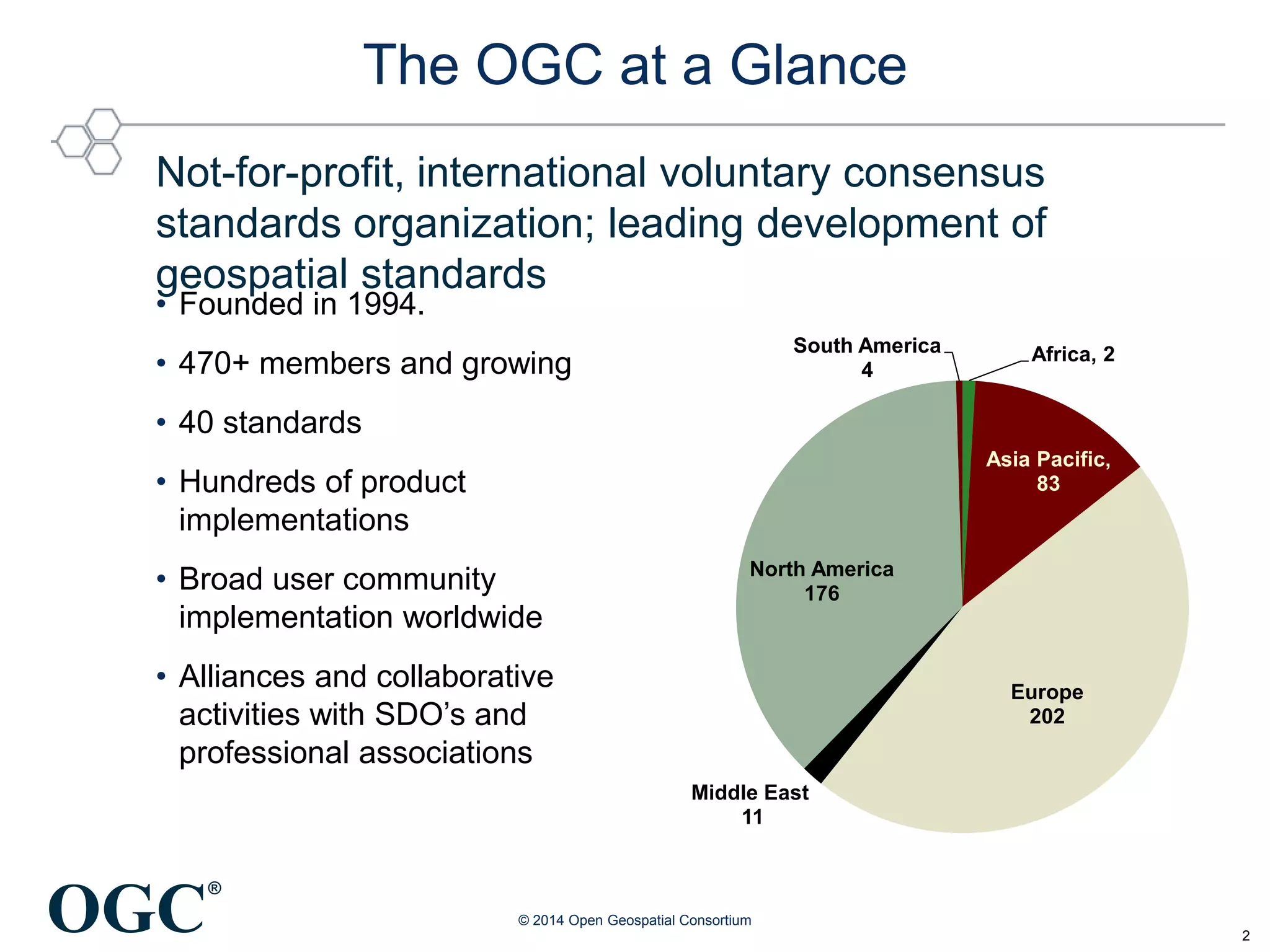
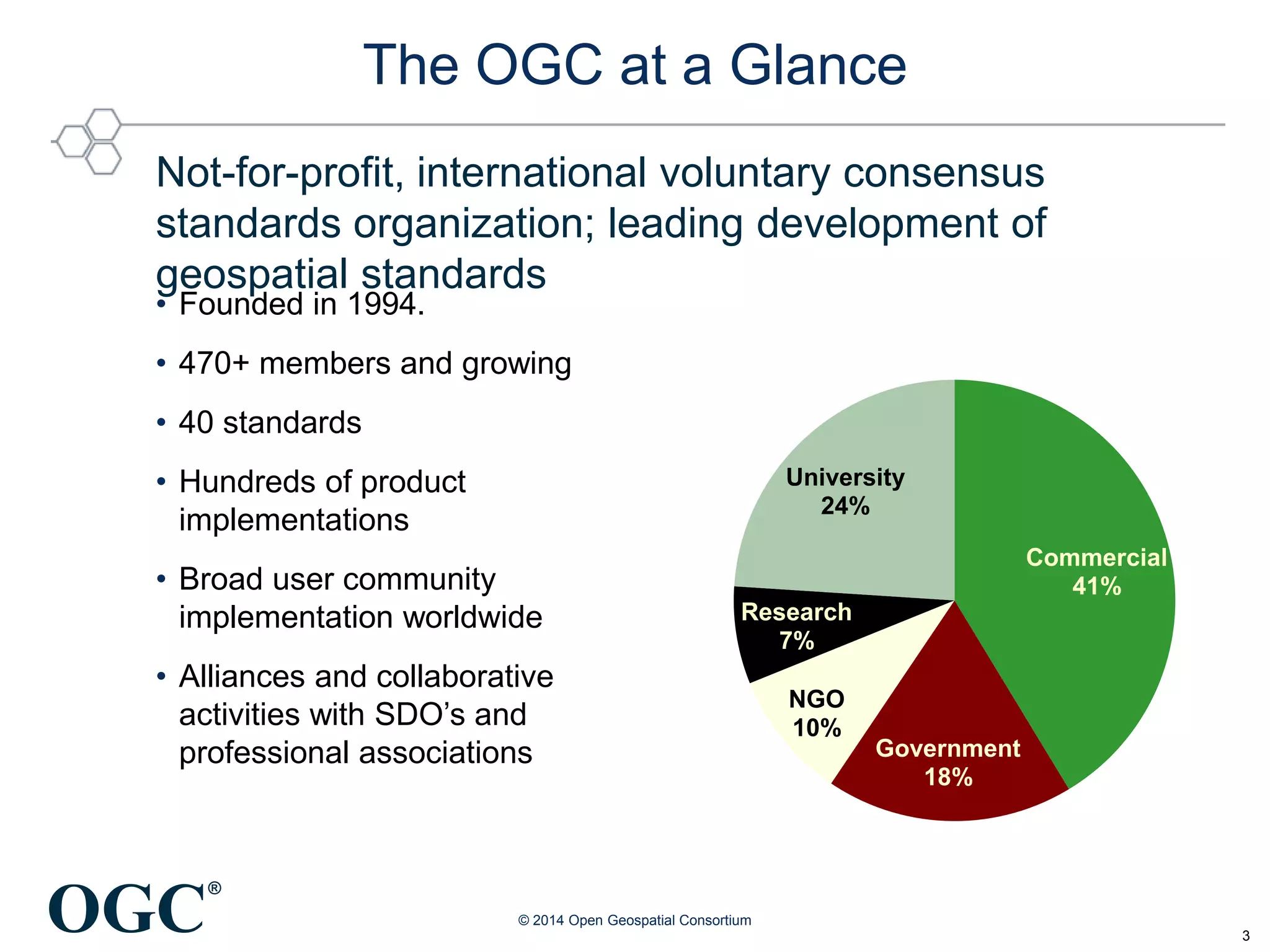
The OGC at a Glance
Not-for-profit, international voluntary consensus
standards organization; leading development of
geospatial standards
© 2014 Open Geospatial Consortium
• Founded in 1994.
• 470+ members and growing
• 40 standards
• Hundreds of product
implementations
• Broad user community
implementation worldwide
• Alliances and collaborative
activities with SDO’s and
professional associations
Africa, 2
Asia Pacific,
83
Europe
202
Middle East
11
North America
176
South America
4
OGC
®
Commercial
41%
Government
18%
NGO
10%
Research
7%
University
24%
3
The OGC at a Glance
Not-for-profit, international voluntary consensus
standards organization; leading development of
geospatial standards
© 2014 Open Geospatial Consortium
• Founded in 1994.
• 470+ members and growing
• 40 standards
• Hundreds of product
implementations
• Broad user community
implementation worldwide
• Alliances and collaborative
activities with SDO’s and
professional associations
OGC
®
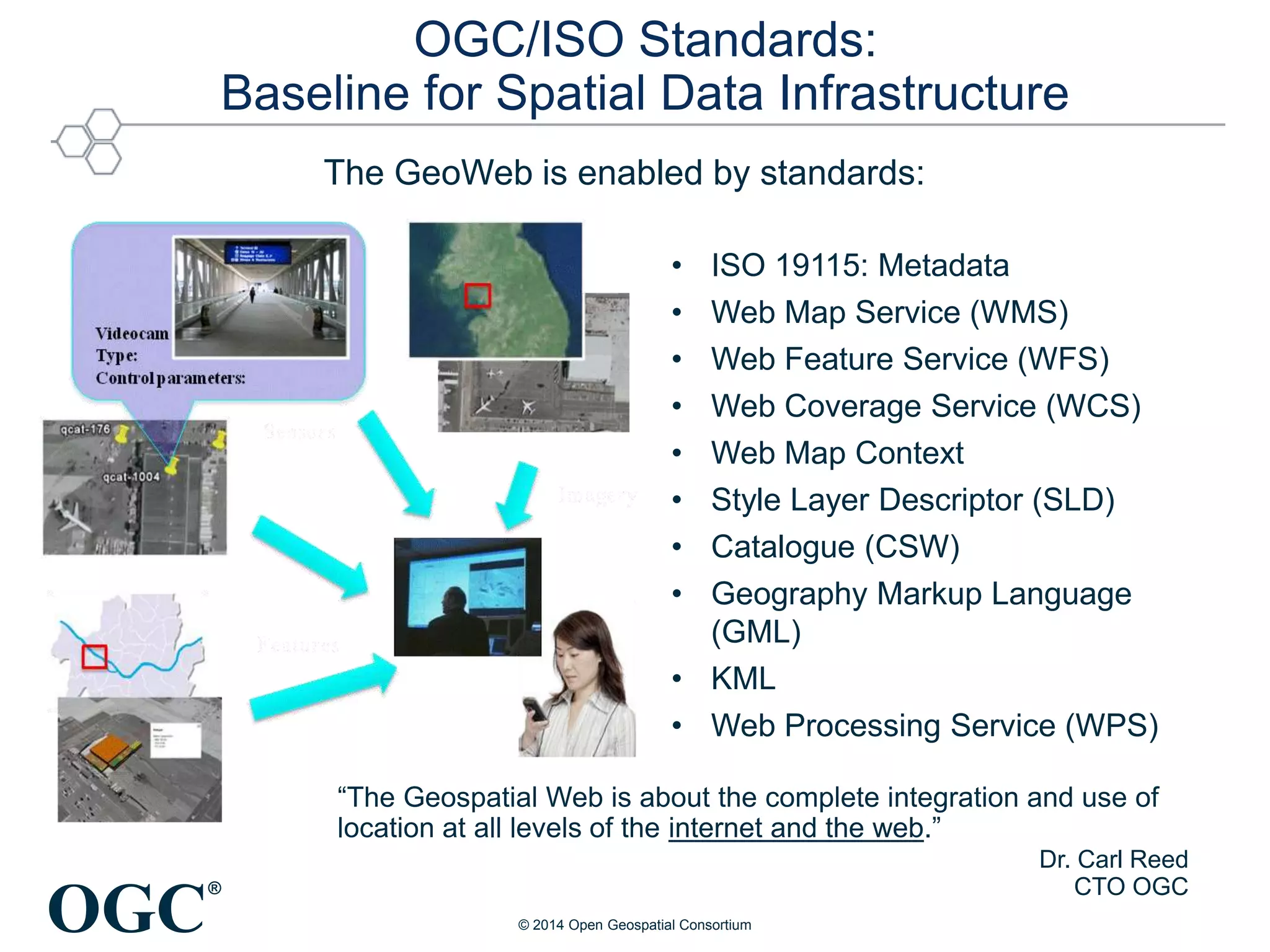
OGC/ISO Standards:
Baseline for Spatial Data Infrastructure
• ISO 19115: Metadata
• Web Map Service (WMS)
• Web Feature Service (WFS)
• Web Coverage Service (WCS)
• Web Map Context
• Style Layer Descriptor (SLD)
• Catalogue (CSW)
• Geography Markup Language
(GML)
• KML
• Web Processing Service (WPS)
The GeoWeb is enabled by standards:
“The Geospatial Web is about the complete integration and use of
location at all levels of the internet and the web.”
Dr. Carl Reed
CTO OGC
© 2014 Open Geospatial Consortium
OGC
®
Why Geo?
• What is IoT?
– abstracting real-world phenomena
into data streams
– combining these data to create
synergistic insights,
especially based on nearness
(contextual awareness)
– visualizing the results
• This is GIS!
© 2014 Open Geospatial Consortium
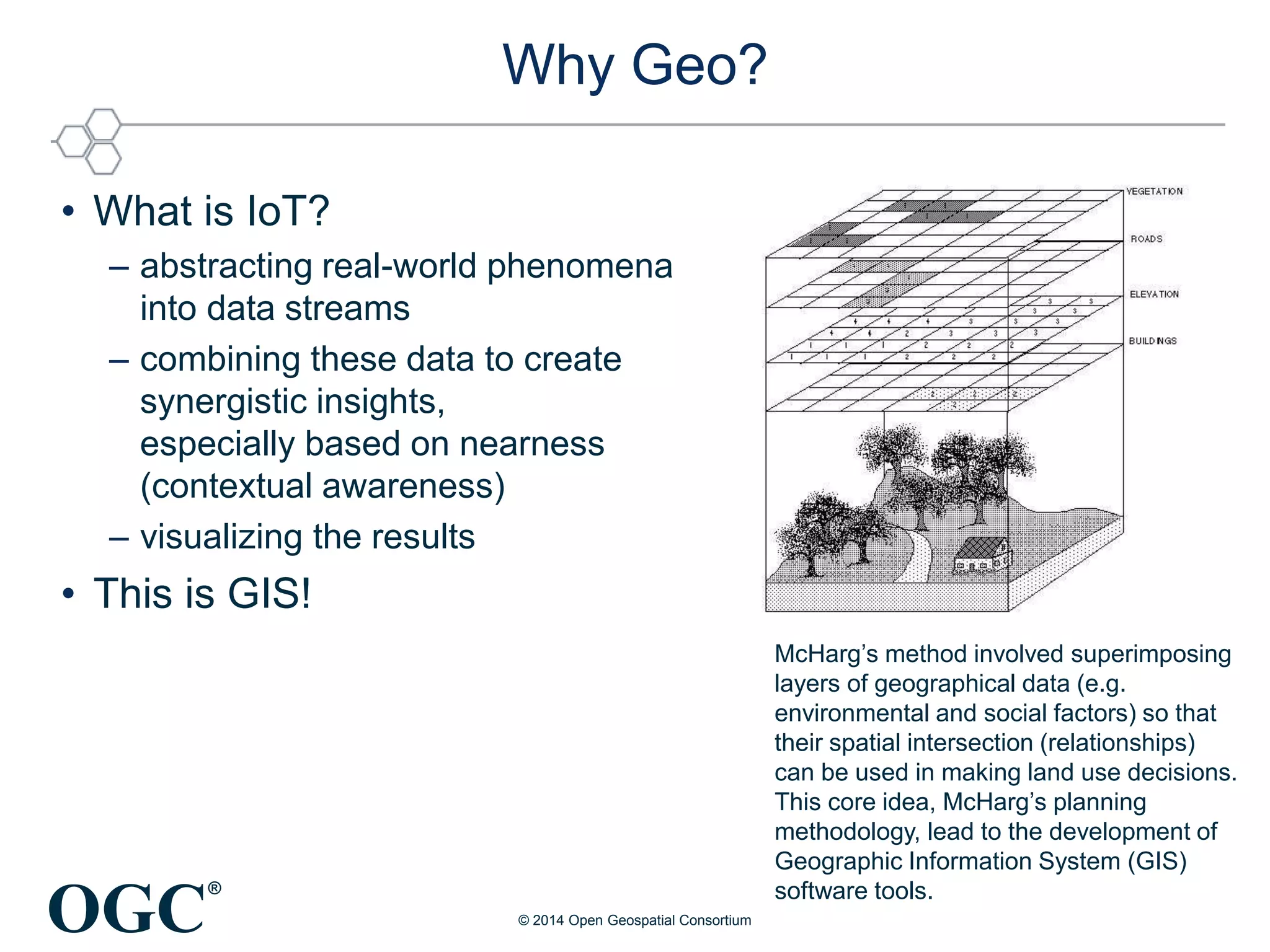
McHarg’s method involved superimposing
layers of geographical data (e.g.
environmental and social factors) so that
their spatial intersection (relationships)
can be used in making land use decisions.
This core idea, McHarg’s planning
methodology, lead to the development of
Geographic Information System (GIS)
software tools.
OGC
®
IoT is finally arriving:
it’s bubbling up from the grassroots.
• IoT: long-prophesied phenomenon of everyday devices
talking to one another — and us — online
– Back in the ’90s, big companies built systems to do tricks like this, but they
were expensive, hard to use, and vendor-specific.
• Hackers now using increasingly inexpensive sensors and
open source hardware, add intelligence to ordinary objects.
– Sensor prices going down; sizes going down. Only limit is your imagination.
– Cloud services – “If This Then That” or Cosm - let devices interact in
unexpected ways
• IoT has reached the “Apple II stage”
– when a new technology finally becomes easy enough to use that
thousands of people start using it.
http://www.wired.com/opinion/2012/12/20-12-st_thompson/
© 2014 Open Geospatial Consortium
OGC
®
OGC Sensor Web Enablement Standards
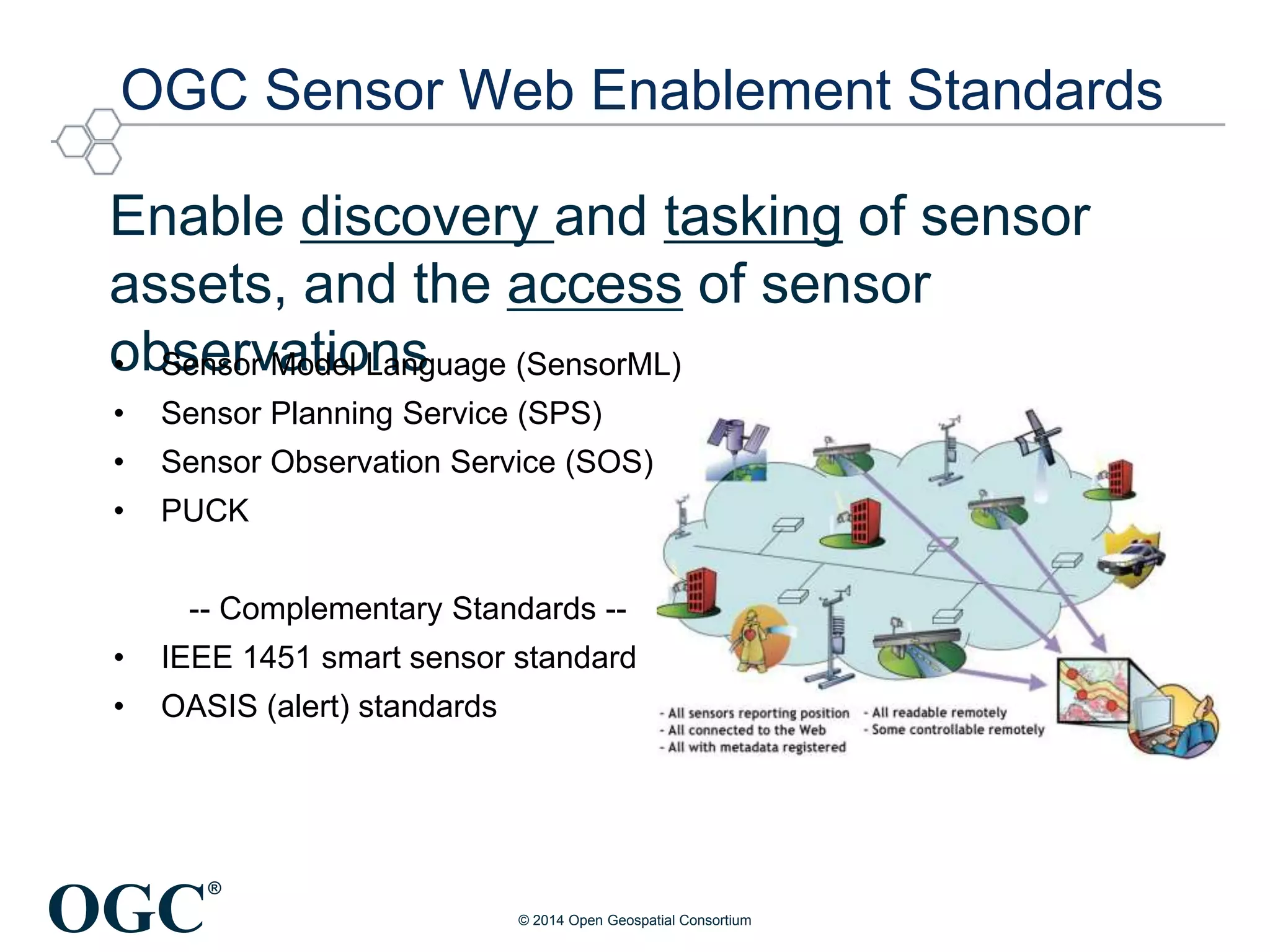
Enable discovery and tasking of sensor
assets, and the access of sensor
observations• Sensor Model Language (SensorML)
• Sensor Planning Service (SPS)
• Sensor Observation Service (SOS)
• PUCK
-- Complementary Standards --
• IEEE 1451 smart sensor standard
• OASIS (alert) standards
© 2014 Open Geospatial Consortium
OGC
®
Large-scale Opportunistic Sensing
• Smartphones to be pocket seismometers
– Right now, can detect earthquakes above Magnitude 5.0. With
better accelerometers in smartphones hope to detect smaller ones
– precious seconds' advance notice that a big trembler is on its way
• pressureNET
– Global network of user-contributed atmospheric pressure readings.
– App displays data as markers on map and graphed over time
– To improve weather forecasting models.
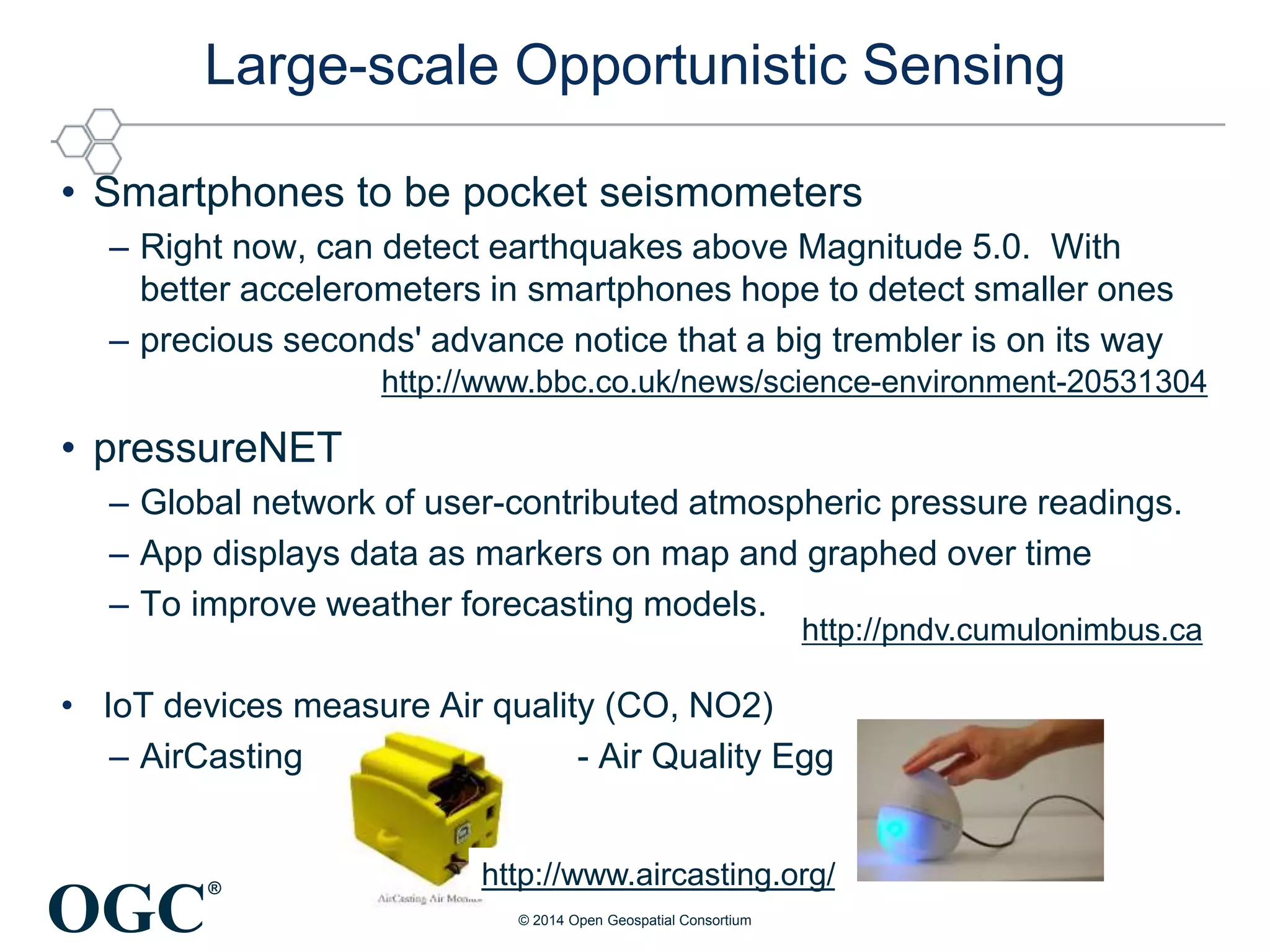
• IoT devices measure Air quality (CO, NO2)
– AirCasting - Air Quality Egg
http://www.bbc.co.uk/news/science-environment-20531304
http://www.aircasting.org/
http://pndv.cumulonimbus.ca
© 2014 Open Geospatial Consortium
OGC
®
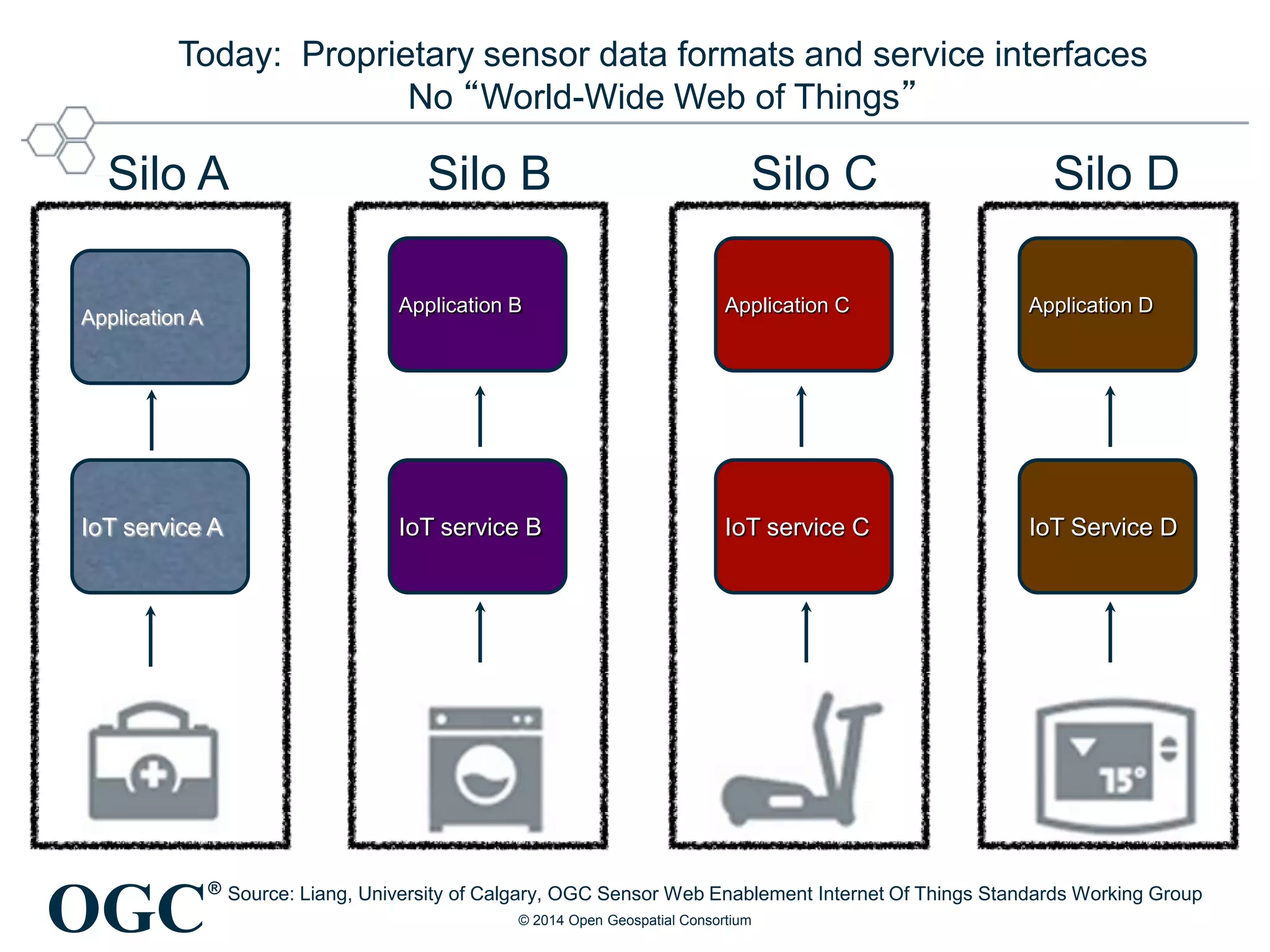
IoT service A IoT service B IoT service C IoT Service D
Application A
Application B Application C Application D
Silo A Silo B Silo C Silo D
Today: Proprietary sensor data formats and service interfaces
No “World-Wide Web of Things”
Source: Liang, University of Calgary, OGC Sensor Web Enablement Internet Of Things Standards Working Group
© 2014 Open Geospatial Consortium
OGC
®
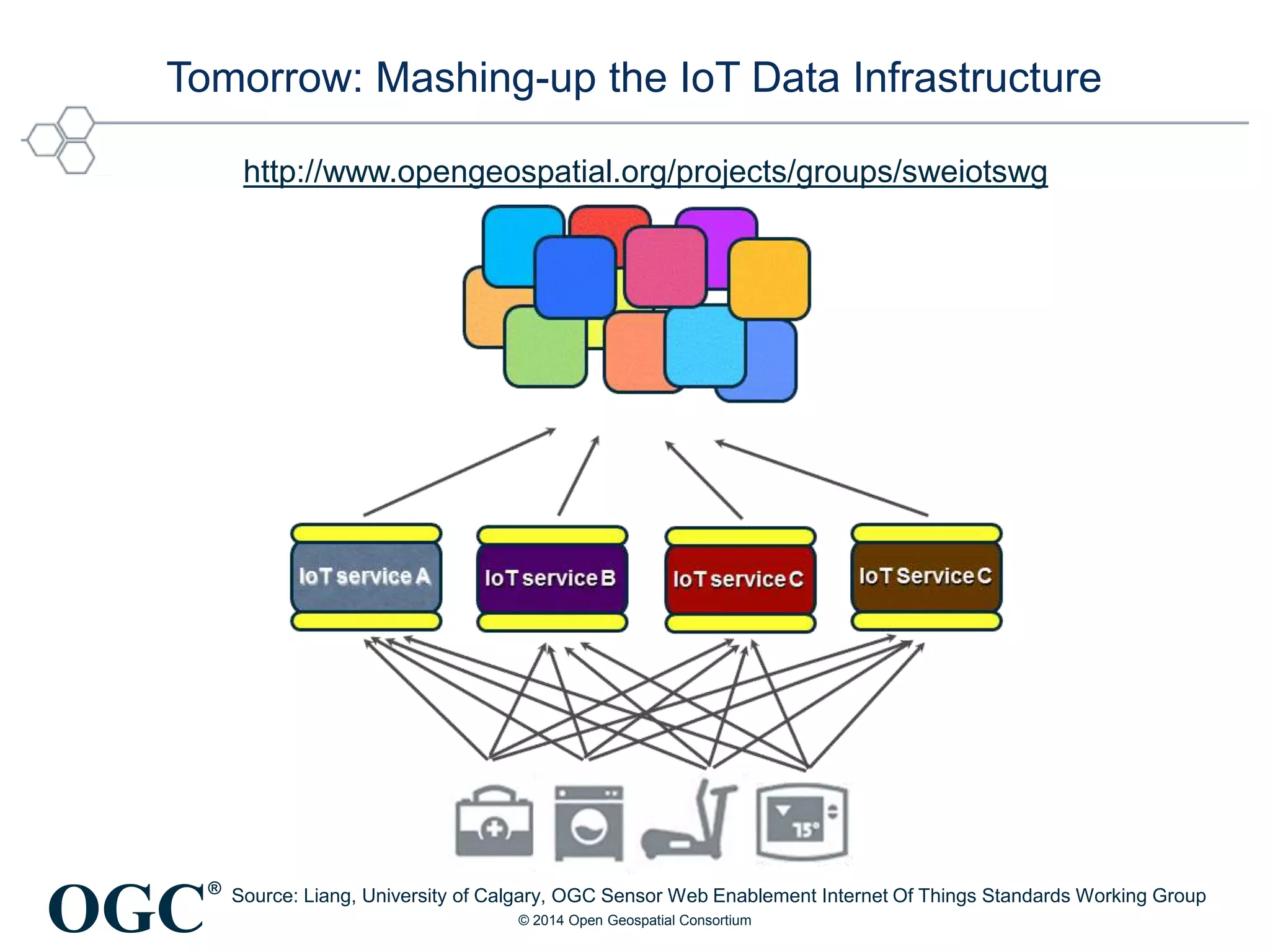
Tomorrow: Mashing-up the IoT Data Infrastructure
Source: Liang, University of Calgary, OGC Sensor Web Enablement Internet Of Things Standards Working Group
http://www.opengeospatial.org/projects/groups/sweiotswg
© 2014 Open Geospatial Consortium
OGC
®
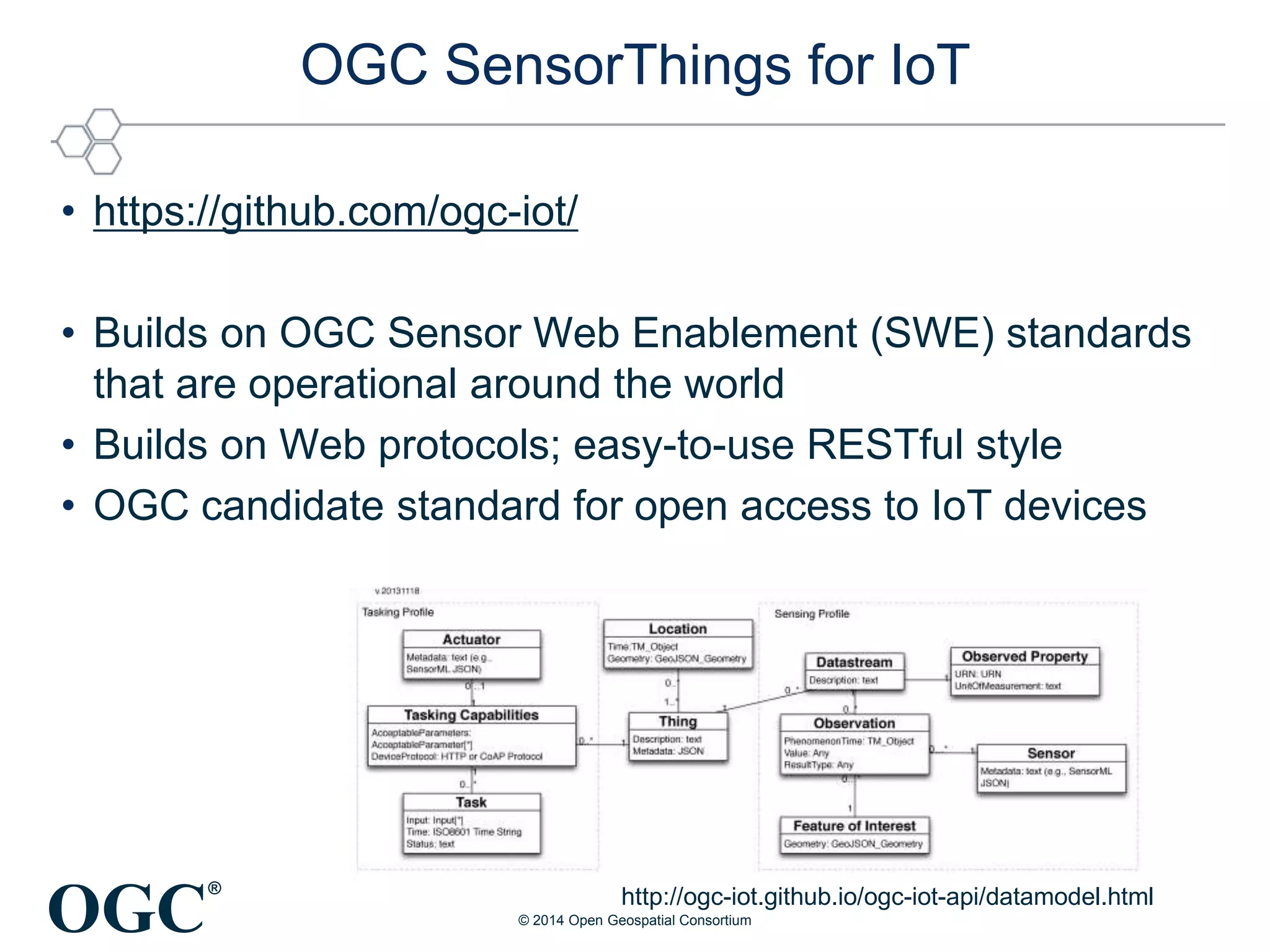
OGC SensorThings for IoT
• https://github.com/ogc-iot/
• Builds on OGC Sensor Web Enablement (SWE) standards
that are operational around the world
• Builds on Web protocols; easy-to-use RESTful style
• OGC candidate standard for open access to IoT devices
http://ogc-iot.github.io/ogc-iot-api/datamodel.html
© 2014 Open Geospatial Consortium

IoT Meets Geo

  • 1.
    ® IoT Meets Geospatial GeowebSummit #8 Raj Singh Open Geospatial Consortium May 22, 2014 © 2014 Open Geospatial Consortium
  • 2.
    OGC ® 2 The OGC ata Glance Not-for-profit, international voluntary consensus standards organization; leading development of geospatial standards © 2014 Open Geospatial Consortium • Founded in 1994. • 470+ members and growing • 40 standards • Hundreds of product implementations • Broad user community implementation worldwide • Alliances and collaborative activities with SDO’s and professional associations Africa, 2 Asia Pacific, 83 Europe 202 Middle East 11 North America 176 South America 4
  • 3.
    OGC ® Commercial 41% Government 18% NGO 10% Research 7% University 24% 3 The OGC ata Glance Not-for-profit, international voluntary consensus standards organization; leading development of geospatial standards © 2014 Open Geospatial Consortium • Founded in 1994. • 470+ members and growing • 40 standards • Hundreds of product implementations • Broad user community implementation worldwide • Alliances and collaborative activities with SDO’s and professional associations
  • 4.
    OGC ® OGC/ISO Standards: Baseline forSpatial Data Infrastructure • ISO 19115: Metadata • Web Map Service (WMS) • Web Feature Service (WFS) • Web Coverage Service (WCS) • Web Map Context • Style Layer Descriptor (SLD) • Catalogue (CSW) • Geography Markup Language (GML) • KML • Web Processing Service (WPS) The GeoWeb is enabled by standards: “The Geospatial Web is about the complete integration and use of location at all levels of the internet and the web.” Dr. Carl Reed CTO OGC © 2014 Open Geospatial Consortium
  • 5.
    OGC ® Why Geo? • Whatis IoT? – abstracting real-world phenomena into data streams – combining these data to create synergistic insights, especially based on nearness (contextual awareness) – visualizing the results • This is GIS! © 2014 Open Geospatial Consortium McHarg’s method involved superimposing layers of geographical data (e.g. environmental and social factors) so that their spatial intersection (relationships) can be used in making land use decisions. This core idea, McHarg’s planning methodology, lead to the development of Geographic Information System (GIS) software tools.
  • 6.
    OGC ® IoT is finallyarriving: it’s bubbling up from the grassroots. • IoT: long-prophesied phenomenon of everyday devices talking to one another — and us — online – Back in the ’90s, big companies built systems to do tricks like this, but they were expensive, hard to use, and vendor-specific. • Hackers now using increasingly inexpensive sensors and open source hardware, add intelligence to ordinary objects. – Sensor prices going down; sizes going down. Only limit is your imagination. – Cloud services – “If This Then That” or Cosm - let devices interact in unexpected ways • IoT has reached the “Apple II stage” – when a new technology finally becomes easy enough to use that thousands of people start using it. http://www.wired.com/opinion/2012/12/20-12-st_thompson/ © 2014 Open Geospatial Consortium
  • 7.
    OGC ® OGC Sensor WebEnablement Standards Enable discovery and tasking of sensor assets, and the access of sensor observations• Sensor Model Language (SensorML) • Sensor Planning Service (SPS) • Sensor Observation Service (SOS) • PUCK -- Complementary Standards -- • IEEE 1451 smart sensor standard • OASIS (alert) standards © 2014 Open Geospatial Consortium
  • 8.
    OGC ® Large-scale Opportunistic Sensing •Smartphones to be pocket seismometers – Right now, can detect earthquakes above Magnitude 5.0. With better accelerometers in smartphones hope to detect smaller ones – precious seconds' advance notice that a big trembler is on its way • pressureNET – Global network of user-contributed atmospheric pressure readings. – App displays data as markers on map and graphed over time – To improve weather forecasting models. • IoT devices measure Air quality (CO, NO2) – AirCasting - Air Quality Egg http://www.bbc.co.uk/news/science-environment-20531304 http://www.aircasting.org/ http://pndv.cumulonimbus.ca © 2014 Open Geospatial Consortium
  • 9.
    OGC ® IoT service AIoT service B IoT service C IoT Service D Application A Application B Application C Application D Silo A Silo B Silo C Silo D Today: Proprietary sensor data formats and service interfaces No “World-Wide Web of Things” Source: Liang, University of Calgary, OGC Sensor Web Enablement Internet Of Things Standards Working Group © 2014 Open Geospatial Consortium
  • 10.
    OGC ® Tomorrow: Mashing-up theIoT Data Infrastructure Source: Liang, University of Calgary, OGC Sensor Web Enablement Internet Of Things Standards Working Group http://www.opengeospatial.org/projects/groups/sweiotswg © 2014 Open Geospatial Consortium
  • 11.
    OGC ® OGC SensorThings forIoT • https://github.com/ogc-iot/ • Builds on OGC Sensor Web Enablement (SWE) standards that are operational around the world • Builds on Web protocols; easy-to-use RESTful style • OGC candidate standard for open access to IoT devices http://ogc-iot.github.io/ogc-iot-api/datamodel.html © 2014 Open Geospatial Consortium