®
Open Standards for Sustainable DevelopmentOpen Standards for Sustainable Development
Denise McKenzie
Executive Director, Communications & Outreach
Open Geospatial Consortium (OGC)
Locate15
Brisbane, Australia
12 March 2015
Copyright © 2015 Open Geospatial ConsortiumCopyright © 2015 Open Geospatial Consortium
OGC
®
Who am I?Who am I?
Executive Director
Communications & Outreach
Open Geospatial Consortium
Australian Citizen
UK Resident
Global traveler
@spatialred
OGC
®
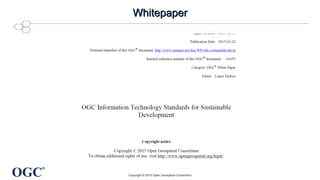
WhitepaperWhitepaper
Copyright © 2015 Open Geospatial Consortium
OGC
®
Anthropocene
OGC
®
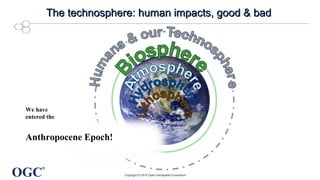
The technosphere: human impacts, good & badThe technosphere: human impacts, good & bad
Copyright © 2015 Open Geospatial Consortium
We have
entered the
Anthropocene Epoch!
OGC
®
Sustainability? It depends on us.Sustainability? It depends on us.
To understand, adapt to and mitigate human-caused
changes in the biosphere that supports us, we need
Information technology (IT), and lots of data!
Copyright © 2015 Open Geospatial Consortium
OGC
®
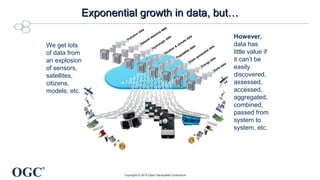
Exponential growth in data, but…Exponential growth in data, but…
However,
data has
little value if
it can’t be
easily
discovered,
assessed,
accessed,
aggregated,
combined,
passed from
system to
system, etc.
We get lots
of data from
an explosion
of sensors,
satellites,
citizens,
models, etc.
Copyright © 2015 Open Geospatial Consortium
OGC
®
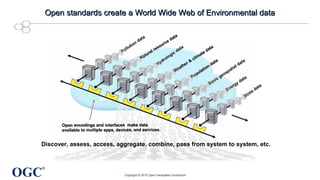
Open standards create a World Wide Web of Environmental dataOpen standards create a World Wide Web of Environmental data
Discover, assess, access, aggregate, combine, pass from system to system, etc.
Copyright © 2015 Open Geospatial Consortium
OGC
®
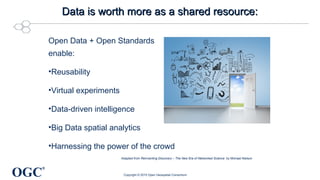
Data is worth more as a shared resource:Data is worth more as a shared resource:
Open Data + Open Standards
enable:
•Reusability
•Virtual experiments
•Data-driven intelligence
•Big Data spatial analytics
•Harnessing the power of the crowd
Adapted from Reinventing Discovery – The New Era of Networked Science by Michael Nielson
Copyright © 2015 Open Geospatial Consortium
OGC
®
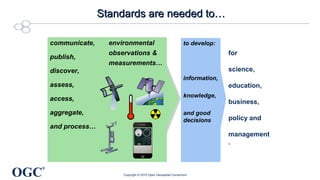
Standards are needed to…Standards are needed to…
for
science,
education,
business,
policy and
management
.
environmental
observations &
measurements…
communicate,
publish,
discover,
assess,
access,
aggregate,
and process…
to develop:
information,
knowledge,
and good
decisions
Copyright © 2015 Open Geospatial Consortium
OGC
®
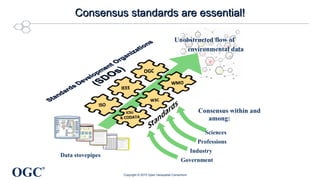
Unobstructed flow of
environmental data
Data stovepipes
Consensus standards are essential!Consensus standards are essential!
Sciences
Professions
Industry
Government
Consensus within and
among:
Copyright © 2015 Open Geospatial Consortium
OGC
®
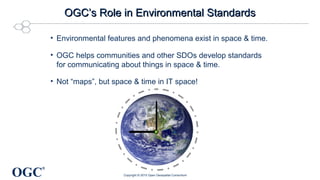
OGC’s Role in Environmental StandardsOGC’s Role in Environmental Standards
• Environmental features and phenomena exist in space & time.
• OGC helps communities and other SDOs develop standards
for communicating about things in space & time.
• Not “maps”, but space & time in IT space!
Copyright © 2015 Open Geospatial Consortium
OGC
®
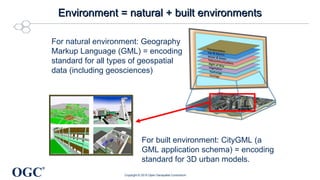
Environment = natural + built environmentsEnvironment = natural + built environments
For natural environment: Geography
Markup Language (GML) = encoding
standard for all types of geospatial
data (including geosciences)
For built environment: CityGML (a
GML application schema) = encoding
standard for 3D urban models.
Copyright © 2015 Open Geospatial Consortium
OGC
®
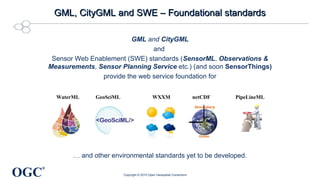
GML, CityGML and SWE – Foundational standardsGML, CityGML and SWE – Foundational standards
GML and CityGML
and
Sensor Web Enablement (SWE) standards (SensorML, Observations &
Measurements, Sensor Planning Service etc.) (and soon SensorThings)
provide the web service foundation for
… and other environmental standards yet to be developed.
WaterML GeoSciML WXXM netCDF PipeLineML
Copyright © 2015 Open Geospatial Consortium
OGC
®
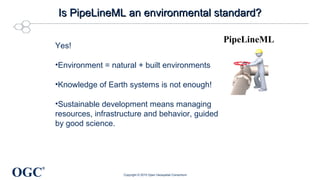
Is PipeLineML an environmental standard?Is PipeLineML an environmental standard?
Yes!
•Environment = natural + built environments
•Knowledge of Earth systems is not enough!
•Sustainable development means managing
resources, infrastructure and behavior, guided
by good science.
PipeLineML
Copyright © 2015 Open Geospatial Consortium
OGC
®
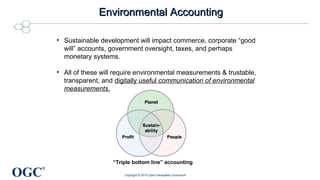
Environmental AccountingEnvironmental Accounting
• Sustainable development will impact commerce, corporate “good
will” accounts, government oversight, taxes, and perhaps
monetary systems.
• All of these will require environmental measurements & trustable,
transparent, and digitally useful communication of environmental
measurements.
“Triple bottom line” accounting
Copyright © 2015 Open Geospatial Consortium
OGC
®
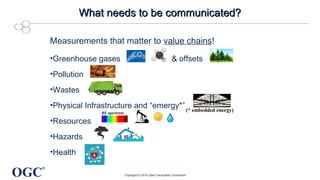
Measurements that matter to value chains!
•Greenhouse gases & offsets
•Pollution
•Wastes
•Physical Infrastructure and “emergy*”
•Resources
•Hazards
•Health
What needs to be communicated?What needs to be communicated?
(* embedded energy)RF spectrum
Copyright © 2015 Open Geospatial Consortium
OGC
®
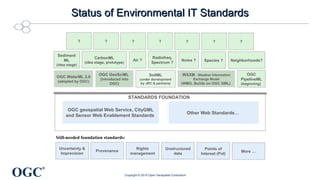
Status of Environmental IT StandardsStatus of Environmental IT Standards
OGC geospatial Web Service, CityGML
and Sensor Web Enablement Standards
Other Web Standards…
OGC WaterML 2.0
(adopted by OGC)
OGC GeoSciML
(introduced into
OGC)
OGC
PipelineML
(beginning)
CarbonML
(idea stage, prototype)
Sediment
ML
(idea stage)
SoilML
(under development
by JRC & partners)
Air ?
WXXM - Weather Information
Exchange Model
(WMO. Builds on OGC GML)
Radiofreq.
Spectrum ?
Noise ? Species ? Neighborhoods?
? ? ? ? ? ? ?
STANDARDS FOUNDATION
Uncertainty &
Imprecision
Still-needed foundation standards:
Provenance
Rights
management
Unstructured
data
Points of
Interest (PoI)
More …
Copyright © 2015 Open Geospatial Consortium
OGC
®
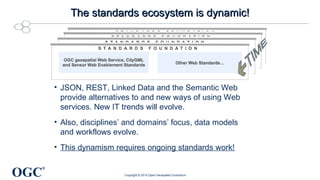
The standards ecosystem is dynamic!The standards ecosystem is dynamic!
• JSON, REST, Linked Data and the Semantic Web
provide alternatives to and new ways of using Web
services. New IT trends will evolve.
• Also, disciplines’ and domains’ focus, data models
and workflows evolve.
• This dynamism requires ongoing standards work!
Copyright © 2015 Open Geospatial Consortium
OGC
®
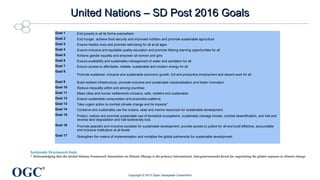
United Nations – SD Post 2016 GoalsUnited Nations – SD Post 2016 Goals
Goal 1 End poverty in all its forms everywhere
Goal 2 End hunger, achieve food security and improved nutrition and promote sustainable agriculture
Goal 3 Ensure healthy lives and promote well-being for all at all ages
Goal 4 Ensure inclusive and equitable quality education and promote lifelong learning opportunities for all
Goal 5 Achieve gender equality and empower all women and girls
Goal 6 Ensure availability and sustainable management of water and sanitation for all
Goal 7 Ensure access to affordable, reliable, sustainable and modern energy for all
Goal 8
Promote sustained, inclusive and sustainable economic growth, full and productive employment and decent work for all
Goal 9 Build resilient infrastructure, promote inclusive and sustainable industrialization and foster innovation
Goal 10 Reduce inequality within and among countries
Goal 11 Make cities and human settlements inclusive, safe, resilient and sustainable
Goal 12 Ensure sustainable consumption and production patterns
Goal 13 Take urgent action to combat climate change and its impacts*
Goal 14 Conserve and sustainably use the oceans, seas and marine resources for sustainable development
Goal 15 Protect, restore and promote sustainable use of terrestrial ecosystems, sustainably manage forests, combat desertification, and halt and
reverse land degradation and halt biodiversity loss
Goal 16 Promote peaceful and inclusive societies for sustainable development, provide access to justice for all and build effective, accountable
and inclusive institutions at all levels
Goal 17 Strengthen the means of implementation and revitalize the global partnership for sustainable development
Copyright © 2015 Open Geospatial Consortium
Sustainable Development Goals
* Acknowledging that the United Nations Framework Convention on Climate Change is the primary international, intergovernmental forum for negotiating the global response to climate change
OGC
®
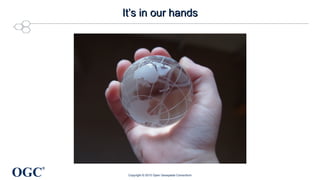
It’s in our handsIt’s in our hands
Copyright © 2015 Open Geospatial Consortium
®
Please keep in touch!Please keep in touch!
www.opengeospatial.orgwww.opengeospatial.org
© 2015 Open Geospatial Consortium© 2015 Open Geospatial Consortium
Denise McKenzie
dmckenzie@opengeospatial.org
@spatialred
@opengeospatial@opengeospatial
Open Geospatial Consortium (OGC)Open Geospatial Consortium (OGC)
http://www.youtube.com/user/ogcvideohttp://www.youtube.com/user/ogcvideo

Locate15 Conference - Brisbane, Australia

  • 1.
    ® Open Standards forSustainable DevelopmentOpen Standards for Sustainable Development Denise McKenzie Executive Director, Communications & Outreach Open Geospatial Consortium (OGC) Locate15 Brisbane, Australia 12 March 2015 Copyright © 2015 Open Geospatial ConsortiumCopyright © 2015 Open Geospatial Consortium
  • 2.
    OGC ® Who am I?Whoam I? Executive Director Communications & Outreach Open Geospatial Consortium Australian Citizen UK Resident Global traveler @spatialred
  • 3.
  • 4.
  • 5.
    OGC ® The technosphere: humanimpacts, good & badThe technosphere: human impacts, good & bad Copyright © 2015 Open Geospatial Consortium We have entered the Anthropocene Epoch!
  • 6.
    OGC ® Sustainability? It dependson us.Sustainability? It depends on us. To understand, adapt to and mitigate human-caused changes in the biosphere that supports us, we need Information technology (IT), and lots of data! Copyright © 2015 Open Geospatial Consortium
  • 7.
    OGC ® Exponential growth indata, but…Exponential growth in data, but… However, data has little value if it can’t be easily discovered, assessed, accessed, aggregated, combined, passed from system to system, etc. We get lots of data from an explosion of sensors, satellites, citizens, models, etc. Copyright © 2015 Open Geospatial Consortium
  • 8.
    OGC ® Open standards createa World Wide Web of Environmental dataOpen standards create a World Wide Web of Environmental data Discover, assess, access, aggregate, combine, pass from system to system, etc. Copyright © 2015 Open Geospatial Consortium
  • 9.
    OGC ® Data is worthmore as a shared resource:Data is worth more as a shared resource: Open Data + Open Standards enable: •Reusability •Virtual experiments •Data-driven intelligence •Big Data spatial analytics •Harnessing the power of the crowd Adapted from Reinventing Discovery – The New Era of Networked Science by Michael Nielson Copyright © 2015 Open Geospatial Consortium
  • 10.
    OGC ® Standards are neededto…Standards are needed to… for science, education, business, policy and management . environmental observations & measurements… communicate, publish, discover, assess, access, aggregate, and process… to develop: information, knowledge, and good decisions Copyright © 2015 Open Geospatial Consortium
  • 11.
    OGC ® Unobstructed flow of environmentaldata Data stovepipes Consensus standards are essential!Consensus standards are essential! Sciences Professions Industry Government Consensus within and among: Copyright © 2015 Open Geospatial Consortium
  • 12.
    OGC ® OGC’s Role inEnvironmental StandardsOGC’s Role in Environmental Standards • Environmental features and phenomena exist in space & time. • OGC helps communities and other SDOs develop standards for communicating about things in space & time. • Not “maps”, but space & time in IT space! Copyright © 2015 Open Geospatial Consortium
  • 13.
    OGC ® Environment = natural+ built environmentsEnvironment = natural + built environments For natural environment: Geography Markup Language (GML) = encoding standard for all types of geospatial data (including geosciences) For built environment: CityGML (a GML application schema) = encoding standard for 3D urban models. Copyright © 2015 Open Geospatial Consortium
  • 14.
    OGC ® GML, CityGML andSWE – Foundational standardsGML, CityGML and SWE – Foundational standards GML and CityGML and Sensor Web Enablement (SWE) standards (SensorML, Observations & Measurements, Sensor Planning Service etc.) (and soon SensorThings) provide the web service foundation for … and other environmental standards yet to be developed. WaterML GeoSciML WXXM netCDF PipeLineML Copyright © 2015 Open Geospatial Consortium
  • 15.
    OGC ® Is PipeLineML anenvironmental standard?Is PipeLineML an environmental standard? Yes! •Environment = natural + built environments •Knowledge of Earth systems is not enough! •Sustainable development means managing resources, infrastructure and behavior, guided by good science. PipeLineML Copyright © 2015 Open Geospatial Consortium
  • 16.
    OGC ® Environmental AccountingEnvironmental Accounting •Sustainable development will impact commerce, corporate “good will” accounts, government oversight, taxes, and perhaps monetary systems. • All of these will require environmental measurements & trustable, transparent, and digitally useful communication of environmental measurements. “Triple bottom line” accounting Copyright © 2015 Open Geospatial Consortium
  • 17.
    OGC ® Measurements that matterto value chains! •Greenhouse gases & offsets •Pollution •Wastes •Physical Infrastructure and “emergy*” •Resources •Hazards •Health What needs to be communicated?What needs to be communicated? (* embedded energy)RF spectrum Copyright © 2015 Open Geospatial Consortium
  • 18.
    OGC ® Status of EnvironmentalIT StandardsStatus of Environmental IT Standards OGC geospatial Web Service, CityGML and Sensor Web Enablement Standards Other Web Standards… OGC WaterML 2.0 (adopted by OGC) OGC GeoSciML (introduced into OGC) OGC PipelineML (beginning) CarbonML (idea stage, prototype) Sediment ML (idea stage) SoilML (under development by JRC & partners) Air ? WXXM - Weather Information Exchange Model (WMO. Builds on OGC GML) Radiofreq. Spectrum ? Noise ? Species ? Neighborhoods? ? ? ? ? ? ? ? STANDARDS FOUNDATION Uncertainty & Imprecision Still-needed foundation standards: Provenance Rights management Unstructured data Points of Interest (PoI) More … Copyright © 2015 Open Geospatial Consortium
  • 19.
    OGC ® The standards ecosystemis dynamic!The standards ecosystem is dynamic! • JSON, REST, Linked Data and the Semantic Web provide alternatives to and new ways of using Web services. New IT trends will evolve. • Also, disciplines’ and domains’ focus, data models and workflows evolve. • This dynamism requires ongoing standards work! Copyright © 2015 Open Geospatial Consortium
  • 20.
    OGC ® United Nations –SD Post 2016 GoalsUnited Nations – SD Post 2016 Goals Goal 1 End poverty in all its forms everywhere Goal 2 End hunger, achieve food security and improved nutrition and promote sustainable agriculture Goal 3 Ensure healthy lives and promote well-being for all at all ages Goal 4 Ensure inclusive and equitable quality education and promote lifelong learning opportunities for all Goal 5 Achieve gender equality and empower all women and girls Goal 6 Ensure availability and sustainable management of water and sanitation for all Goal 7 Ensure access to affordable, reliable, sustainable and modern energy for all Goal 8 Promote sustained, inclusive and sustainable economic growth, full and productive employment and decent work for all Goal 9 Build resilient infrastructure, promote inclusive and sustainable industrialization and foster innovation Goal 10 Reduce inequality within and among countries Goal 11 Make cities and human settlements inclusive, safe, resilient and sustainable Goal 12 Ensure sustainable consumption and production patterns Goal 13 Take urgent action to combat climate change and its impacts* Goal 14 Conserve and sustainably use the oceans, seas and marine resources for sustainable development Goal 15 Protect, restore and promote sustainable use of terrestrial ecosystems, sustainably manage forests, combat desertification, and halt and reverse land degradation and halt biodiversity loss Goal 16 Promote peaceful and inclusive societies for sustainable development, provide access to justice for all and build effective, accountable and inclusive institutions at all levels Goal 17 Strengthen the means of implementation and revitalize the global partnership for sustainable development Copyright © 2015 Open Geospatial Consortium Sustainable Development Goals * Acknowledging that the United Nations Framework Convention on Climate Change is the primary international, intergovernmental forum for negotiating the global response to climate change
  • 21.
    OGC ® It’s in ourhandsIt’s in our hands Copyright © 2015 Open Geospatial Consortium
  • 22.
    ® Please keep intouch!Please keep in touch! www.opengeospatial.orgwww.opengeospatial.org © 2015 Open Geospatial Consortium© 2015 Open Geospatial Consortium Denise McKenzie dmckenzie@opengeospatial.org @spatialred @opengeospatial@opengeospatial Open Geospatial Consortium (OGC)Open Geospatial Consortium (OGC) http://www.youtube.com/user/ogcvideohttp://www.youtube.com/user/ogcvideo

Editor's Notes

  • #2 Sustainabile Development – UN focus on how the world will continue to develop Urban Resilience UN SD goals later this year. COBWEB at GGIM and VGI and citizen science
  • #5 Epoch or Era of the world – in the same way that we classify the Jurassic period. Commissioned in 2012 by the Planet Under Pressure for a conference in London. https://www.youtube.com/watch?v=fvgG-pxlobk Data from OGC members such as NASA, NOAA, NGA
  • #6 There’s solid scientific consensus on global warming. I (we) thought the 1972 Limits to Growth findings had been discredited, but this Australian Research shows that we still face serious challenges from population and resource depletion.
  • #7 Change behavior BASEDO ON FACTS!
  • #9 So we can discover, assess, verify, access, aggregate, combine, reuse, and pass data from model to model…
  • #10 When apps implement standards, “citizen science” creates better data and better metadata. Enhancing citizen scientists’ real value enhances their love of science.
  • #13 Deveolop a model in IT space of the environment Spatial awareness at all levels, esp IOT hyperlocal geography and spatial awareness
  • #17 All depend on environmental evidence: National income accounting, financial accounting, & internal business managerial accounting: B corporations Cap and trade schemes City rating systems (STAR, C40, ISO 37120, etc.) Environmental impact statements Environmental regulation Environmental taxes Human Development Index Human Security Index Triple bottom line accounting Trustable measurements & trustable, transparent, and digitally useful communication of measurements of Greenhouse gases Hazards & risk Health Physical Infrastructure Pollution Resources Wastes etc.
  • #19 A domain that develops a domain-specific data encoding standard based on OGC standards and on the domain's semantic standards gives domain participants much fuller access to developments in the mainstream digital technology world: Web searches, chained computer models, full use of cloud infrastructures, Big Data, data analytics, data fusion, management tools for open data, heterogeneous sensor webs and much more .  Need some discussion of the modeling and “management” of uncertainty and inherent inprecission at some point. Dotted border indicates standard is not adopted yet. (Not sure about JRC’s SoilML.)
  • #20 Technology does not stay still – advancements and developments will always mean that we need to continue working together to define our.
  • #22 Whereas sustainable development depends on the communication of environmental data, and Whereas such communication depends on open standards, We call upon funding agencies to support research in Developing information requirements for environmental value chains and workflows, addressing users’ needs to publish, discover, assess, access, aggregate, analyze and display environmental data and information. Analyzing the open data encodings and interfaces necessary for accomplishing these use cases in open distributed computing environments. Providing estimates of the societal and industry stakeholder value that would be realized through development of such encodings and interfaces. Also, implementing and testing candidate standards. The OGC calls upon academic, industry, foundation and government leaders to Appeal to funding agencies to support standards work that supports sustainable development. Consider the value that would accrue to their stakeholders if they were to help develop one or more of the standards and best practices suggested by the studies proposed here. Work with the appropriate standards development organizations to begin developing those standards.