®

The Future of Geospatial
and
Top Geomatic Trends
George Percivall, OGC Chief Engineer

TECTERRA Geomatics Showcase 2013
5 November 2013

© 2013 Open Geospatial Consortium
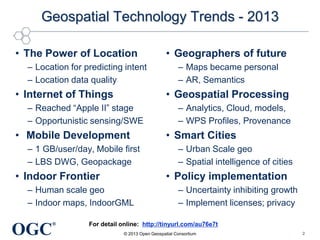
Geospatial Technology Trends - 2013
• The Power of Location
– Location for predicting intent
– Location data quality

• Internet of Things

• Mobile Development
– 1 GB/user/day, Mobile first
– LBS DWG, Geopackage

• Indoor Frontier

– Analytics, Cloud, models,
– WPS Profiles, Provenance

• Smart Cities
– Urban Scale geo
– Spatial intelligence of cities

• Policy implementation

– Human scale geo
– Indoor maps, IndoorGML

OGC

– Maps became personal
– AR, Semantics

• Geospatial Processing

– Reached ―Apple II‖ stage
– Opportunistic sensing/SWE

®

• Geographers of future

– Uncertainty inhibiting growth
– Implement licenses; privacy

For detail online: http://tinyurl.com/au76e7t
© 2013 Open Geospatial Consortium

2
®

The Power of Location

―location has become the cookie of mobile‖
- Eli Portnoy, Thinknear

© 2013 Open Geospatial Consortium
Power of Location
• ―Location targeting is holy grail for marketers‖
– Sir Martin Sorrell, WPP CEO, MWC 2011

• By measuring the entropy of each individual‘s trajectory, we
find a 93% potential predictability in user mobility
– Limits of Predictability in Human Mobility, Science 2010

• 1st law of geography: "Everything is related to everything
else, but near things are more related than distant things.‖
– Waldo Tobler

OGC

®
© 2013 Open Geospatial Consortium

4
Yelp Engineering

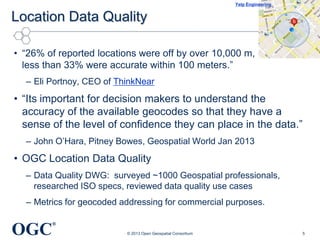
Location Data Quality
• ―26% of reported locations were off by over 10,000 m,
less than 33% were accurate within 100 meters.‖
– Eli Portnoy, CEO of ThinkNear

• ―Its important for decision makers to understand the
accuracy of the available geocodes so that they have a
sense of the level of confidence they can place in the data.‖
– John O‘Hara, Pitney Bowes, Geospatial World Jan 2013

• OGC Location Data Quality
– Data Quality DWG: surveyed ~1000 Geospatial professionals,
researched ISO specs, reviewed data quality use cases
– Metrics for geocoded addressing for commercial purposes.

OGC

®
© 2013 Open Geospatial Consortium

5
Points of Interest
• POI Standard development
– Began in W3C with OGC participation
– OGC Standards Working Group formed to complete work

• Key Use Case
– Authoritative source maintains PoIs (Starbucks maintains their PoIs)
– PoI Aggregators offer services (Google offers search on PoI
database)
– Consolidators gather PoIs from Authoritative sources using OGC
PoI Spec

OGC

®
© 2013 Open Geospatial Consortium

6
®

Internet of Things (IoT)

In 2008, the number of devices connected to the
Internet exceeded the number of people on Earth
• CISCO

© 2013 Open Geospatial Consortium
Major industrials have been preparing for IoT
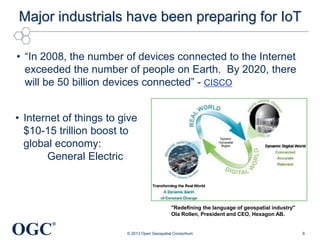
• ―In 2008, the number of devices connected to the Internet
exceeded the number of people on Earth. By 2020, there
will be 50 billion devices connected‖ - CISCO
• Internet of things to give
$10-15 trillion boost to
global economy:
General Electric

"Redefining the language of geospatial industry"
Ola Rollen, President and CEO, Hexagon AB.

OGC

®
© 2013 Open Geospatial Consortium

8
IoT is finally arriving:
it‘s bubbling up from the grassroots.
• IoT: long-prophesied phenomenon of everyday devices
talking to one another — and us — online
– Back in the ‘90s, big companies built systems to do tricks like this, but they
were expensive, hard to use, and vendor-specific.

• Hackers now using increasingly inexpensive sensors and
open source hardware, add intelligence to ordinary objects.
– Sensor prices going down; sizes going down. Only limit is your imagination.
– Cloud services – ―If This Then That‖ or Cosm - let devices interact in
unexpected ways

• IoT has reached the ―Apple II stage‖
– when a new technology finally becomes easy enough to use that
thousands of people start using it.

OGC

®

http://www.wired.com/opinion/2012/12/20-12-st_thompson/
© 2013 Open Geospatial Consortium

9
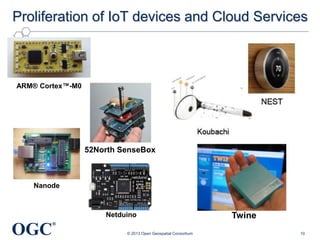
Proliferation of IoT devices and Cloud Services
ARM® Cortex™-M0

52North SenseBox

Nanode

Netduino

OGC

Twine

®
© 2013 Open Geospatial Consortium

10
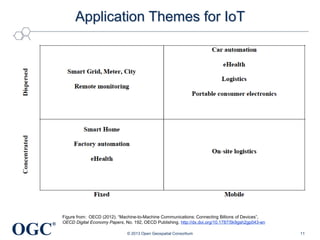
Application Themes for IoT

OGC

®

Figure from: OECD (2012), ―Machine-to-Machine Communications: Connecting Billions of Devices‖,
OECD Digital Economy Papers, No. 192, OECD Publishing. http://dx.doi.org/10.1787/5k9gsh2gp043-en
© 2013 Open Geospatial Consortium

11
Large-scale Opportunistic Sensing
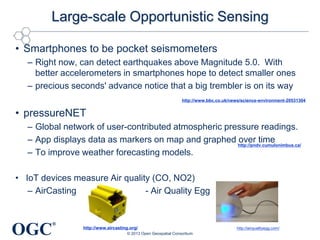
• Smartphones to be pocket seismometers
– Right now, can detect earthquakes above Magnitude 5.0. With
better accelerometers in smartphones hope to detect smaller ones
– precious seconds' advance notice that a big trembler is on its way
http://www.bbc.co.uk/news/science-environment-20531304

• pressureNET
– Global network of user-contributed atmospheric pressure readings.
– App displays data as markers on map and graphed http://pndv.cumulonimbus.ca/
over time
– To improve weather forecasting models.
• IoT devices measure Air quality (CO, NO2)
– AirCasting
- Air Quality Egg

OGC

®

http://www.aircasting.org/
© 2013 Open Geospatial Consortium

http://airqualityegg.com/
®

Mobile Development

1GB per mobile user per day by 2020
- Y. Neuvo, CTO NOKIA

© 2013 Open Geospatial Consortium
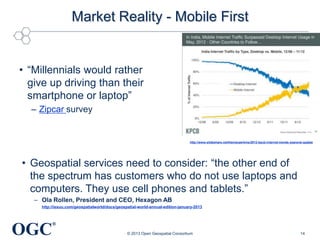
Market Reality - Mobile First

• ―Millennials would rather
give up driving than their
smartphone or laptop‖
– Zipcar survey

http://www.slideshare.net/kleinerperkins/2012-kpcb-internet-trends-yearend-update

• Geospatial services need to consider: ―the other end of
the spectrum has customers who do not use laptops and
computers. They use cell phones and tablets.‖
– Ola Rollen, President and CEO, Hexagon AB
http://issuu.com/geospatialworld/docs/geospatial-world-annual-edition-january-2013

OGC

®
© 2013 Open Geospatial Consortium

14
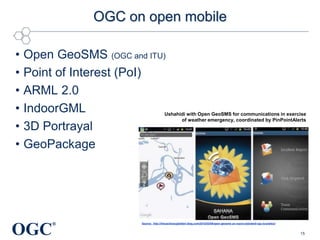
OGC on open mobile
•
•
•
•
•
•

Open GeoSMS (OGC and ITU)
Point of Interest (PoI)
ARML 2.0
IndoorGML
3D Portrayal
GeoPackage

OGC

Ushahidi with Open GeoSMS for communications in exercise
of weather emergency, coordinated by PinPointAlerts

®

Source: http://ilmuschiosuglialberi.blog.com/2012/02/08/open-geosms-un-nuovo-standard-ogc-la-pratica/

15
GeoPackage
the new universal geodata file format
• GeoPackage is a universal file format for geodata.
– open, standards-based, application and platform independent, and
self-describing.
– Built on SQLite, so works on any desktop or mobile OS
– Connected / disconnected environment us

• GeoPackage - the modern alternative to
formats like GeoTIFF, SDTS and vendor specific
• Experience it here:
http://www.ogcnetwork.net/geopackage
• Final public review period through 8 November 2013

OGC

®
© 2013 Open Geospatial Consortium

16
OGC Mobile Innovations
Link to Video: http://www.youtube.com/watch?v=N5je0tnjXLY&list=PLQsQNjNIDU862xKukmrpDkkjNI55syDGN&index=7

OGC

®
© 2013 Open Geospatial Consortium

17
®

Indoor Frontier
The simple reason LBS has have not quite yet lived up to the
promise: people spend nearly 90% of time indoors
- Joep van Beurden, CEO CSR Plc

Indoor infighting means technology companies are
duplicating their efforts at great expense
- The Economist

© 2013 Open Geospatial Consortium
Indoor Frontier
Framework for Indoor Location and Navigation
1. Position Determination
2. Indoor Maps
3. Navigation and Routing
4. Indoor location quality

• OGC standards
– IndoorGML – underway
– Indoor 2D venue map - TBD
– Indoor location quality

OGC

®
© 2013 Open Geospatial Consortium

19
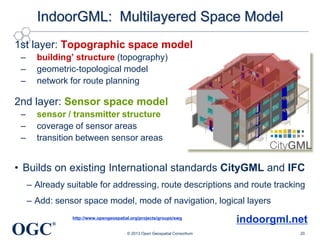
IndoorGML: Multilayered Space Model
1st layer: Topographic space model
–
–
–

building’ structure (topography)
geometric-topological model
network for route planning

2nd layer: Sensor space model
–
–
–

sensor / transmitter structure
coverage of sensor areas
transition between sensor areas

• Builds on existing International standards CityGML and IFC
– Already suitable for addressing, route descriptions and route tracking
– Add: sensor space model, mode of navigation, logical layers
http://www.opengeospatial.org/projects/groups/swg

OGC

®
© 2013 Open Geospatial Consortium

indoorgml.net
20
®

Cartographers Of The Future
Redefining the way the people think about geography and place

The future ―living‖ 3D map must be extensible at every
tier by every developer, not just GIS specialists
- S. Lawler, Bing

© 2013 Open Geospatial Consortium
Cartographers Of The Future
• The major change in mapping in the past decade, as
opposed to in the previous 6,000 to 10,000 years, is that
mapping has become personal
– Michael Jones, Google

• Cybercartography
―Organisation, presentation, analysis and communication of spatially
referenced information on a wide range of topics of interest and use to
society in an interactive, dynamic, multimedia, multi-sensory format
with the use of multimedia and multimodal interfaces.‖
– Fraser Taylor, Carleton University and ICA, 2003

New ways of viewing the world;
new ways of annotating the world

OGC

®

http://www.theatlantic.com/technology/archive/2013/01/googles-michael-jones-on-how-maps-became-personal/266781/
http://issuu.com/geospatialworld/docs/geospatial-world-annual-edition-january-2013
© 2013 Open Geospatial Consortium

22
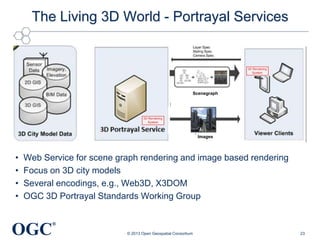
The Living 3D World - Portrayal Services

Scenegraph

Images

•
•
•
•

Web Service for scene graph rendering and image based rendering
Focus on 3D city models
Several encodings, e.g., Web3D, X3DOM
OGC 3D Portrayal Standards Working Group

OGC

®
© 2013 Open Geospatial Consortium

23
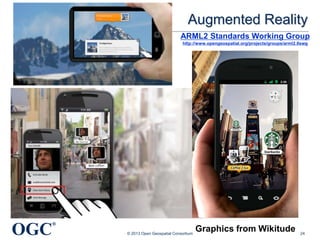
Augmented Reality
ARML2 Standards Working Group
http://www.opengeospatial.org/projects/groups/arml2.0swg

OGC

®
© 2013 Open Geospatial Consortium

Graphics from Wikitude

24
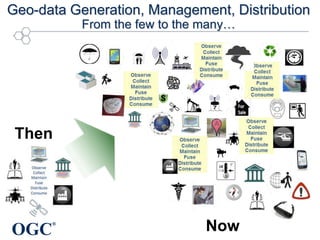
Geo-data Generation, Management, Distribution
From the few to the many…

Then

OGC

®

Now
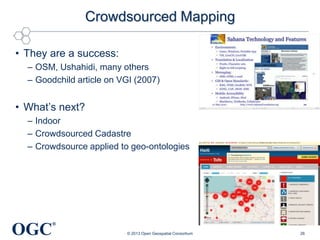
Crowdsourced Mapping
• They are a success:
– OSM, Ushahidi, many others
– Goodchild article on VGI (2007)

• What‘s next?
– Indoor
– Crowdsourced Cadastre
– Crowdsource applied to geo-ontologies

OGC

®
© 2013 Open Geospatial Consortium

26
Semantics and the new geography
• Semantic technology progress
– Google Knowledge Graph: contains more than 500 million objects,
as well as 3.5 billion facts and relationships between the objects
– But - the Semantic Web Services Challenge showed over a 5-year
period, almost no one could simply reuse a previously successful
ontology without close collaboration with its authors

• Geo-semantics development
– OGC standards: GeoSPARQL and future
– Cross Community Interoperability thread in OGC Testbed

OGC

®

http://issuu.com/geospatialworld/docs/geospatial-world-annual-edition-january-2013
http://googleblog.blogspot.com/2012/05/introducing-knowledge-graph-things-not.html
http://ieeexplore.ieee.org/xpl/articleDetails.jsp?tp=&arnumber=6319309
http://ieeexplore.ieee.org/xpl/articleDetails.jsp?arnumber=6200249

© 2013 Open Geospatial Consortium

27
®

Big Processing of Geospatial Data
The three ‗V‘s of Big Data: Volume, Velocity and Variety
- Doug Laney, Gartner

© 2013 Open Geospatial Consortium
Big Processing of Geospatial Data
• Big Data: Online imagery access
– 100‘s of TB of imagery online now common
– Open license on Landsat data has opened new applications

• GIS moves to processing in the cloud
– Lightweight client access to powerful processing services in cloud

• Next flood of Big Data coming from mobile and IoT devices
– Location-based Analytics; NoSQL; Transaction oriented analytics;
Processing of streaming spatial data.

• OGC standards support Big Data

OGC

®
© 2013 Open Geospatial Consortium

29
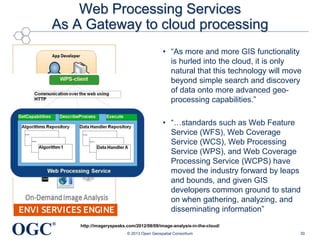
Web Processing Services
As A Gateway to cloud processing
• ―As more and more GIS functionality
is hurled into the cloud, it is only
natural that this technology will move
beyond simple search and discovery
of data onto more advanced geoprocessing capabilities.‖
• ―…standards such as Web Feature
Service (WFS), Web Coverage
Service (WCS), Web Processing
Service (WPS), and Web Coverage
Processing Service (WCPS) have
moved the industry forward by leaps
and bounds, and given GIS
developers common ground to stand
on when gathering, analyzing, and
disseminating information‖

OGC

®

http://imageryspeaks.com/2012/08/09/image-analysis-in-the-cloud/
© 2013 Open Geospatial Consortium

30
From Data to Integrated Modeling
Open Modeling Interface: OpenMI

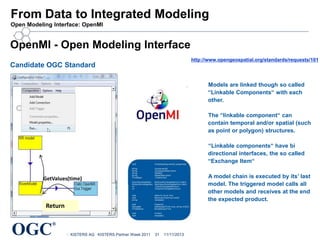
OpenMI - Open Modeling Interface
http://www.opengeospatial.org/standards/requests/101

Candidate OGC Standard

Models are linked though so called
“Linkable Components“ with each
other.
The “linkable component“ can
contain temporal and/or spatial (such
as point or polygon) structures.

My
model

“Linkable components“ have bi
directional interfaces, the so called
“Exchange Item“
A model chain is executed by its’ last
model. The triggered model calls all
other models and receives at the end
the expected product.

GetValues(time)

Return

OGC

®
KISTERS AG KISTERS Partner Week 2011

31

11/11/2013
Geospatial Analytics
• Analytic exploitation of the space-time features will usher in
advances in high-quality prediction systems.
– Space time features: the highest order bits - Jonas, Tucker

• Using algorithmic extraction and big data graphs to create
and relate entities on the Web, organising them through a
semantic taxonomy and enabling natural access
– The future is ‗Where‘" - S. Lawler, Bing

• Entity oriented analytics to transform raw data into
actionable intelligence without external data models or
human effort
– Digital Reasoning

OGC

®

http://issuu.com/geospatialworld/docs/geospatial-world-annual-edition-january-2013
http://www.digitalreasoning.com/
© 2013 Open Geospatial Consortium

32
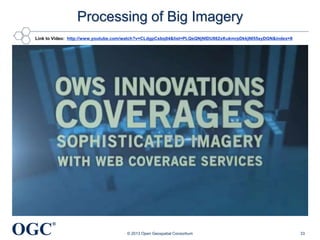
Processing of Big Imagery
Link to Video: http://www.youtube.com/watch?v=CLdgpCsbq04&list=PLQsQNjNIDU862xKukmrpDkkjNI55syDGN&index=8

OGC

®
© 2013 Open Geospatial Consortium

33
®

Smart Cities
The goal of the smart city is to get information in real time
and to use this information to increase the quality of life,
reduce environmental impact and increase the efficiency of
city services
- Pilar Conesa

© 2013 Open Geospatial Consortium
The Battle for Control of Smart Cities
• Who will own the brains of smart cities: citizens or
corporations?
– At stake is an impending massive trove of data, not to mention
issues of privacy, services, and inclusion.

• Battle in the streets between hacktivists pushing for selfserve governance and monopolies e.g., IBM or Cisco
– Delicate balance between big companies and DIY spirit of ―gov 2.0‖
champions
– The urban poor could be the biggest losers.

• Achieving balance falls to smarter cities‘ mayors, who must
keep the tech heavyweights in check and ―frame an
agenda of openness, transparency and inclusiveness.‖

OGC

®

http://www.fastcompany.com/1710342/battle-control-smart-cities
© 2013 Open Geospatial Consortium

35
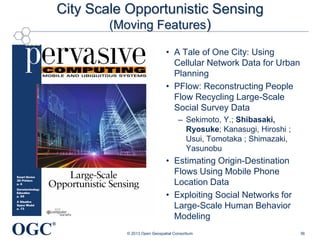
City Scale Opportunistic Sensing
(Moving Features)
• A Tale of One City: Using
Cellular Network Data for Urban
Planning
• PFlow: Reconstructing People
Flow Recycling Large-Scale
Social Survey Data
– Sekimoto, Y.; Shibasaki,
Ryosuke; Kanasugi, Hiroshi ;
Usui, Tomotaka ; Shimazaki,
Yasunobu

• Estimating Origin-Destination
Flows Using Mobile Phone
Location Data
• Exploiting Social Networks for
Large-Scale Human Behavior
Modeling

OGC

®
© 2013 Open Geospatial Consortium

36
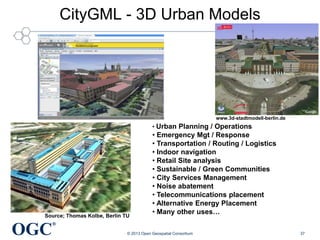
CityGML - 3D Urban Models

www.3d-stadtmodell-berlin.de

• Urban Planning / Operations

Source; Thomas Kolbe, Berlin TU

OGC

• Emergency Mgt / Response
• Transportation / Routing / Logistics
• Indoor navigation
• Retail Site analysis
• Sustainable / Green Communities
• City Services Management
• Noise abatement
• Telecommunications placement
• Alternative Energy Placement
• Many other uses…

®
© 2013 Open Geospatial Consortium

37
®

Policy Implementation

Privacy as a core system requirement is poised to become one of
the key trends of our time – and justifiably so.
In the pursuit of freedom and liberty, as individuals and at a societal
level, we deserve nothing less.
- Ann Cavoukian, Information & Privacy Commissioner, Ontario,
Canada

© 2013 Open Geospatial Consortium
Policy Implementation
• Further progress of geospatial services is inhibited by lack
of efficient handling of policies
• A strong geospatial data industry requires
– Clear open data policies and effective geo-infrastructure
– Open data policies allow investments to flow to users

• Location privacy concerns need to be tamed

OGC

®

http://www.sensorsandsystems.com/dialog/perspectives/29311-do-the-google-sponsored-research-reports-shed-new-light-on-the-geo-services-industry.html

© 2013 Open Geospatial Consortium

39
"Regulations to support a ‗location-enabled‘
society‖ - Kevin Pomfret
• Policy and legal developments are beginning to threaten
broader adoption of geospatial technologies and
consequently the creation of location-enabled societies.
– including concerns over privacy, increased government regulation,
uncertainty over ownership rights in location information, issues
involving national and homeland security as well government
funding challenges.

• Combining spatially-enabled information from
governments, commercial enterprises (and increasingly,
individuals) from around the world will be subject to
differing and uncertain intellectual property regimes.
• Must take into account that a person‘s location information
is different from other types of personal information.

OGC

®

http://issuu.com/geospatialworld/docs/geospatial-world-annual-edition-january-2013
© 2013 Open Geospatial Consortium

40
Geospatial Technology Trends - 2013
• The Power of Location
– Location for predicting intent
– Location data quality

• Internet of Things

• Mobile Development
– 1 GB/user/day, Mobile first
– LBS DWG, Geopackage

• Indoor Frontier

– Analytics, Cloud, models,
– WPS Profiles, Provenance

• Smart Cities
– Urban Scale geo
– Spatial intelligence of cities

• Policy implementation

– Human scale geo
– Indoor maps, IndoorGML

OGC

– Maps became personal
– AR, Semantics

• Geospatial Processing

– Reached ―Apple II‖ stage
– Opportunistic sensing/SWE

®

• Geographers of future

– Uncertainty inhibiting growth
– Implement licenses; privacy

For detail online: http://tinyurl.com/au76e7t
© 2013 Open Geospatial Consortium

41
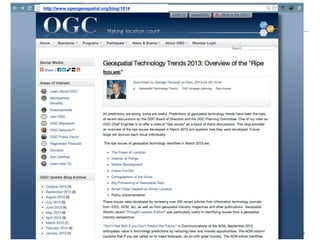
http://www.opengeospatial.org/blog/1814

Blog

OGC

®
© 2013 Open Geospatial Consortium

42
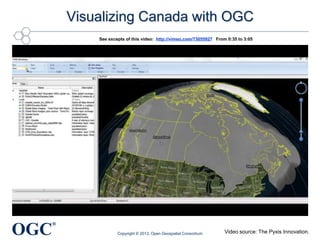
Visualizing Canada with OGC
See excepts of this video: http://vimeo.com/73055927 From 0:35 to 3:05

OGC

®
Copyright © 2013, Open Geospatial Consortium

Video source: The Pyxis Innovation.
Thanks to TECTERRA
for an excellent
Geomatics Showcase 2013

OGC

®
© 2013 Open Geospatial Consortium

44

Geospatial trends

  • 1.
    ® The Future ofGeospatial and Top Geomatic Trends George Percivall, OGC Chief Engineer TECTERRA Geomatics Showcase 2013 5 November 2013 © 2013 Open Geospatial Consortium
  • 2.
    Geospatial Technology Trends- 2013 • The Power of Location – Location for predicting intent – Location data quality • Internet of Things • Mobile Development – 1 GB/user/day, Mobile first – LBS DWG, Geopackage • Indoor Frontier – Analytics, Cloud, models, – WPS Profiles, Provenance • Smart Cities – Urban Scale geo – Spatial intelligence of cities • Policy implementation – Human scale geo – Indoor maps, IndoorGML OGC – Maps became personal – AR, Semantics • Geospatial Processing – Reached ―Apple II‖ stage – Opportunistic sensing/SWE ® • Geographers of future – Uncertainty inhibiting growth – Implement licenses; privacy For detail online: http://tinyurl.com/au76e7t © 2013 Open Geospatial Consortium 2
  • 3.
    ® The Power ofLocation ―location has become the cookie of mobile‖ - Eli Portnoy, Thinknear © 2013 Open Geospatial Consortium
  • 4.
    Power of Location •―Location targeting is holy grail for marketers‖ – Sir Martin Sorrell, WPP CEO, MWC 2011 • By measuring the entropy of each individual‘s trajectory, we find a 93% potential predictability in user mobility – Limits of Predictability in Human Mobility, Science 2010 • 1st law of geography: "Everything is related to everything else, but near things are more related than distant things.‖ – Waldo Tobler OGC ® © 2013 Open Geospatial Consortium 4
  • 5.
    Yelp Engineering Location DataQuality • ―26% of reported locations were off by over 10,000 m, less than 33% were accurate within 100 meters.‖ – Eli Portnoy, CEO of ThinkNear • ―Its important for decision makers to understand the accuracy of the available geocodes so that they have a sense of the level of confidence they can place in the data.‖ – John O‘Hara, Pitney Bowes, Geospatial World Jan 2013 • OGC Location Data Quality – Data Quality DWG: surveyed ~1000 Geospatial professionals, researched ISO specs, reviewed data quality use cases – Metrics for geocoded addressing for commercial purposes. OGC ® © 2013 Open Geospatial Consortium 5
  • 6.
    Points of Interest •POI Standard development – Began in W3C with OGC participation – OGC Standards Working Group formed to complete work • Key Use Case – Authoritative source maintains PoIs (Starbucks maintains their PoIs) – PoI Aggregators offer services (Google offers search on PoI database) – Consolidators gather PoIs from Authoritative sources using OGC PoI Spec OGC ® © 2013 Open Geospatial Consortium 6
  • 7.
    ® Internet of Things(IoT) In 2008, the number of devices connected to the Internet exceeded the number of people on Earth • CISCO © 2013 Open Geospatial Consortium
  • 8.
    Major industrials havebeen preparing for IoT • ―In 2008, the number of devices connected to the Internet exceeded the number of people on Earth. By 2020, there will be 50 billion devices connected‖ - CISCO • Internet of things to give $10-15 trillion boost to global economy: General Electric "Redefining the language of geospatial industry" Ola Rollen, President and CEO, Hexagon AB. OGC ® © 2013 Open Geospatial Consortium 8
  • 9.
    IoT is finallyarriving: it‘s bubbling up from the grassroots. • IoT: long-prophesied phenomenon of everyday devices talking to one another — and us — online – Back in the ‘90s, big companies built systems to do tricks like this, but they were expensive, hard to use, and vendor-specific. • Hackers now using increasingly inexpensive sensors and open source hardware, add intelligence to ordinary objects. – Sensor prices going down; sizes going down. Only limit is your imagination. – Cloud services – ―If This Then That‖ or Cosm - let devices interact in unexpected ways • IoT has reached the ―Apple II stage‖ – when a new technology finally becomes easy enough to use that thousands of people start using it. OGC ® http://www.wired.com/opinion/2012/12/20-12-st_thompson/ © 2013 Open Geospatial Consortium 9
  • 10.
    Proliferation of IoTdevices and Cloud Services ARM® Cortex™-M0 52North SenseBox Nanode Netduino OGC Twine ® © 2013 Open Geospatial Consortium 10
  • 11.
    Application Themes forIoT OGC ® Figure from: OECD (2012), ―Machine-to-Machine Communications: Connecting Billions of Devices‖, OECD Digital Economy Papers, No. 192, OECD Publishing. http://dx.doi.org/10.1787/5k9gsh2gp043-en © 2013 Open Geospatial Consortium 11
  • 12.
    Large-scale Opportunistic Sensing •Smartphones to be pocket seismometers – Right now, can detect earthquakes above Magnitude 5.0. With better accelerometers in smartphones hope to detect smaller ones – precious seconds' advance notice that a big trembler is on its way http://www.bbc.co.uk/news/science-environment-20531304 • pressureNET – Global network of user-contributed atmospheric pressure readings. – App displays data as markers on map and graphed http://pndv.cumulonimbus.ca/ over time – To improve weather forecasting models. • IoT devices measure Air quality (CO, NO2) – AirCasting - Air Quality Egg OGC ® http://www.aircasting.org/ © 2013 Open Geospatial Consortium http://airqualityegg.com/
  • 13.
    ® Mobile Development 1GB permobile user per day by 2020 - Y. Neuvo, CTO NOKIA © 2013 Open Geospatial Consortium
  • 14.
    Market Reality -Mobile First • ―Millennials would rather give up driving than their smartphone or laptop‖ – Zipcar survey http://www.slideshare.net/kleinerperkins/2012-kpcb-internet-trends-yearend-update • Geospatial services need to consider: ―the other end of the spectrum has customers who do not use laptops and computers. They use cell phones and tablets.‖ – Ola Rollen, President and CEO, Hexagon AB http://issuu.com/geospatialworld/docs/geospatial-world-annual-edition-january-2013 OGC ® © 2013 Open Geospatial Consortium 14
  • 15.
    OGC on openmobile • • • • • • Open GeoSMS (OGC and ITU) Point of Interest (PoI) ARML 2.0 IndoorGML 3D Portrayal GeoPackage OGC Ushahidi with Open GeoSMS for communications in exercise of weather emergency, coordinated by PinPointAlerts ® Source: http://ilmuschiosuglialberi.blog.com/2012/02/08/open-geosms-un-nuovo-standard-ogc-la-pratica/ 15
  • 16.
    GeoPackage the new universalgeodata file format • GeoPackage is a universal file format for geodata. – open, standards-based, application and platform independent, and self-describing. – Built on SQLite, so works on any desktop or mobile OS – Connected / disconnected environment us • GeoPackage - the modern alternative to formats like GeoTIFF, SDTS and vendor specific • Experience it here: http://www.ogcnetwork.net/geopackage • Final public review period through 8 November 2013 OGC ® © 2013 Open Geospatial Consortium 16
  • 17.
    OGC Mobile Innovations Linkto Video: http://www.youtube.com/watch?v=N5je0tnjXLY&list=PLQsQNjNIDU862xKukmrpDkkjNI55syDGN&index=7 OGC ® © 2013 Open Geospatial Consortium 17
  • 18.
    ® Indoor Frontier The simplereason LBS has have not quite yet lived up to the promise: people spend nearly 90% of time indoors - Joep van Beurden, CEO CSR Plc Indoor infighting means technology companies are duplicating their efforts at great expense - The Economist © 2013 Open Geospatial Consortium
  • 19.
    Indoor Frontier Framework forIndoor Location and Navigation 1. Position Determination 2. Indoor Maps 3. Navigation and Routing 4. Indoor location quality • OGC standards – IndoorGML – underway – Indoor 2D venue map - TBD – Indoor location quality OGC ® © 2013 Open Geospatial Consortium 19
  • 20.
    IndoorGML: Multilayered SpaceModel 1st layer: Topographic space model – – – building’ structure (topography) geometric-topological model network for route planning 2nd layer: Sensor space model – – – sensor / transmitter structure coverage of sensor areas transition between sensor areas • Builds on existing International standards CityGML and IFC – Already suitable for addressing, route descriptions and route tracking – Add: sensor space model, mode of navigation, logical layers http://www.opengeospatial.org/projects/groups/swg OGC ® © 2013 Open Geospatial Consortium indoorgml.net 20
  • 21.
    ® Cartographers Of TheFuture Redefining the way the people think about geography and place The future ―living‖ 3D map must be extensible at every tier by every developer, not just GIS specialists - S. Lawler, Bing © 2013 Open Geospatial Consortium
  • 22.
    Cartographers Of TheFuture • The major change in mapping in the past decade, as opposed to in the previous 6,000 to 10,000 years, is that mapping has become personal – Michael Jones, Google • Cybercartography ―Organisation, presentation, analysis and communication of spatially referenced information on a wide range of topics of interest and use to society in an interactive, dynamic, multimedia, multi-sensory format with the use of multimedia and multimodal interfaces.‖ – Fraser Taylor, Carleton University and ICA, 2003 New ways of viewing the world; new ways of annotating the world OGC ® http://www.theatlantic.com/technology/archive/2013/01/googles-michael-jones-on-how-maps-became-personal/266781/ http://issuu.com/geospatialworld/docs/geospatial-world-annual-edition-january-2013 © 2013 Open Geospatial Consortium 22
  • 23.
    The Living 3DWorld - Portrayal Services Scenegraph Images • • • • Web Service for scene graph rendering and image based rendering Focus on 3D city models Several encodings, e.g., Web3D, X3DOM OGC 3D Portrayal Standards Working Group OGC ® © 2013 Open Geospatial Consortium 23
  • 24.
    Augmented Reality ARML2 StandardsWorking Group http://www.opengeospatial.org/projects/groups/arml2.0swg OGC ® © 2013 Open Geospatial Consortium Graphics from Wikitude 24
  • 25.
    Geo-data Generation, Management,Distribution From the few to the many… Then OGC ® Now
  • 26.
    Crowdsourced Mapping • Theyare a success: – OSM, Ushahidi, many others – Goodchild article on VGI (2007) • What‘s next? – Indoor – Crowdsourced Cadastre – Crowdsource applied to geo-ontologies OGC ® © 2013 Open Geospatial Consortium 26
  • 27.
    Semantics and thenew geography • Semantic technology progress – Google Knowledge Graph: contains more than 500 million objects, as well as 3.5 billion facts and relationships between the objects – But - the Semantic Web Services Challenge showed over a 5-year period, almost no one could simply reuse a previously successful ontology without close collaboration with its authors • Geo-semantics development – OGC standards: GeoSPARQL and future – Cross Community Interoperability thread in OGC Testbed OGC ® http://issuu.com/geospatialworld/docs/geospatial-world-annual-edition-january-2013 http://googleblog.blogspot.com/2012/05/introducing-knowledge-graph-things-not.html http://ieeexplore.ieee.org/xpl/articleDetails.jsp?tp=&arnumber=6319309 http://ieeexplore.ieee.org/xpl/articleDetails.jsp?arnumber=6200249 © 2013 Open Geospatial Consortium 27
  • 28.
    ® Big Processing ofGeospatial Data The three ‗V‘s of Big Data: Volume, Velocity and Variety - Doug Laney, Gartner © 2013 Open Geospatial Consortium
  • 29.
    Big Processing ofGeospatial Data • Big Data: Online imagery access – 100‘s of TB of imagery online now common – Open license on Landsat data has opened new applications • GIS moves to processing in the cloud – Lightweight client access to powerful processing services in cloud • Next flood of Big Data coming from mobile and IoT devices – Location-based Analytics; NoSQL; Transaction oriented analytics; Processing of streaming spatial data. • OGC standards support Big Data OGC ® © 2013 Open Geospatial Consortium 29
  • 30.
    Web Processing Services AsA Gateway to cloud processing • ―As more and more GIS functionality is hurled into the cloud, it is only natural that this technology will move beyond simple search and discovery of data onto more advanced geoprocessing capabilities.‖ • ―…standards such as Web Feature Service (WFS), Web Coverage Service (WCS), Web Processing Service (WPS), and Web Coverage Processing Service (WCPS) have moved the industry forward by leaps and bounds, and given GIS developers common ground to stand on when gathering, analyzing, and disseminating information‖ OGC ® http://imageryspeaks.com/2012/08/09/image-analysis-in-the-cloud/ © 2013 Open Geospatial Consortium 30
  • 31.
    From Data toIntegrated Modeling Open Modeling Interface: OpenMI OpenMI - Open Modeling Interface http://www.opengeospatial.org/standards/requests/101 Candidate OGC Standard Models are linked though so called “Linkable Components“ with each other. The “linkable component“ can contain temporal and/or spatial (such as point or polygon) structures. My model “Linkable components“ have bi directional interfaces, the so called “Exchange Item“ A model chain is executed by its’ last model. The triggered model calls all other models and receives at the end the expected product. GetValues(time) Return OGC ® KISTERS AG KISTERS Partner Week 2011 31 11/11/2013
  • 32.
    Geospatial Analytics • Analyticexploitation of the space-time features will usher in advances in high-quality prediction systems. – Space time features: the highest order bits - Jonas, Tucker • Using algorithmic extraction and big data graphs to create and relate entities on the Web, organising them through a semantic taxonomy and enabling natural access – The future is ‗Where‘" - S. Lawler, Bing • Entity oriented analytics to transform raw data into actionable intelligence without external data models or human effort – Digital Reasoning OGC ® http://issuu.com/geospatialworld/docs/geospatial-world-annual-edition-january-2013 http://www.digitalreasoning.com/ © 2013 Open Geospatial Consortium 32
  • 33.
    Processing of BigImagery Link to Video: http://www.youtube.com/watch?v=CLdgpCsbq04&list=PLQsQNjNIDU862xKukmrpDkkjNI55syDGN&index=8 OGC ® © 2013 Open Geospatial Consortium 33
  • 34.
    ® Smart Cities The goalof the smart city is to get information in real time and to use this information to increase the quality of life, reduce environmental impact and increase the efficiency of city services - Pilar Conesa © 2013 Open Geospatial Consortium
  • 35.
    The Battle forControl of Smart Cities • Who will own the brains of smart cities: citizens or corporations? – At stake is an impending massive trove of data, not to mention issues of privacy, services, and inclusion. • Battle in the streets between hacktivists pushing for selfserve governance and monopolies e.g., IBM or Cisco – Delicate balance between big companies and DIY spirit of ―gov 2.0‖ champions – The urban poor could be the biggest losers. • Achieving balance falls to smarter cities‘ mayors, who must keep the tech heavyweights in check and ―frame an agenda of openness, transparency and inclusiveness.‖ OGC ® http://www.fastcompany.com/1710342/battle-control-smart-cities © 2013 Open Geospatial Consortium 35
  • 36.
    City Scale OpportunisticSensing (Moving Features) • A Tale of One City: Using Cellular Network Data for Urban Planning • PFlow: Reconstructing People Flow Recycling Large-Scale Social Survey Data – Sekimoto, Y.; Shibasaki, Ryosuke; Kanasugi, Hiroshi ; Usui, Tomotaka ; Shimazaki, Yasunobu • Estimating Origin-Destination Flows Using Mobile Phone Location Data • Exploiting Social Networks for Large-Scale Human Behavior Modeling OGC ® © 2013 Open Geospatial Consortium 36
  • 37.
    CityGML - 3DUrban Models www.3d-stadtmodell-berlin.de • Urban Planning / Operations Source; Thomas Kolbe, Berlin TU OGC • Emergency Mgt / Response • Transportation / Routing / Logistics • Indoor navigation • Retail Site analysis • Sustainable / Green Communities • City Services Management • Noise abatement • Telecommunications placement • Alternative Energy Placement • Many other uses… ® © 2013 Open Geospatial Consortium 37
  • 38.
    ® Policy Implementation Privacy asa core system requirement is poised to become one of the key trends of our time – and justifiably so. In the pursuit of freedom and liberty, as individuals and at a societal level, we deserve nothing less. - Ann Cavoukian, Information & Privacy Commissioner, Ontario, Canada © 2013 Open Geospatial Consortium
  • 39.
    Policy Implementation • Furtherprogress of geospatial services is inhibited by lack of efficient handling of policies • A strong geospatial data industry requires – Clear open data policies and effective geo-infrastructure – Open data policies allow investments to flow to users • Location privacy concerns need to be tamed OGC ® http://www.sensorsandsystems.com/dialog/perspectives/29311-do-the-google-sponsored-research-reports-shed-new-light-on-the-geo-services-industry.html © 2013 Open Geospatial Consortium 39
  • 40.
    "Regulations to supporta ‗location-enabled‘ society‖ - Kevin Pomfret • Policy and legal developments are beginning to threaten broader adoption of geospatial technologies and consequently the creation of location-enabled societies. – including concerns over privacy, increased government regulation, uncertainty over ownership rights in location information, issues involving national and homeland security as well government funding challenges. • Combining spatially-enabled information from governments, commercial enterprises (and increasingly, individuals) from around the world will be subject to differing and uncertain intellectual property regimes. • Must take into account that a person‘s location information is different from other types of personal information. OGC ® http://issuu.com/geospatialworld/docs/geospatial-world-annual-edition-january-2013 © 2013 Open Geospatial Consortium 40
  • 41.
    Geospatial Technology Trends- 2013 • The Power of Location – Location for predicting intent – Location data quality • Internet of Things • Mobile Development – 1 GB/user/day, Mobile first – LBS DWG, Geopackage • Indoor Frontier – Analytics, Cloud, models, – WPS Profiles, Provenance • Smart Cities – Urban Scale geo – Spatial intelligence of cities • Policy implementation – Human scale geo – Indoor maps, IndoorGML OGC – Maps became personal – AR, Semantics • Geospatial Processing – Reached ―Apple II‖ stage – Opportunistic sensing/SWE ® • Geographers of future – Uncertainty inhibiting growth – Implement licenses; privacy For detail online: http://tinyurl.com/au76e7t © 2013 Open Geospatial Consortium 41
  • 42.
  • 43.
    Visualizing Canada withOGC See excepts of this video: http://vimeo.com/73055927 From 0:35 to 3:05 OGC ® Copyright © 2013, Open Geospatial Consortium Video source: The Pyxis Innovation.
  • 44.
    Thanks to TECTERRA foran excellent Geomatics Showcase 2013 OGC ® © 2013 Open Geospatial Consortium 44

Editor's Notes

  • #14 Mobile GrowthOne GB per mobile user per day by 2020 – Y. NeuvoMobile device market to reach 2.6 billion units by 2016App downloads to hit 56 billion in 2013 Forecast Growth of LBS LBS revenues in Europe to grow from € 325 million in 2012 at a compound annual growth rate of 20.5 % to € 825 million in 2017.40 percent of all mobile subscribers in Europe use LBSOla Rollen, President and CEO, Hexagon AB
  • #15 Mobile GrowthOne GB per mobile user per day by 2020 – Y. NeuvoMobile device market to reach 2.6 billion units by 2016App downloads to hit 56 billion in 2013 Forecast Growth of LBS LBS revenues in Europe to grow from € 325 million in 2012 at a compound annual growth rate of 20.5 % to € 825 million in 2017.40 percent of all mobile subscribers in Europe use LBShttp://www10.giscafe.com/nbc/articles/view_article.php?section=CorpNews&articleid=1164623http://www.mobileworldlive.com/app-downloads-to-hit-56-billion-in-2013?elq=e035a906e35a4c289eebd3882c110c4ehttp://www.berginsight.com/News.aspx
  • #19 The simple reason LBS has have not quite yet lived up to the promise: people spend nearly 90% of time indoorsJoep van Beurden, CEO CSR PlcIndoor location brings a new dawn in mapmakingChristof Hellmis, Vice President-Map Platform, NokiaOver 15,000 indoor venue maps throughout the world developed by one company: MicelloIndoor infighting means technology companies are duplicating their efforts at great expense - The Economisthttp://informedinfrastructure.com/2668/interior-location-and-mapping-prompted-by-innovations-that-improve-position-and-navigation/http://issuu.com/geospatialworld/docs/geospatial-world-annual-edition-january-2013http://www.micello.com/http://www.economist.com/news/technology-quarterly/21567197-navigation-technology-using-satellites-determine-your-position-only-works
  • #26 Do all of today’s geospatial information and technology players understand the
  • #28 Going beyond the feature concept to rich semantics for geographic reasoning Open world hypothesis – will run in to ad hoc ontologies and we need the ability to harness the crowd to map between communities
  • #37 University of Tokyo Shibasaki – Moving Features Standards Working Group in formation stages.