®
OGC perspective on
CyberGIS for Collaborative
Problem Solving
AAG Annual Meeting panel, April 2015
George Percivall
Chief Engineer and CTO
+1 301 560-6439
gpercivall@myogc.org
Copyright © 2015 Open Geospatial Consortium
OGC
®
What is/are CyberGIS Architecture(s)?
• Internet-based, collaborative knowledge and
decision environment based on the value of
location information
• Best implemented when including
–Open Interfaces
–Open Source
–Open Data
Copyright © 2015 Open Geospatial Consortium
OGC
®
Visualization / Decision Tools and Applications
GeoAPI
OpenLS
SLD
SE
Data Models
and EncodingsWMC
FE
GML
GeoXACML
KML
CityGML OpenGeoSMS
IndoorGML GeoSparql
WaterML GeoPackage
NetCDF GMLJP2
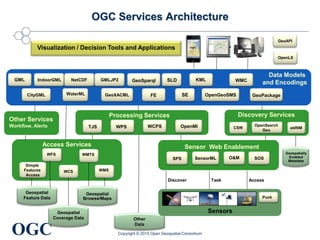
OGC Services Architecture
Other
Data
Processing Services
OpenMIWPSTJS WCPS
Geospatially
Enabled
Metadata
Discovery Services
CSW
OpenSearch
Geo
ebRIM
WMS
WMTSWFS
Simple
Features
Access
Access Services
Geospatial
Feature Data
Geospatial
Browse/Maps
Geospatial
Coverage Data
WCS
Other Services
Workflow, Alerts
Sensors
Puck
SOSSPS O&MSensorML
Sensor Web Enablement
Discover Task Access
Copyright © 2015 Open Geospatial Consortium
OGC
®
CyberGIS plumbing for collaboration is in place
Geospatial interoperability solved - several times
• Geospatial Web Services: WMS, WMTS, WFS, WCS including REST
• Geospatial Processing: Web Processing Service
• Workflow and Model interoperability
Collaboration containers exist
• OWS Context
• OGC GeoPackage built on SQLite
Improvements for the big part of “CyberGIS”
• Big Data applications, e.g. Apache Spark, Storm; GeoTrellis
• OGC Discrete Global Grid Systems
Copyright © 2015 Open Geospatial Consortium
OGC
®
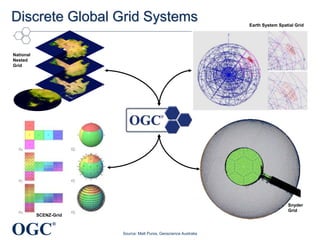
Discrete Global Grid Systems
Source: Matt Purss, Geoscience Australia
National
Nested
Grid
SCENZ-Grid
Earth System Spatial Grid
Snyder
Grid
OGC
®
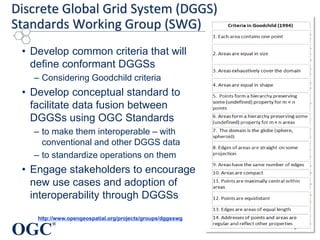
Discrete Global Grid System (DGGS)
Standards Working Group (SWG)
• Develop common criteria that will
define conformant DGGSs
– Considering Goodchild criteria
• Develop conceptual standard to
facilitate data fusion between
DGGSs using OGC Standards
– to make them interoperable – with
conventional and other DGGS data
– to standardize operations on them
• Engage stakeholders to encourage
new use cases and adoption of
interoperability through DGGSs
http://www.opengeospatial.org/projects/groups/dggsswg
OGC
®
Knowledge Objects need to be
conceptually modeled and implemented
• “Decision” and “Hypothesis” as 1st class objects
– UML Model of the concepts and linked data relationships
– Ontology for Types of decisions and hypothesis
– Encodings of conceptual models
– Templates for Decisions and Hypothesis
• Recommender systems - a guess at the riddle
– If I see “these conditions” then consider this “decision template”
– If I am researching “these topics” then consider this “hypothesis”
• “Geodata fusion” Proceedings SPIE Geospatial InfoFusion III,
87470A (23 May 2013); doi: 10.1117/12.2016226
Copyright © 2015 Open Geospatial Consortium

CyberGIS Architectures for Collaborative Problem Solving - OGC perspective

  • 1.
    ® OGC perspective on CyberGISfor Collaborative Problem Solving AAG Annual Meeting panel, April 2015 George Percivall Chief Engineer and CTO +1 301 560-6439 gpercivall@myogc.org Copyright © 2015 Open Geospatial Consortium
  • 2.
    OGC ® What is/are CyberGISArchitecture(s)? • Internet-based, collaborative knowledge and decision environment based on the value of location information • Best implemented when including –Open Interfaces –Open Source –Open Data Copyright © 2015 Open Geospatial Consortium
  • 3.
    OGC ® Visualization / DecisionTools and Applications GeoAPI OpenLS SLD SE Data Models and EncodingsWMC FE GML GeoXACML KML CityGML OpenGeoSMS IndoorGML GeoSparql WaterML GeoPackage NetCDF GMLJP2 OGC Services Architecture Other Data Processing Services OpenMIWPSTJS WCPS Geospatially Enabled Metadata Discovery Services CSW OpenSearch Geo ebRIM WMS WMTSWFS Simple Features Access Access Services Geospatial Feature Data Geospatial Browse/Maps Geospatial Coverage Data WCS Other Services Workflow, Alerts Sensors Puck SOSSPS O&MSensorML Sensor Web Enablement Discover Task Access Copyright © 2015 Open Geospatial Consortium
  • 4.
    OGC ® CyberGIS plumbing forcollaboration is in place Geospatial interoperability solved - several times • Geospatial Web Services: WMS, WMTS, WFS, WCS including REST • Geospatial Processing: Web Processing Service • Workflow and Model interoperability Collaboration containers exist • OWS Context • OGC GeoPackage built on SQLite Improvements for the big part of “CyberGIS” • Big Data applications, e.g. Apache Spark, Storm; GeoTrellis • OGC Discrete Global Grid Systems Copyright © 2015 Open Geospatial Consortium
  • 5.
    OGC ® Discrete Global GridSystems Source: Matt Purss, Geoscience Australia National Nested Grid SCENZ-Grid Earth System Spatial Grid Snyder Grid
  • 6.
    OGC ® Discrete Global GridSystem (DGGS) Standards Working Group (SWG) • Develop common criteria that will define conformant DGGSs – Considering Goodchild criteria • Develop conceptual standard to facilitate data fusion between DGGSs using OGC Standards – to make them interoperable – with conventional and other DGGS data – to standardize operations on them • Engage stakeholders to encourage new use cases and adoption of interoperability through DGGSs http://www.opengeospatial.org/projects/groups/dggsswg
  • 7.
    OGC ® Knowledge Objects needto be conceptually modeled and implemented • “Decision” and “Hypothesis” as 1st class objects – UML Model of the concepts and linked data relationships – Ontology for Types of decisions and hypothesis – Encodings of conceptual models – Templates for Decisions and Hypothesis • Recommender systems - a guess at the riddle – If I see “these conditions” then consider this “decision template” – If I am researching “these topics” then consider this “hypothesis” • “Geodata fusion” Proceedings SPIE Geospatial InfoFusion III, 87470A (23 May 2013); doi: 10.1117/12.2016226 Copyright © 2015 Open Geospatial Consortium

Editor's Notes

  • #4 Acronym List: Catalog Web Service (CSW) - Support the ability to publish and search collections of descriptive information (metadata) for data, services, and related information objects. Web Map Service (WMS) - XML encoding for the transport and storage of geographic information modeled according to the conceptual modeling framework including both the spatial and non-spatial properties of geographic features. Web Map Tile Service (WMTS) - Serves digital maps using predefined image tiles and complements the existing Web Map Service providing flexibility in the client request enabling clients to obtain the precise final image required. Web Coverage Service (WCS) – Provides access to detailed and rich sets of geospatial information in forms that are useful for client-side rendering, multi-valued coverages, and input into scientific models and other clients. Web Coverage Service Transactional (WCS-T) - Enables clients to add, modify, and delete grid coverages that are available from a WCS server. Web Feature Service (WFS) – Defines the interfaces for data access and manipulation operations on geographic features, feature information behind a map image. Web Feature Service Transactional (WFS-T) - Enables clients to add, modify, and delete feature data that are available from a WFS server. Sensor Planning Service (SPS) - Enables a client to determine collection feasibility for a desired set of collection requests for sensors and directly task those sensors. Sensor Observation Service (SOS) - Interface for requesting, filtering, and retrieving observations and sensor system information. Sensor Model Language (SML) - Enables users to access sensors; their location, their capabilities, and the data they acquire along with the ability to process the data through a standards-based, non-proprietary web interface. Observation & Measurements (O&M) - Specifies the core model, framework, and encoding for measurements and observations. Observation & Measurements XML (O&M XML) - XML schemas for observations, and for features involved in sampling when making observations. Geo eXtended Access Control Markup Language (GeoXACML) - An extension to the eXtensible Access Control Markup Language (XACML) Policy Language that supports the declaration and enforcement of access restrictions on geographic information. Styled Layer Descriptor (SLD) – Provides analysts control of the visual portrayal of the data with which they work. Symbology Encoding (SE) - an XML language to encode user-defined styling information that can be applied to digital Feature and Coverage data. Geography Markup Language (GML) - XML encoding for the transport and storage of geographic information modeled according to the conceptual modeling framework. KeyHole Markup Language (KML) - XML language focused on geographic visualization and used to encode and transport representations of geographic data for display in web browser, including annotation of maps and images. Filter Encoding (FE) - an XML encoding of the OGC Common Catalog Query Language (CQL) as a system neutral query representation. Web Map Context (WMC) - XML schemas for observations, and for features involved in sampling when making observations. Table Join Service (TJS) –Provides a mechanism to expose corporate tabular data, with geographic identifiers so that it can be discovered, accessed, and merged with spatial data to enable mapping or geospatial analysis. Table Join Service Transactional (TJS-T) - Enables clients to add, modify, and delete tabular data available from a TJS server. Web Processing Service (WPS) - WPS provides client access across a network to pre-programmed calculations and/or computation models that operate on spatially referenced data. Geo Short Message Service (GeoSMS) - Facilitate communication of location content between different LBS (Location-Based Service) devices or applications by extending Short Messaging Service (SMS). GeoSynchronization Service (GeoSynch) - Enables data collectors to submit new data or make modifications to existing data without directly affecting the data in the provider's data store(s) until validation has been applied.
  • #6 There are many different types of Discrete Global Grid Systems. Some examples include: The National Nested Grid – developed as an ANZLIC specification guideline in 2012 SCENZ-grid (or, Spatial Computation Engine for NZ) – developed by Landcare Research NZ Earth System Spatial Grid – being developed under the GEOSS 2013-2015 workplan; and Snyder Grid – Developed in a collaboration involving The PYXIS Innovation Inc. There is a need for the development of a standard to enable interoperability within and between Discrete Global Grid Systems and to promote reusability, knowledge exchange, and choices between different data sources and architectures. The Open Geospatial Consortium’s Web Service Architecture presents a promising set of technologies to enable this fusion between Discrete Global Grid Systems.