Chapter 11
       Property Transactions:
     Nonrecognition of Gains and
               Losses
ยฉ2012 CCH. All Rights Reserved.
4025 W. Peterson Ave.
Chicago, IL 60646-6085
1 800 248 3248
www.CCHGroup.com
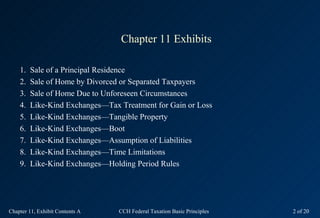
Chapter 11 Exhibits

    1.   Sale of a Principal Residence
    2.   Sale of Home by Divorced or Separated Taxpayers
    3.   Sale of Home Due to Unforeseen Circumstances
    4.   Like-Kind Exchangesโ€”Tax Treatment for Gain or Loss
    5.   Like-Kind Exchangesโ€”Tangible Property
    6.   Like-Kind Exchangesโ€”Boot
    7.   Like-Kind Exchangesโ€”Assumption of Liabilities
    8.   Like-Kind Exchangesโ€”Time Limitations
    9.   Like-Kind Exchangesโ€”Holding Period Rules


Chapter 11, Exhibit Contents A   CCH Federal Taxation Basic Principles   2 of 20
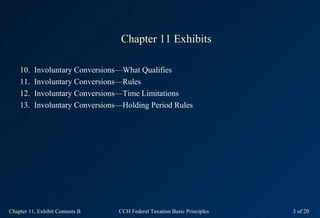
Chapter 11 Exhibits

    10.   Involuntary Conversionsโ€”What Qualifies
    11.   Involuntary Conversionsโ€”Rules
    12.   Involuntary Conversionsโ€”Time Limitations
    13.   Involuntary Conversionsโ€”Holding Period Rules


Chapter 11, Exhibit Contents B   CCH Federal Taxation Basic Principles   3 of 20
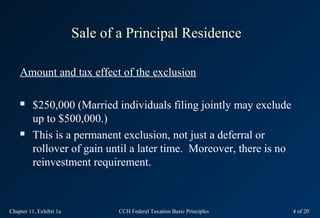
Sale of a Principal Residence

    Amount and tax effect of the exclusion

    ๏ฎ    $250,000 (Married individuals filing jointly may exclude
         up to $500,000.)
    ๏ฎ    This is a permanent exclusion, not just a deferral or
         rollover of gain until a later time. Moreover, there is no
         reinvestment requirement.


Chapter 11, Exhibit 1a           CCH Federal Taxation Basic Principles   4 of 20
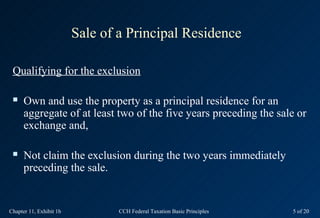
Sale of a Principal Residence

 Qualifying for the exclusion

 ๏ฎ    Own and use the property as a principal residence for an
      aggregate of at least two of the five years preceding the sale or
      exchange and,

 ๏ฎ    Not claim the exclusion during the two years immediately
      preceding the sale.


Chapter 11, Exhibit 1b           CCH Federal Taxation Basic Principles   5 of 20
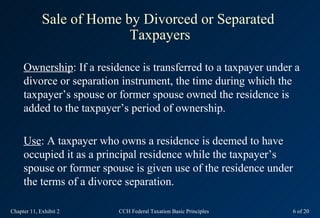
Sale of Home by Divorced or Separated
                           Taxpayers

     Ownership: If a residence is transferred to a taxpayer under a
     divorce or separation instrument, the time during which the
     taxpayerโ€™s spouse or former spouse owned the residence is
     added to the taxpayerโ€™s period of ownership.

     Use: A taxpayer who owns a residence is deemed to have
     occupied it as a principal residence while the taxpayerโ€™s
     spouse or former spouse is given use of the residence under
     the terms of a divorce separation.

Chapter 11, Exhibit 2     CCH Federal Taxation Basic Principles    6 of 20
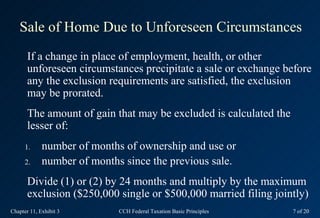
Sale of Home Due to Unforeseen Circumstances
       If a change in place of employment, health, or other
       unforeseen circumstances precipitate a sale or exchange before
       any the exclusion requirements are satisfied, the exclusion
       may be prorated.
       The amount of gain that may be excluded is calculated the
       lesser of:
      1.     number of months of ownership and use or
      2.     number of months since the previous sale.
       Divide (1) or (2) by 24 months and multiply by the maximum
       exclusion ($250,000 single or $500,000 married filing jointly)
Chapter 11, Exhibit 3        CCH Federal Taxation Basic Principles   7 of 20
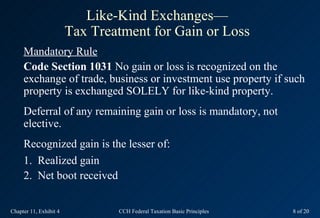
Like-Kind Exchangesโ€”
                        Tax Treatment for Gain or Loss
     Mandatory Rule
     Code Section 1031 No gain or loss is recognized on the
     exchange of trade, business or investment use property if such
     property is exchanged SOLELY for like-kind property.
     Deferral of any remaining gain or loss is mandatory, not
     elective.
     Recognized gain is the lesser of:
     1. Realized gain
     2. Net boot received


Chapter 11, Exhibit 4           CCH Federal Taxation Basic Principles   8 of 20
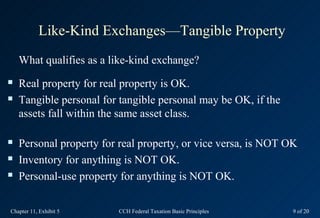
Like-Kind Exchangesโ€”Tangible Property
    What qualifies as a like-kind exchange?
๏ฎ   Real property for real property is OK.
๏ฎ   Tangible personal for tangible personal may be OK, if the
    assets fall within the same asset class.

๏ฎ   Personal property for real property, or vice versa, is NOT OK
๏ฎ   Inventory for anything is NOT OK.
๏ฎ   Personal-use property for anything is NOT OK.

Chapter 11, Exhibit 5    CCH Federal Taxation Basic Principles   9 of 20
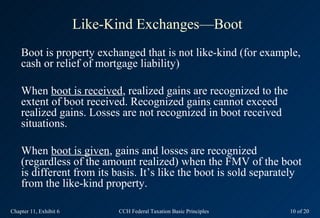
Like-Kind Exchangesโ€”Boot
    Boot is property exchanged that is not like-kind (for example,
    cash or relief of mortgage liability)

    When boot is received, realized gains are recognized to the
    extent of boot received. Recognized gains cannot exceed
    realized gains. Losses are not recognized in boot received
    situations.

    When boot is given, gains and losses are recognized
    (regardless of the amount realized) when the FMV of the boot
    is different from its basis. Itโ€™s like the boot is sold separately
    from the like-kind property.

Chapter 11, Exhibit 6         CCH Federal Taxation Basic Principles   10 of 20
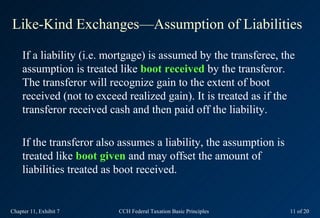
Like-Kind Exchangesโ€”Assumption of Liabilities

     If a liability (i.e. mortgage) is assumed by the transferee, the
     assumption is treated like boot received by the transferor.
     The transferor will recognize gain to the extent of boot
     received (not to exceed realized gain). It is treated as if the
     transferor received cash and then paid off the liability.

     If the transferor also assumes a liability, the assumption is
     treated like boot given and may offset the amount of
     liabilities treated as boot received.


Chapter 11, Exhibit 7      CCH Federal Taxation Basic Principles     11 of 20
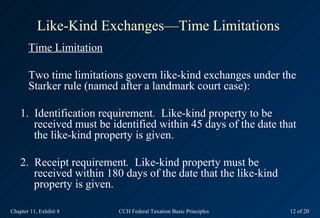
Like-Kind Exchangesโ€”Time Limitations
       Time Limitation

       Two time limitations govern like-kind exchanges under the
       Starker rule (named after a landmark court case):

    1. Identification requirement. Like-kind property to be
       received must be identified within 45 days of the date that
       the like-kind property is given.

    2. Receipt requirement. Like-kind property must be
       received within 180 days of the date that the like-kind
       property is given.

Chapter 11, Exhibit 8     CCH Federal Taxation Basic Principles   12 of 20
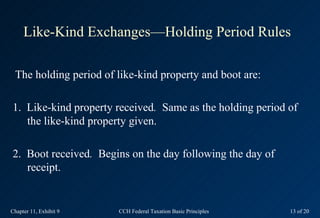
Like-Kind Exchangesโ€”Holding Period Rules

 The holding period of like-kind property and boot are:

1. Like-kind property received. Same as the holding period of
   the like-kind property given.

2. Boot received. Begins on the day following the day of
   receipt.


Chapter 11, Exhibit 9   CCH Federal Taxation Basic Principles   13 of 20
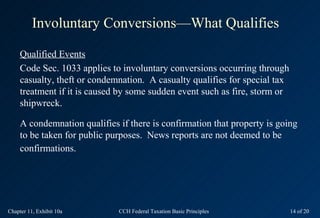
Involuntary Conversionsโ€”What Qualifies

     Qualified Events
     Code Sec. 1033 applies to involuntary conversions occurring through
     casualty, theft or condemnation. A casualty qualifies for special tax
     treatment if it is caused by some sudden event such as fire, storm or
     shipwreck.

     A condemnation qualifies if there is confirmation that property is going
     to be taken for public purposes. News reports are not deemed to be
     confirmations.


Chapter 11, Exhibit 10a       CCH Federal Taxation Basic Principles          14 of 20
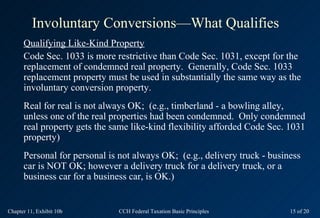
Involuntary Conversionsโ€”What Qualifies
      Qualifying Like-Kind Property
      Code Sec. 1033 is more restrictive than Code Sec. 1031, except for the
      replacement of condemned real property. Generally, Code Sec. 1033
      replacement property must be used in substantially the same way as the
      involuntary conversion property.
      Real for real is not always OK; (e.g., timberland - a bowling alley,
      unless one of the real properties had been condemned. Only condemned
      real property gets the same like-kind flexibility afforded Code Sec. 1031
      property)
      Personal for personal is not always OK; (e.g., delivery truck - business
      car is NOT OK; however a delivery truck for a delivery truck, or a
      business car for a business car, is OK.)


Chapter 11, Exhibit 10b       CCH Federal Taxation Basic Principles        15 of 20
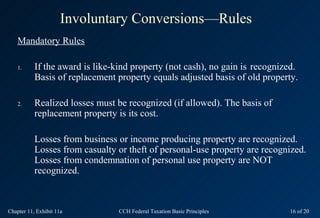
Involuntary Conversionsโ€”Rules
    Mandatory Rules

    1.     If the award is like-kind property (not cash), no gain is recognized.
           Basis of replacement property equals adjusted basis of old property.

    2.     Realized losses must be recognized (if allowed). The basis of
           replacement property is its cost.

           Losses from business or income producing property are recognized.
           Losses from casualty or theft of personal-use property are recognized.
           Losses from condemnation of personal use property are NOT
           recognized.


Chapter 11, Exhibit 11a          CCH Federal Taxation Basic Principles       16 of 20
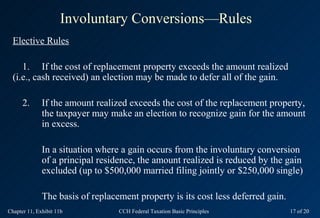
Involuntary Conversionsโ€”Rules
  Elective Rules

     1. If the cost of replacement property exceeds the amount realized
  (i.e., cash received) an election may be made to defer all of the gain.

      2.      If the amount realized exceeds the cost of the replacement property,
              the taxpayer may make an election to recognize gain for the amount
              in excess.

              In a situation where a gain occurs from the involuntary conversion
              of a principal residence, the amount realized is reduced by the gain
              excluded (up to $500,000 married filing jointly or $250,000 single)

              The basis of replacement property is its cost less deferred gain.
Chapter 11, Exhibit 11b           CCH Federal Taxation Basic Principles           17 of 20
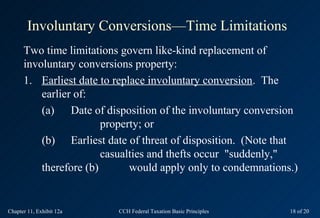
Involuntary Conversionsโ€”Time Limitations
      Two time limitations govern like-kind replacement of
      involuntary conversions property:
      1. Earliest date to replace involuntary conversion. The
          earlier of:
          (a) Date of disposition of the involuntary conversion
                        property; or
          (b) Earliest date of threat of disposition. (Note that
                        casualties and thefts occur "suddenly,"
          therefore (b)       would apply only to condemnations.)


Chapter 11, Exhibit 12a   CCH Federal Taxation Basic Principles   18 of 20
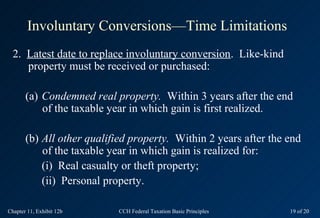
Involuntary Conversionsโ€”Time Limitations
  2. Latest date to replace involuntary conversion. Like-kind
     property must be received or purchased:

       (a) Condemned real property. Within 3 years after the end
           of the taxable year in which gain is first realized.

       (b) All other qualified property. Within 2 years after the end
           of the taxable year in which gain is realized for:
           (i) Real casualty or theft property;
           (ii) Personal property.

Chapter 11, Exhibit 12b     CCH Federal Taxation Basic Principles   19 of 20
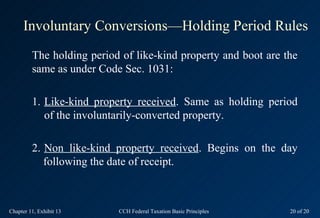
Involuntary Conversionsโ€”Holding Period Rules
         The holding period of like-kind property and boot are the
         same as under Code Sec. 1031:

         1. Like-kind property received. Same as holding period
            of the involuntarily-converted property.

         2. Non like-kind property received. Begins on the day
            following the date of receipt.


Chapter 11, Exhibit 13     CCH Federal Taxation Basic Principles   20 of 20

2013 cch basic principles ch11

  • 1.
    Chapter 11 Property Transactions: Nonrecognition of Gains and Losses ยฉ2012 CCH. All Rights Reserved. 4025 W. Peterson Ave. Chicago, IL 60646-6085 1 800 248 3248 www.CCHGroup.com
  • 2.
    Chapter 11 Exhibits 1. Sale of a Principal Residence 2. Sale of Home by Divorced or Separated Taxpayers 3. Sale of Home Due to Unforeseen Circumstances 4. Like-Kind Exchangesโ€”Tax Treatment for Gain or Loss 5. Like-Kind Exchangesโ€”Tangible Property 6. Like-Kind Exchangesโ€”Boot 7. Like-Kind Exchangesโ€”Assumption of Liabilities 8. Like-Kind Exchangesโ€”Time Limitations 9. Like-Kind Exchangesโ€”Holding Period Rules Chapter 11, Exhibit Contents A CCH Federal Taxation Basic Principles 2 of 20
  • 3.
    Chapter 11 Exhibits 10. Involuntary Conversionsโ€”What Qualifies 11. Involuntary Conversionsโ€”Rules 12. Involuntary Conversionsโ€”Time Limitations 13. Involuntary Conversionsโ€”Holding Period Rules Chapter 11, Exhibit Contents B CCH Federal Taxation Basic Principles 3 of 20
  • 4.
    Sale of aPrincipal Residence Amount and tax effect of the exclusion ๏ฎ $250,000 (Married individuals filing jointly may exclude up to $500,000.) ๏ฎ This is a permanent exclusion, not just a deferral or rollover of gain until a later time. Moreover, there is no reinvestment requirement. Chapter 11, Exhibit 1a CCH Federal Taxation Basic Principles 4 of 20
  • 5.
    Sale of aPrincipal Residence Qualifying for the exclusion ๏ฎ Own and use the property as a principal residence for an aggregate of at least two of the five years preceding the sale or exchange and, ๏ฎ Not claim the exclusion during the two years immediately preceding the sale. Chapter 11, Exhibit 1b CCH Federal Taxation Basic Principles 5 of 20
  • 6.
    Sale of Homeby Divorced or Separated Taxpayers Ownership: If a residence is transferred to a taxpayer under a divorce or separation instrument, the time during which the taxpayerโ€™s spouse or former spouse owned the residence is added to the taxpayerโ€™s period of ownership. Use: A taxpayer who owns a residence is deemed to have occupied it as a principal residence while the taxpayerโ€™s spouse or former spouse is given use of the residence under the terms of a divorce separation. Chapter 11, Exhibit 2 CCH Federal Taxation Basic Principles 6 of 20
  • 7.
    Sale of HomeDue to Unforeseen Circumstances If a change in place of employment, health, or other unforeseen circumstances precipitate a sale or exchange before any the exclusion requirements are satisfied, the exclusion may be prorated. The amount of gain that may be excluded is calculated the lesser of: 1. number of months of ownership and use or 2. number of months since the previous sale. Divide (1) or (2) by 24 months and multiply by the maximum exclusion ($250,000 single or $500,000 married filing jointly) Chapter 11, Exhibit 3 CCH Federal Taxation Basic Principles 7 of 20
  • 8.
    Like-Kind Exchangesโ€” Tax Treatment for Gain or Loss Mandatory Rule Code Section 1031 No gain or loss is recognized on the exchange of trade, business or investment use property if such property is exchanged SOLELY for like-kind property. Deferral of any remaining gain or loss is mandatory, not elective. Recognized gain is the lesser of: 1. Realized gain 2. Net boot received Chapter 11, Exhibit 4 CCH Federal Taxation Basic Principles 8 of 20
  • 9.
    Like-Kind Exchangesโ€”Tangible Property What qualifies as a like-kind exchange? ๏ฎ Real property for real property is OK. ๏ฎ Tangible personal for tangible personal may be OK, if the assets fall within the same asset class. ๏ฎ Personal property for real property, or vice versa, is NOT OK ๏ฎ Inventory for anything is NOT OK. ๏ฎ Personal-use property for anything is NOT OK. Chapter 11, Exhibit 5 CCH Federal Taxation Basic Principles 9 of 20
  • 10.
    Like-Kind Exchangesโ€”Boot Boot is property exchanged that is not like-kind (for example, cash or relief of mortgage liability) When boot is received, realized gains are recognized to the extent of boot received. Recognized gains cannot exceed realized gains. Losses are not recognized in boot received situations. When boot is given, gains and losses are recognized (regardless of the amount realized) when the FMV of the boot is different from its basis. Itโ€™s like the boot is sold separately from the like-kind property. Chapter 11, Exhibit 6 CCH Federal Taxation Basic Principles 10 of 20
  • 11.
    Like-Kind Exchangesโ€”Assumption ofLiabilities If a liability (i.e. mortgage) is assumed by the transferee, the assumption is treated like boot received by the transferor. The transferor will recognize gain to the extent of boot received (not to exceed realized gain). It is treated as if the transferor received cash and then paid off the liability. If the transferor also assumes a liability, the assumption is treated like boot given and may offset the amount of liabilities treated as boot received. Chapter 11, Exhibit 7 CCH Federal Taxation Basic Principles 11 of 20
  • 12.
    Like-Kind Exchangesโ€”Time Limitations Time Limitation Two time limitations govern like-kind exchanges under the Starker rule (named after a landmark court case): 1. Identification requirement. Like-kind property to be received must be identified within 45 days of the date that the like-kind property is given. 2. Receipt requirement. Like-kind property must be received within 180 days of the date that the like-kind property is given. Chapter 11, Exhibit 8 CCH Federal Taxation Basic Principles 12 of 20
  • 13.
    Like-Kind Exchangesโ€”Holding PeriodRules The holding period of like-kind property and boot are: 1. Like-kind property received. Same as the holding period of the like-kind property given. 2. Boot received. Begins on the day following the day of receipt. Chapter 11, Exhibit 9 CCH Federal Taxation Basic Principles 13 of 20
  • 14.
    Involuntary Conversionsโ€”What Qualifies Qualified Events Code Sec. 1033 applies to involuntary conversions occurring through casualty, theft or condemnation. A casualty qualifies for special tax treatment if it is caused by some sudden event such as fire, storm or shipwreck. A condemnation qualifies if there is confirmation that property is going to be taken for public purposes. News reports are not deemed to be confirmations. Chapter 11, Exhibit 10a CCH Federal Taxation Basic Principles 14 of 20
  • 15.
    Involuntary Conversionsโ€”What Qualifies Qualifying Like-Kind Property Code Sec. 1033 is more restrictive than Code Sec. 1031, except for the replacement of condemned real property. Generally, Code Sec. 1033 replacement property must be used in substantially the same way as the involuntary conversion property. Real for real is not always OK; (e.g., timberland - a bowling alley, unless one of the real properties had been condemned. Only condemned real property gets the same like-kind flexibility afforded Code Sec. 1031 property) Personal for personal is not always OK; (e.g., delivery truck - business car is NOT OK; however a delivery truck for a delivery truck, or a business car for a business car, is OK.) Chapter 11, Exhibit 10b CCH Federal Taxation Basic Principles 15 of 20
  • 16.
    Involuntary Conversionsโ€”Rules Mandatory Rules 1. If the award is like-kind property (not cash), no gain is recognized. Basis of replacement property equals adjusted basis of old property. 2. Realized losses must be recognized (if allowed). The basis of replacement property is its cost. Losses from business or income producing property are recognized. Losses from casualty or theft of personal-use property are recognized. Losses from condemnation of personal use property are NOT recognized. Chapter 11, Exhibit 11a CCH Federal Taxation Basic Principles 16 of 20
  • 17.
    Involuntary Conversionsโ€”Rules Elective Rules 1. If the cost of replacement property exceeds the amount realized (i.e., cash received) an election may be made to defer all of the gain. 2. If the amount realized exceeds the cost of the replacement property, the taxpayer may make an election to recognize gain for the amount in excess. In a situation where a gain occurs from the involuntary conversion of a principal residence, the amount realized is reduced by the gain excluded (up to $500,000 married filing jointly or $250,000 single) The basis of replacement property is its cost less deferred gain. Chapter 11, Exhibit 11b CCH Federal Taxation Basic Principles 17 of 20
  • 18.
    Involuntary Conversionsโ€”Time Limitations Two time limitations govern like-kind replacement of involuntary conversions property: 1. Earliest date to replace involuntary conversion. The earlier of: (a) Date of disposition of the involuntary conversion property; or (b) Earliest date of threat of disposition. (Note that casualties and thefts occur "suddenly," therefore (b) would apply only to condemnations.) Chapter 11, Exhibit 12a CCH Federal Taxation Basic Principles 18 of 20
  • 19.
    Involuntary Conversionsโ€”Time Limitations 2. Latest date to replace involuntary conversion. Like-kind property must be received or purchased: (a) Condemned real property. Within 3 years after the end of the taxable year in which gain is first realized. (b) All other qualified property. Within 2 years after the end of the taxable year in which gain is realized for: (i) Real casualty or theft property; (ii) Personal property. Chapter 11, Exhibit 12b CCH Federal Taxation Basic Principles 19 of 20
  • 20.
    Involuntary Conversionsโ€”Holding PeriodRules The holding period of like-kind property and boot are the same as under Code Sec. 1031: 1. Like-kind property received. Same as holding period of the involuntarily-converted property. 2. Non like-kind property received. Begins on the day following the date of receipt. Chapter 11, Exhibit 13 CCH Federal Taxation Basic Principles 20 of 20