Chapter 10
         Property Transactions:
        Determination of Basis and
            Gains and Losses
©2012 CCH. All Rights Reserved.
4025 W. Peterson Ave.
Chicago, IL 60646-6085
1 800 248 3248
www.CCHGroup.com
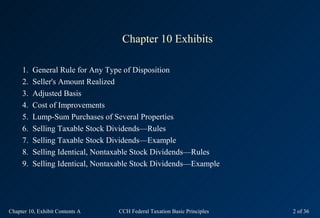
Chapter 10 Exhibits

     1.   General Rule for Any Type of Disposition
     2.   Seller's Amount Realized
     3.   Adjusted Basis
     4.   Cost of Improvements
     5.   Lump-Sum Purchases of Several Properties
     6.   Selling Taxable Stock Dividends—Rules
     7.   Selling Taxable Stock Dividends—Example
     8.   Selling Identical, Nontaxable Stock Dividends—Rules
     9.   Selling Identical, Nontaxable Stock Dividends—Example


Chapter 10, Exhibit Contents A    CCH Federal Taxation Basic Principles   2 of 36
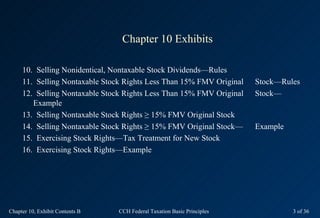
Chapter 10 Exhibits

     10. Selling Nonidentical, Nontaxable Stock Dividends—Rules
     11. Selling Nontaxable Stock Rights Less Than 15% FMV Original      Stock—Rules
     12. Selling Nontaxable Stock Rights Less Than 15% FMV Original      Stock—
        Example
     13. Selling Nontaxable Stock Rights ≥ 15% FMV Original Stock
     14. Selling Nontaxable Stock Rights ≥ 15% FMV Original Stock—       Example
     15. Exercising Stock Rights—Tax Treatment for New Stock
     16. Exercising Stock Rights—Example


Chapter 10, Exhibit Contents B   CCH Federal Taxation Basic Principles             3 of 36
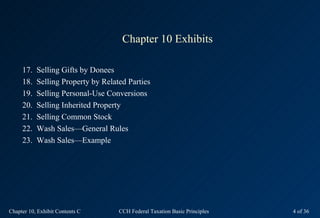
Chapter 10 Exhibits

     17.   Selling Gifts by Donees
     18.   Selling Property by Related Parties
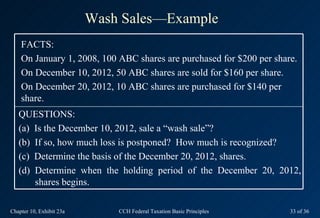
     19.   Selling Personal-Use Conversions
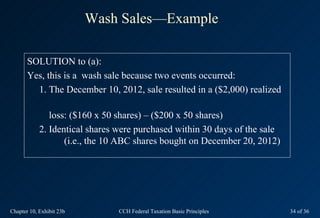
     20.   Selling Inherited Property
     21.   Selling Common Stock
     22.   Wash Sales—General Rules
     23.   Wash Sales—Example


Chapter 10, Exhibit Contents C      CCH Federal Taxation Basic Principles   4 of 36
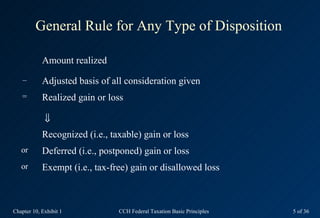
General Rule for Any Type of Disposition

            Amount realized
    –       Adjusted basis of all consideration given
   =        Realized gain or loss

             ⇓
            Recognized (i.e., taxable) gain or loss
   or       Deferred (i.e., postponed) gain or loss
   or       Exempt (i.e., tax-free) gain or disallowed loss


Chapter 10, Exhibit 1           CCH Federal Taxation Basic Principles   5 of 36
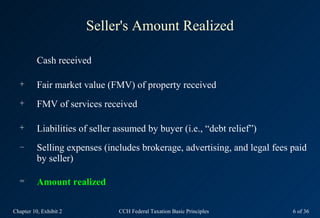
Seller's Amount Realized

          Cash received

  +       Fair market value (FMV) of property received
  +       FMV of services received

  +       Liabilities of seller assumed by buyer (i.e., “debt relief”)
  –       Selling expenses (includes brokerage, advertising, and legal fees paid
          by seller)

  =       Amount realized

Chapter 10, Exhibit 2           CCH Federal Taxation Basic Principles       6 of 36
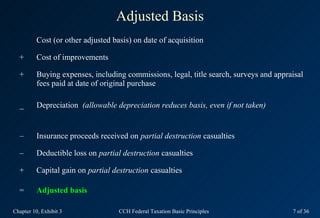
Adjusted Basis
          Cost (or other adjusted basis) on date of acquisition

  +       Cost of improvements

  +       Buying expenses, including commissions, legal, title search, surveys and appraisal
          fees paid at date of original purchase

  _       Depreciation (allowable depreciation reduces basis, even if not taken)


  –       Insurance proceeds received on partial destruction casualties

  –       Deductible loss on partial destruction casualties

  +       Capital gain on partial destruction casualties

  =       Adjusted basis

Chapter 10, Exhibit 3               CCH Federal Taxation Basic Principles               7 of 36
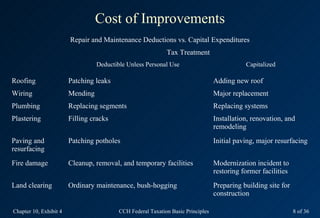
Cost of Improvements
                        Repair and Maintenance Deductions vs. Capital Expenditures
                                                             Tax Treatment
                                  Deductible Unless Personal Use                             Capitalized

Roofing                 Patching leaks                                            Adding new roof
Wiring                  Mending                                                   Major replacement
Plumbing                Replacing segments                                        Replacing systems
Plastering              Filling cracks                                            Installation, renovation, and
                                                                                  remodeling
Paving and              Patching potholes                                         Initial paving, major resurfacing
resurfacing
Fire damage             Cleanup, removal, and temporary facilities                Modernization incident to
                                                                                  restoring former facilities
Land clearing           Ordinary maintenance, bush-hogging                        Preparing building site for
                                                                                  construction

Chapter 10, Exhibit 4                     CCH Federal Taxation Basic Principles                                 8 of 36
Lump-Sum Purchases of Several Properties
General Rule. Allocate total cost according to the relative fair market
value of each property.

                                        Example
FACTS: A buyer pays a seller a lump-sum amount of $800,000 for land tracts A, B,
and C valued at $200,000, $300,000, and $500,000 respectively. ($1,000,000 is the total
value of the three tracts.)

QUESTION: What is the buyer’s basis in the three tracts?
SOLUTION:
     A: $160,000 ($800,000 x [$200,000 ÷ $1,000,000])
     B: $240,000 ($800,000 x [$300,000 ÷ $1,000,000])
     C: $400,000 ($800,000 x [$500,000 ÷ $1,000,000])


Chapter 10, Exhibit 5          CCH Federal Taxation Basic Principles                9 of 36
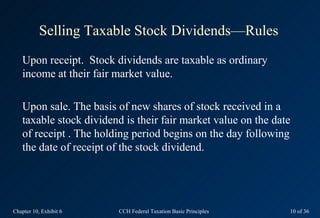
Selling Taxable Stock Dividends—Rules
   Upon receipt. Stock dividends are taxable as ordinary
   income at their fair market value.

   Upon sale. The basis of new shares of stock received in a
   taxable stock dividend is their fair market value on the date
   of receipt . The holding period begins on the day following
   the date of receipt of the stock dividend.


Chapter 10, Exhibit 6   CCH Federal Taxation Basic Principles   10 of 36
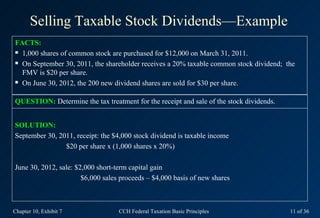
Selling Taxable Stock Dividends—Example
FACTS:
 1,000 shares of common stock are purchased for $12,000 on March 31, 2011.

 On September 30, 2011, the shareholder receives a 20% taxable common stock dividend; the

  FMV is $20 per share.
 On June 30, 2012, the 200 new dividend shares are sold for $30 per share.


QUESTION: Determine the tax treatment for the receipt and sale of the stock dividends.


SOLUTION:
September 30, 2011, receipt: the $4,000 stock dividend is taxable income
                $20 per share x (1,000 shares x 20%)

June 30, 2012, sale: $2,000 short-term capital gain
                       $6,000 sales proceeds – $4,000 basis of new shares


Chapter 10, Exhibit 7              CCH Federal Taxation Basic Principles                 11 of 36
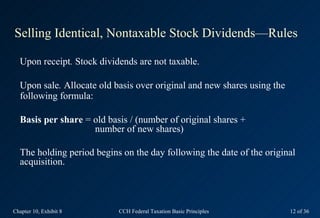
Selling Identical, Nontaxable Stock Dividends—Rules

  Upon receipt. Stock dividends are not taxable.

  Upon sale. Allocate old basis over original and new shares using the
  following formula:

  Basis per share = old basis / (number of original shares +
                    number of new shares)

  The holding period begins on the day following the date of the original
  acquisition.


Chapter 10, Exhibit 8      CCH Federal Taxation Basic Principles         12 of 36
Selling Identical, Nontaxable Stock Dividends—Example
 FACTS:
 1. 1,000 shares of common stock are purchased for $12,000 on March 31, 2011.
 2. On September 30, 2011, the shareholder receives a 20% nontaxable common stock dividend.
 3. On June 30, 2012, the 200 new dividend shares are sold for $30 per share.


 QUESTION: Determine the tax treatment for the receipt and sale of the stock dividends.


 SOLUTION:
 September 30, 2011, receipt: The stock dividends are not taxable.

 June 30, 2012, sale results is a $4,000 long term capital gain.
                Amount realized = 200 shares x $30 = $6,000
                Adjusted basis = 200 shares x $10 = $2,000

 **Basis per share = [$12,000 ÷ (1,000 old shares + 200 new shares)] = $10


Chapter 10, Exhibit 9             CCH Federal Taxation Basic Principles                   13 of 36
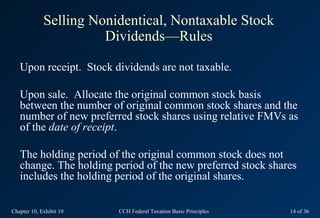
Selling Nonidentical, Nontaxable Stock
                       Dividends—Rules

   Upon receipt. Stock dividends are not taxable.

   Upon sale. Allocate the original common stock basis
   between the number of original common stock shares and the
   number of new preferred stock shares using relative FMVs as
   of the date of receipt.

   The holding period of the original common stock does not
   change. The holding period of the new preferred stock shares
   includes the holding period of the original shares.

Chapter 10, Exhibit 10   CCH Federal Taxation Basic Principles   14 of 36
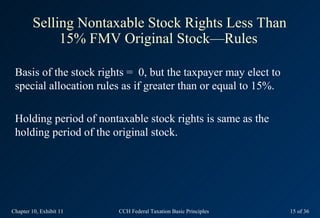
Selling Nontaxable Stock Rights Less Than
             15% FMV Original Stock—Rules

 Basis of the stock rights = 0, but the taxpayer may elect to
 special allocation rules as if greater than or equal to 15%.

 Holding period of nontaxable stock rights is same as the
 holding period of the original stock.


Chapter 10, Exhibit 11   CCH Federal Taxation Basic Principles   15 of 36
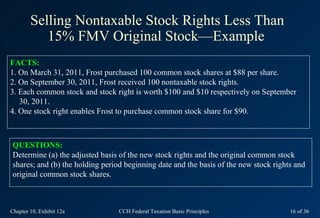
Selling Nontaxable Stock Rights Less Than
           15% FMV Original Stock—Example
FACTS:
1. On March 31, 2011, Frost purchased 100 common stock shares at $88 per share.
2. On September 30, 2011, Frost received 100 nontaxable stock rights.
3. Each common stock and stock right is worth $100 and $10 respectively on September
   30, 2011.
4. One stock right enables Frost to purchase common stock share for $90.


QUESTIONS:
Determine (a) the adjusted basis of the new stock rights and the original common stock
shares; and (b) the holding period beginning date and the basis of the new stock rights and
original common stock shares.


Chapter 10, Exhibit 12a          CCH Federal Taxation Basic Principles                16 of 36
Selling Nontaxable Stock Rights Less Than
           15% FMV Original Stock—Example

 SOLUTION to (a):
 Adjusted basis of new stock rights: $0, since their value is < 15% FMV of common stock
 [100 stock rights x $10 FMV per share] < [15% x (100 common stock shares x $100 FMV
 per share)];
 Adjusted basis of original common stock shares: $8,800 (i.e., no change).


 SOLUTION to (b):
 Holding period of the stock rights and original common stock shares begins on the day
 following March 31, 2011.


Chapter 10, Exhibit 12b          CCH Federal Taxation Basic Principles              17 of 36
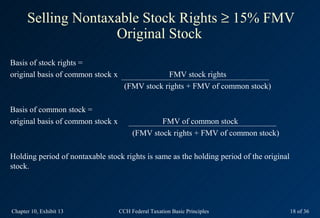
Selling Nontaxable Stock Rights ≥ 15% FMV
                    Original Stock
Basis of stock rights =
original basis of common stock x                 FMV stock rights
                                     (FMV stock rights + FMV of common stock)

Basis of common stock =
original basis of common stock x                FMV of common stock
                                        (FMV stock rights + FMV of common stock)

Holding period of nontaxable stock rights is same as the holding period of the original
stock.


Chapter 10, Exhibit 13             CCH Federal Taxation Basic Principles                  18 of 36
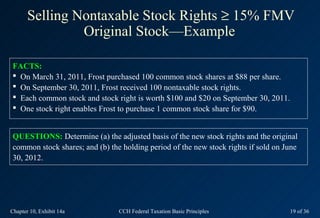
Selling Nontaxable Stock Rights ≥ 15% FMV
                Original Stock—Example

FACTS:
 On March 31, 2011, Frost purchased 100 common stock shares at $88 per share.
 On September 30, 2011, Frost received 100 nontaxable stock rights.
 Each common stock and stock right is worth $100 and $20 on September 30, 2011.
 One stock right enables Frost to purchase 1 common stock share for $90.


QUESTIONS: Determine (a) the adjusted basis of the new stock rights and the original
common stock shares; and (b) the holding period of the new stock rights if sold on June
30, 2012.


Chapter 10, Exhibit 14a         CCH Federal Taxation Basic Principles               19 of 36
Selling Nontaxable Stock Rights ≥ 15% FMV
                Original Stock—Example
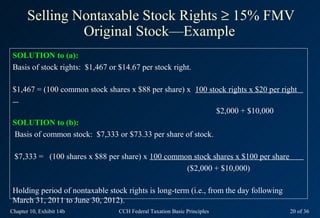
 SOLUTION to (a):
 Basis of stock rights: $1,467 or $14.67 per stock right.

 $1,467 = (100 common stock shares x $88 per share) x 100 stock rights x $20 per right

                                                                          $2,000 + $10,000
 SOLUTION to (b):
 Basis of common stock: $7,333 or $73.33 per share of stock.

 $7,333 = (100 shares x $88 per share) x 100 common stock shares x $100 per share
                                                  ($2,000 + $10,000)

 Holding period of nontaxable stock rights is long-term (i.e., from the day following
 March 31, 2011 to June 30, 2012).
Chapter 10, Exhibit 14b           CCH Federal Taxation Basic Principles                      20 of 36
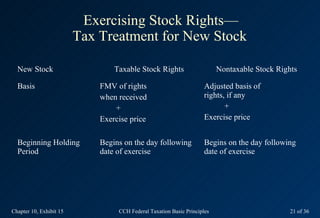
Exercising Stock Rights—
                         Tax Treatment for New Stock

  New Stock                      Taxable Stock Rights                     Nontaxable Stock Rights

  Basis                      FMV of rights                           Adjusted basis of
                             when received                           rights, if any
                                 +                                          +
                             Exercise price                          Exercise price


  Beginning Holding          Begins on the day following             Begins on the day following
  Period                     date of exercise                        date of exercise


Chapter 10, Exhibit 15            CCH Federal Taxation Basic Principles                        21 of 36
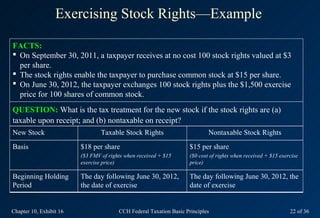
Exercising Stock Rights—Example

FACTS:
 On September 30, 2011, a taxpayer receives at no cost 100 stock rights valued at $3
  per share.
 The stock rights enable the taxpayer to purchase common stock at $15 per share.
 On June 30, 2012, the taxpayer exchanges 100 stock rights plus the $1,500 exercise
  price for 100 shares of common stock.
QUESTION: What is the tax treatment for the new stock if the stock rights are (a)
taxable upon receipt; and (b) nontaxable on receipt?
New Stock                        Taxable Stock Rights                        Nontaxable Stock Rights
Basis                    $18 per share                               $15 per share
                         ($3 FMV of rights when received + $15       ($0 cost of rights when received + $15 exercise
                         exercise price)                             price)

Beginning Holding        The day following June 30, 2012,            The day following June 30, 2012, the
Period                   the date of exercise                        date of exercise


Chapter 10, Exhibit 16                  CCH Federal Taxation Basic Principles                                   22 of 36
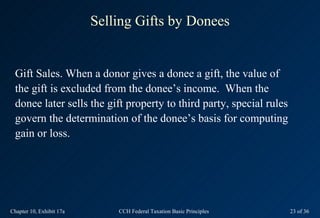
Selling Gifts by Donees


 Gift Sales. When a donor gives a donee a gift, the value of
 the gift is excluded from the donee’s income. When the
 donee later sells the gift property to third party, special rules
 govern the determination of the donee’s basis for computing
 gain or loss.


Chapter 10, Exhibit 17a       CCH Federal Taxation Basic Principles   23 of 36
Selling Gifts by Donees
                              Donee's Adjusted Basis (AB)                Donee's Holding Period (HP)

       “Gain” basis        Same as donor's AB.                        Same as donor's HP.
       “Loss” basis        Lesser of:                                 If donor's basis is used,
                            Donor's basis or                            HP = donor's HP.
                            FMV at gift date (but use GAIN           If FMV is used,
                             basis for depreciation.).                  HP begins on gift date.


       “No gain or loss” For depreciation, use GAIN basis.            Same HP for GAIN basis.
       basis

       Gift tax rule. When a donee assumes a donor's basis, the basis includes:
       [Gift tax paid by donor x (FMV at gift date - Donor's basis at gift date)]
                                taxable amount of the gift


Chapter 10, Exhibit 17b                CCH Federal Taxation Basic Principles                           24 of 36
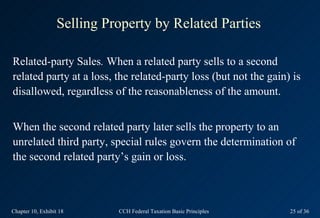
Selling Property by Related Parties

Related-party Sales. When a related party sells to a second
related party at a loss, the related-party loss (but not the gain) is
disallowed, regardless of the reasonableness of the amount.


When the second related party later sells the property to an
unrelated third party, special rules govern the determination of
the second related party’s gain or loss.


Chapter 10, Exhibit 18       CCH Federal Taxation Basic Principles   25 of 36
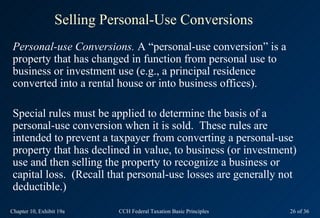
Selling Personal-Use Conversions
Personal-use Conversions. A “personal-use conversion” is a
property that has changed in function from personal use to
business or investment use (e.g., a principal residence
converted into a rental house or into business offices).

Special rules must be applied to determine the basis of a
personal-use conversion when it is sold. These rules are
intended to prevent a taxpayer from converting a personal-use
property that has declined in value, to business (or investment)
use and then selling the property to recognize a business or
capital loss. (Recall that personal-use losses are generally not
deductible.)

Chapter 10, Exhibit 19a     CCH Federal Taxation Basic Principles   26 of 36
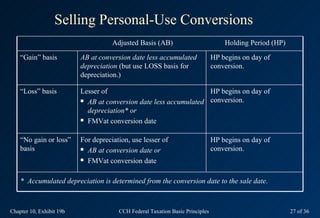
Selling Personal-Use Conversions
                                     Adjusted Basis (AB)                           Holding Period (HP)

    “Gain” basis          AB at conversion date less accumulated               HP begins on day of
                          depreciation (but use LOSS basis for                 conversion.
                          depreciation.)

    “Loss” basis          Lesser of                                HP begins on day of
                           AB at conversion date less accumulated conversion.

                            depreciation* or
                           FMVat conversion date


    “No gain or loss”     For depreciation, use lesser of                      HP begins on day of
    basis                  AB at conversion date or                           conversion.
                           FMVat conversion date


    * Accumulated depreciation is determined from the conversion date to the sale date.


Chapter 10, Exhibit 19b                CCH Federal Taxation Basic Principles                             27 of 36
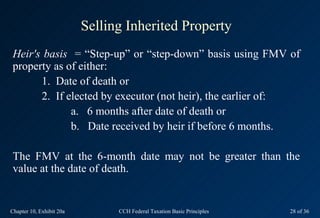
Selling Inherited Property
Heir's basis = “Step-up” or “step-down” basis using FMV of
property as of either:
      1. Date of death or
      2. If elected by executor (not heir), the earlier of:
             a. 6 months after date of death or
             b. Date received by heir if before 6 months.

The FMV at the 6-month date may not be greater than the
value at the date of death.


Chapter 10, Exhibit 20a         CCH Federal Taxation Basic Principles   28 of 36
Selling Inherited Property

      Holding period = ALWAYS long-term, even if held by
      heir for 1 day and then sold.

      Special rule. If a donee wills “appreciated” property back
      to donor and dies within 1 year of receipt from donor, then
      the donor/heir's basis is the donee/decedent's BASIS as of
      the date of death (i.e., the original basis), NOT the FMV at
      date of death.


Chapter 10, Exhibit 20b         CCH Federal Taxation Basic Principles   29 of 36
Selling Common Stock

         Three methods may be used to determine basis:

         Specific identification may be used if the certificate
         numbers can be identified. (With this method, taxpayers
         may select specific shares based on FIFO, LIFO, highest
         basis, lowest basis, etc. Average cost is also available if
         the shares were bought and sold through a broker or
         agent.)


Chapter 10, Exhibit 21a       CCH Federal Taxation Basic Principles    30 of 36
Selling Common Stock

       First-In, First-Out may be used if specific shares cannot be
       identified. (However, average cost is also available if the
       shares were bought and sold through a broker or agent.)

       Average cost may be used if the shares were bought and sold
       through a broker or agent. (Specific identification is also
       allowed if the shares are bought and sold through a broker or
       agent, provided that the certificate numbers can be
       identified.)


Chapter 10, Exhibit 21b       CCH Federal Taxation Basic Principles   31 of 36
Wash Sales—General Rules

  Purpose. To prevent investors from avoiding taxes by selling
                 at a loss, then buying back identical shares.
  Definition. A wash sale is a sale of shares that:
           Realizes a LOSS, and
           Where substantially IDENTICAL SHARES are
            BOUGHT within 30 days BEFORE or AFTER
            the date of sale (i.e., a 61-day period.)
       Basis of new shares = Cost of new shares + Postponed
       loss from wash sale of old shares

Chapter 10, Exhibit 22         CCH Federal Taxation Basic Principles   32 of 36
Wash Sales—Example
    FACTS:
    On January 1, 2008, 100 ABC shares are purchased for $200 per share.
    On December 10, 2012, 50 ABC shares are sold for $160 per share.
    On December 20, 2012, 10 ABC shares are purchased for $140 per
    share.
   QUESTIONS:
   (a) Is the December 10, 2012, sale a “wash sale”?
   (b) If so, how much loss is postponed? How much is recognized?
   (c) Determine the basis of the December 20, 2012, shares.
   (d) Determine when the holding period of the December 20, 2012,
       shares begins.

Chapter 10, Exhibit 23a       CCH Federal Taxation Basic Principles   33 of 36
Wash Sales—Example

       SOLUTION to (a):
       Yes, this is a wash sale because two events occurred:
         1. The December 10, 2012, sale resulted in a ($2,000) realized

               loss: ($160 x 50 shares) – ($200 x 50 shares)
            2. Identical shares were purchased within 30 days of the sale
                   (i.e., the 10 ABC shares bought on December 20, 2012)


Chapter 10, Exhibit 23b         CCH Federal Taxation Basic Principles       34 of 36
Wash Sales—Example

    SOLUTION to (b):
    Loss postponed: ($400); Loss recognized: ($1,600)

    Only that portion of loss attributable to the wash sale is postponed as
    shown below:

    Portion attributable to wash sale: ($400) postponed loss
                                     [10 shares/50 shares x (2,000) = (400)]

    Portion NOT attributable to wash sale: ($1,600) recognized loss
                                   [40 shares/50 shares x (2,000) = (1,600)]


Chapter 10, Exhibit 23c       CCH Federal Taxation Basic Principles           35 of 36
Wash Sales—Example

SOLUTION to (c):
Basis of December 20, 2012, shares: $1,800

  $1,400 [10 shares bought on December 20, 2012 x $140 cost per share]
+    400 [Postponed loss on December 10, 2012 wash sale, computed
= $1,800 at (b)]


 SOLUTION to (d):
 Beginning holding period of the December 20, 2012 shares: the day
 following January 1, 2008 (i.e., the holding period “tacks on” to the
 holding period of the original shares)

Chapter 10, Exhibit 23d        CCH Federal Taxation Basic Principles     36 of 36

2013 cch basic principles ch10

  • 1.
    Chapter 10 Property Transactions: Determination of Basis and Gains and Losses ©2012 CCH. All Rights Reserved. 4025 W. Peterson Ave. Chicago, IL 60646-6085 1 800 248 3248 www.CCHGroup.com
  • 2.
    Chapter 10 Exhibits 1. General Rule for Any Type of Disposition 2. Seller's Amount Realized 3. Adjusted Basis 4. Cost of Improvements 5. Lump-Sum Purchases of Several Properties 6. Selling Taxable Stock Dividends—Rules 7. Selling Taxable Stock Dividends—Example 8. Selling Identical, Nontaxable Stock Dividends—Rules 9. Selling Identical, Nontaxable Stock Dividends—Example Chapter 10, Exhibit Contents A CCH Federal Taxation Basic Principles 2 of 36
  • 3.
    Chapter 10 Exhibits 10. Selling Nonidentical, Nontaxable Stock Dividends—Rules 11. Selling Nontaxable Stock Rights Less Than 15% FMV Original Stock—Rules 12. Selling Nontaxable Stock Rights Less Than 15% FMV Original Stock— Example 13. Selling Nontaxable Stock Rights ≥ 15% FMV Original Stock 14. Selling Nontaxable Stock Rights ≥ 15% FMV Original Stock— Example 15. Exercising Stock Rights—Tax Treatment for New Stock 16. Exercising Stock Rights—Example Chapter 10, Exhibit Contents B CCH Federal Taxation Basic Principles 3 of 36
  • 4.
    Chapter 10 Exhibits 17. Selling Gifts by Donees 18. Selling Property by Related Parties 19. Selling Personal-Use Conversions 20. Selling Inherited Property 21. Selling Common Stock 22. Wash Sales—General Rules 23. Wash Sales—Example Chapter 10, Exhibit Contents C CCH Federal Taxation Basic Principles 4 of 36
  • 5.
    General Rule forAny Type of Disposition Amount realized – Adjusted basis of all consideration given = Realized gain or loss ⇓ Recognized (i.e., taxable) gain or loss or Deferred (i.e., postponed) gain or loss or Exempt (i.e., tax-free) gain or disallowed loss Chapter 10, Exhibit 1 CCH Federal Taxation Basic Principles 5 of 36
  • 6.
    Seller's Amount Realized Cash received + Fair market value (FMV) of property received + FMV of services received + Liabilities of seller assumed by buyer (i.e., “debt relief”) – Selling expenses (includes brokerage, advertising, and legal fees paid by seller) = Amount realized Chapter 10, Exhibit 2 CCH Federal Taxation Basic Principles 6 of 36
  • 7.
    Adjusted Basis Cost (or other adjusted basis) on date of acquisition + Cost of improvements + Buying expenses, including commissions, legal, title search, surveys and appraisal fees paid at date of original purchase _ Depreciation (allowable depreciation reduces basis, even if not taken) – Insurance proceeds received on partial destruction casualties – Deductible loss on partial destruction casualties + Capital gain on partial destruction casualties = Adjusted basis Chapter 10, Exhibit 3 CCH Federal Taxation Basic Principles 7 of 36
  • 8.
    Cost of Improvements Repair and Maintenance Deductions vs. Capital Expenditures Tax Treatment Deductible Unless Personal Use Capitalized Roofing Patching leaks Adding new roof Wiring Mending Major replacement Plumbing Replacing segments Replacing systems Plastering Filling cracks Installation, renovation, and remodeling Paving and Patching potholes Initial paving, major resurfacing resurfacing Fire damage Cleanup, removal, and temporary facilities Modernization incident to restoring former facilities Land clearing Ordinary maintenance, bush-hogging Preparing building site for construction Chapter 10, Exhibit 4 CCH Federal Taxation Basic Principles 8 of 36
  • 9.
    Lump-Sum Purchases ofSeveral Properties General Rule. Allocate total cost according to the relative fair market value of each property. Example FACTS: A buyer pays a seller a lump-sum amount of $800,000 for land tracts A, B, and C valued at $200,000, $300,000, and $500,000 respectively. ($1,000,000 is the total value of the three tracts.) QUESTION: What is the buyer’s basis in the three tracts? SOLUTION: A: $160,000 ($800,000 x [$200,000 ÷ $1,000,000]) B: $240,000 ($800,000 x [$300,000 ÷ $1,000,000]) C: $400,000 ($800,000 x [$500,000 ÷ $1,000,000]) Chapter 10, Exhibit 5 CCH Federal Taxation Basic Principles 9 of 36
  • 10.
    Selling Taxable StockDividends—Rules Upon receipt. Stock dividends are taxable as ordinary income at their fair market value. Upon sale. The basis of new shares of stock received in a taxable stock dividend is their fair market value on the date of receipt . The holding period begins on the day following the date of receipt of the stock dividend. Chapter 10, Exhibit 6 CCH Federal Taxation Basic Principles 10 of 36
  • 11.
    Selling Taxable StockDividends—Example FACTS:  1,000 shares of common stock are purchased for $12,000 on March 31, 2011.  On September 30, 2011, the shareholder receives a 20% taxable common stock dividend; the FMV is $20 per share.  On June 30, 2012, the 200 new dividend shares are sold for $30 per share. QUESTION: Determine the tax treatment for the receipt and sale of the stock dividends. SOLUTION: September 30, 2011, receipt: the $4,000 stock dividend is taxable income $20 per share x (1,000 shares x 20%) June 30, 2012, sale: $2,000 short-term capital gain $6,000 sales proceeds – $4,000 basis of new shares Chapter 10, Exhibit 7 CCH Federal Taxation Basic Principles 11 of 36
  • 12.
    Selling Identical, NontaxableStock Dividends—Rules Upon receipt. Stock dividends are not taxable. Upon sale. Allocate old basis over original and new shares using the following formula: Basis per share = old basis / (number of original shares + number of new shares) The holding period begins on the day following the date of the original acquisition. Chapter 10, Exhibit 8 CCH Federal Taxation Basic Principles 12 of 36
  • 13.
    Selling Identical, NontaxableStock Dividends—Example FACTS: 1. 1,000 shares of common stock are purchased for $12,000 on March 31, 2011. 2. On September 30, 2011, the shareholder receives a 20% nontaxable common stock dividend. 3. On June 30, 2012, the 200 new dividend shares are sold for $30 per share. QUESTION: Determine the tax treatment for the receipt and sale of the stock dividends. SOLUTION: September 30, 2011, receipt: The stock dividends are not taxable. June 30, 2012, sale results is a $4,000 long term capital gain. Amount realized = 200 shares x $30 = $6,000 Adjusted basis = 200 shares x $10 = $2,000 **Basis per share = [$12,000 ÷ (1,000 old shares + 200 new shares)] = $10 Chapter 10, Exhibit 9 CCH Federal Taxation Basic Principles 13 of 36
  • 14.
    Selling Nonidentical, NontaxableStock Dividends—Rules Upon receipt. Stock dividends are not taxable. Upon sale. Allocate the original common stock basis between the number of original common stock shares and the number of new preferred stock shares using relative FMVs as of the date of receipt. The holding period of the original common stock does not change. The holding period of the new preferred stock shares includes the holding period of the original shares. Chapter 10, Exhibit 10 CCH Federal Taxation Basic Principles 14 of 36
  • 15.
    Selling Nontaxable StockRights Less Than 15% FMV Original Stock—Rules Basis of the stock rights = 0, but the taxpayer may elect to special allocation rules as if greater than or equal to 15%. Holding period of nontaxable stock rights is same as the holding period of the original stock. Chapter 10, Exhibit 11 CCH Federal Taxation Basic Principles 15 of 36
  • 16.
    Selling Nontaxable StockRights Less Than 15% FMV Original Stock—Example FACTS: 1. On March 31, 2011, Frost purchased 100 common stock shares at $88 per share. 2. On September 30, 2011, Frost received 100 nontaxable stock rights. 3. Each common stock and stock right is worth $100 and $10 respectively on September 30, 2011. 4. One stock right enables Frost to purchase common stock share for $90. QUESTIONS: Determine (a) the adjusted basis of the new stock rights and the original common stock shares; and (b) the holding period beginning date and the basis of the new stock rights and original common stock shares. Chapter 10, Exhibit 12a CCH Federal Taxation Basic Principles 16 of 36
  • 17.
    Selling Nontaxable StockRights Less Than 15% FMV Original Stock—Example SOLUTION to (a): Adjusted basis of new stock rights: $0, since their value is < 15% FMV of common stock [100 stock rights x $10 FMV per share] < [15% x (100 common stock shares x $100 FMV per share)]; Adjusted basis of original common stock shares: $8,800 (i.e., no change). SOLUTION to (b): Holding period of the stock rights and original common stock shares begins on the day following March 31, 2011. Chapter 10, Exhibit 12b CCH Federal Taxation Basic Principles 17 of 36
  • 18.
    Selling Nontaxable StockRights ≥ 15% FMV Original Stock Basis of stock rights = original basis of common stock x FMV stock rights (FMV stock rights + FMV of common stock) Basis of common stock = original basis of common stock x FMV of common stock (FMV stock rights + FMV of common stock) Holding period of nontaxable stock rights is same as the holding period of the original stock. Chapter 10, Exhibit 13 CCH Federal Taxation Basic Principles 18 of 36
  • 19.
    Selling Nontaxable StockRights ≥ 15% FMV Original Stock—Example FACTS:  On March 31, 2011, Frost purchased 100 common stock shares at $88 per share.  On September 30, 2011, Frost received 100 nontaxable stock rights.  Each common stock and stock right is worth $100 and $20 on September 30, 2011.  One stock right enables Frost to purchase 1 common stock share for $90. QUESTIONS: Determine (a) the adjusted basis of the new stock rights and the original common stock shares; and (b) the holding period of the new stock rights if sold on June 30, 2012. Chapter 10, Exhibit 14a CCH Federal Taxation Basic Principles 19 of 36
  • 20.
    Selling Nontaxable StockRights ≥ 15% FMV Original Stock—Example SOLUTION to (a): Basis of stock rights: $1,467 or $14.67 per stock right. $1,467 = (100 common stock shares x $88 per share) x 100 stock rights x $20 per right $2,000 + $10,000 SOLUTION to (b): Basis of common stock: $7,333 or $73.33 per share of stock. $7,333 = (100 shares x $88 per share) x 100 common stock shares x $100 per share ($2,000 + $10,000) Holding period of nontaxable stock rights is long-term (i.e., from the day following March 31, 2011 to June 30, 2012). Chapter 10, Exhibit 14b CCH Federal Taxation Basic Principles 20 of 36
  • 21.
    Exercising Stock Rights— Tax Treatment for New Stock New Stock Taxable Stock Rights Nontaxable Stock Rights Basis FMV of rights Adjusted basis of when received rights, if any + + Exercise price Exercise price Beginning Holding Begins on the day following Begins on the day following Period date of exercise date of exercise Chapter 10, Exhibit 15 CCH Federal Taxation Basic Principles 21 of 36
  • 22.
    Exercising Stock Rights—Example FACTS: On September 30, 2011, a taxpayer receives at no cost 100 stock rights valued at $3 per share.  The stock rights enable the taxpayer to purchase common stock at $15 per share.  On June 30, 2012, the taxpayer exchanges 100 stock rights plus the $1,500 exercise price for 100 shares of common stock. QUESTION: What is the tax treatment for the new stock if the stock rights are (a) taxable upon receipt; and (b) nontaxable on receipt? New Stock Taxable Stock Rights Nontaxable Stock Rights Basis $18 per share $15 per share ($3 FMV of rights when received + $15 ($0 cost of rights when received + $15 exercise exercise price) price) Beginning Holding The day following June 30, 2012, The day following June 30, 2012, the Period the date of exercise date of exercise Chapter 10, Exhibit 16 CCH Federal Taxation Basic Principles 22 of 36
  • 23.
    Selling Gifts byDonees Gift Sales. When a donor gives a donee a gift, the value of the gift is excluded from the donee’s income. When the donee later sells the gift property to third party, special rules govern the determination of the donee’s basis for computing gain or loss. Chapter 10, Exhibit 17a CCH Federal Taxation Basic Principles 23 of 36
  • 24.
    Selling Gifts byDonees Donee's Adjusted Basis (AB) Donee's Holding Period (HP) “Gain” basis Same as donor's AB. Same as donor's HP. “Loss” basis Lesser of: If donor's basis is used,  Donor's basis or HP = donor's HP.  FMV at gift date (but use GAIN If FMV is used, basis for depreciation.). HP begins on gift date. “No gain or loss” For depreciation, use GAIN basis. Same HP for GAIN basis. basis Gift tax rule. When a donee assumes a donor's basis, the basis includes: [Gift tax paid by donor x (FMV at gift date - Donor's basis at gift date)] taxable amount of the gift Chapter 10, Exhibit 17b CCH Federal Taxation Basic Principles 24 of 36
  • 25.
    Selling Property byRelated Parties Related-party Sales. When a related party sells to a second related party at a loss, the related-party loss (but not the gain) is disallowed, regardless of the reasonableness of the amount. When the second related party later sells the property to an unrelated third party, special rules govern the determination of the second related party’s gain or loss. Chapter 10, Exhibit 18 CCH Federal Taxation Basic Principles 25 of 36
  • 26.
    Selling Personal-Use Conversions Personal-useConversions. A “personal-use conversion” is a property that has changed in function from personal use to business or investment use (e.g., a principal residence converted into a rental house or into business offices). Special rules must be applied to determine the basis of a personal-use conversion when it is sold. These rules are intended to prevent a taxpayer from converting a personal-use property that has declined in value, to business (or investment) use and then selling the property to recognize a business or capital loss. (Recall that personal-use losses are generally not deductible.) Chapter 10, Exhibit 19a CCH Federal Taxation Basic Principles 26 of 36
  • 27.
    Selling Personal-Use Conversions Adjusted Basis (AB) Holding Period (HP) “Gain” basis AB at conversion date less accumulated HP begins on day of depreciation (but use LOSS basis for conversion. depreciation.) “Loss” basis Lesser of HP begins on day of  AB at conversion date less accumulated conversion. depreciation* or  FMVat conversion date “No gain or loss” For depreciation, use lesser of HP begins on day of basis  AB at conversion date or conversion.  FMVat conversion date * Accumulated depreciation is determined from the conversion date to the sale date. Chapter 10, Exhibit 19b CCH Federal Taxation Basic Principles 27 of 36
  • 28.
    Selling Inherited Property Heir'sbasis = “Step-up” or “step-down” basis using FMV of property as of either: 1. Date of death or 2. If elected by executor (not heir), the earlier of: a. 6 months after date of death or b. Date received by heir if before 6 months. The FMV at the 6-month date may not be greater than the value at the date of death. Chapter 10, Exhibit 20a CCH Federal Taxation Basic Principles 28 of 36
  • 29.
    Selling Inherited Property Holding period = ALWAYS long-term, even if held by heir for 1 day and then sold. Special rule. If a donee wills “appreciated” property back to donor and dies within 1 year of receipt from donor, then the donor/heir's basis is the donee/decedent's BASIS as of the date of death (i.e., the original basis), NOT the FMV at date of death. Chapter 10, Exhibit 20b CCH Federal Taxation Basic Principles 29 of 36
  • 30.
    Selling Common Stock Three methods may be used to determine basis: Specific identification may be used if the certificate numbers can be identified. (With this method, taxpayers may select specific shares based on FIFO, LIFO, highest basis, lowest basis, etc. Average cost is also available if the shares were bought and sold through a broker or agent.) Chapter 10, Exhibit 21a CCH Federal Taxation Basic Principles 30 of 36
  • 31.
    Selling Common Stock First-In, First-Out may be used if specific shares cannot be identified. (However, average cost is also available if the shares were bought and sold through a broker or agent.) Average cost may be used if the shares were bought and sold through a broker or agent. (Specific identification is also allowed if the shares are bought and sold through a broker or agent, provided that the certificate numbers can be identified.) Chapter 10, Exhibit 21b CCH Federal Taxation Basic Principles 31 of 36
  • 32.
    Wash Sales—General Rules Purpose. To prevent investors from avoiding taxes by selling at a loss, then buying back identical shares. Definition. A wash sale is a sale of shares that:  Realizes a LOSS, and  Where substantially IDENTICAL SHARES are BOUGHT within 30 days BEFORE or AFTER the date of sale (i.e., a 61-day period.) Basis of new shares = Cost of new shares + Postponed loss from wash sale of old shares Chapter 10, Exhibit 22 CCH Federal Taxation Basic Principles 32 of 36
  • 33.
    Wash Sales—Example FACTS: On January 1, 2008, 100 ABC shares are purchased for $200 per share. On December 10, 2012, 50 ABC shares are sold for $160 per share. On December 20, 2012, 10 ABC shares are purchased for $140 per share. QUESTIONS: (a) Is the December 10, 2012, sale a “wash sale”? (b) If so, how much loss is postponed? How much is recognized? (c) Determine the basis of the December 20, 2012, shares. (d) Determine when the holding period of the December 20, 2012, shares begins. Chapter 10, Exhibit 23a CCH Federal Taxation Basic Principles 33 of 36
  • 34.
    Wash Sales—Example SOLUTION to (a): Yes, this is a wash sale because two events occurred: 1. The December 10, 2012, sale resulted in a ($2,000) realized loss: ($160 x 50 shares) – ($200 x 50 shares) 2. Identical shares were purchased within 30 days of the sale (i.e., the 10 ABC shares bought on December 20, 2012) Chapter 10, Exhibit 23b CCH Federal Taxation Basic Principles 34 of 36
  • 35.
    Wash Sales—Example SOLUTION to (b): Loss postponed: ($400); Loss recognized: ($1,600) Only that portion of loss attributable to the wash sale is postponed as shown below: Portion attributable to wash sale: ($400) postponed loss [10 shares/50 shares x (2,000) = (400)] Portion NOT attributable to wash sale: ($1,600) recognized loss [40 shares/50 shares x (2,000) = (1,600)] Chapter 10, Exhibit 23c CCH Federal Taxation Basic Principles 35 of 36
  • 36.
    Wash Sales—Example SOLUTION to(c): Basis of December 20, 2012, shares: $1,800 $1,400 [10 shares bought on December 20, 2012 x $140 cost per share] + 400 [Postponed loss on December 10, 2012 wash sale, computed = $1,800 at (b)] SOLUTION to (d): Beginning holding period of the December 20, 2012 shares: the day following January 1, 2008 (i.e., the holding period “tacks on” to the holding period of the original shares) Chapter 10, Exhibit 23d CCH Federal Taxation Basic Principles 36 of 36