Chapter 3
                           Individual Taxation
                              An Overview
©2012 CCH. All Rights Reserved.
4025 W. Peterson Ave.
Chicago, IL 60646-6085
1 800 248 3248
www.CCHGroup.com
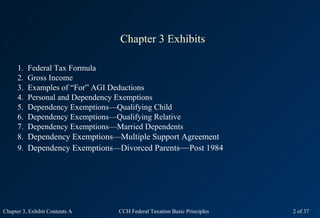
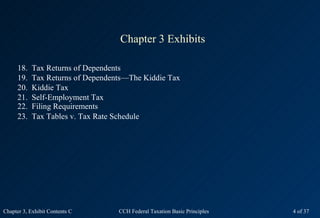
Chapter 3 Exhibits

      1.   Federal Tax Formula
      2.   Gross Income
      3.   Examples of “For” AGI Deductions
      4.   Personal and Dependency Exemptions
      5.   Dependency Exemptions—Qualifying Child
      6.   Dependency Exemptions—Qualifying Relative
      7.   Dependency Exemptions—Married Dependents
      8.   Dependency Exemptions—Multiple Support Agreement
      9.   Dependency Exemptions—Divorced Parents—Post 1984


Chapter 3, Exhibit Contents A    CCH Federal Taxation Basic Principles   2 of 37
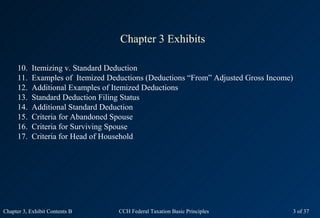
Chapter 3 Exhibits

     10.   Itemizing v. Standard Deduction
     11.   Examples of Itemized Deductions (Deductions “From” Adjusted Gross Income)
     12.   Additional Examples of Itemized Deductions
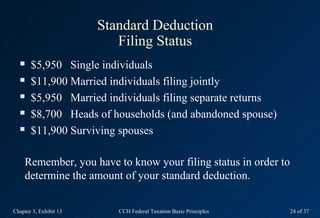
     13.   Standard Deduction Filing Status
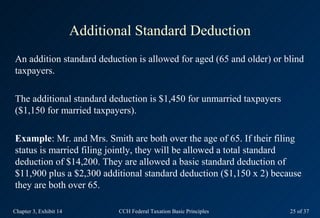
     14.   Additional Standard Deduction
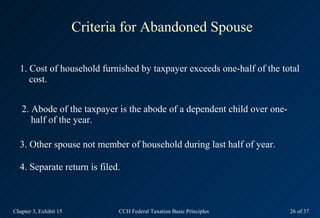
     15.   Criteria for Abandoned Spouse
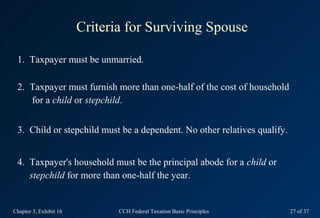
     16.   Criteria for Surviving Spouse
     17.   Criteria for Head of Household


Chapter 3, Exhibit Contents B      CCH Federal Taxation Basic Principles           3 of 37
Chapter 3 Exhibits

     18.   Tax Returns of Dependents
     19.   Tax Returns of Dependents—The Kiddie Tax
     20.   Kiddie Tax
     21.   Self-Employment Tax
     22.   Filing Requirements
     23.   Tax Tables v. Tax Rate Schedule


Chapter 3, Exhibit Contents C     CCH Federal Taxation Basic Principles   4 of 37
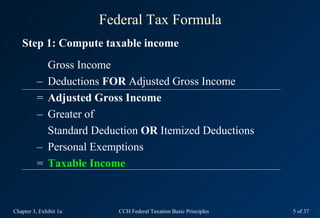
Federal Tax Formula
   Step 1: Compute taxable income
              Gross Income
          –   Deductions FOR Adjusted Gross Income
          =   Adjusted Gross Income
          –   Greater of
              Standard Deduction OR Itemized Deductions
          –   Personal Exemptions
          =   Taxable Income


Chapter 3, Exhibit 1a       CCH Federal Taxation Basic Principles   5 of 37
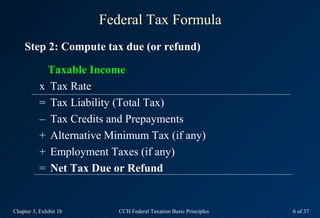
Federal Tax Formula
    Step 2: Compute tax due (or refund)

             Taxable Income
           x Tax Rate
           = Tax Liability (Total Tax)
           – Tax Credits and Prepayments
           + Alternative Minimum Tax (if any)
           + Employment Taxes (if any)
           = Net Tax Due or Refund


Chapter 3, Exhibit 1b      CCH Federal Taxation Basic Principles   6 of 37
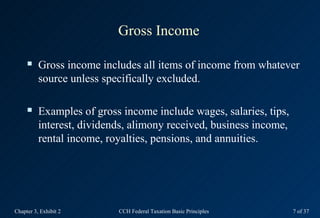
Gross Income

         Gross income includes all items of income from whatever
          source unless specifically excluded.

         Examples of gross income include wages, salaries, tips,
          interest, dividends, alimony received, business income,
          rental income, royalties, pensions, and annuities.


Chapter 3, Exhibit 2       CCH Federal Taxation Basic Principles    7 of 37
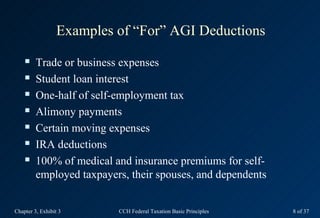
Examples of “For” AGI Deductions
        Trade or business expenses
        Student loan interest
        One-half of self-employment tax
        Alimony payments
        Certain moving expenses
        IRA deductions
        100% of medical and insurance premiums for self-
         employed taxpayers, their spouses, and dependents


Chapter 3, Exhibit 3       CCH Federal Taxation Basic Principles   8 of 37
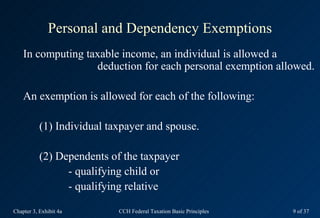
Personal and Dependency Exemptions
    In computing taxable income, an individual is allowed a
                   deduction for each personal exemption allowed.

    An exemption is allowed for each of the following:

           (1) Individual taxpayer and spouse.

           (2) Dependents of the taxpayer
                 - qualifying child or
                 - qualifying relative

Chapter 3, Exhibit 4a       CCH Federal Taxation Basic Principles   9 of 37
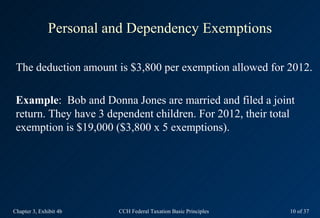
Personal and Dependency Exemptions

 The deduction amount is $3,800 per exemption allowed for 2012.

 Example: Bob and Donna Jones are married and filed a joint
 return. They have 3 dependent children. For 2012, their total
 exemption is $19,000 ($3,800 x 5 exemptions).


Chapter 3, Exhibit 4b   CCH Federal Taxation Basic Principles   10 of 37
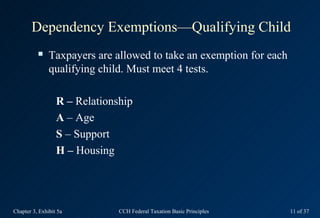
Dependency Exemptions—Qualifying Child
              Taxpayers are allowed to take an exemption for each
               qualifying child. Must meet 4 tests.

                  R – Relationship
                  A – Age
                  S – Support
                  H – Housing


Chapter 3, Exhibit 5a          CCH Federal Taxation Basic Principles   11 of 37
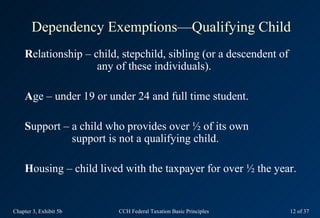
Dependency Exemptions—Qualifying Child
    Relationship – child, stepchild, sibling (or a descendent of
                    any of these individuals).

    Age – under 19 or under 24 and full time student.

    Support – a child who provides over ½ of its own
              support is not a qualifying child.

    Housing – child lived with the taxpayer for over ½ the year.


Chapter 3, Exhibit 5b    CCH Federal Taxation Basic Principles     12 of 37
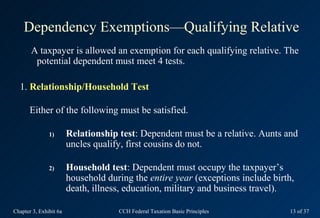
Dependency Exemptions—Qualifying Relative
       A taxpayer is allowed an exemption for each qualifying relative. The
        potential dependent must meet 4 tests.

  1. Relationship/Household Test

       Either of the following must be satisfied.

               1)       Relationship test: Dependent must be a relative. Aunts and
                        uncles qualify, first cousins do not.

               2)       Household test: Dependent must occupy the taxpayer’s
                        household during the entire year (exceptions include birth,
                        death, illness, education, military and business travel).

Chapter 3, Exhibit 6a                CCH Federal Taxation Basic Principles       13 of 37
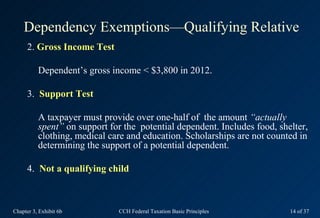
Dependency Exemptions—Qualifying Relative
      2. Gross Income Test

          Dependent’s gross income < $3,800 in 2012.

      3. Support Test

          A taxpayer must provide over one-half of the amount “actually
          spent” on support for the potential dependent. Includes food, shelter,
          clothing, medical care and education. Scholarships are not counted in
          determining the support of a potential dependent.

      4. Not a qualifying child


Chapter 3, Exhibit 6b         CCH Federal Taxation Basic Principles        14 of 37
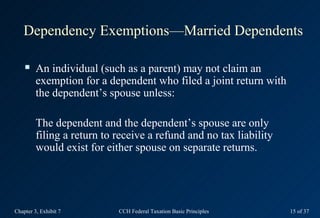
Dependency Exemptions—Married Dependents

        An individual (such as a parent) may not claim an
         exemption for a dependent who filed a joint return with
         the dependent’s spouse unless:

         The dependent and the dependent’s spouse are only
         filing a return to receive a refund and no tax liability
         would exist for either spouse on separate returns.


Chapter 3, Exhibit 7        CCH Federal Taxation Basic Principles   15 of 37
Dependency Exemptions—Multiple
                      Support Agreement
       A taxpayer is considered as having provided over half the
        support of an individual where 2 or more people
        contributed support if the following 4 tests are met.

         1)      No one person contributed over half the support.

         2)      Those who collectively furnished over ½ the support
                 could have claimed the exemption except for the
                 support test.


Chapter 3, Exhibit 8a          CCH Federal Taxation Basic Principles   16 of 37
Dependency Exemptions—Multiple
                      Support Agreement

         3)       The taxpayer claiming the exemption paid over 10%
                  of the support and

         4)       Each person who paid over 10% files a written
                  declaration that they will not claim the individual as a
                  dependent.


Chapter 3, Exhibit 8b           CCH Federal Taxation Basic Principles   17 of 37
Dependency Exemptions
                       Divorced Parents—Post 1984
      The general rule is that the custodial parent is entitled to the
       exemption in all cases UNLESS the following is met:

       The custodial parent files a written declaration waiving the
       right to the exemptions


Chapter 3, Exhibit 9          CCH Federal Taxation Basic Principles   18 of 37
Itemizing v. Standard Deduction
      All taxpayers receive a minimum deduction called the
       standard deduction. The standard deduction is based on
       your filing status.

      Some taxpayers may have expenses that qualify as
       itemized deductions. Itemized deductions are expenses of
       a personal nature that are specifically allowed as a
       deduction.


Chapter 3, Exhibit 10a           CCH Federal Taxation Basic Principles   19 of 37
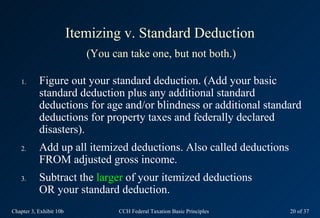
Itemizing v. Standard Deduction
                            (You can take one, but not both.)

   1.      Figure out your standard deduction. (Add your basic
           standard deduction plus any additional standard
           deductions for age and/or blindness or additional standard
           deductions for property taxes and federally declared
           disasters).
   2.      Add up all itemized deductions. Also called deductions
           FROM adjusted gross income.
   3.      Subtract the larger of your itemized deductions
           OR your standard deduction.
Chapter 3, Exhibit 10b             CCH Federal Taxation Basic Principles   20 of 37
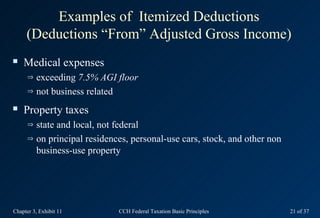
Examples of Itemized Deductions
     (Deductions “From” Adjusted Gross Income)
   Medical expenses
      ⇒ exceeding 7.5% AGI floor
      ⇒ not business related

   Property taxes
      ⇒ state and local, not federal
      ⇒ on principal residences, personal-use cars, stock, and other non

        business-use property


Chapter 3, Exhibit 11        CCH Federal Taxation Basic Principles         21 of 37
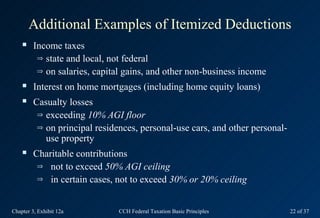
Additional Examples of Itemized Deductions
        Income taxes
          ⇒ state and local, not federal

          ⇒ on salaries, capital gains, and other non-business income

        Interest on home mortgages (including home equity loans)
        Casualty losses
          ⇒ exceeding 10% AGI floor

          ⇒ on principal residences, personal-use cars, and other personal-
            use property
        Charitable contributions
          ⇒ not to exceed 50% AGI ceiling

          ⇒ in certain cases, not to exceed 30% or 20% ceiling


Chapter 3, Exhibit 12a         CCH Federal Taxation Basic Principles          22 of 37
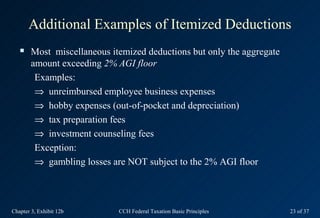
Additional Examples of Itemized Deductions
       Most miscellaneous itemized deductions but only the aggregate
        amount exceeding 2% AGI floor
         Examples:
         ⇒ unreimbursed employee business expenses
         ⇒ hobby expenses (out-of-pocket and depreciation)
         ⇒ tax preparation fees
         ⇒ investment counseling fees
         Exception:
         ⇒ gambling losses are NOT subject to the 2% AGI floor


Chapter 3, Exhibit 12b       CCH Federal Taxation Basic Principles      23 of 37
Standard Deduction
                           Filing Status
      $5,950 Single individuals
      $11,900 Married individuals filing jointly
      $5,950 Married individuals filing separate returns
      $8,700 Heads of households (and abandoned spouse)
      $11,900 Surviving spouses

    Remember, you have to know your filing status in order to
    determine the amount of your standard deduction.


Chapter 3, Exhibit 13      CCH Federal Taxation Basic Principles   24 of 37
Additional Standard Deduction
An addition standard deduction is allowed for aged (65 and older) or blind
taxpayers.

The additional standard deduction is $1,450 for unmarried taxpayers
($1,150 for married taxpayers).

Example: Mr. and Mrs. Smith are both over the age of 65. If their filing
status is married filing jointly, they will be allowed a total standard
deduction of $14,200. They are allowed a basic standard deduction of
$11,900 plus a $2,300 additional standard deduction ($1,150 x 2) because
they are both over 65.

Chapter 3, Exhibit 14          CCH Federal Taxation Basic Principles   25 of 37
Criteria for Abandoned Spouse

  1. Cost of household furnished by taxpayer exceeds one-half of the total
     cost.


   2. Abode of the taxpayer is the abode of a dependent child over one-
      half of the year.

  3. Other spouse not member of household during last half of year.

  4. Separate return is filed.


Chapter 3, Exhibit 15          CCH Federal Taxation Basic Principles      26 of 37
Criteria for Surviving Spouse

 1. Taxpayer must be unmarried.

 2. Taxpayer must furnish more than one-half of the cost of household
    for a child or stepchild.


 3. Child or stepchild must be a dependent. No other relatives qualify.


 4. Taxpayer's household must be the principal abode for a child or
    stepchild for more than one-half the year.


Chapter 3, Exhibit 16          CCH Federal Taxation Basic Principles      27 of 37
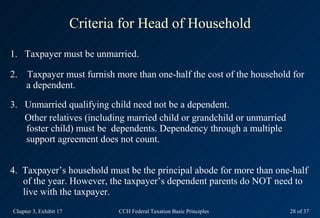
Criteria for Head of Household
1. Taxpayer must be unmarried.

2. Taxpayer must furnish more than one-half the cost of the household for
   a dependent.

3. Unmarried qualifying child need not be a dependent.
   Other relatives (including married child or grandchild or unmarried
   foster child) must be dependents. Dependency through a multiple
   support agreement does not count.


4. Taxpayer’s household must be the principal abode for more than one-half
   of the year. However, the taxpayer’s dependent parents do NOT need to
   live with the taxpayer.
Chapter 3, Exhibit 17           CCH Federal Taxation Basic Principles    28 of 37
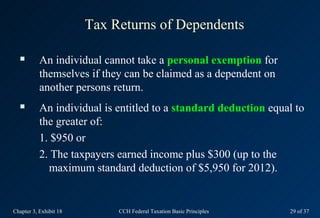
Tax Returns of Dependents

          An individual cannot take a personal exemption for
           themselves if they can be claimed as a dependent on
           another persons return.
          An individual is entitled to a standard deduction equal to
           the greater of:
           1. $950 or
           2. The taxpayers earned income plus $300 (up to the
             maximum standard deduction of $5,950 for 2012).


Chapter 3, Exhibit 18        CCH Federal Taxation Basic Principles   29 of 37
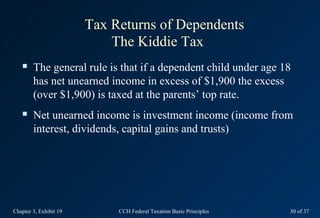
Tax Returns of Dependents
                            The Kiddie Tax
       The general rule is that if a dependent child under age 18
        has net unearned income in excess of $1,900 the excess
        (over $1,900) is taxed at the parents’ top rate.
       Net unearned income is investment income (income from
        interest, dividends, capital gains and trusts)


Chapter 3, Exhibit 19        CCH Federal Taxation Basic Principles   30 of 37
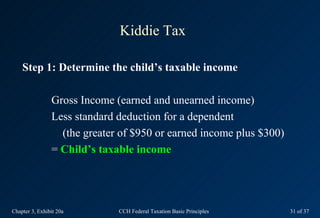
Kiddie Tax

    Step 1: Determine the child’s taxable income

                Gross Income (earned and unearned income)
                Less standard deduction for a dependent
                  (the greater of $950 or earned income plus $300)
                = Child’s taxable income


Chapter 3, Exhibit 20a        CCH Federal Taxation Basic Principles   31 of 37
Kiddie Tax
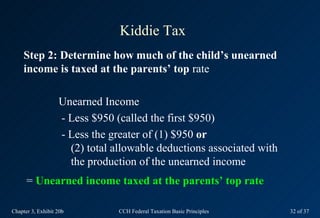
     Step 2: Determine how much of the child’s unearned
     income is taxed at the parents’ top rate

                   Unearned Income
                   - Less $950 (called the first $950)
                   - Less the greater of (1) $950 or
                     (2) total allowable deductions associated with
                     the production of the unearned income
      = Unearned income taxed at the parents’ top rate

Chapter 3, Exhibit 20b          CCH Federal Taxation Basic Principles   32 of 37
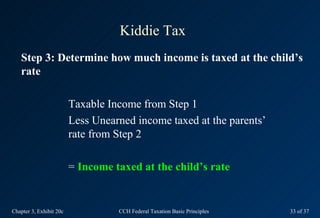
Kiddie Tax
   Step 3: Determine how much income is taxed at the child’s
   rate

                         Taxable Income from Step 1
                         Less Unearned income taxed at the parents’
                         rate from Step 2

                         = Income taxed at the child’s rate


Chapter 3, Exhibit 20c             CCH Federal Taxation Basic Principles   33 of 37
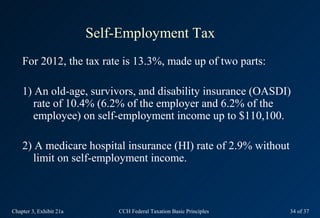
Self-Employment Tax
    For 2012, the tax rate is 13.3%, made up of two parts:

    1) An old-age, survivors, and disability insurance (OASDI)
       rate of 10.4% (6.2% of the employer and 6.2% of the
       employee) on self-employment income up to $110,100.

    2) A medicare hospital insurance (HI) rate of 2.9% without
       limit on self-employment income.


Chapter 3, Exhibit 21a       CCH Federal Taxation Basic Principles   34 of 37
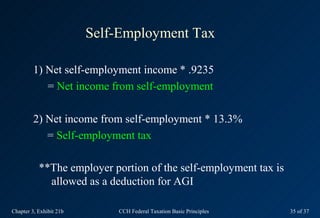
Self-Employment Tax

         1) Net self-employment income * .9235
            = Net income from self-employment

         2) Net income from self-employment * 13.3%
            = Self-employment tax

           **The employer portion of the self-employment tax is
             allowed as a deduction for AGI

Chapter 3, Exhibit 21b       CCH Federal Taxation Basic Principles   35 of 37
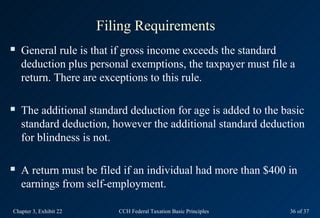
Filing Requirements
   General rule is that if gross income exceeds the standard
    deduction plus personal exemptions, the taxpayer must file a
    return. There are exceptions to this rule.

   The additional standard deduction for age is added to the basic
    standard deduction, however the additional standard deduction
    for blindness is not.

   A return must be filed if an individual had more than $400 in
    earnings from self-employment.

Chapter 3, Exhibit 22      CCH Federal Taxation Basic Principles   36 of 37
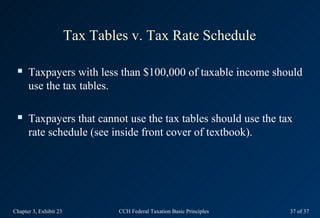
Tax Tables v. Tax Rate Schedule

     Taxpayers with less than $100,000 of taxable income should
      use the tax tables.

     Taxpayers that cannot use the tax tables should use the tax
      rate schedule (see inside front cover of textbook).


Chapter 3, Exhibit 23           CCH Federal Taxation Basic Principles   37 of 37

2013 cch basic principles ch03

  • 1.
    Chapter 3 Individual Taxation An Overview ©2012 CCH. All Rights Reserved. 4025 W. Peterson Ave. Chicago, IL 60646-6085 1 800 248 3248 www.CCHGroup.com
  • 2.
    Chapter 3 Exhibits 1. Federal Tax Formula 2. Gross Income 3. Examples of “For” AGI Deductions 4. Personal and Dependency Exemptions 5. Dependency Exemptions—Qualifying Child 6. Dependency Exemptions—Qualifying Relative 7. Dependency Exemptions—Married Dependents 8. Dependency Exemptions—Multiple Support Agreement 9. Dependency Exemptions—Divorced Parents—Post 1984 Chapter 3, Exhibit Contents A CCH Federal Taxation Basic Principles 2 of 37
  • 3.
    Chapter 3 Exhibits 10. Itemizing v. Standard Deduction 11. Examples of Itemized Deductions (Deductions “From” Adjusted Gross Income) 12. Additional Examples of Itemized Deductions 13. Standard Deduction Filing Status 14. Additional Standard Deduction 15. Criteria for Abandoned Spouse 16. Criteria for Surviving Spouse 17. Criteria for Head of Household Chapter 3, Exhibit Contents B CCH Federal Taxation Basic Principles 3 of 37
  • 4.
    Chapter 3 Exhibits 18. Tax Returns of Dependents 19. Tax Returns of Dependents—The Kiddie Tax 20. Kiddie Tax 21. Self-Employment Tax 22. Filing Requirements 23. Tax Tables v. Tax Rate Schedule Chapter 3, Exhibit Contents C CCH Federal Taxation Basic Principles 4 of 37
  • 5.
    Federal Tax Formula Step 1: Compute taxable income Gross Income – Deductions FOR Adjusted Gross Income = Adjusted Gross Income – Greater of Standard Deduction OR Itemized Deductions – Personal Exemptions = Taxable Income Chapter 3, Exhibit 1a CCH Federal Taxation Basic Principles 5 of 37
  • 6.
    Federal Tax Formula Step 2: Compute tax due (or refund) Taxable Income x Tax Rate = Tax Liability (Total Tax) – Tax Credits and Prepayments + Alternative Minimum Tax (if any) + Employment Taxes (if any) = Net Tax Due or Refund Chapter 3, Exhibit 1b CCH Federal Taxation Basic Principles 6 of 37
  • 7.
    Gross Income  Gross income includes all items of income from whatever source unless specifically excluded.  Examples of gross income include wages, salaries, tips, interest, dividends, alimony received, business income, rental income, royalties, pensions, and annuities. Chapter 3, Exhibit 2 CCH Federal Taxation Basic Principles 7 of 37
  • 8.
    Examples of “For”AGI Deductions  Trade or business expenses  Student loan interest  One-half of self-employment tax  Alimony payments  Certain moving expenses  IRA deductions  100% of medical and insurance premiums for self- employed taxpayers, their spouses, and dependents Chapter 3, Exhibit 3 CCH Federal Taxation Basic Principles 8 of 37
  • 9.
    Personal and DependencyExemptions In computing taxable income, an individual is allowed a deduction for each personal exemption allowed. An exemption is allowed for each of the following: (1) Individual taxpayer and spouse. (2) Dependents of the taxpayer - qualifying child or - qualifying relative Chapter 3, Exhibit 4a CCH Federal Taxation Basic Principles 9 of 37
  • 10.
    Personal and DependencyExemptions The deduction amount is $3,800 per exemption allowed for 2012. Example: Bob and Donna Jones are married and filed a joint return. They have 3 dependent children. For 2012, their total exemption is $19,000 ($3,800 x 5 exemptions). Chapter 3, Exhibit 4b CCH Federal Taxation Basic Principles 10 of 37
  • 11.
    Dependency Exemptions—Qualifying Child  Taxpayers are allowed to take an exemption for each qualifying child. Must meet 4 tests. R – Relationship A – Age S – Support H – Housing Chapter 3, Exhibit 5a CCH Federal Taxation Basic Principles 11 of 37
  • 12.
    Dependency Exemptions—Qualifying Child Relationship – child, stepchild, sibling (or a descendent of any of these individuals). Age – under 19 or under 24 and full time student. Support – a child who provides over ½ of its own support is not a qualifying child. Housing – child lived with the taxpayer for over ½ the year. Chapter 3, Exhibit 5b CCH Federal Taxation Basic Principles 12 of 37
  • 13.
    Dependency Exemptions—Qualifying Relative A taxpayer is allowed an exemption for each qualifying relative. The potential dependent must meet 4 tests. 1. Relationship/Household Test Either of the following must be satisfied. 1) Relationship test: Dependent must be a relative. Aunts and uncles qualify, first cousins do not. 2) Household test: Dependent must occupy the taxpayer’s household during the entire year (exceptions include birth, death, illness, education, military and business travel). Chapter 3, Exhibit 6a CCH Federal Taxation Basic Principles 13 of 37
  • 14.
    Dependency Exemptions—Qualifying Relative 2. Gross Income Test Dependent’s gross income < $3,800 in 2012. 3. Support Test A taxpayer must provide over one-half of the amount “actually spent” on support for the potential dependent. Includes food, shelter, clothing, medical care and education. Scholarships are not counted in determining the support of a potential dependent. 4. Not a qualifying child Chapter 3, Exhibit 6b CCH Federal Taxation Basic Principles 14 of 37
  • 15.
    Dependency Exemptions—Married Dependents  An individual (such as a parent) may not claim an exemption for a dependent who filed a joint return with the dependent’s spouse unless: The dependent and the dependent’s spouse are only filing a return to receive a refund and no tax liability would exist for either spouse on separate returns. Chapter 3, Exhibit 7 CCH Federal Taxation Basic Principles 15 of 37
  • 16.
    Dependency Exemptions—Multiple Support Agreement  A taxpayer is considered as having provided over half the support of an individual where 2 or more people contributed support if the following 4 tests are met. 1) No one person contributed over half the support. 2) Those who collectively furnished over ½ the support could have claimed the exemption except for the support test. Chapter 3, Exhibit 8a CCH Federal Taxation Basic Principles 16 of 37
  • 17.
    Dependency Exemptions—Multiple Support Agreement 3) The taxpayer claiming the exemption paid over 10% of the support and 4) Each person who paid over 10% files a written declaration that they will not claim the individual as a dependent. Chapter 3, Exhibit 8b CCH Federal Taxation Basic Principles 17 of 37
  • 18.
    Dependency Exemptions Divorced Parents—Post 1984  The general rule is that the custodial parent is entitled to the exemption in all cases UNLESS the following is met: The custodial parent files a written declaration waiving the right to the exemptions Chapter 3, Exhibit 9 CCH Federal Taxation Basic Principles 18 of 37
  • 19.
    Itemizing v. StandardDeduction  All taxpayers receive a minimum deduction called the standard deduction. The standard deduction is based on your filing status.  Some taxpayers may have expenses that qualify as itemized deductions. Itemized deductions are expenses of a personal nature that are specifically allowed as a deduction. Chapter 3, Exhibit 10a CCH Federal Taxation Basic Principles 19 of 37
  • 20.
    Itemizing v. StandardDeduction (You can take one, but not both.) 1. Figure out your standard deduction. (Add your basic standard deduction plus any additional standard deductions for age and/or blindness or additional standard deductions for property taxes and federally declared disasters). 2. Add up all itemized deductions. Also called deductions FROM adjusted gross income. 3. Subtract the larger of your itemized deductions OR your standard deduction. Chapter 3, Exhibit 10b CCH Federal Taxation Basic Principles 20 of 37
  • 21.
    Examples of ItemizedDeductions (Deductions “From” Adjusted Gross Income)  Medical expenses ⇒ exceeding 7.5% AGI floor ⇒ not business related  Property taxes ⇒ state and local, not federal ⇒ on principal residences, personal-use cars, stock, and other non business-use property Chapter 3, Exhibit 11 CCH Federal Taxation Basic Principles 21 of 37
  • 22.
    Additional Examples ofItemized Deductions  Income taxes ⇒ state and local, not federal ⇒ on salaries, capital gains, and other non-business income  Interest on home mortgages (including home equity loans)  Casualty losses ⇒ exceeding 10% AGI floor ⇒ on principal residences, personal-use cars, and other personal- use property  Charitable contributions ⇒ not to exceed 50% AGI ceiling ⇒ in certain cases, not to exceed 30% or 20% ceiling Chapter 3, Exhibit 12a CCH Federal Taxation Basic Principles 22 of 37
  • 23.
    Additional Examples ofItemized Deductions  Most miscellaneous itemized deductions but only the aggregate amount exceeding 2% AGI floor Examples: ⇒ unreimbursed employee business expenses ⇒ hobby expenses (out-of-pocket and depreciation) ⇒ tax preparation fees ⇒ investment counseling fees Exception: ⇒ gambling losses are NOT subject to the 2% AGI floor Chapter 3, Exhibit 12b CCH Federal Taxation Basic Principles 23 of 37
  • 24.
    Standard Deduction Filing Status  $5,950 Single individuals  $11,900 Married individuals filing jointly  $5,950 Married individuals filing separate returns  $8,700 Heads of households (and abandoned spouse)  $11,900 Surviving spouses Remember, you have to know your filing status in order to determine the amount of your standard deduction. Chapter 3, Exhibit 13 CCH Federal Taxation Basic Principles 24 of 37
  • 25.
    Additional Standard Deduction Anaddition standard deduction is allowed for aged (65 and older) or blind taxpayers. The additional standard deduction is $1,450 for unmarried taxpayers ($1,150 for married taxpayers). Example: Mr. and Mrs. Smith are both over the age of 65. If their filing status is married filing jointly, they will be allowed a total standard deduction of $14,200. They are allowed a basic standard deduction of $11,900 plus a $2,300 additional standard deduction ($1,150 x 2) because they are both over 65. Chapter 3, Exhibit 14 CCH Federal Taxation Basic Principles 25 of 37
  • 26.
    Criteria for AbandonedSpouse 1. Cost of household furnished by taxpayer exceeds one-half of the total cost. 2. Abode of the taxpayer is the abode of a dependent child over one- half of the year. 3. Other spouse not member of household during last half of year. 4. Separate return is filed. Chapter 3, Exhibit 15 CCH Federal Taxation Basic Principles 26 of 37
  • 27.
    Criteria for SurvivingSpouse 1. Taxpayer must be unmarried. 2. Taxpayer must furnish more than one-half of the cost of household for a child or stepchild. 3. Child or stepchild must be a dependent. No other relatives qualify. 4. Taxpayer's household must be the principal abode for a child or stepchild for more than one-half the year. Chapter 3, Exhibit 16 CCH Federal Taxation Basic Principles 27 of 37
  • 28.
    Criteria for Headof Household 1. Taxpayer must be unmarried. 2. Taxpayer must furnish more than one-half the cost of the household for a dependent. 3. Unmarried qualifying child need not be a dependent. Other relatives (including married child or grandchild or unmarried foster child) must be dependents. Dependency through a multiple support agreement does not count. 4. Taxpayer’s household must be the principal abode for more than one-half of the year. However, the taxpayer’s dependent parents do NOT need to live with the taxpayer. Chapter 3, Exhibit 17 CCH Federal Taxation Basic Principles 28 of 37
  • 29.
    Tax Returns ofDependents  An individual cannot take a personal exemption for themselves if they can be claimed as a dependent on another persons return.  An individual is entitled to a standard deduction equal to the greater of: 1. $950 or 2. The taxpayers earned income plus $300 (up to the maximum standard deduction of $5,950 for 2012). Chapter 3, Exhibit 18 CCH Federal Taxation Basic Principles 29 of 37
  • 30.
    Tax Returns ofDependents The Kiddie Tax  The general rule is that if a dependent child under age 18 has net unearned income in excess of $1,900 the excess (over $1,900) is taxed at the parents’ top rate.  Net unearned income is investment income (income from interest, dividends, capital gains and trusts) Chapter 3, Exhibit 19 CCH Federal Taxation Basic Principles 30 of 37
  • 31.
    Kiddie Tax Step 1: Determine the child’s taxable income Gross Income (earned and unearned income) Less standard deduction for a dependent (the greater of $950 or earned income plus $300) = Child’s taxable income Chapter 3, Exhibit 20a CCH Federal Taxation Basic Principles 31 of 37
  • 32.
    Kiddie Tax Step 2: Determine how much of the child’s unearned income is taxed at the parents’ top rate Unearned Income - Less $950 (called the first $950) - Less the greater of (1) $950 or (2) total allowable deductions associated with the production of the unearned income = Unearned income taxed at the parents’ top rate Chapter 3, Exhibit 20b CCH Federal Taxation Basic Principles 32 of 37
  • 33.
    Kiddie Tax Step 3: Determine how much income is taxed at the child’s rate Taxable Income from Step 1 Less Unearned income taxed at the parents’ rate from Step 2 = Income taxed at the child’s rate Chapter 3, Exhibit 20c CCH Federal Taxation Basic Principles 33 of 37
  • 34.
    Self-Employment Tax For 2012, the tax rate is 13.3%, made up of two parts: 1) An old-age, survivors, and disability insurance (OASDI) rate of 10.4% (6.2% of the employer and 6.2% of the employee) on self-employment income up to $110,100. 2) A medicare hospital insurance (HI) rate of 2.9% without limit on self-employment income. Chapter 3, Exhibit 21a CCH Federal Taxation Basic Principles 34 of 37
  • 35.
    Self-Employment Tax 1) Net self-employment income * .9235 = Net income from self-employment 2) Net income from self-employment * 13.3% = Self-employment tax **The employer portion of the self-employment tax is allowed as a deduction for AGI Chapter 3, Exhibit 21b CCH Federal Taxation Basic Principles 35 of 37
  • 36.
    Filing Requirements  General rule is that if gross income exceeds the standard deduction plus personal exemptions, the taxpayer must file a return. There are exceptions to this rule.  The additional standard deduction for age is added to the basic standard deduction, however the additional standard deduction for blindness is not.  A return must be filed if an individual had more than $400 in earnings from self-employment. Chapter 3, Exhibit 22 CCH Federal Taxation Basic Principles 36 of 37
  • 37.
    Tax Tables v.Tax Rate Schedule  Taxpayers with less than $100,000 of taxable income should use the tax tables.  Taxpayers that cannot use the tax tables should use the tax rate schedule (see inside front cover of textbook). Chapter 3, Exhibit 23 CCH Federal Taxation Basic Principles 37 of 37