Direct Tax Laws
Income under the Head
Capital Gains
Presented by
Dr. M. Baby
Associate Professor in Corporate
Secretaryship
Vellalar College for
Women(Autonomous)
Erode
INTRODUCTION
CAPITAL GAINS “Any profit or gains
arising from the transfer of capital assets
is taxable under the head capital gains in
the previous year in which the transfer has
taken place.”
The capital asset should be transferred by
the assessee.
Such transfer should take place during the
previous year.
The profits or gains should arise as a
result of this transfer
DEFINITION OF CAPITAL
ASSETS
Capital asset is defined to include property of
any kind, whether fixed or circulating,
movable or immovable, tangible or intangible
What is not a Capital Asset? a) Any stock-in-
trade, consumable stores or raw material
held for the purposes of business or
profession. b) Movable property of the
Assessee including wearing apparel and
furniture held for his personal use or for the
use of any member of his family dependent
on him. The exception to this condition is
jewellery, which is treated as a capital asset,
even though it is meant for personal use.
c) Agricultural land in India provided it is not
situated in urban area. d) 6 ½ % Gold
Bonds, 7% Gold Bonds or National
Defence Gold Bonds, issued by the
central government. e) Special Bearer
Bonds, and f) Gold Deposit bonds issued
under Gold Deposit Scheme of 1999.
Type of Capital Assets
 Short Term Capital Asset “Short term
capital assets” means a capital asset
held by the assessee for not more than
36 months, immediately prior to its date
of transfer. However, the following assets
are treated as short term assets if they
are held for not more than 12 months,
they are:
 1. Equity or preference shares in a
company
 2. Securities like debentures,
government securities listed in a
recognized stock exchange in India
 3. Units of UTI and 4. Units of mutual
Long Term Capital Asset
 An asset, which is held by the
assessee for 36 months or more,
immediately before its transfer, is
called Long Term Capital Assets.
 In other words, an asset, which is
transferred on or after 36 months of its
acquisition by assessee, is called
Long Term Capital Assets.
Types of Capital Gain
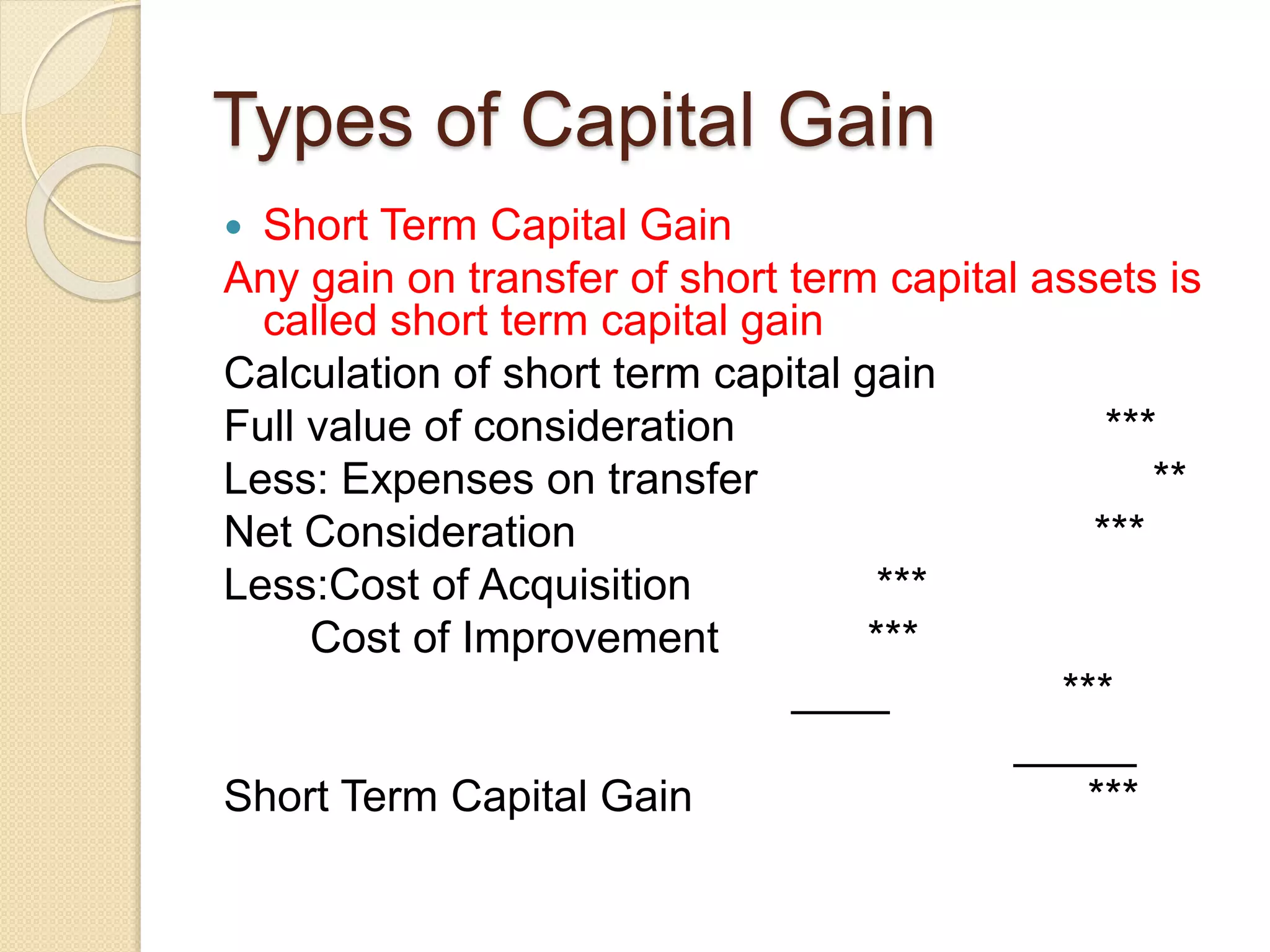
 Short Term Capital Gain
Any gain on transfer of short term capital assets is
called short term capital gain
Calculation of short term capital gain
Full value of consideration ***
Less: Expenses on transfer **
Net Consideration ***
Less:Cost of Acquisition ***
Cost of Improvement ***
____ ***
_____
Short Term Capital Gain ***
Long Term Capital Gain
 Any gain on transfer of long term capital assets is called
long term capital gain
Calculation of Long Term Capital Gain
Full value of consideration ***
Less: Expenses on transfer **
Net Consideration ***
Less:Indexed Cost of Acquisition ***
Indexed Cost of Improvement ***
____ ***
_____
Long Term Capital Gain ***
Calculation of Indexed Cost of
Acquisition
 Long term assets acquired before 1.4.2001
Actual Cost (or) F.M.V(w. e. m) /C.I.I. for the year 2001-
2002 i.e., 100 *C.I.I. for the year of Sale i.e., 2018-19
 Long term assets acquired after 1.4.2001
Actual Cost /C.I.I. for the year of purchase *C.I.I. for the
year of Sale i.e., 2018-19
 Long term assets acquired before 1.4.2001but
transferred to the present seller on or after 1.4.2001
Actual Cost (or) F.M.V(w. e. m) /C.I.I. for the year when
present seller became its owner *C.I.I. for the year of
Sale i.e., 2018-19
Indexed cost of Improvement
 No indexing for the improvement made
before 1.4.2001
 Improvement made after 1.4.2001
Cost of Improvement / C.I.I. for the year of
Improvement * C.I.I. for the year of Sale
Advance money received and
forfeited by the present seller
The cost of such asset shall be reduced
by such advance money received and forfeited
by the assessee. In case FMV on 1.4.2001 is
adopted and advance money is received either
before or after this date and is forfeited, it shall
be reduced out of the F.M.V
Capital Gains Exempted u/s 54
Capital gain on Transfer of Long Term
Residential House Property
Income /Gain from sale of long term residential
house property is reinvested in;
 purchase of another residential house within one
year before or two years after the sale of the house
(or)
 Construction of new house within three years after
the sale of the house
 The amount of capital gain so invested shall be
exempted from tax
 New house property can not be transferred for
next 3 years
Capital Gain on Transfer of any Long
Term Capital Assets re invested in Long
Term Specified Assets
In case the capital gain arises from the
transfer of a long term capital assets and the
assessee has, a any time within a period of 6
month after the date of such transfer, invested
the whole or any part of capital gains in the
long term specified assets, such capital gain
shall be exempted
Long Term Specified Assets
LTSA means any bond redeemable after 5
years and issued by
National Highway Authority of India
Rural Electrification Corporation Ltd
Power Finance Corporation
Transfer of any Long Term Capital Asset
(other than Residential House) and invested in
the Purchase or Construction of a Residential
House (sec 54 F)
Exempted Long Term Capital Gain
 Long Term Capital Gain * Amount Invested in
New House / Net Consideration
AMOUNT DEPOSITED IN CAPITAL GAIN DEPOSIT
ACCOUNT SCHEME
 In case the amount of capital gain is not
reinvested for the purchase or construction
of the new residential house up to the last
date of filling of return of income u/s 139
then it should be deposited in the capital
gain deposit account scheme
 The amount so deposited must be utilised
within 3 years unless it will be taxable
THANK YOU

PPT on Capital Gains

  • 1.
    Direct Tax Laws Incomeunder the Head Capital Gains
  • 2.
    Presented by Dr. M.Baby Associate Professor in Corporate Secretaryship Vellalar College for Women(Autonomous) Erode
  • 3.
    INTRODUCTION CAPITAL GAINS “Anyprofit or gains arising from the transfer of capital assets is taxable under the head capital gains in the previous year in which the transfer has taken place.” The capital asset should be transferred by the assessee. Such transfer should take place during the previous year. The profits or gains should arise as a result of this transfer
  • 4.
    DEFINITION OF CAPITAL ASSETS Capitalasset is defined to include property of any kind, whether fixed or circulating, movable or immovable, tangible or intangible What is not a Capital Asset? a) Any stock-in- trade, consumable stores or raw material held for the purposes of business or profession. b) Movable property of the Assessee including wearing apparel and furniture held for his personal use or for the use of any member of his family dependent on him. The exception to this condition is jewellery, which is treated as a capital asset, even though it is meant for personal use.
  • 5.
    c) Agricultural landin India provided it is not situated in urban area. d) 6 ½ % Gold Bonds, 7% Gold Bonds or National Defence Gold Bonds, issued by the central government. e) Special Bearer Bonds, and f) Gold Deposit bonds issued under Gold Deposit Scheme of 1999.
  • 6.
    Type of CapitalAssets  Short Term Capital Asset “Short term capital assets” means a capital asset held by the assessee for not more than 36 months, immediately prior to its date of transfer. However, the following assets are treated as short term assets if they are held for not more than 12 months, they are:  1. Equity or preference shares in a company  2. Securities like debentures, government securities listed in a recognized stock exchange in India  3. Units of UTI and 4. Units of mutual
  • 7.
    Long Term CapitalAsset  An asset, which is held by the assessee for 36 months or more, immediately before its transfer, is called Long Term Capital Assets.  In other words, an asset, which is transferred on or after 36 months of its acquisition by assessee, is called Long Term Capital Assets.
  • 8.
    Types of CapitalGain  Short Term Capital Gain Any gain on transfer of short term capital assets is called short term capital gain Calculation of short term capital gain Full value of consideration *** Less: Expenses on transfer ** Net Consideration *** Less:Cost of Acquisition *** Cost of Improvement *** ____ *** _____ Short Term Capital Gain ***
  • 9.
    Long Term CapitalGain  Any gain on transfer of long term capital assets is called long term capital gain Calculation of Long Term Capital Gain Full value of consideration *** Less: Expenses on transfer ** Net Consideration *** Less:Indexed Cost of Acquisition *** Indexed Cost of Improvement *** ____ *** _____ Long Term Capital Gain ***
  • 10.
    Calculation of IndexedCost of Acquisition  Long term assets acquired before 1.4.2001 Actual Cost (or) F.M.V(w. e. m) /C.I.I. for the year 2001- 2002 i.e., 100 *C.I.I. for the year of Sale i.e., 2018-19  Long term assets acquired after 1.4.2001 Actual Cost /C.I.I. for the year of purchase *C.I.I. for the year of Sale i.e., 2018-19  Long term assets acquired before 1.4.2001but transferred to the present seller on or after 1.4.2001 Actual Cost (or) F.M.V(w. e. m) /C.I.I. for the year when present seller became its owner *C.I.I. for the year of Sale i.e., 2018-19
  • 11.
    Indexed cost ofImprovement  No indexing for the improvement made before 1.4.2001  Improvement made after 1.4.2001 Cost of Improvement / C.I.I. for the year of Improvement * C.I.I. for the year of Sale
  • 12.
    Advance money receivedand forfeited by the present seller The cost of such asset shall be reduced by such advance money received and forfeited by the assessee. In case FMV on 1.4.2001 is adopted and advance money is received either before or after this date and is forfeited, it shall be reduced out of the F.M.V
  • 13.
    Capital Gains Exemptedu/s 54 Capital gain on Transfer of Long Term Residential House Property Income /Gain from sale of long term residential house property is reinvested in;  purchase of another residential house within one year before or two years after the sale of the house (or)  Construction of new house within three years after the sale of the house  The amount of capital gain so invested shall be exempted from tax  New house property can not be transferred for next 3 years
  • 14.
    Capital Gain onTransfer of any Long Term Capital Assets re invested in Long Term Specified Assets In case the capital gain arises from the transfer of a long term capital assets and the assessee has, a any time within a period of 6 month after the date of such transfer, invested the whole or any part of capital gains in the long term specified assets, such capital gain shall be exempted
  • 15.
    Long Term SpecifiedAssets LTSA means any bond redeemable after 5 years and issued by National Highway Authority of India Rural Electrification Corporation Ltd Power Finance Corporation
  • 16.
    Transfer of anyLong Term Capital Asset (other than Residential House) and invested in the Purchase or Construction of a Residential House (sec 54 F) Exempted Long Term Capital Gain  Long Term Capital Gain * Amount Invested in New House / Net Consideration
  • 17.
    AMOUNT DEPOSITED INCAPITAL GAIN DEPOSIT ACCOUNT SCHEME  In case the amount of capital gain is not reinvested for the purchase or construction of the new residential house up to the last date of filling of return of income u/s 139 then it should be deposited in the capital gain deposit account scheme  The amount so deposited must be utilised within 3 years unless it will be taxable
  • 18.