Spaces for Knowledge
                           Generation: A Framework
                             for Designing Student
                            Learning Environments

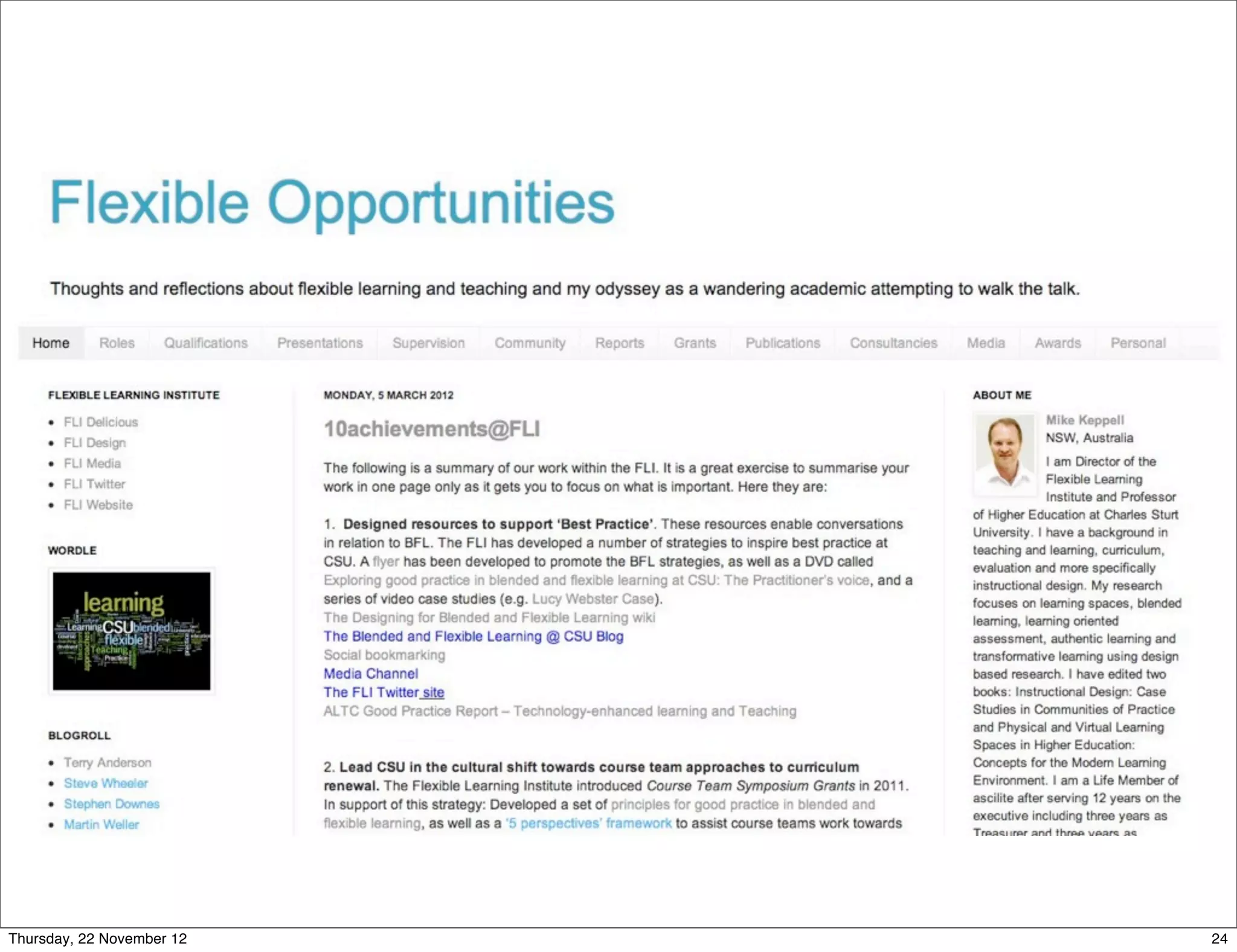
                                  Professor Mike Keppell
                                    Executive Director
                            Australian Digital Futures Institute

                                                                   1

Thursday, 22 November 12                                               1
Overview
     ‣   What are the trends and challenges we need
         to consider?
     ‣   What are ‘spaces for knowledge generation’?
     ‣   What is a framework for designing student
         learning environments?
     ‣   How do we meet student needs and improve
         the learning environment?
     ‣   What design principles are useful for learning
         space design?

                                                          2

Thursday, 22 November 12                                      2
What are the trends and
                challenges we need to consider?


                                                  3

Thursday, 22 November 12                              3
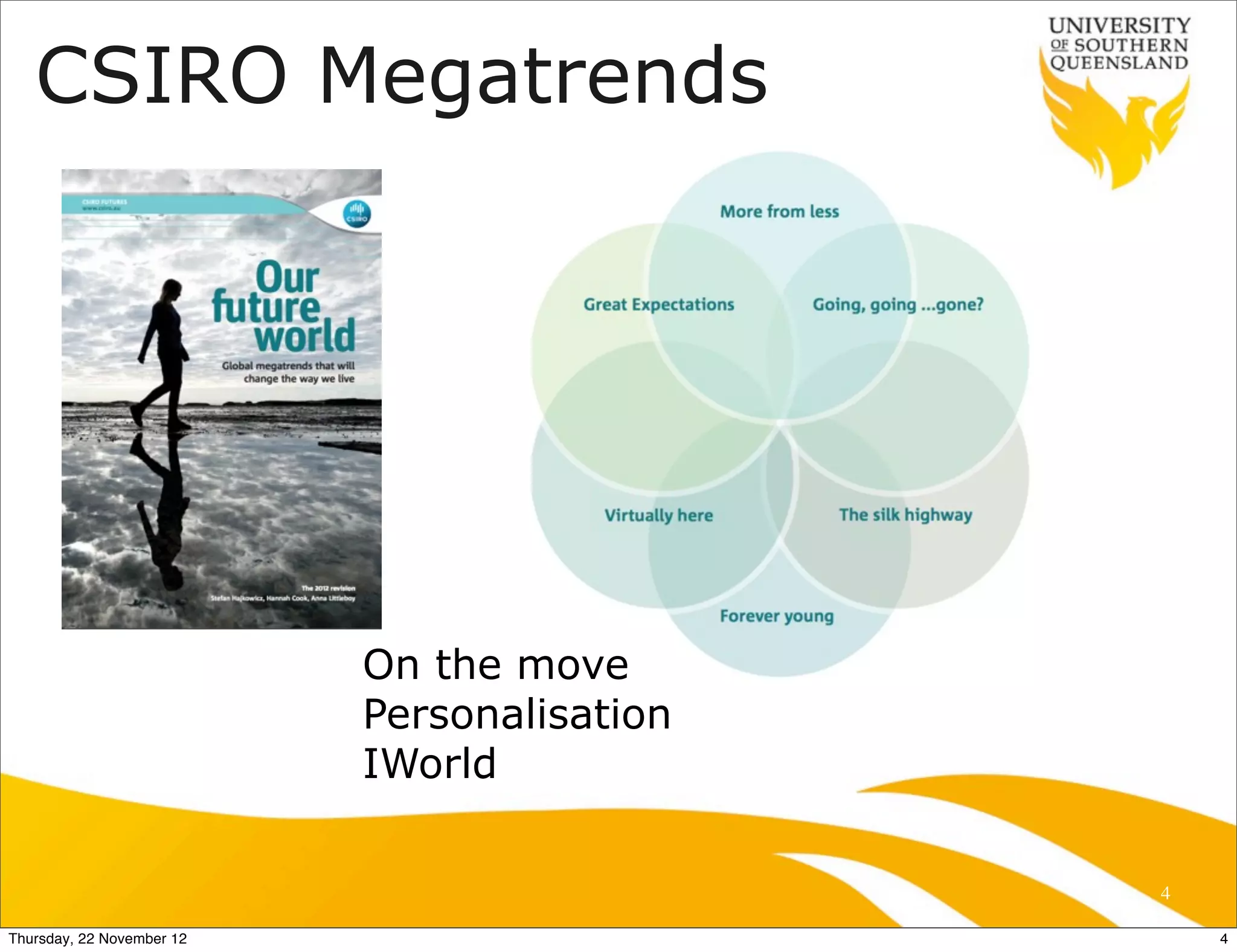
CSIRO Megatrends


                           On the move
                           Personalisation
                           IWorld

                                             4

Thursday, 22 November 12                         4
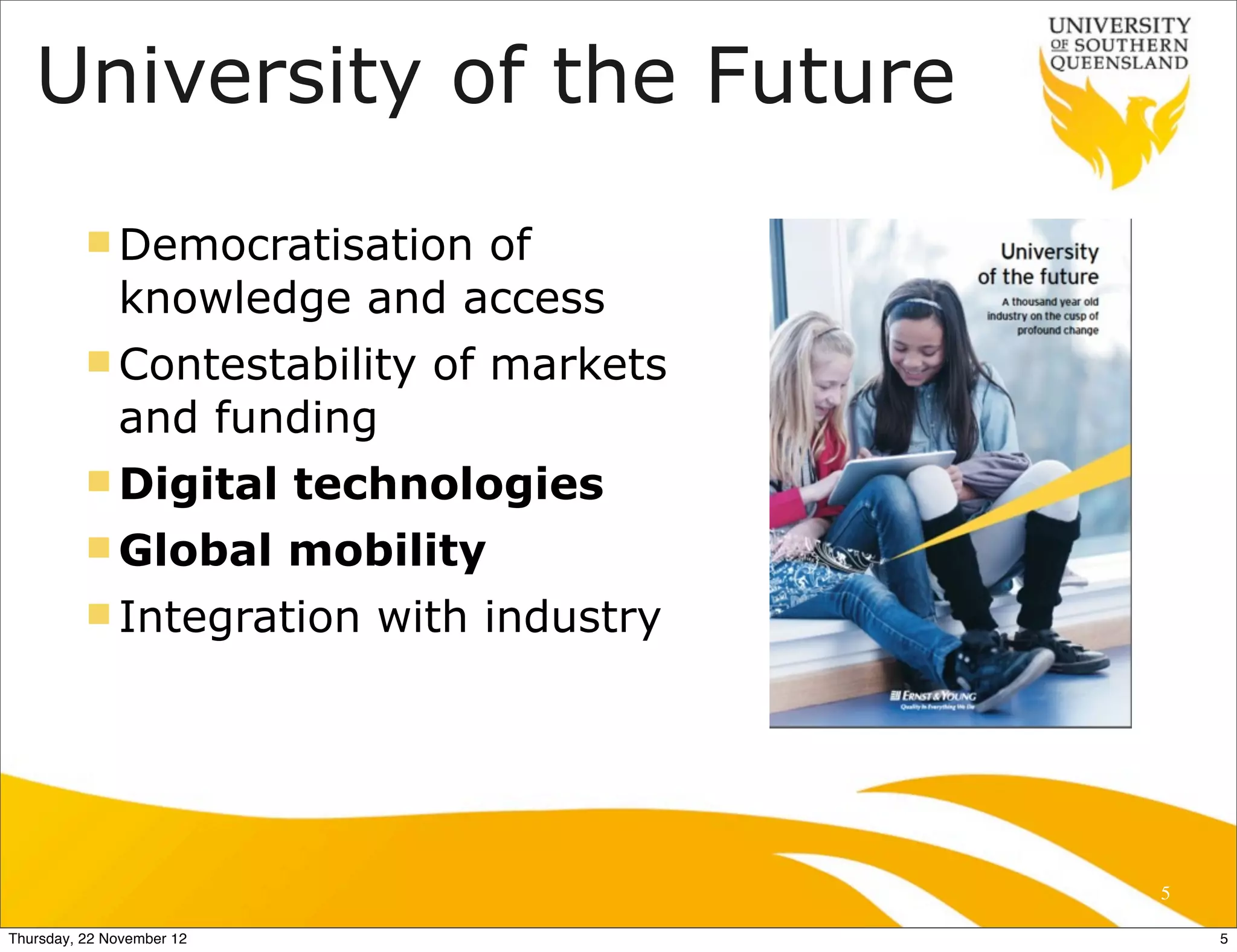
University of the Future
          n Democratisation of
              knowledge and access
          n Contestability     of markets
              and funding
          n Digital       technologies
          n Global        mobility
          n Integration      with industry


                                              5

Thursday, 22 November 12                          5
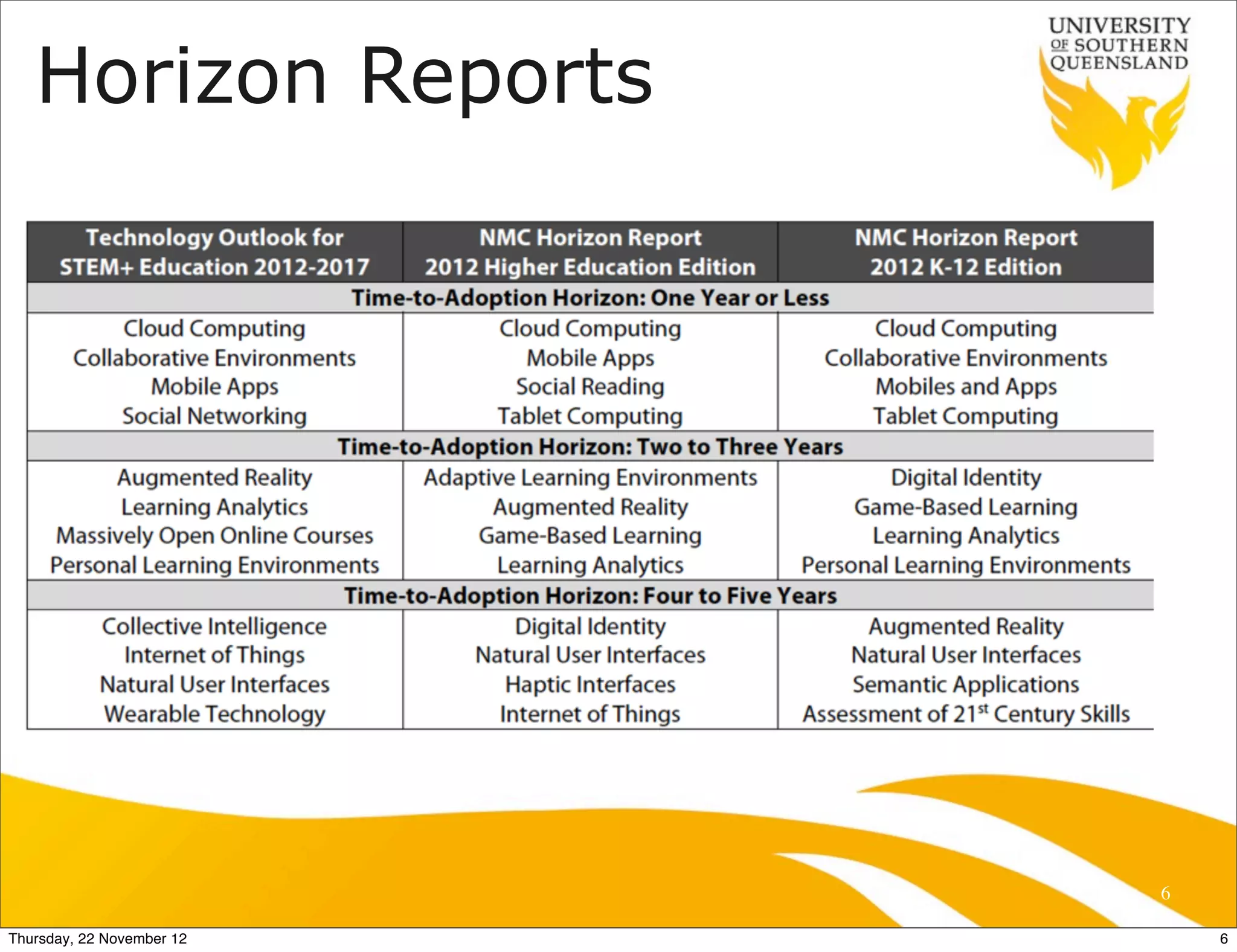
Horizon Reports


                           6

Thursday, 22 November 12       6
Trends
        ‣   People expect to be able to work, learn, and
            study whenever and wherever they want.
        ‣   The abundance of resources and
            relationships will challenge our educational
            identity.
        ‣   Students want to use their own technology
            for learning.
        ‣   Shift across all sectors to online learning,

            hybrid learning and collaborative models.
        ‣

                                                           7

Thursday, 22 November 12                                       7
Challenges
       n Seamless     learning – people expect to be
            able to work, learn, and study whenever
            and wherever they want.
       n Digital    literacies – capabilities which fit an
            individual for living, learning and working in a
            digital society (JISC)
       n Personalisation      - our learning, teaching,
            place of learning, technologies will be
            individualised
       n Digital          scholarship will be the norm.


                                                               8

Thursday, 22 November 12                                           8
What are spaces for knowledge
              generation?


                                              9

Thursday, 22 November 12                          9
Spaces for Knowledge
    Generation
        n Physical,         blended or virtual ‘areas’ that:
              n    enhance learning
              n that      motivate learners
              n promote      authentic learning interactions
        n Spaces   where both teachers and students
            optimize the perceived and actual
            affordances of the space (Keppell &
            Riddle, 2012).


                                           10
Thursday, 22 November 12                                        10
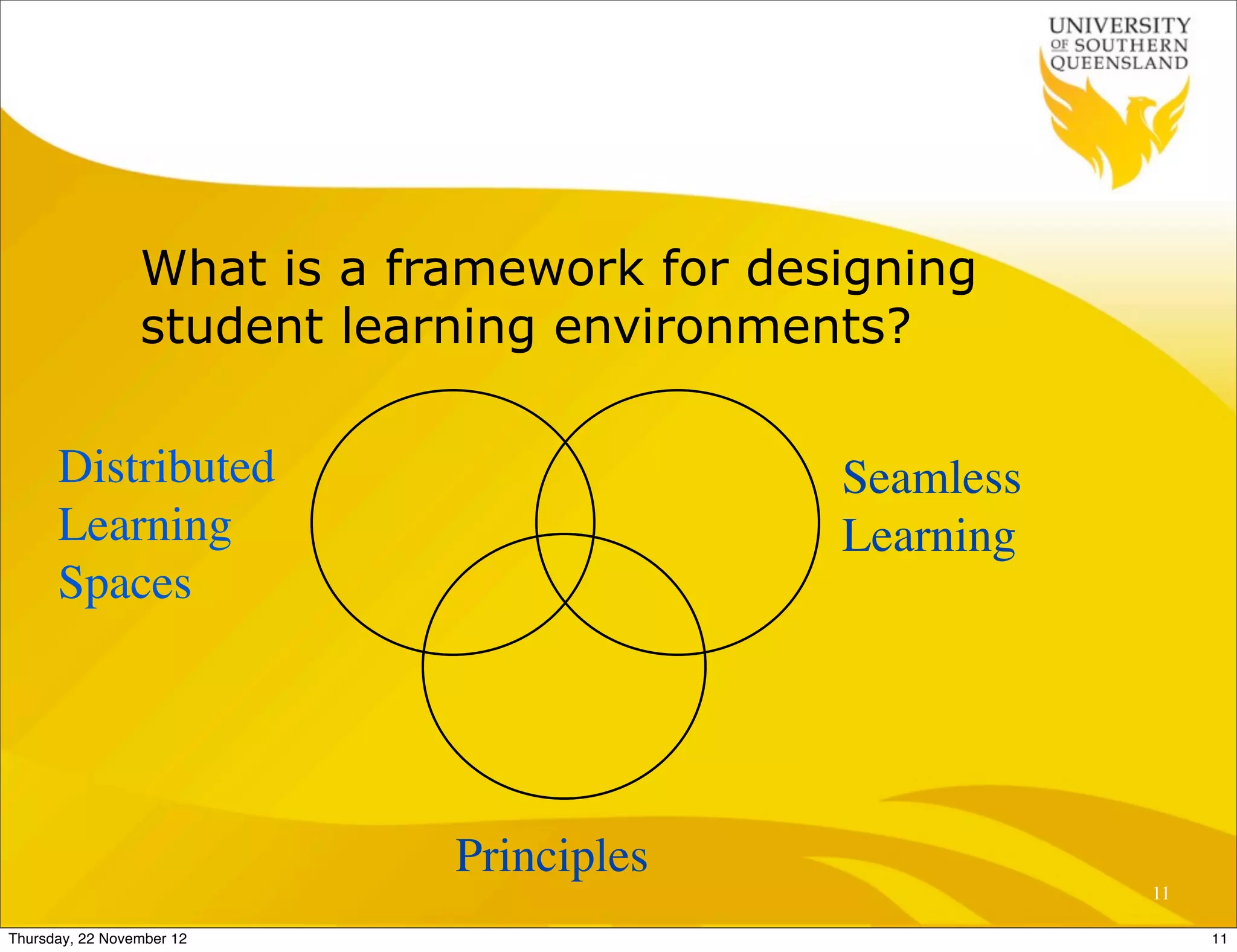
What is a framework for designing
                 student learning environments?

      Distributed                           Seamless
      Learning                              Learning
      Spaces


                             Principles
                                                       11

Thursday, 22 November 12                                    11
Distributed Spaces
           n Growing     acceptance that learning occurs in
                different ‘places’
           n Ubiquity   of learning in a wide range of
                contexts (Lea & Nicholl, 2002).
           n Growing   acceptance of life-long and life-
                wide learning also have a major influence on
                distributed learning spaces.


                                                               12

Thursday, 22 November 12                                            12
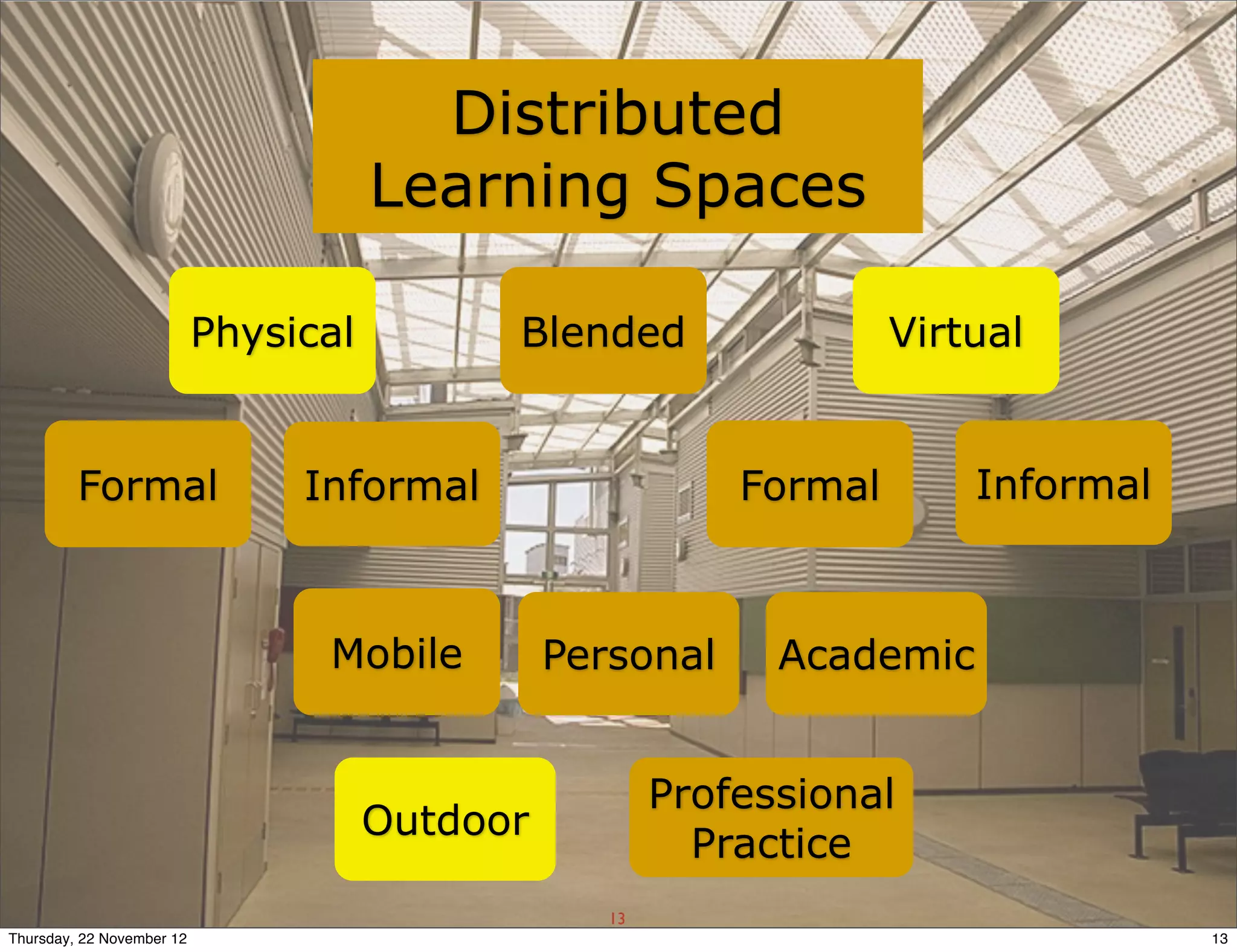
Distributed
                                      Learning Spaces

                           Physical         Blended                  Virtual


         Formal                 Informal                    Formal       Informal


                                 Mobile         Personal      Academic


                                                        Professional
                                      Outdoor
                                                          Practice
                                                   13
Thursday, 22 November 12                                                            13
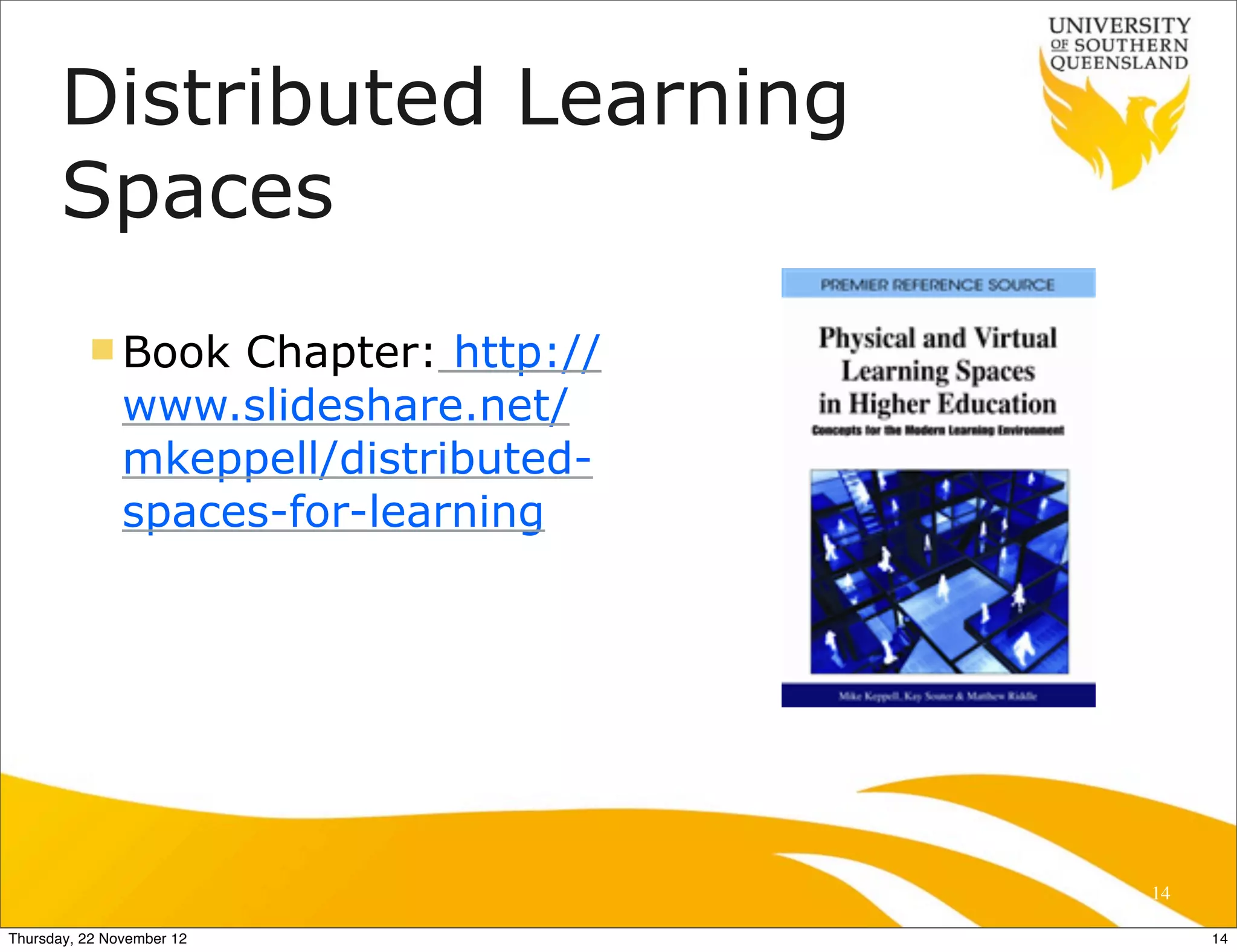
Distributed Learning
      Spaces
          n Book   Chapter: http://
               www.slideshare.net/
               mkeppell/distributed-
               spaces-for-learning


                                       14

Thursday, 22 November 12                    14
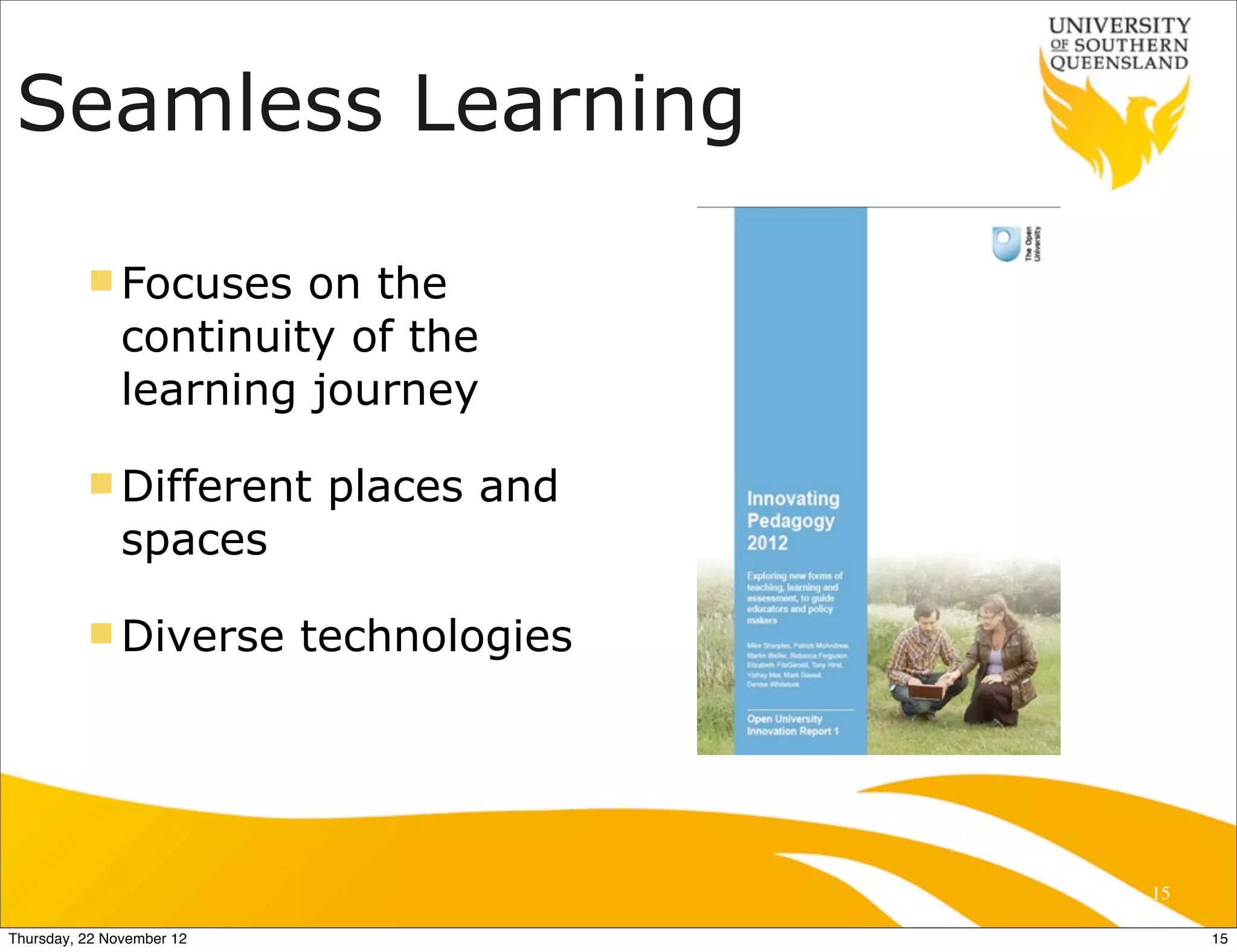
Seamless Learning

          n Focuses    on the
               continuity of the
               learning journey

          n Different      places and
               spaces

          n Diverse       technologies


                                          15

Thursday, 22 November 12                       15
Thursday, 22 November 12   16
Seven Principles of
   Learning Space Design
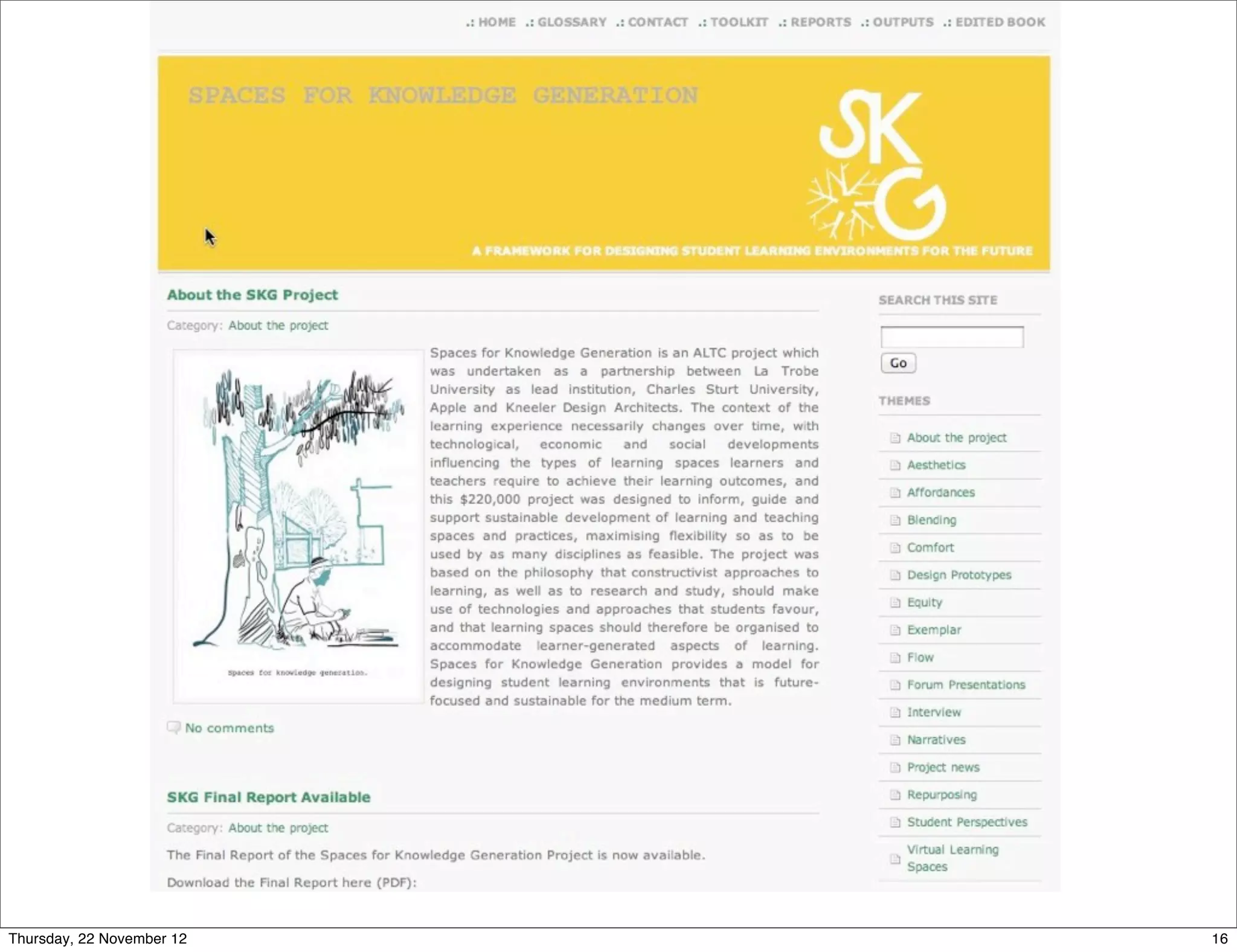
       n   The SKG project has established seven principles of
            learning space design which support a collaborative
            and student-centred approach to learning:
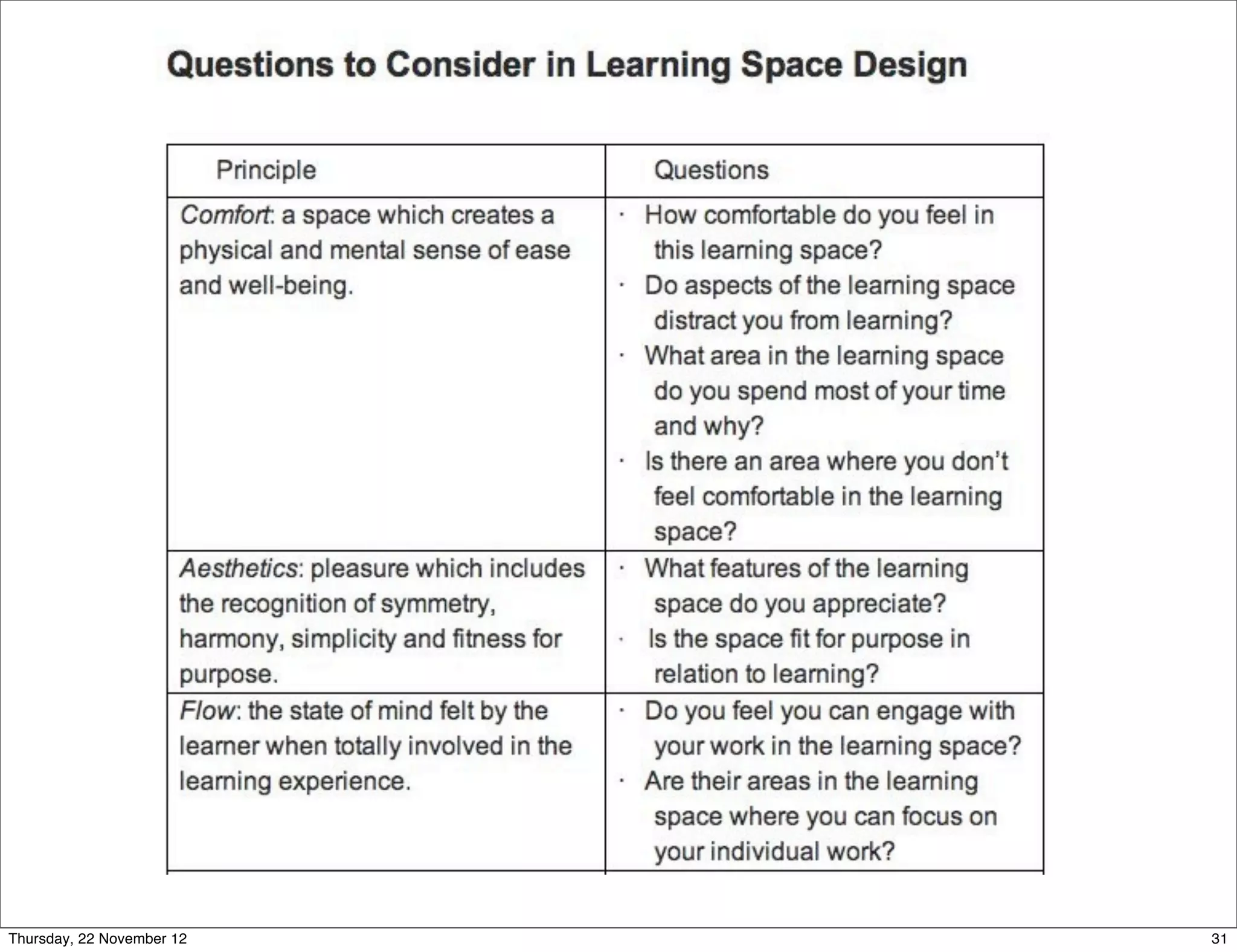
       n   Comfort: a space which creates a physical and
            mental sense of ease and well-being
       n   Aesthetics: pleasure which includes the
            recognition of symmetry, harmony, simplicity and
            fitness for purpose
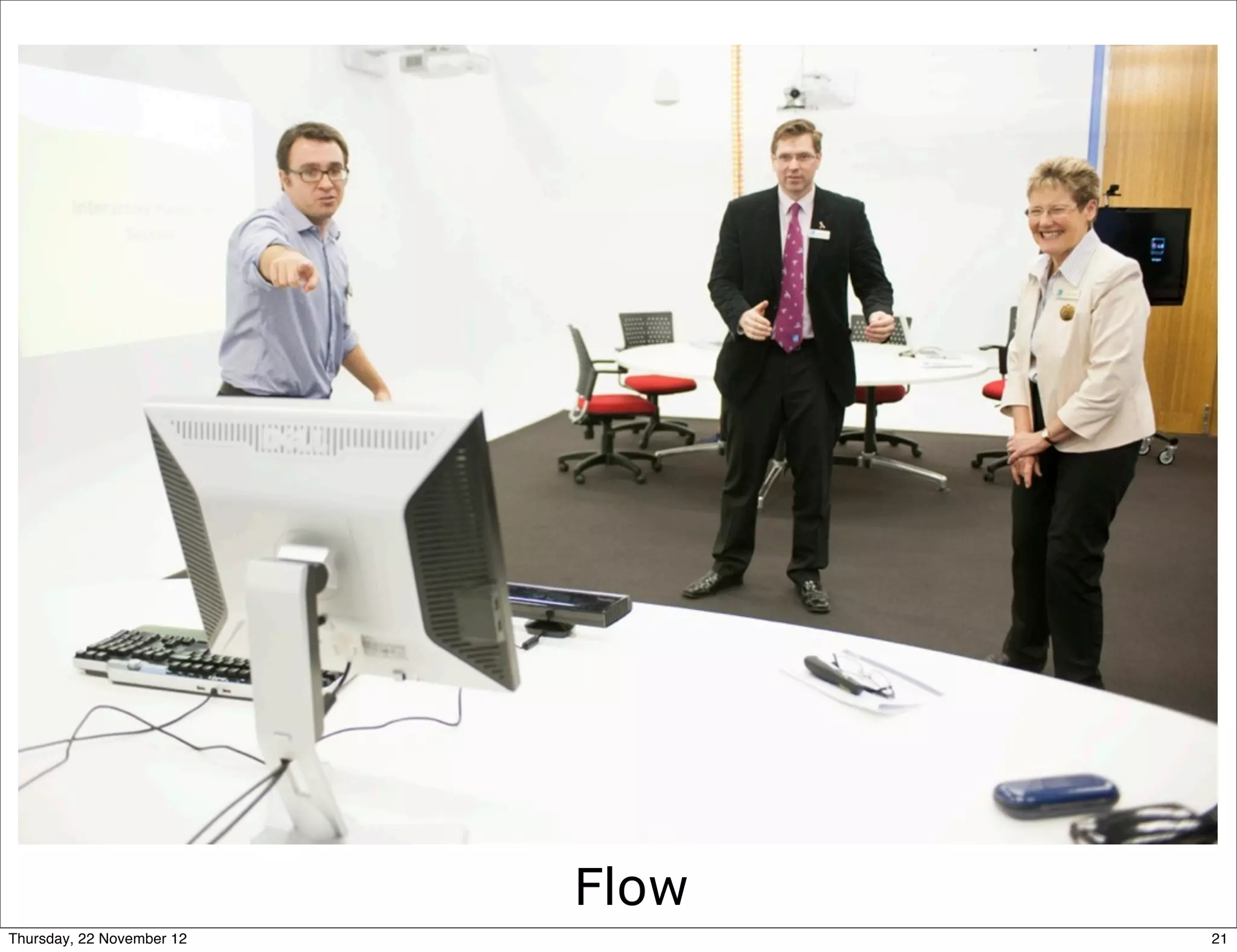
       n   Flow: the state of mind felt by the learner when
            totally involved in the learning experience


                                                                  17

Thursday, 22 November 12                                               17
Seven Principles of
 Learning Space Design
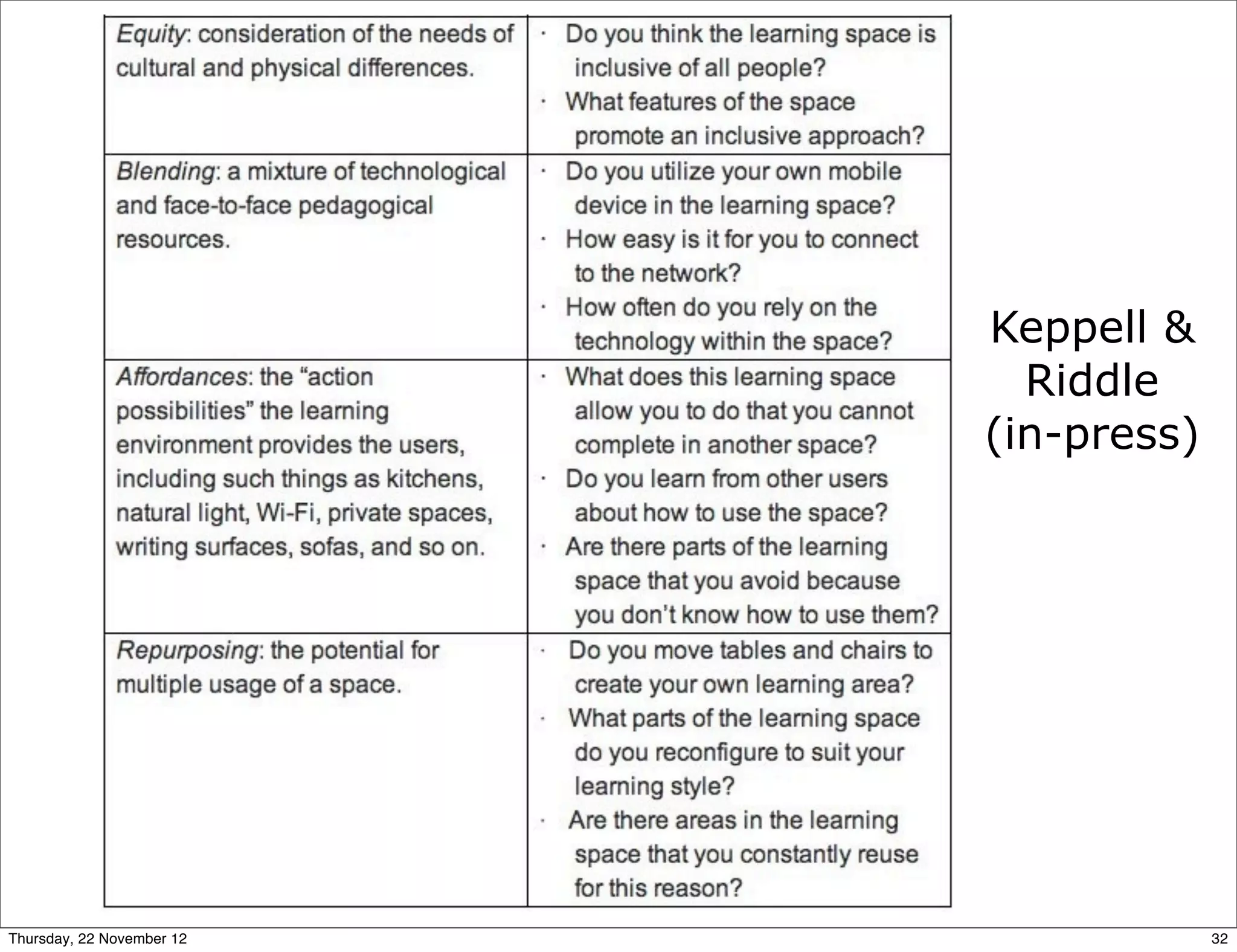
     •Equity: consideration of the needs of cultural and
         physical differences
     •Blending: a mixture of technological and face-to-face
         pedagogical resources
     •Affordances: the “action possibilities” the learning
         environment provides the users, including such things as
         kitchens, natural light, wifi, private spaces, writing
         surfaces, sofas, and so on.
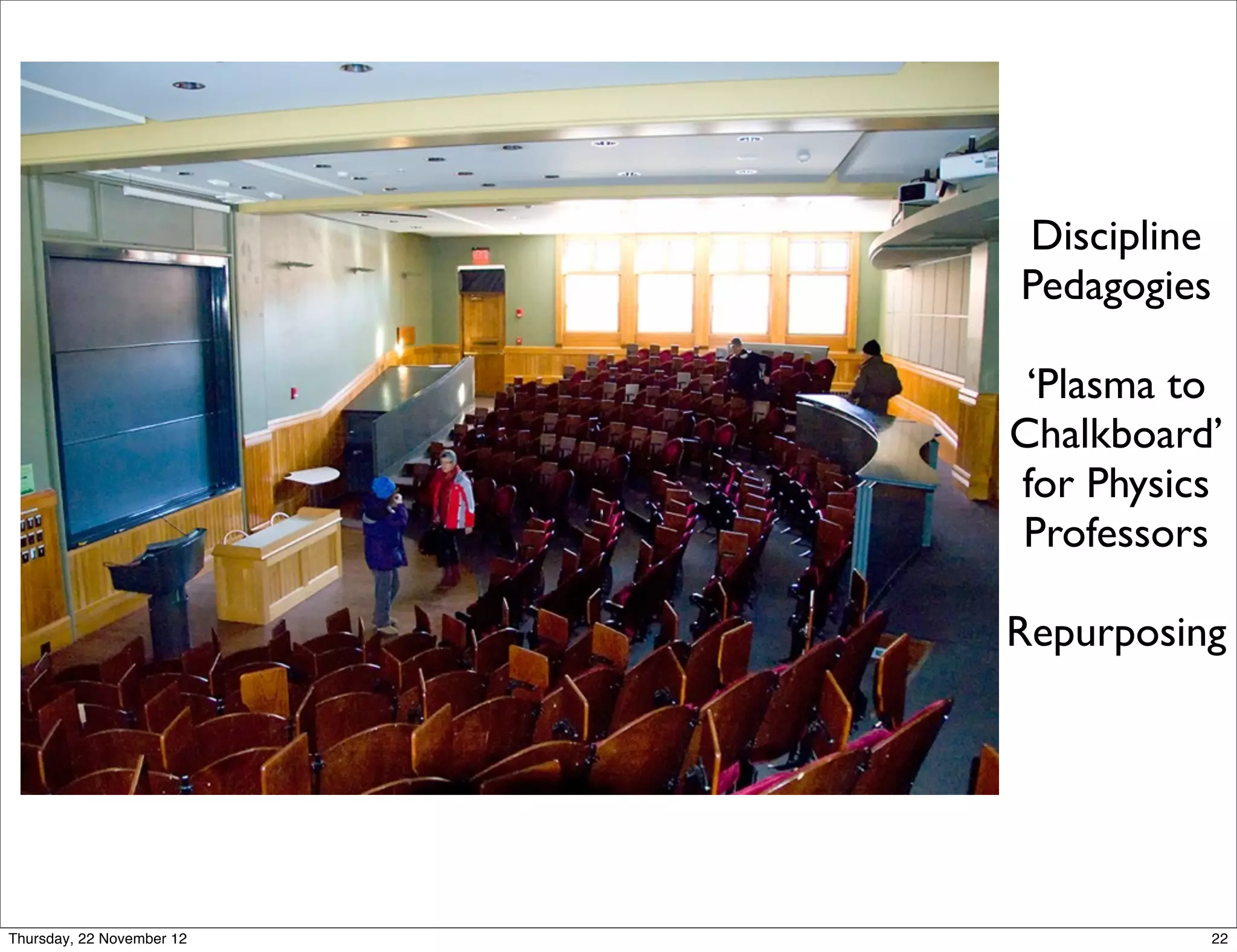
     •Repurposing: the potential for multiple usage of a
         space (Souter, Riddle, Keppell, 2010) (http://
         www.skgproject.com)

                                                               18

Thursday, 22 November 12                                            18
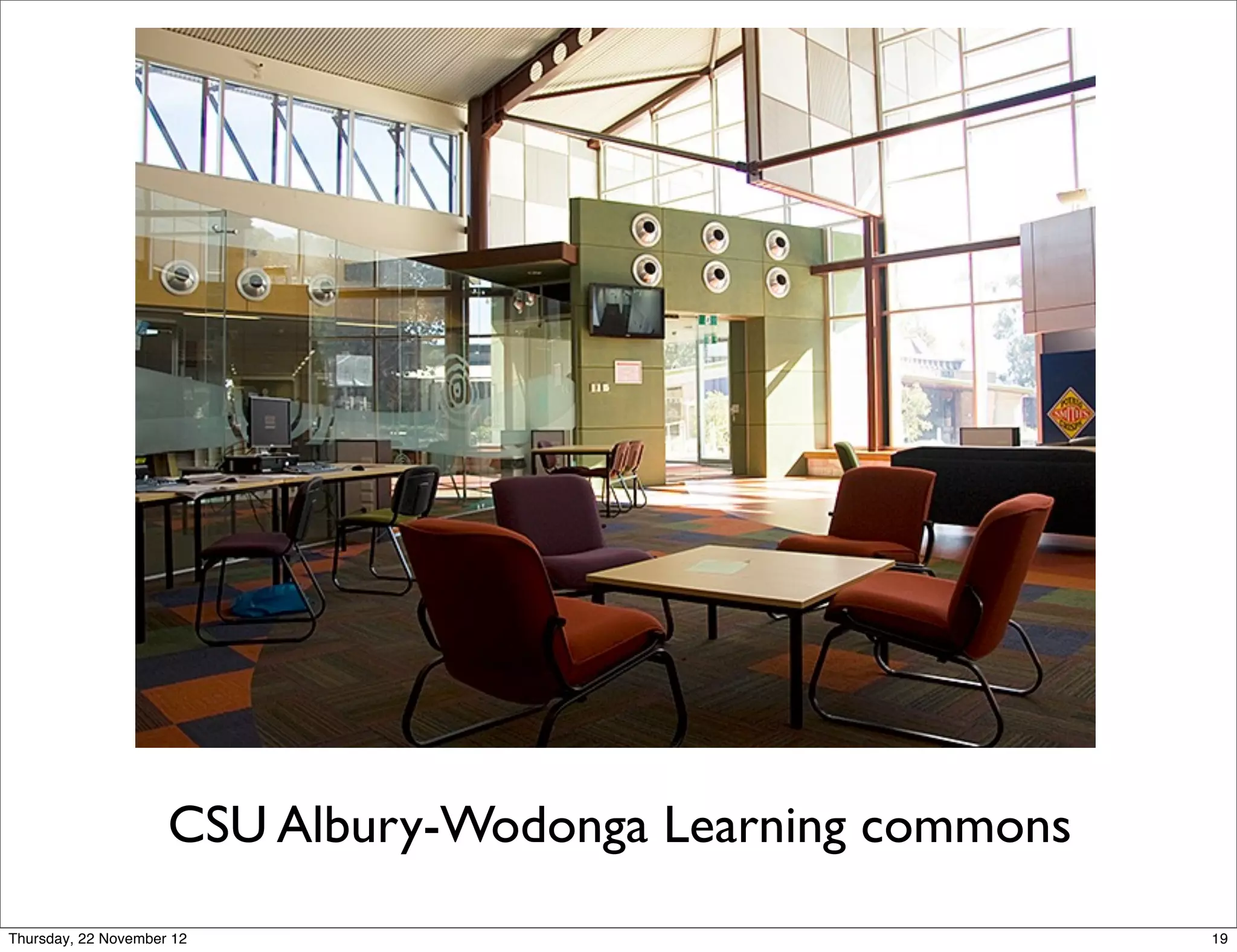
CSU Albury-Wodonga Learning commons
Thursday, 22 November 12                                   19
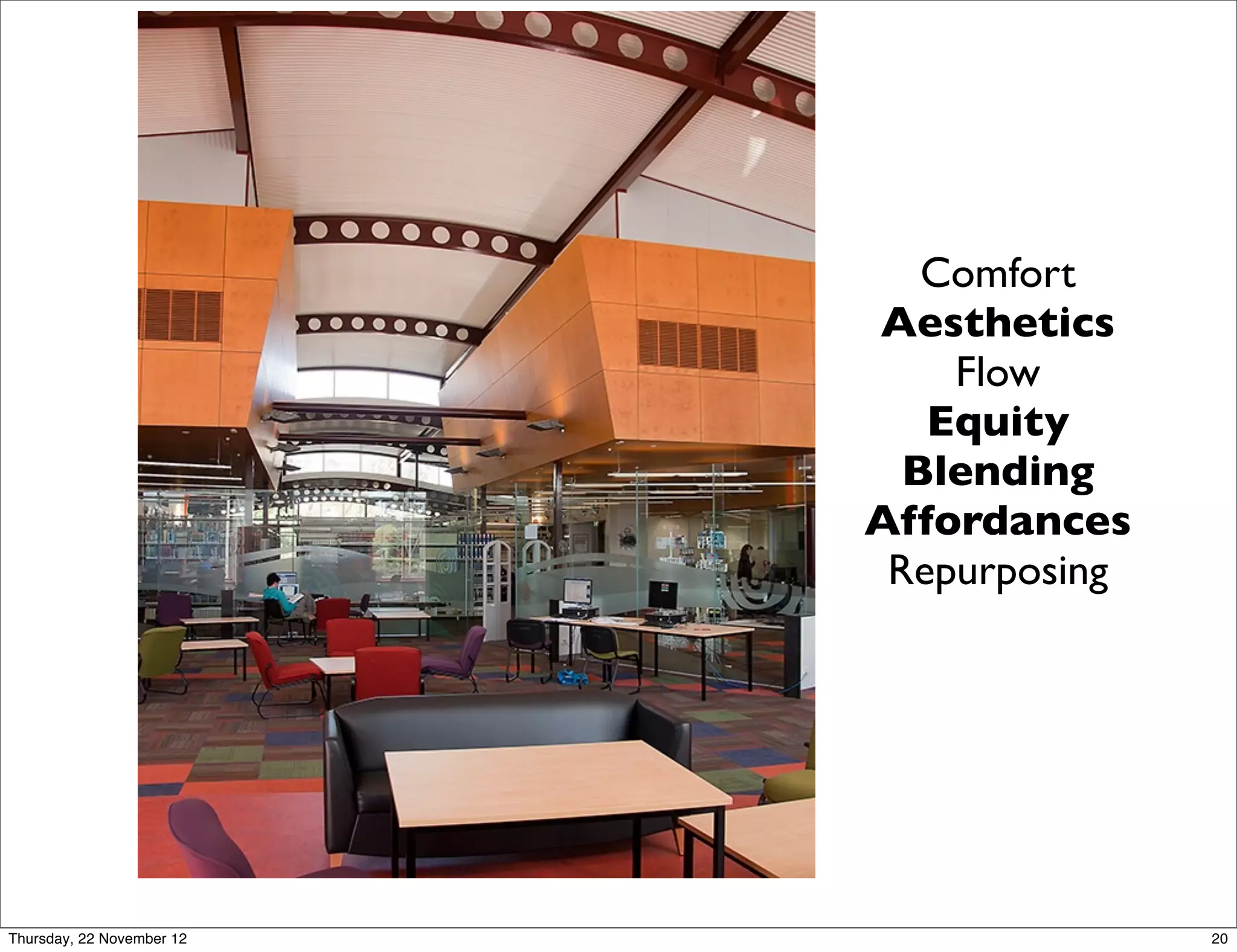
Comfort
                           Aesthetics
                               Flow
                              Equity
                             Blending
                           Affordances
                            Repurposing


Thursday, 22 November 12                  20
Flow
Thursday, 22 November 12          21
Discipline
                           Pedagogies

                            ‘Plasma to
                           Chalkboard’
                           for Physics
                           Professors

                           Repurposing


Thursday, 22 November 12                22
Virtual Learning
                                      Spaces


                           Blending - Affordances - Equity?
Thursday, 22 November 12                                      23
Thursday, 22 November 12   24
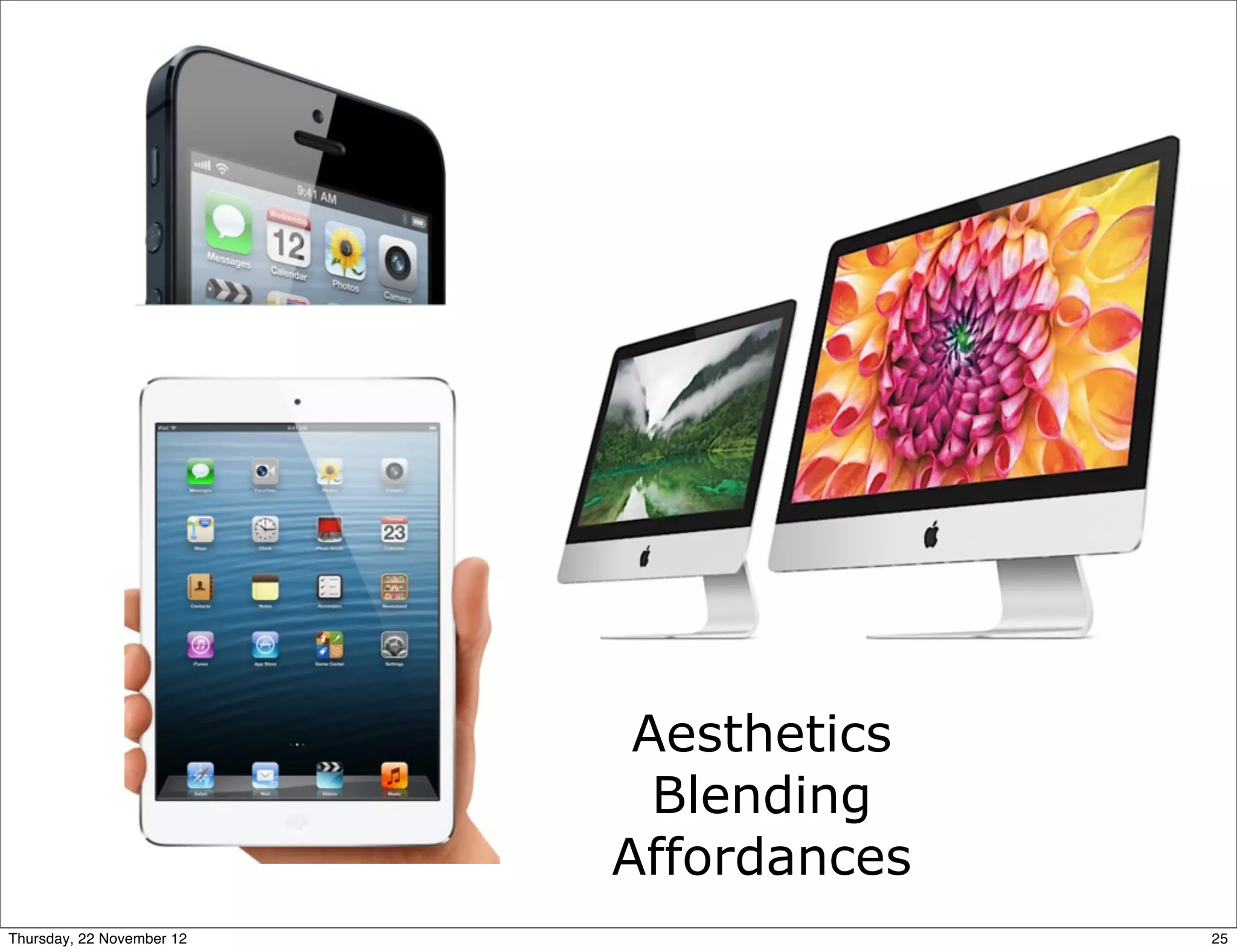
Aesthetics
                             Blending
                           Affordances
Thursday, 22 November 12                 25
Thursday, 22 November 12   26
Thursday, 22 November 12   27
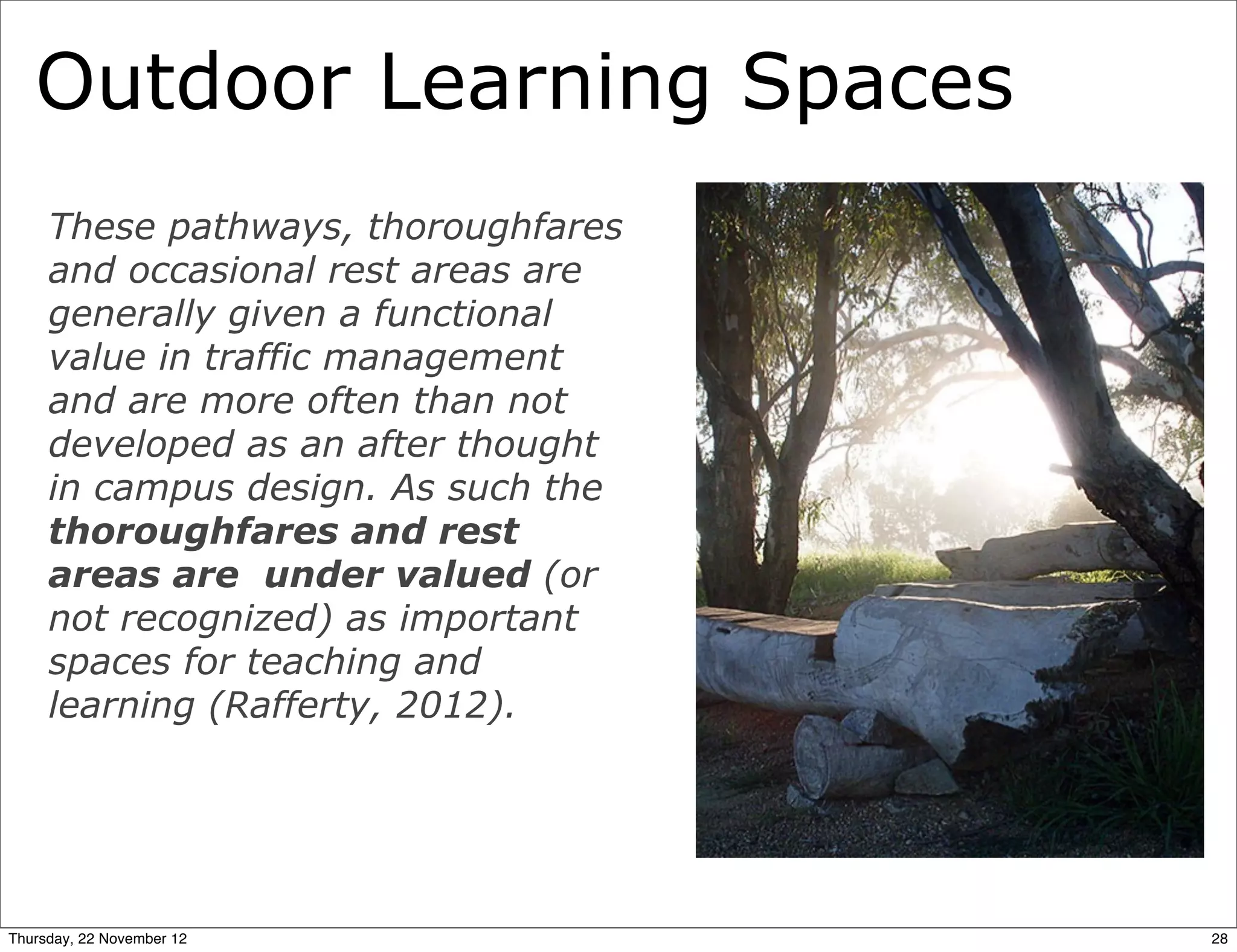
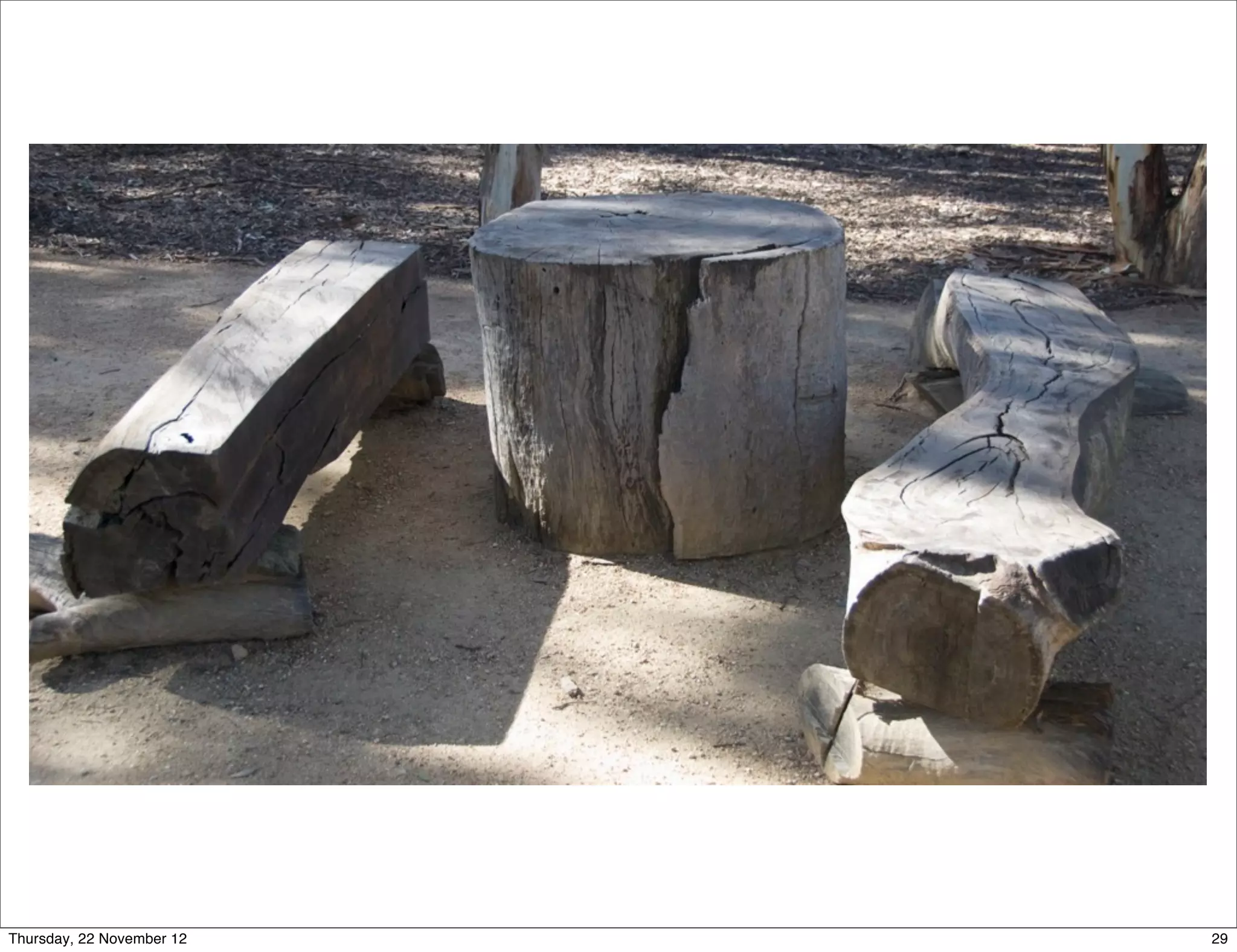
Outdoor Learning Spaces
     These pathways, thoroughfares
     and occasional rest areas are
     generally given a functional
     value in traffic management
     and are more often than not
     developed as an after thought
     in campus design. As such the
     thoroughfares and rest
     areas are under valued (or
     not recognized) as important
     spaces for teaching and
     learning (Rafferty, 2012).


Thursday, 22 November 12             28
Thursday, 22 November 12   29
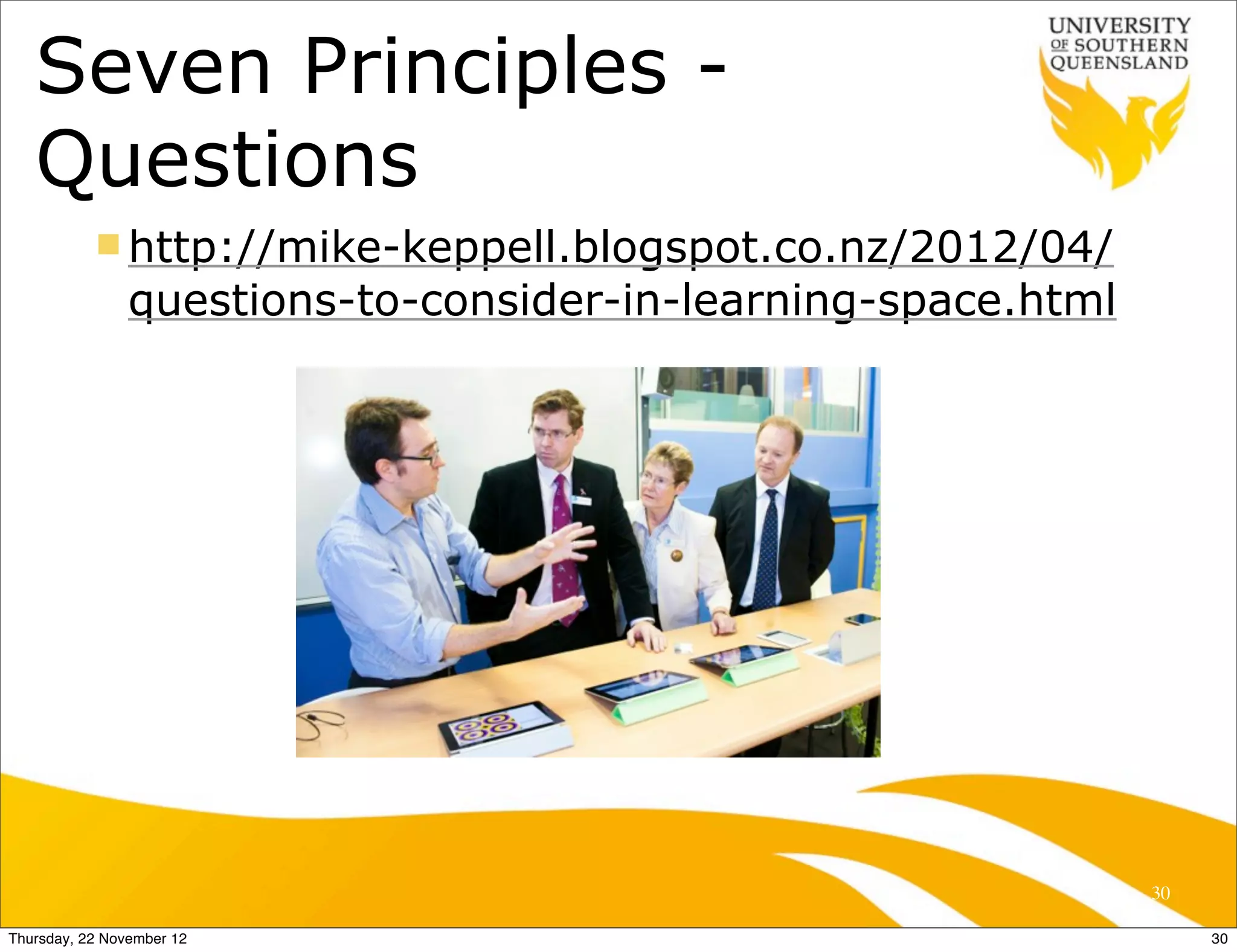
Seven Principles -
   Questions
           n http://mike-keppell.blogspot.co.nz/2012/04/
                questions-to-consider-in-learning-space.html


                                                               30

Thursday, 22 November 12                                            30
Thursday, 22 November 12   31
Keppell &
                             Riddle
                           (in-press)


Thursday, 22 November 12                32
How do we meet student
                           needs and improve the
                           learning environment?


                                                    33

Thursday, 22 November 12                                 33
Thursday, 22 November 12   34
Thursday, 22 November 12   35
Questions?


                                        36

Thursday, 22 November 12                     36

2012 nov 3_rls

  • 1.
    Spaces for Knowledge Generation: A Framework for Designing Student Learning Environments Professor Mike Keppell Executive Director Australian Digital Futures Institute 1 Thursday, 22 November 12 1
  • 2.
    Overview ‣ What are the trends and challenges we need to consider? ‣ What are ‘spaces for knowledge generation’? ‣ What is a framework for designing student learning environments? ‣ How do we meet student needs and improve the learning environment? ‣ What design principles are useful for learning space design? 2 Thursday, 22 November 12 2
  • 3.
    What are thetrends and challenges we need to consider? 3 Thursday, 22 November 12 3
  • 4.
    CSIRO Megatrends On the move Personalisation IWorld 4 Thursday, 22 November 12 4
  • 5.
    University of theFuture n Democratisation of knowledge and access n Contestability of markets and funding n Digital technologies n Global mobility n Integration with industry 5 Thursday, 22 November 12 5
  • 6.
    Horizon Reports 6 Thursday, 22 November 12 6
  • 7.
    Trends ‣ People expect to be able to work, learn, and study whenever and wherever they want. ‣ The abundance of resources and relationships will challenge our educational identity. ‣ Students want to use their own technology for learning. ‣ Shift across all sectors to online learning, hybrid learning and collaborative models. ‣ 7 Thursday, 22 November 12 7
  • 8.
    Challenges n Seamless learning – people expect to be able to work, learn, and study whenever and wherever they want. n Digital literacies – capabilities which fit an individual for living, learning and working in a digital society (JISC) n Personalisation - our learning, teaching, place of learning, technologies will be individualised n Digital scholarship will be the norm. 8 Thursday, 22 November 12 8
  • 9.
    What are spacesfor knowledge generation? 9 Thursday, 22 November 12 9
  • 10.
    Spaces for Knowledge Generation n Physical, blended or virtual ‘areas’ that: n enhance learning n that motivate learners n promote authentic learning interactions n Spaces where both teachers and students optimize the perceived and actual affordances of the space (Keppell & Riddle, 2012). 10 Thursday, 22 November 12 10
  • 11.
    What is aframework for designing student learning environments? Distributed Seamless Learning Learning Spaces Principles 11 Thursday, 22 November 12 11
  • 12.
    Distributed Spaces n Growing acceptance that learning occurs in different ‘places’ n Ubiquity of learning in a wide range of contexts (Lea & Nicholl, 2002). n Growing acceptance of life-long and life- wide learning also have a major influence on distributed learning spaces. 12 Thursday, 22 November 12 12
  • 13.
    Distributed Learning Spaces Physical Blended Virtual Formal Informal Formal Informal Mobile Personal Academic Professional Outdoor Practice 13 Thursday, 22 November 12 13
  • 14.
    Distributed Learning Spaces n Book Chapter: http:// www.slideshare.net/ mkeppell/distributed- spaces-for-learning 14 Thursday, 22 November 12 14
  • 15.
    Seamless Learning n Focuses on the continuity of the learning journey n Different places and spaces n Diverse technologies 15 Thursday, 22 November 12 15
  • 16.
  • 17.
    Seven Principles of Learning Space Design n The SKG project has established seven principles of learning space design which support a collaborative and student-centred approach to learning: n Comfort: a space which creates a physical and mental sense of ease and well-being n Aesthetics: pleasure which includes the recognition of symmetry, harmony, simplicity and fitness for purpose n Flow: the state of mind felt by the learner when totally involved in the learning experience 17 Thursday, 22 November 12 17
  • 18.
    Seven Principles of Learning Space Design •Equity: consideration of the needs of cultural and physical differences •Blending: a mixture of technological and face-to-face pedagogical resources •Affordances: the “action possibilities” the learning environment provides the users, including such things as kitchens, natural light, wifi, private spaces, writing surfaces, sofas, and so on. •Repurposing: the potential for multiple usage of a space (Souter, Riddle, Keppell, 2010) (http:// www.skgproject.com) 18 Thursday, 22 November 12 18
  • 19.
    CSU Albury-Wodonga Learningcommons Thursday, 22 November 12 19
  • 20.
    Comfort Aesthetics Flow Equity Blending Affordances Repurposing Thursday, 22 November 12 20
  • 21.
  • 22.
    Discipline Pedagogies ‘Plasma to Chalkboard’ for Physics Professors Repurposing Thursday, 22 November 12 22
  • 23.
    Virtual Learning Spaces Blending - Affordances - Equity? Thursday, 22 November 12 23
  • 24.
  • 25.
    Aesthetics Blending Affordances Thursday, 22 November 12 25
  • 26.
  • 27.
  • 28.
    Outdoor Learning Spaces These pathways, thoroughfares and occasional rest areas are generally given a functional value in traffic management and are more often than not developed as an after thought in campus design. As such the thoroughfares and rest areas are under valued (or not recognized) as important spaces for teaching and learning (Rafferty, 2012). Thursday, 22 November 12 28
  • 29.
  • 30.
    Seven Principles - Questions n http://mike-keppell.blogspot.co.nz/2012/04/ questions-to-consider-in-learning-space.html 30 Thursday, 22 November 12 30
  • 31.
  • 32.
    Keppell & Riddle (in-press) Thursday, 22 November 12 32
  • 33.
    How do wemeet student needs and improve the learning environment? 33 Thursday, 22 November 12 33
  • 34.
  • 35.
  • 36.
    Questions? 36 Thursday, 22 November 12 36