




DISTRIBUTED LEARNING SPACES:
            PHYSICAL, BLENDED AND VIRTUAL
        LEARNING SPACES IN HIGHER EDUCATION


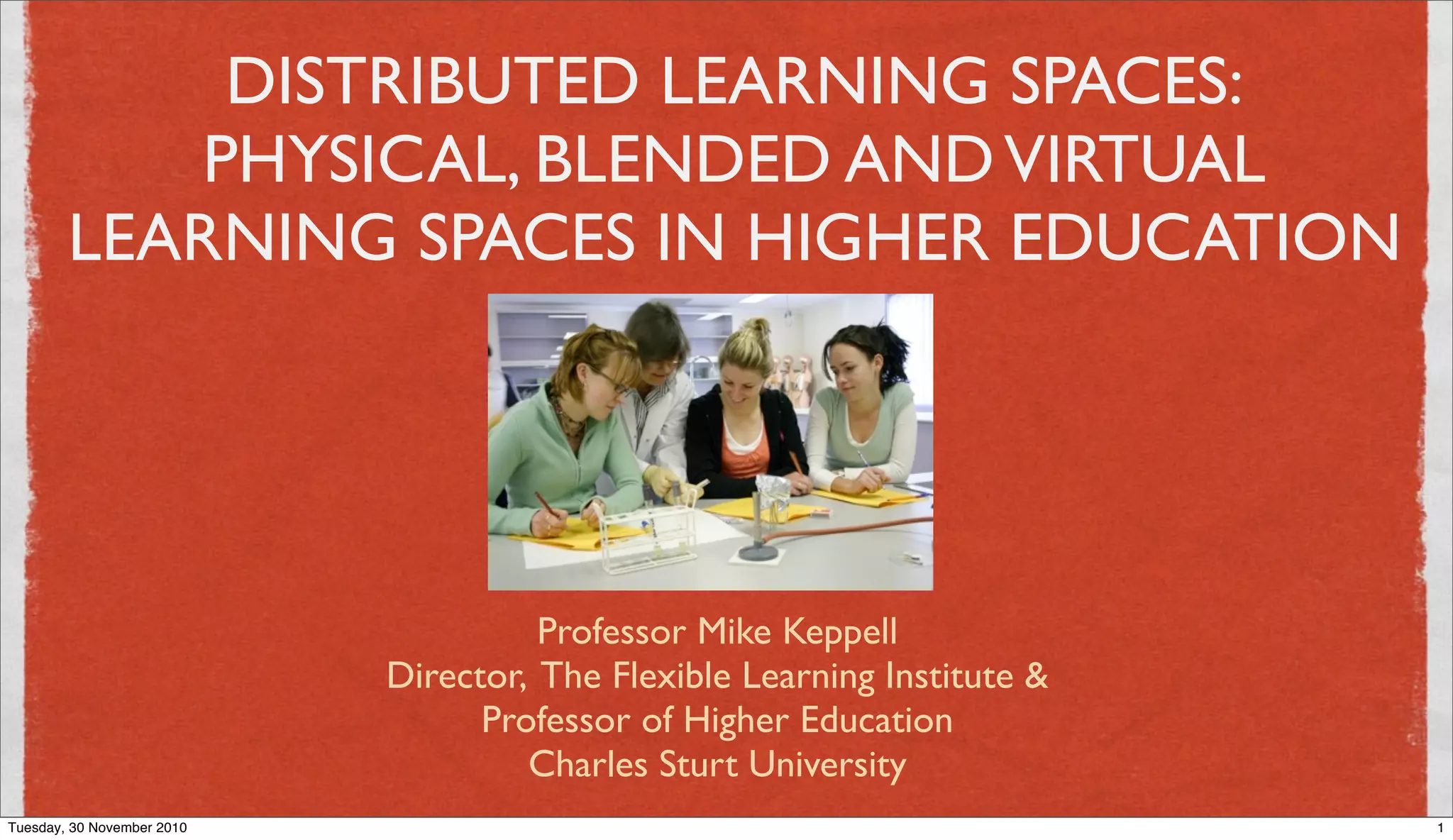
                                      Professor Mike Keppell
                            Director, The Flexible Learning Institute &
                                  Professor of Higher Education
                                     Charles Sturt University
Tuesday, 30 November 2010                                                 1
OVERVIEW

                   Pedagogy
                   Students who don’t attend a
                   campus
                   Distributed learning spaces
                   Students who are
                   undertaking a PhD at 70
                   years of age

Tuesday, 30 November 2010                          2
ASSUMPTIONS

                Universities value and seek to enhance the skills essential for lifelong and
                life wide learning, developing graduates who will continue to develop
                intellectually, professionally and socially beyond the bounds of
                formal education.
                Universities believe that programs, services and teaching methods should
                be responsive to the diverse cultural, social and academic
                needs of students, enabling them to adapt to the demands of
                university education and providing them with the cultural capital
                for life success.


Tuesday, 30 November 2010                                                                      3
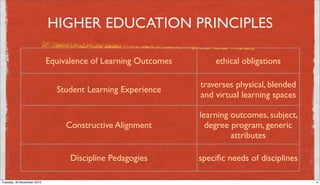
HIGHER EDUCATION PRINCIPLES

                            Equivalence of Learning Outcomes       ethical obligations

                                                               traverses physical, blended
                              Student Learning Experience
                                                               and virtual learning spaces

                                                               learning outcomes, subject,
                                 Constructive Alignment          degree program, generic
                                                                        attributes

                                  Discipline Pedagogies        specific needs of disciplines

Tuesday, 30 November 2010                                                                     4
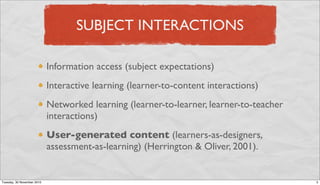
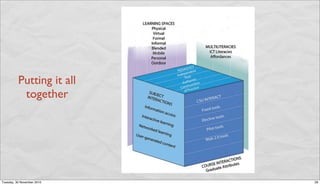
SUBJECT INTERACTIONS

                            Information access (subject expectations)
                            Interactive learning (learner-to-content interactions)
                            Networked learning (learner-to-learner, learner-to-teacher
                            interactions)
                            User-generated content (learners-as-designers,
                            assessment-as-learning) (Herrington & Oliver, 2001).


Tuesday, 30 November 2010                                                                5
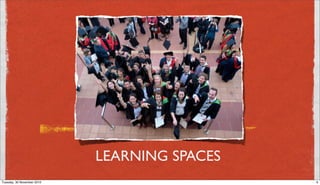
LEARNING SPACES
Tuesday, 30 November 2010                     6
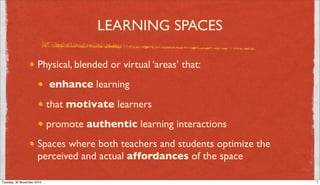
LEARNING SPACES

                      Physical, blended or virtual ‘areas’ that:
                            enhance learning
                            that motivate learners
                            promote authentic learning interactions
                      Spaces where both teachers and students optimize the
                      perceived and actual affordances of the space

Tuesday, 30 November 2010                                                    7
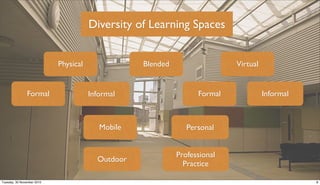
Diversity of Learning Spaces


                            Physical               Blended                  Virtual


               Formal                  Informal                    Formal             Informal


                                          Mobile                Personal


                                                             Professional
                                         Outdoor
                                                               Practice

Tuesday, 30 November 2010                                                                        8
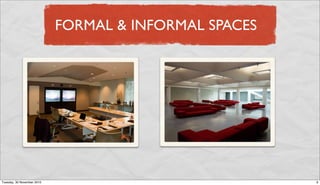
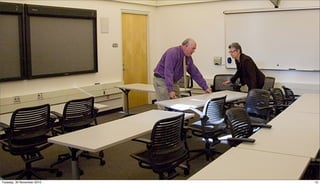
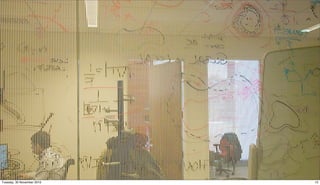
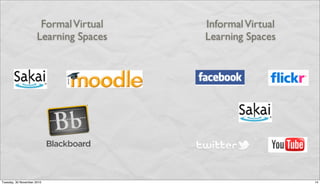
FORMAL & INFORMAL SPACES


Tuesday, 30 November 2010                              9
Tuesday, 30 November 2010   10
Tuesday, 30 November 2010   11
Tuesday, 30 November 2010   12
Tuesday, 30 November 2010   13
Formal Virtual   Informal Virtual
                      Learning Spaces   Learning Spaces


Tuesday, 30 November 2010                                  14
MOBILE LEARNING SPACES


                 “Learning when mobile means that context becomes
                 all-important since even a simple change of
                 location is an invitation to revisit
                 learning” (ALT-J Vol 17, No.3 p.159)


Tuesday, 30 November 2010                                           15
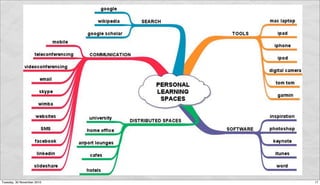
PERSONAL LEARNING SPACES


                   Studying subject materials while travelling to work via
                   train or bus may represent the learning space for some
                   students


Tuesday, 30 November 2010                                                    16
Tuesday, 30 November 2010   17
Tuesday, 30 November 2010   18
Tuesday, 30 November 2010   19
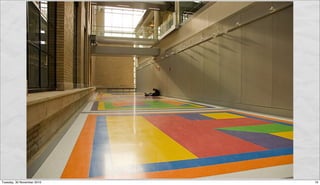
OUTDOOR LEARNING SPACES

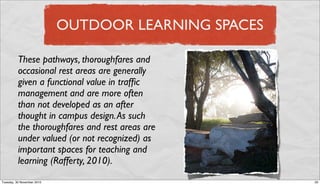
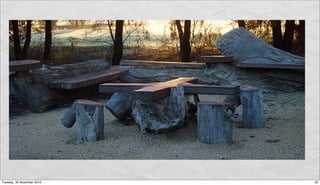
          These pathways, thoroughfares and
          occasional rest areas are generally
          given a functional value in traffic
          management and are more often
          than not developed as an after
          thought in campus design. As such
          the thoroughfares and rest areas are
          under valued (or not recognized) as
          important spaces for teaching and
          learning (Rafferty, 2010).
Tuesday, 30 November 2010                             20
Tuesday, 30 November 2010   21
Tuesday, 30 November 2010   22
Tuesday, 30 November 2010   23
Tuesday, 30 November 2010   24
Tuesday, 30 November 2010   25
FLEXIBLE LEARNING


                   “Flexible learning” provides opportunities to improve the student
                   learning experience through flexibility in time, pace, place
                   (physical, virtual, on-campus, off-campus), mode of study (print-
                   based, face-to-face, blended, online), teaching approach
                   (collaborative, independent), forms of assessment and staffing.
                   It may utilise a wide range of media, environments, learning spaces and
                   technologies for learning and teaching.


Tuesday, 30 November 2010                                                                    26
BLENDED & FLEXIBLE LEARNING


                   “Blended and flexible learning” is a design approach that examines
                   the relationships between flexible learning opportunities, in
                   order to optimise student engagement and equivalence in learning
                   outcomes regardless of mode of study (Keppell, 2010, p. 3).


Tuesday, 30 November 2010                                                              27
PERSPECTIVES ON BLENDED LEARNING


                   … It’s very, very hard to get people who come on
                   campus to want to do something that’s not face-to-face
                   and it’s very hard to get people who want to be totally
                   flexible and do something at two o’clock in the morning
                   by themselves to actually want to engage with other
                   people (Teaching Fellow, 2008).

Tuesday, 30 November 2010                                                    28
Putting it all
           together


Tuesday, 30 November 2010   29
SEVEN PRINCIPLES OF
                              LEARNING SPACE DESIGN
                   The SKG project has established seven principles of learning space
                   design which support a collaborative and student-centred  approach to
                   learning:
                   Comfort: a space which creates a physical and mental sense of ease
                   and well-being
                   Aesthetics: pleasure which includes the recognition of symmetry,
                   harmony, simplicity and fitness for purpose
                   Flow: the state of mind felt by the learner when totally involved in the
                   learning experience

Tuesday, 30 November 2010                                                                     30
SEVEN PRINCIPLES OF
                              LEARNING SPACE DESIGN
              • Equity: consideration of the needs of cultural and physical differences
              • Blending:      a mixture of technological and face-to-face pedagogical
                  resources

              • Affordances:        the “action possibilities” the learning environment
                  provides the users, including such things as kitchens, natural light, wifi,
                  private spaces, writing surfaces, sofas, and so on.

              • Repurposing:         the potential for multiple usage of a space (Souter,
                  Riddle, Keppell, 2010)
Tuesday, 30 November 2010                                                                      31
CONCLUSION


                   Due to lifelong and lifewide learning students may range from
                   17-70
                   Increasingly learners are deciding spaces appropriate for their
                   own learning and life context
                   Personal learning spaces may not include the campus


Tuesday, 30 November 2010                                                            32
Tuesday, 30 November 2010   33
Tuesday, 30 November 2010   34
http://www.skgproject.com


Tuesday, 30 November 2010                               35

Learning Space Design Summit

  • 1.
    DISTRIBUTED LEARNING SPACES: PHYSICAL, BLENDED AND VIRTUAL LEARNING SPACES IN HIGHER EDUCATION Professor Mike Keppell Director, The Flexible Learning Institute & Professor of Higher Education Charles Sturt University Tuesday, 30 November 2010 1
  • 2.
    OVERVIEW Pedagogy Students who don’t attend a campus Distributed learning spaces Students who are undertaking a PhD at 70 years of age Tuesday, 30 November 2010 2
  • 3.
    ASSUMPTIONS Universities value and seek to enhance the skills essential for lifelong and life wide learning, developing graduates who will continue to develop intellectually, professionally and socially beyond the bounds of formal education. Universities believe that programs, services and teaching methods should be responsive to the diverse cultural, social and academic needs of students, enabling them to adapt to the demands of university education and providing them with the cultural capital for life success. Tuesday, 30 November 2010 3
  • 4.
    HIGHER EDUCATION PRINCIPLES Equivalence of Learning Outcomes ethical obligations traverses physical, blended Student Learning Experience and virtual learning spaces learning outcomes, subject, Constructive Alignment degree program, generic attributes Discipline Pedagogies specific needs of disciplines Tuesday, 30 November 2010 4
  • 5.
    SUBJECT INTERACTIONS Information access (subject expectations) Interactive learning (learner-to-content interactions) Networked learning (learner-to-learner, learner-to-teacher interactions) User-generated content (learners-as-designers, assessment-as-learning) (Herrington & Oliver, 2001). Tuesday, 30 November 2010 5
  • 6.
  • 7.
    LEARNING SPACES Physical, blended or virtual ‘areas’ that: enhance learning that motivate learners promote authentic learning interactions Spaces where both teachers and students optimize the perceived and actual affordances of the space Tuesday, 30 November 2010 7
  • 8.
    Diversity of LearningSpaces Physical Blended Virtual Formal Informal Formal Informal Mobile Personal Professional Outdoor Practice Tuesday, 30 November 2010 8
  • 9.
    FORMAL & INFORMALSPACES Tuesday, 30 November 2010 9
  • 10.
  • 11.
  • 12.
  • 13.
  • 14.
    Formal Virtual Informal Virtual Learning Spaces Learning Spaces Tuesday, 30 November 2010 14
  • 15.
    MOBILE LEARNING SPACES “Learning when mobile means that context becomes all-important since even a simple change of location is an invitation to revisit learning” (ALT-J Vol 17, No.3 p.159) Tuesday, 30 November 2010 15
  • 16.
    PERSONAL LEARNING SPACES Studying subject materials while travelling to work via train or bus may represent the learning space for some students Tuesday, 30 November 2010 16
  • 17.
  • 18.
  • 19.
  • 20.
    OUTDOOR LEARNING SPACES These pathways, thoroughfares and occasional rest areas are generally given a functional value in traffic management and are more often than not developed as an after thought in campus design. As such the thoroughfares and rest areas are under valued (or not recognized) as important spaces for teaching and learning (Rafferty, 2010). Tuesday, 30 November 2010 20
  • 21.
  • 22.
  • 23.
  • 24.
  • 25.
  • 26.
    FLEXIBLE LEARNING “Flexible learning” provides opportunities to improve the student learning experience through flexibility in time, pace, place (physical, virtual, on-campus, off-campus), mode of study (print- based, face-to-face, blended, online), teaching approach (collaborative, independent), forms of assessment and staffing. It may utilise a wide range of media, environments, learning spaces and technologies for learning and teaching. Tuesday, 30 November 2010 26
  • 27.
    BLENDED & FLEXIBLELEARNING “Blended and flexible learning” is a design approach that examines the relationships between flexible learning opportunities, in order to optimise student engagement and equivalence in learning outcomes regardless of mode of study (Keppell, 2010, p. 3). Tuesday, 30 November 2010 27
  • 28.
    PERSPECTIVES ON BLENDEDLEARNING … It’s very, very hard to get people who come on campus to want to do something that’s not face-to-face and it’s very hard to get people who want to be totally flexible and do something at two o’clock in the morning by themselves to actually want to engage with other people (Teaching Fellow, 2008). Tuesday, 30 November 2010 28
  • 29.
    Putting it all together Tuesday, 30 November 2010 29
  • 30.
    SEVEN PRINCIPLES OF LEARNING SPACE DESIGN The SKG project has established seven principles of learning space design which support a collaborative and student-centred  approach to learning: Comfort: a space which creates a physical and mental sense of ease and well-being Aesthetics: pleasure which includes the recognition of symmetry, harmony, simplicity and fitness for purpose Flow: the state of mind felt by the learner when totally involved in the learning experience Tuesday, 30 November 2010 30
  • 31.
    SEVEN PRINCIPLES OF LEARNING SPACE DESIGN • Equity: consideration of the needs of cultural and physical differences • Blending: a mixture of technological and face-to-face pedagogical resources • Affordances: the “action possibilities” the learning environment provides the users, including such things as kitchens, natural light, wifi, private spaces, writing surfaces, sofas, and so on. • Repurposing: the potential for multiple usage of a space (Souter, Riddle, Keppell, 2010) Tuesday, 30 November 2010 31
  • 32.
    CONCLUSION Due to lifelong and lifewide learning students may range from 17-70 Increasingly learners are deciding spaces appropriate for their own learning and life context Personal learning spaces may not include the campus Tuesday, 30 November 2010 32
  • 33.
  • 34.
  • 35.