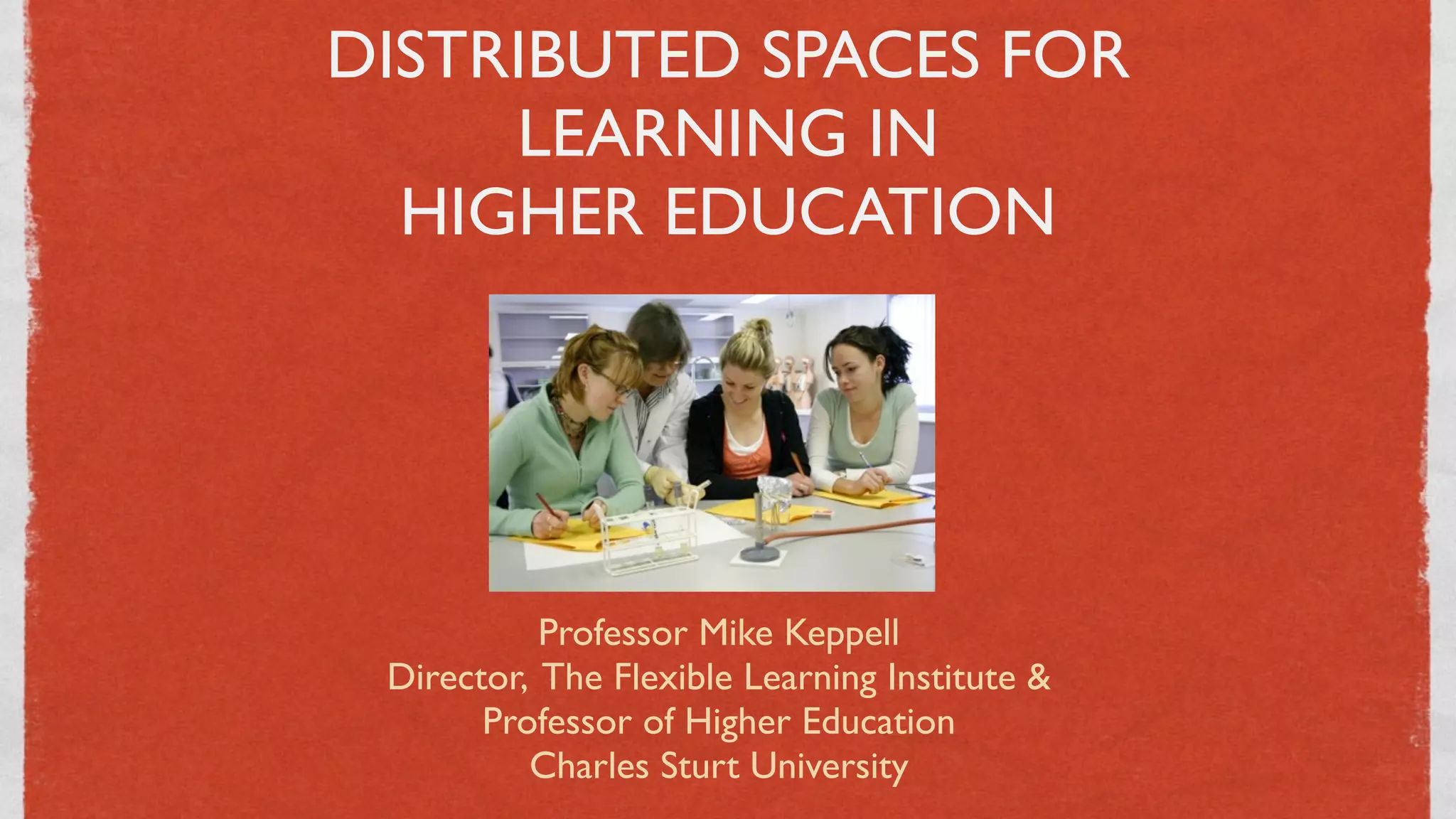
DISTRIBUTED SPACES FOR
     LEARNING IN
  HIGHER EDUCATION


           Professor Mike Keppell
 Director, The Flexible Learning Institute &
       Professor of Higher Education
          Charles Sturt University
                      1
OVERVIEW

Distributed spaces
Ecological university
Assumptions and principles
underlying higher education
Pedagogy
Diversity of spaces
Implications
                              2
OVERVIEW

Growing acceptance that learning occurs in different ‘places’
Proliferation of approaches emerging including ‘flexible’, ‘open’, ‘distance’
and ‘off-campus’ that assist the ubiquity of learning in a wide
range of contexts (Lea & Nicholl, 2002).
Growing acceptance of life-long and life-wide learning also have a
major influence on distributed learning spaces.


                                    3
FLEXIBLE LEARNING


“Flexible learning” provides opportunities to improve the student
learning experience through flexibility in time, pace, place
(physical, virtual, on-campus, off-campus), mode of study (print-
based, face-to-face, blended, online), teaching approach
(collaborative, independent), forms of assessment and staffing.
It may utilise a wide range of media, environments, learning spaces and
technologies for learning and teaching.


                                  4
BLENDED & FLEXIBLE LEARNING


“Blended and flexible learning” is a design approach that examines
the relationships between flexible learning opportunities, in
order to optimise student engagement and equivalence in learning
outcomes regardless of mode of study (Keppell, 2010, p. 3).


                               5
6
ASSUMPTIONS

Universities value and seek to enhance the skills essential for lifelong and
life wide learning, developing graduates who will continue to develop
intellectually, professionally and socially beyond the bounds of
formal education.
Universities believe that programs, services and teaching methods should
be responsive to the diverse cultural, social and academic
needs of students, enabling them to adapt to the demands of
university education and providing them with the cultural capital
for life success.

                                    7
ECOLOGICAL UNIVERSITY

Instead of ‘having an impact’ on the world, ecological universities seek
sustainability and more importantly self sustainability in multiple
levels of interactions. It adopts a ‘care for the world’ as opposed
to an ‘impact on the world’ approach (Barnett, 2011).
It is a networked university that values and fosters its networks
and their interconnectedness and feels a responsibility to the
wellbeing of these networks.


                                 8
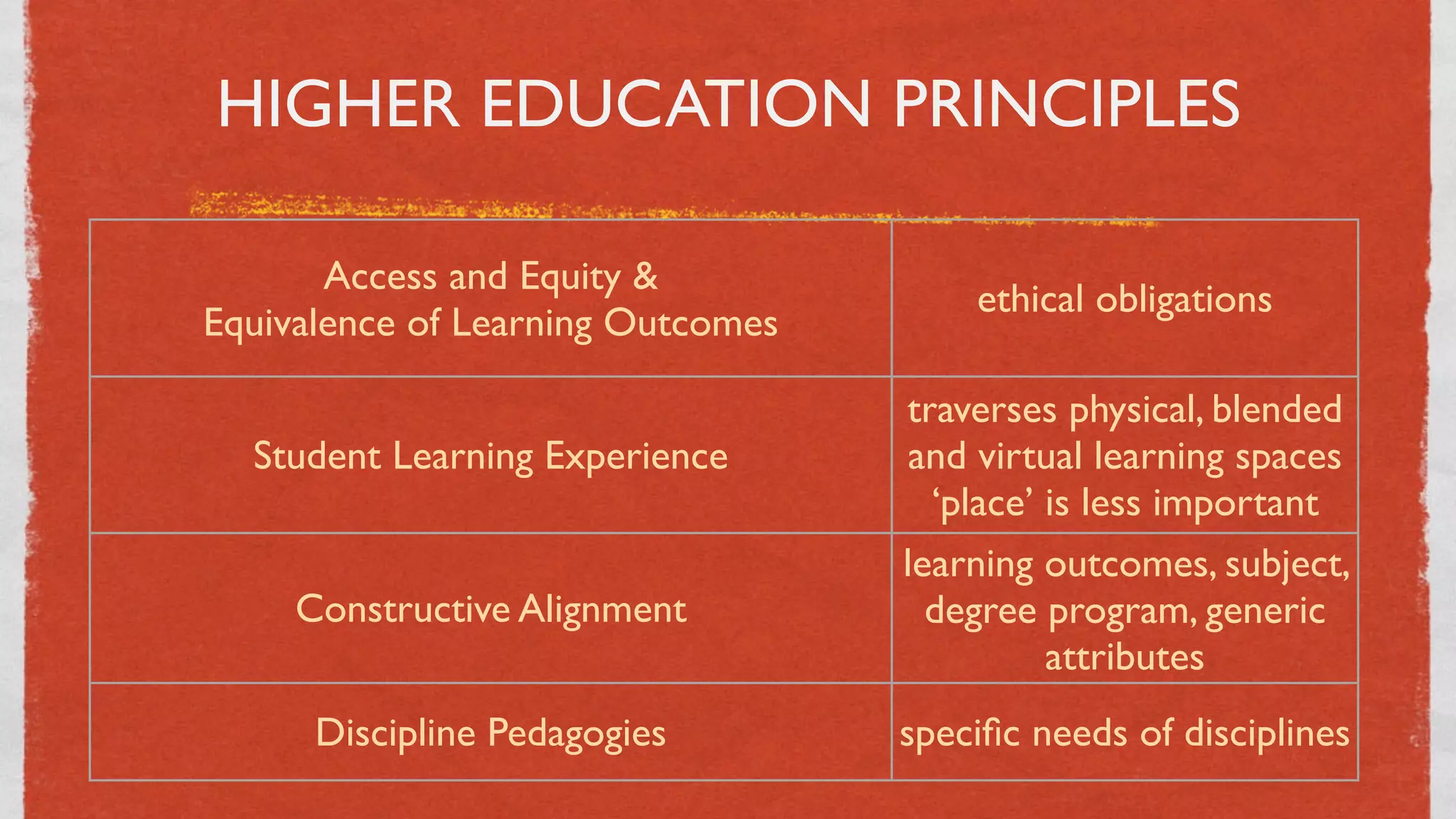
HIGHER EDUCATION PRINCIPLES

       Access and Equity &
                                       ethical obligations
Equivalence of Learning Outcomes

                                   traverses physical, blended
  Student Learning Experience       and virtual learning spaces
                                     ‘place’ is less important
                                   learning outcomes, subject,
     Constructive Alignment          degree program, generic
                                             attributes
      Discipline Pedagogies        specific needs of disciplines
                              9
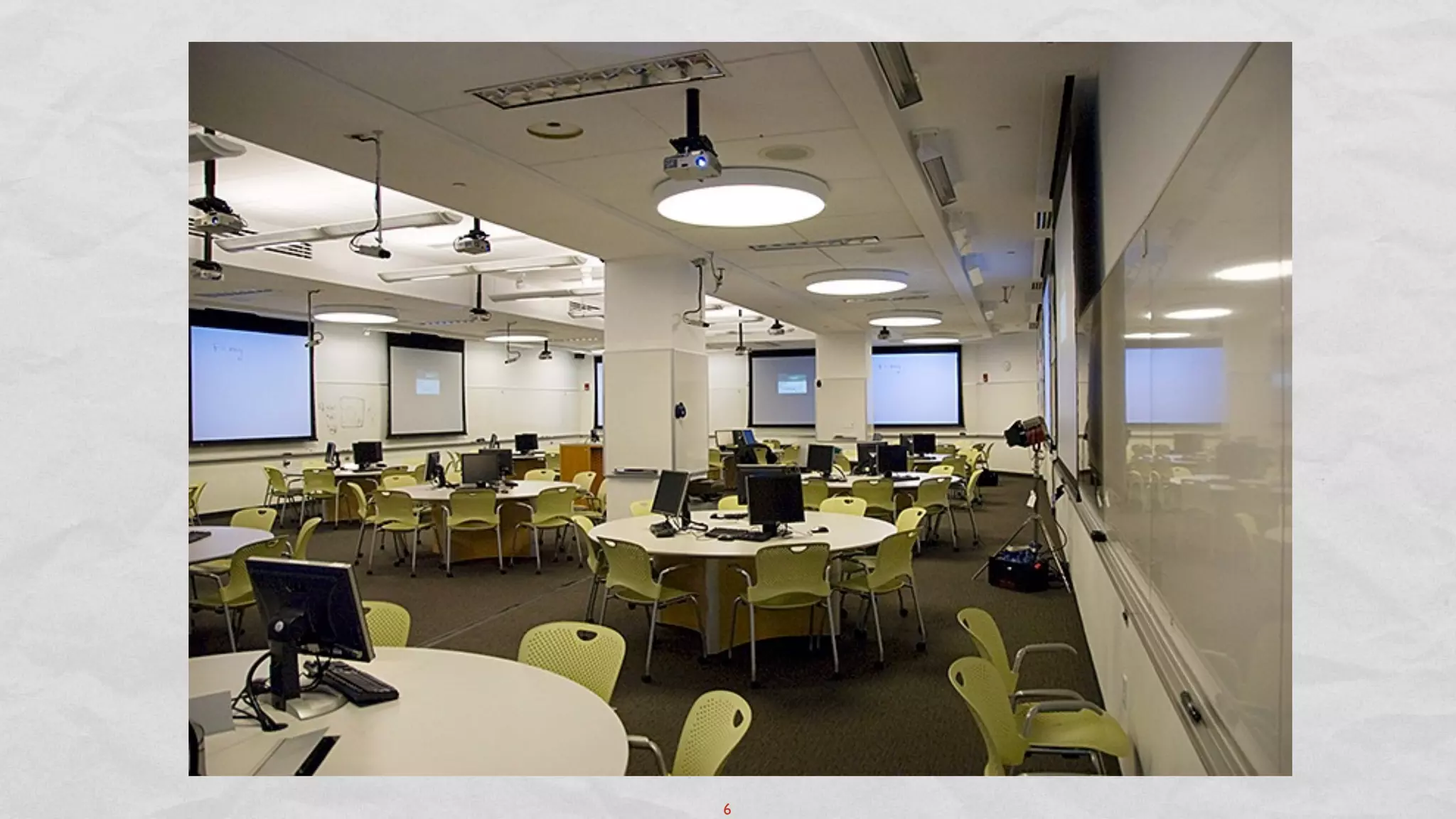
LEARNING SPACES
       10
LEARNING SPACES

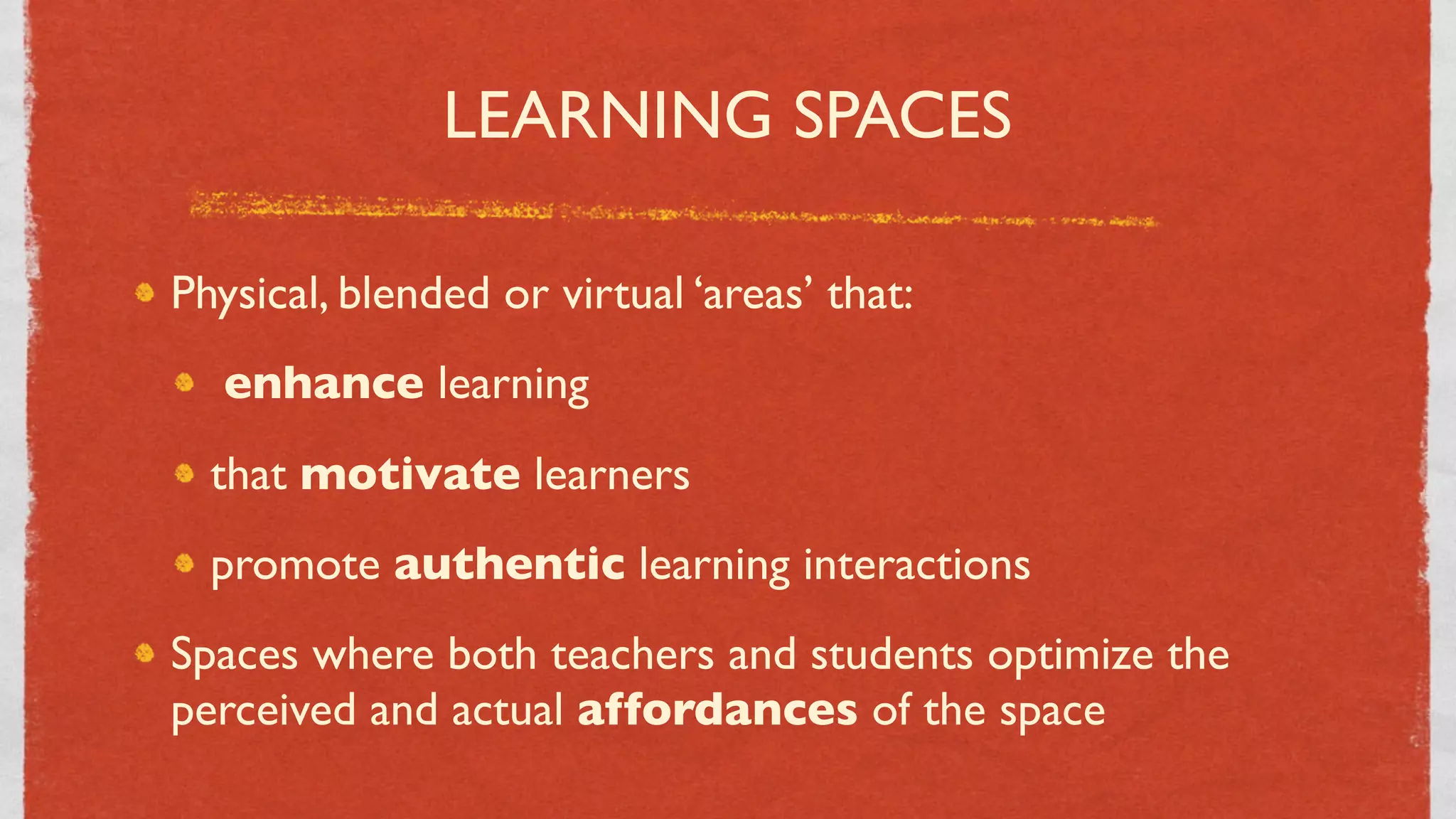
Physical, blended or virtual ‘areas’ that:
   enhance learning
  that motivate learners
  promote authentic learning interactions
Spaces where both teachers and students optimize the
perceived and actual affordances of the space
                               11
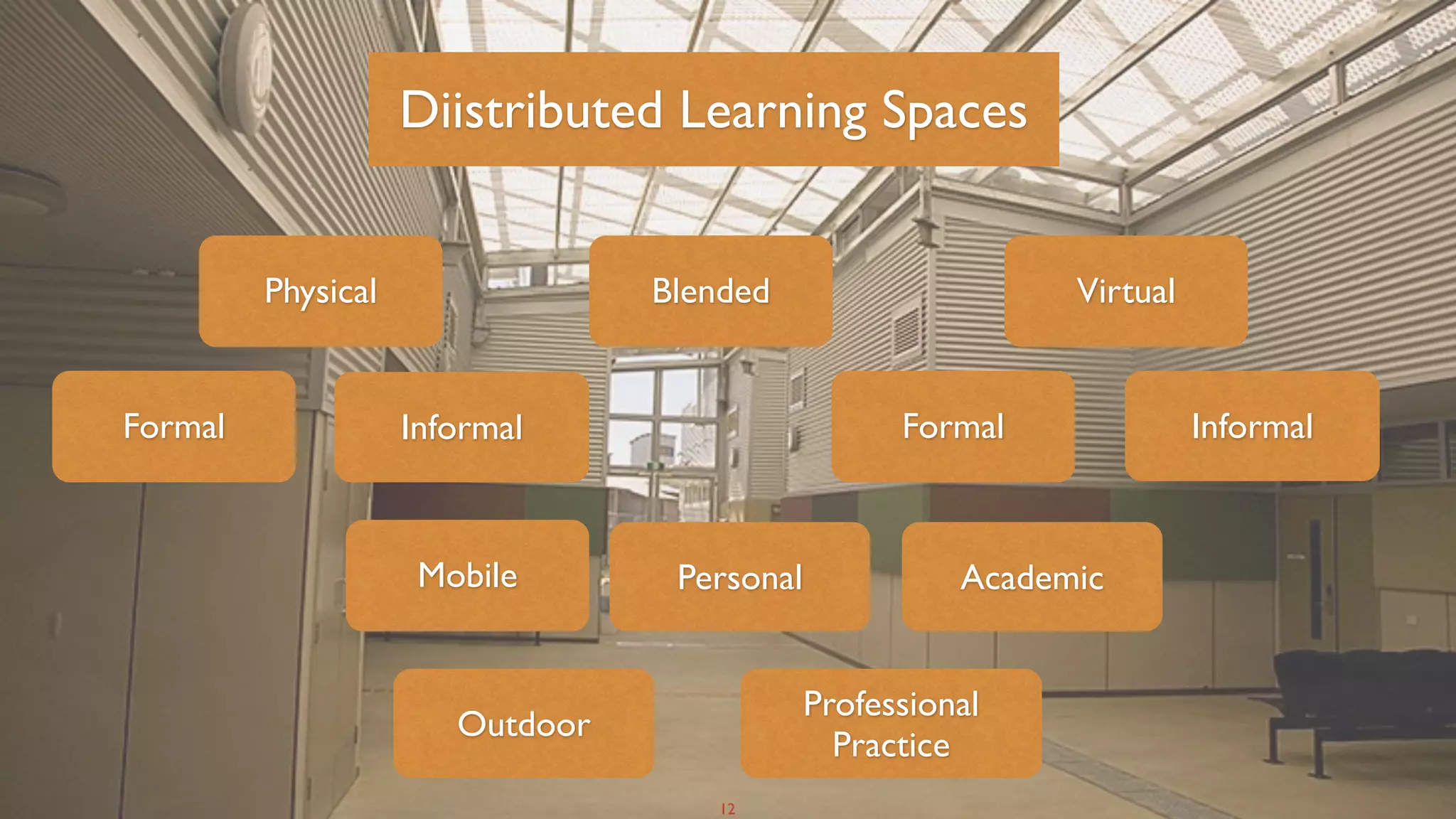
Diistributed Learning Spaces


         Physical                Blended                     Virtual


Formal              Informal                       Formal              Informal


                     Mobile       Personal             Academic


                                             Professional
                       Outdoor
                                               Practice
                                     12
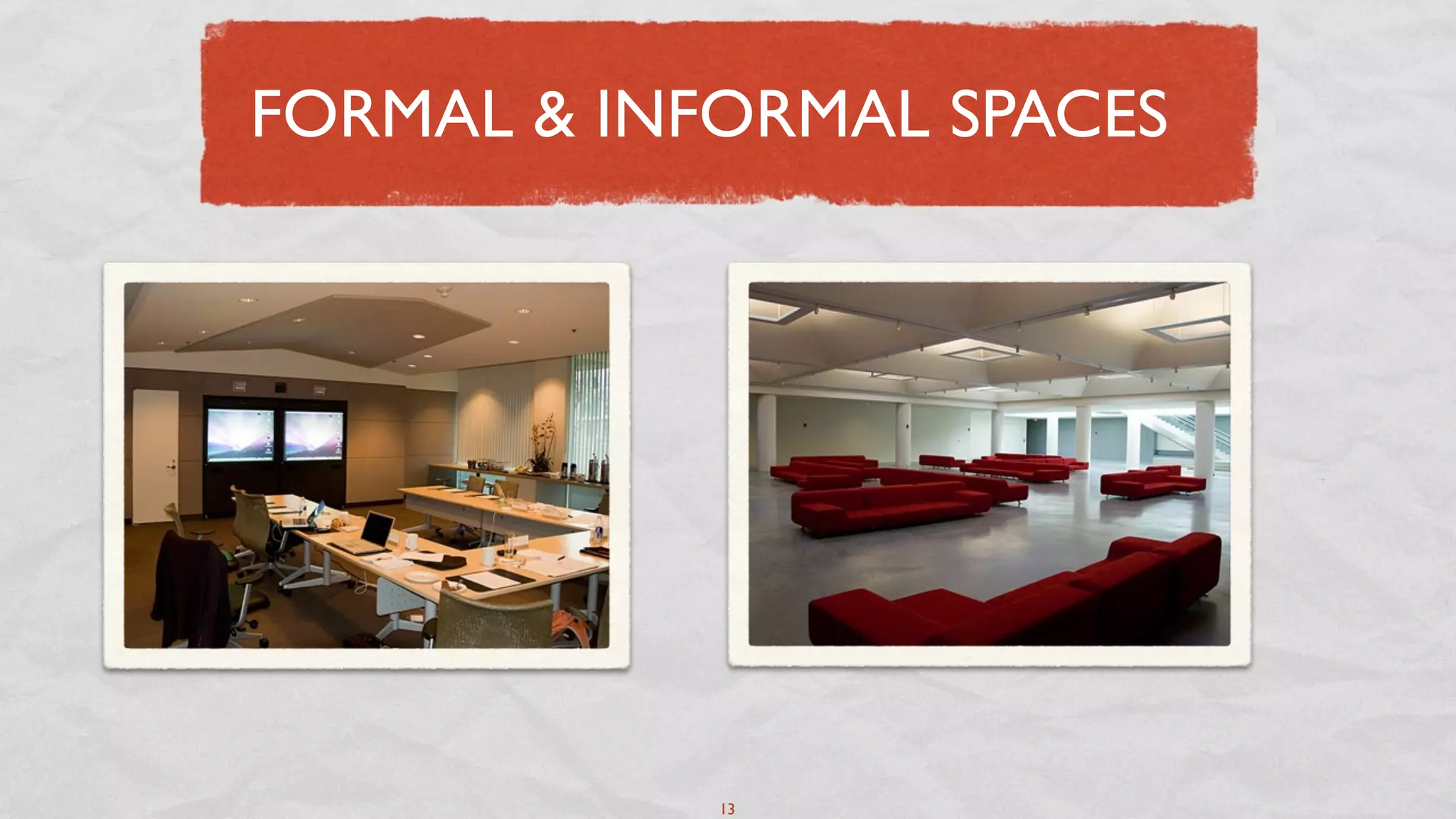
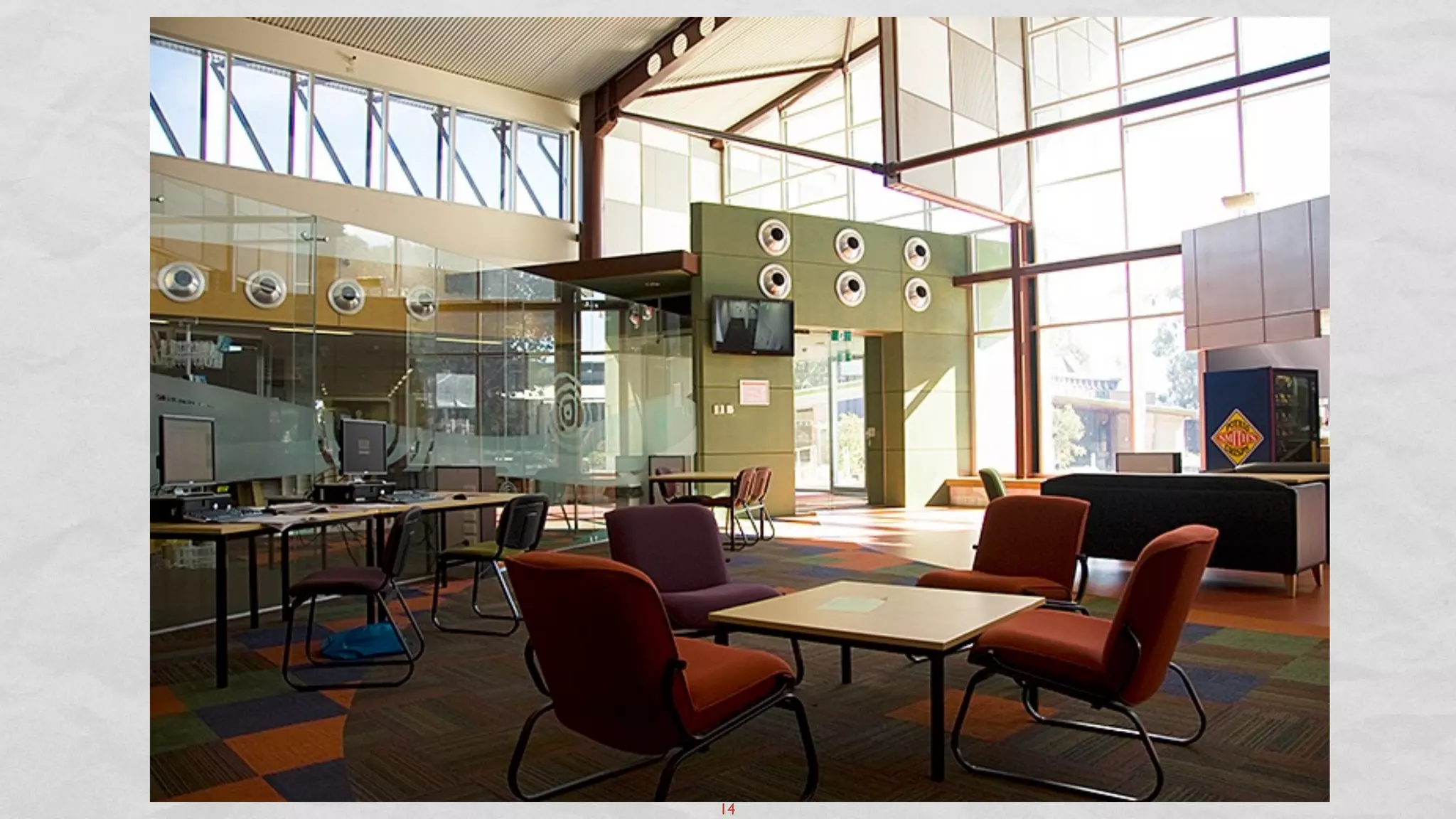
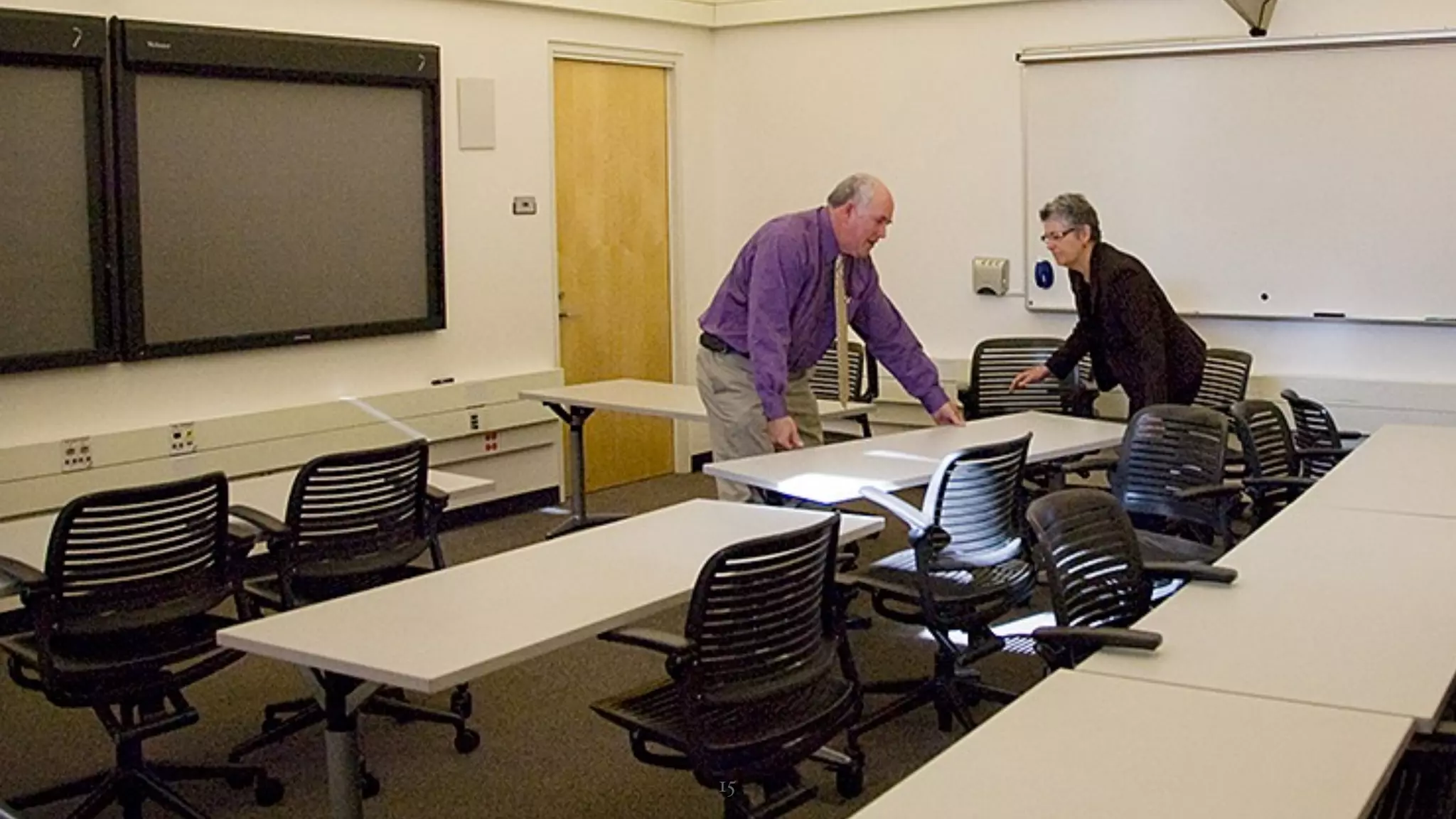
FORMAL & INFORMAL SPACES


            13
14
15
16
SEVEN PRINCIPLES OF
           LEARNING SPACE DESIGN
The SKG project has established seven principles of learning space
design which support a collaborative and student-centred  approach to
learning:
Comfort: a space which creates a physical and mental sense of ease
and well-being
Aesthetics: pleasure which includes the recognition of symmetry,
harmony, simplicity and fitness for purpose
Flow: the state of mind felt by the learner when totally involved in the
learning experience
                                  17
SEVEN PRINCIPLES OF
             LEARNING SPACE DESIGN
• Equity: consideration of the needs of cultural and physical differences
• Blending: a mixture of technological and face-to-face pedagogical
 resources

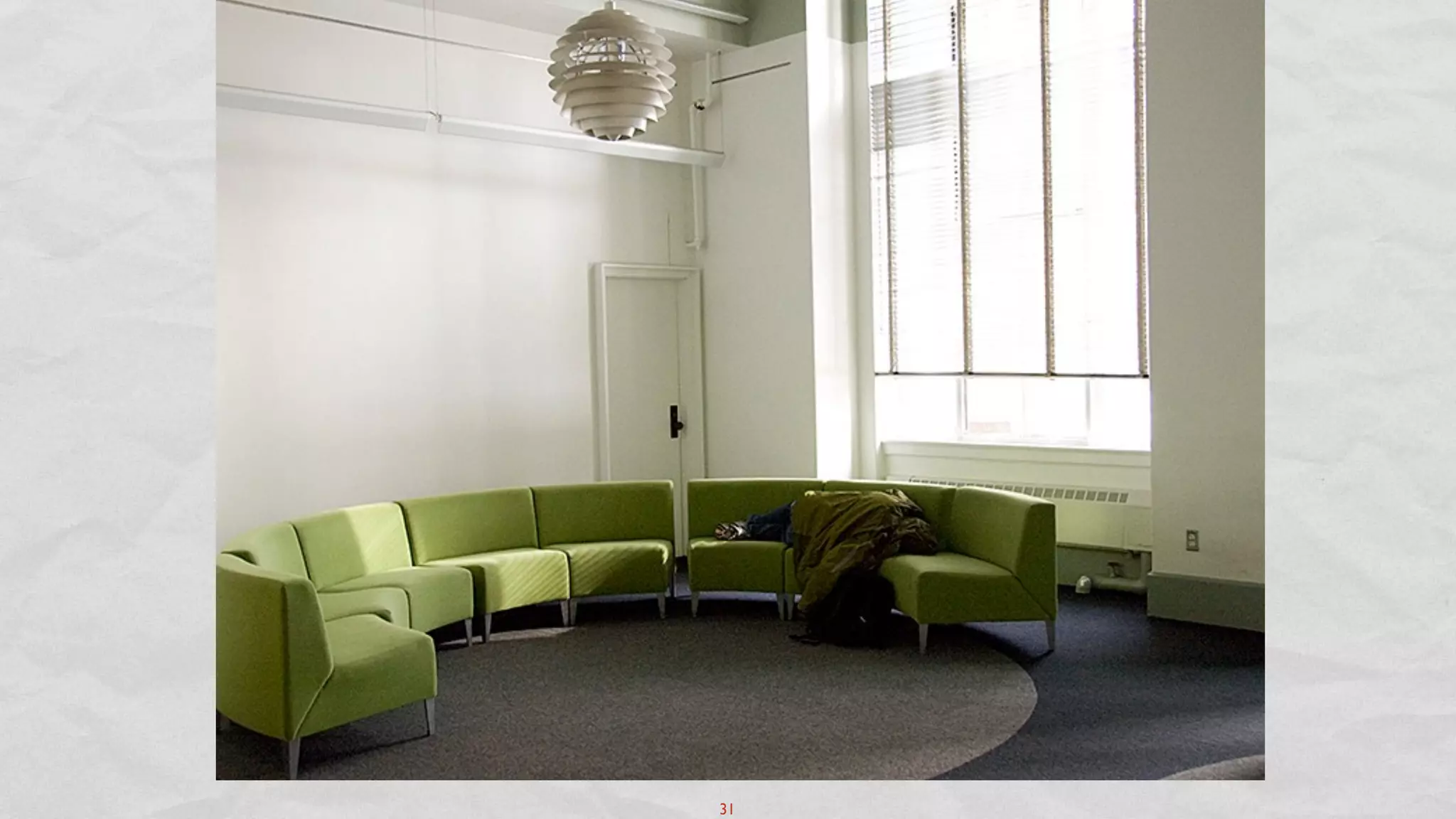
• Affordances: the “action possibilities” the learning environment
 provides the users, including such things as kitchens, natural light, wifi,
 private spaces, writing surfaces, sofas, and so on.

• Repurposing: the potential for multiple usage of a space (Souter,
 Riddle, Keppell, 2010) (http://www.skgproject.com)
                                    18
VIRTUAL LEARNING SPACES


Virtual learning spaces provide unique opportunities that are unavailable
in physical learning spaces
These affordances or ‘action possibilities’ allow a richer range of
learning interactions


                                  19
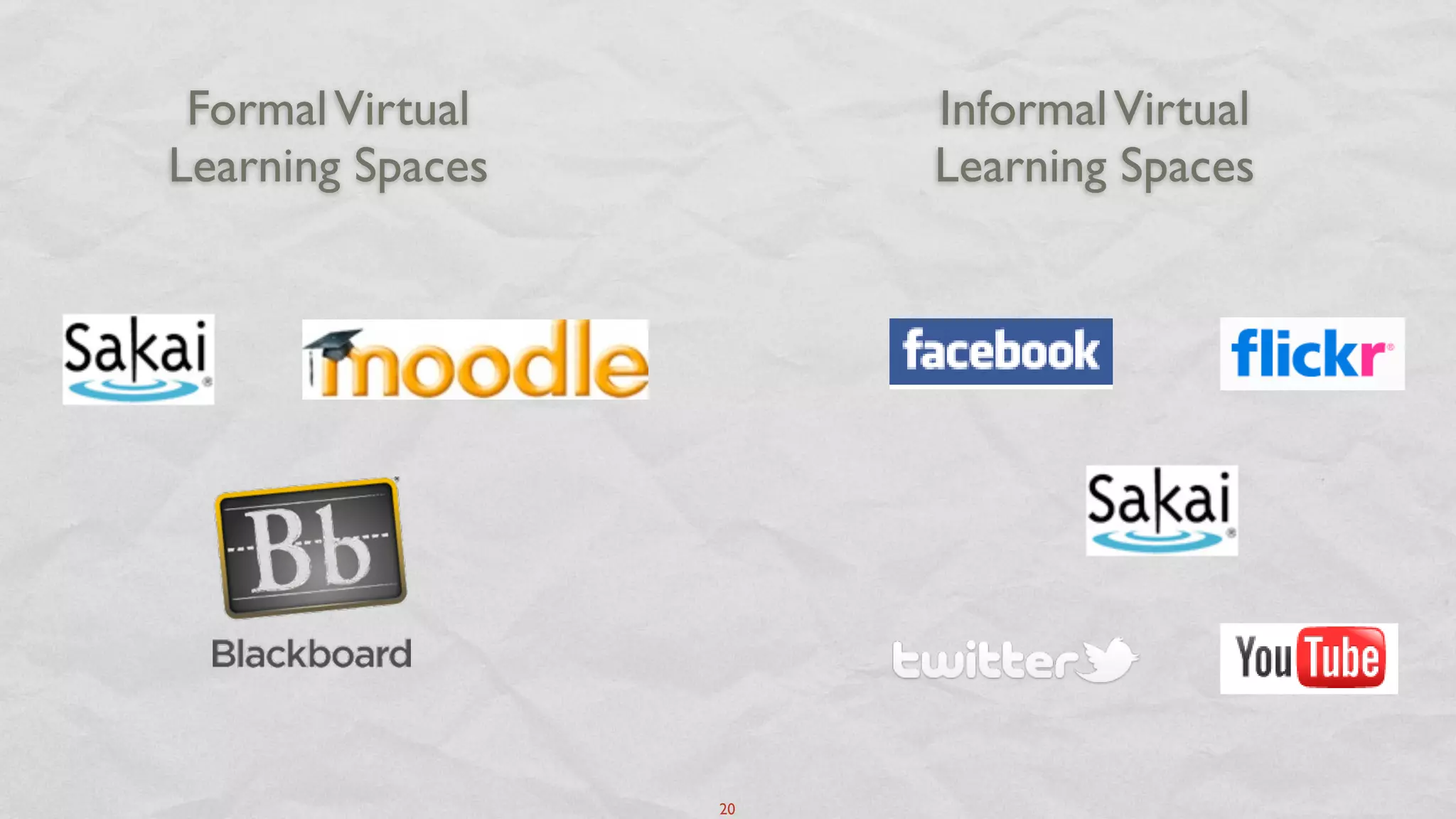
Formal Virtual        Informal Virtual
Learning Spaces        Learning Spaces


                  20
FACEBOOK


“Online and offline worlds are clearly coexisting, but used in
different ways for developing and sustaining different types of
relationships. For example, face-to-face friendships from home
have been developed and sustained through continued
online interactions, whilst newer online relationships have
flourished at university and developed into face-to-face indepth
relationships” (Madge, Meek, Wellens and Hooley 2010, p. 145).


                              21
VIRTUAL SPACES

FLI Website: http://www.csu.edu.au/division/landt/flexible-learning/
FLI Blog: http://blendedandflexiblelearning.blogspot.com/
FLI Twitter: http://twitter.com/#%21/FLINews
FLI Delicious: http://www.delicious.com/flexiblelearninginstitute
Design: http://blendedandflexiblelearning.wikispaces.com/home
FLI YouTube: http://www.youtube.com/user/FLIMedia
Slidehare: http://www.slideshare.net/mkeppell
                                   22
MOBILE LEARNING SPACES


“Learning when mobile means that context becomes all-important since
even a simple change of location is an invitation to revisit
learning” (ALT-J Vol 17, No.3 p.159)


                                 23
MOBILE LEARNING SPACES


“With its strong emphasis on learning rather than teaching, mobile
learning challenges educators to try to understand learners’ needs,
circumstances and abilities even better than before. This extends to
understanding how learning takes place beyond the
classroom, in the course of daily routines, commuting and travel, and
in the intersection of education, life, work and
leisure” (Kukulska-Hulme, 2010, p.181).


                                 24
ACADEMIC SPACES


Barnett (2011) suggests that “today’s university lives amid multiple
time-spans, and time-speeds” (p. 74). He suggests that the
arrival of constant email would be considered one of these multiple
time-spans, and other time spans might include historians who focus
on the past and researchers who may focus on the future of their
research.
Universities may need to be conscious of the 24/7 existence of
their students across the globe, each in their own unique time-span.

                                   25
ACADEMIC SPACES


Barnett (2011) suggests that academics may be active in university
spaces that may include:
Intellectual and discursive space which focus on the
contribution to the wider public sphere.
Epistemological space which focuses on the “space available for
academics to pursue their own research interests” (p. 76).


                                  26
ACADEMIC SPACES


Pedagogical and curricular space focuses on the spaces
available to trial new pedagogical approaches and new curricular
initiatives.
Ontological space which focuses on ‘academic being’ which is
becoming increasingly multi-faceted beyond the research, teaching
and community commitments. In fact “the widening of
universities’ ontological spaces may bring both peril
and liberation” (p. 77).

                               27
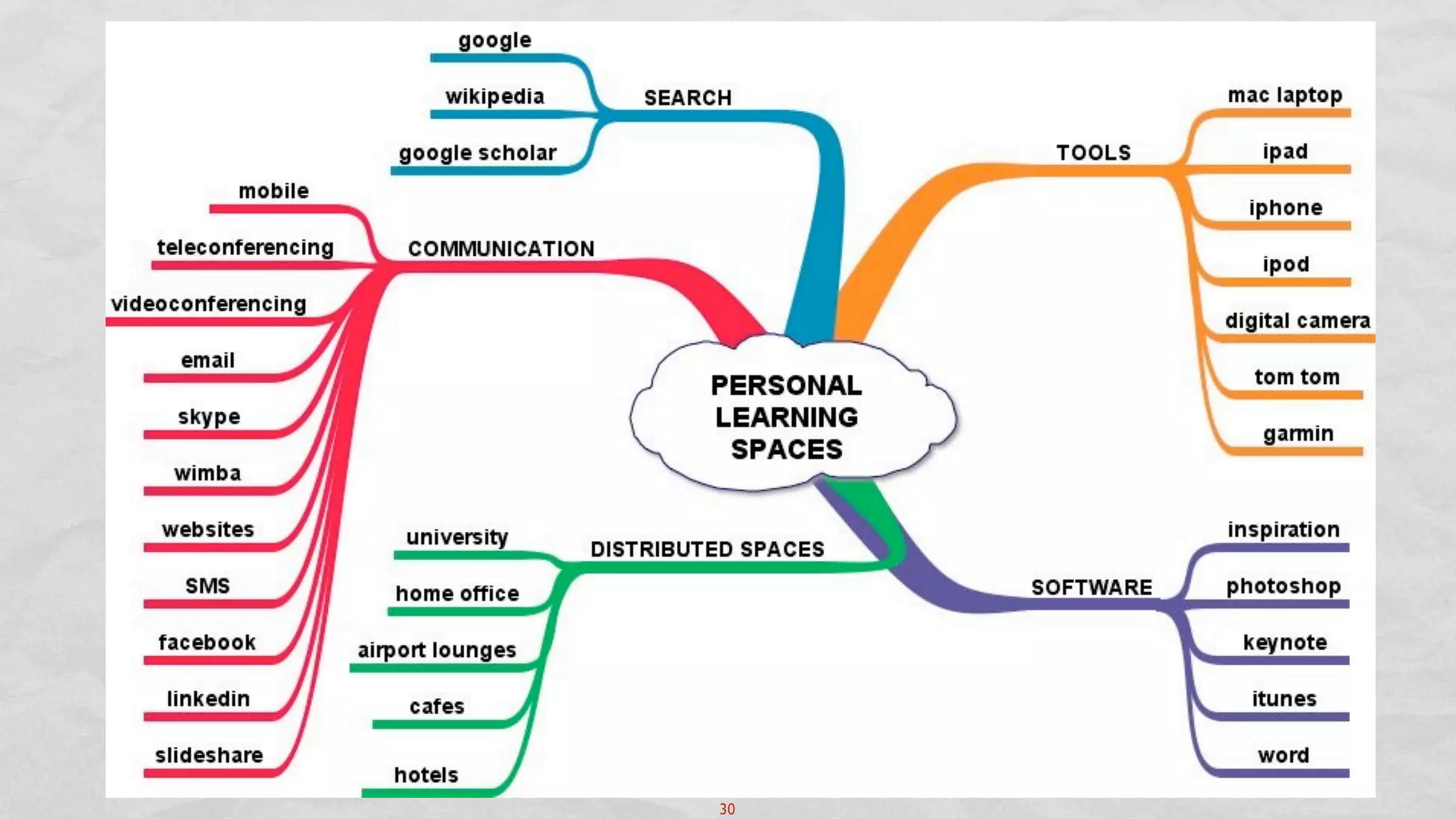
PERSONAL LEARNING SPACES


Personal learning environments (PLE) integrate formal and
informal learning spaces
Customised by the individual to suit their needs and allow them to
create their own identities.
A PLE recognises ongoing learning and the need for tools to
support life-long and life-wide learning.


                                28
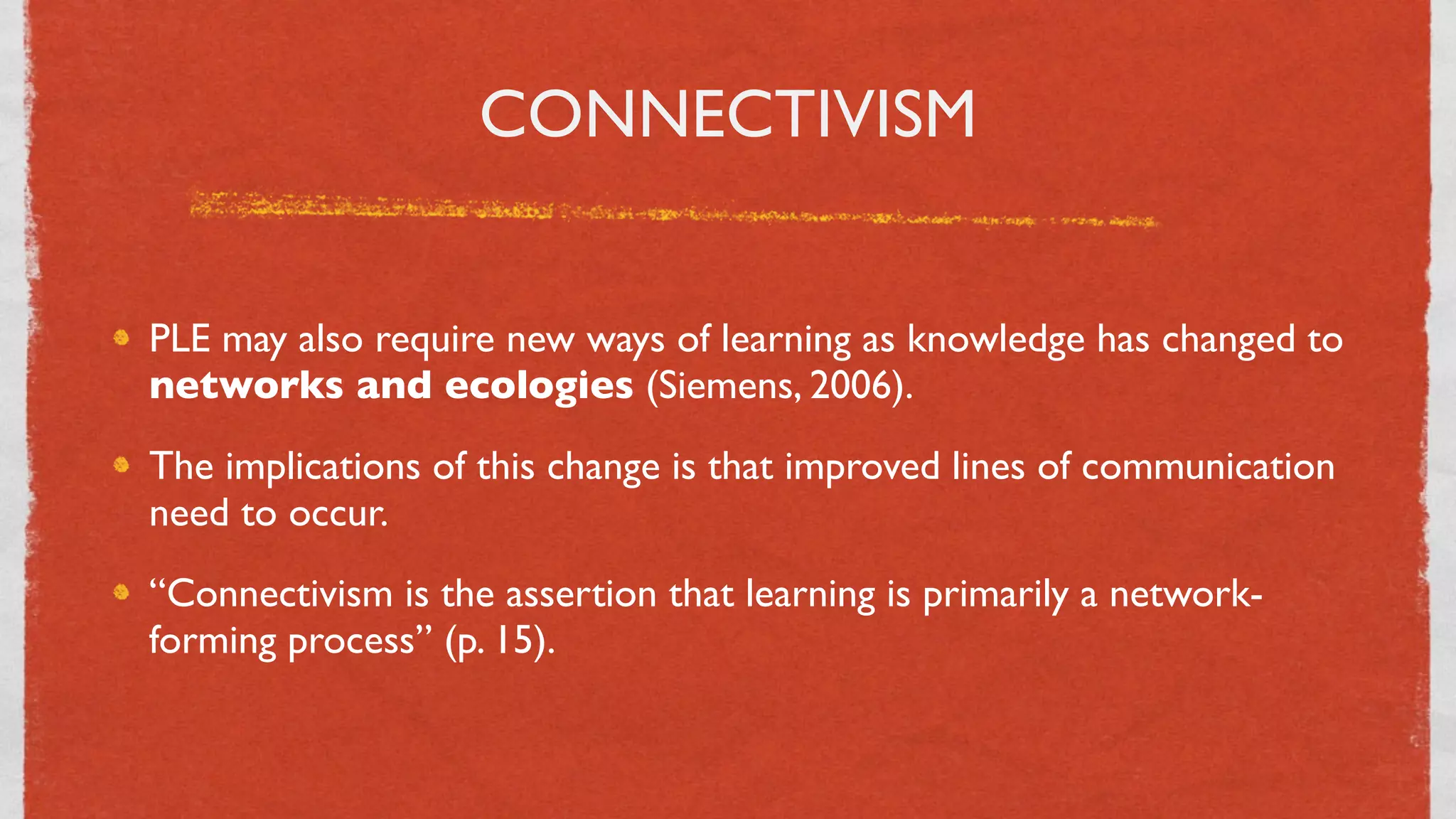
CONNECTIVISM


PLE may also require new ways of learning as knowledge has changed to
networks and ecologies (Siemens, 2006).
The implications of this change is that improved lines of communication
need to occur.
“Connectivism is the assertion that learning is primarily a network-
forming process” (p. 15).


                                  29
30
31
32
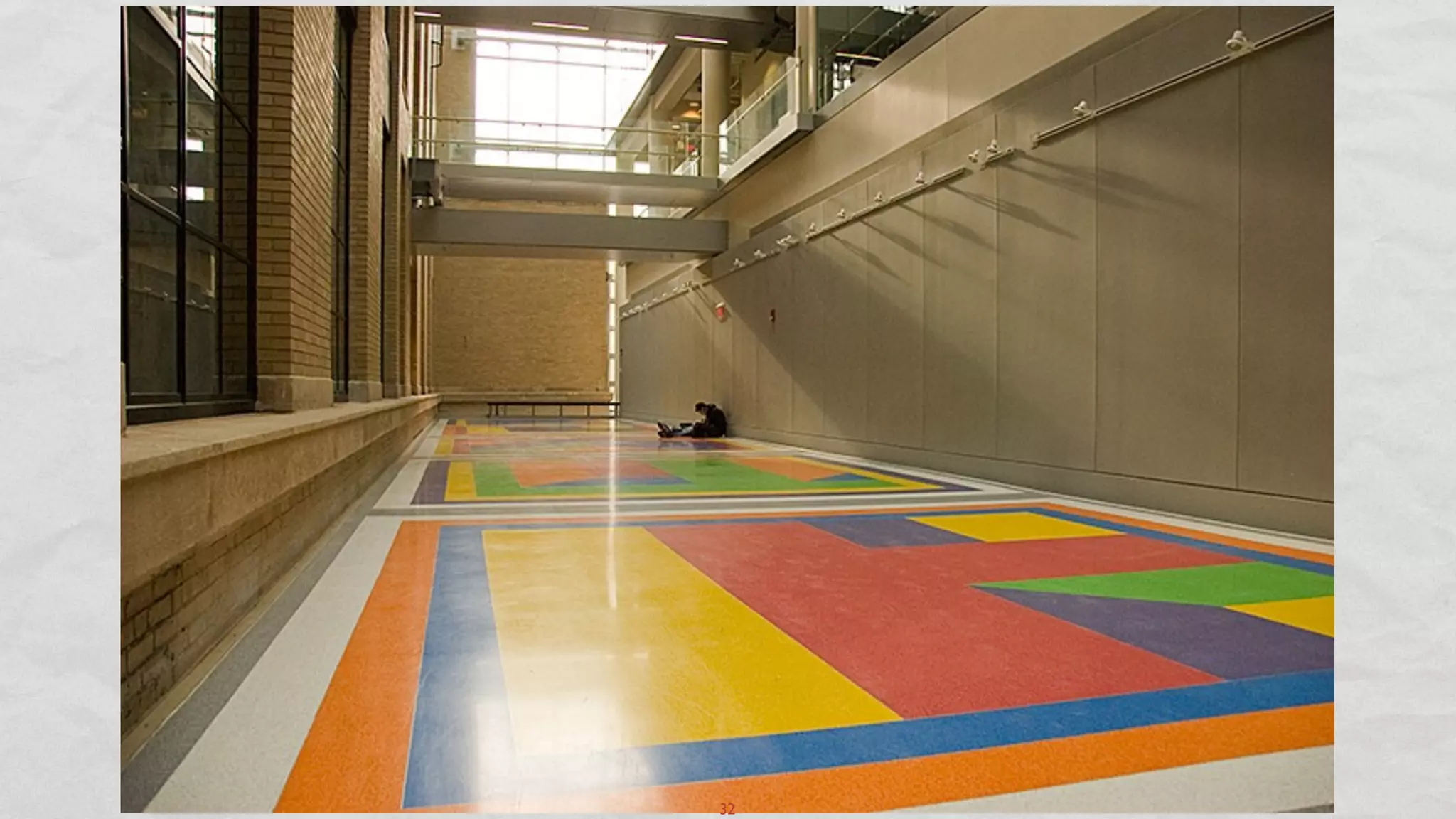
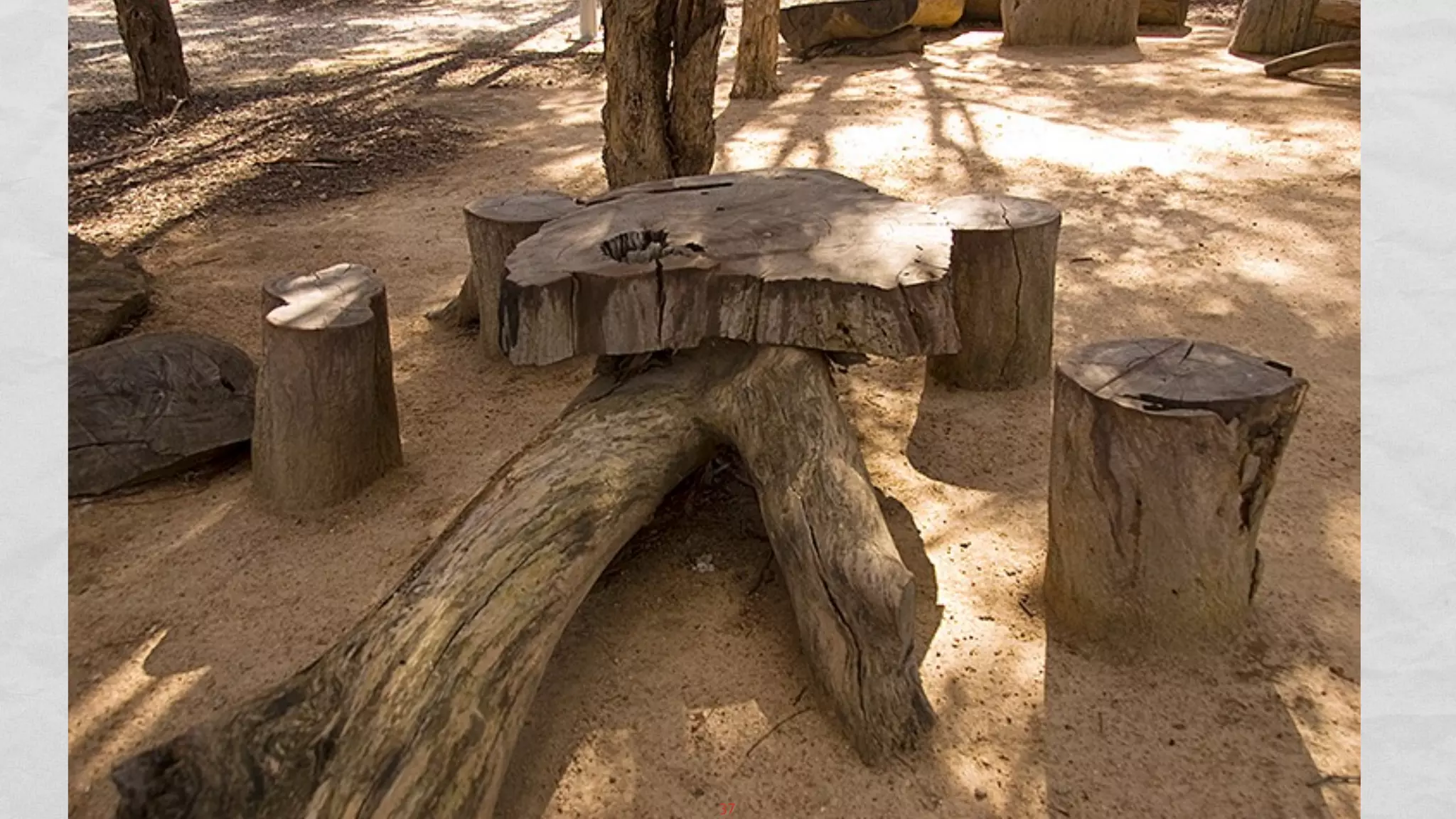
OUTDOOR LEARNING SPACES

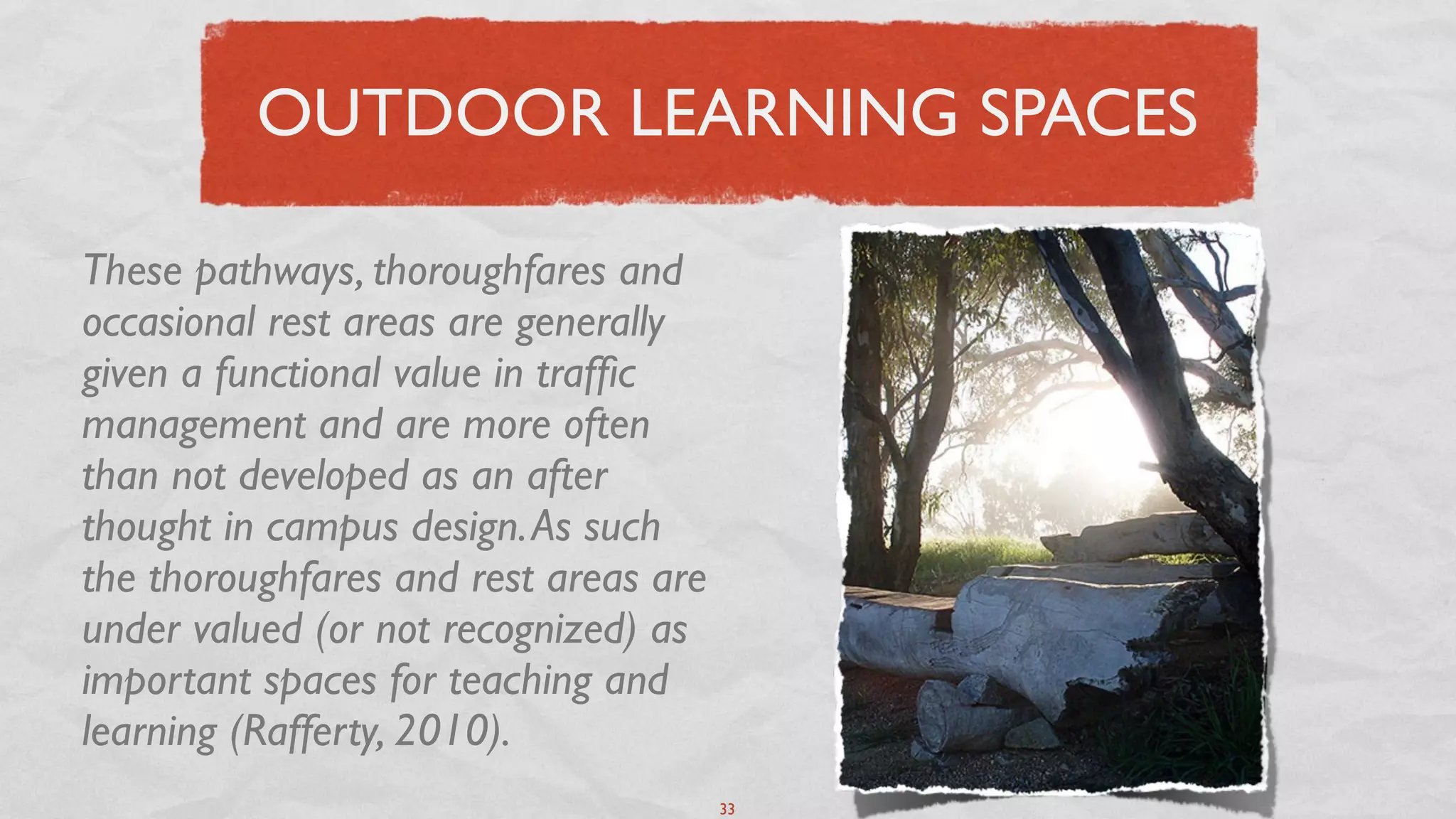
These pathways, thoroughfares and
occasional rest areas are generally
given a functional value in traffic
management and are more often
than not developed as an after
thought in campus design. As such
the thoroughfares and rest areas are
under valued (or not recognized) as
important spaces for teaching and
learning (Rafferty, 2010).
                                       33
34
35
36
37
38
CONCLUSION

Adapatability
Study time and place
Decision-making
It is time that we begin changing our thinking about the ‘place’ of
learning.
We need to let go of the tradition of universities as being a ‘singular
place’ where learning and teaching occur.
                                    39
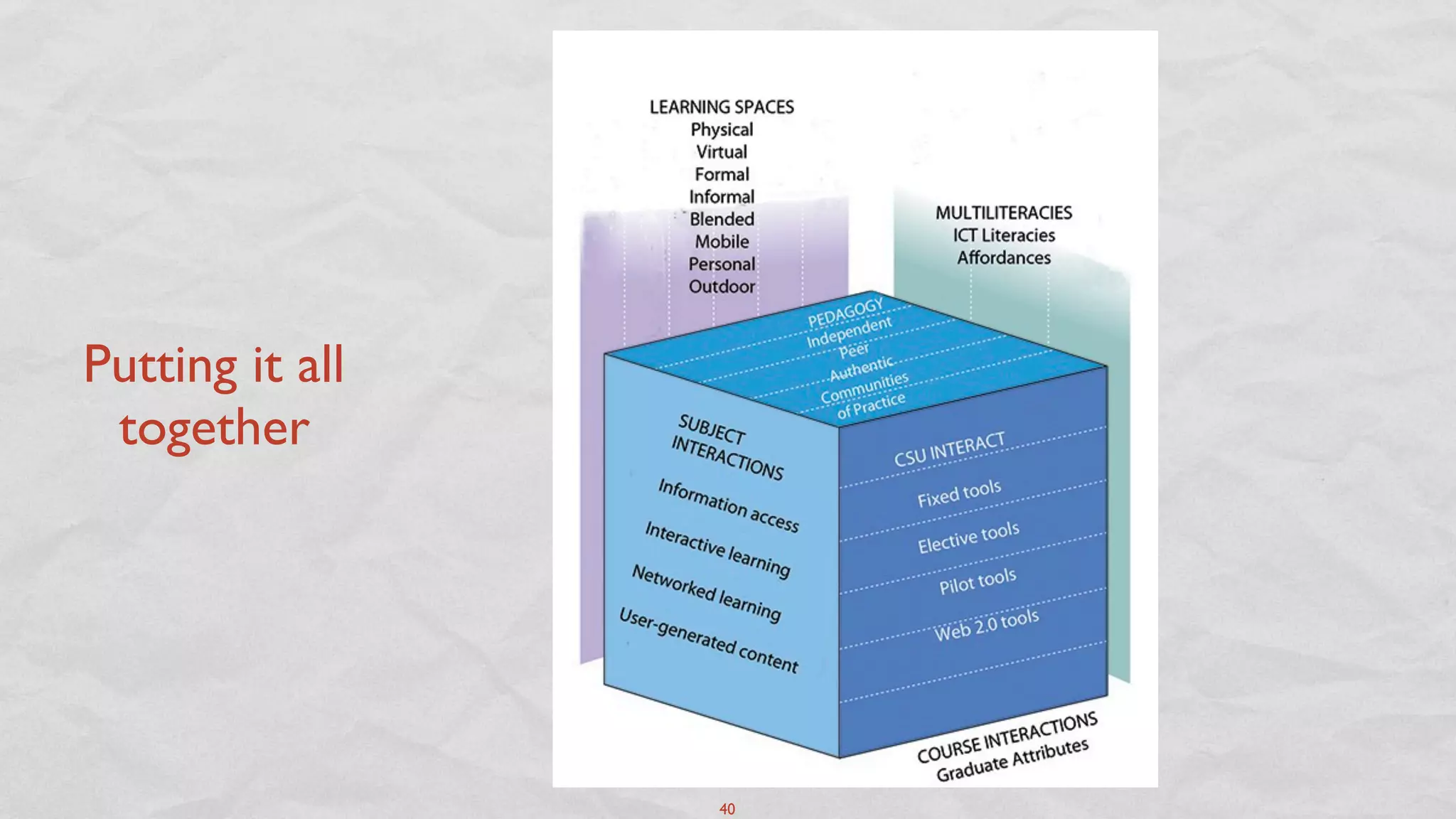
Putting it all
 together


                 40
41

Distributed Spaces for Learning

  • 1.
    DISTRIBUTED SPACES FOR LEARNING IN HIGHER EDUCATION Professor Mike Keppell Director, The Flexible Learning Institute & Professor of Higher Education Charles Sturt University 1
  • 2.
    OVERVIEW Distributed spaces Ecological university Assumptionsand principles underlying higher education Pedagogy Diversity of spaces Implications 2
  • 3.
    OVERVIEW Growing acceptance thatlearning occurs in different ‘places’ Proliferation of approaches emerging including ‘flexible’, ‘open’, ‘distance’ and ‘off-campus’ that assist the ubiquity of learning in a wide range of contexts (Lea & Nicholl, 2002). Growing acceptance of life-long and life-wide learning also have a major influence on distributed learning spaces. 3
  • 4.
    FLEXIBLE LEARNING “Flexible learning”provides opportunities to improve the student learning experience through flexibility in time, pace, place (physical, virtual, on-campus, off-campus), mode of study (print- based, face-to-face, blended, online), teaching approach (collaborative, independent), forms of assessment and staffing. It may utilise a wide range of media, environments, learning spaces and technologies for learning and teaching. 4
  • 5.
    BLENDED & FLEXIBLELEARNING “Blended and flexible learning” is a design approach that examines the relationships between flexible learning opportunities, in order to optimise student engagement and equivalence in learning outcomes regardless of mode of study (Keppell, 2010, p. 3). 5
  • 6.
  • 7.
    ASSUMPTIONS Universities value andseek to enhance the skills essential for lifelong and life wide learning, developing graduates who will continue to develop intellectually, professionally and socially beyond the bounds of formal education. Universities believe that programs, services and teaching methods should be responsive to the diverse cultural, social and academic needs of students, enabling them to adapt to the demands of university education and providing them with the cultural capital for life success. 7
  • 8.
    ECOLOGICAL UNIVERSITY Instead of‘having an impact’ on the world, ecological universities seek sustainability and more importantly self sustainability in multiple levels of interactions. It adopts a ‘care for the world’ as opposed to an ‘impact on the world’ approach (Barnett, 2011). It is a networked university that values and fosters its networks and their interconnectedness and feels a responsibility to the wellbeing of these networks. 8
  • 9.
    HIGHER EDUCATION PRINCIPLES Access and Equity & ethical obligations Equivalence of Learning Outcomes traverses physical, blended Student Learning Experience and virtual learning spaces ‘place’ is less important learning outcomes, subject, Constructive Alignment degree program, generic attributes Discipline Pedagogies specific needs of disciplines 9
  • 10.
  • 11.
    LEARNING SPACES Physical, blendedor virtual ‘areas’ that: enhance learning that motivate learners promote authentic learning interactions Spaces where both teachers and students optimize the perceived and actual affordances of the space 11
  • 12.
    Diistributed Learning Spaces Physical Blended Virtual Formal Informal Formal Informal Mobile Personal Academic Professional Outdoor Practice 12
  • 13.
  • 14.
  • 15.
  • 16.
  • 17.
    SEVEN PRINCIPLES OF LEARNING SPACE DESIGN The SKG project has established seven principles of learning space design which support a collaborative and student-centred  approach to learning: Comfort: a space which creates a physical and mental sense of ease and well-being Aesthetics: pleasure which includes the recognition of symmetry, harmony, simplicity and fitness for purpose Flow: the state of mind felt by the learner when totally involved in the learning experience 17
  • 18.
    SEVEN PRINCIPLES OF LEARNING SPACE DESIGN • Equity: consideration of the needs of cultural and physical differences • Blending: a mixture of technological and face-to-face pedagogical resources • Affordances: the “action possibilities” the learning environment provides the users, including such things as kitchens, natural light, wifi, private spaces, writing surfaces, sofas, and so on. • Repurposing: the potential for multiple usage of a space (Souter, Riddle, Keppell, 2010) (http://www.skgproject.com) 18
  • 19.
    VIRTUAL LEARNING SPACES Virtuallearning spaces provide unique opportunities that are unavailable in physical learning spaces These affordances or ‘action possibilities’ allow a richer range of learning interactions 19
  • 20.
    Formal Virtual Informal Virtual Learning Spaces Learning Spaces 20
  • 21.
    FACEBOOK “Online and offlineworlds are clearly coexisting, but used in different ways for developing and sustaining different types of relationships. For example, face-to-face friendships from home have been developed and sustained through continued online interactions, whilst newer online relationships have flourished at university and developed into face-to-face indepth relationships” (Madge, Meek, Wellens and Hooley 2010, p. 145). 21
  • 22.
    VIRTUAL SPACES FLI Website:http://www.csu.edu.au/division/landt/flexible-learning/ FLI Blog: http://blendedandflexiblelearning.blogspot.com/ FLI Twitter: http://twitter.com/#%21/FLINews FLI Delicious: http://www.delicious.com/flexiblelearninginstitute Design: http://blendedandflexiblelearning.wikispaces.com/home FLI YouTube: http://www.youtube.com/user/FLIMedia Slidehare: http://www.slideshare.net/mkeppell 22
  • 23.
    MOBILE LEARNING SPACES “Learningwhen mobile means that context becomes all-important since even a simple change of location is an invitation to revisit learning” (ALT-J Vol 17, No.3 p.159) 23
  • 24.
    MOBILE LEARNING SPACES “Withits strong emphasis on learning rather than teaching, mobile learning challenges educators to try to understand learners’ needs, circumstances and abilities even better than before. This extends to understanding how learning takes place beyond the classroom, in the course of daily routines, commuting and travel, and in the intersection of education, life, work and leisure” (Kukulska-Hulme, 2010, p.181). 24
  • 25.
    ACADEMIC SPACES Barnett (2011)suggests that “today’s university lives amid multiple time-spans, and time-speeds” (p. 74). He suggests that the arrival of constant email would be considered one of these multiple time-spans, and other time spans might include historians who focus on the past and researchers who may focus on the future of their research. Universities may need to be conscious of the 24/7 existence of their students across the globe, each in their own unique time-span. 25
  • 26.
    ACADEMIC SPACES Barnett (2011)suggests that academics may be active in university spaces that may include: Intellectual and discursive space which focus on the contribution to the wider public sphere. Epistemological space which focuses on the “space available for academics to pursue their own research interests” (p. 76). 26
  • 27.
    ACADEMIC SPACES Pedagogical andcurricular space focuses on the spaces available to trial new pedagogical approaches and new curricular initiatives. Ontological space which focuses on ‘academic being’ which is becoming increasingly multi-faceted beyond the research, teaching and community commitments. In fact “the widening of universities’ ontological spaces may bring both peril and liberation” (p. 77). 27
  • 28.
    PERSONAL LEARNING SPACES Personallearning environments (PLE) integrate formal and informal learning spaces Customised by the individual to suit their needs and allow them to create their own identities. A PLE recognises ongoing learning and the need for tools to support life-long and life-wide learning. 28
  • 29.
    CONNECTIVISM PLE may alsorequire new ways of learning as knowledge has changed to networks and ecologies (Siemens, 2006). The implications of this change is that improved lines of communication need to occur. “Connectivism is the assertion that learning is primarily a network- forming process” (p. 15). 29
  • 30.
  • 31.
  • 32.
  • 33.
    OUTDOOR LEARNING SPACES Thesepathways, thoroughfares and occasional rest areas are generally given a functional value in traffic management and are more often than not developed as an after thought in campus design. As such the thoroughfares and rest areas are under valued (or not recognized) as important spaces for teaching and learning (Rafferty, 2010). 33
  • 34.
  • 35.
  • 36.
  • 37.
  • 38.
  • 39.
    CONCLUSION Adapatability Study time andplace Decision-making It is time that we begin changing our thinking about the ‘place’ of learning. We need to let go of the tradition of universities as being a ‘singular place’ where learning and teaching occur. 39
  • 40.
    Putting it all together 40
  • 41.

Editor's Notes