


Authentic Learning and
                 Collaboration
           with Web 2.0 Technologies
                        October 13, 2012

                              Bert Y. Kimura
                             University of Hawaii

                            Mary E.O. Kimura
                      NPO Forum for I-Learning Creation

                               Curtis P. Ho
                             University of Hawaii

                             Kenichi Kubota
                              Kansai University


JAEMS Kenkyukai, Nagoya, Japan
Introduction
                Classes taught in
                 English before and
                 after fieldwork in
                 Philippines and
                 Cambodia.
                Authentic learning
                 and collaboration
                 using WEB 2.0
                 technologies.
                   ◦ Oral Comm. (Spring)
                   ◦ ICT for Learning
                     (Fall)
Authentic Learning (AL)
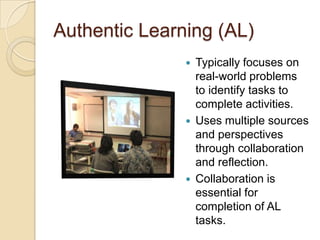
                  Typically focuses on
                   real-world problems
                   to identify tasks to
                   complete activities.
                  Uses multiple sources
                   and perspectives
                   through collaboration
                   and reflection.
                  Collaboration is
                   essential for
                   completion of AL
                   tasks.
Learning from Collaboration
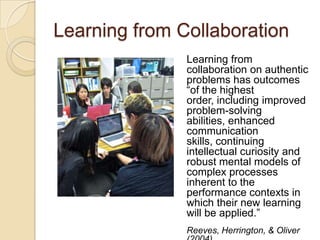
               Learning from
               collaboration on authentic
               problems has outcomes
               “of the highest
               order, including improved
               problem-solving
               abilities, enhanced
               communication
               skills, continuing
               intellectual curiosity and
               robust mental models of
               complex processes
               inherent to the
               performance contexts in
               which their new learning
               will be applied.”
               Reeves, Herrington, & Oliver
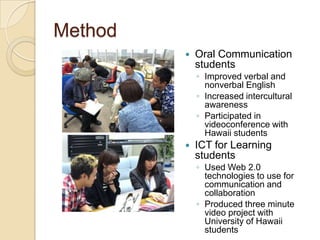
Method
            Oral Communication
             students
             ◦ Improved verbal and
               nonverbal English
             ◦ Increased intercultural
               awareness
             ◦ Participated in
               videoconference with
               Hawaii students
            ICT for Learning
             students
             ◦ Used Web 2.0
               technologies to use for
               communication and
               collaboration
             ◦ Produced three minute
               video project with
               University of Hawaii
               students
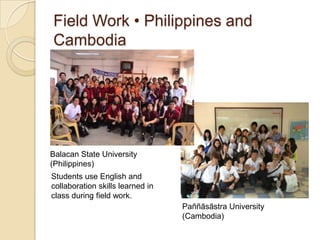
Field Work • Philippines and
Cambodia


Balacan State University
(Philippines)
Students use English and
collaboration skills learned in
class during field work.
                                  Paññāsāstra University
                                  (Cambodia)
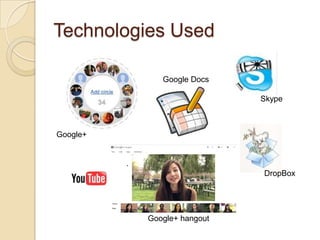
Technologies Used

             Google Docs

                            Skype


Google+


                            DropBox


          Google+ hangout
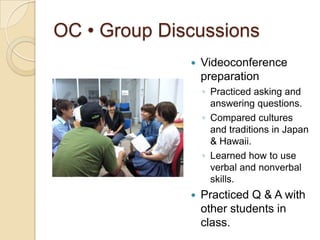
OC • Group Discussions
                 Videoconference
                  preparation
                  ◦ Practiced asking and
                    answering questions.
                  ◦ Compared cultures
                    and traditions in Japan
                    & Hawaii.
                  ◦ Learned how to use
                    verbal and nonverbal
                    skills.
                 Practiced Q & A with
                  other students in
                  class.
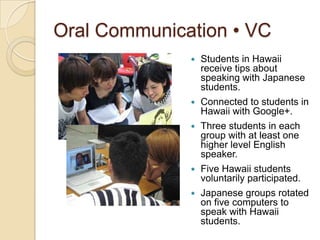
Oral Communication • VC
                 Students in Hawaii
                  receive tips about
                  speaking with Japanese
                  students.
                 Connected to students in
                  Hawaii with Google+.
                 Three students in each
                  group with at least one
                  higher level English
                  speaker.
                 Five Hawaii students
                  voluntarily participated.
                 Japanese groups rotated
                  on five computers to
                  speak with Hawaii
                  students.
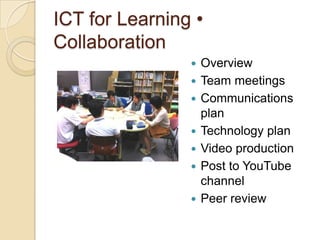
ICT for Learning •
Collaboration
                   Overview
                   Team meetings
                   Communications
                    plan
                   Technology plan
                   Video production
                   Post to YouTube
                    channel
                   Peer review
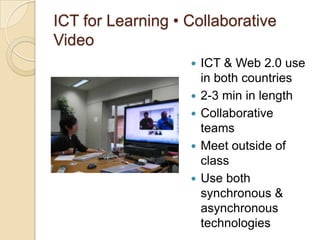
ICT for Learning • Collaborative
Video
                      ICT & Web 2.0 use
                       in both countries
                      2-3 min in length
                      Collaborative
                       teams
                      Meet outside of
                       class
                      Use both
                       synchronous &
                       asynchronous
                       technologies
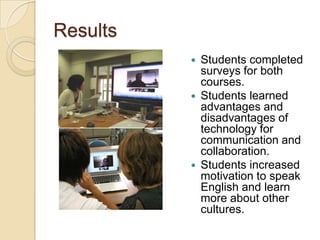
Results
             Students completed
              surveys for both
              courses.
             Students learned
              advantages and
              disadvantages of
              technology for
              communication and
              collaboration.
             Students increased
              motivation to speak
              English and learn
              more about other
              cultures.
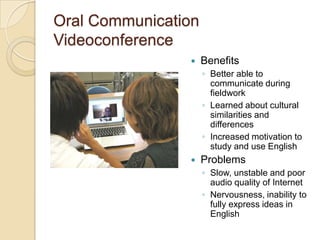
Oral Communication
Videoconference
                    Benefits
                     ◦ Better able to
                       communicate during
                       fieldwork
                     ◦ Learned about cultural
                       similarities and
                       differences
                     ◦ Increased motivation to
                       study and use English
                    Problems
                     ◦ Slow, unstable and poor
                       audio quality of Internet
                     ◦ Nervousness, inability to
                       fully express ideas in
                       English
Student Comments
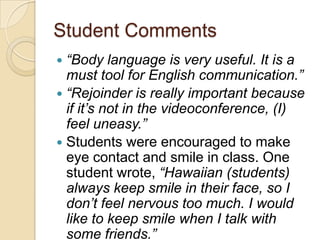
 “Body language is very useful. It is a
  must tool for English communication.”
 “Rejoinder is really important because
  if it’s not in the videoconference, (I)
  feel uneasy.”
 Students were encouraged to make
  eye contact and smile in class. One
  student wrote, “Hawaiian (students)
  always keep smile in their face, so I
  don’t feel nervous too much. I would
  like to keep smile when I talk with
  some friends.”
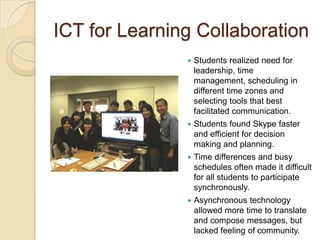
ICT for Learning Collaboration
                  Students realized need for
                   leadership, time
                   management, scheduling in
                   different time zones and
                   selecting tools that best
                   facilitated communication.
                  Students found Skype faster
                   and efficient for decision
                   making and planning.
                  Time differences and busy
                   schedules often made it difficult
                   for all students to participate
                   synchronously.
                  Asynchronous technology
                   allowed more time to translate
                   and compose messages, but
                   lacked feeling of community.
Student Comments
   “I think CVP is great curriculum for us.
    because i tried to communicate with
    english and i knew new ICT tools.
    Thanks so much!”
   “I overall was glad to participate in this
    assignment and would like to do this
    again.”
   “This was a wonderful learning
    experience about collaborating with
    students at a distance and at a time
Conclusion
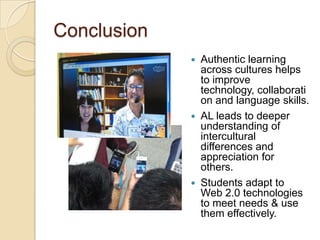
                Authentic learning
                 across cultures helps
                 to improve
                 technology, collaborati
                 on and language skills.
                AL leads to deeper
                 understanding of
                 intercultural
                 differences and
                 appreciation for
                 others.
                Students adapt to
                 Web 2.0 technologies
                 to meet needs & use
                 them effectively.
Future Research
   Collecting more quantitative data
   Conducting similar activities with
    universities in other countries
References
   Overbaugh, R. C., & Schultz, L.
    Bloom’s taxonomy. Old Dominion
    University.

   Reeves, T. C., Herrington, J., & Oliver, R.
    Authentic Activities and Online Learning.

   Reeves, T. C., Herrington, J., & Oliver, R.
    A development research agenda for online
    collaborative learning.
Acknowledgements
   Supported by the Kansai University
    research fund,
    KyoikuKenkyuKodokaSokushin-hi, in 2012.

   The authors are affiliated with the NPO
    Forum for i-Learning Creation (FiLC).
Contact Information

               Bert Y. Kimura
            Bert.at.hawaii.dot.edu
            Mary E. O. Kimura
    mary_kimura.at.alumni.stanford.dot.edu
                Curtis P. Ho
           curtis.at.hawaii.dot.edu
              Kenichi Kubota
     kubota.at.res.kutc.kansai-u.ac.dot.jp
Question and Answers

Authenthic Learning & Collaboration with Web 2.0 Technologies

  • 1.
    Authentic Learning and Collaboration with Web 2.0 Technologies October 13, 2012 Bert Y. Kimura University of Hawaii Mary E.O. Kimura NPO Forum for I-Learning Creation Curtis P. Ho University of Hawaii Kenichi Kubota Kansai University JAEMS Kenkyukai, Nagoya, Japan
  • 2.
    Introduction  Classes taught in English before and after fieldwork in Philippines and Cambodia.  Authentic learning and collaboration using WEB 2.0 technologies. ◦ Oral Comm. (Spring) ◦ ICT for Learning (Fall)
  • 3.
    Authentic Learning (AL)  Typically focuses on real-world problems to identify tasks to complete activities.  Uses multiple sources and perspectives through collaboration and reflection.  Collaboration is essential for completion of AL tasks.
  • 4.
    Learning from Collaboration Learning from collaboration on authentic problems has outcomes “of the highest order, including improved problem-solving abilities, enhanced communication skills, continuing intellectual curiosity and robust mental models of complex processes inherent to the performance contexts in which their new learning will be applied.” Reeves, Herrington, & Oliver
  • 5.
    Method  Oral Communication students ◦ Improved verbal and nonverbal English ◦ Increased intercultural awareness ◦ Participated in videoconference with Hawaii students  ICT for Learning students ◦ Used Web 2.0 technologies to use for communication and collaboration ◦ Produced three minute video project with University of Hawaii students
  • 6.
    Field Work •Philippines and Cambodia Balacan State University (Philippines) Students use English and collaboration skills learned in class during field work. Paññāsāstra University (Cambodia)
  • 7.
    Technologies Used Google Docs Skype Google+ DropBox Google+ hangout
  • 8.
    OC • GroupDiscussions  Videoconference preparation ◦ Practiced asking and answering questions. ◦ Compared cultures and traditions in Japan & Hawaii. ◦ Learned how to use verbal and nonverbal skills.  Practiced Q & A with other students in class.
  • 9.
    Oral Communication •VC  Students in Hawaii receive tips about speaking with Japanese students.  Connected to students in Hawaii with Google+.  Three students in each group with at least one higher level English speaker.  Five Hawaii students voluntarily participated.  Japanese groups rotated on five computers to speak with Hawaii students.
  • 10.
    ICT for Learning• Collaboration  Overview  Team meetings  Communications plan  Technology plan  Video production  Post to YouTube channel  Peer review
  • 11.
    ICT for Learning• Collaborative Video  ICT & Web 2.0 use in both countries  2-3 min in length  Collaborative teams  Meet outside of class  Use both synchronous & asynchronous technologies
  • 14.
    Results  Students completed surveys for both courses.  Students learned advantages and disadvantages of technology for communication and collaboration.  Students increased motivation to speak English and learn more about other cultures.
  • 15.
    Oral Communication Videoconference  Benefits ◦ Better able to communicate during fieldwork ◦ Learned about cultural similarities and differences ◦ Increased motivation to study and use English  Problems ◦ Slow, unstable and poor audio quality of Internet ◦ Nervousness, inability to fully express ideas in English
  • 16.
    Student Comments  “Bodylanguage is very useful. It is a must tool for English communication.”  “Rejoinder is really important because if it’s not in the videoconference, (I) feel uneasy.”  Students were encouraged to make eye contact and smile in class. One student wrote, “Hawaiian (students) always keep smile in their face, so I don’t feel nervous too much. I would like to keep smile when I talk with some friends.”
  • 17.
    ICT for LearningCollaboration  Students realized need for leadership, time management, scheduling in different time zones and selecting tools that best facilitated communication.  Students found Skype faster and efficient for decision making and planning.  Time differences and busy schedules often made it difficult for all students to participate synchronously.  Asynchronous technology allowed more time to translate and compose messages, but lacked feeling of community.
  • 18.
    Student Comments  “I think CVP is great curriculum for us. because i tried to communicate with english and i knew new ICT tools. Thanks so much!”  “I overall was glad to participate in this assignment and would like to do this again.”  “This was a wonderful learning experience about collaborating with students at a distance and at a time
  • 19.
    Conclusion  Authentic learning across cultures helps to improve technology, collaborati on and language skills.  AL leads to deeper understanding of intercultural differences and appreciation for others.  Students adapt to Web 2.0 technologies to meet needs & use them effectively.
  • 20.
    Future Research  Collecting more quantitative data  Conducting similar activities with universities in other countries
  • 21.
    References  Overbaugh, R. C., & Schultz, L. Bloom’s taxonomy. Old Dominion University.  Reeves, T. C., Herrington, J., & Oliver, R. Authentic Activities and Online Learning.  Reeves, T. C., Herrington, J., & Oliver, R. A development research agenda for online collaborative learning.
  • 22.
    Acknowledgements  Supported by the Kansai University research fund, KyoikuKenkyuKodokaSokushin-hi, in 2012.  The authors are affiliated with the NPO Forum for i-Learning Creation (FiLC).
  • 23.
    Contact Information Bert Y. Kimura Bert.at.hawaii.dot.edu Mary E. O. Kimura mary_kimura.at.alumni.stanford.dot.edu Curtis P. Ho curtis.at.hawaii.dot.edu Kenichi Kubota kubota.at.res.kutc.kansai-u.ac.dot.jp
  • 24.

Editor's Notes

  • #2 It good to see all of you again. Today we would like to talk about our work with Kubota sensei's Kansai University students, using authentic learning and Web 2.0 technologies.
  • #3 We will discuss classes taught in English before and after fieldwork that students perform in the Philippines and Cambodia.In the spring students take an Oral Communications class and in the fall, they participate in ICT for Learning.We’ll discuss both classes and how students improve their English, collaborative skills, increase intercultural awareness and use technology.
  • #4 Conclude: so Authentic Activities provide a way to prepare students for their field work before they leave Japan and allows them to continue using collaborative skills on their return.
  • #5 M
  • #6 M
  • #7 M
  • #8 B
  • #9 B
  • #10 BFind pic on Canon Ixi or iPhoto
  • #11 B
  • #12 B
  • #13 Link to YouTube video
  • #14 Link to YouTube video
  • #17 M
  • #19 M
  • #20 B
  • #21 B
  • #22 B
  • #23 We also wish to thank Kageto sensei, Sato sensei and students at Nihon Fukushi University for the opportunity to present at this research meeting.