


Creating Successful Māori Futures
     Te Rau Whakaara Māori

           William Flavell
        MEd (hons), BTchg, BA, PGDip(Ed)
Māori students enjoying education
                success as Māori
• Indicators of success
   –   Feeling confident to identify as Māori
   –   Attending school more often and more regularly
   –   Staying at school longer
   –   Engaging with learning
   –   Achieving at higher levels
   –   Achieving across a range of achievement data
   –   Leaving with qualifications and career pathways
   –   Participating in Māori focussed school activities
   –   Participating within the range of school leadership roles
   –   A stronger whānau presence in the school
   –   Family involvement becoming more self-determined and less directed by the
       school.
Case Study:
        Year 9/10 Te Reo Māori Class Project
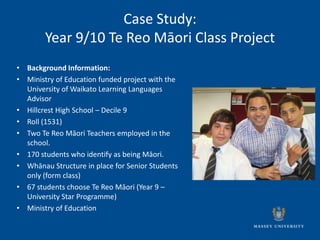
• Background Information:
• Ministry of Education funded project with the
  University of Waikato Learning Languages
  Advisor
• Hillcrest High School – Decile 9
• Roll (1531)
• Two Te Reo Māori Teachers employed in the
  school.
• 170 students who identify as being Māori.
• Whānau Structure in place for Senior Students
  only (form class)
• 67 students choose Te Reo Māori (Year 9 –
  University Star Programme)
• Ministry of Education
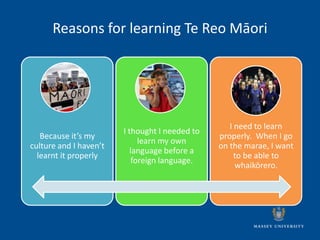
Reasons for learning Te Reo Māori


                                                   I need to learn
                        I thought I needed to
   Because it’s my                              properly. When I go
                             learn my own
culture and I haven’t                           on the marae, I want
                           language before a
  learnt it properly                                 to be able to
                           foreign language.
                                                     whaikōrero.
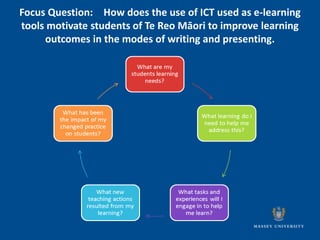
Focus Question: How does the use of ICT used as e-learning
tools motivate students of Te Reo Māori to improve learning
     outcomes in the modes of writing and presenting.
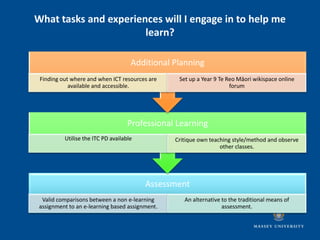
What tasks and experiences will I engage in to help me
                       learn?

                                     Additional Planning
 Finding out where and when ICT resources are     Set up a Year 9 Te Reo Māori wikispace online
            available and accessible.                                 forum


                                    Professional Learning
          Utilise the ITC PD available           Critique own teaching style/method and observe
                                                                  other classes.


                                         Assessment
  Valid comparisons between a non e-learning        An alternative to the traditional means of
 assignment to an e-learning based assignment.                     assessment.
How do I go answering the focus question?


What you introduced,           How I collected data           How I analysed the
changed or tried out in        on student                     data
your teaching?                 achievement                    • Compared assessment
                               • Asking students how they       results of 2008 cohort with
• Student voice                  want to use ICT tools as a     2009 cohort.
                                 means of learning?           • Compared ongoing results
• Co-construction of units
                               • Questionaires                  from classroom assessments
• Implementing and using ICT                                    in this Year 9 class.
  tools.                       • Analysing student results
• Alternative forms of           from assignments.
  assessment.                  • Formative/Summative
                                 assessments.
                               • Feedback/Feedforward
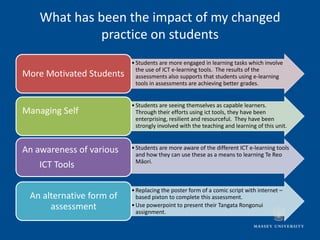
What has been the impact of my changed
             practice on students
                          • Students are more engaged in learning tasks which involve
                            the use of ICT e-learning tools. The results of the
More Motivated Students     assessments also supports that students using e-learning
                            tools in assessments are achieving better grades.


                          • Students are seeing themselves as capable learners.
Managing Self               Through their efforts using ict tools, they have been
                            enterprising, resilient and resourceful. They have been
                            strongly involved with the teaching and learning of this unit.


An awareness of various   • Students are more aware of the different ICT e-learning tools
                            and how they can use these as a means to learning Te Reo
                            Māori.
    ICT Tools

                          • Replacing the poster form of a comic script with internet –
 An alternative form of     based pixton to complete this assessment.
      assessment          • Use powerpoint to present their Tangata Rongonui
                            assignment.
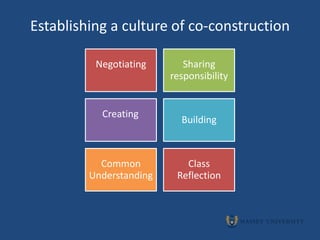
Establishing a culture of co-construction

          Negotiating       Sharing
                         responsibility


           Creating
                           Building


           Common           Class
         Understanding    Reflection
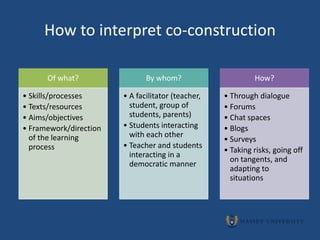
How to interpret co-construction

      Of what?                 By whom?                      How?

• Skills/processes      • A facilitator (teacher,   • Through dialogue
• Texts/resources         student, group of         • Forums
• Aims/objectives         students, parents)        • Chat spaces
• Framework/direction   • Students interacting      • Blogs
  of the learning         with each other
                                                    • Surveys
  process               • Teacher and students
                                                    • Taking risks, going off
                          interacting in a
                                                      on tangents, and
                          democratic manner
                                                      adapting to
                                                      situations
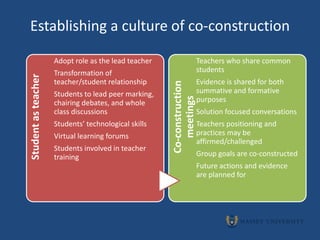
Establishing a culture of co-construction

                     Adopt role as the lead teacher                     Teachers who share common
                     Transformation of                                  students
Student as teacher


                     teacher/student relationship                       Evidence is shared for both


                                                      Co-construction
                     Students to lead peer marking,                     summative and formative


                                                         meetings
                     chairing debates, and whole                        purposes
                     class discussions                                  Solution focused conversations
                     Students’ technological skills                     Teachers positioning and
                     Virtual learning forums                            practices may be
                                                                        affirmed/challenged
                     Students involved in teacher
                     training                                           Group goals are co-constructed
                                                                        Future actions and evidence
                                                                        are planned for
Questions to consider
• How do you feel about developing any of these ideas
  in your school? Which ideas do you think would be
  most attractive to your students and staff?
• If schools are to become thriving learning
  communities, to what extent should they include
  students, parents, as well as staff, in training to
  improve teaching and learning?

Establishing a Co-construction Environment

  • 1.
    Creating Successful MāoriFutures Te Rau Whakaara Māori William Flavell MEd (hons), BTchg, BA, PGDip(Ed)
  • 2.
    Māori students enjoyingeducation success as Māori • Indicators of success – Feeling confident to identify as Māori – Attending school more often and more regularly – Staying at school longer – Engaging with learning – Achieving at higher levels – Achieving across a range of achievement data – Leaving with qualifications and career pathways – Participating in Māori focussed school activities – Participating within the range of school leadership roles – A stronger whānau presence in the school – Family involvement becoming more self-determined and less directed by the school.
  • 3.
    Case Study: Year 9/10 Te Reo Māori Class Project • Background Information: • Ministry of Education funded project with the University of Waikato Learning Languages Advisor • Hillcrest High School – Decile 9 • Roll (1531) • Two Te Reo Māori Teachers employed in the school. • 170 students who identify as being Māori. • Whānau Structure in place for Senior Students only (form class) • 67 students choose Te Reo Māori (Year 9 – University Star Programme) • Ministry of Education
  • 4.
    Reasons for learningTe Reo Māori I need to learn I thought I needed to Because it’s my properly. When I go learn my own culture and I haven’t on the marae, I want language before a learnt it properly to be able to foreign language. whaikōrero.
  • 5.
    Focus Question: Howdoes the use of ICT used as e-learning tools motivate students of Te Reo Māori to improve learning outcomes in the modes of writing and presenting.
  • 6.
    What tasks andexperiences will I engage in to help me learn? Additional Planning Finding out where and when ICT resources are Set up a Year 9 Te Reo Māori wikispace online available and accessible. forum Professional Learning Utilise the ITC PD available Critique own teaching style/method and observe other classes. Assessment Valid comparisons between a non e-learning An alternative to the traditional means of assignment to an e-learning based assignment. assessment.
  • 7.
    How do Igo answering the focus question? What you introduced, How I collected data How I analysed the changed or tried out in on student data your teaching? achievement • Compared assessment • Asking students how they results of 2008 cohort with • Student voice want to use ICT tools as a 2009 cohort. means of learning? • Compared ongoing results • Co-construction of units • Questionaires from classroom assessments • Implementing and using ICT in this Year 9 class. tools. • Analysing student results • Alternative forms of from assignments. assessment. • Formative/Summative assessments. • Feedback/Feedforward
  • 8.
    What has beenthe impact of my changed practice on students • Students are more engaged in learning tasks which involve the use of ICT e-learning tools. The results of the More Motivated Students assessments also supports that students using e-learning tools in assessments are achieving better grades. • Students are seeing themselves as capable learners. Managing Self Through their efforts using ict tools, they have been enterprising, resilient and resourceful. They have been strongly involved with the teaching and learning of this unit. An awareness of various • Students are more aware of the different ICT e-learning tools and how they can use these as a means to learning Te Reo Māori. ICT Tools • Replacing the poster form of a comic script with internet – An alternative form of based pixton to complete this assessment. assessment • Use powerpoint to present their Tangata Rongonui assignment.
  • 9.
    Establishing a cultureof co-construction Negotiating Sharing responsibility Creating Building Common Class Understanding Reflection
  • 10.
    How to interpretco-construction Of what? By whom? How? • Skills/processes • A facilitator (teacher, • Through dialogue • Texts/resources student, group of • Forums • Aims/objectives students, parents) • Chat spaces • Framework/direction • Students interacting • Blogs of the learning with each other • Surveys process • Teacher and students • Taking risks, going off interacting in a on tangents, and democratic manner adapting to situations
  • 11.
    Establishing a cultureof co-construction Adopt role as the lead teacher Teachers who share common Transformation of students Student as teacher teacher/student relationship Evidence is shared for both Co-construction Students to lead peer marking, summative and formative meetings chairing debates, and whole purposes class discussions Solution focused conversations Students’ technological skills Teachers positioning and Virtual learning forums practices may be affirmed/challenged Students involved in teacher training Group goals are co-constructed Future actions and evidence are planned for
  • 12.
    Questions to consider •How do you feel about developing any of these ideas in your school? Which ideas do you think would be most attractive to your students and staff? • If schools are to become thriving learning communities, to what extent should they include students, parents, as well as staff, in training to improve teaching and learning?