Central Nervous System
The central nervous system (CNS) is comprised of
the brain and spinal cord. The CNS receives
sensory information from the nervous system
and controls the body's responses.
The brain plays a central role in the control of most
bodily functions, including awareness,
movements, sensations, thoughts, speech,
and memory.
Some reflex movements can occur via spinal cord
pathways without the participation of brain
structures. The spinal cord is connected to a
section of the brain called the brainstem and
runs through the spinal canal.
Protections
 Skull and Vertebrae
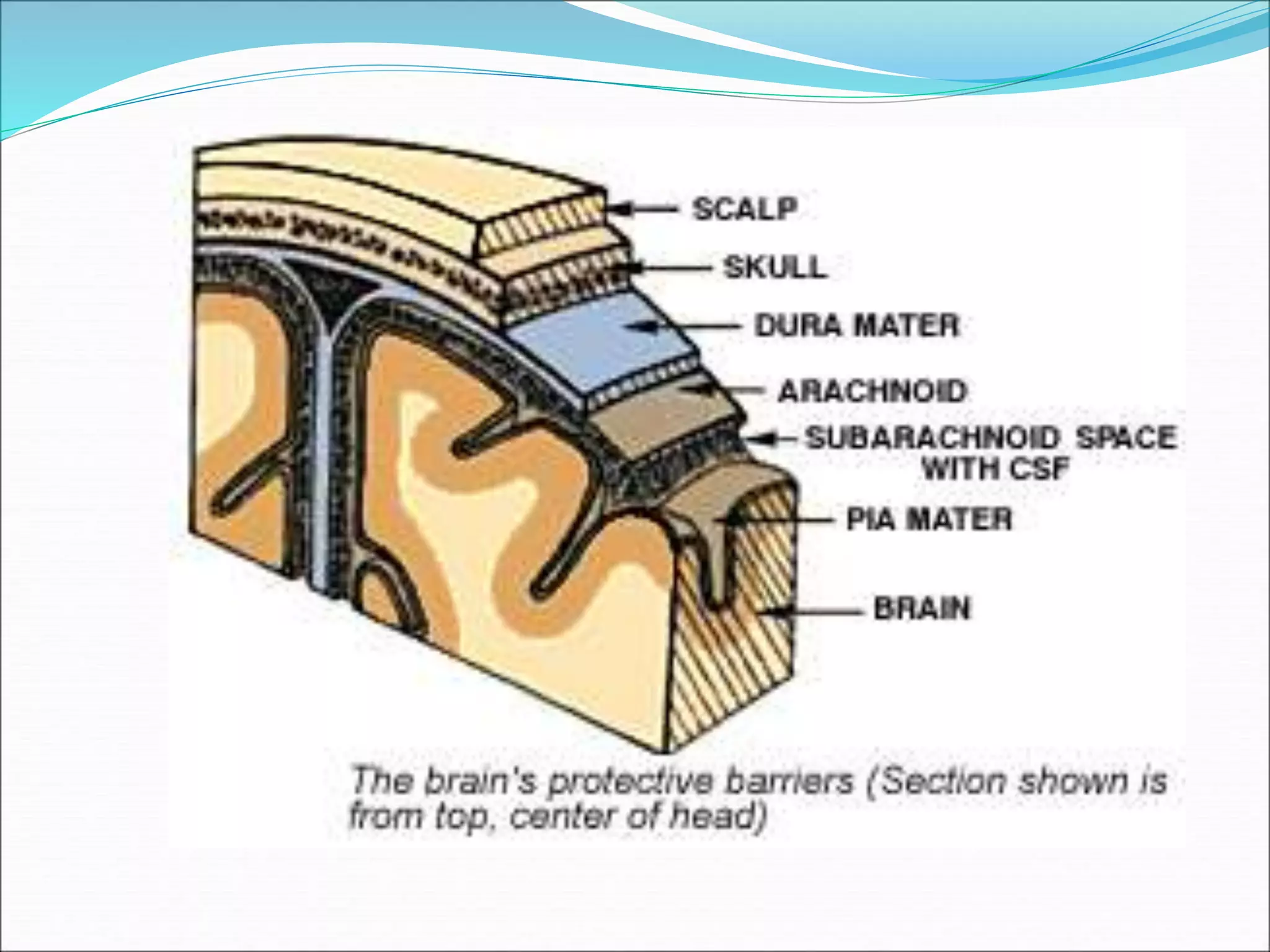
 3 protective layers called meninges
1. Dura Mater (outer layer): consists of connective tissues,
blood vessels, and nerves.
2. Arachnoid Layer (middle layer): elastic and weblike
3. Pia Mater (inner layer): contains nerves and blood vessels.
 Cerebrospinal fluid
 a clear watery liquid
 separates the middle and inner layers
 Acts as shock absorber
 exchange of nutrients between blood and nervous system
Structure of the Brain
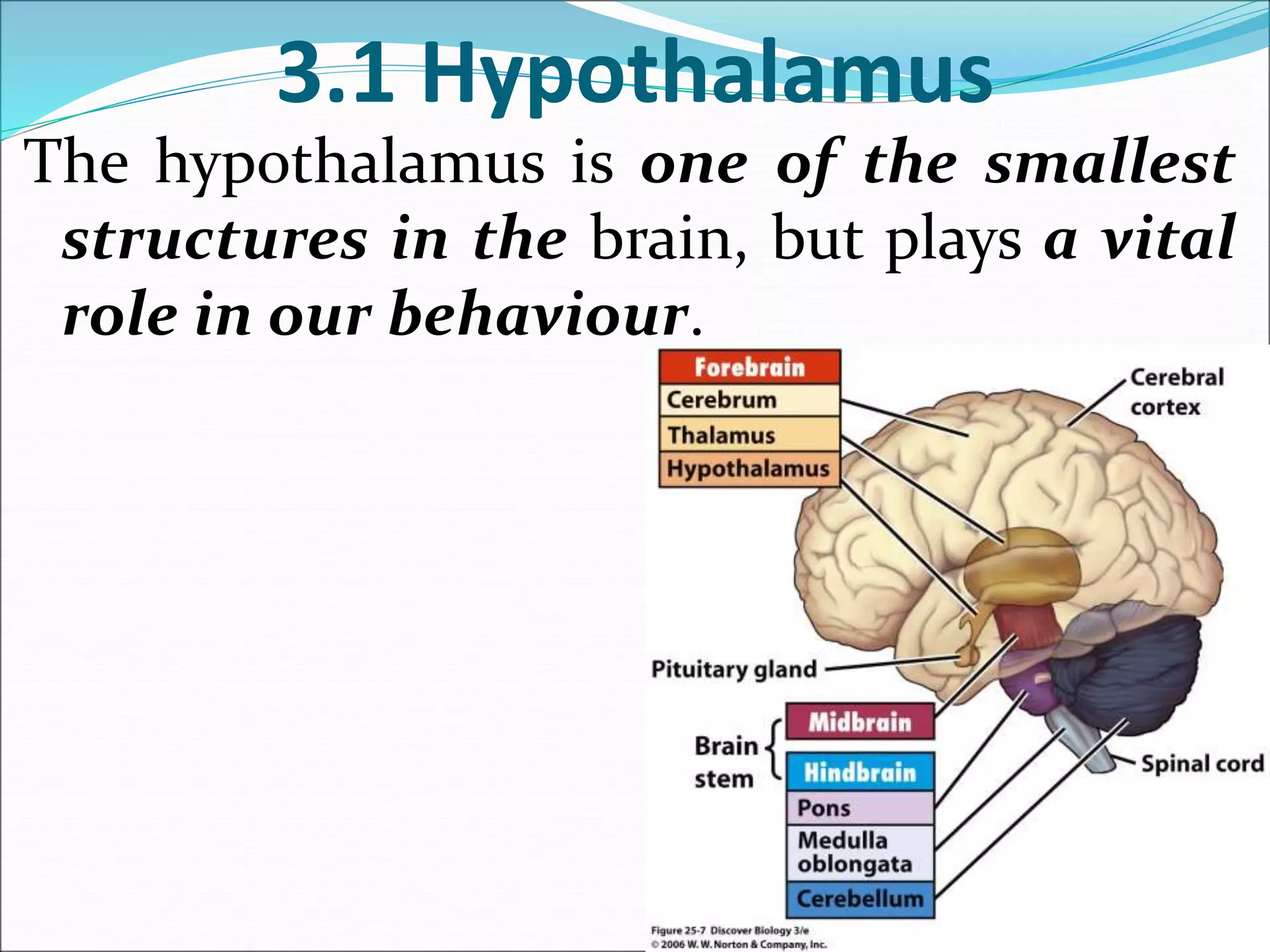
For the convenience of study, the brain can
be divided into three parts:
1. Hindbrain,
2. Midbrain and
3. Forebrain.
1. Hindbrain
I. Medulla Oblongata
II. Pones
III. Cerebellum
1.1 Medulla Oblongata
It is the lowest part of the brain that exists
in continuation of the spinal cord. It
contains neural centres, which regulate
basic life supporting activities like
breathing, heart rate, and blood
pressure.
This is why medulla is known as the vital
centre of the brain.
It has some centres of autonomic
activities also.
1.2 Pons
It is connected with medulla on one side
and with the midbrain on the other. A
nucleus (neural centre) of pons receives
auditory signals relayed by our ears. It is
believed that pons is involved in sleep
mechanism, particularly the sleep
characterised by dreaming.
It contains nuclei affecting respiratory
movement and facial expressions also.
1.3 Cerebellum
This highly developed part of the hindbrain can
be easily recognised by its wrinkled surface.
It maintains and controls posture and
equilibrium of the body.
Its mainfunction is coordination of muscular
movements. Though the motor commands
originate in the forebrain, the cerebellum
receives and coordinates them to relay to the
muscles.
It also stores the memory of movement patterns
so that we do not have to concentrate on how
to walk, dance, or ride a bicycle.
2. Midbrain
The midbrain is relatively small in size and it
connects the hindbrain with the forebrain.
A few neural centres related to some special
reflexes and visual and auditory sensations
are found here.
2. Midbrain
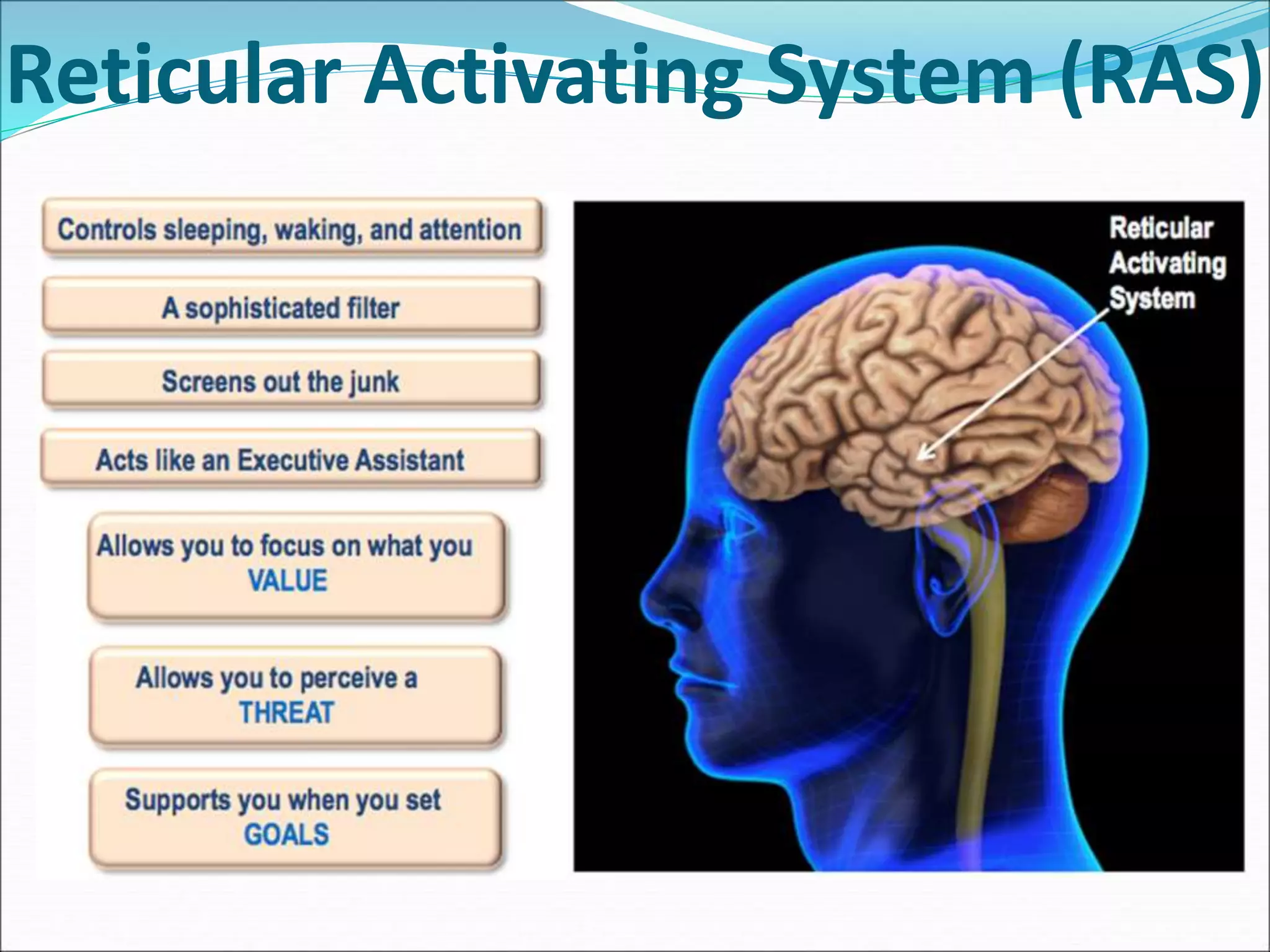
An important part of midbrain, known as
Reticular Activating System (RAS), is
responsible for our arousal.
It makes us alert and active by
regulating sensory inputs. It also helps
us in selecting information from the
environment.
Reticular Activating System (RAS)
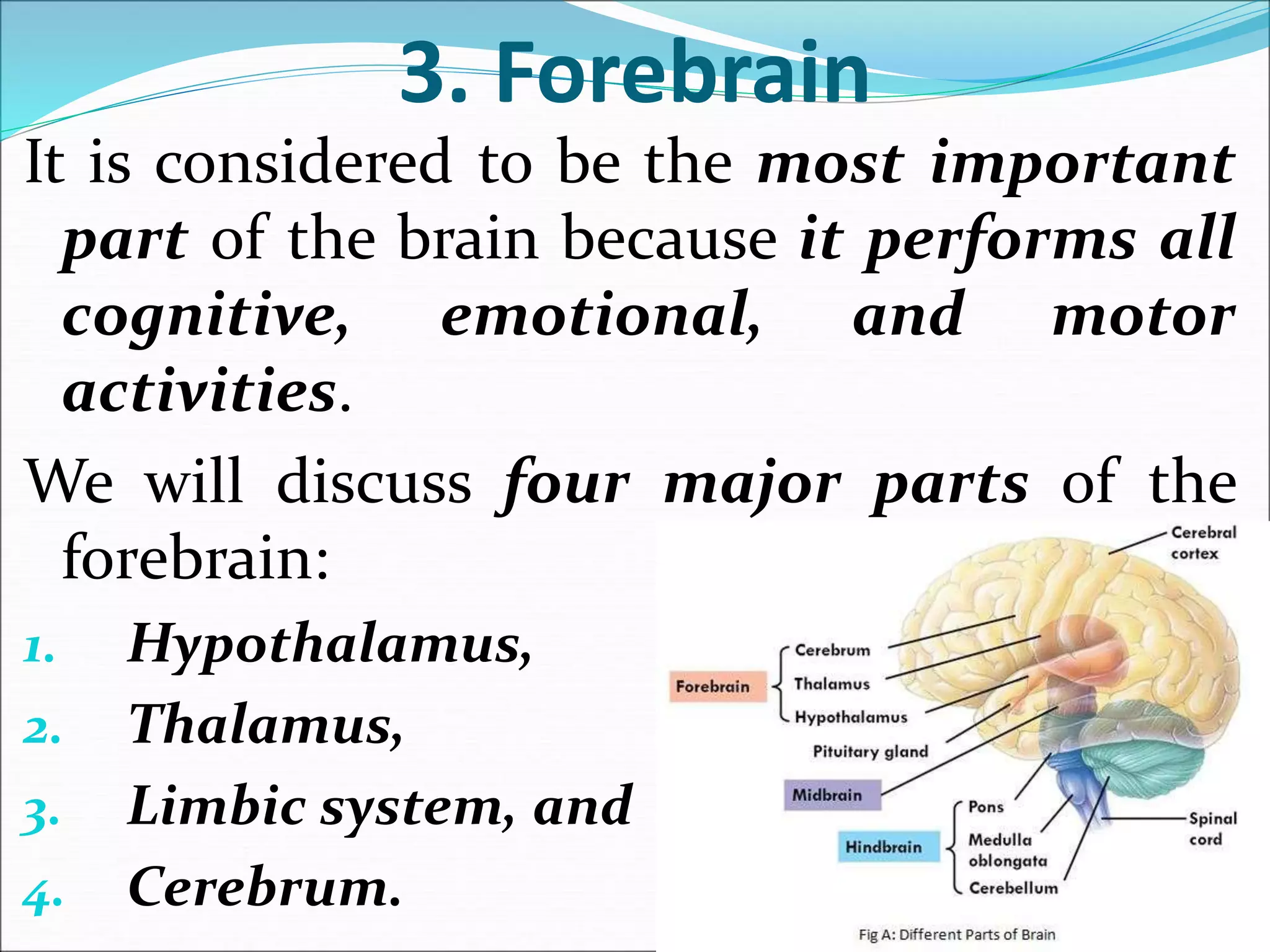
3. Forebrain
It is considered to be the most important
part of the brain because it performs all
cognitive, emotional, and motor
activities.
We will discuss four major parts of the
forebrain:
1. Hypothalamus,
2. Thalamus,
3. Limbic system, and
4. Cerebrum.
3.1 Hypothalamus
The hypothalamus is one of the smallest
structures in the brain, but plays a vital
role in our behaviour.
3.1 Hypothalamus
It regulates physiological processes
involved emotional and motivational
behaviour, such as eating, drinking,
sleeping, temperature regulation, and
sexual arousal.
It also regulates and controls the internal
environment of the body (e.g., heart
rate, blood pressure, temperature) and
regulates the secretion of hormones
from various endocrine glands.
3.2 Thalamus
It consists of an egg-shaped cluster of
neurons situated on the ventral (upper)
side of the hypothalamus.
It is like a relay station that receives all
incoming sensory signals from sense
organs and sends them to appropriate
parts of the cortex for processing.
It also receives all outgoing motor signals
coming from the cortex and sends them to
appropriate parts of the body.
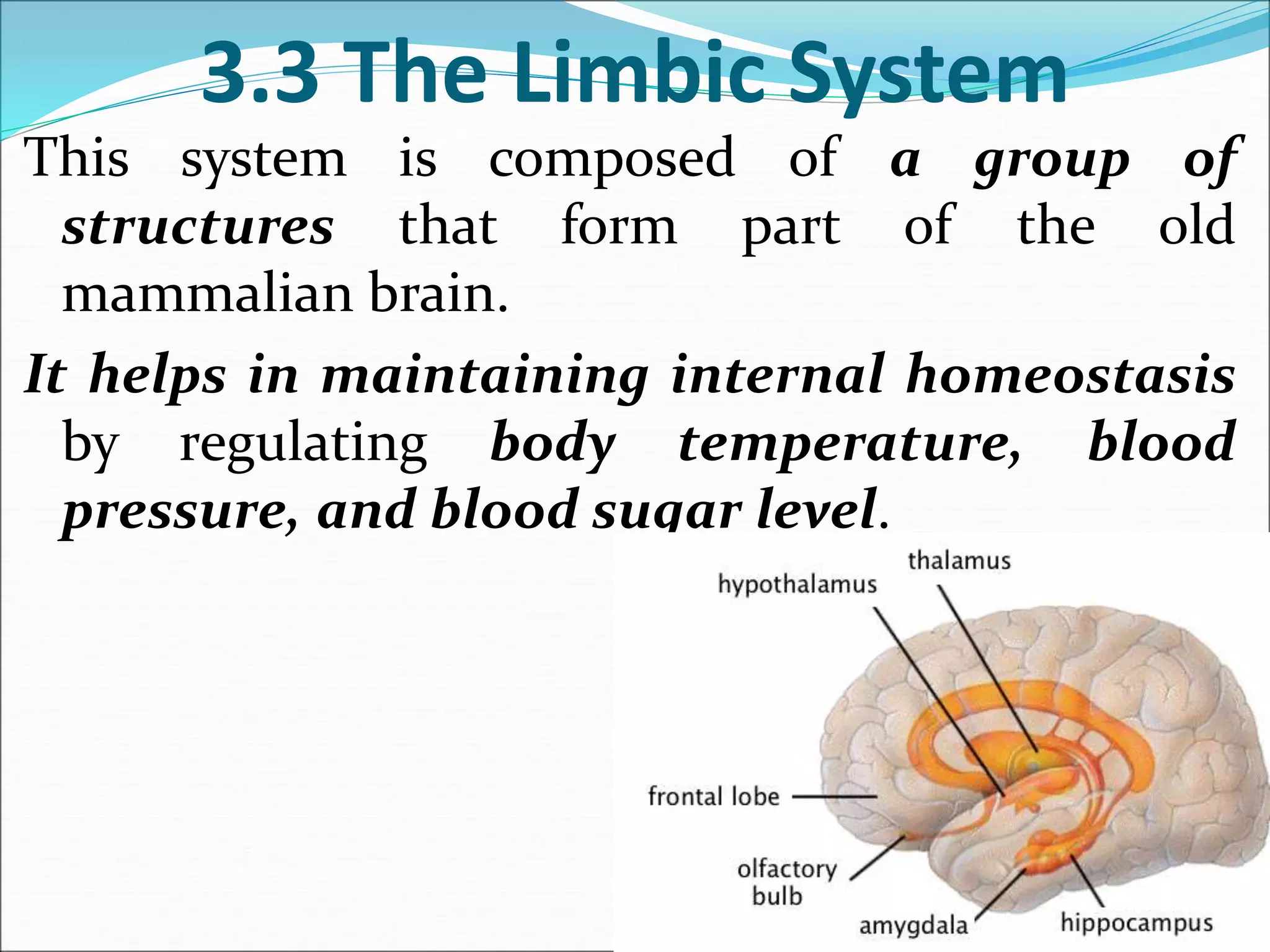
3.3 The Limbic System
This system is composed of a group of
structures that form part of the old
mammalian brain.
It helps in maintaining internal homeostasis
by regulating body temperature, blood
pressure, and blood sugar level.
3.3 The Limbic System
It has close links with the hypothalamus.
Besides hypothalamus, the limbic system
comprises the Hippocampus and
Amygdala.
The hippocampus plays an important role
in long-term memory.
The amygdala plays an important role in
emotional behaviour.
3.4 Cerebrum
Also known as Cerebral Cortex, this part regulates
all higher levels of cognitive functions, such as
attention, perception, learning, memory,
language behaviour, reasoning, and problem
solving.
3.4 Cerebrum
The cerebrum makes two-third of the total
mass of the human brain.
Its thickness varies from 1.5 mm to 4 mm,
which covers the entire surface of the
brain and contains neurons, neural nets,
and bundles of axons.
All these make it possible for us to
perform organised actions and create
images, symbols, associations, and
memories.
Two Hemispheres
The cerebrum is divided into two symmetrical halves,
called the Cerebral Hemispheres. Although the two
hemispheres appear identical, functionally one
hemisphere usually dominates the other.
The left hemisphere usually controls language
behaviour.
The right hemisphere is usually specialised to deal
with images, spatial relationships, and pattern
recognition.
These two hemispheres are connected by a white
bundle of myelinated fibers, called Corpus
Callosum that carries messages back and forth
between the hemispheres.
Four Lobes
Cerebral cortex has also been divided into four lobes -
Frontal lobe, Parietal lobe, Temporal lobe, and
Occipital lobe.
Four Lobes
The Frontal lobe is mainly concerned with
cognitive functions, such as attention,
thinking, memory, learning, and
reasoning, but it also exerts inhibitory
effects on autonomic and
emotional responses.
The Parietal lobe is mainly concerned with
cutaneous sensations and their
coordination with visual and auditory
sensations.
Four Lobes
The Temporal lobe is primarily concerned
with the processing of auditory
information. Memory for symbolic sounds
and words resides here. Understanding of
speech and written language depends on
this lobe.
The Occipital lobe is mainly concerned
with visual information. It is believed that
interpretation of visual impulses, memory
for visual stimuli and colour visual
orientation is performed by this lobe.

3 central nervous system brain

  • 2.
    Central Nervous System Thecentral nervous system (CNS) is comprised of the brain and spinal cord. The CNS receives sensory information from the nervous system and controls the body's responses. The brain plays a central role in the control of most bodily functions, including awareness, movements, sensations, thoughts, speech, and memory. Some reflex movements can occur via spinal cord pathways without the participation of brain structures. The spinal cord is connected to a section of the brain called the brainstem and runs through the spinal canal.
  • 3.
    Protections  Skull andVertebrae  3 protective layers called meninges 1. Dura Mater (outer layer): consists of connective tissues, blood vessels, and nerves. 2. Arachnoid Layer (middle layer): elastic and weblike 3. Pia Mater (inner layer): contains nerves and blood vessels.  Cerebrospinal fluid  a clear watery liquid  separates the middle and inner layers  Acts as shock absorber  exchange of nutrients between blood and nervous system
  • 5.
    Structure of theBrain For the convenience of study, the brain can be divided into three parts: 1. Hindbrain, 2. Midbrain and 3. Forebrain.
  • 6.
    1. Hindbrain I. MedullaOblongata II. Pones III. Cerebellum
  • 7.
    1.1 Medulla Oblongata Itis the lowest part of the brain that exists in continuation of the spinal cord. It contains neural centres, which regulate basic life supporting activities like breathing, heart rate, and blood pressure. This is why medulla is known as the vital centre of the brain. It has some centres of autonomic activities also.
  • 8.
    1.2 Pons It isconnected with medulla on one side and with the midbrain on the other. A nucleus (neural centre) of pons receives auditory signals relayed by our ears. It is believed that pons is involved in sleep mechanism, particularly the sleep characterised by dreaming. It contains nuclei affecting respiratory movement and facial expressions also.
  • 9.
    1.3 Cerebellum This highlydeveloped part of the hindbrain can be easily recognised by its wrinkled surface. It maintains and controls posture and equilibrium of the body. Its mainfunction is coordination of muscular movements. Though the motor commands originate in the forebrain, the cerebellum receives and coordinates them to relay to the muscles. It also stores the memory of movement patterns so that we do not have to concentrate on how to walk, dance, or ride a bicycle.
  • 10.
    2. Midbrain The midbrainis relatively small in size and it connects the hindbrain with the forebrain. A few neural centres related to some special reflexes and visual and auditory sensations are found here.
  • 11.
    2. Midbrain An importantpart of midbrain, known as Reticular Activating System (RAS), is responsible for our arousal. It makes us alert and active by regulating sensory inputs. It also helps us in selecting information from the environment.
  • 12.
  • 13.
    3. Forebrain It isconsidered to be the most important part of the brain because it performs all cognitive, emotional, and motor activities. We will discuss four major parts of the forebrain: 1. Hypothalamus, 2. Thalamus, 3. Limbic system, and 4. Cerebrum.
  • 14.
    3.1 Hypothalamus The hypothalamusis one of the smallest structures in the brain, but plays a vital role in our behaviour.
  • 15.
    3.1 Hypothalamus It regulatesphysiological processes involved emotional and motivational behaviour, such as eating, drinking, sleeping, temperature regulation, and sexual arousal. It also regulates and controls the internal environment of the body (e.g., heart rate, blood pressure, temperature) and regulates the secretion of hormones from various endocrine glands.
  • 16.
    3.2 Thalamus It consistsof an egg-shaped cluster of neurons situated on the ventral (upper) side of the hypothalamus. It is like a relay station that receives all incoming sensory signals from sense organs and sends them to appropriate parts of the cortex for processing. It also receives all outgoing motor signals coming from the cortex and sends them to appropriate parts of the body.
  • 17.
    3.3 The LimbicSystem This system is composed of a group of structures that form part of the old mammalian brain. It helps in maintaining internal homeostasis by regulating body temperature, blood pressure, and blood sugar level.
  • 18.
    3.3 The LimbicSystem It has close links with the hypothalamus. Besides hypothalamus, the limbic system comprises the Hippocampus and Amygdala. The hippocampus plays an important role in long-term memory. The amygdala plays an important role in emotional behaviour.
  • 19.
    3.4 Cerebrum Also knownas Cerebral Cortex, this part regulates all higher levels of cognitive functions, such as attention, perception, learning, memory, language behaviour, reasoning, and problem solving.
  • 20.
    3.4 Cerebrum The cerebrummakes two-third of the total mass of the human brain. Its thickness varies from 1.5 mm to 4 mm, which covers the entire surface of the brain and contains neurons, neural nets, and bundles of axons. All these make it possible for us to perform organised actions and create images, symbols, associations, and memories.
  • 21.
    Two Hemispheres The cerebrumis divided into two symmetrical halves, called the Cerebral Hemispheres. Although the two hemispheres appear identical, functionally one hemisphere usually dominates the other. The left hemisphere usually controls language behaviour. The right hemisphere is usually specialised to deal with images, spatial relationships, and pattern recognition. These two hemispheres are connected by a white bundle of myelinated fibers, called Corpus Callosum that carries messages back and forth between the hemispheres.
  • 22.
    Four Lobes Cerebral cortexhas also been divided into four lobes - Frontal lobe, Parietal lobe, Temporal lobe, and Occipital lobe.
  • 23.
    Four Lobes The Frontallobe is mainly concerned with cognitive functions, such as attention, thinking, memory, learning, and reasoning, but it also exerts inhibitory effects on autonomic and emotional responses. The Parietal lobe is mainly concerned with cutaneous sensations and their coordination with visual and auditory sensations.
  • 24.
    Four Lobes The Temporallobe is primarily concerned with the processing of auditory information. Memory for symbolic sounds and words resides here. Understanding of speech and written language depends on this lobe. The Occipital lobe is mainly concerned with visual information. It is believed that interpretation of visual impulses, memory for visual stimuli and colour visual orientation is performed by this lobe.