Linked Library Data and the Semantic Web Leveraging Library Authority Control outside of MARC Applications Presented 2008-09-17 At the National Library of Sweden Corey A Harper
Topical Overview Linked Open Data and SemWeb Library Authorities and Controlled Vocabularies – Toward Library LOD Work in progress in these areas Metadata Normalization, Harmonization and Recombination Possibilities…
“ The vast bulk of data to be on the Semantic Web is already sitting in databases … all that is needed [is] to write an adapter to convert a particular format into RDF and all the content in that format is available.”   - Tim Berners-Lee    in an interview with the    Consortium Standards Bulletin
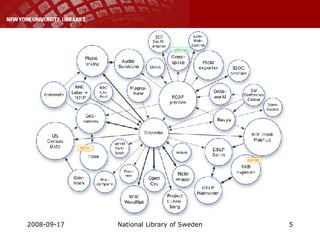
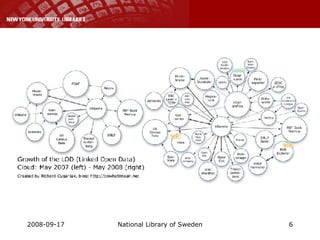
Linked Open Data Use URIs as names for things  Use HTTP URIs so that people can look up those names.  When someone looks up a URI, provide useful information.  Include links to other URIs. so that they can discover more things.  http://www.w3.org/DesignIssues/LinkedData.html
 
 
Linked Library Data Resources get URI’s early in lifecycle Properties get URI’s Vocabularies get URI’s Everything is dereferenceable: Able to request meaning over http
Library Authority Data “ Include links to other URIs. so that they can discover more things.” Short of providing and linking to URIs, this *is* authority data. This is what our authority files are for.
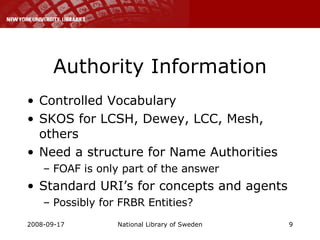
Authority Information Controlled Vocabulary SKOS for LCSH, Dewey, LCC, Mesh, others Need a structure for Name Authorities  FOAF is only part of the answer Standard URI’s for concepts and agents Possibly for FRBR Entities?
 
Library Controlled Vocabularies: Benefits Reputation - Trusted Tradition Mature - Time tested and carefully developed General & Comprehensive - Cover large knowledge spaces
Library Controlled Vocabularies: Drawbacks Overly Complicated - extraneous information Archaic Syntax - MARC Records Slow to evolve - authorities control the authority control
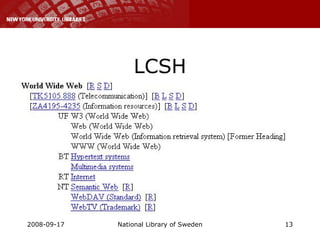
LCSH
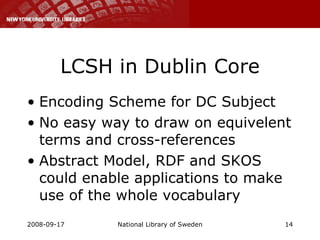
LCSH in Dublin Core Encoding Scheme for DC Subject No easy way to draw on equivelent terms and cross-references Abstract Model, RDF and SKOS could enable applications to make use of the whole vocabulary
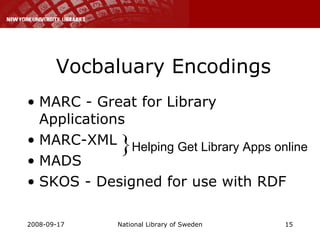
Vocbaluary Encodings MARC - Great for Library Applications MARC-XML MADS SKOS - Designed for use with RDF } Helping Get Library Apps online
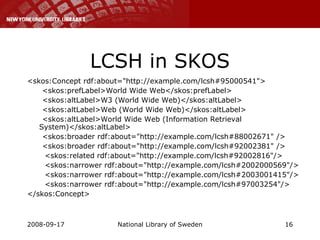
LCSH in SKOS <skos:Concept rdf:about=&quot;http://example.com/lcsh#95000541&quot;> <skos:prefLabel>World Wide Web</skos:prefLabel> <skos:altLabel>W3 (World Wide Web)</skos:altLabel> <skos:altLabel>Web (World Wide Web)</skos:altLabel> <skos:altLabel>World Wide Web (Information Retrieval  System)</skos:altLabel> <skos:broader rdf:about=&quot;http://example.com/lcsh#88002671&quot; /> <skos:broader rdf:about=&quot;http://example.com/lcsh#92002381&quot; /> <skos:related rdf:about=&quot;http://example.com/lcsh#92002816&quot;/> <skos:narrower rdf:about=&quot;http://example.com/lcsh#2002000569&quot;/> <skos:narrower rdf:about=&quot;http://example.com/lcsh#2003001415&quot;/> <skos:narrower rdf:about=&quot;http://example.com/lcsh#97003254&quot;/> </skos:Concept>
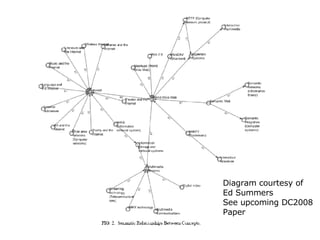
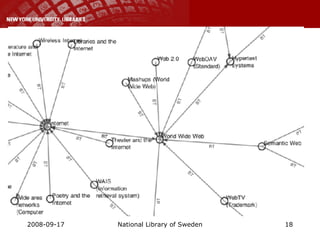
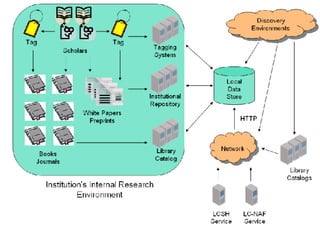
Diagram courtesy of  Ed Summers See upcoming DC2008 Paper
 
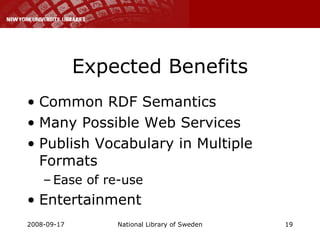
Expected Benefits Common RDF Semantics Many Possible Web Services Publish Vocabulary in Multiple Formats Ease of re-use Entertainment
Name Authorities Many National Authority Files Separate records representing same author Different Languages Different Scripts
VIAF Virtual International Authority File First try - Merging Second try - Linking  (then merging?) Why not just link….?
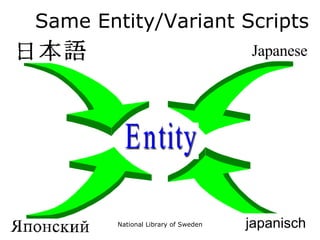
Same Entity/Variant Scripts Japanese japanisch
Linking Open Names Need an RDF Vocabulary for Names and Corporations FOAF is one piece of the puzzle DC Agents Application Profile Quasi-Active DCMI Task Group
VIAF as LOD Use owl:sameAs to declare equality Every national authority file gets a SPARQL endpoint No need to merge authority files Applications can query, merging relevant sets locally
Renew, reuse, recycle Enable better sharing within Library community Share our data with other communities Reuse Authority Data in new and interesting ways…
 
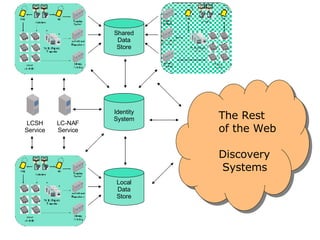
Shared Data Store Local Data Store Identity System LCSH Service LC-NAF Service The Rest of the Web Discovery  Systems
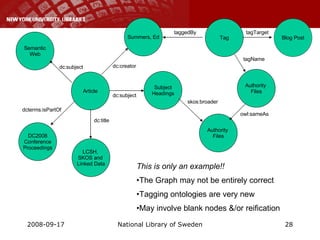
Summers, Ed DC2008 Conference Proceedings Authority  Files Subject Headings Semantic Web LCSH,  SKOS and  Linked Data Article Tag Blog Post dc:subject dc:creator dc:subject dc:title dcterms:isPartOf skos:broader Authority  Files taggedBy tagTarget owl:sameAs tagName This is only an example!! The Graph may not be entirely correct Tagging ontologies are very new May involve blank nodes &/or reification
Controlled Vocabularies Recontextualized LOD notion of “Information” vs. “Non-information” resources. Info - documents on the web Non-info - anything else: people, places, things, books Non-info resources have representations / descriptions These are info resources
Controlled Vocabularies Recontextualized Authority records are descriptions of non-information resources Bibliographic records are (usually) descriptions of non-information resources Other areas of Authority Control…
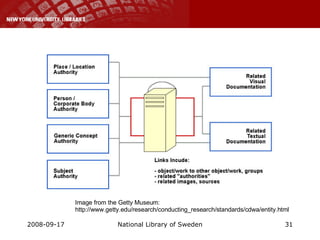
Image from the Getty Museum: http://www.getty.edu/research/conducting_research/standards/cdwa/entity.html
FRBR Library community’s first formalization of our data model Untested Incredibly complicated Not reflected well in descriptive standards or practice
FRBR “ Simply by clustering your records into work sets, you have not moved your records into the FRBR model. FRBR is a complete data model that is a new way of looking at our data, not just taking existing records and identifying work relationships”    - J. Rochkind - bibwild.wordpress.com
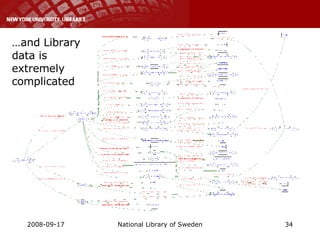
… and Library data is  extremely complicated
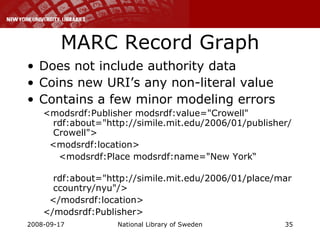
MARC Record Graph Does not include authority data Coins new URI’s any non-literal value Contains a few minor modeling errors <modsrdf:Publisher modsrdf:value=&quot;Crowell&quot; rdf:about=&quot;http://simile.mit.edu/2006/01/publisher/Crowell&quot;> <modsrdf:location> <modsrdf:Place modsrdf:name=&quot;New York“ rdf:about=&quot;http://simile.mit.edu/2006/01/place/marccountry/nyu&quot;/> </modsrdf:location> </modsrdf:Publisher>
A Distinction Metadata  Harmonization : the “ability to use serveral different metadata standards in a single software system.” Metadata  Normalization : mapping serveral different metadata standards to a single schema or structure for use in a single software system.
Primo: A Case Study Normalization Rules Delivery templates Tight SFX and MetaLib Integration “ Pipes” for different data sources Hourly Availability Checking (Real Time in Version 2.0)
Harvesting Different Data Sources Different Normalization Rules All standardized on Primo Normalized XML (PNX) Record Very Flat, sections corresponding to Primo Functionality
Issues and Challenges Managing Deduplication Dedup Data only out of box for MARC Writing for OAI-PMH sources (EAD) Consortial Environment(s) Appropriate Delivery Options “ Interpreting” Metadata
EAD Records Archivists Toolkit Previously in Access, Notepad, Excel Authority Control (sort of) OAI-PMH Overlay Multiple layers of Crosswalking Deduping
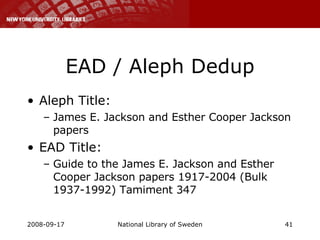
EAD / Aleph Dedup Aleph Title: James E. Jackson and Esther Cooper Jackson papers EAD Title: Guide to the James E. Jackson and Esther Cooper Jackson papers 1917-2004 (Bulk 1937-1992) Tamiment 347
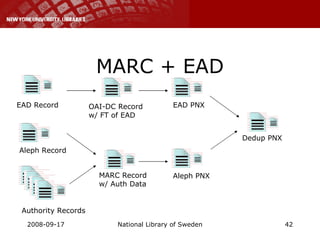
MARC + EAD EAD Record Aleph Record Authority Records MARC Record w/ Auth Data OAI-DC Record w/ FT of EAD EAD PNX Aleph PNX Dedup PNX
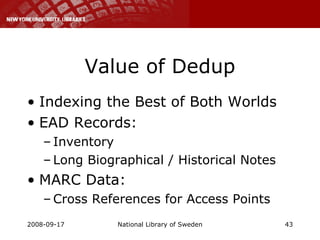
Value of Dedup Indexing the Best of Both Worlds EAD Records: Inventory Long Biographical / Historical Notes MARC Data: Cross References for Access Points
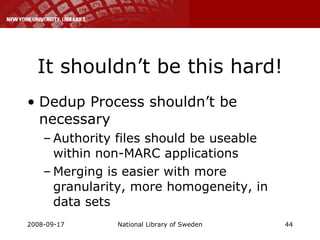
It shouldn’t be this hard! Dedup Process shouldn’t be necessary Authority files should be useable within non-MARC applications Merging is easier with more granularity, more homogeneity, in data sets
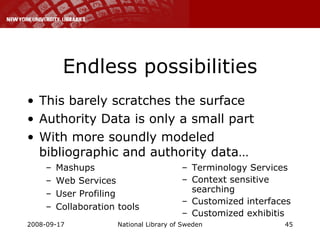
Endless possibilities This barely scratches the surface Authority Data is only a small part With more soundly modeled bibliographic and authority data… Terminology Services Context sensitive searching Customized interfaces Customized exhibitis Mashups Web Services User Profiling Collaboration tools
Thanks! Questions? [email_address] +1 212.998.2479

20080917 Rev

  • 1.
    Linked Library Dataand the Semantic Web Leveraging Library Authority Control outside of MARC Applications Presented 2008-09-17 At the National Library of Sweden Corey A Harper
  • 2.
    Topical Overview LinkedOpen Data and SemWeb Library Authorities and Controlled Vocabularies – Toward Library LOD Work in progress in these areas Metadata Normalization, Harmonization and Recombination Possibilities…
  • 3.
    “ The vastbulk of data to be on the Semantic Web is already sitting in databases … all that is needed [is] to write an adapter to convert a particular format into RDF and all the content in that format is available.” - Tim Berners-Lee in an interview with the Consortium Standards Bulletin
  • 4.
    Linked Open DataUse URIs as names for things Use HTTP URIs so that people can look up those names. When someone looks up a URI, provide useful information. Include links to other URIs. so that they can discover more things. http://www.w3.org/DesignIssues/LinkedData.html
  • 5.
  • 6.
  • 7.
    Linked Library DataResources get URI’s early in lifecycle Properties get URI’s Vocabularies get URI’s Everything is dereferenceable: Able to request meaning over http
  • 8.
    Library Authority Data“ Include links to other URIs. so that they can discover more things.” Short of providing and linking to URIs, this *is* authority data. This is what our authority files are for.
  • 9.
    Authority Information ControlledVocabulary SKOS for LCSH, Dewey, LCC, Mesh, others Need a structure for Name Authorities FOAF is only part of the answer Standard URI’s for concepts and agents Possibly for FRBR Entities?
  • 10.
  • 11.
    Library Controlled Vocabularies:Benefits Reputation - Trusted Tradition Mature - Time tested and carefully developed General & Comprehensive - Cover large knowledge spaces
  • 12.
    Library Controlled Vocabularies:Drawbacks Overly Complicated - extraneous information Archaic Syntax - MARC Records Slow to evolve - authorities control the authority control
  • 13.
  • 14.
    LCSH in DublinCore Encoding Scheme for DC Subject No easy way to draw on equivelent terms and cross-references Abstract Model, RDF and SKOS could enable applications to make use of the whole vocabulary
  • 15.
    Vocbaluary Encodings MARC- Great for Library Applications MARC-XML MADS SKOS - Designed for use with RDF } Helping Get Library Apps online
  • 16.
    LCSH in SKOS<skos:Concept rdf:about=&quot;http://example.com/lcsh#95000541&quot;> <skos:prefLabel>World Wide Web</skos:prefLabel> <skos:altLabel>W3 (World Wide Web)</skos:altLabel> <skos:altLabel>Web (World Wide Web)</skos:altLabel> <skos:altLabel>World Wide Web (Information Retrieval System)</skos:altLabel> <skos:broader rdf:about=&quot;http://example.com/lcsh#88002671&quot; /> <skos:broader rdf:about=&quot;http://example.com/lcsh#92002381&quot; /> <skos:related rdf:about=&quot;http://example.com/lcsh#92002816&quot;/> <skos:narrower rdf:about=&quot;http://example.com/lcsh#2002000569&quot;/> <skos:narrower rdf:about=&quot;http://example.com/lcsh#2003001415&quot;/> <skos:narrower rdf:about=&quot;http://example.com/lcsh#97003254&quot;/> </skos:Concept>
  • 17.
    Diagram courtesy of Ed Summers See upcoming DC2008 Paper
  • 18.
  • 19.
    Expected Benefits CommonRDF Semantics Many Possible Web Services Publish Vocabulary in Multiple Formats Ease of re-use Entertainment
  • 20.
    Name Authorities ManyNational Authority Files Separate records representing same author Different Languages Different Scripts
  • 21.
    VIAF Virtual InternationalAuthority File First try - Merging Second try - Linking (then merging?) Why not just link….?
  • 22.
    Same Entity/Variant ScriptsJapanese japanisch
  • 23.
    Linking Open NamesNeed an RDF Vocabulary for Names and Corporations FOAF is one piece of the puzzle DC Agents Application Profile Quasi-Active DCMI Task Group
  • 24.
    VIAF as LODUse owl:sameAs to declare equality Every national authority file gets a SPARQL endpoint No need to merge authority files Applications can query, merging relevant sets locally
  • 25.
    Renew, reuse, recycleEnable better sharing within Library community Share our data with other communities Reuse Authority Data in new and interesting ways…
  • 26.
  • 27.
    Shared Data StoreLocal Data Store Identity System LCSH Service LC-NAF Service The Rest of the Web Discovery Systems
  • 28.
    Summers, Ed DC2008Conference Proceedings Authority Files Subject Headings Semantic Web LCSH, SKOS and Linked Data Article Tag Blog Post dc:subject dc:creator dc:subject dc:title dcterms:isPartOf skos:broader Authority Files taggedBy tagTarget owl:sameAs tagName This is only an example!! The Graph may not be entirely correct Tagging ontologies are very new May involve blank nodes &/or reification
  • 29.
    Controlled Vocabularies RecontextualizedLOD notion of “Information” vs. “Non-information” resources. Info - documents on the web Non-info - anything else: people, places, things, books Non-info resources have representations / descriptions These are info resources
  • 30.
    Controlled Vocabularies RecontextualizedAuthority records are descriptions of non-information resources Bibliographic records are (usually) descriptions of non-information resources Other areas of Authority Control…
  • 31.
    Image from theGetty Museum: http://www.getty.edu/research/conducting_research/standards/cdwa/entity.html
  • 32.
    FRBR Library community’sfirst formalization of our data model Untested Incredibly complicated Not reflected well in descriptive standards or practice
  • 33.
    FRBR “ Simplyby clustering your records into work sets, you have not moved your records into the FRBR model. FRBR is a complete data model that is a new way of looking at our data, not just taking existing records and identifying work relationships” - J. Rochkind - bibwild.wordpress.com
  • 34.
    … and Librarydata is extremely complicated
  • 35.
    MARC Record GraphDoes not include authority data Coins new URI’s any non-literal value Contains a few minor modeling errors <modsrdf:Publisher modsrdf:value=&quot;Crowell&quot; rdf:about=&quot;http://simile.mit.edu/2006/01/publisher/Crowell&quot;> <modsrdf:location> <modsrdf:Place modsrdf:name=&quot;New York“ rdf:about=&quot;http://simile.mit.edu/2006/01/place/marccountry/nyu&quot;/> </modsrdf:location> </modsrdf:Publisher>
  • 36.
    A Distinction Metadata Harmonization : the “ability to use serveral different metadata standards in a single software system.” Metadata Normalization : mapping serveral different metadata standards to a single schema or structure for use in a single software system.
  • 37.
    Primo: A CaseStudy Normalization Rules Delivery templates Tight SFX and MetaLib Integration “ Pipes” for different data sources Hourly Availability Checking (Real Time in Version 2.0)
  • 38.
    Harvesting Different DataSources Different Normalization Rules All standardized on Primo Normalized XML (PNX) Record Very Flat, sections corresponding to Primo Functionality
  • 39.
    Issues and ChallengesManaging Deduplication Dedup Data only out of box for MARC Writing for OAI-PMH sources (EAD) Consortial Environment(s) Appropriate Delivery Options “ Interpreting” Metadata
  • 40.
    EAD Records ArchivistsToolkit Previously in Access, Notepad, Excel Authority Control (sort of) OAI-PMH Overlay Multiple layers of Crosswalking Deduping
  • 41.
    EAD / AlephDedup Aleph Title: James E. Jackson and Esther Cooper Jackson papers EAD Title: Guide to the James E. Jackson and Esther Cooper Jackson papers 1917-2004 (Bulk 1937-1992) Tamiment 347
  • 42.
    MARC + EADEAD Record Aleph Record Authority Records MARC Record w/ Auth Data OAI-DC Record w/ FT of EAD EAD PNX Aleph PNX Dedup PNX
  • 43.
    Value of DedupIndexing the Best of Both Worlds EAD Records: Inventory Long Biographical / Historical Notes MARC Data: Cross References for Access Points
  • 44.
    It shouldn’t bethis hard! Dedup Process shouldn’t be necessary Authority files should be useable within non-MARC applications Merging is easier with more granularity, more homogeneity, in data sets
  • 45.
    Endless possibilities Thisbarely scratches the surface Authority Data is only a small part With more soundly modeled bibliographic and authority data… Terminology Services Context sensitive searching Customized interfaces Customized exhibitis Mashups Web Services User Profiling Collaboration tools
  • 46.