LOD-LAM Jenel Farrell - SAA 2011 Metadata Object Roundtable
LINKED  OPEN  DATA DATA DATA
LIBRARIES ARCHIVES MUSEUMS MUSEUMS MUSEUMS
The current web is a  web of documents  intended for  h uman interpretation
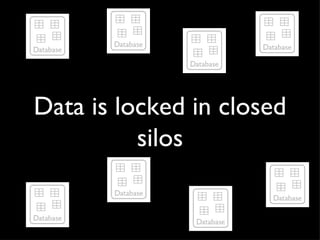
Data is locked in closed silos
The  linked data vision  is to...
Move away from the repository-centric mind-set and  open  data silos Publish data applications computers can  access  &  interpret Use “standards” in the form of common  Web technologies
Making it possible for applications to look up  (meta)data ...
...about  things books  concepts  people  places  by looking up their names   http://dbpedia.org/resource/The_Metamorphosis on the  web web web web web
But, to allow applications to look up metadata in your database, we need some  technology
Uniform Resource Identifier (URI) URI is a string of characters used to identify (UI) a name or resource on the internet URIs are more specific than URLs, which name the location of something.  URIs are the ‘thing’
Resource Description Framework (RDF) In addition to having a unique identifier for your ‘thing’, you need RDF, which is a model for representing  metadata  on the web This representation comes in the form of statements, which are called ‘triples’ Triples  define the relationships  between things Language for describing vocabularies (there  are others) Way to represent info on the web
Simple Knowledge Organization System (SKOS) A language (built on RDF) for describing  controlled vocabularies  thesauri classification schemes taxonomies subject-heading systems
SPARQL And, of course, a language to query the data SPARQL is a query language built on RDF
DBPedia...  The main objective of DBpedia is to extract structured information from Wikipedia, convert it into RDF, and make it freely available on the Web. In a nutshell, DBpedia is the Semantic Web mirror of Wikipedia.
In a nutshell, the basics of LINKED OPEN DATA LINKED OPEN DATA LINKED OPEN DATA
Make your stuff  available on the web  (whatever format) under an open license
Make your data available as  structured data  (ex. CSV table instead of an image scan of a table)
Use  non-proprietary formats  (CSV instead of Excel)
Use  URIs to identify things , so that people can point at your stuff
Link your data  to other data to provide context
Linked data is essential to connect the  semantic web
By linking up data, we gain access to many more databases &  discover new connections

Lodlam saa 2011_jenelfarrell_2

  • 1.
    LOD-LAM Jenel Farrell- SAA 2011 Metadata Object Roundtable
  • 2.
    LINKED OPEN DATA DATA DATA
  • 3.
  • 4.
    The current webis a web of documents intended for h uman interpretation
  • 5.
    Data is lockedin closed silos
  • 6.
    The linkeddata vision is to...
  • 7.
    Move away fromthe repository-centric mind-set and open data silos Publish data applications computers can access & interpret Use “standards” in the form of common Web technologies
  • 8.
    Making it possiblefor applications to look up (meta)data ...
  • 9.
    ...about thingsbooks concepts people places by looking up their names http://dbpedia.org/resource/The_Metamorphosis on the web web web web web
  • 10.
    But, to allowapplications to look up metadata in your database, we need some technology
  • 11.
    Uniform Resource Identifier(URI) URI is a string of characters used to identify (UI) a name or resource on the internet URIs are more specific than URLs, which name the location of something. URIs are the ‘thing’
  • 12.
    Resource Description Framework(RDF) In addition to having a unique identifier for your ‘thing’, you need RDF, which is a model for representing metadata on the web This representation comes in the form of statements, which are called ‘triples’ Triples define the relationships between things Language for describing vocabularies (there are others) Way to represent info on the web
  • 13.
    Simple Knowledge OrganizationSystem (SKOS) A language (built on RDF) for describing controlled vocabularies thesauri classification schemes taxonomies subject-heading systems
  • 14.
    SPARQL And, ofcourse, a language to query the data SPARQL is a query language built on RDF
  • 15.
    DBPedia... Themain objective of DBpedia is to extract structured information from Wikipedia, convert it into RDF, and make it freely available on the Web. In a nutshell, DBpedia is the Semantic Web mirror of Wikipedia.
  • 16.
    In a nutshell,the basics of LINKED OPEN DATA LINKED OPEN DATA LINKED OPEN DATA
  • 17.
    Make your stuff available on the web (whatever format) under an open license
  • 18.
    Make your dataavailable as structured data (ex. CSV table instead of an image scan of a table)
  • 19.
    Use non-proprietaryformats (CSV instead of Excel)
  • 20.
    Use URIsto identify things , so that people can point at your stuff
  • 21.
    Link your data to other data to provide context
  • 22.
    Linked data isessential to connect the semantic web
  • 23.
    By linking updata, we gain access to many more databases & discover new connections