SPARQL Query Forms Leigh Dodds, Oxford SWIG, March 2008 Photo Credit:  Glen Bowman
Why are there 4 SPARQL Query Forms? SPARQL  Use Cases  doesn’t help very much…
…neither does the SPARQL specification SELECT Returns all, or a subset of, the variables bound in a query pattern match. CONSTRUCT Returns an RDF graph constructed by substituting variables in a set of triple templates. ASK Returns a boolean indicating whether a query pattern matches or not. DESCRIBE Returns an RDF graph that describes the resources found.
What are they for?
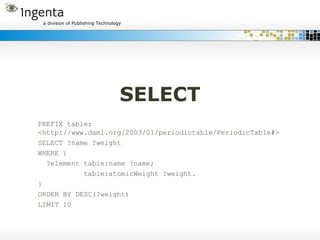
SELECT Equivalent to SQL SELECT Returns a nice, regular table
SELECT PREFIX table: <http://www.daml.org/2003/01/periodictable/PeriodicTable#> SELECT ?name ?weight WHERE { ?element table:name ?name; table:atomicWeight ?weight. } ORDER BY DESC(?weight) LIMIT 10
ASK Returns a true/false value Is there data that looks like  this ? Do you have any information about  that ?
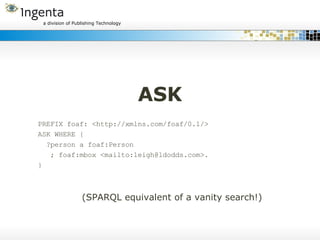
ASK PREFIX foaf: <http://xmlns.com/foaf/0.1/> ASK WHERE { ?person a foaf:Person ; foaf:mbox <mailto:leigh@ldodds.com>. } (SPARQL equivalent of a vanity search!)
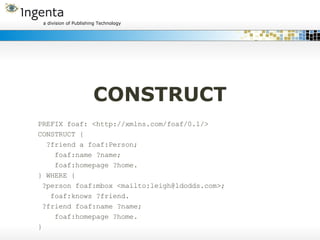
CONSTRUCT Returns an RDF graph Extract a specific subset of the queried data I want  this ,  this , and  this
CONSTRUCT PREFIX foaf: <http://xmlns.com/foaf/0.1/> CONSTRUCT { ?friend a foaf:Person; foaf:name ?name; foaf:homepage ?home. } WHERE { ?person foaf:mbox <mailto:leigh@ldodds.com>; foaf:knows ?friend. ?friend foaf:name ?name; foaf:homepage ?home. }
DESCRIBE Returns an RDF graph Tell me about  this  or  things that look like this … but you decide what’s relevant
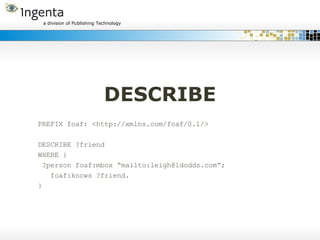
DESCRIBE PREFIX foaf: <http://xmlns.com/foaf/0.1/> DESCRIBE ?friend  WHERE { ?person foaf:mbox “mailto:leigh@ldodds.com”; foaf:knows ?friend. }
Applied Uses Beyond the basics
DESCRIBE for Prototyping DESCRIBE <http://example.org/someResource>  Quickly assembling UIs Web APIs
SELECT for Indexing Building an ordering over some data ORDER BY, LIMIT
CONSTRUCT for Transformation … and also simple inferencing CONSTRUCT could be the XSLT of RDF Currently limited by lack of expressions in CONSTRUCT triple templates
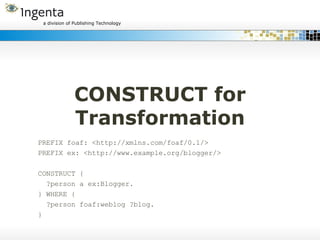
CONSTRUCT for Transformation PREFIX foaf: <http://xmlns.com/foaf/0.1/> PREFIX ex: <http://www.example.org/blogger/> CONSTRUCT { ?person a ex:Blogger. } WHERE { ?person foaf:weblog ?blog. }
SPARQL for Validation XSLT can be used for XML Validation (Schematron) SPARQL can be used for RDF Validation
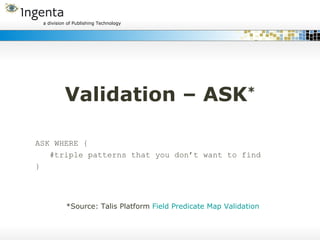
Validation – ASK * ASK WHERE { #triple patterns that you don’t want to find } *Source: Talis Platform  Field Predicate Map Validation
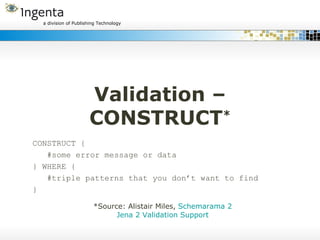
Validation – CONSTRUCT * CONSTRUCT { #some error message or data } WHERE { #triple patterns that you don’t want to find } *Source: Alistair Miles,  Schemarama  2 Jena 2 Validation Support
In Combination?
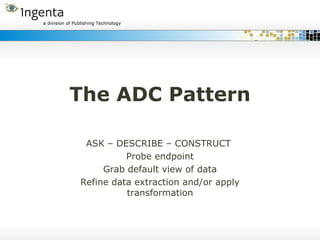
The ADC Pattern ASK – DESCRIBE – CONSTRUCT  Probe endpoint Grab default view of data Refine data extraction and/or apply transformation
Questions?

SPARQL Query Forms

  • 1.
    SPARQL Query FormsLeigh Dodds, Oxford SWIG, March 2008 Photo Credit: Glen Bowman
  • 2.
    Why are there4 SPARQL Query Forms? SPARQL Use Cases doesn’t help very much…
  • 3.
    …neither does theSPARQL specification SELECT Returns all, or a subset of, the variables bound in a query pattern match. CONSTRUCT Returns an RDF graph constructed by substituting variables in a set of triple templates. ASK Returns a boolean indicating whether a query pattern matches or not. DESCRIBE Returns an RDF graph that describes the resources found.
  • 4.
  • 5.
    SELECT Equivalent toSQL SELECT Returns a nice, regular table
  • 6.
    SELECT PREFIX table:<http://www.daml.org/2003/01/periodictable/PeriodicTable#> SELECT ?name ?weight WHERE { ?element table:name ?name; table:atomicWeight ?weight. } ORDER BY DESC(?weight) LIMIT 10
  • 7.
    ASK Returns atrue/false value Is there data that looks like this ? Do you have any information about that ?
  • 8.
    ASK PREFIX foaf:<http://xmlns.com/foaf/0.1/> ASK WHERE { ?person a foaf:Person ; foaf:mbox <mailto:leigh@ldodds.com>. } (SPARQL equivalent of a vanity search!)
  • 9.
    CONSTRUCT Returns anRDF graph Extract a specific subset of the queried data I want this , this , and this
  • 10.
    CONSTRUCT PREFIX foaf:<http://xmlns.com/foaf/0.1/> CONSTRUCT { ?friend a foaf:Person; foaf:name ?name; foaf:homepage ?home. } WHERE { ?person foaf:mbox <mailto:leigh@ldodds.com>; foaf:knows ?friend. ?friend foaf:name ?name; foaf:homepage ?home. }
  • 11.
    DESCRIBE Returns anRDF graph Tell me about this or things that look like this … but you decide what’s relevant
  • 12.
    DESCRIBE PREFIX foaf:<http://xmlns.com/foaf/0.1/> DESCRIBE ?friend WHERE { ?person foaf:mbox “mailto:leigh@ldodds.com”; foaf:knows ?friend. }
  • 13.
  • 14.
    DESCRIBE for PrototypingDESCRIBE <http://example.org/someResource> Quickly assembling UIs Web APIs
  • 15.
    SELECT for IndexingBuilding an ordering over some data ORDER BY, LIMIT
  • 16.
    CONSTRUCT for Transformation… and also simple inferencing CONSTRUCT could be the XSLT of RDF Currently limited by lack of expressions in CONSTRUCT triple templates
  • 17.
    CONSTRUCT for TransformationPREFIX foaf: <http://xmlns.com/foaf/0.1/> PREFIX ex: <http://www.example.org/blogger/> CONSTRUCT { ?person a ex:Blogger. } WHERE { ?person foaf:weblog ?blog. }
  • 18.
    SPARQL for ValidationXSLT can be used for XML Validation (Schematron) SPARQL can be used for RDF Validation
  • 19.
    Validation – ASK* ASK WHERE { #triple patterns that you don’t want to find } *Source: Talis Platform Field Predicate Map Validation
  • 20.
    Validation – CONSTRUCT* CONSTRUCT { #some error message or data } WHERE { #triple patterns that you don’t want to find } *Source: Alistair Miles, Schemarama 2 Jena 2 Validation Support
  • 21.
  • 22.
    The ADC PatternASK – DESCRIBE – CONSTRUCT Probe endpoint Grab default view of data Refine data extraction and/or apply transformation
  • 23.