http://www.flickr.com/photos/pict_u_re/2372235999


The State of Linked Open Data in Libraries,
Archives & Museums
SemTech 2011
June 8, 2011

Jon Voss
Strategic Partnerships Director, Historypin
@jonvoss
jon.voss@wearewhatwedo.org

#lodlam
                                                  v1.1_2011-05-26
About LODLAM

 • #lodlam teaser: http://youtu.be/YdrVI7emnt4


 • Using WWW standards to explore data interoperability not only between
   institutions but with the Web community and end users as well.


 • The last few years have seen a major cultural shift on the whole, but in
   institutions, addressing changing expectations from audiences,
   curators, & technologists


 • This amounts to an enormous opportunity for libraries, archives, &
   museums, and for the semantic web community as well.
LODLAM is a Growing Movement

• in its infancy, but picking up steam


• it requires experimentation

• small, niche, domain-specific implementations

• use cases, reasons for content providers to get excited about contributing
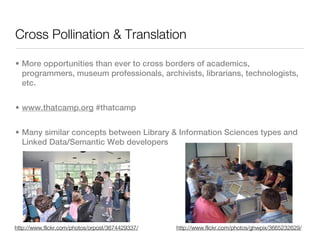
Cross Pollination & Translation

• More opportunities than ever to cross borders of academics,
  programmers, museum professionals, archivists, librarians, technologists,
  etc.


• www.thatcamp.org #thatcamp


• Many similar concepts between Library & Information Sciences types and
  Linked Data/Semantic Web developers


http://www.flickr.com/photos/orpost/3674429337/   http://www.flickr.com/photos/ghwpix/3665232629/
LODLAM is a product of our increasingly
 connected culture.
• it’s an unfolding story, but it’s awn...


• first funded projects in the US exploring Linked Open Data in the
  humanities now underway: http://lod-lam.net


   • 100 people gathered from around the world June 2-3 to forward
     LODLAM in the next year, thanks to generous funding from:
LOD-LAM Summit: over 85 organizations

• First of it’s kind meeting


• Bridging sciences and humanities to focus on moving Linked Open Data
  forward in public & academic libraries, archives & museums world wide in
  the next year.


• Libraries like: Library of Congress, French & German National libraries,
  NYPL, Open Library, state libraries across the country


• Archives like: the National Archives of US and UK, California Digital Library


• Museums like: The Met, SFMOMA, Powerhouse, Smithsonian
LODLAM Summit Outcomes

• Outreach, Education, Evangelization


• Making sense of copyright, licensing, publishing options, setting precedent


• Developing collaborative use cases
Examples of working within LODLAM
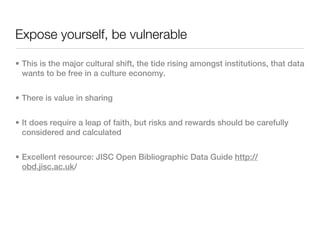
Expose yourself, be vulnerable

• This is the major cultural shift, the tide rising amongst institutions, that data
  wants to be free in a culture economy.


• There is value in sharing


• It does require a leap of faith, but risks and rewards should be carefully
  considered and calculated


• Excellent resource: JISC Open Bibliographic Data Guide http://
  obd.jisc.ac.uk/
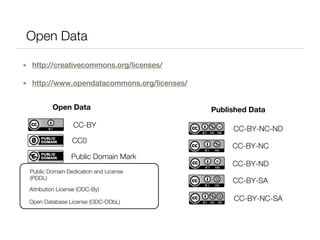
Open Data

• http://creativecommons.org/licenses/

• http://www.opendatacommons.org/licenses/


          Open Data                          Published Data

                  CC-BY                           CC-BY-NC-ND
                  CC0
                                                  CC-BY-NC
                 Public Domain Mark
                                                  CC-BY-ND
 Public Domain Dedication and License
 (PDDL)
                                                  CC-BY-SA
 Attribution License (ODC-By)

 Open Database License (ODC-ODbL)                 CC-BY-NC-SA
Metadata vs. data, assets, digital surrogates

• A key conceptual shift with Open Data is looking at metadata and data as
  two separate things, that can have different licensing and permissions
Examples and precedents

• Bibliographic data:


  • British Library (CC0), University of Michigan (CC0), Stanford (CC-BY)
    have published large, raw datasets of bibliographic data they have
    created (being careful not to publish OCLC or other vendor controlled or
    licensed metadata)
Examples and precedents

 • Civil War Data 150


   • Metadata from contributing federal institutions are largely considered
     to be Public Domain.


   • State, local, university & individual researchers are considering
     policies for metadata publishing on a case by case basis.
Civil War Data 150 - Linked Data in Scholarship


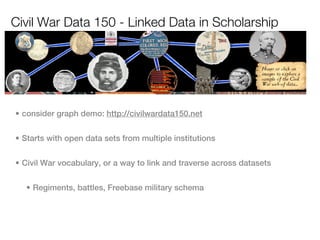
• consider graph demo: http://civilwardata150.net


• Starts with open data sets from multiple institutions


• Civil War vocabulary, or a way to link and traverse across datasets


   • Regiments, battles, Freebase military schema
Civil War Data 150 - Linked Data in Scholarship


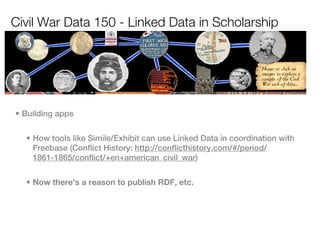
• Building apps


  • How tools like Simile/Exhibit can use Linked Data in coordination with
    Freebase (Conflict History: http://conflicthistory.com/#/period/
    1861-1865/conflict/+en+american_civil_war)


  • Now there’s a reason to publish RDF, etc.
What will happen to your data?

• If you want people to do something with your data/metadata, you have to
  put it out there


• But once you do, it’s [mostly] out of your control. Yet it can be a part of
  something much greater than any of the component parts


• Roots and Wings
What will happen to your data?

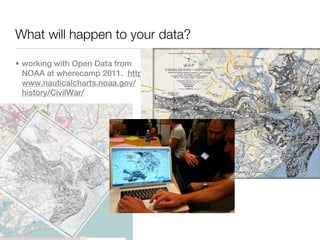
• working with Open Data from
  NOAA at wherecamp 2011. http://
  www.nauticalcharts.noaa.gov/
  history/CivilWar/
Sciences leading the way vs. Humanities

• In the sciences, there have been a lot of advances in the realm of Open
  Data, which will provide models for humanities research as well


  • Nano Publishing: the idea of publishing datasets separately from
    research findings, so that it can more easily be built upon and integrated
    into other datasets. Several scientific journals have already started this.


  • Federally funded medical research must have a data management plan
    and some funders are requiring that data be published separately from
    analysis and findings as Open Data
Join the LODLAM movement

• http://groups.google.com/group/
  lod-lam


• #lodlam hashtag on Twitter


• http://lod-lam.net proceedings
  online and on the road for the next
  year at various annual meetings
  and conferences


• Contribute!

Linked Open Data in Libraries Archives & Museums

  • 1.
    http://www.flickr.com/photos/pict_u_re/2372235999 The State ofLinked Open Data in Libraries, Archives & Museums SemTech 2011 June 8, 2011 Jon Voss Strategic Partnerships Director, Historypin @jonvoss jon.voss@wearewhatwedo.org #lodlam v1.1_2011-05-26
  • 2.
    About LODLAM •#lodlam teaser: http://youtu.be/YdrVI7emnt4 • Using WWW standards to explore data interoperability not only between institutions but with the Web community and end users as well. • The last few years have seen a major cultural shift on the whole, but in institutions, addressing changing expectations from audiences, curators, & technologists • This amounts to an enormous opportunity for libraries, archives, & museums, and for the semantic web community as well.
  • 3.
    LODLAM is aGrowing Movement • in its infancy, but picking up steam • it requires experimentation • small, niche, domain-specific implementations • use cases, reasons for content providers to get excited about contributing
  • 4.
    Cross Pollination &Translation • More opportunities than ever to cross borders of academics, programmers, museum professionals, archivists, librarians, technologists, etc. • www.thatcamp.org #thatcamp • Many similar concepts between Library & Information Sciences types and Linked Data/Semantic Web developers http://www.flickr.com/photos/orpost/3674429337/ http://www.flickr.com/photos/ghwpix/3665232629/
  • 5.
    LODLAM is aproduct of our increasingly connected culture. • it’s an unfolding story, but it’s awn... • first funded projects in the US exploring Linked Open Data in the humanities now underway: http://lod-lam.net • 100 people gathered from around the world June 2-3 to forward LODLAM in the next year, thanks to generous funding from:
  • 6.
    LOD-LAM Summit: over85 organizations • First of it’s kind meeting • Bridging sciences and humanities to focus on moving Linked Open Data forward in public & academic libraries, archives & museums world wide in the next year. • Libraries like: Library of Congress, French & German National libraries, NYPL, Open Library, state libraries across the country • Archives like: the National Archives of US and UK, California Digital Library • Museums like: The Met, SFMOMA, Powerhouse, Smithsonian
  • 7.
    LODLAM Summit Outcomes •Outreach, Education, Evangelization • Making sense of copyright, licensing, publishing options, setting precedent • Developing collaborative use cases
  • 8.
    Examples of workingwithin LODLAM
  • 9.
    Expose yourself, bevulnerable • This is the major cultural shift, the tide rising amongst institutions, that data wants to be free in a culture economy. • There is value in sharing • It does require a leap of faith, but risks and rewards should be carefully considered and calculated • Excellent resource: JISC Open Bibliographic Data Guide http:// obd.jisc.ac.uk/
  • 10.
    Open Data • http://creativecommons.org/licenses/ •http://www.opendatacommons.org/licenses/ Open Data Published Data CC-BY CC-BY-NC-ND CC0 CC-BY-NC Public Domain Mark CC-BY-ND Public Domain Dedication and License (PDDL) CC-BY-SA Attribution License (ODC-By) Open Database License (ODC-ODbL) CC-BY-NC-SA
  • 11.
    Metadata vs. data,assets, digital surrogates • A key conceptual shift with Open Data is looking at metadata and data as two separate things, that can have different licensing and permissions
  • 12.
    Examples and precedents •Bibliographic data: • British Library (CC0), University of Michigan (CC0), Stanford (CC-BY) have published large, raw datasets of bibliographic data they have created (being careful not to publish OCLC or other vendor controlled or licensed metadata)
  • 13.
    Examples and precedents • Civil War Data 150 • Metadata from contributing federal institutions are largely considered to be Public Domain. • State, local, university & individual researchers are considering policies for metadata publishing on a case by case basis.
  • 14.
    Civil War Data150 - Linked Data in Scholarship • consider graph demo: http://civilwardata150.net • Starts with open data sets from multiple institutions • Civil War vocabulary, or a way to link and traverse across datasets • Regiments, battles, Freebase military schema
  • 15.
    Civil War Data150 - Linked Data in Scholarship • Building apps • How tools like Simile/Exhibit can use Linked Data in coordination with Freebase (Conflict History: http://conflicthistory.com/#/period/ 1861-1865/conflict/+en+american_civil_war) • Now there’s a reason to publish RDF, etc.
  • 16.
    What will happento your data? • If you want people to do something with your data/metadata, you have to put it out there • But once you do, it’s [mostly] out of your control. Yet it can be a part of something much greater than any of the component parts • Roots and Wings
  • 17.
    What will happento your data? • working with Open Data from NOAA at wherecamp 2011. http:// www.nauticalcharts.noaa.gov/ history/CivilWar/
  • 18.
    Sciences leading theway vs. Humanities • In the sciences, there have been a lot of advances in the realm of Open Data, which will provide models for humanities research as well • Nano Publishing: the idea of publishing datasets separately from research findings, so that it can more easily be built upon and integrated into other datasets. Several scientific journals have already started this. • Federally funded medical research must have a data management plan and some funders are requiring that data be published separately from analysis and findings as Open Data
  • 19.
    Join the LODLAMmovement • http://groups.google.com/group/ lod-lam • #lodlam hashtag on Twitter • http://lod-lam.net proceedings online and on the road for the next year at various annual meetings and conferences • Contribute!

Editor's Notes