John Breslin (for Stefan Decker) Site Interoperability Projects at DERI Galway‘s SW Cluster [email_address] www.johnbreslin.com Interop Issues in SW Sites 7 th  February 2005
SW Cluster: Overview SIOC: Semantically Interlinked Online Community SemanticWeb.org FOAFRealm RDF Datasets for Site Exchange
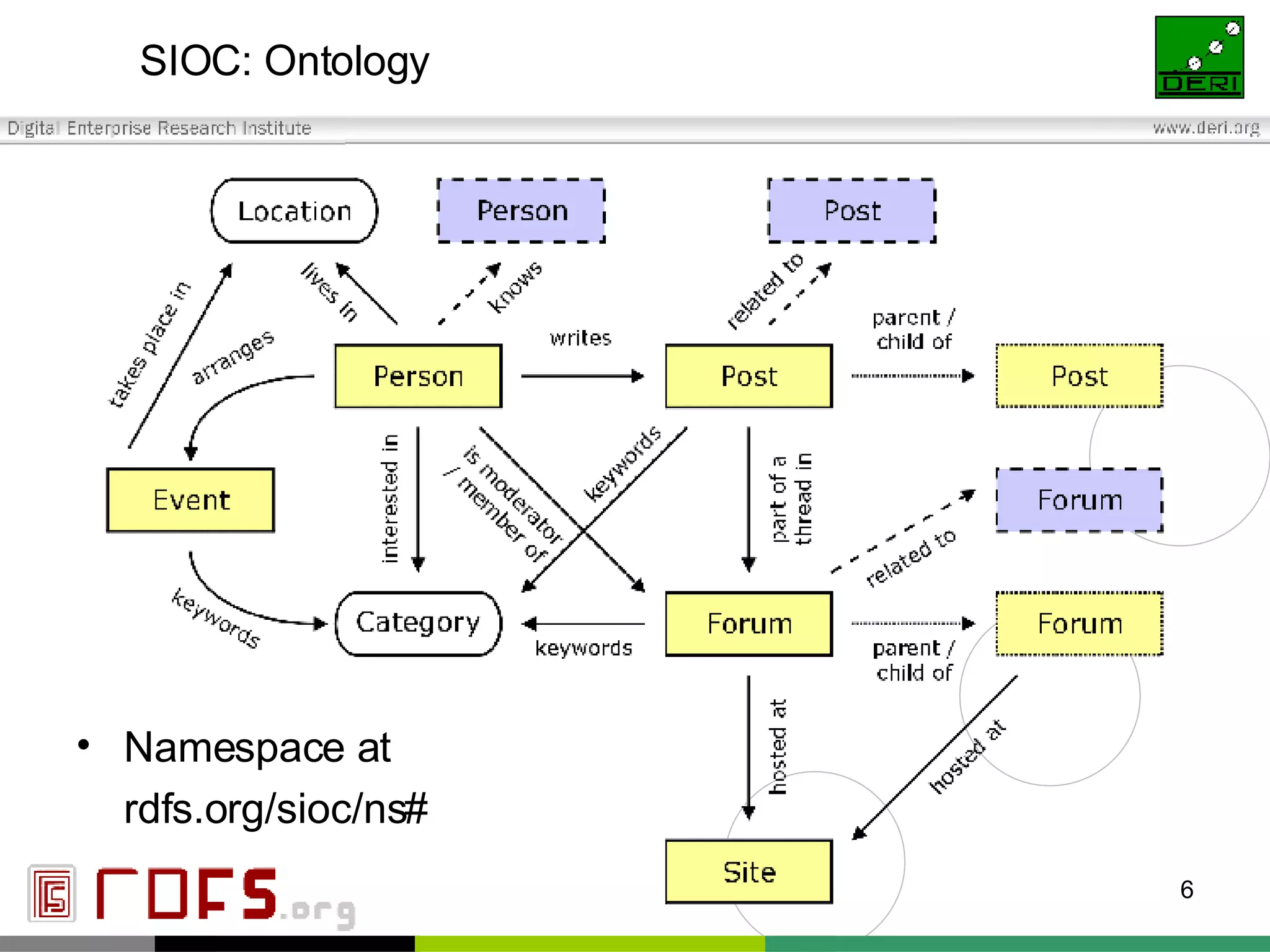
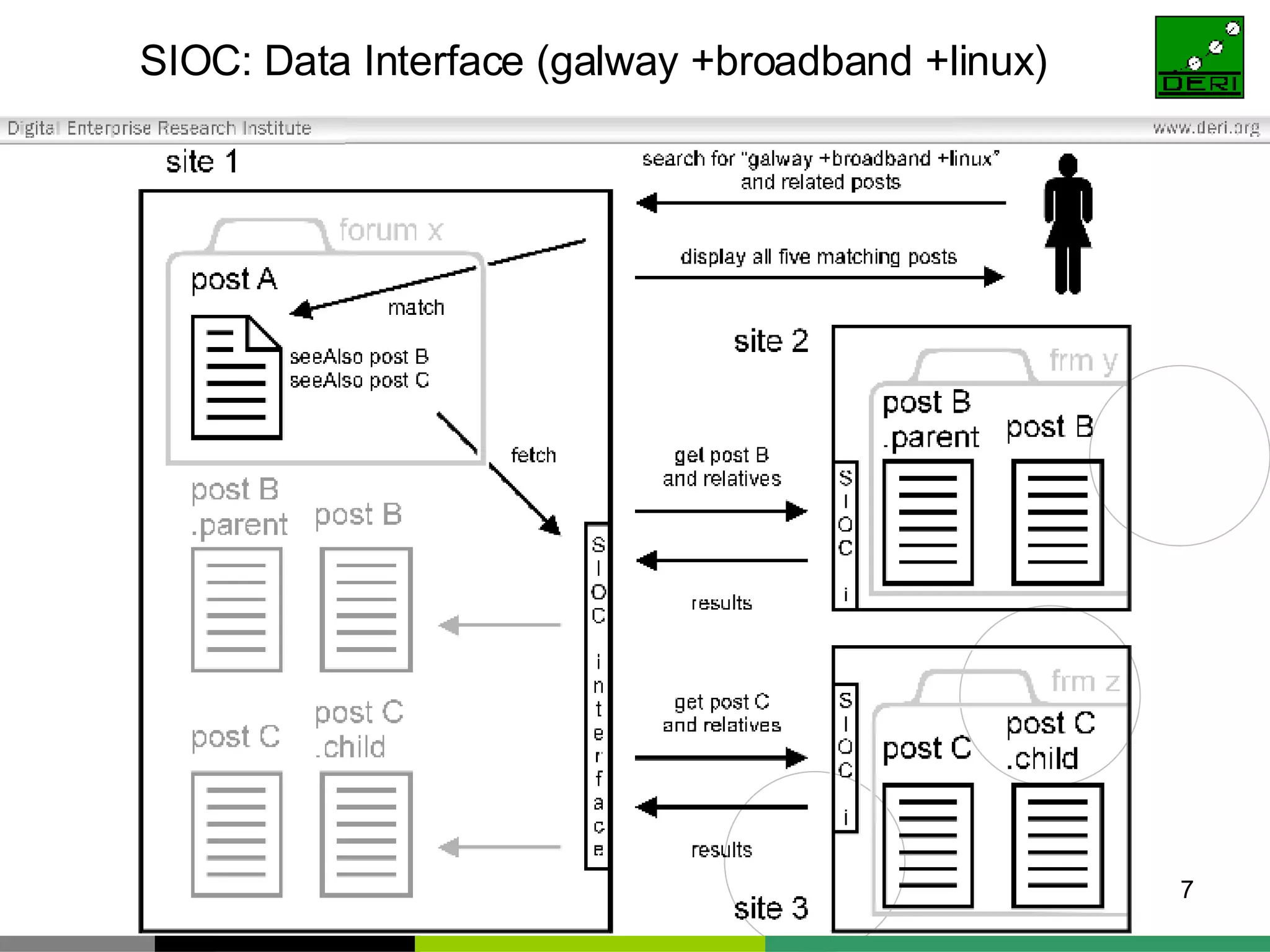
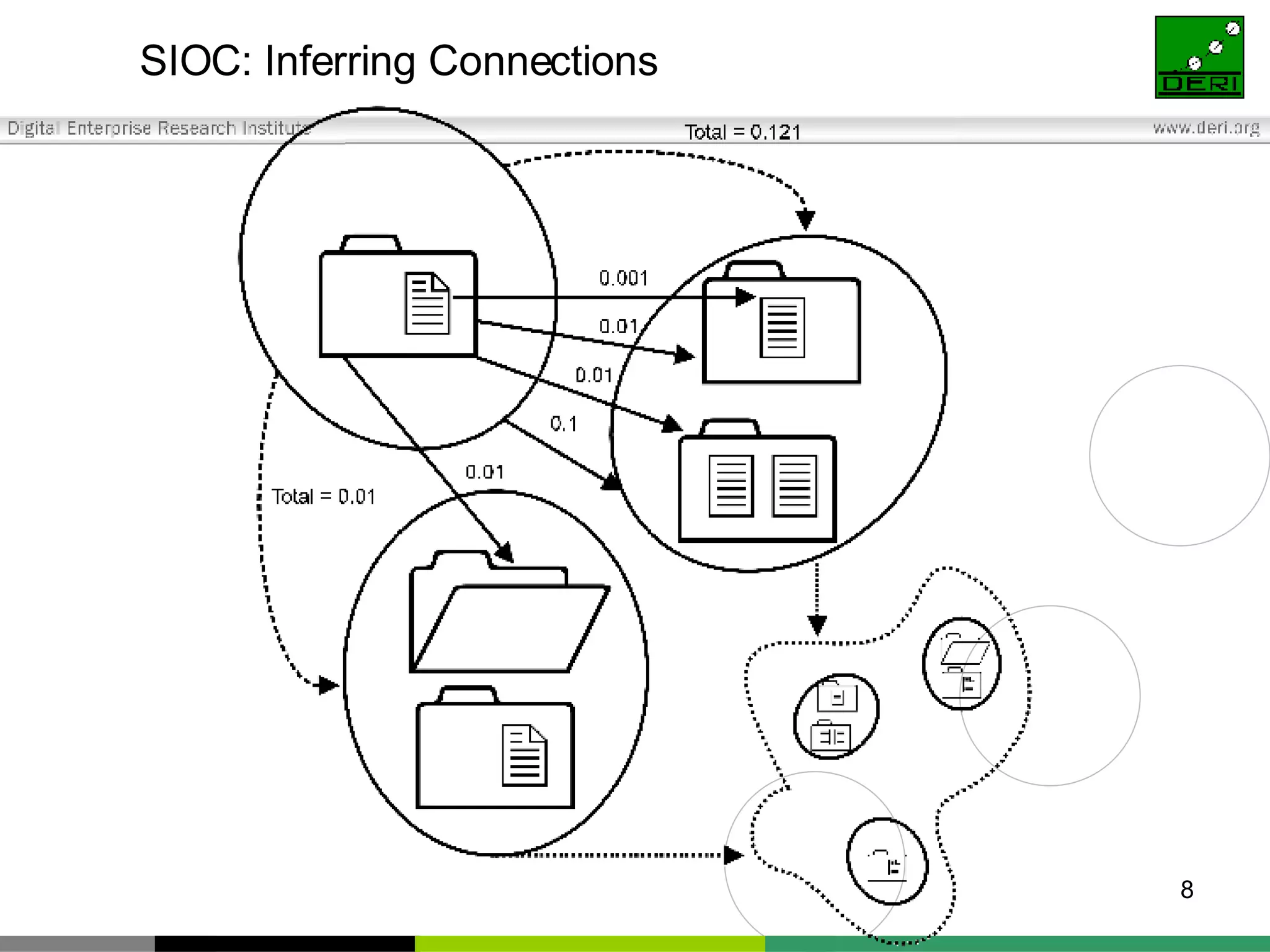
SIOC: Introduction  Issues with online communities: Data on community sites cannot be harnessed correctly Isolated communities discussing complementary topics Information is being repeatedly requested across sites SIOC approach: Ontology Data Interface Inferring Connections
SIOC: To Interconnect Bulletin Board Sites boards.ie boards.us boards.jp boards.geek.nz
SIOC: Ontology Namespace at rdfs.org/sioc/ns#
SIOC: Data Interface (galway +broadband +linux)
SIOC: Inferring Connections
SW Cluster: Overview SIOC: Semantically Interlinked Online Community SemanticWeb.org FOAFRealm RDF Datasets for Site Exchange
SemanticWeb.org: Introduction General interoperability considerations The site RDF/XML views of local data Integration of remote data Data access interface Ontology import and export Possible extensions
SemanticWeb.org: General Interop Considerations Basic idea is to use Semantic Web technology to allow different web sites to „work together“ Interoperability could cover re-use and integration of other sites‘  models ,  data , and  functionality Presentation layer  components (e.g. stylesheets for agreed-on RDF/XML structures) may be considered too
SemanticWeb.org: The Site SemanticWeb.org will (soon again ;-)) be the Semantic Web community portal The new (RDF-enhanced) site will provide information about Semantic Web events, people, tools, organisations, projects, and other related resources Both instance data and model information can be added, modified, extended, and exported online
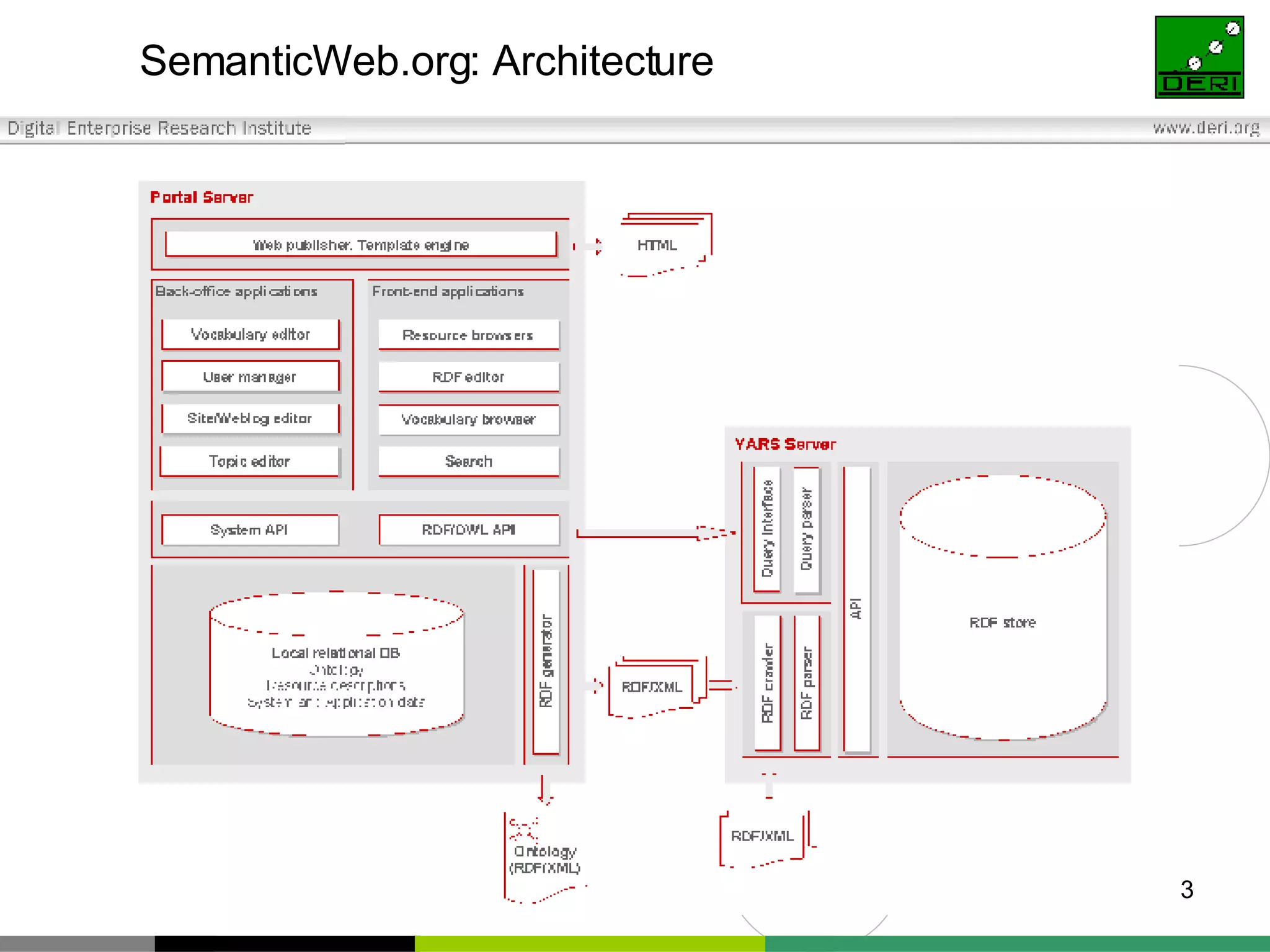
SemanticWeb.org: Architecture
SemanticWeb.org: RDF/XML Views of Local Data Each portal object (page, channel, blog post, user, vocabulary, SKOS concept, resource description...) can be serialized as RDF/XML Resource Description Discovery (RDD) will be enabled by <link /> tags in XHTML, HTTP headers (X-Metadata-Location) and support for URIQA‘s MGET Direct serving of content-negotiated XHTML vs. RDF/XML is considered bad practice (URI overloading etc.), but HTTP redirects may be triggered on certain accept-headers instead
SemanticWeb.org: Integration of Remote Data The site has an „Add URL“ feature to add remotely maintained sources to the portal Information from remote sources will be updated via an RDF crawler (scutter) The final RDF store (Andreas‘ YARS) is going to support HTTP PUT and POST for direct integration of data
SemanticWeb.org: Data Access Interface The final portal is going to provide an HTTP-based query interface (probably SPARQL protocol/query language compliant) Together with the portal‘s RDD features, it will be possible to retrieve Concise Bounded Descriptions (CBDs) of resources for re-use in other environments
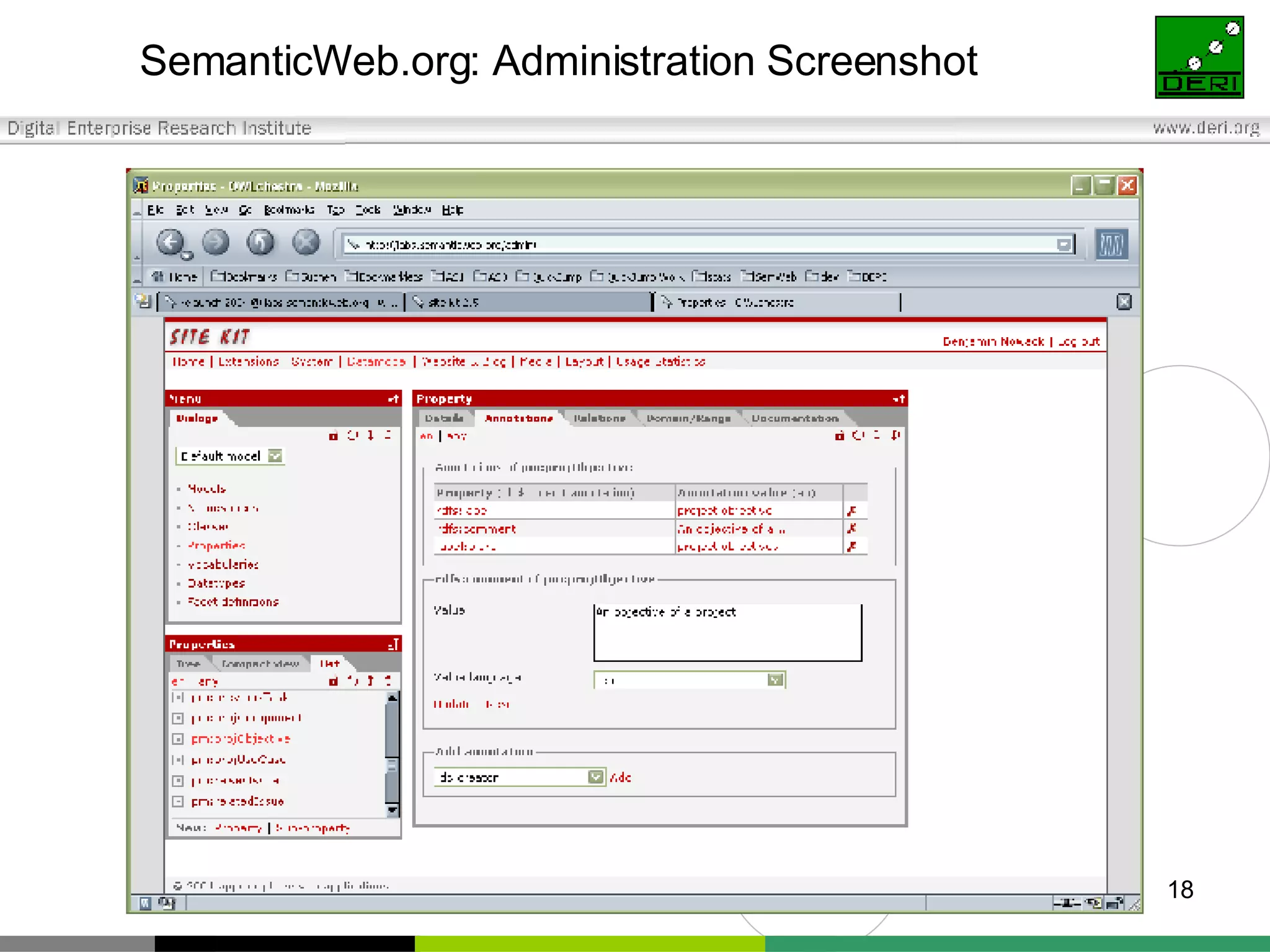
SemanticWeb.org: Ontology Import and Export The portal system has a built-in web-based vocabulary editor and publisher RDFS and OWL term sets can be imported, mixed, and exported Annotation properties are used to add machine-readable presentation information for classes (e.g. re-usable views or forms)
SemanticWeb.org: Administration Screenshot
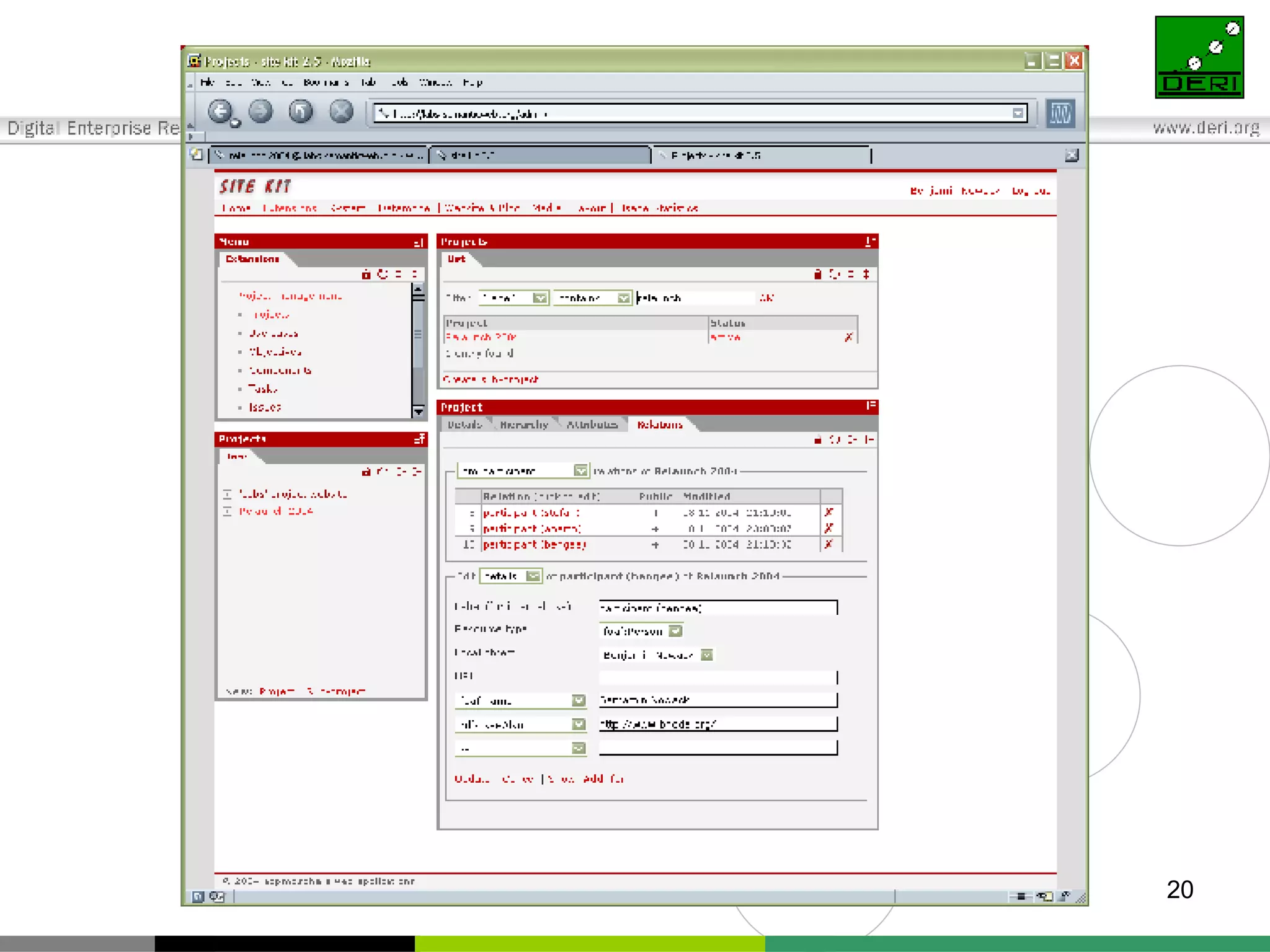
SemanticWeb.org: Possible Extensions Add support for  functionality  re-use (e.g. facilitated sign-up à la FOAFNet) The views are currently generated via PHP code (ontology-guided, though) For improved interoperability, it could make sense to completely separate the presentation layer from program code (e.g. by a stylesheet-like approach and by formally describing the way resource descriptions should be displayed)
 
SW Cluster: Overview SIOC: Semantically Interlinked Online Community SemanticWeb.org FOAFRealm RDF Datasets for Site Exchange
FOAFRealm: Introduction A user management system with social collaborative filtering Embedded mechanisms of authorising and controlling the sharing of resources among users Gives different weights of votes during negotiations
FOAFRealm: Features User profiles management system based on FOAF and P2P Information on relationships between users On-time registration*  Single sign-on* Access control lists based on the distance and trust level between users Implementation of social collaborative filtering (private bookshelves, annotations, evaluations)
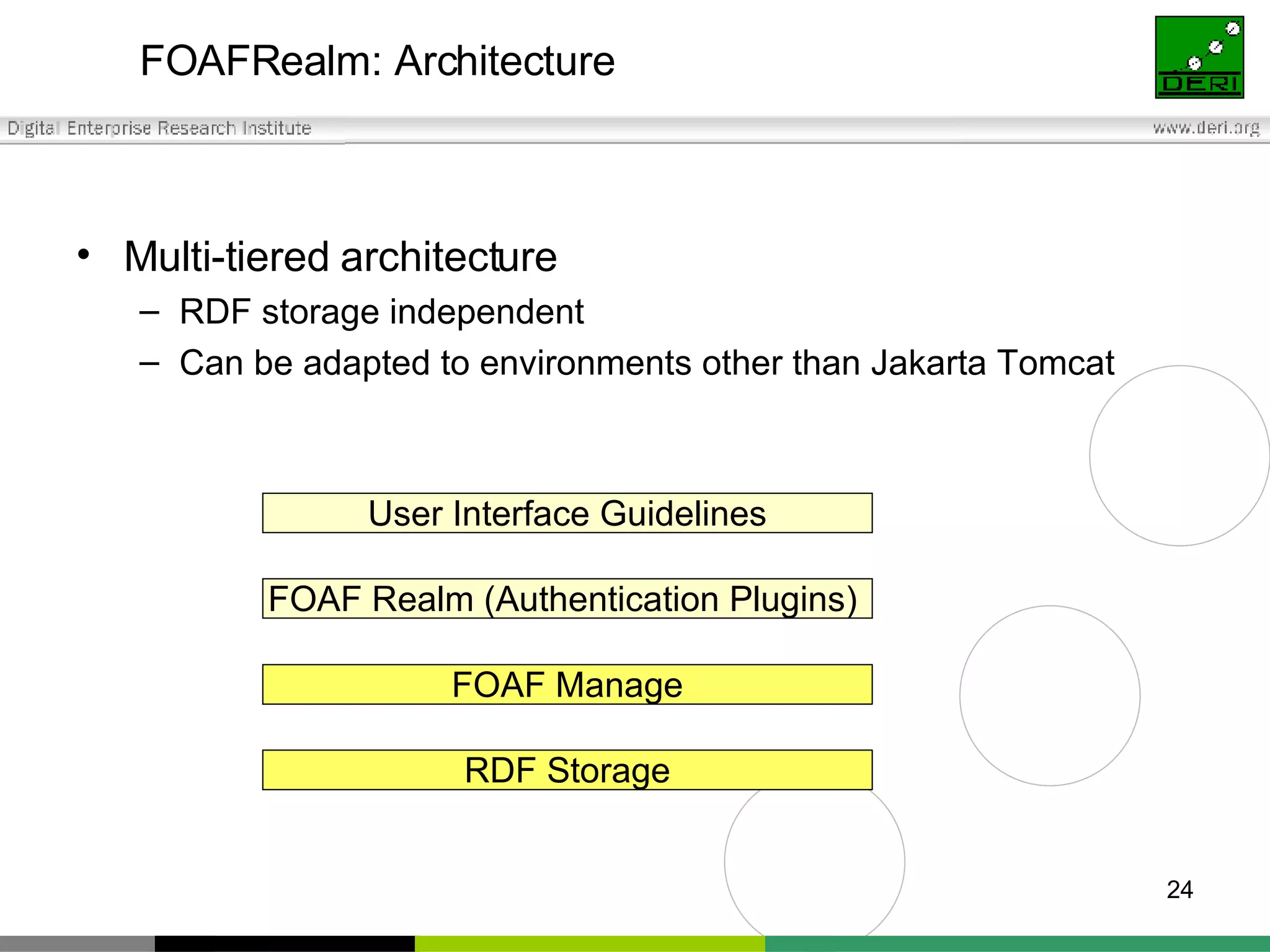
FOAFRealm: Architecture Multi-tiered architecture RDF storage independent Can be adapted to environments other than Jakarta Tomcat  RDF Storage FOAF Manage FOAF Realm (Authentication Plugins)  User Interface Guidelines
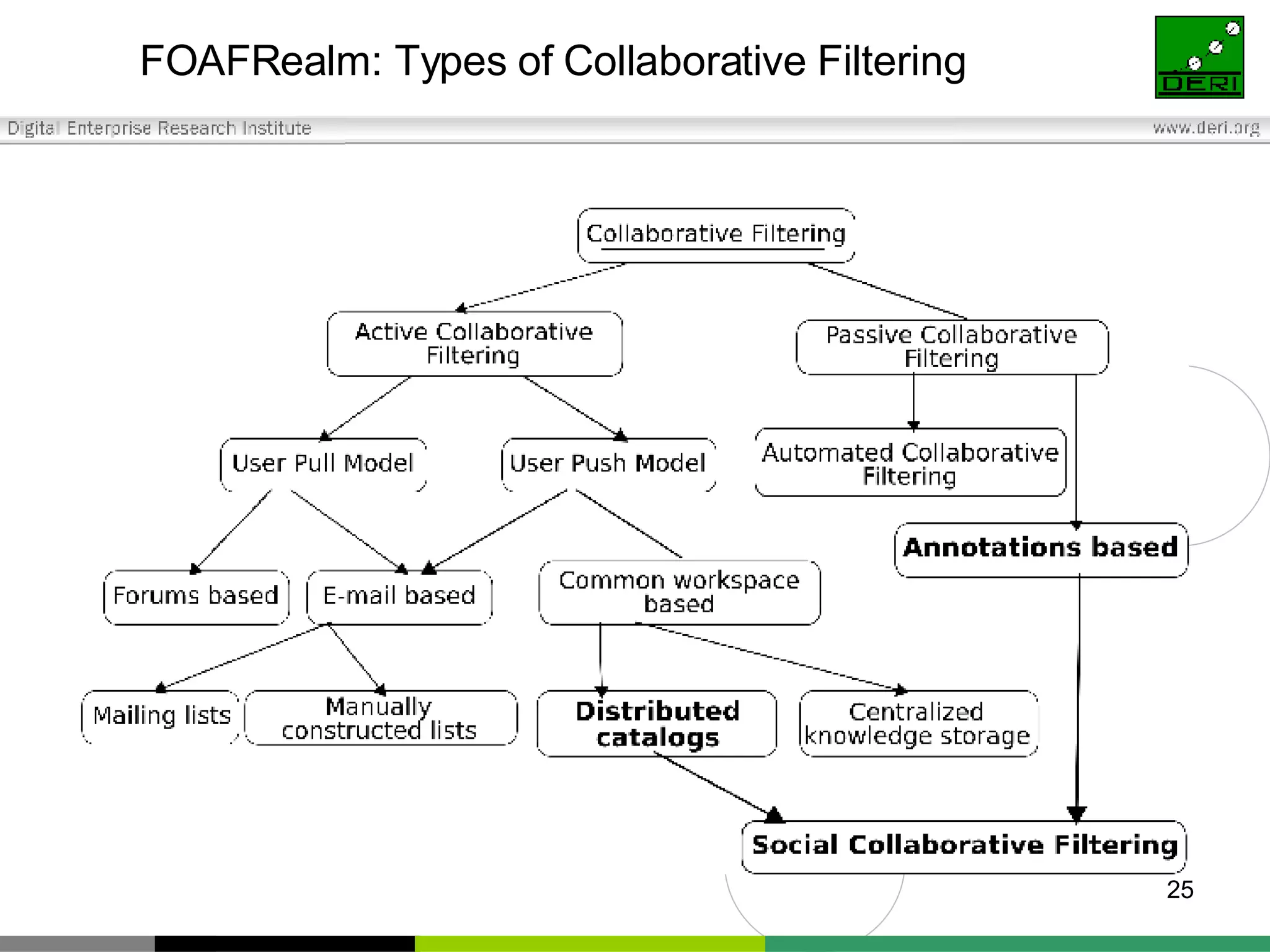
FOAFRealm: Types of Collaborative Filtering
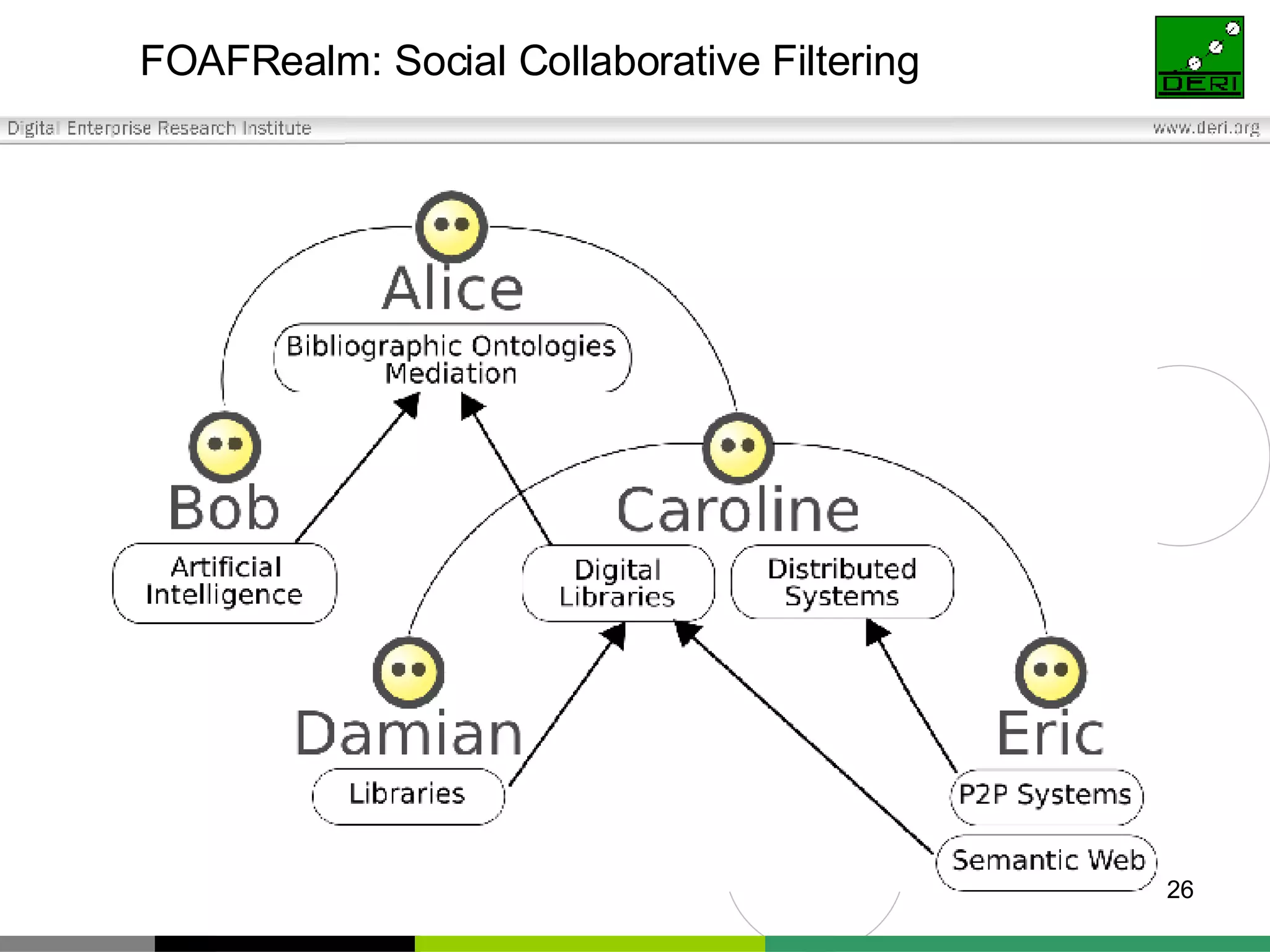
FOAFRealm: Social Collaborative Filtering
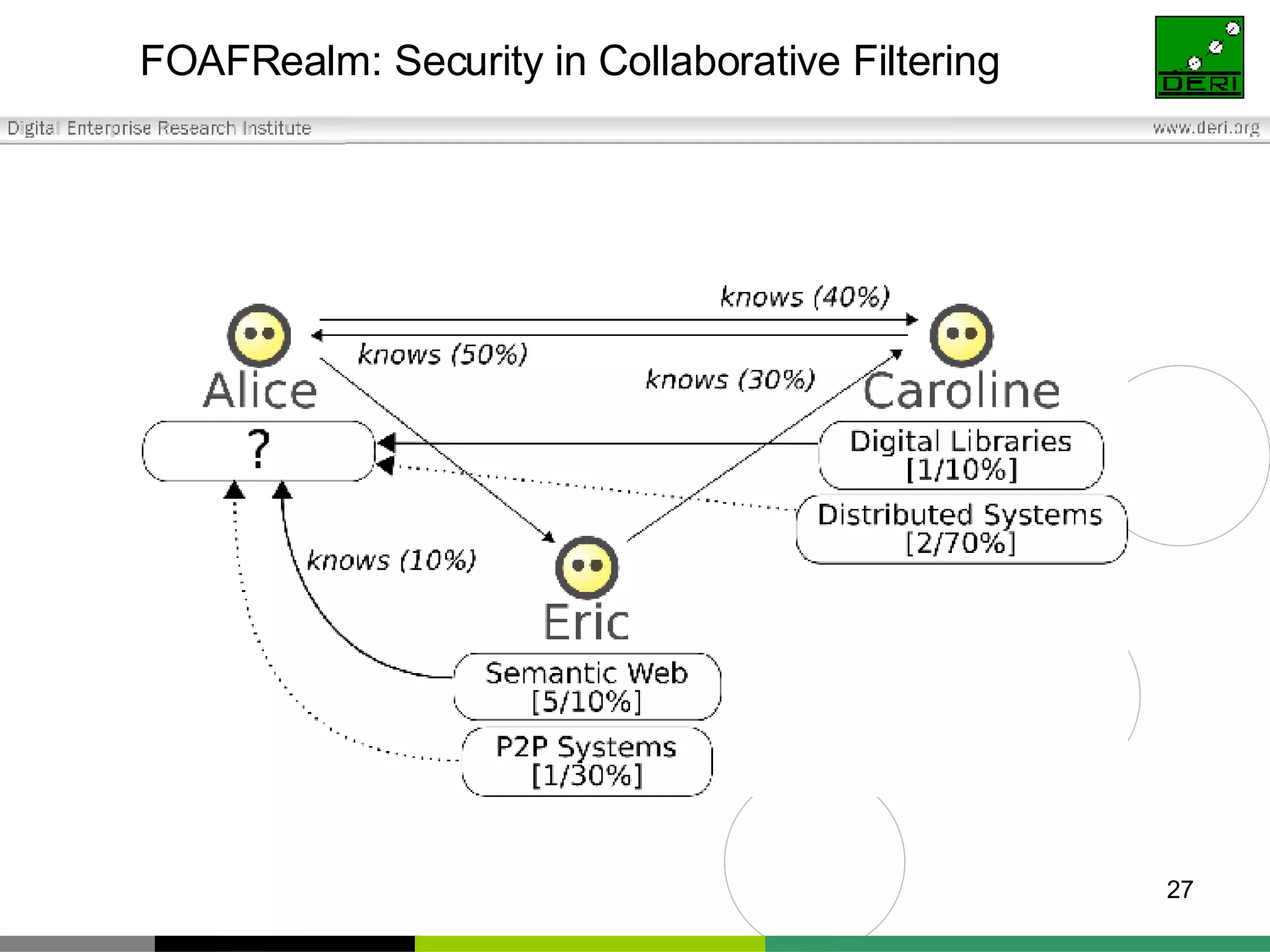
FOAFRealm: Security in Collaborative Filtering
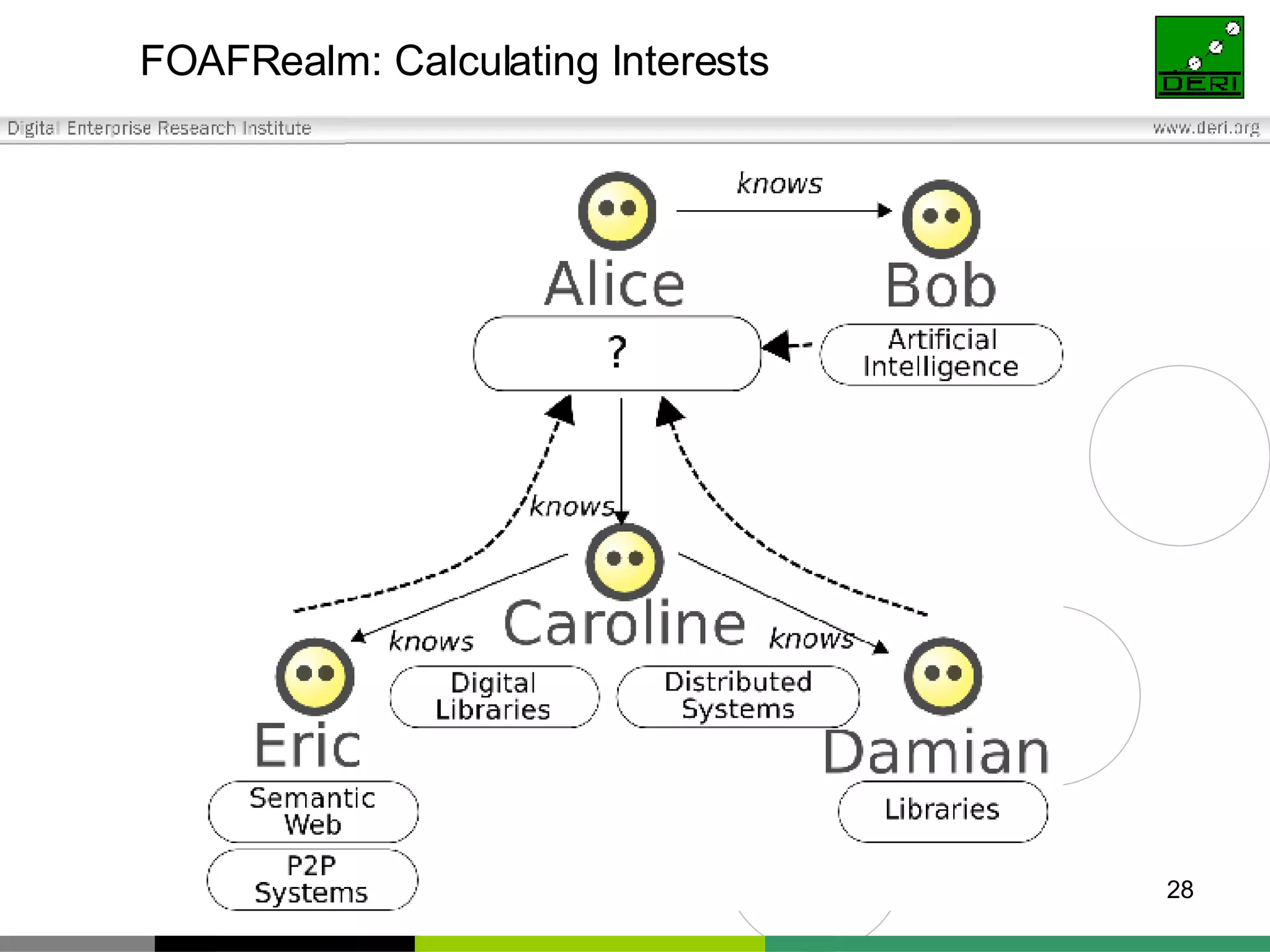
FOAFRealm: Calculating Interests
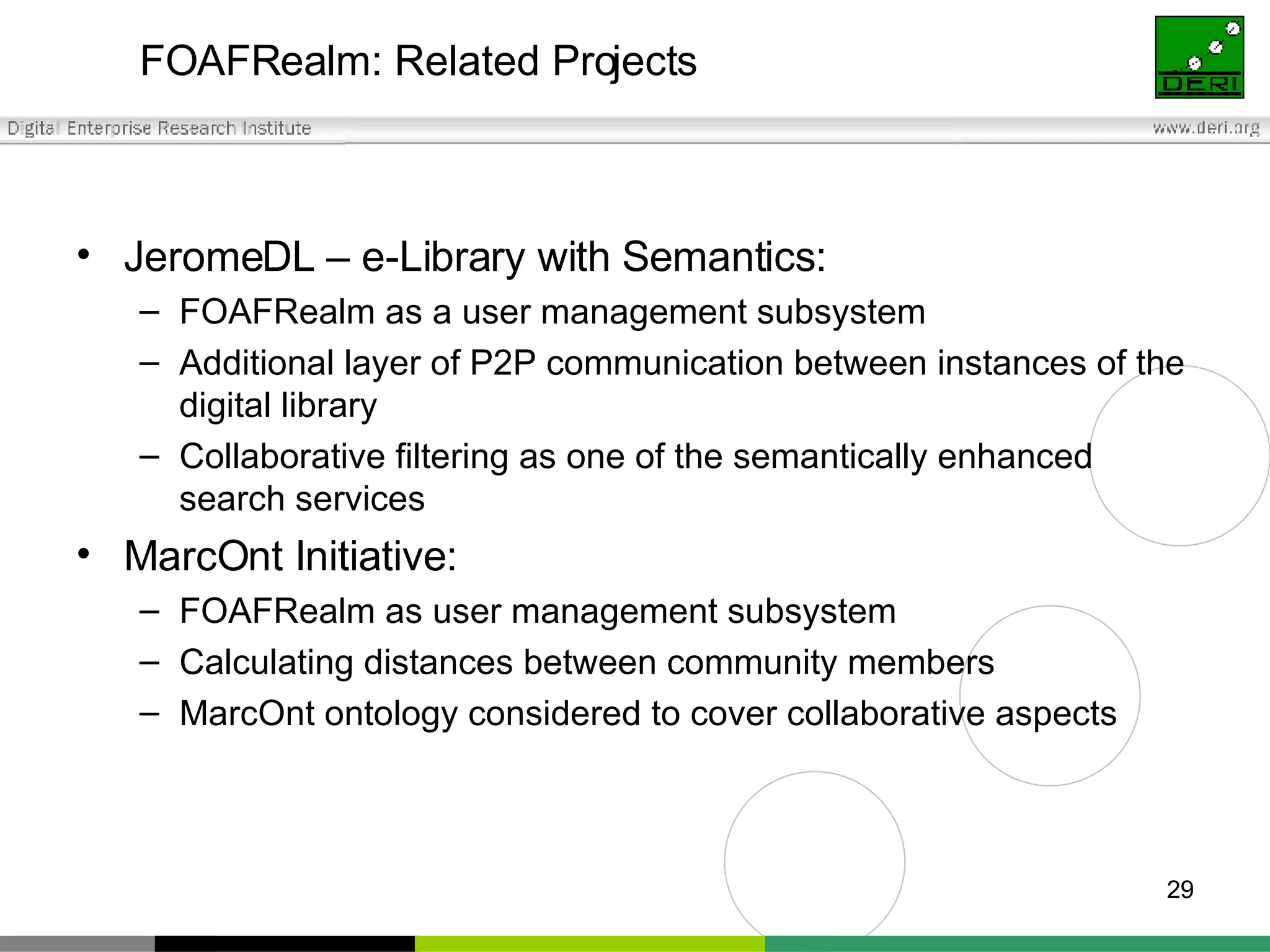
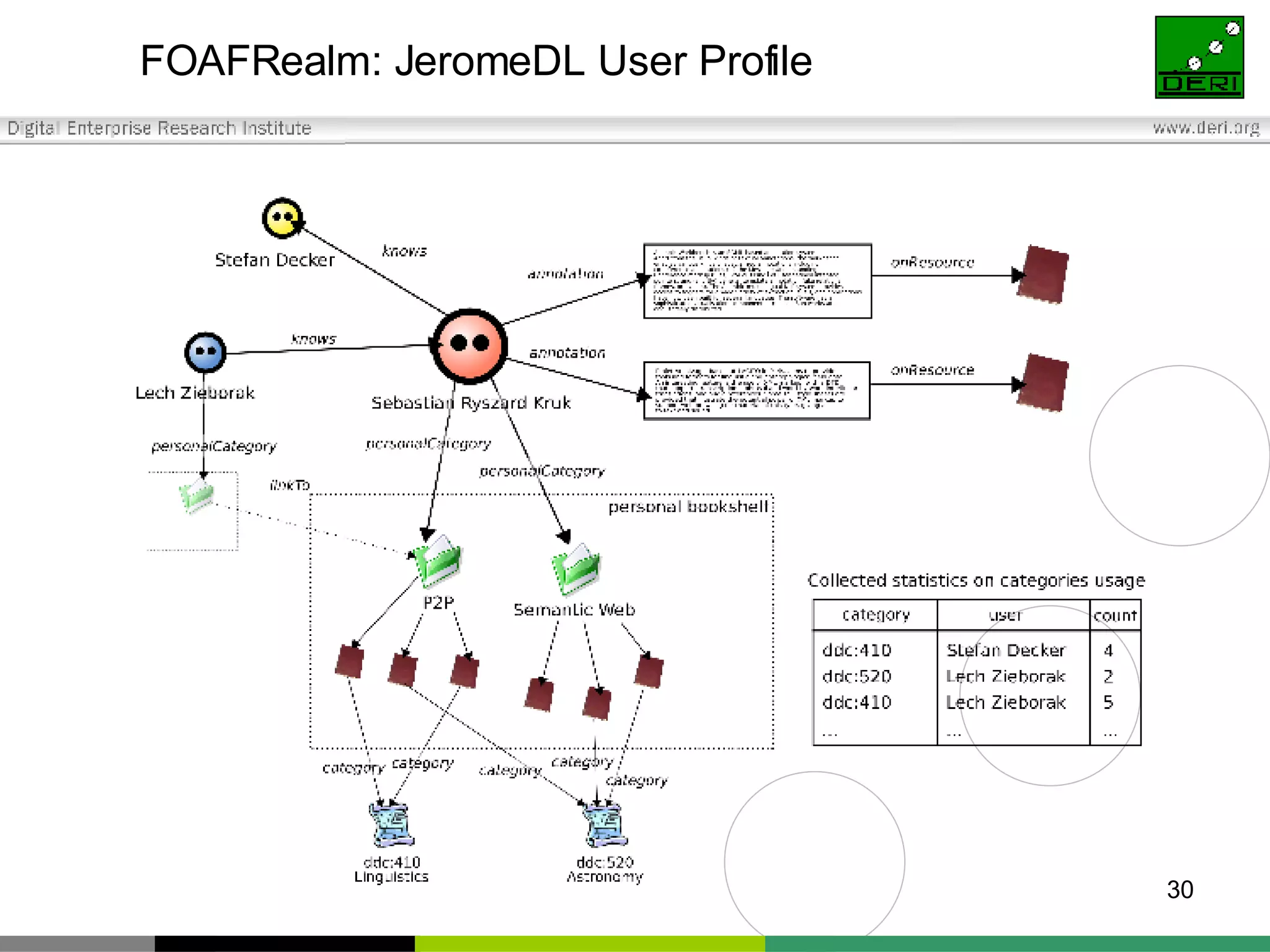
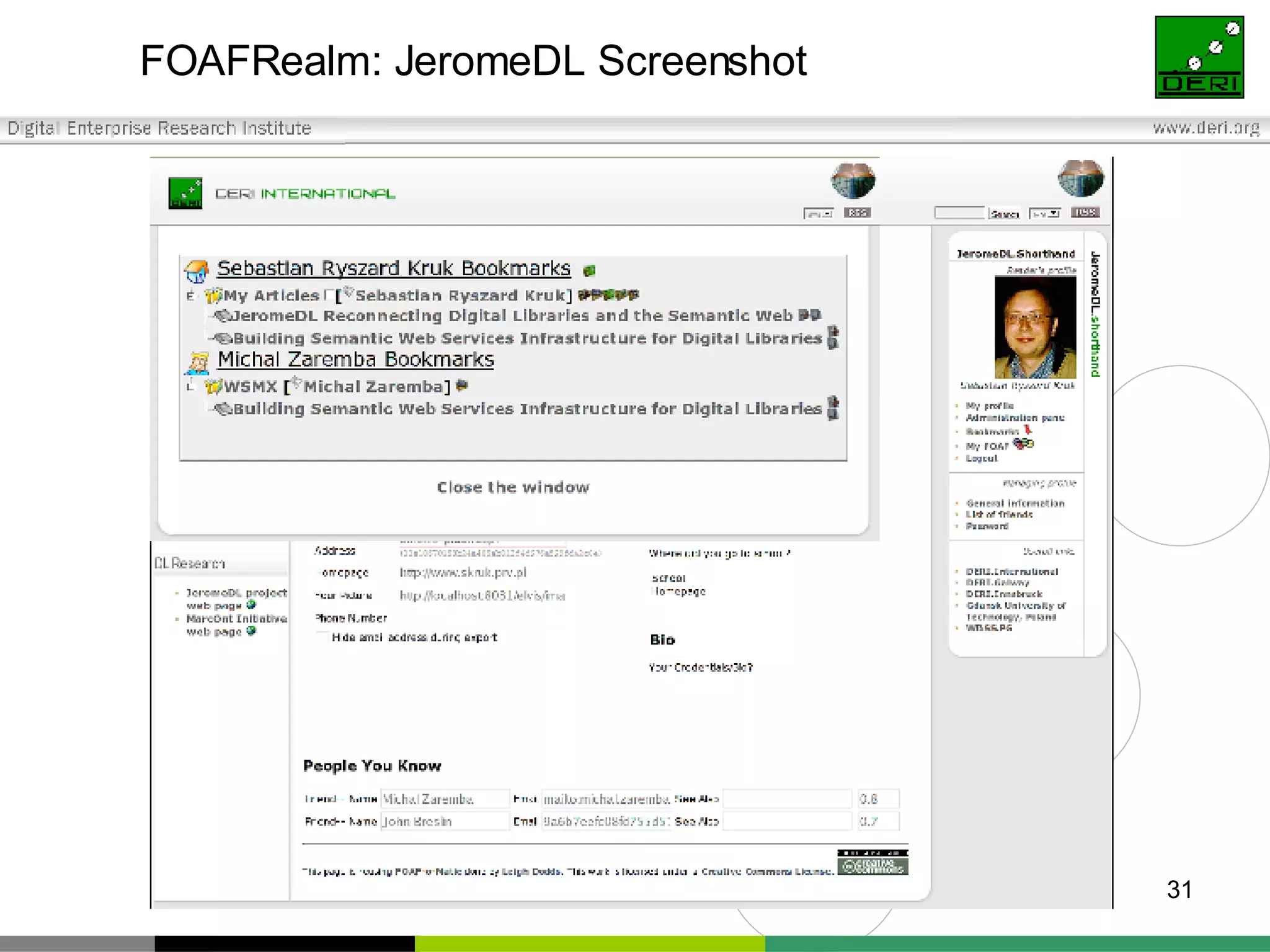
FOAFRealm: Related Projects JeromeDL – e-Library with Semantics: FOAFRealm as a user management subsystem Additional layer of P2P communication between instances of the digital library Collaborative filtering as one of the semantically enhanced search services MarcOnt Initiative: FOAFRealm as user management subsystem Calculating distances between community members MarcOnt ontology considered to cover collaborative aspects
FOAFRealm: JeromeDL User Profile
FOAFRealm: JeromeDL Screenshot
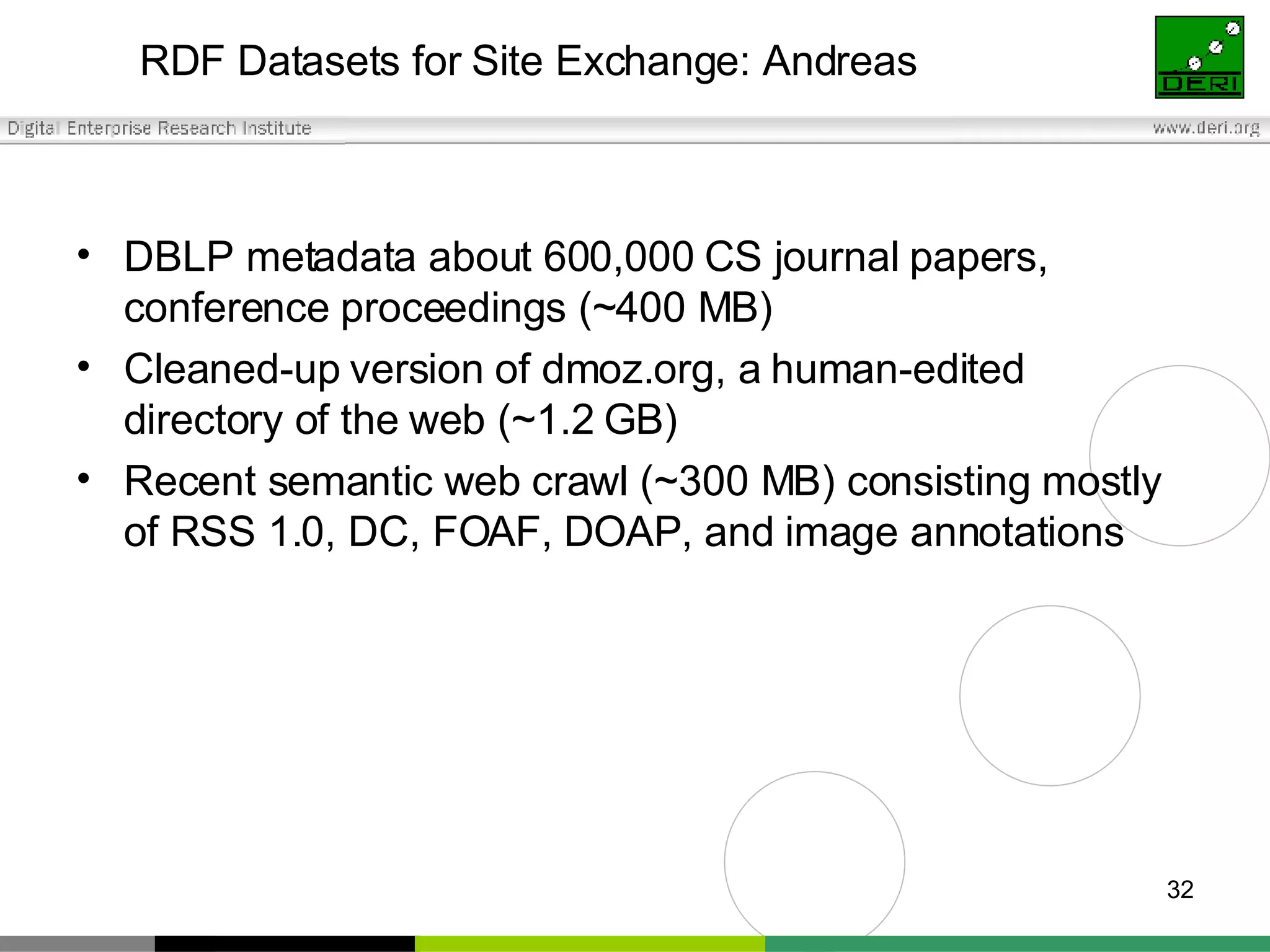
RDF Datasets for Site Exchange: Andreas DBLP metadata about 600,000 CS journal papers, conference proceedings (~400 MB) Cleaned-up version of dmoz.org, a human-edited directory of the web (~1.2 GB)  Recent semantic web crawl (~300 MB) consisting mostly of RSS 1.0, DC, FOAF, DOAP, and image annotations
SW Cluster: Conclusion SIOC: Semantically Interlinked Online Community SemanticWeb.org FOAFRealm RDF Datasets for Site Exchange Thanks for your attention! http://sw.deri.org/

Site Interoperability Projects at DERI Galway's SW Cluster

  • 1.
    John Breslin (forStefan Decker) Site Interoperability Projects at DERI Galway‘s SW Cluster [email_address] www.johnbreslin.com Interop Issues in SW Sites 7 th February 2005
  • 2.
    SW Cluster: OverviewSIOC: Semantically Interlinked Online Community SemanticWeb.org FOAFRealm RDF Datasets for Site Exchange
  • 3.
    SW Cluster: OverviewSIOC: Semantically Interlinked Online Community SemanticWeb.org FOAFRealm RDF Datasets for Site Exchange
  • 4.
    SIOC: Introduction Issues with online communities: Data on community sites cannot be harnessed correctly Isolated communities discussing complementary topics Information is being repeatedly requested across sites SIOC approach: Ontology Data Interface Inferring Connections
  • 5.
    SIOC: To InterconnectBulletin Board Sites boards.ie boards.us boards.jp boards.geek.nz
  • 6.
    SIOC: Ontology Namespaceat rdfs.org/sioc/ns#
  • 7.
    SIOC: Data Interface(galway +broadband +linux)
  • 8.
  • 9.
    SW Cluster: OverviewSIOC: Semantically Interlinked Online Community SemanticWeb.org FOAFRealm RDF Datasets for Site Exchange
  • 10.
    SemanticWeb.org: Introduction Generalinteroperability considerations The site RDF/XML views of local data Integration of remote data Data access interface Ontology import and export Possible extensions
  • 11.
    SemanticWeb.org: General InteropConsiderations Basic idea is to use Semantic Web technology to allow different web sites to „work together“ Interoperability could cover re-use and integration of other sites‘ models , data , and functionality Presentation layer components (e.g. stylesheets for agreed-on RDF/XML structures) may be considered too
  • 12.
    SemanticWeb.org: The SiteSemanticWeb.org will (soon again ;-)) be the Semantic Web community portal The new (RDF-enhanced) site will provide information about Semantic Web events, people, tools, organisations, projects, and other related resources Both instance data and model information can be added, modified, extended, and exported online
  • 13.
  • 14.
    SemanticWeb.org: RDF/XML Viewsof Local Data Each portal object (page, channel, blog post, user, vocabulary, SKOS concept, resource description...) can be serialized as RDF/XML Resource Description Discovery (RDD) will be enabled by <link /> tags in XHTML, HTTP headers (X-Metadata-Location) and support for URIQA‘s MGET Direct serving of content-negotiated XHTML vs. RDF/XML is considered bad practice (URI overloading etc.), but HTTP redirects may be triggered on certain accept-headers instead
  • 15.
    SemanticWeb.org: Integration ofRemote Data The site has an „Add URL“ feature to add remotely maintained sources to the portal Information from remote sources will be updated via an RDF crawler (scutter) The final RDF store (Andreas‘ YARS) is going to support HTTP PUT and POST for direct integration of data
  • 16.
    SemanticWeb.org: Data AccessInterface The final portal is going to provide an HTTP-based query interface (probably SPARQL protocol/query language compliant) Together with the portal‘s RDD features, it will be possible to retrieve Concise Bounded Descriptions (CBDs) of resources for re-use in other environments
  • 17.
    SemanticWeb.org: Ontology Importand Export The portal system has a built-in web-based vocabulary editor and publisher RDFS and OWL term sets can be imported, mixed, and exported Annotation properties are used to add machine-readable presentation information for classes (e.g. re-usable views or forms)
  • 18.
  • 19.
    SemanticWeb.org: Possible ExtensionsAdd support for functionality re-use (e.g. facilitated sign-up à la FOAFNet) The views are currently generated via PHP code (ontology-guided, though) For improved interoperability, it could make sense to completely separate the presentation layer from program code (e.g. by a stylesheet-like approach and by formally describing the way resource descriptions should be displayed)
  • 20.
  • 21.
    SW Cluster: OverviewSIOC: Semantically Interlinked Online Community SemanticWeb.org FOAFRealm RDF Datasets for Site Exchange
  • 22.
    FOAFRealm: Introduction Auser management system with social collaborative filtering Embedded mechanisms of authorising and controlling the sharing of resources among users Gives different weights of votes during negotiations
  • 23.
    FOAFRealm: Features Userprofiles management system based on FOAF and P2P Information on relationships between users On-time registration* Single sign-on* Access control lists based on the distance and trust level between users Implementation of social collaborative filtering (private bookshelves, annotations, evaluations)
  • 24.
    FOAFRealm: Architecture Multi-tieredarchitecture RDF storage independent Can be adapted to environments other than Jakarta Tomcat RDF Storage FOAF Manage FOAF Realm (Authentication Plugins) User Interface Guidelines
  • 25.
    FOAFRealm: Types ofCollaborative Filtering
  • 26.
  • 27.
    FOAFRealm: Security inCollaborative Filtering
  • 28.
  • 29.
    FOAFRealm: Related ProjectsJeromeDL – e-Library with Semantics: FOAFRealm as a user management subsystem Additional layer of P2P communication between instances of the digital library Collaborative filtering as one of the semantically enhanced search services MarcOnt Initiative: FOAFRealm as user management subsystem Calculating distances between community members MarcOnt ontology considered to cover collaborative aspects
  • 30.
  • 31.
  • 32.
    RDF Datasets forSite Exchange: Andreas DBLP metadata about 600,000 CS journal papers, conference proceedings (~400 MB) Cleaned-up version of dmoz.org, a human-edited directory of the web (~1.2 GB) Recent semantic web crawl (~300 MB) consisting mostly of RSS 1.0, DC, FOAF, DOAP, and image annotations
  • 33.
    SW Cluster: ConclusionSIOC: Semantically Interlinked Online Community SemanticWeb.org FOAFRealm RDF Datasets for Site Exchange Thanks for your attention! http://sw.deri.org/