JAYANTA SAHA
 Surgical reduction of breast to achieve
 A.smaller size,
 B.aesthetically shaped breast mound,
 C.Relief of symptoms of mammary
hypertrophy
 A.Reduction of gynaecomastia as early as 6th
century A.D.
 B.Breast amputation mammaplasty by Schaller
in 19th century.
 C.Dieffenbach performed lower pole reduction
in 1848.
 D.Reproducible breast reduction technique
hails from end of 19th century.
 A.Very large breast
 B.Shoulder pain
 C.Cervical and upper thoracic backache
 D.Severe embarrassment physically or sexually
 E.Recurrent intertigo
 A.Inability to exercise due to breast discomfort
 B.Difficulty with breathing during exercise
 C.Difficulty finding clothing to fit
 E.Grooving and hyperpigmentation of
shoulder of shoulder strap areas
 A.Early horizontal& combined scar technique:
 Passat procedure
 Schwarzmann medial dermoglandular pedicle
 Biesenberger technique
 B.Wise pattern approaches:
 Inferior pedicle technique(Courtiss,Goldwin)
 Superior pedicle technique(Pitanguy,Weiner)
 Horizontal bipedicle(strombech)
 Vertical bipedicle(Mckissock)
 Lateral pedicle technique.
 Superomedial pedicle technique(Orlando)
 Superolateral pedicle technique(Skoog)
 Central mound technique(Biesenberger)
 Breast amputation & free nipple graft.
 C.Short-scar technique:
 Lassus –Lejour technique
 Hall-Findlay technique
 Marchac short scar technique
 Regnault B technique
 L reduction
 Benelli round block technique
 Goes periarolar technique
 Hammond SPAIR approach
 D.Liposuction assisted reduction(Courtiss &
matarasso)
 Depends on
 breast size,
 estimated resection vol.
 breast shape,
 experience of surgeon.
 Breast hypertrophy may be divided into
 A.mild(resection <200g.)
 B.Moderate(<200-500g.)
 C.Severe(500-1500g.)
 D.Gigantic(>1500g.)
 A woman with 34” chest
circumference(beneath IMF & under arm) with
36” breast circumference(at nipple level) will
have 34B cup bra/34D cup bra for 38” breast
circumference.
 Size of cup bra:
 32’’-34” =100 gm.
 36”-38”=200 gm.
 40”-42”=300 gm.
 44”-46”=400 gm.
 So 40DD cup bra to 40C size needs resection of
300+300=600gm.of breast on each side.
 A.Nipple lies 21cm.from sternal notch &
midsternal point.
 B.nipple lies 7cm. from IMF.
 C.Nipple forms equilateral triangle with other
nipple & sternal notch.
 D.Pitanguy recommended new nipple level at
midhumeral point plus 2/3 cm.
 E.Average areolar diameter 38-45 cm.
 A.Vertical scar technique(Lassus-Lejour,Hall-
Findlay).
 B.Periareolar technique(Benelli,Goes).
 A.Vertical technique(Lassus-lejour,Hall-
Findlay,SPAIR)
 Wise-pattern technique(Inferior,central
pedicle,superomedial pedicle)
 If nipple distance is within 22 cm. from IMF
,Central mound reduction may be tried.
 Breast amputation & free nipple graft is meant
for gigantomastia.
 It includes
 A.Superior pedicle
 B.Inferior pyramidal glandular resection
 C.Closure with vertical scar
 Modification includes
 A.Skin undermining adjacent to vertical
parenchymal pillar edges
 B.Suture suspension of the pedicle to
pectoralis muscle fascia
 C.Total breast liposuction
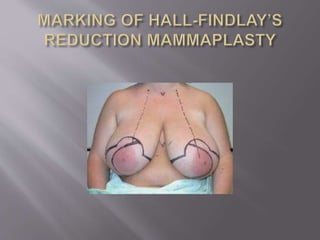
 A.Midline of chest is drawn from suprasternal
notch down onto abdomen.
 B.Second line is drawn from midclavicular
point to nipple.
 C. New nipple position is marked on forward
projection of index finger onto anterior surface
of breast.
 .
 D.Lateral & medial lines are drawn by pushing
breast medially & laterally respectively.
 E.Lower mark ,a curved line is made joining
lower ends of medial& lateral lines between 4-6
cm. from IMF.
 F.Superomedial pedicle is designed with 6-
8cm. base & 1cm.cuff left around areola
A-B& A-C lines represent vertical closure after reduction,length is 5-8cm.,B-C =8cm.
C-D,B-E have lazy s shape
 A.Haematoma:<1% within 12 hrs. of
surgery,unilateral,manifested by pain,swelling
& bruising may lead to tension - induced
ischaemia .Treatment is surgical evacuation &
control of bleeding intercostal perforators.
 B. seroma:1%-5%,aspiration will suffice.
 C.Infection:cellulitis controlled with antibiotics
& abscess formation as a sequelae of infection
within undiagnosed haematoma & fat necrosis
needs open drainage.
 D.Skin necrosis:presents in tension related wise
pattern reduction at the inverted T flap due to
compromise at tip of skin flap.It is virtually
absent in vertical reduction.
 E.Fat necrosis:common in long central or
inferior pedicle in huge breasts.It may mimic
carcinoma & causes pt’s anxiety but
mammography & fnac will make diagnosis.
 F.Nipple loss:associated with smoking.Long
pedicle or thick pedicle folded in vertical
technique causes nipple loss due to inadequate
vascular perfusion.
 G.Nipple numbness:central pedicle preserve
more sensation than upper pole pedicle.
 H.Hypertrophic scars:occurs most medial &
lateral ends of horizontal limbs of wise pattern
technique.Reducing tension,postoperative
taping,silicon application,steroid inj. Maa be
helpful.
 I.Assymetry:what is removed is more
important than what is left in reduction
surgery.Prevention of this complication is
important because reoperation may be
required.
 J.Inadequate or overreduction:problematic for
neophyte than experienced surgeons with
vertical technique.Overresection is risky for
grade III ptosis with empty upper pole.
 K.Boxy breast deformity:presents in inferior
pedicle technique due to inadequate
inferomedial or inferolateral resection.
 L.Inflammatory scarring:visible on
mammography(whorled appearance).
 M.Recurrent enlargement:secondary to massive
weight gain & ongoing virginal
hypertrophy.Reduction should not be done
until breast growth is static for 1yr unless
symptoms are incapacitating or ulcers are
imminent.
 N.Inability to breast feed:breast feeding is
technically possible but succesful feeding is
rarely achieved.
 O.Cancer & breast reduction:reduction does
not cause cancer rather reduces risk due to
volume depletion.
 P.Inadequate mastopexy result:results from
inadequate skin resection to shape the gland or
breast suction.
 Q.Dog ear:occurs in medially & laterally in
wise pattern technique but inferiorly in vertical
technique.Minor adjustment under L.A. may
correct if deformity does not spontaneously
resolve within 6 months of original reduction.
 Reduction mammaplasty is an
establised,highly successful technique reduces
size of large female breast and also
complications associated with it.
 Satisfaction of pt. is high.
 Results are predictable.
 THANK YOU

Breast Reduction Surgery (mammaplasty) in Kolkata | Dr Jayanta Kumar Saha

  • 1.
  • 2.
     Surgical reductionof breast to achieve  A.smaller size,  B.aesthetically shaped breast mound,  C.Relief of symptoms of mammary hypertrophy
  • 3.
     A.Reduction ofgynaecomastia as early as 6th century A.D.  B.Breast amputation mammaplasty by Schaller in 19th century.  C.Dieffenbach performed lower pole reduction in 1848.  D.Reproducible breast reduction technique hails from end of 19th century.
  • 4.
     A.Very largebreast  B.Shoulder pain  C.Cervical and upper thoracic backache  D.Severe embarrassment physically or sexually  E.Recurrent intertigo
  • 5.
     A.Inability toexercise due to breast discomfort  B.Difficulty with breathing during exercise  C.Difficulty finding clothing to fit  E.Grooving and hyperpigmentation of shoulder of shoulder strap areas
  • 6.
     A.Early horizontal&combined scar technique:  Passat procedure  Schwarzmann medial dermoglandular pedicle  Biesenberger technique  B.Wise pattern approaches:  Inferior pedicle technique(Courtiss,Goldwin)  Superior pedicle technique(Pitanguy,Weiner)
  • 7.
     Horizontal bipedicle(strombech) Vertical bipedicle(Mckissock)  Lateral pedicle technique.  Superomedial pedicle technique(Orlando)  Superolateral pedicle technique(Skoog)  Central mound technique(Biesenberger)  Breast amputation & free nipple graft.
  • 8.
     C.Short-scar technique: Lassus –Lejour technique  Hall-Findlay technique  Marchac short scar technique  Regnault B technique  L reduction  Benelli round block technique  Goes periarolar technique  Hammond SPAIR approach  D.Liposuction assisted reduction(Courtiss & matarasso)
  • 9.
     Depends on breast size,  estimated resection vol.  breast shape,  experience of surgeon.
  • 10.
     Breast hypertrophymay be divided into  A.mild(resection <200g.)  B.Moderate(<200-500g.)  C.Severe(500-1500g.)  D.Gigantic(>1500g.)
  • 11.
     A womanwith 34” chest circumference(beneath IMF & under arm) with 36” breast circumference(at nipple level) will have 34B cup bra/34D cup bra for 38” breast circumference.
  • 12.
     Size ofcup bra:  32’’-34” =100 gm.  36”-38”=200 gm.  40”-42”=300 gm.  44”-46”=400 gm.  So 40DD cup bra to 40C size needs resection of 300+300=600gm.of breast on each side.
  • 13.
     A.Nipple lies21cm.from sternal notch & midsternal point.  B.nipple lies 7cm. from IMF.  C.Nipple forms equilateral triangle with other nipple & sternal notch.  D.Pitanguy recommended new nipple level at midhumeral point plus 2/3 cm.  E.Average areolar diameter 38-45 cm.
  • 14.
     A.Vertical scartechnique(Lassus-Lejour,Hall- Findlay).  B.Periareolar technique(Benelli,Goes).
  • 15.
     A.Vertical technique(Lassus-lejour,Hall- Findlay,SPAIR) Wise-pattern technique(Inferior,central pedicle,superomedial pedicle)
  • 16.
     If nippledistance is within 22 cm. from IMF ,Central mound reduction may be tried.  Breast amputation & free nipple graft is meant for gigantomastia.
  • 17.
     It includes A.Superior pedicle  B.Inferior pyramidal glandular resection  C.Closure with vertical scar
  • 18.
     Modification includes A.Skin undermining adjacent to vertical parenchymal pillar edges  B.Suture suspension of the pedicle to pectoralis muscle fascia  C.Total breast liposuction
  • 20.
     A.Midline ofchest is drawn from suprasternal notch down onto abdomen.  B.Second line is drawn from midclavicular point to nipple.  C. New nipple position is marked on forward projection of index finger onto anterior surface of breast.  .
  • 21.
     D.Lateral &medial lines are drawn by pushing breast medially & laterally respectively.  E.Lower mark ,a curved line is made joining lower ends of medial& lateral lines between 4-6 cm. from IMF.  F.Superomedial pedicle is designed with 6- 8cm. base & 1cm.cuff left around areola
  • 23.
    A-B& A-C linesrepresent vertical closure after reduction,length is 5-8cm.,B-C =8cm. C-D,B-E have lazy s shape
  • 29.
     A.Haematoma:<1% within12 hrs. of surgery,unilateral,manifested by pain,swelling & bruising may lead to tension - induced ischaemia .Treatment is surgical evacuation & control of bleeding intercostal perforators.  B. seroma:1%-5%,aspiration will suffice.  C.Infection:cellulitis controlled with antibiotics & abscess formation as a sequelae of infection within undiagnosed haematoma & fat necrosis needs open drainage.
  • 30.
     D.Skin necrosis:presentsin tension related wise pattern reduction at the inverted T flap due to compromise at tip of skin flap.It is virtually absent in vertical reduction.  E.Fat necrosis:common in long central or inferior pedicle in huge breasts.It may mimic carcinoma & causes pt’s anxiety but mammography & fnac will make diagnosis.
  • 31.
     F.Nipple loss:associatedwith smoking.Long pedicle or thick pedicle folded in vertical technique causes nipple loss due to inadequate vascular perfusion.  G.Nipple numbness:central pedicle preserve more sensation than upper pole pedicle.
  • 32.
     H.Hypertrophic scars:occursmost medial & lateral ends of horizontal limbs of wise pattern technique.Reducing tension,postoperative taping,silicon application,steroid inj. Maa be helpful.  I.Assymetry:what is removed is more important than what is left in reduction surgery.Prevention of this complication is important because reoperation may be required.
  • 33.
     J.Inadequate oroverreduction:problematic for neophyte than experienced surgeons with vertical technique.Overresection is risky for grade III ptosis with empty upper pole.  K.Boxy breast deformity:presents in inferior pedicle technique due to inadequate inferomedial or inferolateral resection.
  • 34.
     L.Inflammatory scarring:visibleon mammography(whorled appearance).  M.Recurrent enlargement:secondary to massive weight gain & ongoing virginal hypertrophy.Reduction should not be done until breast growth is static for 1yr unless symptoms are incapacitating or ulcers are imminent.
  • 35.
     N.Inability tobreast feed:breast feeding is technically possible but succesful feeding is rarely achieved.  O.Cancer & breast reduction:reduction does not cause cancer rather reduces risk due to volume depletion.  P.Inadequate mastopexy result:results from inadequate skin resection to shape the gland or breast suction.
  • 36.
     Q.Dog ear:occursin medially & laterally in wise pattern technique but inferiorly in vertical technique.Minor adjustment under L.A. may correct if deformity does not spontaneously resolve within 6 months of original reduction.
  • 37.
     Reduction mammaplastyis an establised,highly successful technique reduces size of large female breast and also complications associated with it.  Satisfaction of pt. is high.  Results are predictable.
  • 38.