




MINIMALLY INVASIVE
SURGERY IN
ONCOLOGY
DR. D. PRADEEP, MCH SURGICAL
ONCOLOGY
TN GOVT MULTI SUPERSPECIALTY
HOSPITAL, CHENNAI. PRESENTED IN
2019
History
 Bozzini and Desormeaux – principle of total
internal reflection in viewing deep seated organs
and genitourinary passages
 Nitze – Cystoscope
 Mikulicz – Gastroscope
 1983 – Lap Appendicectomy by Kurt Semm
 1987 – Lap cholecystectomy by Philip Mouret
Core Principles of MIS
 I – VITROS
 Insufflate/create space
 Visualize – anatomical landmarks, tissues
 Identify – specific structures for surgery
 Triangulate
 Retract
 Operate
 Seal/hemostasis
Pros and Cons
Lap vs Robotic
Laparoscopic Surgical Staging in
Endometrial Cancer
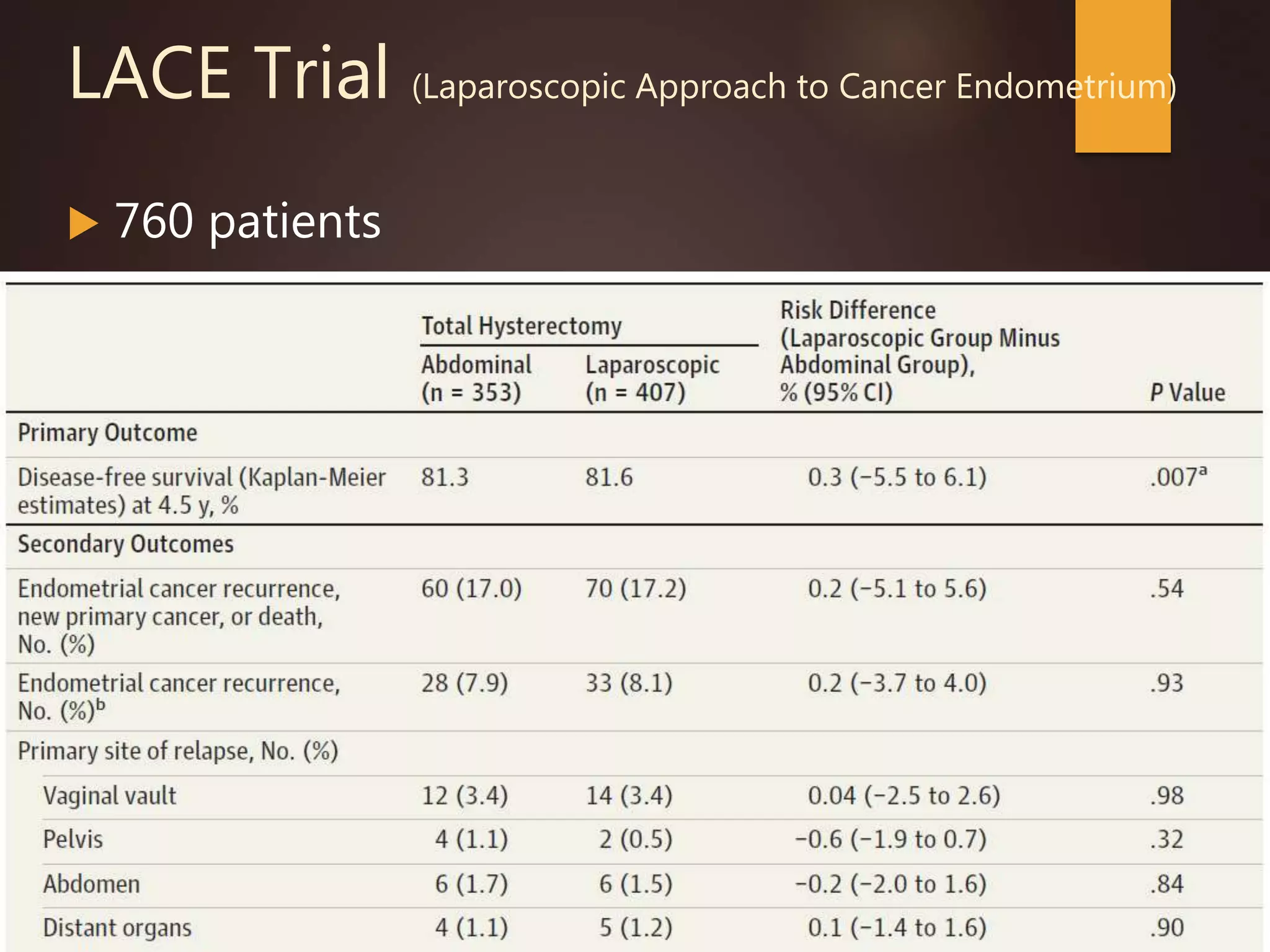
LACE Trial (Laparoscopic Approach to Cancer Endometrium)
 760 patients
Results
 Equivalent DFS at 4.5 years 81.3% TAH vs 81.6%
TLH
 Overall SR at 4.5 years 92.4% TAH vs 92.0% TLH
 Improved Quality of Life Outcome
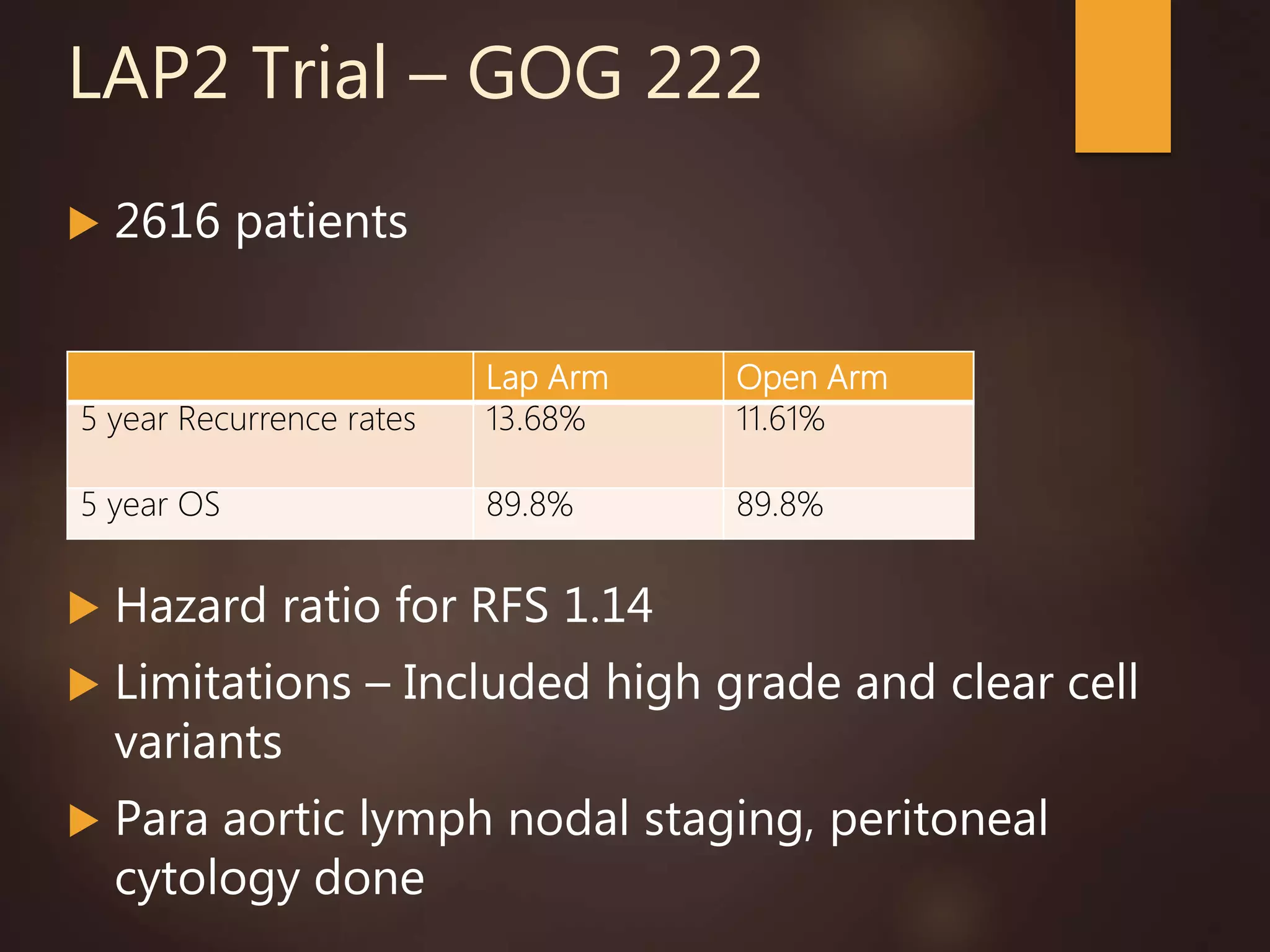
LAP2 Trial – GOG 222
 2616 patients
 Hazard ratio for RFS 1.14
 Limitations – Included high grade and clear cell
variants
 Para aortic lymph nodal staging, peritoneal
cytology done
Lap Arm Open Arm
5 year Recurrence rates 13.68% 11.61%
5 year OS 89.8% 89.8%
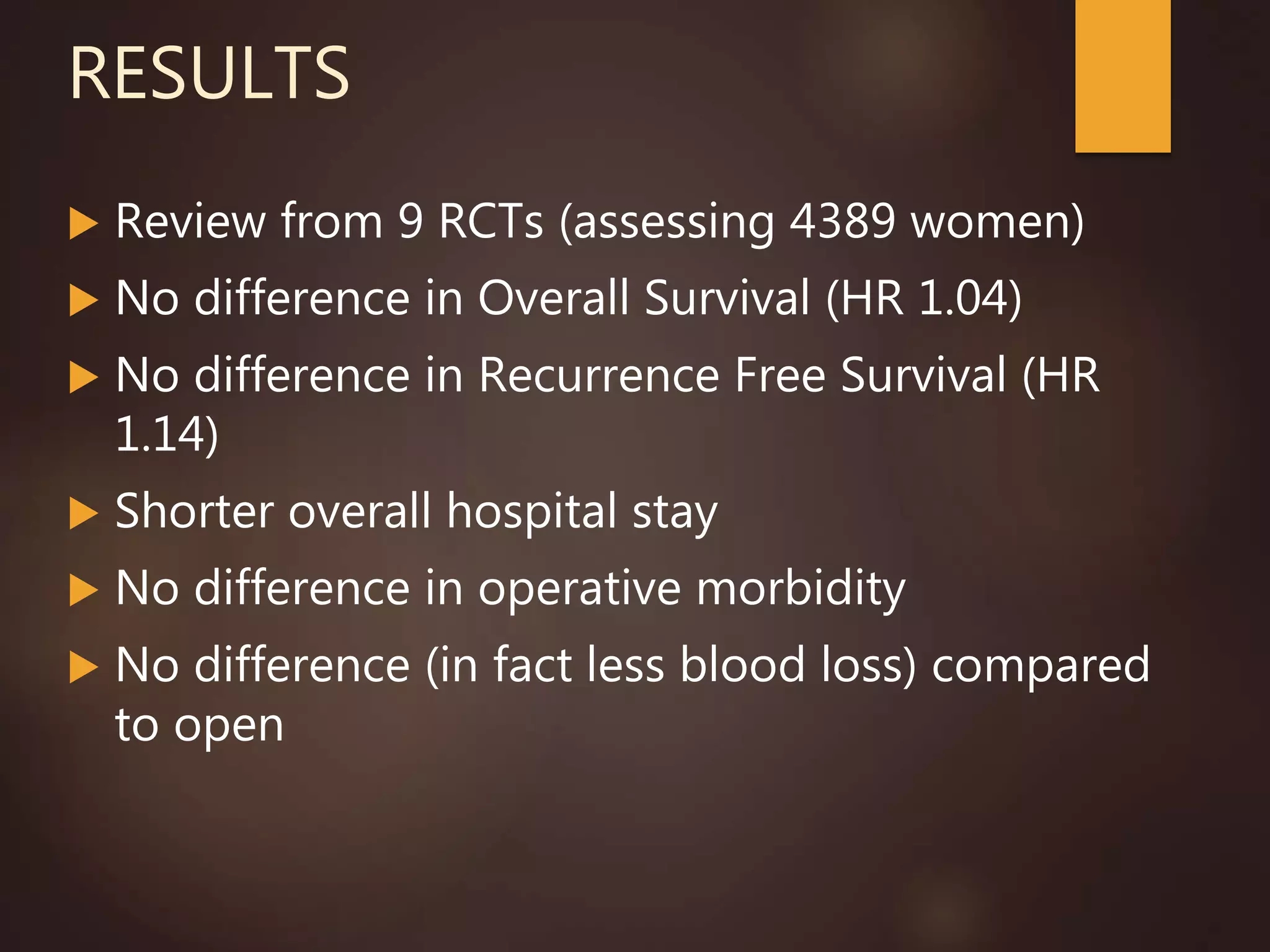
RESULTS
 Review from 9 RCTs (assessing 4389 women)
 No difference in Overall Survival (HR 1.04)
 No difference in Recurrence Free Survival (HR
1.14)
 Shorter overall hospital stay
 No difference in operative morbidity
 No difference (in fact less blood loss) compared
to open
Laparoscopic Radical Hysterectomy
In Early Cancer Cervix
Systematic Reviews
 Wang et al – 12 Studies
 No significant differences in 5 year OS and DFS in
both arms
 Operative morbidity, lymph node yield, positive
surgical margins are similar
 Less blood loss, quicker return to normalcy,
shorter hospital stay are advantages
 With compromise in longer operating times
LACC Trial (Laparoscopic Approach to Cervical Cancer)
 IA1, IA2 to IB1 cervical cancers
Minimally Invasive
RH
Abdominal RH
No of patients 319 312
DFS at 4.5
years
86% 96.5%
3 year OS 93.8% 99.0%
Laparoscopic Rectal Resection
In Rectal Cancers
COLOR II Trial
 COlorectal cancer Laparoscopic or Open
Resection
 T3 and T4 rectal lesions excluded
 Any site in rectum included, both post
Neoadjuvant and Upfront surgeries included
@ 3 Years Lap RR Open RR
Patients 699 345
Local Recurrence 5% 5%
DFS 74.8% 70.8%
Overall Survival 86.7% 83.6%
Involved CRM 10% 10%
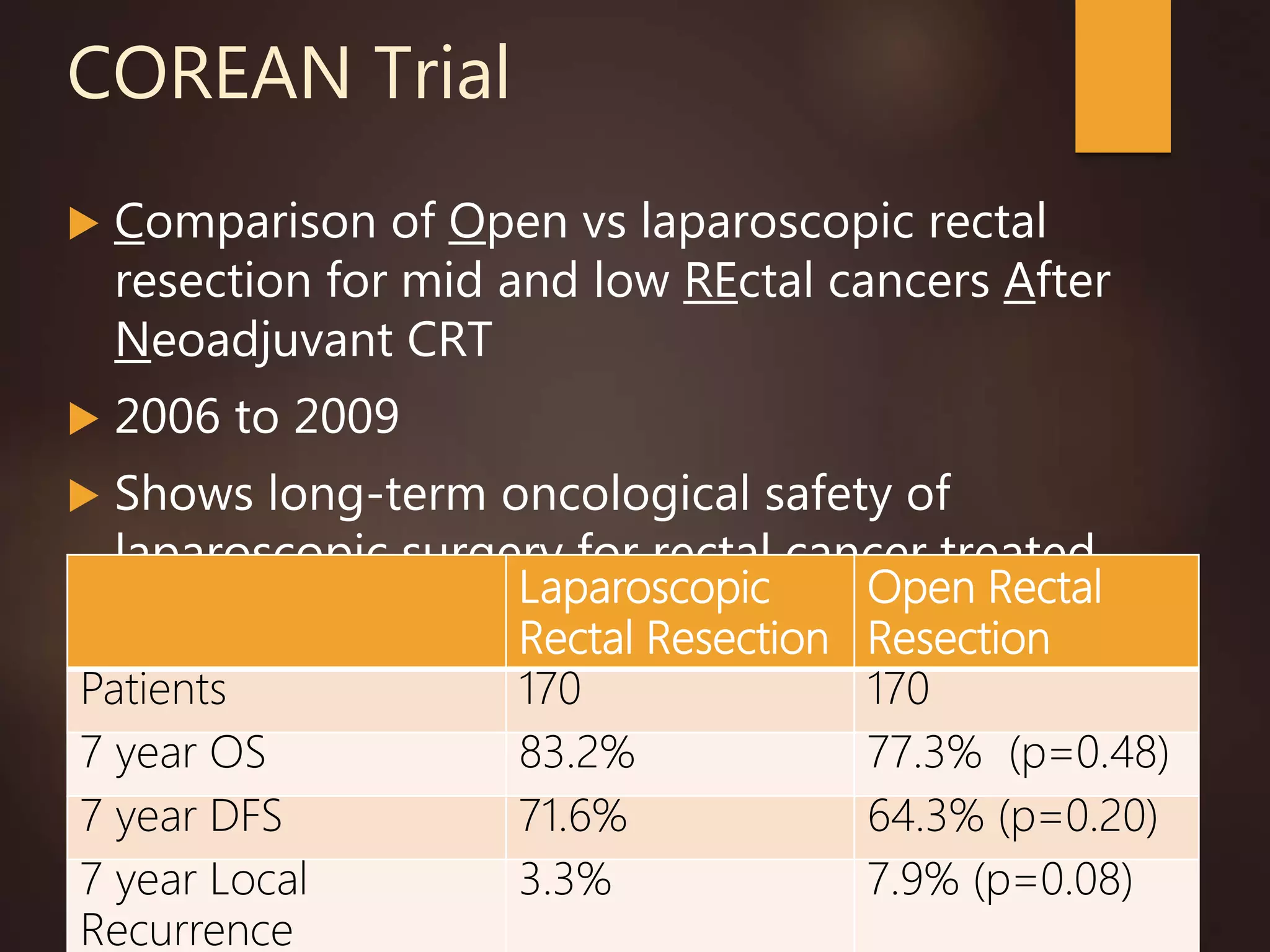
COREAN Trial
 Comparison of Open vs laparoscopic rectal
resection for mid and low REctal cancers After
Neoadjuvant CRT
 2006 to 2009
 Shows long-term oncological safety of
laparoscopic surgery for rectal cancer treated
with NACRT
Laparoscopic
Rectal Resection
Open Rectal
Resection
Patients 170 170
7 year OS 83.2% 77.3% (p=0.48)
7 year DFS 71.6% 64.3% (p=0.20)
7 year Local
Recurrence
3.3% 7.9% (p=0.08)
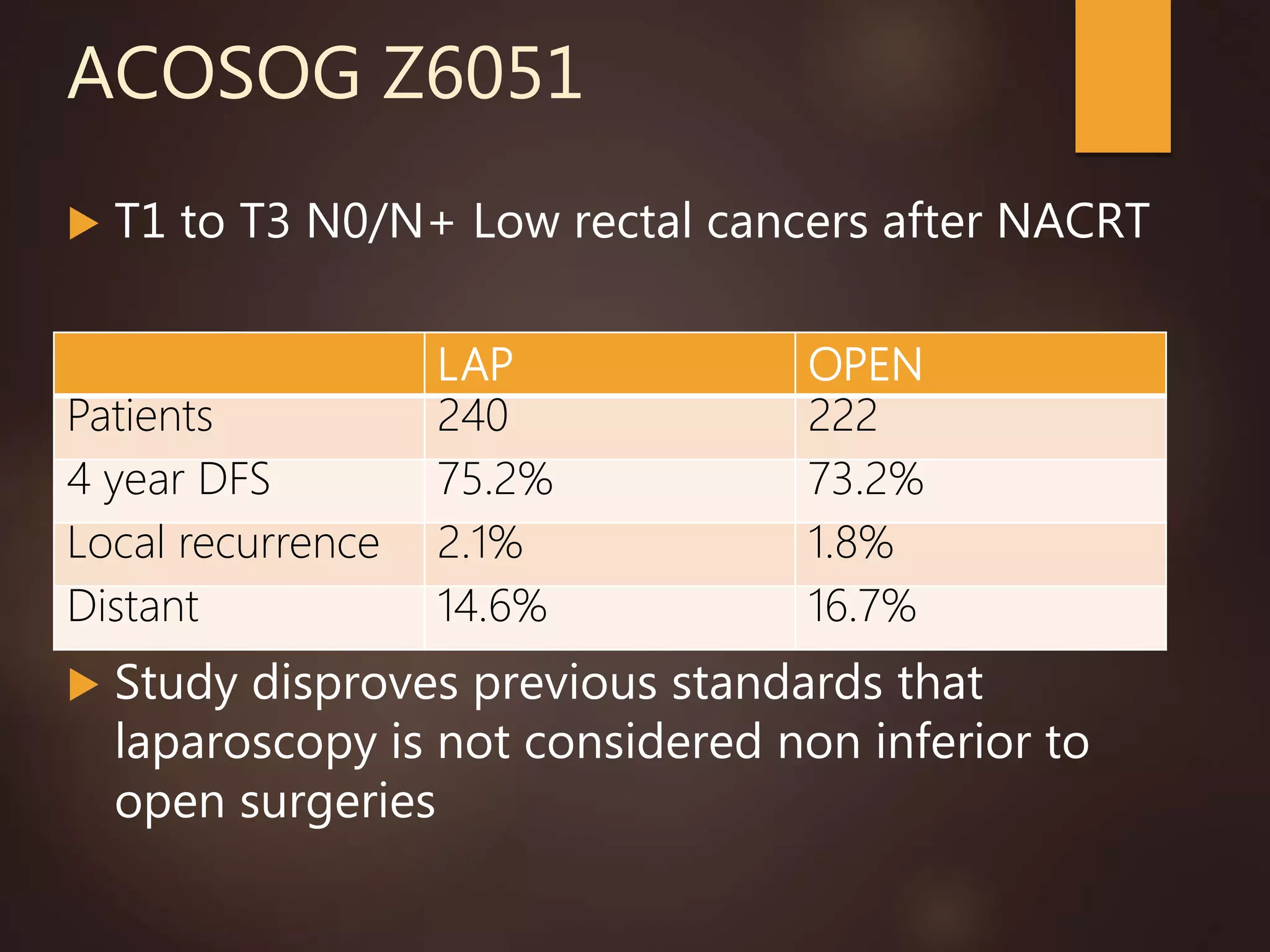
ACOSOG Z6051
 T1 to T3 N0/N+ Low rectal cancers after NACRT
 Study disproves previous standards that
laparoscopy is not considered non inferior to
open surgeries
LAP OPEN
Patients 240 222
4 year DFS 75.2% 73.2%
Local recurrence 2.1% 1.8%
Distant 14.6% 16.7%
ALaCaRT Trial
 Australasian Laparoscopic Cancer of Rectum Trial
 T1 to T3 Low rectal cancers to ensure oncological
adequacy of Lap assisted APR vs Open APR
Lap APR Open APR
Patients 238 237
Successful resection 82% 89% p=0.38
Clear CRM 93% 97% p=0.06
Complete TME 87% 92% p=0.06
Clear Distal margin 99% 99% p=0.67
CLASSIC Trial
 >15 years follow up
 Long-term results continue to support the use of
laparoscopic surgery for both colonic and rectal
cancer.
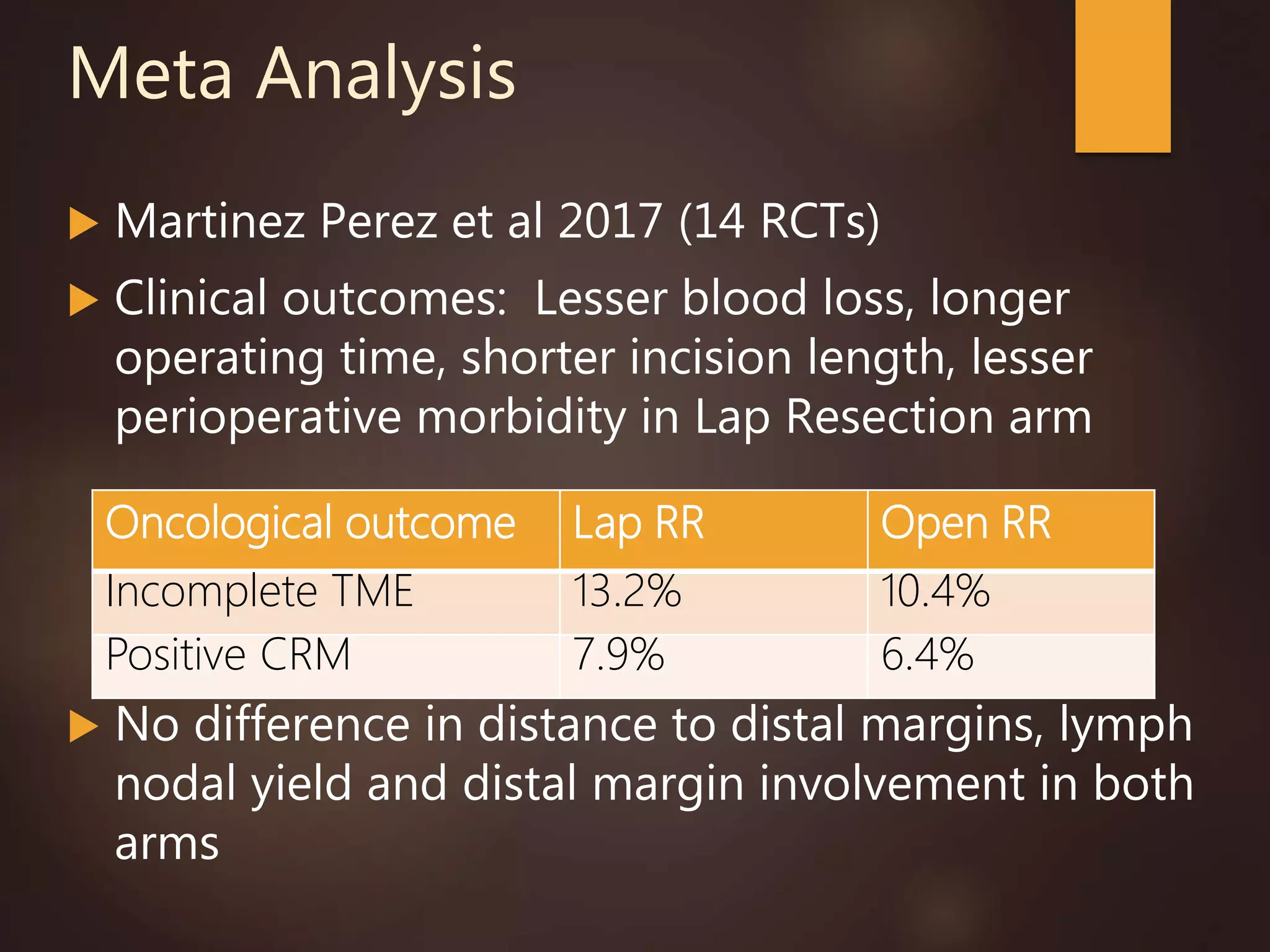
Meta Analysis
 Martinez Perez et al 2017 (14 RCTs)
 Clinical outcomes: Lesser blood loss, longer
operating time, shorter incision length, lesser
perioperative morbidity in Lap Resection arm
 No difference in distance to distal margins, lymph
nodal yield and distal margin involvement in both
arms
Oncological outcome Lap RR Open RR
Incomplete TME 13.2% 10.4%
Positive CRM 7.9% 6.4%
Hybrid Minimally Invasive Esophagectomy
In Esophageal Cancers
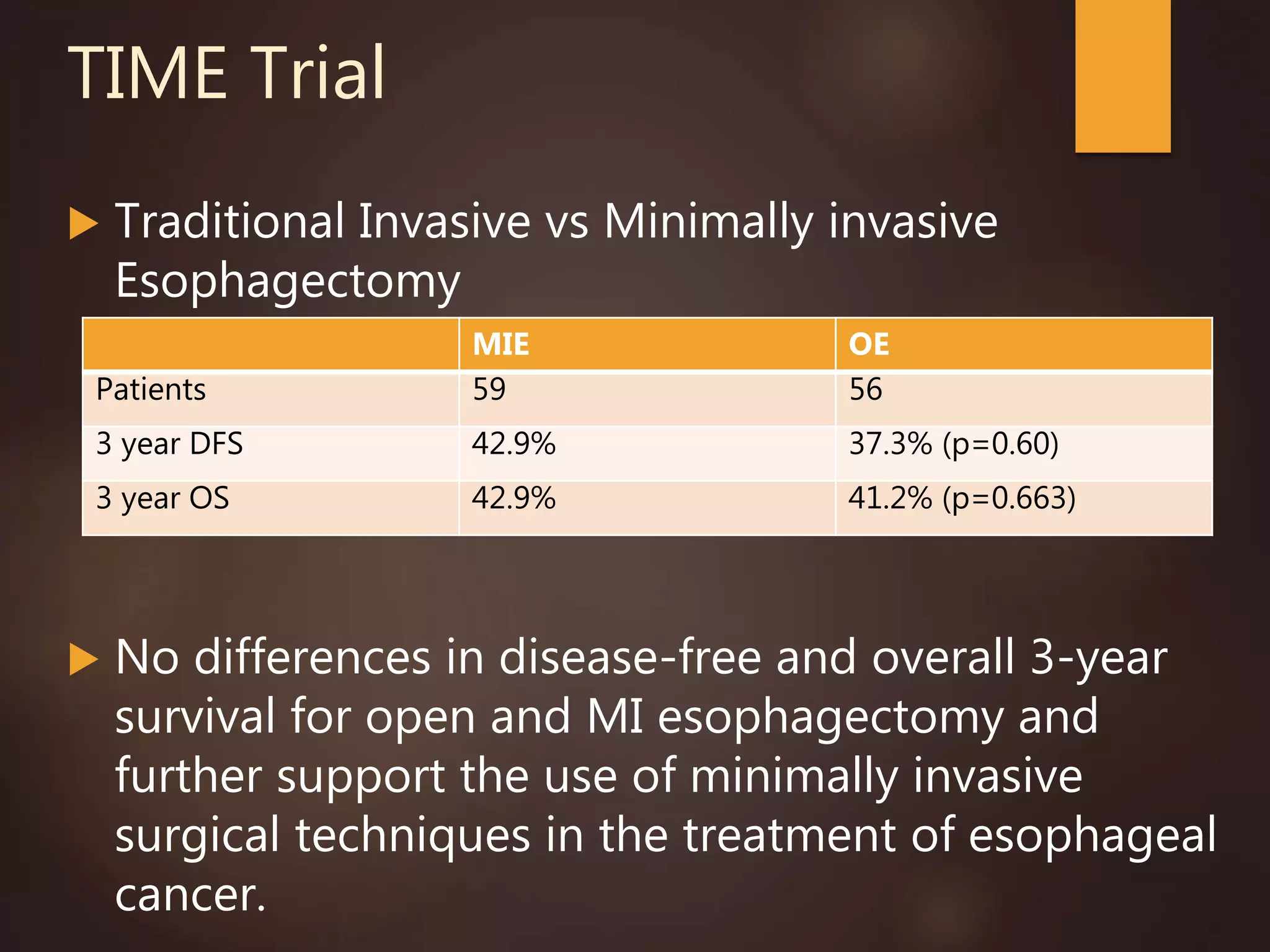
TIME Trial
 Traditional Invasive vs Minimally invasive
Esophagectomy
 No differences in disease-free and overall 3-year
survival for open and MI esophagectomy and
further support the use of minimally invasive
surgical techniques in the treatment of esophageal
cancer.
MIE OE
Patients 59 56
3 year DFS 42.9% 37.3% (p=0.60)
3 year OS 42.9% 41.2% (p=0.663)
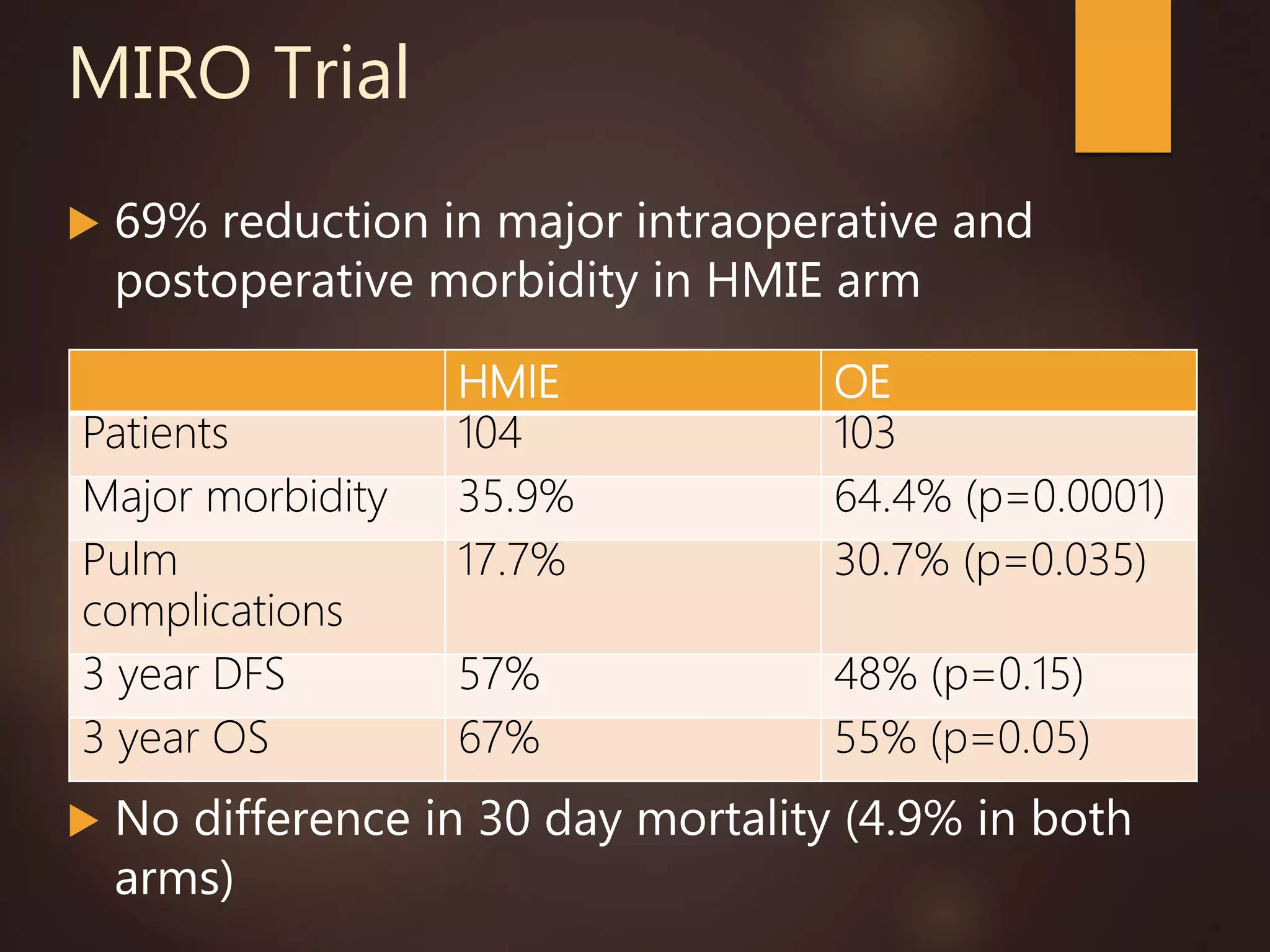
MIRO Trial
 69% reduction in major intraoperative and
postoperative morbidity in HMIE arm
 No difference in 30 day mortality (4.9% in both
arms)
HMIE OE
Patients 104 103
Major morbidity 35.9% 64.4% (p=0.0001)
Pulm
complications
17.7% 30.7% (p=0.035)
3 year DFS 57% 48% (p=0.15)
3 year OS 67% 55% (p=0.05)
Laparoscopic Radical Nephrectomy
In Renal cell carcinomas
Meta Analysis
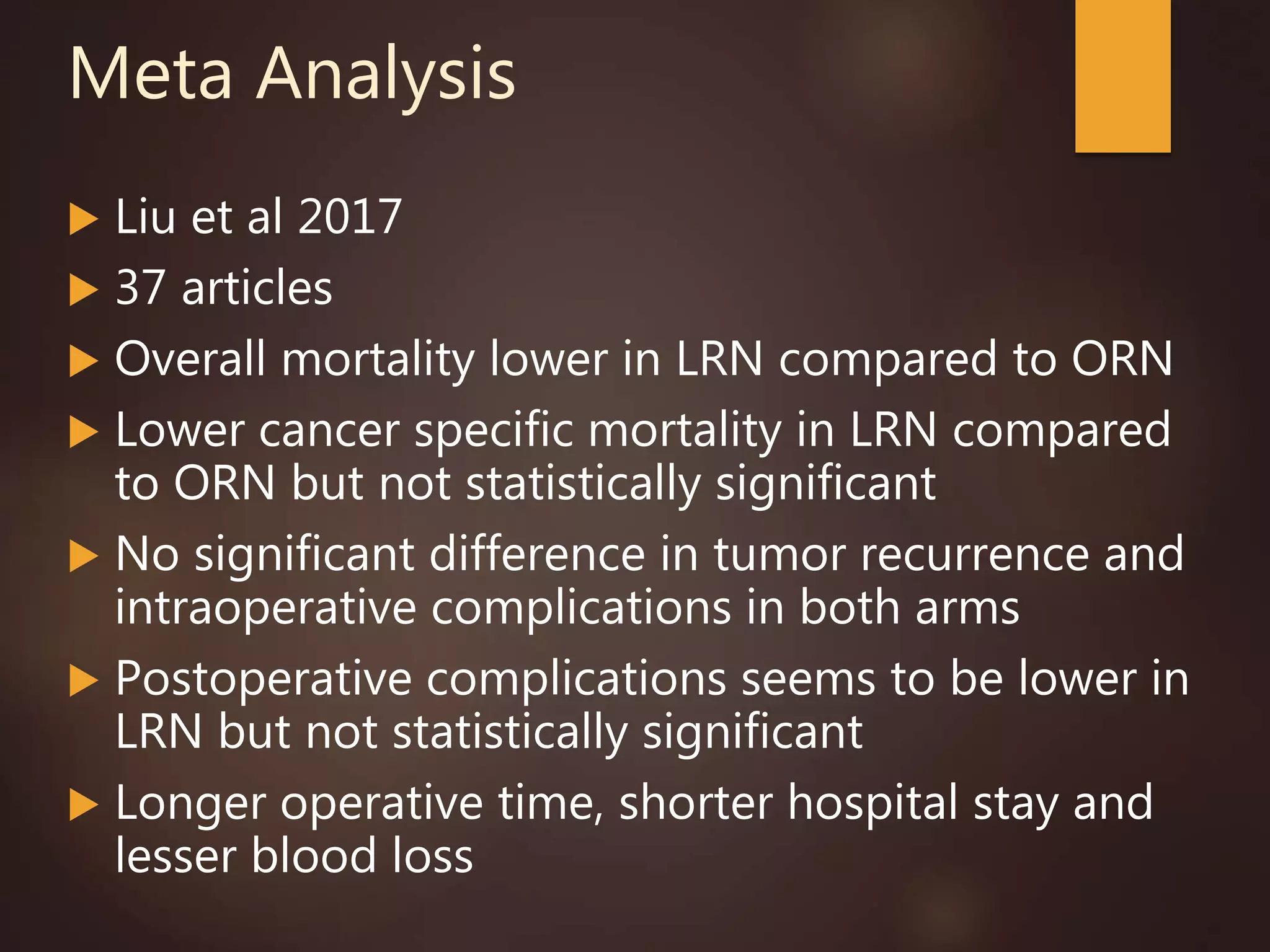
 Liu et al 2017
 37 articles
 Overall mortality lower in LRN compared to ORN
 Lower cancer specific mortality in LRN compared
to ORN but not statistically significant
 No significant difference in tumor recurrence and
intraoperative complications in both arms
 Postoperative complications seems to be lower in
LRN but not statistically significant
 Longer operative time, shorter hospital stay and
lesser blood loss
Thank You

Minimal Invasive Surgery in Oncology

  • 1.
    MINIMALLY INVASIVE SURGERY IN ONCOLOGY DR.D. PRADEEP, MCH SURGICAL ONCOLOGY TN GOVT MULTI SUPERSPECIALTY HOSPITAL, CHENNAI. PRESENTED IN 2019
  • 2.
    History  Bozzini andDesormeaux – principle of total internal reflection in viewing deep seated organs and genitourinary passages  Nitze – Cystoscope  Mikulicz – Gastroscope  1983 – Lap Appendicectomy by Kurt Semm  1987 – Lap cholecystectomy by Philip Mouret
  • 3.
    Core Principles ofMIS  I – VITROS  Insufflate/create space  Visualize – anatomical landmarks, tissues  Identify – specific structures for surgery  Triangulate  Retract  Operate  Seal/hemostasis
  • 4.
  • 5.
  • 6.
    Laparoscopic Surgical Stagingin Endometrial Cancer
  • 7.
    LACE Trial (LaparoscopicApproach to Cancer Endometrium)  760 patients
  • 8.
    Results  Equivalent DFSat 4.5 years 81.3% TAH vs 81.6% TLH  Overall SR at 4.5 years 92.4% TAH vs 92.0% TLH  Improved Quality of Life Outcome
  • 9.
    LAP2 Trial –GOG 222  2616 patients  Hazard ratio for RFS 1.14  Limitations – Included high grade and clear cell variants  Para aortic lymph nodal staging, peritoneal cytology done Lap Arm Open Arm 5 year Recurrence rates 13.68% 11.61% 5 year OS 89.8% 89.8%
  • 11.
    RESULTS  Review from9 RCTs (assessing 4389 women)  No difference in Overall Survival (HR 1.04)  No difference in Recurrence Free Survival (HR 1.14)  Shorter overall hospital stay  No difference in operative morbidity  No difference (in fact less blood loss) compared to open
  • 12.
  • 13.
    Systematic Reviews  Wanget al – 12 Studies  No significant differences in 5 year OS and DFS in both arms  Operative morbidity, lymph node yield, positive surgical margins are similar  Less blood loss, quicker return to normalcy, shorter hospital stay are advantages  With compromise in longer operating times
  • 14.
    LACC Trial (LaparoscopicApproach to Cervical Cancer)  IA1, IA2 to IB1 cervical cancers Minimally Invasive RH Abdominal RH No of patients 319 312 DFS at 4.5 years 86% 96.5% 3 year OS 93.8% 99.0%
  • 15.
  • 16.
    COLOR II Trial COlorectal cancer Laparoscopic or Open Resection  T3 and T4 rectal lesions excluded  Any site in rectum included, both post Neoadjuvant and Upfront surgeries included @ 3 Years Lap RR Open RR Patients 699 345 Local Recurrence 5% 5% DFS 74.8% 70.8% Overall Survival 86.7% 83.6% Involved CRM 10% 10%
  • 17.
    COREAN Trial  Comparisonof Open vs laparoscopic rectal resection for mid and low REctal cancers After Neoadjuvant CRT  2006 to 2009  Shows long-term oncological safety of laparoscopic surgery for rectal cancer treated with NACRT Laparoscopic Rectal Resection Open Rectal Resection Patients 170 170 7 year OS 83.2% 77.3% (p=0.48) 7 year DFS 71.6% 64.3% (p=0.20) 7 year Local Recurrence 3.3% 7.9% (p=0.08)
  • 18.
    ACOSOG Z6051  T1to T3 N0/N+ Low rectal cancers after NACRT  Study disproves previous standards that laparoscopy is not considered non inferior to open surgeries LAP OPEN Patients 240 222 4 year DFS 75.2% 73.2% Local recurrence 2.1% 1.8% Distant 14.6% 16.7%
  • 19.
    ALaCaRT Trial  AustralasianLaparoscopic Cancer of Rectum Trial  T1 to T3 Low rectal cancers to ensure oncological adequacy of Lap assisted APR vs Open APR Lap APR Open APR Patients 238 237 Successful resection 82% 89% p=0.38 Clear CRM 93% 97% p=0.06 Complete TME 87% 92% p=0.06 Clear Distal margin 99% 99% p=0.67
  • 20.
    CLASSIC Trial  >15years follow up  Long-term results continue to support the use of laparoscopic surgery for both colonic and rectal cancer.
  • 21.
    Meta Analysis  MartinezPerez et al 2017 (14 RCTs)  Clinical outcomes: Lesser blood loss, longer operating time, shorter incision length, lesser perioperative morbidity in Lap Resection arm  No difference in distance to distal margins, lymph nodal yield and distal margin involvement in both arms Oncological outcome Lap RR Open RR Incomplete TME 13.2% 10.4% Positive CRM 7.9% 6.4%
  • 22.
    Hybrid Minimally InvasiveEsophagectomy In Esophageal Cancers
  • 23.
    TIME Trial  TraditionalInvasive vs Minimally invasive Esophagectomy  No differences in disease-free and overall 3-year survival for open and MI esophagectomy and further support the use of minimally invasive surgical techniques in the treatment of esophageal cancer. MIE OE Patients 59 56 3 year DFS 42.9% 37.3% (p=0.60) 3 year OS 42.9% 41.2% (p=0.663)
  • 24.
    MIRO Trial  69%reduction in major intraoperative and postoperative morbidity in HMIE arm  No difference in 30 day mortality (4.9% in both arms) HMIE OE Patients 104 103 Major morbidity 35.9% 64.4% (p=0.0001) Pulm complications 17.7% 30.7% (p=0.035) 3 year DFS 57% 48% (p=0.15) 3 year OS 67% 55% (p=0.05)
  • 25.
  • 26.
    Meta Analysis  Liuet al 2017  37 articles  Overall mortality lower in LRN compared to ORN  Lower cancer specific mortality in LRN compared to ORN but not statistically significant  No significant difference in tumor recurrence and intraoperative complications in both arms  Postoperative complications seems to be lower in LRN but not statistically significant  Longer operative time, shorter hospital stay and lesser blood loss
  • 27.