GONDWANA UNIVERCITY GADCHIROLI
BRAMHAPURI – 441206 DIST CHANDRAPUR
DEPARTMENT OF CHEMISTRY
SEMINAR TOPIC
HYBRIDIZATION
PRESENTED BY : TARKESH D. DIWATE
M.Sc. 1st YEAR (CHEMISTRY) 2nd SEMISTER
HEAD OF THE DEPARTMENT : Asst. Prof. Y.P. THAWARI SIR
CONTENT
 Introduction
 Properties of hybrid orbital
 Shape of atomic orbital (s , p , d-orbital )
 Important points
 Types of hybridisation
 Sp hybridisation
 Sp2 hybridisation
 Reference
Introduction
 Mixing of dissimilar orbital of similar energies to form
new orbital is known as hybridization. And new
orbital formed are called hybrid orbital.
 Hybrid orbital are very useful in the explanation of
molecular geometry and atomic bonding properties.
Properties of hybrid orbital
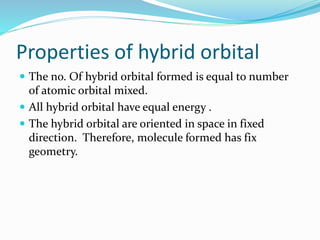
 The no. Of hybrid orbital formed is equal to number
of atomic orbital mixed.
 All hybrid orbital have equal energy .
 The hybrid orbital are oriented in space in fixed
direction. Therefore, molecule formed has fix
geometry.
Shape of atomic orbital
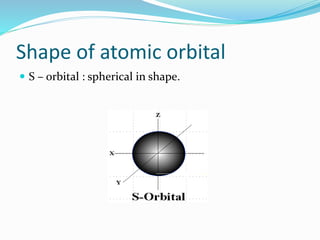
 S – orbital : spherical in shape.
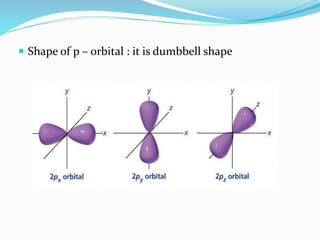
 Shape of p – orbital : it is dumbbell shape
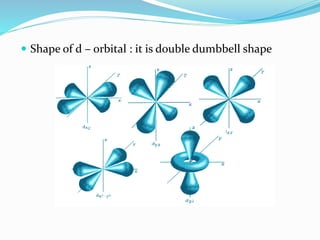
 Shape of d – orbital : it is double dumbbell shape
Important points to study the
hybridisation
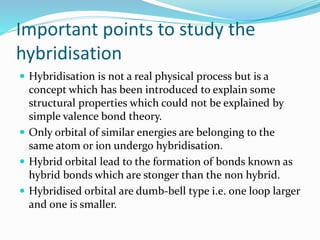
 Hybridisation is not a real physical process but is a
concept which has been introduced to explain some
structural properties which could not be explained by
simple valence bond theory.
 Only orbital of similar energies are belonging to the
same atom or ion undergo hybridisation.
 Hybrid orbital lead to the formation of bonds known as
hybrid bonds which are stonger than the non hybrid.
 Hybridised orbital are dumb-bell type i.e. one loop larger
and one is smaller.
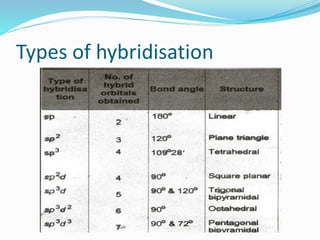
Types of hybridisation
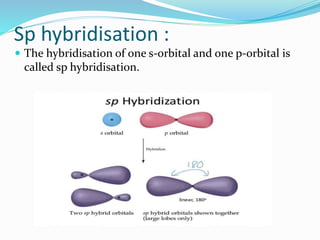
Sp hybridisation :
 The hybridisation of one s-orbital and one p-orbital is
called sp hybridisation.
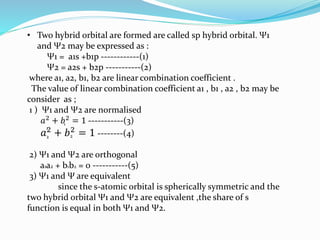
• Two hybrid orbital are formed are called sp hybrid orbital. Ψ1
and Ψ2 may be expressed as :
Ψ1 = a1s +b1p ------------(1)
Ψ2 = a2s + b2p -----------(2)
where a1, a2, b1, b2 are linear combination coefficient .
The value of linear combination coefficient a1 , b1 , a2 , b2 may be
consider as ;
1 ) Ψ1 and Ψ2 are normalised
𝑎2 + 𝑏2 = 1 -----------(3)
𝑎2 + 𝑏2 = 1 --------(4)
2) Ψ1 and Ψ2 are orthogonal
a1a2 + b1b2 = 0 -----------(5)
3) Ψ1 and Ψ are equivalent
since the s-atomic orbital is spherically symmetric and the
two hybrid orbital Ψ1 and Ψ2 are equivalent ,the share of s
function is equal in both Ψ1 and Ψ2.
1
1
2 2
therefore , 𝑎2
+ 𝑎2
= 1
But , 𝑎2
= 𝑎2
= 𝑎2
=> 2 𝑎2
= 1
𝑎2
= ½
a =
1
2
a1 = a2 = =
1
2
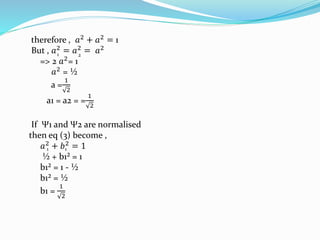
If Ψ1 and Ψ2 are normalised
then eq (3) become ,
𝑎2 + 𝑏2 = 1
½ + b1² = 1
b1² = 1 - ½
b1² = ½
b1 =
1
2
1 2
1 1
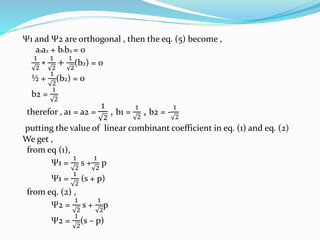
Ψ1 and Ψ2 are orthogonal , then the eq. (5) become ,
a1a2 + b1b2 = 0
1
2
∗
1
2
+
1
2
(b2) = 0
½ +
1
2
(b2) = 0
b2 =
1
2
therefor , a1 = a2 =
1
2
, b1 =
1
2
, b2 = -
1
2
putting the value of linear combinant coefficient in eq. (1) and eq. (2)
We get ,
from eq (1),
Ψ1 =
1
2
s +
1
2
p
Ψ1 =
1
2
(s + p)
from eq. (2) ,
Ψ2 =
1
2
s +
1
2
p
Ψ2 =
1
2
(s – p)
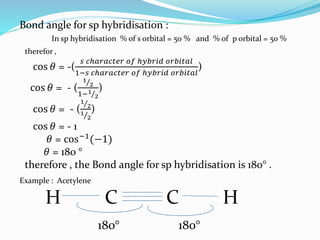
Bond angle for sp hybridisation :
In sp hybridisation % of s orbital = 50 % and % of p orbital = 50 %
therefor ,
cos 𝜃 = -(
𝑠 𝑐ℎ𝑎𝑟𝑎𝑐𝑡𝑒𝑟 𝑜𝑓 ℎ𝑦𝑏𝑟𝑖𝑑 𝑜𝑟𝑏𝑖𝑡𝑎𝑙
1−𝑠 𝑐ℎ𝑎𝑟𝑎𝑐𝑡𝑒𝑟 𝑜𝑓 ℎ𝑦𝑏𝑟𝑖𝑑 𝑜𝑟𝑏𝑖𝑡𝑎𝑙
)
cos 𝜃 = - (
1
2
1−1
2
)
cos 𝜃 = - (
1
2
1
2
)
cos 𝜃 = - 1
𝜃 = cos−1
(−1)
𝜃 = 180 °
therefore , the Bond angle for sp hybridisation is 180° .
Example : Acetylene
H C C H
180° 180°
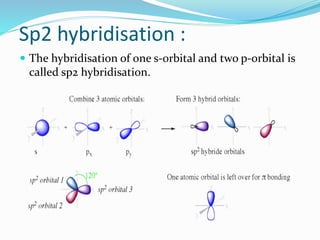
Sp2 hybridisation :
 The hybridisation of one s-orbital and two p-orbital is
called sp2 hybridisation.
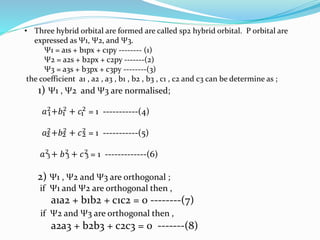
• Three hybrid orbital are formed are called sp2 hybrid orbital. P orbital are
expressed as Ψ1, Ψ2, and Ψ3.
Ψ1 = a1s + b1px + c1py -------- (1)
Ψ2 = a2s + b2px + c2py -------(2)
Ψ3 = a3s + b3px + c3py --------(3)
the coefficient a1 , a2 , a3 , b1 , b2 , b3 , c1 , c2 and c3 can be determine as ;
1) Ψ1 , Ψ2 and Ψ3 are normalised;
𝑎2+𝑏2 + 𝑐2 = 1 -----------(4)
𝑎2+𝑏2 + 𝑐2 = 1 -----------(5)
𝑎2
+ 𝑏2
+ 𝑐2
= 1 -------------(6)
2) Ψ1 , Ψ2 and Ψ3 are orthogonal ;
if Ψ1 and Ψ2 are orthogonal then ,
a1a2 + b1b2 + c1c2 = 0 --------(7)
if Ψ2 and Ψ3 are orthogonal then ,
a2a3 + b2b3 + c2c3 = 0 -------(8)
1 1 1
2 2 2
3 3 3
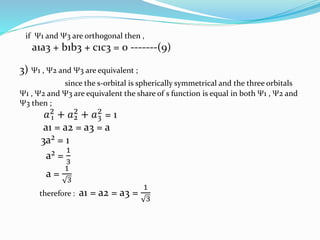
if Ψ1 and Ψ3 are orthogonal then ,
a1a3 + b1b3 + c1c3 = 0 -------(9)
3) Ψ1 , Ψ2 and Ψ3 are equivalent ;
since the s-orbital is spherically symmetrical and the three orbitals
Ψ1 , Ψ2 and Ψ3 are equivalent the share of s function is equal in both Ψ1 , Ψ2 and
Ψ3 then ;
𝑎2
+ 𝑎2
+ 𝑎2
= 1
a1 = a2 = a3 = a
3a² = 1
a² =
1
3
a =
1
3
therefore : a1 = a2 = a3 =
1
3
1 2 3
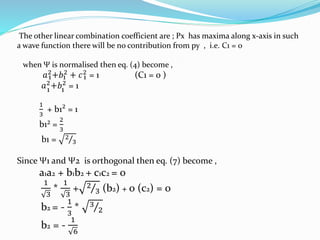
The other linear combination coefficient are ; Px has maxima along x-axis in such
a wave function there will be no contribution from py , i.e. C1 = 0
when Ψ is normalised then eq. (4) become ,
𝑎2
+𝑏2
+ 𝑐2
= 1 (C1 = 0 )
𝑎2
+𝑏2
= 1
1
3
+ b1² = 1
b1² =
2
3
b1 = 2
3
Since Ψ1 and Ψ2 is orthogonal then eq. (7) become ,
a1a2 + b1b2 + c1c2 = 0
1
3
*
1
3
+ 2
3 (b2) + 0 (c2) = 0
b2 = -
1
3
* 3
2
b2 = -
1
6
1 1 1
1 1
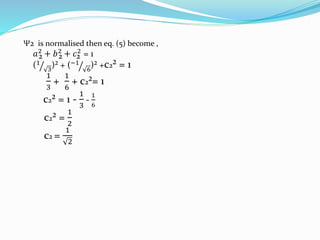
Ψ2 is normalised then eq. (5) become ,
𝑎2 + 𝑏2 + 𝑐2 = 1
(1
3
)² + (−1
6
)² +c2² = 1
1
3
+
1
6
+ c2²= 1
c2² = 1 -
1
3
-
1
6
c2² =
1
2
c2 =
1
2
2 2 2
REFRENCE
1. Principle of physical chemistry :
B.R.PURI , M.S.PATHANIA , L.R SHARMA.
2. Physical chemistry : Atkins.
3. Wikkipidia .
Tarkesh 2nd sem[1]

Tarkesh 2nd sem[1]

  • 1.
    GONDWANA UNIVERCITY GADCHIROLI BRAMHAPURI– 441206 DIST CHANDRAPUR DEPARTMENT OF CHEMISTRY SEMINAR TOPIC HYBRIDIZATION PRESENTED BY : TARKESH D. DIWATE M.Sc. 1st YEAR (CHEMISTRY) 2nd SEMISTER HEAD OF THE DEPARTMENT : Asst. Prof. Y.P. THAWARI SIR
  • 2.
    CONTENT  Introduction  Propertiesof hybrid orbital  Shape of atomic orbital (s , p , d-orbital )  Important points  Types of hybridisation  Sp hybridisation  Sp2 hybridisation  Reference
  • 3.
    Introduction  Mixing ofdissimilar orbital of similar energies to form new orbital is known as hybridization. And new orbital formed are called hybrid orbital.  Hybrid orbital are very useful in the explanation of molecular geometry and atomic bonding properties.
  • 4.
    Properties of hybridorbital  The no. Of hybrid orbital formed is equal to number of atomic orbital mixed.  All hybrid orbital have equal energy .  The hybrid orbital are oriented in space in fixed direction. Therefore, molecule formed has fix geometry.
  • 5.
    Shape of atomicorbital  S – orbital : spherical in shape.
  • 6.
     Shape ofp – orbital : it is dumbbell shape
  • 7.
     Shape ofd – orbital : it is double dumbbell shape
  • 8.
    Important points tostudy the hybridisation  Hybridisation is not a real physical process but is a concept which has been introduced to explain some structural properties which could not be explained by simple valence bond theory.  Only orbital of similar energies are belonging to the same atom or ion undergo hybridisation.  Hybrid orbital lead to the formation of bonds known as hybrid bonds which are stonger than the non hybrid.  Hybridised orbital are dumb-bell type i.e. one loop larger and one is smaller.
  • 9.
  • 10.
    Sp hybridisation : The hybridisation of one s-orbital and one p-orbital is called sp hybridisation.
  • 11.
    • Two hybridorbital are formed are called sp hybrid orbital. Ψ1 and Ψ2 may be expressed as : Ψ1 = a1s +b1p ------------(1) Ψ2 = a2s + b2p -----------(2) where a1, a2, b1, b2 are linear combination coefficient . The value of linear combination coefficient a1 , b1 , a2 , b2 may be consider as ; 1 ) Ψ1 and Ψ2 are normalised 𝑎2 + 𝑏2 = 1 -----------(3) 𝑎2 + 𝑏2 = 1 --------(4) 2) Ψ1 and Ψ2 are orthogonal a1a2 + b1b2 = 0 -----------(5) 3) Ψ1 and Ψ are equivalent since the s-atomic orbital is spherically symmetric and the two hybrid orbital Ψ1 and Ψ2 are equivalent ,the share of s function is equal in both Ψ1 and Ψ2. 1 1 2 2
  • 12.
    therefore , 𝑎2 +𝑎2 = 1 But , 𝑎2 = 𝑎2 = 𝑎2 => 2 𝑎2 = 1 𝑎2 = ½ a = 1 2 a1 = a2 = = 1 2 If Ψ1 and Ψ2 are normalised then eq (3) become , 𝑎2 + 𝑏2 = 1 ½ + b1² = 1 b1² = 1 - ½ b1² = ½ b1 = 1 2 1 2 1 1
  • 13.
    Ψ1 and Ψ2are orthogonal , then the eq. (5) become , a1a2 + b1b2 = 0 1 2 ∗ 1 2 + 1 2 (b2) = 0 ½ + 1 2 (b2) = 0 b2 = 1 2 therefor , a1 = a2 = 1 2 , b1 = 1 2 , b2 = - 1 2 putting the value of linear combinant coefficient in eq. (1) and eq. (2) We get , from eq (1), Ψ1 = 1 2 s + 1 2 p Ψ1 = 1 2 (s + p) from eq. (2) , Ψ2 = 1 2 s + 1 2 p Ψ2 = 1 2 (s – p)
  • 14.
    Bond angle forsp hybridisation : In sp hybridisation % of s orbital = 50 % and % of p orbital = 50 % therefor , cos 𝜃 = -( 𝑠 𝑐ℎ𝑎𝑟𝑎𝑐𝑡𝑒𝑟 𝑜𝑓 ℎ𝑦𝑏𝑟𝑖𝑑 𝑜𝑟𝑏𝑖𝑡𝑎𝑙 1−𝑠 𝑐ℎ𝑎𝑟𝑎𝑐𝑡𝑒𝑟 𝑜𝑓 ℎ𝑦𝑏𝑟𝑖𝑑 𝑜𝑟𝑏𝑖𝑡𝑎𝑙 ) cos 𝜃 = - ( 1 2 1−1 2 ) cos 𝜃 = - ( 1 2 1 2 ) cos 𝜃 = - 1 𝜃 = cos−1 (−1) 𝜃 = 180 ° therefore , the Bond angle for sp hybridisation is 180° . Example : Acetylene H C C H 180° 180°
  • 15.
    Sp2 hybridisation : The hybridisation of one s-orbital and two p-orbital is called sp2 hybridisation.
  • 16.
    • Three hybridorbital are formed are called sp2 hybrid orbital. P orbital are expressed as Ψ1, Ψ2, and Ψ3. Ψ1 = a1s + b1px + c1py -------- (1) Ψ2 = a2s + b2px + c2py -------(2) Ψ3 = a3s + b3px + c3py --------(3) the coefficient a1 , a2 , a3 , b1 , b2 , b3 , c1 , c2 and c3 can be determine as ; 1) Ψ1 , Ψ2 and Ψ3 are normalised; 𝑎2+𝑏2 + 𝑐2 = 1 -----------(4) 𝑎2+𝑏2 + 𝑐2 = 1 -----------(5) 𝑎2 + 𝑏2 + 𝑐2 = 1 -------------(6) 2) Ψ1 , Ψ2 and Ψ3 are orthogonal ; if Ψ1 and Ψ2 are orthogonal then , a1a2 + b1b2 + c1c2 = 0 --------(7) if Ψ2 and Ψ3 are orthogonal then , a2a3 + b2b3 + c2c3 = 0 -------(8) 1 1 1 2 2 2 3 3 3
  • 17.
    if Ψ1 andΨ3 are orthogonal then , a1a3 + b1b3 + c1c3 = 0 -------(9) 3) Ψ1 , Ψ2 and Ψ3 are equivalent ; since the s-orbital is spherically symmetrical and the three orbitals Ψ1 , Ψ2 and Ψ3 are equivalent the share of s function is equal in both Ψ1 , Ψ2 and Ψ3 then ; 𝑎2 + 𝑎2 + 𝑎2 = 1 a1 = a2 = a3 = a 3a² = 1 a² = 1 3 a = 1 3 therefore : a1 = a2 = a3 = 1 3 1 2 3
  • 18.
    The other linearcombination coefficient are ; Px has maxima along x-axis in such a wave function there will be no contribution from py , i.e. C1 = 0 when Ψ is normalised then eq. (4) become , 𝑎2 +𝑏2 + 𝑐2 = 1 (C1 = 0 ) 𝑎2 +𝑏2 = 1 1 3 + b1² = 1 b1² = 2 3 b1 = 2 3 Since Ψ1 and Ψ2 is orthogonal then eq. (7) become , a1a2 + b1b2 + c1c2 = 0 1 3 * 1 3 + 2 3 (b2) + 0 (c2) = 0 b2 = - 1 3 * 3 2 b2 = - 1 6 1 1 1 1 1
  • 19.
    Ψ2 is normalisedthen eq. (5) become , 𝑎2 + 𝑏2 + 𝑐2 = 1 (1 3 )² + (−1 6 )² +c2² = 1 1 3 + 1 6 + c2²= 1 c2² = 1 - 1 3 - 1 6 c2² = 1 2 c2 = 1 2 2 2 2
  • 20.
    REFRENCE 1. Principle ofphysical chemistry : B.R.PURI , M.S.PATHANIA , L.R SHARMA. 2. Physical chemistry : Atkins. 3. Wikkipidia .