Prepared by : Wong Yew Yip
20 Types of Tricky Bosses
Source : How to manage your boss - Ros Jay
2
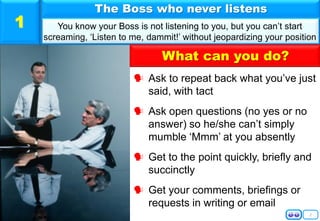
 Ask to repeat back what you’ve just
said, with tact
 Ask open questions (no yes or no
answer) so he/she can’t simply
mumble ‘Mmm’ at you absently
 Get to the point quickly, briefly and
succinctly
 Get your comments, briefings or
requests in writing or email
The Boss who never listens
You know your Boss is not listening to you, but you can’t start
screaming, ‘Listen to me, dammit!’ without jeopardizing your position
1
What can you do?
3
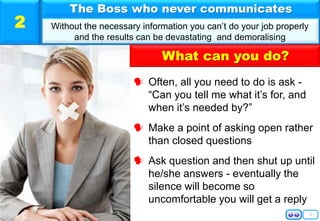
 Often, all you need to do is ask -
“Can you tell me what it’s for, and
when it’s needed by?”
 Make a point of asking open rather
than closed questions
 Ask question and then shut up until
he/she answers - eventually the
silence will become so
uncomfortable you will get a reply
The Boss who never communicates
Without the necessary information you can’t do your job properly
and the results can be devastating and demoralising
2
What can you do?
4
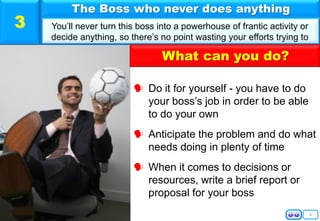
 Do it for yourself - you have to do
your boss’s job in order to be able
to do your own
 Anticipate the problem and do what
needs doing in plenty of time
 When it comes to decisions or
resources, write a brief report or
proposal for your boss
The Boss who never does anything
You’ll never turn this boss into a powerhouse of frantic activity or
decide anything, so there’s no point wasting your efforts trying to
3
What can you do?
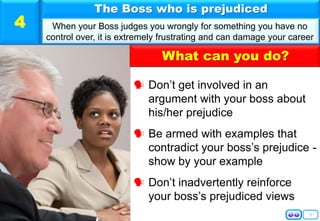
What can you do?
5
 Don’t get involved in an
argument with your boss about
his/her prejudice
 Be armed with examples that
contradict your boss’s prejudice -
show by your example
 Don’t inadvertently reinforce
your boss’s prejudiced views
The Boss who is prejudiced
When your Boss judges you wrongly for something you have no
control over, it is extremely frustrating and can damage your career
4
6
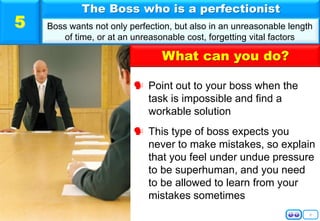
 Point out to your boss when the
task is impossible and find a
workable solution
 This type of boss expects you
never to make mistakes, so explain
that you feel under undue pressure
to be superhuman, and you need
to be allowed to learn from your
mistakes sometimes
The Boss who is a perfectionist
Boss wants not only perfection, but also in an unreasonable length
of time, or at an unreasonable cost, forgetting vital factors
5
What can you do?
7
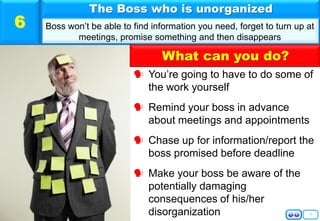
 You’re going to have to do some of
the work yourself
 Remind your boss in advance
about meetings and appointments
 Chase up for information/report the
boss promised before deadline
 Make your boss be aware of the
potentially damaging
consequences of his/her
disorganization
The Boss who is unorganized
Boss won’t be able to find information you need, forget to turn up at
meetings, promise something and then disappears
6
What can you do?
8
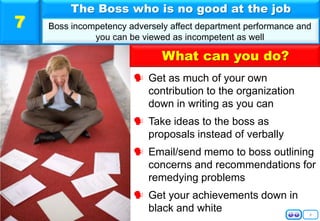
 Get as much of your own
contribution to the organization
down in writing as you can
 Take ideas to the boss as
proposals instead of verbally
 Email/send memo to boss outlining
concerns and recommendations for
remedying problems
 Get your achievements down in
black and white
The Boss who is no good at the job
Boss incompetency adversely affect department performance and
you can be viewed as incompetent as well
7
What can you do?
9
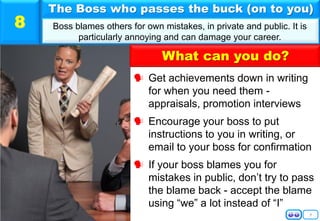
 Get achievements down in writing
for when you need them -
appraisals, promotion interviews
 Encourage your boss to put
instructions to you in writing, or
email to your boss for confirmation
 If your boss blames you for
mistakes in public, don’t try to pass
the blame back - accept the blame
using “we” a lot instead of “I”
The Boss who passes the buck (on to you)
Boss blames others for own mistakes, in private and public. It is
particularly annoying and can damage your career.
8
What can you do?
10
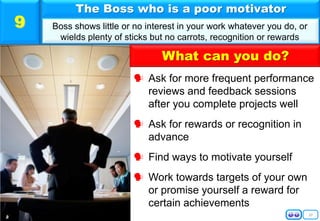
 Ask for more frequent performance
reviews and feedback sessions
after you complete projects well
 Ask for rewards or recognition in
advance
 Find ways to motivate yourself
 Work towards targets of your own
or promise yourself a reward for
certain achievements
The Boss who is a poor motivator
Boss shows little or no interest in your work whatever you do, or
wields plenty of sticks but no carrots, recognition or rewards
9
What can you do?
11
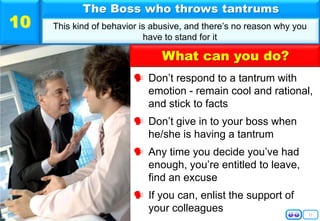
 Don’t respond to a tantrum with
emotion - remain cool and rational,
and stick to facts
 Don’t give in to your boss when
he/she is having a tantrum
 Any time you decide you’ve had
enough, you’re entitled to leave,
find an excuse
 If you can, enlist the support of
your colleagues
The Boss who throws tantrums
This kind of behavior is abusive, and there’s no reason why you
have to stand for it
10
What can you do?
12
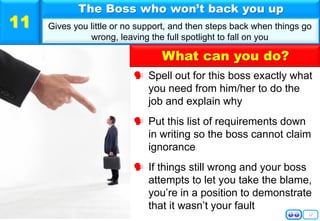
 Spell out for this boss exactly what
you need from him/her to do the
job and explain why
 Put this list of requirements down
in writing so the boss cannot claim
ignorance
 If things still wrong and your boss
attempts to let you take the blame,
you’re in a position to demonstrate
that it wasn’t your fault
The Boss who won’t back you up
Gives you little or no support, and then steps back when things go
wrong, leaving the full spotlight to fall on you
11
What can you do?
13
 Volunteer for extra responsibilities
as often as you can
 Ask for training and new
responsibilities
 Point out to your boss the
advantages, for example, covering
for other staff
The Boss who won’t let you develop
You want new challenges/fresh responsibilities. But your boss is
happy for you to stay as you are, doing a good job.
12
What can you do?
14
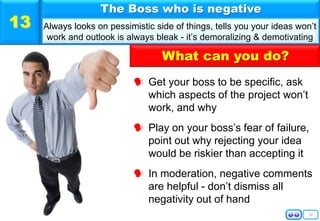
 Get your boss to be specific, ask
which aspects of the project won’t
work, and why
 Play on your boss’s fear of failure,
point out why rejecting your idea
would be riskier than accepting it
 In moderation, negative comments
are helpful - don’t dismiss all
negativity out of hand
The Boss who is negative
Always looks on pessimistic side of things, tells you your ideas won’t
work and outlook is always bleak - it’s demoralizing & demotivating
13
What can you do?
15
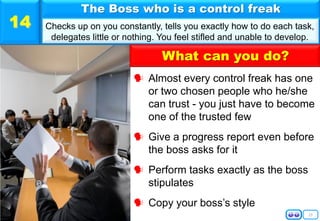
 Almost every control freak has one
or two chosen people who he/she
can trust - you just have to become
one of the trusted few
 Give a progress report even before
the boss asks for it
 Perform tasks exactly as the boss
stipulates
 Copy your boss’s style
The Boss who is a control freak
Checks up on you constantly, tells you exactly how to do each task,
delegates little or nothing. You feel stifled and unable to develop.
14
What can you do?
What can you do?
16
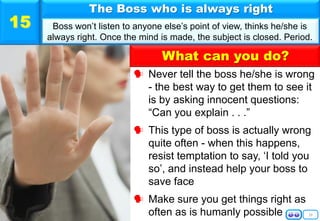
 Never tell the boss he/she is wrong
- the best way to get them to see it
is by asking innocent questions:
“Can you explain . . .”
 This type of boss is actually wrong
quite often - when this happens,
resist temptation to say, ‘I told you
so’, and instead help your boss to
save face
 Make sure you get things right as
often as is humanly possible
The Boss who is always right
Boss won’t listen to anyone else’s point of view, thinks he/she is
always right. Once the mind is made, the subject is closed. Period.
15
17
 If your boss is stalling, there is
some kind of conflict - ask what it is
 If your boss is simply indecisive
and puts off making decisions, try
acting as an unofficial adviser and
help to make the decision
 Don’t pressure this kind of boss too
hard - he/she may do anything just
to get you off his/her back
The Boss who stalls
When you need a decision or to put your case to senior
management, boss somehow wriggles, stalls, or just plain disappear
16
What can you do?
18
 Keep records of your ideas and
suggestions and notes of relevant
meetings with your boss
 Get your ideas down as a formal
proposal, with your name on the
cover page, and the date
 Let other people know about your
ideas, either verbally or by copying
to them anything you can justify,
including your proposal
The Boss who takes credit for your ideas
This is infuriating and damaging to your career. If your good ideas
aren’t recognised as your own, how can you be rewarded for them?
17
What can you do?
19
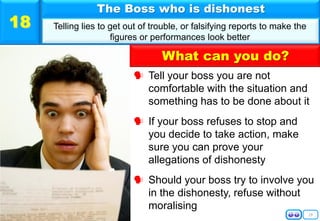
 Tell your boss you are not
comfortable with the situation and
something has to be done about it
 If your boss refuses to stop and
you decide to take action, make
sure you can prove your
allegations of dishonesty
 Should your boss try to involve you
in the dishonesty, refuse without
moralising
The Boss who is dishonest
Telling lies to get out of trouble, or falsifying reports to make the
figures or performances look better
18
What can you do?
20
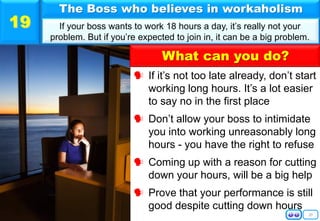
 If it’s not too late already, don’t start
working long hours. It’s a lot easier
to say no in the first place
 Don’t allow your boss to intimidate
you into working unreasonably long
hours - you have the right to refuse
 Coming up with a reason for cutting
down your hours, will be a big help
 Prove that your performance is still
good despite cutting down hours
The Boss who believes in workaholism
If your boss wants to work 18 hours a day, it’s really not your
problem. But if you’re expected to join in, it can be a big problem.
19
What can you do?
21
 Try feedback with your boss who
may be unaware of the problems
he/she is causing
 Anticipate what you’re likely to
need so that when he/she is
around, you can sort out all the
things you’re going to need
 Put all your requests as briefly as
you can, so as not to waste what
precious time you have with boss
The Boss who is simply never there
The boss is needed to make decisions, authorises things and solve
issues - hard to achieve when your boss is never around
20
What can you do?
Thank You
yewyip@gmail.com

20 Types of Tricky Bosses

  • 1.
    Prepared by :Wong Yew Yip 20 Types of Tricky Bosses Source : How to manage your boss - Ros Jay
  • 2.
    2  Ask torepeat back what you’ve just said, with tact  Ask open questions (no yes or no answer) so he/she can’t simply mumble ‘Mmm’ at you absently  Get to the point quickly, briefly and succinctly  Get your comments, briefings or requests in writing or email The Boss who never listens You know your Boss is not listening to you, but you can’t start screaming, ‘Listen to me, dammit!’ without jeopardizing your position 1 What can you do?
  • 3.
    3  Often, allyou need to do is ask - “Can you tell me what it’s for, and when it’s needed by?”  Make a point of asking open rather than closed questions  Ask question and then shut up until he/she answers - eventually the silence will become so uncomfortable you will get a reply The Boss who never communicates Without the necessary information you can’t do your job properly and the results can be devastating and demoralising 2 What can you do?
  • 4.
    4  Do itfor yourself - you have to do your boss’s job in order to be able to do your own  Anticipate the problem and do what needs doing in plenty of time  When it comes to decisions or resources, write a brief report or proposal for your boss The Boss who never does anything You’ll never turn this boss into a powerhouse of frantic activity or decide anything, so there’s no point wasting your efforts trying to 3 What can you do?
  • 5.
    What can youdo? 5  Don’t get involved in an argument with your boss about his/her prejudice  Be armed with examples that contradict your boss’s prejudice - show by your example  Don’t inadvertently reinforce your boss’s prejudiced views The Boss who is prejudiced When your Boss judges you wrongly for something you have no control over, it is extremely frustrating and can damage your career 4
  • 6.
    6  Point outto your boss when the task is impossible and find a workable solution  This type of boss expects you never to make mistakes, so explain that you feel under undue pressure to be superhuman, and you need to be allowed to learn from your mistakes sometimes The Boss who is a perfectionist Boss wants not only perfection, but also in an unreasonable length of time, or at an unreasonable cost, forgetting vital factors 5 What can you do?
  • 7.
    7  You’re goingto have to do some of the work yourself  Remind your boss in advance about meetings and appointments  Chase up for information/report the boss promised before deadline  Make your boss be aware of the potentially damaging consequences of his/her disorganization The Boss who is unorganized Boss won’t be able to find information you need, forget to turn up at meetings, promise something and then disappears 6 What can you do?
  • 8.
    8  Get asmuch of your own contribution to the organization down in writing as you can  Take ideas to the boss as proposals instead of verbally  Email/send memo to boss outlining concerns and recommendations for remedying problems  Get your achievements down in black and white The Boss who is no good at the job Boss incompetency adversely affect department performance and you can be viewed as incompetent as well 7 What can you do?
  • 9.
    9  Get achievementsdown in writing for when you need them - appraisals, promotion interviews  Encourage your boss to put instructions to you in writing, or email to your boss for confirmation  If your boss blames you for mistakes in public, don’t try to pass the blame back - accept the blame using “we” a lot instead of “I” The Boss who passes the buck (on to you) Boss blames others for own mistakes, in private and public. It is particularly annoying and can damage your career. 8 What can you do?
  • 10.
    10  Ask formore frequent performance reviews and feedback sessions after you complete projects well  Ask for rewards or recognition in advance  Find ways to motivate yourself  Work towards targets of your own or promise yourself a reward for certain achievements The Boss who is a poor motivator Boss shows little or no interest in your work whatever you do, or wields plenty of sticks but no carrots, recognition or rewards 9 What can you do?
  • 11.
    11  Don’t respondto a tantrum with emotion - remain cool and rational, and stick to facts  Don’t give in to your boss when he/she is having a tantrum  Any time you decide you’ve had enough, you’re entitled to leave, find an excuse  If you can, enlist the support of your colleagues The Boss who throws tantrums This kind of behavior is abusive, and there’s no reason why you have to stand for it 10 What can you do?
  • 12.
    12  Spell outfor this boss exactly what you need from him/her to do the job and explain why  Put this list of requirements down in writing so the boss cannot claim ignorance  If things still wrong and your boss attempts to let you take the blame, you’re in a position to demonstrate that it wasn’t your fault The Boss who won’t back you up Gives you little or no support, and then steps back when things go wrong, leaving the full spotlight to fall on you 11 What can you do?
  • 13.
    13  Volunteer forextra responsibilities as often as you can  Ask for training and new responsibilities  Point out to your boss the advantages, for example, covering for other staff The Boss who won’t let you develop You want new challenges/fresh responsibilities. But your boss is happy for you to stay as you are, doing a good job. 12 What can you do?
  • 14.
    14  Get yourboss to be specific, ask which aspects of the project won’t work, and why  Play on your boss’s fear of failure, point out why rejecting your idea would be riskier than accepting it  In moderation, negative comments are helpful - don’t dismiss all negativity out of hand The Boss who is negative Always looks on pessimistic side of things, tells you your ideas won’t work and outlook is always bleak - it’s demoralizing & demotivating 13 What can you do?
  • 15.
    15  Almost everycontrol freak has one or two chosen people who he/she can trust - you just have to become one of the trusted few  Give a progress report even before the boss asks for it  Perform tasks exactly as the boss stipulates  Copy your boss’s style The Boss who is a control freak Checks up on you constantly, tells you exactly how to do each task, delegates little or nothing. You feel stifled and unable to develop. 14 What can you do?
  • 16.
    What can youdo? 16  Never tell the boss he/she is wrong - the best way to get them to see it is by asking innocent questions: “Can you explain . . .”  This type of boss is actually wrong quite often - when this happens, resist temptation to say, ‘I told you so’, and instead help your boss to save face  Make sure you get things right as often as is humanly possible The Boss who is always right Boss won’t listen to anyone else’s point of view, thinks he/she is always right. Once the mind is made, the subject is closed. Period. 15
  • 17.
    17  If yourboss is stalling, there is some kind of conflict - ask what it is  If your boss is simply indecisive and puts off making decisions, try acting as an unofficial adviser and help to make the decision  Don’t pressure this kind of boss too hard - he/she may do anything just to get you off his/her back The Boss who stalls When you need a decision or to put your case to senior management, boss somehow wriggles, stalls, or just plain disappear 16 What can you do?
  • 18.
    18  Keep recordsof your ideas and suggestions and notes of relevant meetings with your boss  Get your ideas down as a formal proposal, with your name on the cover page, and the date  Let other people know about your ideas, either verbally or by copying to them anything you can justify, including your proposal The Boss who takes credit for your ideas This is infuriating and damaging to your career. If your good ideas aren’t recognised as your own, how can you be rewarded for them? 17 What can you do?
  • 19.
    19  Tell yourboss you are not comfortable with the situation and something has to be done about it  If your boss refuses to stop and you decide to take action, make sure you can prove your allegations of dishonesty  Should your boss try to involve you in the dishonesty, refuse without moralising The Boss who is dishonest Telling lies to get out of trouble, or falsifying reports to make the figures or performances look better 18 What can you do?
  • 20.
    20  If it’snot too late already, don’t start working long hours. It’s a lot easier to say no in the first place  Don’t allow your boss to intimidate you into working unreasonably long hours - you have the right to refuse  Coming up with a reason for cutting down your hours, will be a big help  Prove that your performance is still good despite cutting down hours The Boss who believes in workaholism If your boss wants to work 18 hours a day, it’s really not your problem. But if you’re expected to join in, it can be a big problem. 19 What can you do?
  • 21.
    21  Try feedbackwith your boss who may be unaware of the problems he/she is causing  Anticipate what you’re likely to need so that when he/she is around, you can sort out all the things you’re going to need  Put all your requests as briefly as you can, so as not to waste what precious time you have with boss The Boss who is simply never there The boss is needed to make decisions, authorises things and solve issues - hard to achieve when your boss is never around 20 What can you do?
  • 22.