Identification of an Intelligent
Attacker in ARP Spoofing

Presented By :
Subhash Kumar Singh
(201011044)

Guided By :
Prof Anish Mathuria

20th Nov, DAIICT
Outline
●

ARP Protocol

●

Probe Packet based technique (eg. SDE)

●

Importance of identification of attacker

●

Proposed Idea

●

Results

●

Conclusion
Basic ARP Protocol
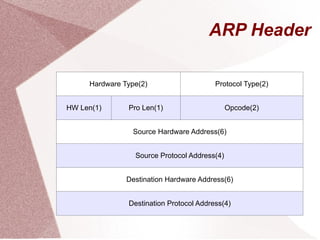
ARP Header
Hardware Type(2)
HW Len(1)

Protocol Type(2)

Pro Len(1)

Opcode(2)

Source Hardware Address(6)
Source Protocol Address(4)
Destination Hardware Address(6)
Destination Protocol Address(4)
Rules for Updating ARP Cache
●

●

●

For creation of new entry - when an ARP
req/rep message arrive at host a new entry is
created if the cache doesn't contain any entry
for the source IP in the received ARP packet.
Updating an entry - when an ARP req/rep
message arrive at host and the entry for the
source IP in ARP header is present then the
information in the ARP packet updated into
cache and timeout time is renewed.
Problem : ARP can't verify the sender of ARP
request/ reply packet.
Various techniques to secure ARP
Port Security

Binding MAC Address to switch port

Enhanced ARP[10]

Conflict resolution of MAC address based on voting

S-ARP[6]

Signing ARP replies

TARP[7]

Centrally issued ticket authentication <IP,MAC>
associations

El-Hajj et al.[3]

Uses stateful ARP cache and fuzzy logic

Trabelsi et al.[9]

Detection technique using trap ICMP ping packet and
analyze packets to varify the correct <IP,MAC> mapping

Kanamori et al.[1]

Uses ARP request packet as confirmation probe packet

Ramachandran et al.[2]

Defines types of attacker explicit and used TCP SYN
packet as confirmation probe packet
Probe Packet based techniques
●

●

Such technique injects a probe packet in
order to confirm the mapping of IP
address and mac address.
Probe packet can be anything :
– ARP packets
– ICMP packets
– TCP SYN packets

●

E.g. - Spoof Detection Engine (SDE)
Working of SDE
Host A
10.100.98.91
00:00:00:00:00:0A

ARP Req/Rep
[arp.src] <10.100.98.92, 00:00:00:00:00:0B>

Host B
10.100.98.92
00:00:00:00:00:0B

If 10.100.98.92 is new entry for ARP cache
then send TCP SYN packet
Otherwise in case of mismatch with ARP
cache, raise the spoof alarm
TCP SYN packet
eth.dst=00:00:00:00:00:0B, IP_dst=10.100.98.92, SYN

TCP SYN/ACK packet
eth.src=00:00:00:00:00:0B, IP.src=10.100.98.92, SYN/ACK

SDE uses TCP SYN packet as probe packet.
Attacking Model[2]
●

Weak Attacker 


●

Generate fake packets.
Can't modify protocol stack.

Strong Attacker

Generate fake packets.



Can also modify the protocol stack.
SDE in Weak Attacking Environment
Host A
10.100.98.91
00:00:00:00:00:0A

ARP Req/Rep
[arp.src] <10.100.98.92, 00:00:00:00:00:0C>

Attacker
10.100.98.93
00:00:00:00:00:0C

If 10.100.98.92 is new entry for ARP cache
TCP SYN packet
eth.dst=00:00:00:00:00:0C, IP_dst=10.100.98.92, SYN

eth.src=00:00:00:00:00:0C, IP.src=10.100.98.92, SYN/ACK

TCP SYN/ACK packet

10.100.98.92 !=
10.100.98.93 so SYN
packet is silently
dropped at IP layer
Host B
10.100.98.92
00:00:00:00:00:0B
SDE in Strong Attacker
Host B
10.100.98.92
00:00:00:00:00:0B

Host A
10.100.98.91
00:00:00:00:00:0A

ARP Req/Rep

Attacker
10.100.98.93
00:00:00:00:00:0C

[arp.src] <10.100.98.92,
00:00:00:00:00:0C>

If 10.100.98.92 is new entry for ARP cache
Arp.src<10.100.98.91, 00:00:00:00:00:0A>
Arp.dst<10.100.98.92, 00:00:00:00:00:00>

Arp.src<10.100.98.91, 00:00:00:00:00:0A>
Arp.dst<10.100.98.92, 00:00:00:00:00:00>

Broadcast ARP Requset for 10.100.98.92

ARP Reply
Arp.src<10.100.98.92, 00:00:00:00:00:0B>
Arp.dst<10.100.98.91, 00:00:00:00:00:0A>

ARP Reply
Arp.src<10.100.98.92, 00:00:00:00:00:0C>
Arp.dst<10.100.98.91, 00:00:00:00:00:0A>
Why the Identification is Important
●

Detection of attacker leaves the host
with a set of possible MAC addresses. A
victim can't determine which MAC
should be selected to associate with IP
address.
Problem : Limitation of Probe
packet based Detection
Techniques
●

A detecting host can not resolve the
correct IP to mac address mapping in
the case of strong attacker, because a
strong attacker can modify the protocol
stack such a way that, he can generate
appropriate response for probe packets.
Proposed Idea
Enhanced Technique
●

●
●

Probe Packet based detection
technique.
ARP request packet as probe packet.
Correctly identifies the mapping of IP
address and MAC address in both the
environments of attacker (weak and
strong attacker).
Assumption
●

●
●

Attacker can modify his protocol stack. It
is not necessary for attacker to follow
flow sequence of packet in any protocol.
Attcker is working in promiscuous mode.
Attacker can't control the network
devices or communication channel.
Working of Enhanced Technique
If there is ARP req/reply
from any host

No

Mismatch in information
of received ARP packet with
ARP chache
or ARP req/reply form
IP that doesn't exist in ARP cache

No
Packet generated form
true host

Go for Broadcast_test()

Yes

If source IP has
entry in ARP cache

Yes

Verify the mapping present
in cache for that IP
Verifying the mapping
present in the ARP cache
Generate Broadcast ARP request for
source IP of received ARP packet

No

Go for Broadcast_test()

any ARP response
is received

Yes

Keep the previous mapping in
the ARP cache and refresh its timeout
period
Broadcast_test()
Generate broadcast ARP Request
for all possible IP address in LAN

Yes

MAC address of
attacker

Got two or more
ARP reply from same
MAC address

No

Legitimate <IP , MAC>
mapping
In case of Strong Attacker
Host B
10.100.98.92
00:00:00:00:00:0B

Host A
10.100.98.91
00:00:00:00:00:0A

ARP Req/Rep

Attacker
10.100.98.93
00:00:00:00:00:0C

[arp.src] <10.100.98.92,
00:00:00:00:00:0C>

If 10.100.98.92 is new entry for ARP cache
Broadcast ARP Req
Arp.src<10.100.98.91, 00:00:00:00:00:0A>
Arp.dst<x.x.x.x, 00:00:00:00:00:00>

Arp.src<10.100.98.92, 00:00:00:00:00:0B>
Arp.dst<10.100.98.91, 00:00:00:00:00:0A>

ARP Reply

Broadcast ARP Req
Arp.src<10.100.98.91, 00:00:00:00:00:0A>
Arp.dst<x.x.x.x, 00:00:00:00:00:00>

Arp.src<10.100.98.92, 00:00:00:00:00:0C>
Arp.dst<10.100.98.91, 00:00:00:00:00:0A>

ARP Reply
Arp.src<10.100.98.93, 00:00:00:00:00:0C>
Arp.dst<10.100.98.91, 00:00:00:00:00:0A>

X.X.X.X – all possible IP in the LAN
Hiding Probe Packets
●

Generate the ARP Request traffic
according to calculated LAN parameters
2
mean (µ) and variance (σ ) from a
random MAC address.
Scheduling
X = µ + σ * random_fun(0,1)
Advantage
●

●

●

Identify correct mapping in the case of
strong attacker.
In case, legitimate host is powered off,
attacker can't do poisoning.
Dynamic changes in mapping of a host
correctly handled.
Setup, Experiment and
Results
Test Bed
●

LAN consist of 20 PC's.
– Gateway.
– Victim (windows XP).
– Attacker (ubuntu 10.10).

●

100 Mbps Switched LAN.

●

Wireshark.
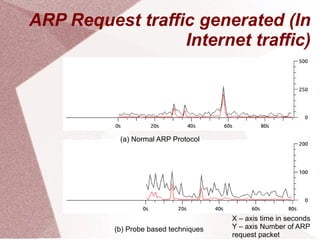
ARP Request traffic generated (In
Internet traffic)

(a) Normal ARP Protocol

Normal ARP Protocol
(b) Probe based techniques

X – axis time in seconds
Y – axis Number of ARP
request packet
ARP Request traffic generated (In
Internet traffic)

(c) Proposed Idea
X – axis time in seconds
Y – axis Number of ARP
request packet
System Load

(a)System Load in Non-Promiscuous mode (core-2 processor)
System Load

(b)System Load in Promiscuous mode (core-2 processor)
Conclusion
●

●

●

The proposed technique can identify the
weak and strong attacker.
We are paying some traffic overhead but
it is not significant high.
Proposed technique is backward
compatible.
References
●

●

●

●

●

[1]K. Masataka, K. Takashi, and Y. Suguru, “A self-confirming
engine for preventing man-in-the-middle attack(security)(internet
technology iv),” IEICE transactions on communications, vol. 87,
no. 3, pp. 530–538, 2004-03.
[2]V. Ramachandran and S. Nandi, “Detecting arp spoofing: an
active technique,” in Proceedings of the First international
conference on Information Systems Security, ICISS’05, (Berlin,
Heidelberg), pp. 239–250, Springer-Verlag, 2005.
[3] W. El-Hajj and Z. Trabelsi, “Using a fuzzy logic controller to
thwart data link layer attacks in ethernet networks,” in WCNC, pp.
2547–2552, 2007.
[4] W. R. Stevens, TCP/IP Illustrated, Volume 1: The Protocols.
Addison Wesley, 1994.
[5] C. L. Abad and R. I. Bonilla, “An analysis on the schemes for
detecting and preventing arp cache poisoning attacks,” in
Proceedings of the 27th International Conference on Distributed
Computing Systems Workshops, ICDCSW ’07, (Washington, DC,
USA), pp. 60–, IEEE Computer Society, 2007.
Cont..
●

●

●

●

●

[6] D. Bruschi, A. Ornaghi, and E. Rosti, “S-arp: a secure
address resolution protocol,” in Proceedings of the 19th
Annual Computer Security Applications Conference,
ACSAC ’03, (Washington, DC, USA), pp. 66–, IEEE
Computer Society, 2003.
[7] W. Lootah, W. Enck, and P. McDaniel, “Tarp: Ticketbased address resolution protocol,” Comput. Netw., vol. 51,
pp. 4322–4337, Oct. 2007.
[8] Z. Trabelsi and H. Rahmani, “Detection of sniffers in an
ethernet network,” in ISC, pp. 170–182, 2004.
[9] Z. Trabelsi and K. Shuaib, “Spoofed arp packets
detection in switched lan networks,” in SECRYPT, pp. 40–
47, 2006.
[10] S. Y. Nam, D. Kim, and J. Kim, “Enhanced arp:
preventing arp poisoning-based man-in-the-middle
attacks,” Comm. Letters., vol. 14, pp. 187–189, Feb. 2010.
Cont..
●

●

●

●

[11] B. Issac, “Secure arp and secure dhcp protocols to
mitigate security attacks,” I. J. Network Security, vol. 8, no.
2, pp. 107–118, 2009.
[12] Z. Wang and Y. Zhou, “Monitoring arp attack using
responding time and state arp cache,” in ISNN (4), pp.
701–709, 2009.
[13] M. V. Tripunitara and P. Dutta, “A middleware approach
to asynchronous and backward compatible detection and
prevention of arp cache poisoning,” in Proceedings of the
15th Annual Computer Security Applications Conference,
ACSAC ’99, (Washington, DC, USA), pp. 303–, IEEE
Computer Society, 1999.
[14] V. Goyal and R. Tripathy, “An efficient solution to the
arp cache poisoning problem,” in Proceedings of the 10th
Australasian conference on Information Security and
Privacy, ACISP’05, (Berlin, Heidelberg), pp. 40–51,
Springer-Verlag, 2005.
Thanking You...
In case of Weak Attacker
ARP Req/Rep

Host A
10.100.98.91
00:00:00:00:00:0A

Attacker
10.100.98.93
00:00:00:00:00:0C

[arp.src] <10.100.98.92, 00:00:00:00:00:0C>

If 10.100.98.92 is new entry for ARP cache
Broadcast requst for all possible IP
Arp.src<10.100.98.91, 00:00:00:00:00:0A>
Arp.dst<x.x.x.x, 00:00:00:00:00:00>

ARP Reply
Arp.src<10.100.98.92, 00:00:00:00:00:0C>
Arp.dst<10.100.98.91, 00:00:00:00:00:0A>

Host IP doesn't
matches with
destination IP in the
received ARP header,
so drop ARP Request
Host B
10.100.98.92
00:00:00:00:00:0B

ARP Reply
Arp.src<10.100.98.92, 00:00:00:00:00:0B>
Arp.dst<10.100.98.91, 00:00:00:00:00:0A>

X.X.X.X – all possible IP in the LAN

Arp Cache Poisoning

  • 1.
    Identification of anIntelligent Attacker in ARP Spoofing Presented By : Subhash Kumar Singh (201011044) Guided By : Prof Anish Mathuria 20th Nov, DAIICT
  • 2.
    Outline ● ARP Protocol ● Probe Packetbased technique (eg. SDE) ● Importance of identification of attacker ● Proposed Idea ● Results ● Conclusion
  • 3.
  • 4.
    ARP Header Hardware Type(2) HWLen(1) Protocol Type(2) Pro Len(1) Opcode(2) Source Hardware Address(6) Source Protocol Address(4) Destination Hardware Address(6) Destination Protocol Address(4)
  • 5.
    Rules for UpdatingARP Cache ● ● ● For creation of new entry - when an ARP req/rep message arrive at host a new entry is created if the cache doesn't contain any entry for the source IP in the received ARP packet. Updating an entry - when an ARP req/rep message arrive at host and the entry for the source IP in ARP header is present then the information in the ARP packet updated into cache and timeout time is renewed. Problem : ARP can't verify the sender of ARP request/ reply packet.
  • 6.
    Various techniques tosecure ARP Port Security Binding MAC Address to switch port Enhanced ARP[10] Conflict resolution of MAC address based on voting S-ARP[6] Signing ARP replies TARP[7] Centrally issued ticket authentication <IP,MAC> associations El-Hajj et al.[3] Uses stateful ARP cache and fuzzy logic Trabelsi et al.[9] Detection technique using trap ICMP ping packet and analyze packets to varify the correct <IP,MAC> mapping Kanamori et al.[1] Uses ARP request packet as confirmation probe packet Ramachandran et al.[2] Defines types of attacker explicit and used TCP SYN packet as confirmation probe packet
  • 7.
    Probe Packet basedtechniques ● ● Such technique injects a probe packet in order to confirm the mapping of IP address and mac address. Probe packet can be anything : – ARP packets – ICMP packets – TCP SYN packets ● E.g. - Spoof Detection Engine (SDE)
  • 8.
    Working of SDE HostA 10.100.98.91 00:00:00:00:00:0A ARP Req/Rep [arp.src] <10.100.98.92, 00:00:00:00:00:0B> Host B 10.100.98.92 00:00:00:00:00:0B If 10.100.98.92 is new entry for ARP cache then send TCP SYN packet Otherwise in case of mismatch with ARP cache, raise the spoof alarm TCP SYN packet eth.dst=00:00:00:00:00:0B, IP_dst=10.100.98.92, SYN TCP SYN/ACK packet eth.src=00:00:00:00:00:0B, IP.src=10.100.98.92, SYN/ACK SDE uses TCP SYN packet as probe packet.
  • 9.
    Attacking Model[2] ● Weak Attacker  ● Generate fake packets. Can't modify protocol stack. Strong Attacker Generate fake packets.  Can also modify the protocol stack.
  • 10.
    SDE in WeakAttacking Environment Host A 10.100.98.91 00:00:00:00:00:0A ARP Req/Rep [arp.src] <10.100.98.92, 00:00:00:00:00:0C> Attacker 10.100.98.93 00:00:00:00:00:0C If 10.100.98.92 is new entry for ARP cache TCP SYN packet eth.dst=00:00:00:00:00:0C, IP_dst=10.100.98.92, SYN eth.src=00:00:00:00:00:0C, IP.src=10.100.98.92, SYN/ACK TCP SYN/ACK packet 10.100.98.92 != 10.100.98.93 so SYN packet is silently dropped at IP layer Host B 10.100.98.92 00:00:00:00:00:0B
  • 11.
    SDE in StrongAttacker Host B 10.100.98.92 00:00:00:00:00:0B Host A 10.100.98.91 00:00:00:00:00:0A ARP Req/Rep Attacker 10.100.98.93 00:00:00:00:00:0C [arp.src] <10.100.98.92, 00:00:00:00:00:0C> If 10.100.98.92 is new entry for ARP cache Arp.src<10.100.98.91, 00:00:00:00:00:0A> Arp.dst<10.100.98.92, 00:00:00:00:00:00> Arp.src<10.100.98.91, 00:00:00:00:00:0A> Arp.dst<10.100.98.92, 00:00:00:00:00:00> Broadcast ARP Requset for 10.100.98.92 ARP Reply Arp.src<10.100.98.92, 00:00:00:00:00:0B> Arp.dst<10.100.98.91, 00:00:00:00:00:0A> ARP Reply Arp.src<10.100.98.92, 00:00:00:00:00:0C> Arp.dst<10.100.98.91, 00:00:00:00:00:0A>
  • 12.
    Why the Identificationis Important ● Detection of attacker leaves the host with a set of possible MAC addresses. A victim can't determine which MAC should be selected to associate with IP address.
  • 13.
    Problem : Limitationof Probe packet based Detection Techniques ● A detecting host can not resolve the correct IP to mac address mapping in the case of strong attacker, because a strong attacker can modify the protocol stack such a way that, he can generate appropriate response for probe packets.
  • 14.
  • 15.
    Enhanced Technique ● ● ● Probe Packetbased detection technique. ARP request packet as probe packet. Correctly identifies the mapping of IP address and MAC address in both the environments of attacker (weak and strong attacker).
  • 16.
    Assumption ● ● ● Attacker can modifyhis protocol stack. It is not necessary for attacker to follow flow sequence of packet in any protocol. Attcker is working in promiscuous mode. Attacker can't control the network devices or communication channel.
  • 17.
    Working of EnhancedTechnique If there is ARP req/reply from any host No Mismatch in information of received ARP packet with ARP chache or ARP req/reply form IP that doesn't exist in ARP cache No Packet generated form true host Go for Broadcast_test() Yes If source IP has entry in ARP cache Yes Verify the mapping present in cache for that IP
  • 18.
    Verifying the mapping presentin the ARP cache Generate Broadcast ARP request for source IP of received ARP packet No Go for Broadcast_test() any ARP response is received Yes Keep the previous mapping in the ARP cache and refresh its timeout period
  • 19.
    Broadcast_test() Generate broadcast ARPRequest for all possible IP address in LAN Yes MAC address of attacker Got two or more ARP reply from same MAC address No Legitimate <IP , MAC> mapping
  • 20.
    In case ofStrong Attacker Host B 10.100.98.92 00:00:00:00:00:0B Host A 10.100.98.91 00:00:00:00:00:0A ARP Req/Rep Attacker 10.100.98.93 00:00:00:00:00:0C [arp.src] <10.100.98.92, 00:00:00:00:00:0C> If 10.100.98.92 is new entry for ARP cache Broadcast ARP Req Arp.src<10.100.98.91, 00:00:00:00:00:0A> Arp.dst<x.x.x.x, 00:00:00:00:00:00> Arp.src<10.100.98.92, 00:00:00:00:00:0B> Arp.dst<10.100.98.91, 00:00:00:00:00:0A> ARP Reply Broadcast ARP Req Arp.src<10.100.98.91, 00:00:00:00:00:0A> Arp.dst<x.x.x.x, 00:00:00:00:00:00> Arp.src<10.100.98.92, 00:00:00:00:00:0C> Arp.dst<10.100.98.91, 00:00:00:00:00:0A> ARP Reply Arp.src<10.100.98.93, 00:00:00:00:00:0C> Arp.dst<10.100.98.91, 00:00:00:00:00:0A> X.X.X.X – all possible IP in the LAN
  • 21.
    Hiding Probe Packets ● Generatethe ARP Request traffic according to calculated LAN parameters 2 mean (µ) and variance (σ ) from a random MAC address.
  • 22.
    Scheduling X = µ+ σ * random_fun(0,1)
  • 23.
    Advantage ● ● ● Identify correct mappingin the case of strong attacker. In case, legitimate host is powered off, attacker can't do poisoning. Dynamic changes in mapping of a host correctly handled.
  • 24.
  • 25.
    Test Bed ● LAN consistof 20 PC's. – Gateway. – Victim (windows XP). – Attacker (ubuntu 10.10). ● 100 Mbps Switched LAN. ● Wireshark.
  • 26.
    ARP Request trafficgenerated (In Internet traffic) (a) Normal ARP Protocol Normal ARP Protocol (b) Probe based techniques X – axis time in seconds Y – axis Number of ARP request packet
  • 27.
    ARP Request trafficgenerated (In Internet traffic) (c) Proposed Idea X – axis time in seconds Y – axis Number of ARP request packet
  • 28.
    System Load (a)System Loadin Non-Promiscuous mode (core-2 processor)
  • 29.
    System Load (b)System Loadin Promiscuous mode (core-2 processor)
  • 30.
    Conclusion ● ● ● The proposed techniquecan identify the weak and strong attacker. We are paying some traffic overhead but it is not significant high. Proposed technique is backward compatible.
  • 31.
    References ● ● ● ● ● [1]K. Masataka, K.Takashi, and Y. Suguru, “A self-confirming engine for preventing man-in-the-middle attack(security)(internet technology iv),” IEICE transactions on communications, vol. 87, no. 3, pp. 530–538, 2004-03. [2]V. Ramachandran and S. Nandi, “Detecting arp spoofing: an active technique,” in Proceedings of the First international conference on Information Systems Security, ICISS’05, (Berlin, Heidelberg), pp. 239–250, Springer-Verlag, 2005. [3] W. El-Hajj and Z. Trabelsi, “Using a fuzzy logic controller to thwart data link layer attacks in ethernet networks,” in WCNC, pp. 2547–2552, 2007. [4] W. R. Stevens, TCP/IP Illustrated, Volume 1: The Protocols. Addison Wesley, 1994. [5] C. L. Abad and R. I. Bonilla, “An analysis on the schemes for detecting and preventing arp cache poisoning attacks,” in Proceedings of the 27th International Conference on Distributed Computing Systems Workshops, ICDCSW ’07, (Washington, DC, USA), pp. 60–, IEEE Computer Society, 2007.
  • 32.
    Cont.. ● ● ● ● ● [6] D. Bruschi,A. Ornaghi, and E. Rosti, “S-arp: a secure address resolution protocol,” in Proceedings of the 19th Annual Computer Security Applications Conference, ACSAC ’03, (Washington, DC, USA), pp. 66–, IEEE Computer Society, 2003. [7] W. Lootah, W. Enck, and P. McDaniel, “Tarp: Ticketbased address resolution protocol,” Comput. Netw., vol. 51, pp. 4322–4337, Oct. 2007. [8] Z. Trabelsi and H. Rahmani, “Detection of sniffers in an ethernet network,” in ISC, pp. 170–182, 2004. [9] Z. Trabelsi and K. Shuaib, “Spoofed arp packets detection in switched lan networks,” in SECRYPT, pp. 40– 47, 2006. [10] S. Y. Nam, D. Kim, and J. Kim, “Enhanced arp: preventing arp poisoning-based man-in-the-middle attacks,” Comm. Letters., vol. 14, pp. 187–189, Feb. 2010.
  • 33.
    Cont.. ● ● ● ● [11] B. Issac,“Secure arp and secure dhcp protocols to mitigate security attacks,” I. J. Network Security, vol. 8, no. 2, pp. 107–118, 2009. [12] Z. Wang and Y. Zhou, “Monitoring arp attack using responding time and state arp cache,” in ISNN (4), pp. 701–709, 2009. [13] M. V. Tripunitara and P. Dutta, “A middleware approach to asynchronous and backward compatible detection and prevention of arp cache poisoning,” in Proceedings of the 15th Annual Computer Security Applications Conference, ACSAC ’99, (Washington, DC, USA), pp. 303–, IEEE Computer Society, 1999. [14] V. Goyal and R. Tripathy, “An efficient solution to the arp cache poisoning problem,” in Proceedings of the 10th Australasian conference on Information Security and Privacy, ACISP’05, (Berlin, Heidelberg), pp. 40–51, Springer-Verlag, 2005.
  • 34.
  • 35.
    In case ofWeak Attacker ARP Req/Rep Host A 10.100.98.91 00:00:00:00:00:0A Attacker 10.100.98.93 00:00:00:00:00:0C [arp.src] <10.100.98.92, 00:00:00:00:00:0C> If 10.100.98.92 is new entry for ARP cache Broadcast requst for all possible IP Arp.src<10.100.98.91, 00:00:00:00:00:0A> Arp.dst<x.x.x.x, 00:00:00:00:00:00> ARP Reply Arp.src<10.100.98.92, 00:00:00:00:00:0C> Arp.dst<10.100.98.91, 00:00:00:00:00:0A> Host IP doesn't matches with destination IP in the received ARP header, so drop ARP Request Host B 10.100.98.92 00:00:00:00:00:0B ARP Reply Arp.src<10.100.98.92, 00:00:00:00:00:0B> Arp.dst<10.100.98.91, 00:00:00:00:00:0A> X.X.X.X – all possible IP in the LAN