DNS cache poisoning
  Christiaan Ottow, christiaan.ottow@pine.nl
Contents

•   Overview of DNS

•   About cache poisoning

•   Timeline of vulnerabilities

•   Counter-measures
Overview of DNS
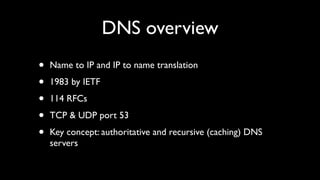
DNS overview
•   Name to IP and IP to name translation

•   1983 by IETF

•   114 RFCs

•   TCP & UDP port 53

•   Key concept: authoritative and recursive (caching) DNS
    servers
DNS - servers
•   Authoritative server

    •   Responsible for one or more zones

    •   Answers queries based on its zones

•   Recursing server (resolver, recursor, cache)

    •   No records of its own, just cache

    •   Queries authoritative servers for the answer
DNS - zones
•   Zone

    •   Domain name, e.g. pine.nl

    •   Contains resource records (RRs)

    •   Stored on authoritative servers

        •   Usually master and slave(s)

    •   SOA record

        •   E-mail, serial, refresh, retry, expire, minTTL
DNS - records
•   Records are the actual mappings of hostnames to IP addresses

•   Different types, not all give an IP address

    •   Common: A, AAAA, NS, CNAME, MX
•   Examples
    • pine.nl.     86400           IN A           213.156.1.80
    • www.pine.nl. 86400           IN CNAME sechost.pine.nl.
    • pine.nl.     86400           IN MX          1 mx.pine.nl.
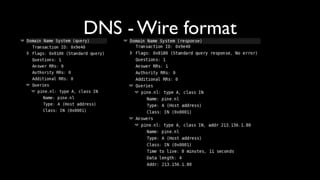
DNS - Wire format
•   Server on UDP/TCP port 53 (TCP for large query/response)

•   Transaction ID

•   Flags

    •   e.g. recursion desired, authoritative, is-response, truncated

•   Sections

    •   Question, Answer, Authority, Additional
DNS - Wire format
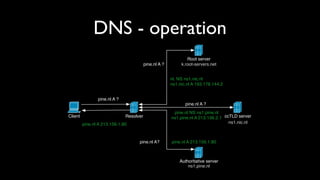
DNS - operation
                                                               Root server
                                         pine.nl A ?        k.root-servers.net


                                                       nl. NS ns1.nic.nl
                                                       ns1.nic.nl A 193.176.144.2


                pine.nl A ?
                                                              pine.nl A ?
                                                        pine.nl NS ns1.pine.nl
Client                        Resolver                 ns1.pine.nl A 213.156.2.1 ccTLD server
         pine.nl A 213.156.1.80                                                    ns1.nic.nl


                                    pine.nl A?         pine.nl A 213.156.1.80


                                                           Authoritative server
                                                               ns1.pine.nl
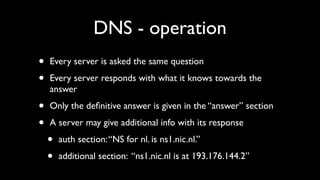
DNS - operation
•   Every server is asked the same question

•   Every server responds with what it knows towards the
    answer

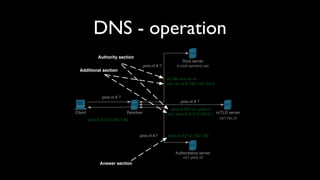
•   Only the definitive answer is given in the “answer” section

•   A server may give additional info with its response

    •   auth section: “NS for nl. is ns1.nic.nl.”

    •   additional section: “ns1.nic.nl is at 193.176.144.2”
DNS - operation
              Authority section
                                                               Root server
                                         pine.nl A ?        k.root-servers.net
  Additional section
                                                       nl. NS ns1.nic.nl
                                                       ns1.nic.nl A 193.176.144.2


                pine.nl A ?
                                                              pine.nl A ?
                                                        pine.nl NS ns1.pine.nl
Client                        Resolver                 ns1.pine.nl A 213.156.2.1 ccTLD server
         pine.nl A 213.156.1.80                                                    ns1.nic.nl


                                    pine.nl A?         pine.nl A 213.156.1.80


                                                           Authoritative server
                                                               ns1.pine.nl
               Answer section
DNS - operation
DNS - operation

•   What if nameserver voor pine.nl is ns1.pine.nl?
DNS - operation

•   What if nameserver voor pine.nl is ns1.pine.nl?

•   Glue records
DNS - operation

•   What if nameserver voor pine.nl is ns1.pine.nl?

•   Glue records

•   Additional section
DNS - operation

•   What if nameserver voor pine.nl is ns1.pine.nl?

•   Glue records

•   Additional section

    •   Extra info the server has that you will probably need
DNS - operation

•   What if nameserver voor pine.nl is ns1.pine.nl?

•   Glue records

•   Additional section

    •   Extra info the server has that you will probably need

    •   Prevents an endless loop
On cache poisoning
Poisoning - what?

•   Entering specific (non-authoritative) RRs into a resolver
    cache

•   Resolver will provide this information to all clients that query
    it
Poisoning - why?

•   Suppose Alice wants to login to secure.bank.net

•   Eve has poisoned her resolver’s cache

•   secure.bank.net may now resolve to the address of Eves
    computer

•   DNS cache poisoning results in MITM attacks or excellent
    phishing
Poisoning - how?
•   Faulty protocol implementations

    •   Send unauthoritative additional RRs

•   Reply before authoritative answer

    •   Brute force - for n replies, n/65535 success rate for static
        port

    •   Birthday attack

    •   Weak PRNG exploitation
Poisoning - brute force

•   Resolver uses UDP, thus stateless
Poisoning - brute force

•   Resolver uses UDP, thus stateless

•   Reply as the authoritative server would but with different
    answer
Poisoning - brute force

•   Resolver uses UDP, thus stateless

•   Reply as the authoritative server would but with different
    answer

•   Need to guess the source port of the resolver (sometimes
    static)
Poisoning - brute force

•   Resolver uses UDP, thus stateless

•   Reply as the authoritative server would but with different
    answer

•   Need to guess the source port of the resolver (sometimes
    static)

•   Need to guess transaction ID
Poisoning - birthday attack

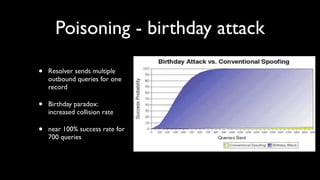
•   Resolver sends multiple
    outbound queries for one
    record

•   Birthday paradox:
    increased collision rate

•   near 100% success rate for
    700 queries
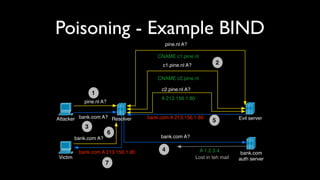
Poisoning - weak PRNG

•   2007/2008 BIND bugs: weak transaction ID randomization
    (simple LFSR)
Poisoning - weak PRNG

•   2007/2008 BIND bugs: weak transaction ID randomization
    (simple LFSR)

•   Static source port (53) up to BIND 9.4.1, so just 16 bits poor
    entropy
Poisoning - weak PRNG

•   2007/2008 BIND bugs: weak transaction ID randomization
    (simple LFSR)

•   Static source port (53) up to BIND 9.4.1, so just 16 bits poor
    entropy

•   Need up to 10 transaction IDs to predict the next
Poisoning - weak PRNG

•   2007/2008 BIND bugs: weak transaction ID randomization
    (simple LFSR)

•   Static source port (53) up to BIND 9.4.1, so just 16 bits poor
    entropy

•   Need up to 10 transaction IDs to predict the next

•   How can we do this?
Poisoning - Example BIND
                                           pine.nl A?

                                        CNAME c1.pine.nl
                                          c1.pine.nl A?            2

                                        CNAME c2.pine.nl

                                         c2.pine.nl A?
                 1
                                         A 213.156.1.80
            pine.nl A?


Attacker bank.com A? Resolver       bank.com A 213.156.1.80
                                                                  5          Evil server
             3
                         6
         bank.com A?                     bank.com A?


          bank.com A 213.156.1.80         4                 A 1.2.3.4         bank.com
Victim                                                    Lost in teh mail   auth server
                       7
Timeline of vulnerabilities
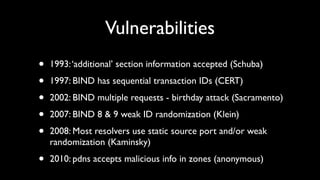
Vulnerabilities
•   1993: ‘additional’ section information accepted (Schuba)

•   1997: BIND has sequential transaction IDs (CERT)

•   2002: BIND multiple requests - birthday attack (Sacramento)

•   2007: BIND 8 & 9 weak ID randomization (Klein)

•   2008: Most resolvers use static source port and/or weak
    randomization (Kaminsky)

•   2010: pdns accepts malicious info in zones (anonymous)
Counter-measures
Counter-measures

•   Proper randomization of source port and transaction ID

    •   Temporary fix, protocol is still weak (32 bits entropy)

    •   A man-in-the-middle (or even just passive sniffer) can
        always poison the cache, regardless of entropy
DNSSEC


•   Message authentication

•   Message integrity

•   Authenticated denial of existence
DNSSEC
•   New record types: DNSKEY, RRSIG, DS, NSEC3

•   Public key cryptography

•   RRSIG contains signature for requested data

•   DNSKEY contains public key of a zone

•   Upstream DNS server has hash of key in DS record

•   NSEC3 for denial of existence
DNSSEC

•   Mostly backwards compatible with DNS

    •   requires EDNS extension and larger packets

•   .org and some ccTLDs are signed

    •   dig -t DNSKEY org @B2.ORG.AFILIAS-NST.org

    •   dig axfr . @k.root-servers.net | grep -w DS

•   .nl signed but not in root yet
References
•   http://www.secureworks.com/research/articles/dns-cache-poisoning

•   http://en.wikipedia.org/wiki/Domain_Name_System

•   http://www.trusteer.com/list-context/publications/bind-9-dns-cache-poisoning

•   http://code.google.com/p/nschaind/

•   http://www.firewall.cx/dns-query-format.php

•   https://www.dns-oarc.net/oarc/services/dnsentropy

•   http://tools.ietf.org/html/rfc3755

•   http://ds9a.nl/dnssec/

DNS Cache Poisoning

  • 1.
    DNS cache poisoning Christiaan Ottow, christiaan.ottow@pine.nl
  • 2.
    Contents • Overview of DNS • About cache poisoning • Timeline of vulnerabilities • Counter-measures
  • 3.
  • 4.
    DNS overview • Name to IP and IP to name translation • 1983 by IETF • 114 RFCs • TCP & UDP port 53 • Key concept: authoritative and recursive (caching) DNS servers
  • 5.
    DNS - servers • Authoritative server • Responsible for one or more zones • Answers queries based on its zones • Recursing server (resolver, recursor, cache) • No records of its own, just cache • Queries authoritative servers for the answer
  • 6.
    DNS - zones • Zone • Domain name, e.g. pine.nl • Contains resource records (RRs) • Stored on authoritative servers • Usually master and slave(s) • SOA record • E-mail, serial, refresh, retry, expire, minTTL
  • 7.
    DNS - records • Records are the actual mappings of hostnames to IP addresses • Different types, not all give an IP address • Common: A, AAAA, NS, CNAME, MX • Examples • pine.nl. 86400 IN A 213.156.1.80 • www.pine.nl. 86400 IN CNAME sechost.pine.nl. • pine.nl. 86400 IN MX 1 mx.pine.nl.
  • 8.
    DNS - Wireformat • Server on UDP/TCP port 53 (TCP for large query/response) • Transaction ID • Flags • e.g. recursion desired, authoritative, is-response, truncated • Sections • Question, Answer, Authority, Additional
  • 9.
    DNS - Wireformat
  • 10.
    DNS - operation Root server pine.nl A ? k.root-servers.net nl. NS ns1.nic.nl ns1.nic.nl A 193.176.144.2 pine.nl A ? pine.nl A ? pine.nl NS ns1.pine.nl Client Resolver ns1.pine.nl A 213.156.2.1 ccTLD server pine.nl A 213.156.1.80 ns1.nic.nl pine.nl A? pine.nl A 213.156.1.80 Authoritative server ns1.pine.nl
  • 11.
    DNS - operation • Every server is asked the same question • Every server responds with what it knows towards the answer • Only the definitive answer is given in the “answer” section • A server may give additional info with its response • auth section: “NS for nl. is ns1.nic.nl.” • additional section: “ns1.nic.nl is at 193.176.144.2”
  • 12.
    DNS - operation Authority section Root server pine.nl A ? k.root-servers.net Additional section nl. NS ns1.nic.nl ns1.nic.nl A 193.176.144.2 pine.nl A ? pine.nl A ? pine.nl NS ns1.pine.nl Client Resolver ns1.pine.nl A 213.156.2.1 ccTLD server pine.nl A 213.156.1.80 ns1.nic.nl pine.nl A? pine.nl A 213.156.1.80 Authoritative server ns1.pine.nl Answer section
  • 13.
  • 14.
    DNS - operation • What if nameserver voor pine.nl is ns1.pine.nl?
  • 15.
    DNS - operation • What if nameserver voor pine.nl is ns1.pine.nl? • Glue records
  • 16.
    DNS - operation • What if nameserver voor pine.nl is ns1.pine.nl? • Glue records • Additional section
  • 17.
    DNS - operation • What if nameserver voor pine.nl is ns1.pine.nl? • Glue records • Additional section • Extra info the server has that you will probably need
  • 18.
    DNS - operation • What if nameserver voor pine.nl is ns1.pine.nl? • Glue records • Additional section • Extra info the server has that you will probably need • Prevents an endless loop
  • 19.
  • 20.
    Poisoning - what? • Entering specific (non-authoritative) RRs into a resolver cache • Resolver will provide this information to all clients that query it
  • 21.
    Poisoning - why? • Suppose Alice wants to login to secure.bank.net • Eve has poisoned her resolver’s cache • secure.bank.net may now resolve to the address of Eves computer • DNS cache poisoning results in MITM attacks or excellent phishing
  • 22.
    Poisoning - how? • Faulty protocol implementations • Send unauthoritative additional RRs • Reply before authoritative answer • Brute force - for n replies, n/65535 success rate for static port • Birthday attack • Weak PRNG exploitation
  • 23.
  • 24.
    Poisoning - bruteforce • Resolver uses UDP, thus stateless
  • 25.
    Poisoning - bruteforce • Resolver uses UDP, thus stateless • Reply as the authoritative server would but with different answer
  • 26.
    Poisoning - bruteforce • Resolver uses UDP, thus stateless • Reply as the authoritative server would but with different answer • Need to guess the source port of the resolver (sometimes static)
  • 27.
    Poisoning - bruteforce • Resolver uses UDP, thus stateless • Reply as the authoritative server would but with different answer • Need to guess the source port of the resolver (sometimes static) • Need to guess transaction ID
  • 28.
    Poisoning - birthdayattack • Resolver sends multiple outbound queries for one record • Birthday paradox: increased collision rate • near 100% success rate for 700 queries
  • 29.
  • 30.
    Poisoning - weakPRNG • 2007/2008 BIND bugs: weak transaction ID randomization (simple LFSR)
  • 31.
    Poisoning - weakPRNG • 2007/2008 BIND bugs: weak transaction ID randomization (simple LFSR) • Static source port (53) up to BIND 9.4.1, so just 16 bits poor entropy
  • 32.
    Poisoning - weakPRNG • 2007/2008 BIND bugs: weak transaction ID randomization (simple LFSR) • Static source port (53) up to BIND 9.4.1, so just 16 bits poor entropy • Need up to 10 transaction IDs to predict the next
  • 33.
    Poisoning - weakPRNG • 2007/2008 BIND bugs: weak transaction ID randomization (simple LFSR) • Static source port (53) up to BIND 9.4.1, so just 16 bits poor entropy • Need up to 10 transaction IDs to predict the next • How can we do this?
  • 34.
    Poisoning - ExampleBIND pine.nl A? CNAME c1.pine.nl c1.pine.nl A? 2 CNAME c2.pine.nl c2.pine.nl A? 1 A 213.156.1.80 pine.nl A? Attacker bank.com A? Resolver bank.com A 213.156.1.80 5 Evil server 3 6 bank.com A? bank.com A? bank.com A 213.156.1.80 4 A 1.2.3.4 bank.com Victim Lost in teh mail auth server 7
  • 35.
  • 36.
    Vulnerabilities • 1993: ‘additional’ section information accepted (Schuba) • 1997: BIND has sequential transaction IDs (CERT) • 2002: BIND multiple requests - birthday attack (Sacramento) • 2007: BIND 8 & 9 weak ID randomization (Klein) • 2008: Most resolvers use static source port and/or weak randomization (Kaminsky) • 2010: pdns accepts malicious info in zones (anonymous)
  • 37.
  • 38.
    Counter-measures • Proper randomization of source port and transaction ID • Temporary fix, protocol is still weak (32 bits entropy) • A man-in-the-middle (or even just passive sniffer) can always poison the cache, regardless of entropy
  • 39.
    DNSSEC • Message authentication • Message integrity • Authenticated denial of existence
  • 40.
    DNSSEC • New record types: DNSKEY, RRSIG, DS, NSEC3 • Public key cryptography • RRSIG contains signature for requested data • DNSKEY contains public key of a zone • Upstream DNS server has hash of key in DS record • NSEC3 for denial of existence
  • 41.
    DNSSEC • Mostly backwards compatible with DNS • requires EDNS extension and larger packets • .org and some ccTLDs are signed • dig -t DNSKEY org @B2.ORG.AFILIAS-NST.org • dig axfr . @k.root-servers.net | grep -w DS • .nl signed but not in root yet
  • 42.
    References • http://www.secureworks.com/research/articles/dns-cache-poisoning • http://en.wikipedia.org/wiki/Domain_Name_System • http://www.trusteer.com/list-context/publications/bind-9-dns-cache-poisoning • http://code.google.com/p/nschaind/ • http://www.firewall.cx/dns-query-format.php • https://www.dns-oarc.net/oarc/services/dnsentropy • http://tools.ietf.org/html/rfc3755 • http://ds9a.nl/dnssec/