Project ManagementMMOPEMANabellon | calivo | dayan | gamba | marquezprof gusjuly 27, 2011
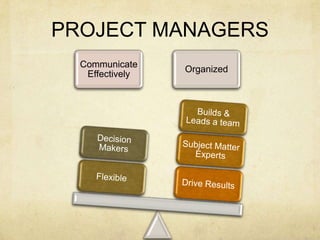
PROJECT MANAGERS
PROJECTIs a time bound endeavour undertaken to create a product or service. It is characterized by the need for the service of many different people in an organization while requiring considerable planning and coordination of tasks.
PROJECT MANAGEMENTThe application of knowledge, skills, tools and techniques to project activities to meet requirements.
Take action by decomposition or breakdown into major project deliverablesWork Breakdown Structure [WBS]
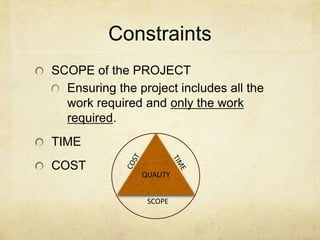
ConstraintsSCOPE of the PROJECTEnsuring the project includes all the work required and only the work required.TIMECOSTCOSTTIMEQUALITYSCOPE
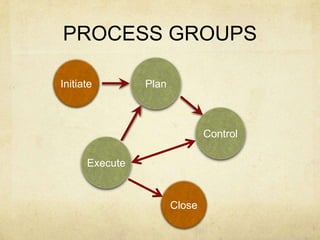
PROCESS GROUPSInitiatePlanControlExecuteClose
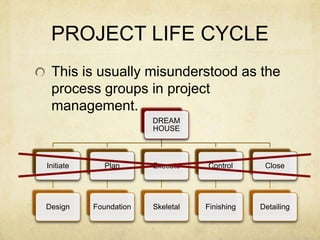
PROJECT LIFE CYCLEThis is usually misunderstood as the process groups in project management.
SPAN TIME ESTIMATINGabellon | calivo | dayan | gamba | marquezprof gusjuly 27, 2011
Determining When the Project will Be DoneProject assignments always have DEADLINE.Required Info to determine the amount of time for your project:Duration: length each individual activity takesSequence: order of activities
Developing a Network DiagramNetwork Diagrama flowchart illustrating the order of project activities performed
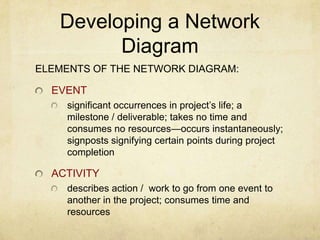
Developing a Network DiagramElements of the network diagram:Eventsignificant occurrences in project’s life; a milestone / deliverable; takes no time and consumes no resources—occurs instantaneously; signposts signifying certain points during project completionActivitydescribes action /  work to go from one event to another in the project; consumes time and resources
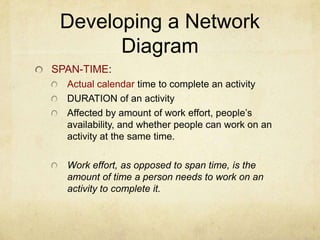
Developing a Network DiagramSpan-time: Actual calendar time to complete an activityDURATION of an activityAffected by amount of work effort, people’s availability, and whether people can work on an activity at the same time.Work effort, as opposed to span time, is the amount of time a person needs to work on an activity to complete it.
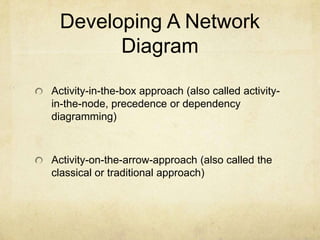
Developing A Network DiagramActivity-in-the-box approach (also called activity-in-the-node, precedence or dependency diagramming)Activity-on-the-arrow-approach (also called the classical or traditional approach)
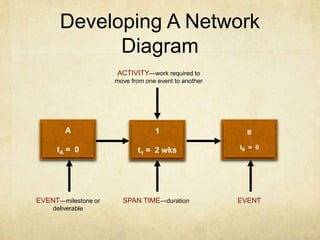
Developing A Network DiagramActivity—work required to move from one event to anotherAtA =  0BtB  =  0Event—milestone or deliverableSpan Time—durationEvent1t1 =  2 wks
Importance of A Network DiagramDetermine how long the entire project will takeIdentify potential difficultiesConsider alternatives to complete the project more quicklyThe network diagram represents your PLAN—your ROAD Map…
Defining Span Time EstimateSpan-time estimate:your best sense of how long you need to actually perform an activity (realistically speaking)
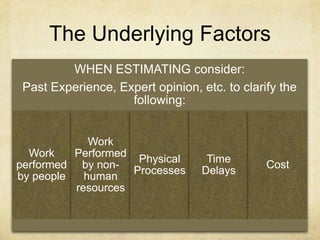
The Underlying FactorsThe underlying makeup of an activity determines how long it will take.You are required to determine its different aspects and how they affect one other.
The Underlying Factors
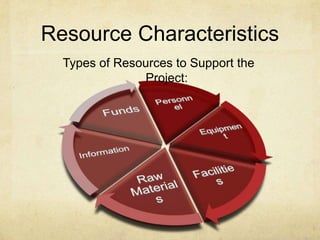
Resource CharacteristicsTypes of Resources to Support the Project:
Resource CharacteristicsFor each resource, determine its…Capacityproductivity per unit time periodAvailabilityon the calendar; when a resource will be available
Sources of Info SupportSources can be based from the following:Historical records of how long similar activities have taken place in the pastPeople who have performed similar activities in the pastPeople who will be working on the activitiesExperts familiar with the type of activity, even if they haven’t performed work exactly like it in the past
Improving Activity Span-Time EstimatesDefine your activities clearly.Subdivide your activities until your lowest level activity estimates are two weeks or less.Define activity start and end points clearly.Involve the people who will perform an activity when estimating its duration.Minimize the use of fudge factors.
Displaying your project’s scheduleKey-events listActivities listCombined key-events/activities listGantt ChartCombined milestone chart and Gantt chart
PROJECT SCHEDULINGabellon | calivo | dayan | gamba | marquezprof gusjuly 27, 2011
IMPORTANCE OF PROJECT SCHEDULEProvides a basis for you to monitor and control project activities.Helps you determine how best to allocate resources so you can achieve the project goal.Helps you assess how time delays will impact the project.Figures out where excess resources are available to allocate to other projects.Provides basis to help you track project progress.
SCHEDULE INPUTSPersonal and project calendars– critical elements are working days, shifts and resource availability Description of project scope– key start and end datesProject risks– to ensure that there’s enough extra time to deal with identified risksLists of activities and resource requirements– identifying possible constraints and other factors that may affect the schedule* A Project Manager should be aware of deadlines and resource availability issues that may make the schedule less flexible *
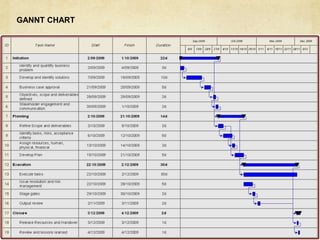
SCHEDULING TOOLSSchedule Network AnalysisGraphic presentation of the project’s activitiesGantt Chartuseful tools for analyzing and planning more complex projects; helps you monitor whether the project is on schedule.
GANNT CHART
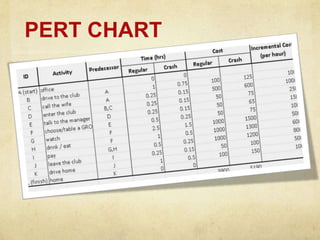
SCHEDULING TOOLSCritical Path Analysis & PERT Chartshelps you to plan all tasks that must be completed as part of a project; act as the basis both for preparation of a schedule, and of resource planning
PERT CHART
Schedule Compression helps shorten the total duration of a project by decreasing the time allotted for certain activities.CRASHING - assign more resources to an activity thus decreasing the time it takes to complete itFAST TRACKING- rearranging activities to allow more parallel workSCHEDULING TOOLS
PROJECT REVIEW“ What if” scenario analysiscompares and measures the effects of different scenarios on a projectResource levelingrearrange the sequence of activities to address the possibility of unavailable resources Critical chain methodthis also addresses resource availability; you plan activities using their latest possible  start and finish datesRisk multipliersadding extra time to high-risk activities
KEY POINTSScheduling aims to predict the future, and it has to consider many uncertainties and assumptions,The schedule identifies and organizes project tasks into a sequence of events that create the project management plan.A variety of inputs and tools are used in the scheduling process, all of which are designed to help you understand your resources, your constraints, and your risks. The end result is a plan that links events in the best way to complete the project efficiently.
RESOURCE MANAGEMENTabellon | calivo | dayan | gamba | marquezprof gusjuly 27, 2011
RESOURCE MANAGEMENTThe process of using a company’s resources in the most efficient way possible.resources such as goods and equipment, financial resources, and labor resources such as employees.
RESOURCE MANAGEMENTResource management can include ideas such as making sure one has enough physical resources for one's business, but not an overabundance so that products won't get used, or making sure that people are assigned to tasks that will keep them busy and not have too much downtime
Human ResourcesIdentify the skills and knowledge needed to perform your project’s activitiesSpecify the people who’ll work on each activityDetermine how much effort they have to invest to complete their assigned tasksDetermine their slack times and reevaluate
ENNEAGRAMUse the ENNEAGRAM to get an insight on the qualities of our employees and to check if they “fit” into their job description.Appoint project leaders into more appropriate positions based on their strengths and weaknesses thus increasing productivityCan help understand fears and desires, strengths  and weaknesses, defenses and anxieties, how we react to frustration and disappointment -  and, more positively, what our truest capacities and greatest  strengths are so that we can build on those rather  than on misjudgments and illusions.
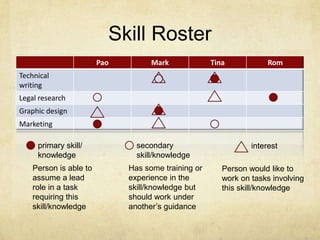
Skill Rosterprimary skill/ knowledgesecondary skill/knowledgeinterestPerson is able to assume a lead role in a task requiring this skill/knowledgeHas some training or experience in the skill/knowledge but should work under another’s guidancePerson would like to work on tasks involving this skill/knowledge
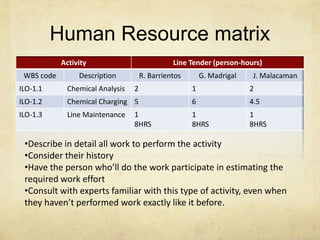
Human Resource matrixDescribe in detail all work to perform the activity
Consider their history
Have the person who’ll do the work participate in estimating the required work effort
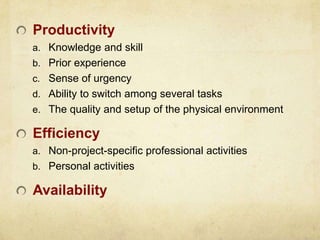
Consult with experts familiar with this type of activity, even when they haven’t performed work exactly like it before.ProductivityKnowledge and skillPrior experienceSense of urgencyAbility to switch among several tasksThe quality and setup of the physical environmentEfficiencyNon-project-specific professional activitiesPersonal activitiesAvailability
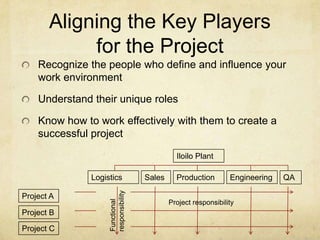
Aligning the Key Players for the ProjectRecognize the people who define and influence your work environmentUnderstand their unique rolesKnow how to work effectively with them to create a successful projectIloilo PlantLogisticsProductionSalesEngineeringQAProject AProject responsibilityFunctionalresponsibilityProject BProject C
Defining Team Member’s Roles and ResponsibilitiesAuthorityability to make binding decisions about your project’s products, schedule, resources, and activitiesResponsibilityThe commitment to achieve specific resultsAccountabilityBringing consequences to bear in response to people’s performance.
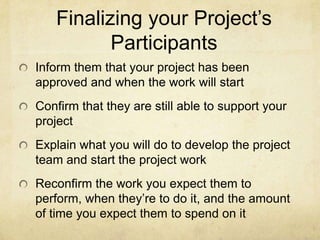
Finalizing your Project’s ParticipantsInform them that your project has been approved and when the work will startConfirm that they are still able to support your projectExplain what you will do to develop the project team and start the project workReconfirm the work you expect them to perform, when they’re to do it, and the amount of time you expect them to spend on it
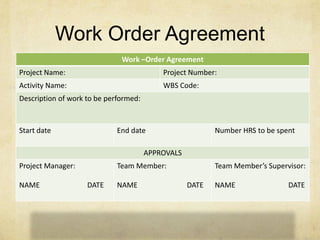
Work Order Agreement
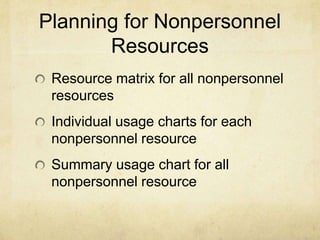
Planning for Nonpersonnel ResourcesResource matrix for all nonpersonnel resourcesIndividual usage charts for each nonpersonnel resourceSummary usage chart for all nonpersonnel resource
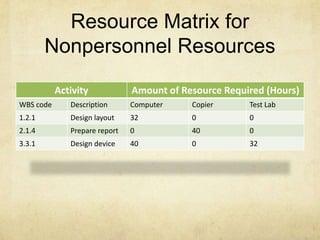
Resource Matrix for Nonpersonnel Resources
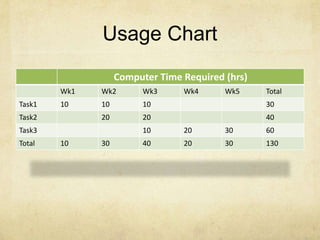
Usage Chart
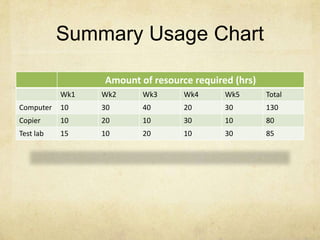
Summary Usage Chart
COSTMANAGEMENTabellon | calivo | dayan | gamba | marquezprof gusjuly 27, 2011
Cost ManagementProject Cost EstimationProgressiveevolves as more project details become available.Varianceeach estimate should provide a range of cost and time.
What is a GOOD Estimate?Defines what the project will accomplishWhat assumptions were madeHow long the estimates are validProject Cost based on the Current Information
What is a GOOD Estimate?Presents to the stakeholder everything that is relevant to the proposed work – Transparency.If there are any disagreements, in the estimate, it is better to talk about it sooner than later.
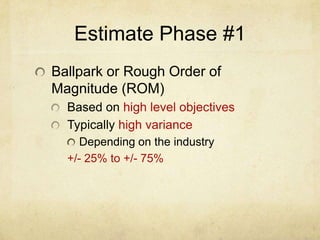
Estimate Phase #1Ballpark or Rough Order of Magnitude (ROM)Based on high level objectivesTypically high varianceDepending on the industry+/- 25% to +/- 75%
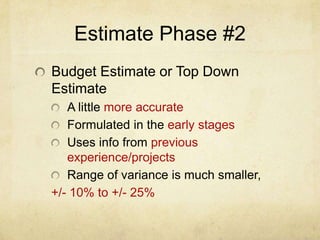
Estimate Phase #2Budget Estimate or Top Down EstimateA little more accurateFormulated in the early stagesUses info from previous experience/projectsRange of variance is much smaller, +/- 10% to +/- 25%
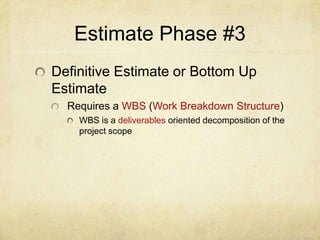
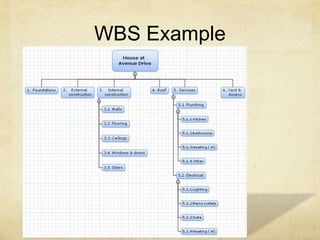
Estimate Phase #3Definitive Estimate or Bottom Up EstimateRequires a WBS (Work Breakdown Structure)WBS is a deliverables oriented decomposition of the project scope
WBS Example
WBS ExplainedCode of accounts clarifies the deliverable to all participantsProvides an accurate record of all the elements in the projectSaves time and helps control costsWBS Dictionary or Reference helps keep all divisions on the same page
Definitive EstimateTakes the most time but is the Most Accurate, +/- 5% to +/-10% of varianceVery detailedEasier to make accurate estimates once you know everything that the project will create
POOR EstimatesControlledPoor planningRushed, bloated, “low-balled” estimateUncontrolledFluctuation in Raw Materials costsInaccurate information
POOR EstimatesCan come from the Customer, Stakeholders, and even Project SponsorChange Orders or new deliverables after project scope has been finalized
QUALITY & RISKMANAGEMENTabellon | calivo | dayan | gamba | marquezprof gusjuly 27, 2011
Four Aspects of QualityClient SatisfactionAccurate and Current specificationsQuality of the Product of the ProjectQuality of the Project
Achieving QualityDo the Right Thing Right the First Time (DTRTRTFT)The CUSTOMER is the next Person/Operation in the ProcessStatistical Process Control
Risk“The possibility that you may not achieve your product, schedule, or resource targets because something unexpected occurs or something planned doesn’t occur.”
Risk Management“It is the systematic process of identifying, analyzing, and responding to project risk. It includes maximizing the probability and consequences of positive events and minimizing the probability & consequences of adverse events to project objectives.”
Risk ManagementRisk Management PlanningRisk IdentificationQualitative Risk AnalysisQuantitative Risk AnalysisRisk Response PlanningRisk Monitoring and Control
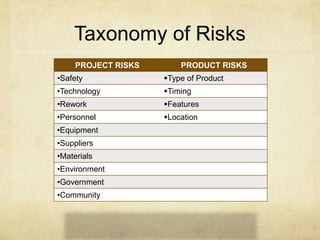
Taxonomy of Risks
REPORTING & CONROLMANAGEMENTabellon | calivo | dayan | gamba | marquezprof gusjuly 27, 2011
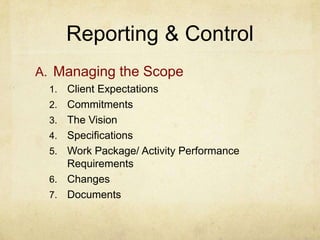
Reporting & ControlManaging the ScopeClient ExpectationsCommitments The VisionSpecificationsWork Package/ Activity Performance RequirementsChanges Documents
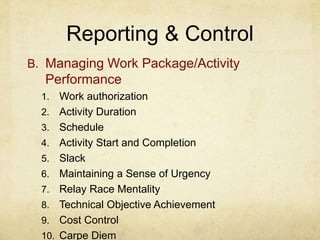
Reporting & ControlManaging Work Package/Activity PerformanceWork authorizationActivity DurationScheduleActivity Start and CompletionSlackMaintaining a Sense of UrgencyRelay Race MentalityTechnical Objective AchievementCost ControlCarpe Diem

Project Management

  • 1.
    Project ManagementMMOPEMANabellon |calivo | dayan | gamba | marquezprof gusjuly 27, 2011
  • 2.
  • 3.
    PROJECTIs a timebound endeavour undertaken to create a product or service. It is characterized by the need for the service of many different people in an organization while requiring considerable planning and coordination of tasks.
  • 4.
    PROJECT MANAGEMENTThe applicationof knowledge, skills, tools and techniques to project activities to meet requirements.
  • 6.
    Take action bydecomposition or breakdown into major project deliverablesWork Breakdown Structure [WBS]
  • 7.
    ConstraintsSCOPE of thePROJECTEnsuring the project includes all the work required and only the work required.TIMECOSTCOSTTIMEQUALITYSCOPE
  • 8.
  • 9.
    PROJECT LIFE CYCLEThisis usually misunderstood as the process groups in project management.
  • 10.
    SPAN TIME ESTIMATINGabellon| calivo | dayan | gamba | marquezprof gusjuly 27, 2011
  • 11.
    Determining When theProject will Be DoneProject assignments always have DEADLINE.Required Info to determine the amount of time for your project:Duration: length each individual activity takesSequence: order of activities
  • 12.
    Developing a NetworkDiagramNetwork Diagrama flowchart illustrating the order of project activities performed
  • 13.
    Developing a NetworkDiagramElements of the network diagram:Eventsignificant occurrences in project’s life; a milestone / deliverable; takes no time and consumes no resources—occurs instantaneously; signposts signifying certain points during project completionActivitydescribes action / work to go from one event to another in the project; consumes time and resources
  • 14.
    Developing a NetworkDiagramSpan-time: Actual calendar time to complete an activityDURATION of an activityAffected by amount of work effort, people’s availability, and whether people can work on an activity at the same time.Work effort, as opposed to span time, is the amount of time a person needs to work on an activity to complete it.
  • 15.
    Developing A NetworkDiagramActivity-in-the-box approach (also called activity-in-the-node, precedence or dependency diagramming)Activity-on-the-arrow-approach (also called the classical or traditional approach)
  • 16.
    Developing A NetworkDiagramActivity—work required to move from one event to anotherAtA = 0BtB = 0Event—milestone or deliverableSpan Time—durationEvent1t1 = 2 wks
  • 17.
    Importance of ANetwork DiagramDetermine how long the entire project will takeIdentify potential difficultiesConsider alternatives to complete the project more quicklyThe network diagram represents your PLAN—your ROAD Map…
  • 18.
    Defining Span TimeEstimateSpan-time estimate:your best sense of how long you need to actually perform an activity (realistically speaking)
  • 19.
    The Underlying FactorsTheunderlying makeup of an activity determines how long it will take.You are required to determine its different aspects and how they affect one other.
  • 20.
  • 21.
    Resource CharacteristicsTypes ofResources to Support the Project:
  • 22.
    Resource CharacteristicsFor eachresource, determine its…Capacityproductivity per unit time periodAvailabilityon the calendar; when a resource will be available
  • 23.
    Sources of InfoSupportSources can be based from the following:Historical records of how long similar activities have taken place in the pastPeople who have performed similar activities in the pastPeople who will be working on the activitiesExperts familiar with the type of activity, even if they haven’t performed work exactly like it in the past
  • 24.
    Improving Activity Span-TimeEstimatesDefine your activities clearly.Subdivide your activities until your lowest level activity estimates are two weeks or less.Define activity start and end points clearly.Involve the people who will perform an activity when estimating its duration.Minimize the use of fudge factors.
  • 25.
    Displaying your project’sscheduleKey-events listActivities listCombined key-events/activities listGantt ChartCombined milestone chart and Gantt chart
  • 26.
    PROJECT SCHEDULINGabellon |calivo | dayan | gamba | marquezprof gusjuly 27, 2011
  • 27.
    IMPORTANCE OF PROJECTSCHEDULEProvides a basis for you to monitor and control project activities.Helps you determine how best to allocate resources so you can achieve the project goal.Helps you assess how time delays will impact the project.Figures out where excess resources are available to allocate to other projects.Provides basis to help you track project progress.
  • 28.
    SCHEDULE INPUTSPersonal andproject calendars– critical elements are working days, shifts and resource availability Description of project scope– key start and end datesProject risks– to ensure that there’s enough extra time to deal with identified risksLists of activities and resource requirements– identifying possible constraints and other factors that may affect the schedule* A Project Manager should be aware of deadlines and resource availability issues that may make the schedule less flexible *
  • 29.
    SCHEDULING TOOLSSchedule NetworkAnalysisGraphic presentation of the project’s activitiesGantt Chartuseful tools for analyzing and planning more complex projects; helps you monitor whether the project is on schedule.
  • 30.
  • 31.
    SCHEDULING TOOLSCritical PathAnalysis & PERT Chartshelps you to plan all tasks that must be completed as part of a project; act as the basis both for preparation of a schedule, and of resource planning
  • 32.
  • 33.
    Schedule Compression helpsshorten the total duration of a project by decreasing the time allotted for certain activities.CRASHING - assign more resources to an activity thus decreasing the time it takes to complete itFAST TRACKING- rearranging activities to allow more parallel workSCHEDULING TOOLS
  • 34.
    PROJECT REVIEW“ Whatif” scenario analysiscompares and measures the effects of different scenarios on a projectResource levelingrearrange the sequence of activities to address the possibility of unavailable resources Critical chain methodthis also addresses resource availability; you plan activities using their latest possible start and finish datesRisk multipliersadding extra time to high-risk activities
  • 35.
    KEY POINTSScheduling aimsto predict the future, and it has to consider many uncertainties and assumptions,The schedule identifies and organizes project tasks into a sequence of events that create the project management plan.A variety of inputs and tools are used in the scheduling process, all of which are designed to help you understand your resources, your constraints, and your risks. The end result is a plan that links events in the best way to complete the project efficiently.
  • 36.
    RESOURCE MANAGEMENTabellon |calivo | dayan | gamba | marquezprof gusjuly 27, 2011
  • 37.
    RESOURCE MANAGEMENTThe processof using a company’s resources in the most efficient way possible.resources such as goods and equipment, financial resources, and labor resources such as employees.
  • 38.
    RESOURCE MANAGEMENTResource managementcan include ideas such as making sure one has enough physical resources for one's business, but not an overabundance so that products won't get used, or making sure that people are assigned to tasks that will keep them busy and not have too much downtime
  • 39.
    Human ResourcesIdentify theskills and knowledge needed to perform your project’s activitiesSpecify the people who’ll work on each activityDetermine how much effort they have to invest to complete their assigned tasksDetermine their slack times and reevaluate
  • 40.
    ENNEAGRAMUse the ENNEAGRAMto get an insight on the qualities of our employees and to check if they “fit” into their job description.Appoint project leaders into more appropriate positions based on their strengths and weaknesses thus increasing productivityCan help understand fears and desires, strengths and weaknesses, defenses and anxieties, how we react to frustration and disappointment - and, more positively, what our truest capacities and greatest strengths are so that we can build on those rather than on misjudgments and illusions.
  • 41.
    Skill Rosterprimary skill/knowledgesecondary skill/knowledgeinterestPerson is able to assume a lead role in a task requiring this skill/knowledgeHas some training or experience in the skill/knowledge but should work under another’s guidancePerson would like to work on tasks involving this skill/knowledge
  • 42.
    Human Resource matrixDescribein detail all work to perform the activity
  • 43.
  • 44.
    Have the personwho’ll do the work participate in estimating the required work effort
  • 45.
    Consult with expertsfamiliar with this type of activity, even when they haven’t performed work exactly like it before.ProductivityKnowledge and skillPrior experienceSense of urgencyAbility to switch among several tasksThe quality and setup of the physical environmentEfficiencyNon-project-specific professional activitiesPersonal activitiesAvailability
  • 46.
    Aligning the KeyPlayers for the ProjectRecognize the people who define and influence your work environmentUnderstand their unique rolesKnow how to work effectively with them to create a successful projectIloilo PlantLogisticsProductionSalesEngineeringQAProject AProject responsibilityFunctionalresponsibilityProject BProject C
  • 47.
    Defining Team Member’sRoles and ResponsibilitiesAuthorityability to make binding decisions about your project’s products, schedule, resources, and activitiesResponsibilityThe commitment to achieve specific resultsAccountabilityBringing consequences to bear in response to people’s performance.
  • 48.
    Finalizing your Project’sParticipantsInform them that your project has been approved and when the work will startConfirm that they are still able to support your projectExplain what you will do to develop the project team and start the project workReconfirm the work you expect them to perform, when they’re to do it, and the amount of time you expect them to spend on it
  • 49.
  • 50.
    Planning for NonpersonnelResourcesResource matrix for all nonpersonnel resourcesIndividual usage charts for each nonpersonnel resourceSummary usage chart for all nonpersonnel resource
  • 51.
    Resource Matrix forNonpersonnel Resources
  • 52.
  • 53.
  • 54.
    COSTMANAGEMENTabellon | calivo| dayan | gamba | marquezprof gusjuly 27, 2011
  • 55.
    Cost ManagementProject CostEstimationProgressiveevolves as more project details become available.Varianceeach estimate should provide a range of cost and time.
  • 56.
    What is aGOOD Estimate?Defines what the project will accomplishWhat assumptions were madeHow long the estimates are validProject Cost based on the Current Information
  • 57.
    What is aGOOD Estimate?Presents to the stakeholder everything that is relevant to the proposed work – Transparency.If there are any disagreements, in the estimate, it is better to talk about it sooner than later.
  • 58.
    Estimate Phase #1Ballparkor Rough Order of Magnitude (ROM)Based on high level objectivesTypically high varianceDepending on the industry+/- 25% to +/- 75%
  • 59.
    Estimate Phase #2BudgetEstimate or Top Down EstimateA little more accurateFormulated in the early stagesUses info from previous experience/projectsRange of variance is much smaller, +/- 10% to +/- 25%
  • 60.
    Estimate Phase #3DefinitiveEstimate or Bottom Up EstimateRequires a WBS (Work Breakdown Structure)WBS is a deliverables oriented decomposition of the project scope
  • 61.
  • 62.
    WBS ExplainedCode ofaccounts clarifies the deliverable to all participantsProvides an accurate record of all the elements in the projectSaves time and helps control costsWBS Dictionary or Reference helps keep all divisions on the same page
  • 63.
    Definitive EstimateTakes themost time but is the Most Accurate, +/- 5% to +/-10% of varianceVery detailedEasier to make accurate estimates once you know everything that the project will create
  • 64.
    POOR EstimatesControlledPoor planningRushed,bloated, “low-balled” estimateUncontrolledFluctuation in Raw Materials costsInaccurate information
  • 65.
    POOR EstimatesCan comefrom the Customer, Stakeholders, and even Project SponsorChange Orders or new deliverables after project scope has been finalized
  • 66.
    QUALITY & RISKMANAGEMENTabellon| calivo | dayan | gamba | marquezprof gusjuly 27, 2011
  • 67.
    Four Aspects ofQualityClient SatisfactionAccurate and Current specificationsQuality of the Product of the ProjectQuality of the Project
  • 68.
    Achieving QualityDo theRight Thing Right the First Time (DTRTRTFT)The CUSTOMER is the next Person/Operation in the ProcessStatistical Process Control
  • 69.
    Risk“The possibility thatyou may not achieve your product, schedule, or resource targets because something unexpected occurs or something planned doesn’t occur.”
  • 70.
    Risk Management“It isthe systematic process of identifying, analyzing, and responding to project risk. It includes maximizing the probability and consequences of positive events and minimizing the probability & consequences of adverse events to project objectives.”
  • 71.
    Risk ManagementRisk ManagementPlanningRisk IdentificationQualitative Risk AnalysisQuantitative Risk AnalysisRisk Response PlanningRisk Monitoring and Control
  • 72.
  • 73.
    REPORTING & CONROLMANAGEMENTabellon| calivo | dayan | gamba | marquezprof gusjuly 27, 2011
  • 74.
    Reporting & ControlManagingthe ScopeClient ExpectationsCommitments The VisionSpecificationsWork Package/ Activity Performance RequirementsChanges Documents
  • 75.
    Reporting & ControlManagingWork Package/Activity PerformanceWork authorizationActivity DurationScheduleActivity Start and CompletionSlackMaintaining a Sense of UrgencyRelay Race MentalityTechnical Objective AchievementCost ControlCarpe Diem

Editor's Notes

  • #3 These answers the who are involved or stakeholdersThese are the some of the traits an effective project manager must have.
  • #4 This is the what. This definition was from project management body of knowledge PMBOK.The project here has a definite beginning and end not an ongoing endeavour. then you ask the class what is the project is to you?another definition of a project is to manage a project means to Complete a series of tasks with a due date.From there you can determine how much project management tools you need to apply.
  • #7 How to manage a projectIn any project we do we sometimes get overwhelmed by the weight of the project at hand. Breakdown to smaller manageable portions
  • #8 By adjusting the constraints we alter the project
  • #10 Project life cycle should reflect the end poduct.This should not be confused with the project process grps.Here it can be seen that the dream house has been broken down into end products that need to be delivered when combined create the dream house
  • #40 On the last note these are for the tasks on wc they are less than fully committed, thus determine where they need to invest in their time.
  • #41 One such tool in recognizing the who you should surround yourself with to create a team that his a high productivity and efficeincy
  • #42 Displays the skills and knowledge of people who may work on your project
  • #43 Just because a person has the right skills and knowledge doesn’t assure success. That person must be given an adequate amount of time to perform all the necessary work.Factor in productivity, efficeincy and availability
  • #44 Begin planning your workload by developing human resource matrix and a person load chart
  • #45 Success in this project oriented organization requires you to…Here create a matrix structure where people from different areas of the organization are assigned to lead or work on projects.MANCOM where teams can assemble rapidly, expertise can be available for different projects.Disadvantages – team members work on multiple projects who respond to 2 or more managers, team may not be familiar with style and knowledge, team members may focus more on their individual assigmnents and less on the project and its goals.
  • #47 Reaffirm who you will involve in the projectMake sure everyone concerned with he project is still on board
  • #49 Create the following