The New Project Management
                                By J. Davidson Frame

The new business environment:
      • Downsizing
      • Flattening
      • Empowering Employees
      • Outsourcing

The new project management:
      • Need for a customer focus
      • Need to acquire nontraditional project management skills
              • “hard” skills—basics of contracting, business finance, integrated
                 cost/schedule control, measuring work performance, monitoring
                 quality, and conducting risk analysis
              • “soft” skills—negotiating, managing change, being politically astute,
                 and understanding the needs and wants of the people they deal with
                 (including customers, peers, staff and managers)
      • Redefine role of project managers
              • Primarily seen as implementers but need new paradigm
              • Project managers must be customer focused
              • Project managers must be empowered to operate effectively
              • Majority of their decisions can be made independently without having
                 to pass through the chain of command
              • They possess substantial profit and loss responsibilities
              • They see themselves largely as independent business persons running
                 their own business

Traits of the new project manager:
   • Thorough understanding of project goals
   • Capable of understanding staff needs
   • Good head for details
   • Strong commitment to the project (willing to put in long hours on the project)
   • Able to cope with setbacks and disappointments
   • Good negotiation skills
   • Results oriented and practical
   • Cost conscious and possesses basic business skills
   • Politically savvy (aware of what NOT to do as well as what to do)
   • High tolerance for ambiguity

Common dualities project managers face:
   • Seeing the big picture vs. paying attention to details
   • Maintaining firmness vs. being flexible
   • Being hard vs. being soft in dealing with people
   • Possessing analytical skills vs. trusting one’s instincts
bookreviewframenewpmnotes-doc-101020012442-phpapp02.doc                     Page 1 of 6
                              Dee Pink 10/20/10
Change management strategies:
       • Develop a pro-change mind-set
       • Develop appreciation of change through education and training
       • Encourage upside-down thinking such as:
             o Operations and maintenance efforts should be treated as part of the
                project life cycle
             o Technical people must be adept at understanding and offering
                business solutions to problems
             o There is no such thing as “the” customer. There are always multiple
                customers
             o A key function of managers is to support their workers, not to direct
                them
       • Use crises to shake up stagnant attitudes

Traits of effective Needs Analysts:
   • Strong ability to deal with customers and extract from them a sense of what they
        truly need
   • Good political skills
   • Technically competent
   • Open-minded and possess a good imagination
   • High tolerance for ambiguity
   • Articulate

Steps for improving needs definition:
   1. Understand the present system in its total context
   2. Identify multiple customers and prioritize their needs
   3. Put together a needs-defining task force
   4. Educate the customers

Organizing to achieve customer satisfaction:
   1. Reformulation of corporate culture--Corporate culture must be changed to
       support a customer-focused approach. Project managers and other project staff—
       the frontline troops encountering customers on a daily basis—must be empowered
       to do what it takes to assure customer satisfaction
       • Focus on value
       • Tolerate and encourage upside-down thinking
       • Share power throughout organization
       • Take a long-term view
       • Assume total customer focus
   2. Focus on stability and continuity--Develop projects as islands of stability in a sea
       of change
   3. Assume life cycle perspective--Organization must adopt total life cycle outlook on
       its project efforts. Project staff must do their work with one eye always focused
       on operations and maintenance of final product.


bookreviewframenewpmnotes-doc-101020012442-phpapp02.doc                       Page 2 of 6
                              Dee Pink 10/20/10
4. Establish mechanisms to assure customer satisfaction—development of methods
      and procedures to ensure customer sensibilities will not be violated by oversights
      and sloppy procedures.
   5. Strengthen capabilities of project staff--Everything possible must be done to
      improve the capabilities of project staff. Basic business skills: capital budgeting
      techniques, contracting basics, decision-making methodologies, forecasting, and
      reading financial statements.

What to do when customers don’t cooperate:
  1. Remind customer organization of its contractual obligations
  2. Emphasize very clearly at the outset of the project the importance to project
       success of meeting certain key milestones, including those requiring customer
       inputs. Periodically remind them of upcoming obligations.
  3. Establish a steering committee to oversee project progress. Members should
       include individuals from customer organization as well as the project
       organization.

Politics: the process whereby attempts are made to achieve goals through
accommodation and the exercise of influence.

Players to contend with in project environment:
   • Bosses
   • Peers
   • Functional managers controlling resources
   • Customers
   • Vendors
   • Others (purchasing, information resource management, contracts, secretaries)

Common political pitfalls:
  • Accepting things at face value—good politicians are adept at penetrating through
     the superficial to identify the real issues.
  • Insensitivity to political realities
  • The hyper-politician—being too political; pursues too much of a good thing
  • The hypo-politician—under performs politically; avoids or ignores something that
     will definitely affect them.

How to become more politically effective:
  1. Develop a positive attitude toward politics
  2. Lay a solid foundation for political action by developing a base of authority
  3. Identify key elements of the environment
      • Who are the players?
      • What are the goals of the players?
      • Who am I? Know thyself (strengths, weaknesses) and how colleagues view
          you.
  4. Define the problem, then identify and implement a course of action


bookreviewframenewpmnotes-doc-101020012442-phpapp02.doc                       Page 3 of 6
                              Dee Pink 10/20/10
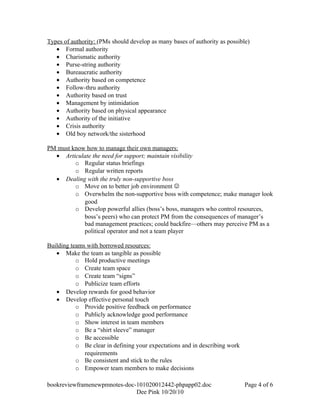
Types of authority: (PMs should develop as many bases of authority as possible)
   • Formal authority
   • Charismatic authority
   • Purse-string authority
   • Bureaucratic authority
   • Authority based on competence
   • Follow-thru authority
   • Authority based on trust
   • Management by intimidation
   • Authority based on physical appearance
   • Authority of the initiative
   • Crisis authority
   • Old boy network/the sisterhood

PM must know how to manage their own managers:
  • Articulate the need for support; maintain visibility
         o Regular status briefings
         o Regular written reports
  • Dealing with the truly non-supportive boss
         o Move on to better job environment 
         o Overwhelm the non-supportive boss with competence; make manager look
            good
         o Develop powerful allies (boss’s boss, managers who control resources,
            boss’s peers) who can protect PM from the consequences of manager’s
            bad management practices; could backfire—others may perceive PM as a
            political operator and not a team player

Building teams with borrowed resources:
   • Make the team as tangible as possible
           o Hold productive meetings
           o Create team space
           o Create team “signs”
           o Publicize team efforts
   • Develop rewards for good behavior
   • Develop effective personal touch
           o Provide positive feedback on performance
           o Publicly acknowledge good performance
           o Show interest in team members
           o Be a “shirt sleeve” manager
           o Be accessible
           o Be clear in defining your expectations and in describing work
              requirements
           o Be consistent and stick to the rules
           o Empower team members to make decisions

bookreviewframenewpmnotes-doc-101020012442-phpapp02.doc                      Page 4 of 6
                              Dee Pink 10/20/10
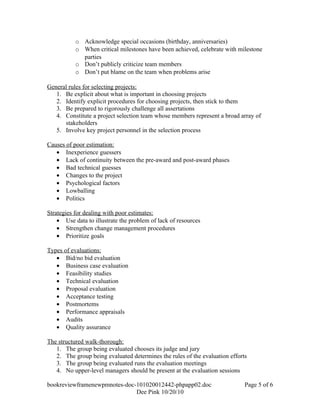
o Acknowledge special occasions (birthday, anniversaries)
           o When critical milestones have been achieved, celebrate with milestone
             parties
           o Don’t publicly criticize team members
           o Don’t put blame on the team when problems arise

General rules for selecting projects:
   1. Be explicit about what is important in choosing projects
   2. Identify explicit procedures for choosing projects, then stick to them
   3. Be prepared to rigorously challenge all assertations
   4. Constitute a project selection team whose members represent a broad array of
      stakeholders
   5. Involve key project personnel in the selection process

Causes of poor estimation:
   • Inexperience guessers
   • Lack of continuity between the pre-award and post-award phases
   • Bad technical guesses
   • Changes to the project
   • Psychological factors
   • Lowballing
   • Politics

Strategies for dealing with poor estimates:
    • Use data to illustrate the problem of lack of resources
    • Strengthen change management procedures
    • Prioritize goals

Types of evaluations:
   • Bid/no bid evaluation
   • Business case evaluation
   • Feasibility studies
   • Technical evaluation
   • Proposal evaluation
   • Acceptance testing
   • Postmortems
   • Performance appraisals
   • Audits
   • Quality assurance

The structured walk-thorough:
   1. The group being evaluated chooses its judge and jury
   2. The group being evaluated determines the rules of the evaluation efforts
   3. The group being evaluated runs the evaluation meetings
   4. No upper-level managers should be present at the evaluation sessions

bookreviewframenewpmnotes-doc-101020012442-phpapp02.doc                      Page 5 of 6
                              Dee Pink 10/20/10
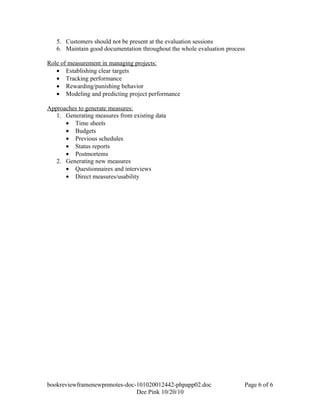
5. Customers should not be present at the evaluation sessions
   6. Maintain good documentation throughout the whole evaluation process

Role of measurement in managing projects:
   • Establishing clear targets
   • Tracking performance
   • Rewarding/punishing behavior
   • Modeling and predicting project performance

Approaches to generate measures:
   1. Generating measures from existing data
      • Time sheets
      • Budgets
      • Previous schedules
      • Status reports
      • Postmortems
   2. Generating new measures
      • Questionnaires and interviews
      • Direct measures/usability


bookreviewframenewpmnotes-doc-101020012442-phpapp02.doc                 Page 6 of 6
                              Dee Pink 10/20/10

Book review framenewp_mnotes.doc

  • 1.
    The New ProjectManagement By J. Davidson Frame The new business environment: • Downsizing • Flattening • Empowering Employees • Outsourcing The new project management: • Need for a customer focus • Need to acquire nontraditional project management skills • “hard” skills—basics of contracting, business finance, integrated cost/schedule control, measuring work performance, monitoring quality, and conducting risk analysis • “soft” skills—negotiating, managing change, being politically astute, and understanding the needs and wants of the people they deal with (including customers, peers, staff and managers) • Redefine role of project managers • Primarily seen as implementers but need new paradigm • Project managers must be customer focused • Project managers must be empowered to operate effectively • Majority of their decisions can be made independently without having to pass through the chain of command • They possess substantial profit and loss responsibilities • They see themselves largely as independent business persons running their own business Traits of the new project manager: • Thorough understanding of project goals • Capable of understanding staff needs • Good head for details • Strong commitment to the project (willing to put in long hours on the project) • Able to cope with setbacks and disappointments • Good negotiation skills • Results oriented and practical • Cost conscious and possesses basic business skills • Politically savvy (aware of what NOT to do as well as what to do) • High tolerance for ambiguity Common dualities project managers face: • Seeing the big picture vs. paying attention to details • Maintaining firmness vs. being flexible • Being hard vs. being soft in dealing with people • Possessing analytical skills vs. trusting one’s instincts bookreviewframenewpmnotes-doc-101020012442-phpapp02.doc Page 1 of 6 Dee Pink 10/20/10
  • 2.
    Change management strategies: • Develop a pro-change mind-set • Develop appreciation of change through education and training • Encourage upside-down thinking such as: o Operations and maintenance efforts should be treated as part of the project life cycle o Technical people must be adept at understanding and offering business solutions to problems o There is no such thing as “the” customer. There are always multiple customers o A key function of managers is to support their workers, not to direct them • Use crises to shake up stagnant attitudes Traits of effective Needs Analysts: • Strong ability to deal with customers and extract from them a sense of what they truly need • Good political skills • Technically competent • Open-minded and possess a good imagination • High tolerance for ambiguity • Articulate Steps for improving needs definition: 1. Understand the present system in its total context 2. Identify multiple customers and prioritize their needs 3. Put together a needs-defining task force 4. Educate the customers Organizing to achieve customer satisfaction: 1. Reformulation of corporate culture--Corporate culture must be changed to support a customer-focused approach. Project managers and other project staff— the frontline troops encountering customers on a daily basis—must be empowered to do what it takes to assure customer satisfaction • Focus on value • Tolerate and encourage upside-down thinking • Share power throughout organization • Take a long-term view • Assume total customer focus 2. Focus on stability and continuity--Develop projects as islands of stability in a sea of change 3. Assume life cycle perspective--Organization must adopt total life cycle outlook on its project efforts. Project staff must do their work with one eye always focused on operations and maintenance of final product. bookreviewframenewpmnotes-doc-101020012442-phpapp02.doc Page 2 of 6 Dee Pink 10/20/10
  • 3.
    4. Establish mechanismsto assure customer satisfaction—development of methods and procedures to ensure customer sensibilities will not be violated by oversights and sloppy procedures. 5. Strengthen capabilities of project staff--Everything possible must be done to improve the capabilities of project staff. Basic business skills: capital budgeting techniques, contracting basics, decision-making methodologies, forecasting, and reading financial statements. What to do when customers don’t cooperate: 1. Remind customer organization of its contractual obligations 2. Emphasize very clearly at the outset of the project the importance to project success of meeting certain key milestones, including those requiring customer inputs. Periodically remind them of upcoming obligations. 3. Establish a steering committee to oversee project progress. Members should include individuals from customer organization as well as the project organization. Politics: the process whereby attempts are made to achieve goals through accommodation and the exercise of influence. Players to contend with in project environment: • Bosses • Peers • Functional managers controlling resources • Customers • Vendors • Others (purchasing, information resource management, contracts, secretaries) Common political pitfalls: • Accepting things at face value—good politicians are adept at penetrating through the superficial to identify the real issues. • Insensitivity to political realities • The hyper-politician—being too political; pursues too much of a good thing • The hypo-politician—under performs politically; avoids or ignores something that will definitely affect them. How to become more politically effective: 1. Develop a positive attitude toward politics 2. Lay a solid foundation for political action by developing a base of authority 3. Identify key elements of the environment • Who are the players? • What are the goals of the players? • Who am I? Know thyself (strengths, weaknesses) and how colleagues view you. 4. Define the problem, then identify and implement a course of action bookreviewframenewpmnotes-doc-101020012442-phpapp02.doc Page 3 of 6 Dee Pink 10/20/10
  • 4.
    Types of authority:(PMs should develop as many bases of authority as possible) • Formal authority • Charismatic authority • Purse-string authority • Bureaucratic authority • Authority based on competence • Follow-thru authority • Authority based on trust • Management by intimidation • Authority based on physical appearance • Authority of the initiative • Crisis authority • Old boy network/the sisterhood PM must know how to manage their own managers: • Articulate the need for support; maintain visibility o Regular status briefings o Regular written reports • Dealing with the truly non-supportive boss o Move on to better job environment  o Overwhelm the non-supportive boss with competence; make manager look good o Develop powerful allies (boss’s boss, managers who control resources, boss’s peers) who can protect PM from the consequences of manager’s bad management practices; could backfire—others may perceive PM as a political operator and not a team player Building teams with borrowed resources: • Make the team as tangible as possible o Hold productive meetings o Create team space o Create team “signs” o Publicize team efforts • Develop rewards for good behavior • Develop effective personal touch o Provide positive feedback on performance o Publicly acknowledge good performance o Show interest in team members o Be a “shirt sleeve” manager o Be accessible o Be clear in defining your expectations and in describing work requirements o Be consistent and stick to the rules o Empower team members to make decisions bookreviewframenewpmnotes-doc-101020012442-phpapp02.doc Page 4 of 6 Dee Pink 10/20/10
  • 5.
    o Acknowledge specialoccasions (birthday, anniversaries) o When critical milestones have been achieved, celebrate with milestone parties o Don’t publicly criticize team members o Don’t put blame on the team when problems arise General rules for selecting projects: 1. Be explicit about what is important in choosing projects 2. Identify explicit procedures for choosing projects, then stick to them 3. Be prepared to rigorously challenge all assertations 4. Constitute a project selection team whose members represent a broad array of stakeholders 5. Involve key project personnel in the selection process Causes of poor estimation: • Inexperience guessers • Lack of continuity between the pre-award and post-award phases • Bad technical guesses • Changes to the project • Psychological factors • Lowballing • Politics Strategies for dealing with poor estimates: • Use data to illustrate the problem of lack of resources • Strengthen change management procedures • Prioritize goals Types of evaluations: • Bid/no bid evaluation • Business case evaluation • Feasibility studies • Technical evaluation • Proposal evaluation • Acceptance testing • Postmortems • Performance appraisals • Audits • Quality assurance The structured walk-thorough: 1. The group being evaluated chooses its judge and jury 2. The group being evaluated determines the rules of the evaluation efforts 3. The group being evaluated runs the evaluation meetings 4. No upper-level managers should be present at the evaluation sessions bookreviewframenewpmnotes-doc-101020012442-phpapp02.doc Page 5 of 6 Dee Pink 10/20/10
  • 6.
    5. Customers shouldnot be present at the evaluation sessions 6. Maintain good documentation throughout the whole evaluation process Role of measurement in managing projects: • Establishing clear targets • Tracking performance • Rewarding/punishing behavior • Modeling and predicting project performance Approaches to generate measures: 1. Generating measures from existing data • Time sheets • Budgets • Previous schedules • Status reports • Postmortems 2. Generating new measures • Questionnaires and interviews • Direct measures/usability bookreviewframenewpmnotes-doc-101020012442-phpapp02.doc Page 6 of 6 Dee Pink 10/20/10