Microtomy
Biological Techniques
What is microtomy?
Introduction
 Thickness of the sections is predetermined at regular
distance on the microtome
 The sections are attached to a surface like glass slides
for staining
 Tissues like muscles, bones, hair are cut of thickness
from 50 nm and 100 µm
 Thickness of the sections may be fixed according to the
need of the study and material involved
 The stained sections can be studied by light or electron
microscopy
Introduction
Advanced Analytical Techniques
Microtomy- Types of
microtomy
Types of microtomy
 Main types include
◦ Rotary microtome
◦ Cryotome
◦ Ultra microtome
◦ Laser microtome
 Use depends on the material under study and the
nature of the work
 Simple studies involve rotary microtome while
detailed studies may involve ultra microtome, etc.
 Similarly cryomicrotome involves sectioning of the
frozen tissues.
 The most common type of the microtome
 Rotary action involves the sectioning process at
predetermined thickness on every rotation of the
flywheel
 Blade is fixed at horizontal position
 The sample holder moves the sample ahead by the
fixed distance for cutting
 Flywheel of the instrument may be automatic or
manual
 Section thickness may vary from 0.5 µm to 60 µm
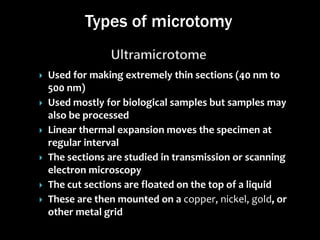
Types of microtomy
Types of microtomy
 Used for making extremely thin sections (40 nm to
500 nm)
 Used mostly for biological samples but samples may
also be processed
 Linear thermal expansion moves the specimen at
regular interval
 The sections are studied in transmission or scanning
electron microscopy
 The cut sections are floated on the top of a liquid
 These are then mounted on a copper, nickel, gold, or
other metal grid
Advanced Analytical Techniques
Microtomy-
Method (fixation
and processing)
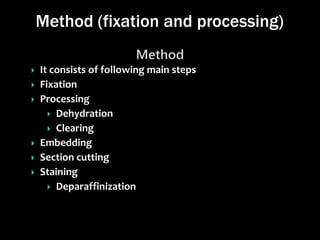
 It consists of following main steps
 Fixation
 Processing
 Dehydration
 Clearing
 Embedding
 Section cutting
 Staining
 Deparaffinization
Method (fixation and processing)
Fixation
Method (fixation and processing)
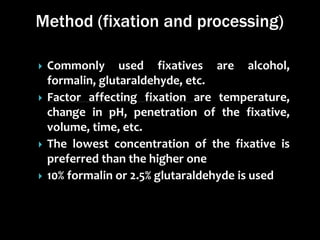
 Commonly used fixatives are alcohol,
formalin, glutaraldehyde, etc.
 Factor affecting fixation are temperature,
change in pH, penetration of the fixative,
volume, time, etc.
 The lowest concentration of the fixative is
preferred than the higher one
 10% formalin or 2.5% glutaraldehyde is used
Method (fixation and processing)
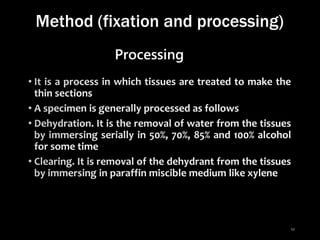
Processing
Method (fixation and processing)
Advanced Analytical Techniques
Microtomy-
Method
(embedding)
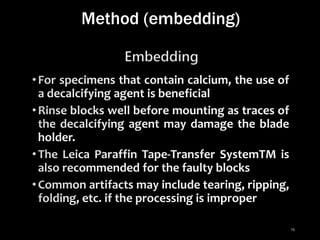
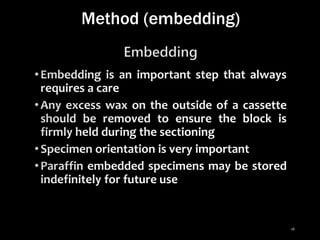
Embedding
Method (embedding)
Method (embedding)
Method (embedding)
Advanced Analytical Techniques
Microtomy-
Method
(sectioning and
staining)
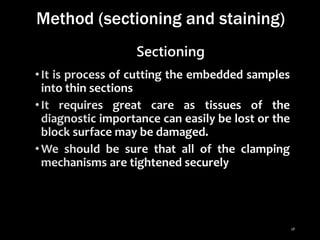
Sectioning
Method (sectioning and staining)
Sectioning
Method (sectioning and staining)
Staining
Method (sectioning and staining)
Staining
Method (sectioning and staining)

2. Microtomy Bio Techniques.pptx