WEC Italia – Cattura e Stoccaggio della CO 2  (CCS) Roma, October 18, 2011 Technologies for Carbon Capture  in Oil Refineries Ivano Miracca Saipem s.p.a.
Saipem Highlights Leading Global EP(I)C General Contractor Designed and built: Over 90 grass roots complexes, 1,700 process units Over 120,000 km of land pipelines, sealines and trunklines In the last decade, more than 100 offshore EPIC projects, including groundbreaking deepwater  achievements Drilled over 7,300 wells of which 1,800 offshore Distinctive ‘frontier focus’ in Oil & Gas industries Full service EP(I)C provider Key local employer and investor in strategic markets Most modern, technologically advanced offshore construction fleet High quality drilling player onshore and in niches offshore 2010 Revenues  11.2 B€  End-of-2010 Backlog  20.5 B€ 40,000 employees, of which  7,000 Engineers & Project Managers Operating in more than 70 countries, more than 50 permanent establishments, employees from 122 nationalities
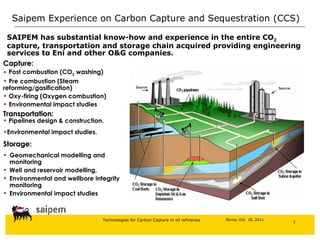
Saipem Experience on  Carbon Capture and Sequestration (CCS)   SAIPEM has substantial know-how and experience in the entire CO 2  capture, transportation and storage chain acquired providing engineering services to Eni and other O&G companies .  Pipelines design & construction.  Environmental impact studies . Geomechanical modelling and monitoring Well and r eservoir modelling,  Environmental and wellbore integrity monitoring Environmental impact studies Storage : Capture : Post combustion (CO 2  washing) Pre combustion (Steam  reforming/gasification) Oxy-firing (Oxygen combustion) Environmental impact studies Transportation : Source Source
Presentation Summary Power Station vs. Refinery Refinery Emission Sources CO 2  Capture in the FCC unit CO 2  Capture in Hydrogen Production CO 2  Capture in Crude Heaters and Steam Boilers Overall approach
Power Station vs. Refinery
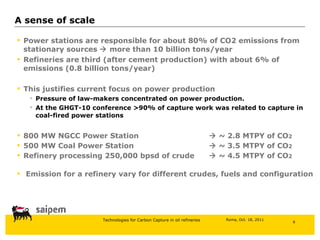
A sense of scale Power stations are responsible for about 80% of CO2 emissions from stationary sources    more than 10 billion tons/year Refineries are third (after cement production) with about 6% of emissions (0.8 billion tons/year) This justifies current focus on power production   Pressure of law-makers concentrated on power production. At the GHGT-10 conference >90% of capture work was related to capture in coal-fired power stations 800 MW NGCC Power Station     ~ 2.8 MTPY of CO 2   500 MW Coal Power Station     ~ 3.5 MTPY of CO 2 Refinery processing 250,000 bpsd of crude    ~ 4.5 MTPY of CO 2 Emission for a refinery vary for different crudes, fuels and configuration
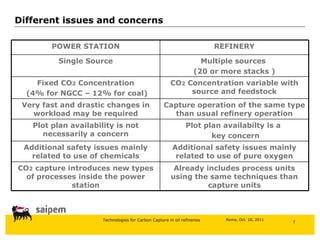
Different issues and concerns Plot plan availabilty is a  key concern Plot plan availability is not necessarily a concern Additional safety issues mainly related to use of pure oxygen Additional safety issues mainly related to use of chemicals Already includes process units using the same techniques than capture units CO 2  capture introduces new types of processes inside the power station Capture operation of the same type than usual refinery operation Very fast and drastic changes in workload may be required CO 2  Concentration variable with source and feedstock Fixed CO 2  Concentration (4% for NGCC – 12% for coal) Multiple sources  (20 or more stacks ) Single Source REFINERY POWER STATION
Refinery Emission Sources
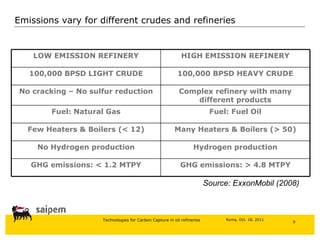
Emissions vary for different crudes and refineries Source: ExxonMobil (2008) GHG emissions: > 4.8 MTPY GHG emissions: < 1.2 MTPY Hydrogen production No Hydrogen production Many Heaters & Boilers (> 50) Few Heaters & Boilers (< 12) Fuel: Fuel Oil Fuel: Natural Gas Complex refinery with many different products No cracking – No sulfur reduction 100,000 BPSD HEAVY CRUDE 100,000 BPSD LIGHT CRUDE HIGH EMISSION REFINERY LOW EMISSION REFINERY
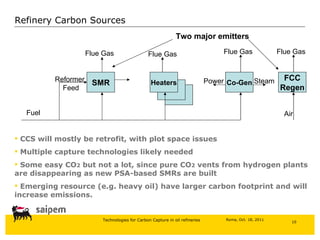
Refinery Carbon Sources SMR Heaters Co-Gen FCC Regen Fuel Reformer Feed Flue Gas Flue Gas Flue Gas Flue Gas Air Two major emitters CCS will mostly be retrofit, with plot space issues Multiple capture technologies likely needed Some easy CO 2  but not a lot, since pure CO 2  vents from hydrogen plants are disappearing as new PSA-based SMRs are built Emerging resource (e.g. heavy oil) have larger carbon footprint and will increase emissions. Power Steam
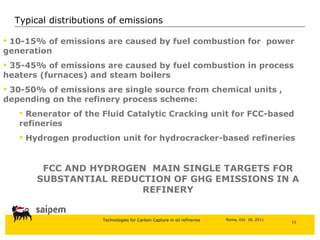
Typical distributions of emissions 10-15% of emissions are caused by fuel combustion for  power generation 35-45% of emissions are caused by fuel combustion in process heaters (furnaces) and steam boilers 30-50% of emissions are single source from chemical units , depending on the refinery process scheme: Renerator of the Fluid Catalytic Cracking unit for FCC-based refineries Hydrogen production unit for hydrocracker-based refineries FCC AND HYDROGEN  MAIN SINGLE TARGETS FOR SUBSTANTIAL REDUCTION OF GHG EMISSIONS IN A REFINERY
CO 2  Capture in the FCC unit
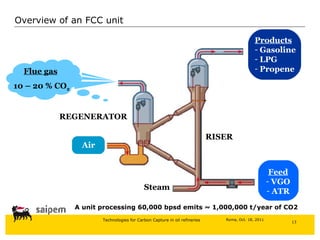
Overview of an FCC unit RISER Products Gasoline LPG Propene Feed VGO ATR Steam Air REGENERATOR Flue gas   10 – 20 % CO 2 A unit processing 60,000 bpsd emits  ~ 1,000,000 t/year of CO2
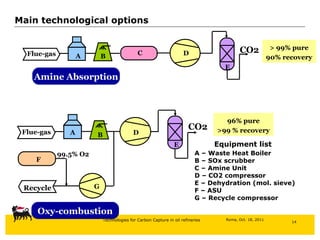
Main technological options A – Waste Heat Boiler B – SOx scrubber C – Amine Unit D – CO2 compressor E – Dehydration (mol. sieve) F – ASU G – Recycle compressor Equipment list > 99% pure 90% recovery 96% pure >99 % recovery Flue-gas A B C D E Amine Absorption CO2 Flue-gas A B F D E G 99.5% O2 Oxy-combustion CO2 Recycle
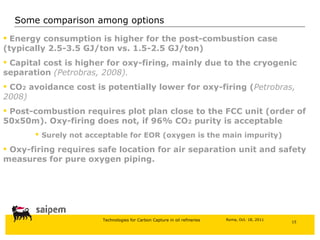
Some comparison among options Energy consumption is higher for the post-combustion case (typically 2.5-3.5 GJ/ton vs. 1.5-2.5 GJ/ton) Capital cost is higher for oxy-firing, mainly due to the cryogenic separation  (Petrobras, 2008). CO 2  avoidance cost is potentially lower for oxy-firing ( Petrobras, 2008) Post-combustion requires plot plan close to the FCC unit (order of 50x50m). Oxy-firing does not, if 96% CO 2  purity is acceptable Surely not acceptable for EOR (oxygen is the main impurity) Oxy-firing requires safe location for air separation unit and safety measures for pure oxygen piping.
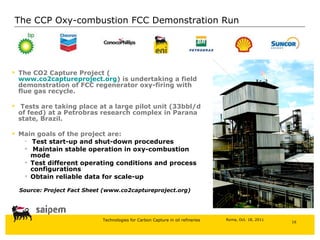
The CO2 Capture Project ( www.co2captureproject.org ) is undertaking a field demonstration of FCC regenerator oxy-firing with flue gas recycle. Tests are taking place at a large pilot unit (33bbl/d of feed) at a Petrobras research complex in Parana state, Brazil. Main goals of the project are: Test start-up and shut-down procedures Maintain stable operation in oxy-combustion mode Test different operating conditions and process configurations Obtain reliable data for scale-up Source: Project Fact Sheet (www.co2captureproject.org) The CCP Oxy-combustion FCC Demonstration Run
CO 2  Capture in hydrogen production
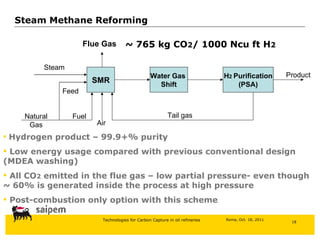
Steam Methane Reforming SMR Water Gas  Shift H 2  Purification (PSA) Natural Gas Flue Gas ~ 765 kg CO 2 / 1000 Ncu ft H 2 Feed Fuel Steam Hydrogen product – 99.9+% purity Low energy usage compared with previous conventional design (MDEA washing) All CO 2  emitted in the flue gas – low partial pressure- even though ~ 60% is generated inside the process at high pressure  Post-combustion only option with this scheme Air Tail gas Product
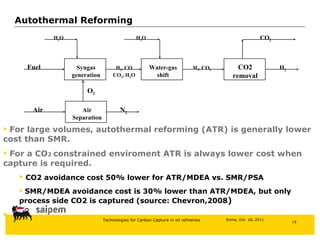
Autothermal Reforming For large volumes, autothermal reforming (ATR) is generally lower cost than SMR. For a CO 2  constrained enviroment ATR is always lower cost when capture is required. CO2 avoidance cost 50% lower for ATR/MDEA vs. SMR/PSA SMR/MDEA avoidance cost is 30% lower than ATR/MDEA, but only process side CO2 is captured (source: Chevron,2008 ) Syngas generation Water-gas shift CO2 removal Fuel H 2 , CO CO 2 , H 2 O H 2 , CO 2 H 2 CO 2 H 2 O O 2 H 2 O Air Separation Air N 2
CO 2  Capture in process heaters & boilers
A large percentage of  refinery CO 2   emissions are generated by the combustion of fuel gas or fuel oil in crude heaters and steam boilers In a world-scale refinery this emission source may account for more than 2 million tons/year. Heaters & boilers are widely scattered in size and in refinery location. Usually a few tens of units, but may be more than 50.  May discharge to ten or more stacks located in different zones  A single unit may roughly emit from 50,000 to 500,000 tons/year CO 2  concentration in flue gas ranging from 4 to 10% vol., depending on the fuel used CAN THIS SOURCE BE MITIGATED? Heaters & Boilers: a peculiar source of CO 2
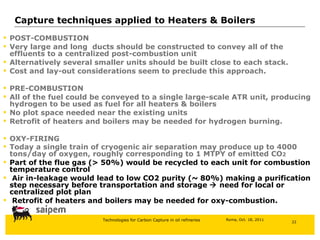
POST-COMBUSTION Very large and long  ducts should be constructed to convey all of the effluents to a centralized post-combustion unit Alternatively several smaller units should be built close to each stack. Cost and lay-out considerations seem to preclude this approach. PRE-COMBUSTION All of the fuel could be conveyed to a single large-scale ATR unit, producing hydrogen to be used as fuel for all heaters & boilers No plot space needed near the existing units Retrofit of heaters and boilers may be needed for hydrogen burning. OXY-FIRING Today a single train of cryogenic air separation may produce up to 4000 tons/day of oxygen, roughly corresponding to 1 MTPY of emitted CO 2 Part of the flue gas (> 50%) would be recycled to each unit for combustion temperature control Air in-leakage would lead to low CO2 purity (~ 80%) making a purification step necessary before transportation and storage    need for local or centralized plot plan Retrofit of heaters and boilers may be needed for oxy-combustion. Capture techniques applied to Heaters & Boilers
Overall approach to carbon capture  in the refinery
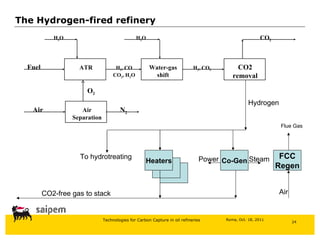
The Hydrogen-fired refinery Heaters Co-Gen FCC Regen Air Power Steam ATR Water-gas shift CO2 removal Fuel H 2 , CO CO 2 , H 2 O H 2 , CO 2 CO 2 H 2 O O 2 H 2 O Air Separation Air N 2 Flue Gas Hydrogen CO2-free gas to stack To hydrotreating
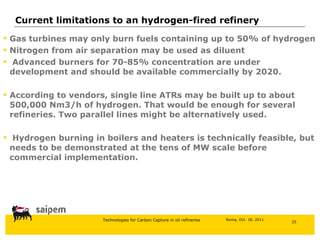
Gas turbines may only burn fuels containing up to 50% of hydrogen Nitrogen from air separation may be used as diluent Advanced burners for 70-85% concentration are under development and should be available commercially by 2020. According to vendors, single line ATRs may be built up to about 500,000 Nm3/h of hydrogen. That would be enough for several refineries. Two parallel lines might be alternatively used. Hydrogen burning in boilers and heaters is technically feasible, but needs to be demonstrated at the tens of MW scale before commercial implementation. Current limitations to an hydrogen-fired refinery
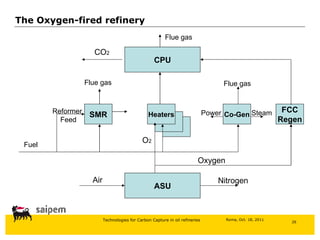
The Oxygen-fired refinery SMR Heaters Co-Gen FCC Regen Fuel Reformer Feed Power Steam ASU Air Nitrogen Oxygen Flue gas O 2 Flue gas CPU CO 2 Flue gas
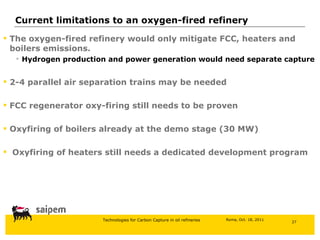
The oxygen-fired refinery would only mitigate FCC, heaters and boilers emissions. Hydrogen production and power generation would need separate capture 2-4 parallel air separation trains may be needed FCC regenerator oxy-firing still needs to be proven Oxyfiring of boilers already at the demo stage (30 MW) Oxyfiring of heaters still needs a dedicated development program Current limitations to an oxygen-fired refinery
The Complete Environmental Services Provider THANK YOU FOR YOUR ATTENTION

Technologies for Carbon Capture in Oil Refineries

  • 1.
    WEC Italia –Cattura e Stoccaggio della CO 2 (CCS) Roma, October 18, 2011 Technologies for Carbon Capture in Oil Refineries Ivano Miracca Saipem s.p.a.
  • 2.
    Saipem Highlights LeadingGlobal EP(I)C General Contractor Designed and built: Over 90 grass roots complexes, 1,700 process units Over 120,000 km of land pipelines, sealines and trunklines In the last decade, more than 100 offshore EPIC projects, including groundbreaking deepwater achievements Drilled over 7,300 wells of which 1,800 offshore Distinctive ‘frontier focus’ in Oil & Gas industries Full service EP(I)C provider Key local employer and investor in strategic markets Most modern, technologically advanced offshore construction fleet High quality drilling player onshore and in niches offshore 2010 Revenues 11.2 B€ End-of-2010 Backlog 20.5 B€ 40,000 employees, of which 7,000 Engineers & Project Managers Operating in more than 70 countries, more than 50 permanent establishments, employees from 122 nationalities
  • 3.
    Saipem Experience on Carbon Capture and Sequestration (CCS) SAIPEM has substantial know-how and experience in the entire CO 2 capture, transportation and storage chain acquired providing engineering services to Eni and other O&G companies . Pipelines design & construction. Environmental impact studies . Geomechanical modelling and monitoring Well and r eservoir modelling, Environmental and wellbore integrity monitoring Environmental impact studies Storage : Capture : Post combustion (CO 2 washing) Pre combustion (Steam reforming/gasification) Oxy-firing (Oxygen combustion) Environmental impact studies Transportation : Source Source
  • 4.
    Presentation Summary PowerStation vs. Refinery Refinery Emission Sources CO 2 Capture in the FCC unit CO 2 Capture in Hydrogen Production CO 2 Capture in Crude Heaters and Steam Boilers Overall approach
  • 5.
  • 6.
    A sense ofscale Power stations are responsible for about 80% of CO2 emissions from stationary sources  more than 10 billion tons/year Refineries are third (after cement production) with about 6% of emissions (0.8 billion tons/year) This justifies current focus on power production Pressure of law-makers concentrated on power production. At the GHGT-10 conference >90% of capture work was related to capture in coal-fired power stations 800 MW NGCC Power Station  ~ 2.8 MTPY of CO 2 500 MW Coal Power Station  ~ 3.5 MTPY of CO 2 Refinery processing 250,000 bpsd of crude  ~ 4.5 MTPY of CO 2 Emission for a refinery vary for different crudes, fuels and configuration
  • 7.
    Different issues andconcerns Plot plan availabilty is a key concern Plot plan availability is not necessarily a concern Additional safety issues mainly related to use of pure oxygen Additional safety issues mainly related to use of chemicals Already includes process units using the same techniques than capture units CO 2 capture introduces new types of processes inside the power station Capture operation of the same type than usual refinery operation Very fast and drastic changes in workload may be required CO 2 Concentration variable with source and feedstock Fixed CO 2 Concentration (4% for NGCC – 12% for coal) Multiple sources (20 or more stacks ) Single Source REFINERY POWER STATION
  • 8.
  • 9.
    Emissions vary fordifferent crudes and refineries Source: ExxonMobil (2008) GHG emissions: > 4.8 MTPY GHG emissions: < 1.2 MTPY Hydrogen production No Hydrogen production Many Heaters & Boilers (> 50) Few Heaters & Boilers (< 12) Fuel: Fuel Oil Fuel: Natural Gas Complex refinery with many different products No cracking – No sulfur reduction 100,000 BPSD HEAVY CRUDE 100,000 BPSD LIGHT CRUDE HIGH EMISSION REFINERY LOW EMISSION REFINERY
  • 10.
    Refinery Carbon SourcesSMR Heaters Co-Gen FCC Regen Fuel Reformer Feed Flue Gas Flue Gas Flue Gas Flue Gas Air Two major emitters CCS will mostly be retrofit, with plot space issues Multiple capture technologies likely needed Some easy CO 2 but not a lot, since pure CO 2 vents from hydrogen plants are disappearing as new PSA-based SMRs are built Emerging resource (e.g. heavy oil) have larger carbon footprint and will increase emissions. Power Steam
  • 11.
    Typical distributions ofemissions 10-15% of emissions are caused by fuel combustion for power generation 35-45% of emissions are caused by fuel combustion in process heaters (furnaces) and steam boilers 30-50% of emissions are single source from chemical units , depending on the refinery process scheme: Renerator of the Fluid Catalytic Cracking unit for FCC-based refineries Hydrogen production unit for hydrocracker-based refineries FCC AND HYDROGEN MAIN SINGLE TARGETS FOR SUBSTANTIAL REDUCTION OF GHG EMISSIONS IN A REFINERY
  • 12.
    CO 2 Capture in the FCC unit
  • 13.
    Overview of anFCC unit RISER Products Gasoline LPG Propene Feed VGO ATR Steam Air REGENERATOR Flue gas 10 – 20 % CO 2 A unit processing 60,000 bpsd emits ~ 1,000,000 t/year of CO2
  • 14.
    Main technological optionsA – Waste Heat Boiler B – SOx scrubber C – Amine Unit D – CO2 compressor E – Dehydration (mol. sieve) F – ASU G – Recycle compressor Equipment list > 99% pure 90% recovery 96% pure >99 % recovery Flue-gas A B C D E Amine Absorption CO2 Flue-gas A B F D E G 99.5% O2 Oxy-combustion CO2 Recycle
  • 15.
    Some comparison amongoptions Energy consumption is higher for the post-combustion case (typically 2.5-3.5 GJ/ton vs. 1.5-2.5 GJ/ton) Capital cost is higher for oxy-firing, mainly due to the cryogenic separation (Petrobras, 2008). CO 2 avoidance cost is potentially lower for oxy-firing ( Petrobras, 2008) Post-combustion requires plot plan close to the FCC unit (order of 50x50m). Oxy-firing does not, if 96% CO 2 purity is acceptable Surely not acceptable for EOR (oxygen is the main impurity) Oxy-firing requires safe location for air separation unit and safety measures for pure oxygen piping.
  • 16.
    The CO2 CaptureProject ( www.co2captureproject.org ) is undertaking a field demonstration of FCC regenerator oxy-firing with flue gas recycle. Tests are taking place at a large pilot unit (33bbl/d of feed) at a Petrobras research complex in Parana state, Brazil. Main goals of the project are: Test start-up and shut-down procedures Maintain stable operation in oxy-combustion mode Test different operating conditions and process configurations Obtain reliable data for scale-up Source: Project Fact Sheet (www.co2captureproject.org) The CCP Oxy-combustion FCC Demonstration Run
  • 17.
    CO 2 Capture in hydrogen production
  • 18.
    Steam Methane ReformingSMR Water Gas Shift H 2 Purification (PSA) Natural Gas Flue Gas ~ 765 kg CO 2 / 1000 Ncu ft H 2 Feed Fuel Steam Hydrogen product – 99.9+% purity Low energy usage compared with previous conventional design (MDEA washing) All CO 2 emitted in the flue gas – low partial pressure- even though ~ 60% is generated inside the process at high pressure Post-combustion only option with this scheme Air Tail gas Product
  • 19.
    Autothermal Reforming Forlarge volumes, autothermal reforming (ATR) is generally lower cost than SMR. For a CO 2 constrained enviroment ATR is always lower cost when capture is required. CO2 avoidance cost 50% lower for ATR/MDEA vs. SMR/PSA SMR/MDEA avoidance cost is 30% lower than ATR/MDEA, but only process side CO2 is captured (source: Chevron,2008 ) Syngas generation Water-gas shift CO2 removal Fuel H 2 , CO CO 2 , H 2 O H 2 , CO 2 H 2 CO 2 H 2 O O 2 H 2 O Air Separation Air N 2
  • 20.
    CO 2 Capture in process heaters & boilers
  • 21.
    A large percentageof refinery CO 2 emissions are generated by the combustion of fuel gas or fuel oil in crude heaters and steam boilers In a world-scale refinery this emission source may account for more than 2 million tons/year. Heaters & boilers are widely scattered in size and in refinery location. Usually a few tens of units, but may be more than 50. May discharge to ten or more stacks located in different zones A single unit may roughly emit from 50,000 to 500,000 tons/year CO 2 concentration in flue gas ranging from 4 to 10% vol., depending on the fuel used CAN THIS SOURCE BE MITIGATED? Heaters & Boilers: a peculiar source of CO 2
  • 22.
    POST-COMBUSTION Very largeand long ducts should be constructed to convey all of the effluents to a centralized post-combustion unit Alternatively several smaller units should be built close to each stack. Cost and lay-out considerations seem to preclude this approach. PRE-COMBUSTION All of the fuel could be conveyed to a single large-scale ATR unit, producing hydrogen to be used as fuel for all heaters & boilers No plot space needed near the existing units Retrofit of heaters and boilers may be needed for hydrogen burning. OXY-FIRING Today a single train of cryogenic air separation may produce up to 4000 tons/day of oxygen, roughly corresponding to 1 MTPY of emitted CO 2 Part of the flue gas (> 50%) would be recycled to each unit for combustion temperature control Air in-leakage would lead to low CO2 purity (~ 80%) making a purification step necessary before transportation and storage  need for local or centralized plot plan Retrofit of heaters and boilers may be needed for oxy-combustion. Capture techniques applied to Heaters & Boilers
  • 23.
    Overall approach tocarbon capture in the refinery
  • 24.
    The Hydrogen-fired refineryHeaters Co-Gen FCC Regen Air Power Steam ATR Water-gas shift CO2 removal Fuel H 2 , CO CO 2 , H 2 O H 2 , CO 2 CO 2 H 2 O O 2 H 2 O Air Separation Air N 2 Flue Gas Hydrogen CO2-free gas to stack To hydrotreating
  • 25.
    Gas turbines mayonly burn fuels containing up to 50% of hydrogen Nitrogen from air separation may be used as diluent Advanced burners for 70-85% concentration are under development and should be available commercially by 2020. According to vendors, single line ATRs may be built up to about 500,000 Nm3/h of hydrogen. That would be enough for several refineries. Two parallel lines might be alternatively used. Hydrogen burning in boilers and heaters is technically feasible, but needs to be demonstrated at the tens of MW scale before commercial implementation. Current limitations to an hydrogen-fired refinery
  • 26.
    The Oxygen-fired refinerySMR Heaters Co-Gen FCC Regen Fuel Reformer Feed Power Steam ASU Air Nitrogen Oxygen Flue gas O 2 Flue gas CPU CO 2 Flue gas
  • 27.
    The oxygen-fired refinerywould only mitigate FCC, heaters and boilers emissions. Hydrogen production and power generation would need separate capture 2-4 parallel air separation trains may be needed FCC regenerator oxy-firing still needs to be proven Oxyfiring of boilers already at the demo stage (30 MW) Oxyfiring of heaters still needs a dedicated development program Current limitations to an oxygen-fired refinery
  • 28.
    The Complete EnvironmentalServices Provider THANK YOU FOR YOUR ATTENTION