VELOCITY BASED TRAINING
Mike Young, PhD @mikeyoung
The Outline
The Outline
Training Theory Primer
The Outline
Training Theory Primer
Intensity in the Weight Room
The Outline
Training Theory Primer
Benefits of Traditional Methods
Intensity in the Weight Room
The Outline
Training Theory Primer
Benefits of Traditional Methods
Intensity in the Weight Room
Drawbacks of Traditional Methods
The Outline
Training Theory Primer
Benefits of Traditional Methods
Velocity Based Training
Intensity in the Weight Room
Drawbacks of Traditional Methods
The Outline
Training Theory Primer
Benefits of Traditional Methods
Velocity Based Training
Intensity in the Weight Room
Drawbacks of Traditional Methods
Applications
The Outline
Training Theory Primer
Benefits of Traditional Methods
Velocity Based Training
Intensity in the Weight Room
Drawbacks of Traditional Methods
Applications
Logistics
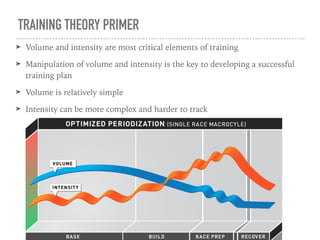
TRAINING THEORY PRIMER
➤ Volume and intensity are most critical elements of training
➤ Manipulation of volume and intensity is the key to developing a successful
training plan
➤ Volume is relatively simple
➤ Intensity can be more complex and harder to track
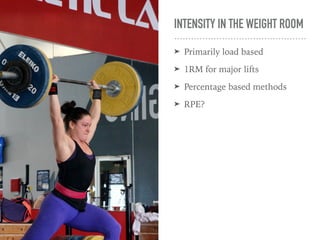
INTENSITY IN THE WEIGHT ROOM
➤ Primarily load based
➤ 1RM for major lifts
➤ Percentage based methods
➤ RPE?
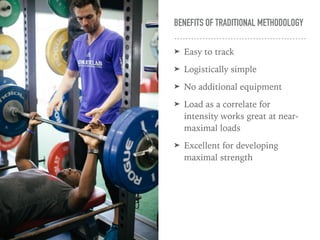
BENEFITS OF TRADITIONAL METHODOLOGY
➤ Easy to track
➤ Logistically simple
➤ No additional equipment
➤ Load as a correlate for
intensity works great at near-
maximal loads
➤ Excellent for developing
maximal strength
DRAWBACKS OF TRADITIONAL METHODOLOGY
➤ Load on the bar is being used
as a correlate for force output
➤ Load may not be the best
indicator of force output
➤ No way to accurately assess
movement velocity or power
output
Maximum strength is
important but power is
what wins games
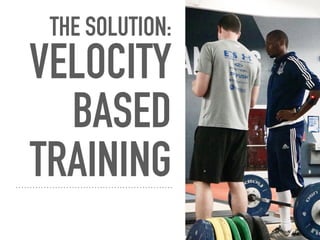
THE SOLUTION:
VELOCITY
BASED
TRAINING
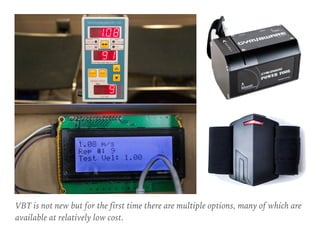
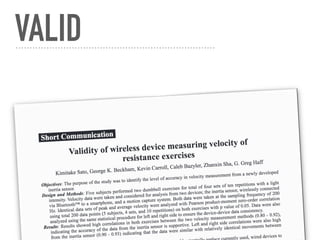
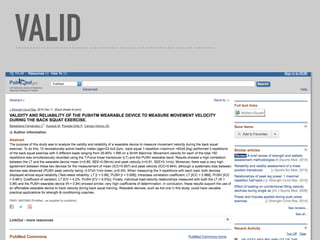
VBT is not new but for the first time there are multiple options, many of which are
available at relatively low cost.
VALID
VALID
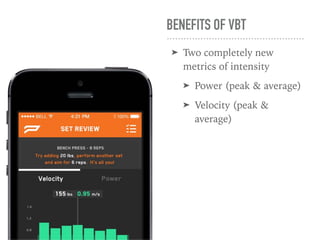
BENEFITS OF VBT
➤ Two completely new
metrics of intensity
➤ Power (peak & average)
➤ Velocity (peak &
average)
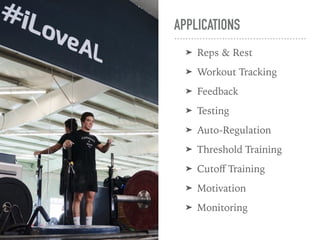
APPLICATIONS
➤ Reps & Rest
➤ Workout Tracking
➤ Feedback
➤ Testing
➤ Auto-Regulation
➤ Threshold Training
➤ Cutoff Training
➤ Motivation
➤ Monitoring
REP
COUNTING
REST TRACKING
REST TRACKING
WORKOUT TRACKING
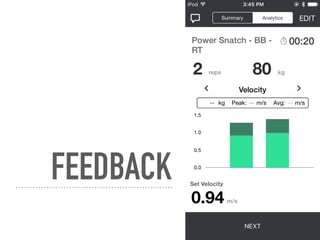
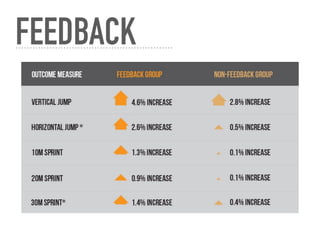
FEEDBACK
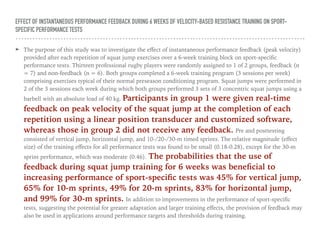
EFFECT OF INSTANTANEOUS PERFORMANCE FEEDBACK DURING 6 WEEKS OF VELOCITY-BASED RESISTANCE TRAINING ON SPORT-
SPECIFIC PERFORMANCE TESTS
➤ The purpose of this study was to investigate the effect of instantaneous performance feedback (peak velocity)
provided after each repetition of squat jump exercises over a 6-week training block on sport-specific
performance tests. Thirteen professional rugby players were randomly assigned to 1 of 2 groups, feedback (n
= 7) and non-feedback (n = 6). Both groups completed a 6-week training program (3 sessions per week)
comprising exercises typical of their normal preseason conditioning program. Squat jumps were performed in
2 of the 3 sessions each week during which both groups performed 3 sets of 3 concentric squat jumps using a
barbell with an absolute load of 40 kg. Participants in group 1 were given real-time
feedback on peak velocity of the squat jump at the completion of each
repetition using a linear position transducer and customized software,
whereas those in group 2 did not receive any feedback. Pre and posttesting
consisted of vertical jump, horizontal jump, and 10-/20-/30-m timed sprints. The relative magnitude (effect
size) of the training effects for all performance tests was found to be small (0.18-0.28), except for the 30-m
sprint performance, which was moderate (0.46). The probabilities that the use of
feedback during squat jump training for 6 weeks was beneficial to
increasing performance of sport-specific tests was 45% for vertical jump,
65% for 10-m sprints, 49% for 20-m sprints, 83% for horizontal jump,
and 99% for 30-m sprints. In addition to improvements in the performance of sport-specific
tests, suggesting the potential for greater adaptation and larger training effects, the provision of feedback may
also be used in applications around performance targets and thresholds during training.
FEEDBACK
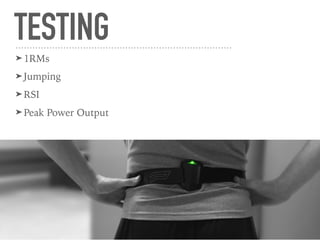
TESTING
➤ 1RMs
➤ Jumping
➤ RSI
➤ Peak Power Output
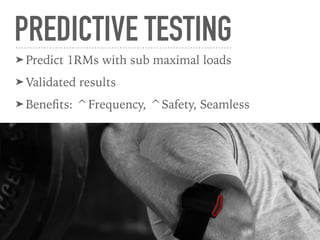
PREDICTIVE TESTING
➤ Predict 1RMs with sub maximal loads
➤ Validated results
➤ Benefits: ^Frequency, ^Safety, Seamless
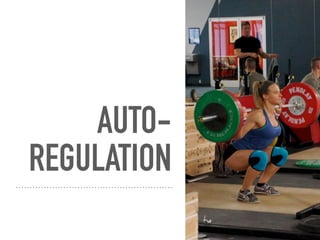
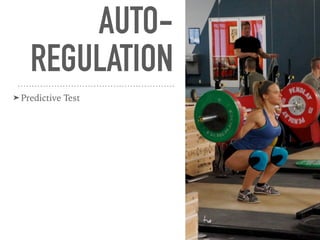
AUTO-
REGULATION
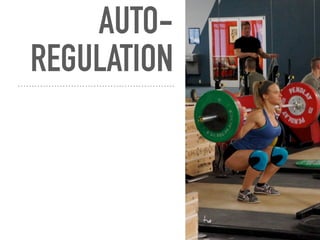
AUTO-
REGULATION
AUTO-
REGULATION
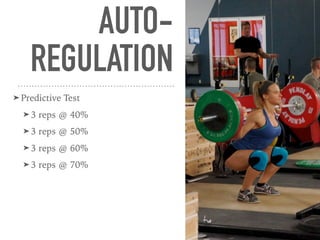
➤ Predictive Test
AUTO-
REGULATION
➤ Predictive Test
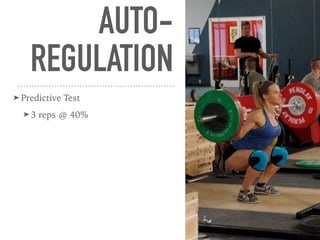
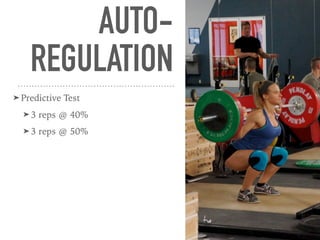
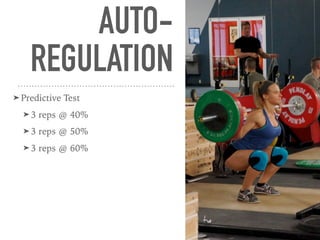
➤ 3 reps @ 40%
AUTO-
REGULATION
➤ Predictive Test
➤ 3 reps @ 40%
➤ 3 reps @ 50%
AUTO-
REGULATION
➤ Predictive Test
➤ 3 reps @ 40%
➤ 3 reps @ 50%
➤ 3 reps @ 60%
AUTO-
REGULATION
➤ Predictive Test
➤ 3 reps @ 40%
➤ 3 reps @ 50%
➤ 3 reps @ 60%
➤ 3 reps @ 70%
AUTO-
REGULATION
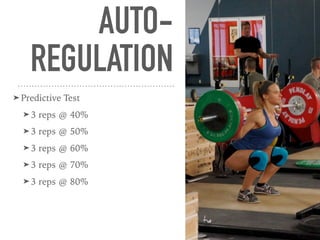
➤ Predictive Test
➤ 3 reps @ 40%
➤ 3 reps @ 50%
➤ 3 reps @ 60%
➤ 3 reps @ 70%
➤ 3 reps @ 80%
AUTO-
REGULATION
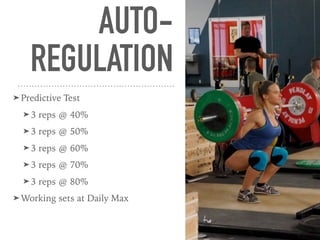
➤ Predictive Test
➤ 3 reps @ 40%
➤ 3 reps @ 50%
➤ 3 reps @ 60%
➤ 3 reps @ 70%
➤ 3 reps @ 80%
➤ Working sets at Daily Max
AUTO-
REGULATION
➤ Predictive Test
➤ 3 reps @ 40%
➤ 3 reps @ 50%
➤ 3 reps @ 60%
➤ 3 reps @ 70%
➤ 3 reps @ 80%
➤ Working sets at Daily Max
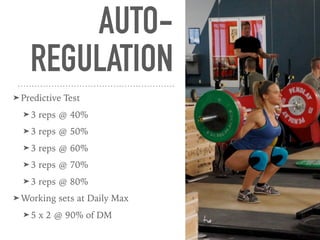
➤ 5 x 2 @ 90% of DM
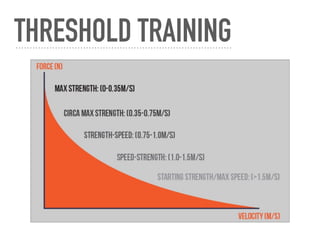
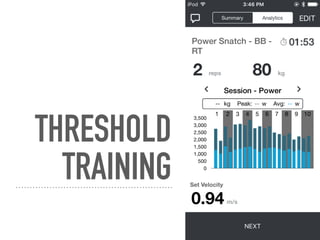
THRESHOLD TRAINING
THRESHOLD
TRAINING
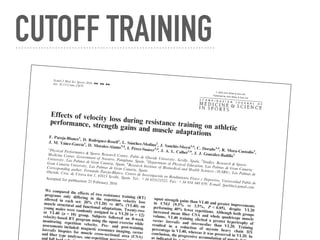
CUTOFF TRAINING
Effects of velocity loss during resistance training on athletic
performance, strength gains and muscle adaptationsF. Pareja-Blanco1
, D. Rodrıguez-Rosell1
, L. Sanchez-Medina2
, J. Sanchis-Moysi3,4
, C. Dorado3,4
, R. Mora-Custodio1
,
J. M. Ya~nez-Garcıa1
, D. Morales-Alamo3,4
, I. Perez-Suarez3,4
, J. A. L. Calbet3,4
, J. J. Gonzalez-Badillo1
1
Physical Performance  Sports Research Center, Pablo de Olavide University, Seville, Spain, 2
Studies, Research  Sports
Medicine Center, Government of Navarre, Pamplona, Spain, 3
Department of Physical Education, Las Palmas de Gran Canaria
University, Las Palmas de Gran Canaria, Spain, 4
Research Institute of Biomedical and Health Sciences (IUIBS), Las Palmas de
Gran Canaria University, Las Palmas de Gran Canaria, Spain
Corresponding author: Fernando Pareja-Blanco, Centro de Investigacion en Rendimiento Fısico y Deportivo, Universidad Pablo de
Olavide, Ctra. de Utrera km 1, 41013 Seville, Spain. Tel.: +34 653121522; Fax: +34 954 348 659; E-mail: fparbla@gmail.com
Accepted for publication 23 February 2016
We compared the effects of two resistance training (RT)
programs only differing in the repetition velocity loss
allowed in each set: 20% (VL20) vs 40% (VL40) on
muscle structural and functional adaptations. Twenty-two
young males were randomly assigned to a VL20 (n = 12)
or VL40 (n = 10) group. Subjects followed an 8-week
velocity-based RT program using the squat exercise while
monitoring repetition velocity. Pre- and post-training
assessments included: magnetic resonance imaging, vastus
lateralis biopsies for muscle cross-sectional area (CSA)
and fiber type analyses, one-repetitioand
squat strength gains than VL40 and greater improvements
in CMJ (9.5% vs 3.5%, P  0.05), despite VL20
performing 40% fewer repetitions. Although both groups
increased mean fiber CSA and whole quadriceps muscle
volume, VL40 training elicited a greater hypertrophy of
vastus lateralis and intermedius than VL20. Training
resulted in a reduction of myosin heavy chain IIX
percentage in VL40, whereas it was preserved in VL20. In
conclusion, the progressive accumulationas indic
Scand J Med Sci Sports 2016: : –doi: 10.1111/sms.12678
ª 2016 John Wiley  Sons A/S.
Published by John Wiley  Sons Ltd
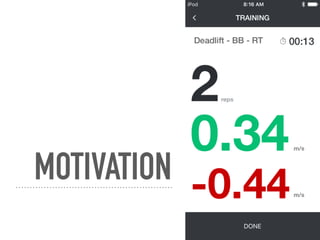
MOTIVATION
LOGISTICS
Implementing VBT without hassles
MONITORING
LOGISTICS
Implementing VBT without hassles
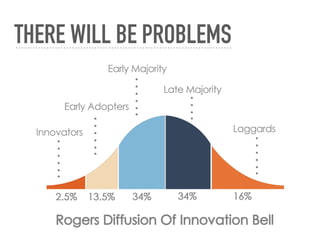
THERE WILL BE PROBLEMS
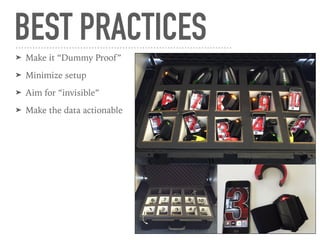
BEST PRACTICES
➤ Make it “Dummy Proof”
➤ Minimize setup
➤ Aim for “invisible”
➤ Make the data actionable
THANKS
@mikeyoung

Velocity Based Training

  • 1.
    VELOCITY BASED TRAINING MikeYoung, PhD @mikeyoung
  • 2.
  • 3.
  • 4.
    The Outline Training TheoryPrimer Intensity in the Weight Room
  • 5.
    The Outline Training TheoryPrimer Benefits of Traditional Methods Intensity in the Weight Room
  • 6.
    The Outline Training TheoryPrimer Benefits of Traditional Methods Intensity in the Weight Room Drawbacks of Traditional Methods
  • 7.
    The Outline Training TheoryPrimer Benefits of Traditional Methods Velocity Based Training Intensity in the Weight Room Drawbacks of Traditional Methods
  • 8.
    The Outline Training TheoryPrimer Benefits of Traditional Methods Velocity Based Training Intensity in the Weight Room Drawbacks of Traditional Methods Applications
  • 9.
    The Outline Training TheoryPrimer Benefits of Traditional Methods Velocity Based Training Intensity in the Weight Room Drawbacks of Traditional Methods Applications Logistics
  • 10.
    TRAINING THEORY PRIMER ➤Volume and intensity are most critical elements of training ➤ Manipulation of volume and intensity is the key to developing a successful training plan ➤ Volume is relatively simple ➤ Intensity can be more complex and harder to track
  • 11.
    INTENSITY IN THEWEIGHT ROOM ➤ Primarily load based ➤ 1RM for major lifts ➤ Percentage based methods ➤ RPE?
  • 12.
    BENEFITS OF TRADITIONALMETHODOLOGY ➤ Easy to track ➤ Logistically simple ➤ No additional equipment ➤ Load as a correlate for intensity works great at near- maximal loads ➤ Excellent for developing maximal strength
  • 13.
    DRAWBACKS OF TRADITIONALMETHODOLOGY ➤ Load on the bar is being used as a correlate for force output ➤ Load may not be the best indicator of force output ➤ No way to accurately assess movement velocity or power output
  • 14.
    Maximum strength is importantbut power is what wins games
  • 15.
  • 16.
    VBT is notnew but for the first time there are multiple options, many of which are available at relatively low cost.
  • 17.
  • 18.
  • 19.
    BENEFITS OF VBT ➤Two completely new metrics of intensity ➤ Power (peak & average) ➤ Velocity (peak & average)
  • 20.
    APPLICATIONS ➤ Reps &Rest ➤ Workout Tracking ➤ Feedback ➤ Testing ➤ Auto-Regulation ➤ Threshold Training ➤ Cutoff Training ➤ Motivation ➤ Monitoring
  • 21.
  • 22.
  • 23.
  • 24.
  • 25.
    EFFECT OF INSTANTANEOUSPERFORMANCE FEEDBACK DURING 6 WEEKS OF VELOCITY-BASED RESISTANCE TRAINING ON SPORT- SPECIFIC PERFORMANCE TESTS ➤ The purpose of this study was to investigate the effect of instantaneous performance feedback (peak velocity) provided after each repetition of squat jump exercises over a 6-week training block on sport-specific performance tests. Thirteen professional rugby players were randomly assigned to 1 of 2 groups, feedback (n = 7) and non-feedback (n = 6). Both groups completed a 6-week training program (3 sessions per week) comprising exercises typical of their normal preseason conditioning program. Squat jumps were performed in 2 of the 3 sessions each week during which both groups performed 3 sets of 3 concentric squat jumps using a barbell with an absolute load of 40 kg. Participants in group 1 were given real-time feedback on peak velocity of the squat jump at the completion of each repetition using a linear position transducer and customized software, whereas those in group 2 did not receive any feedback. Pre and posttesting consisted of vertical jump, horizontal jump, and 10-/20-/30-m timed sprints. The relative magnitude (effect size) of the training effects for all performance tests was found to be small (0.18-0.28), except for the 30-m sprint performance, which was moderate (0.46). The probabilities that the use of feedback during squat jump training for 6 weeks was beneficial to increasing performance of sport-specific tests was 45% for vertical jump, 65% for 10-m sprints, 49% for 20-m sprints, 83% for horizontal jump, and 99% for 30-m sprints. In addition to improvements in the performance of sport-specific tests, suggesting the potential for greater adaptation and larger training effects, the provision of feedback may also be used in applications around performance targets and thresholds during training.
  • 26.
  • 27.
    TESTING ➤ 1RMs ➤ Jumping ➤RSI ➤ Peak Power Output
  • 28.
    PREDICTIVE TESTING ➤ Predict1RMs with sub maximal loads ➤ Validated results ➤ Benefits: ^Frequency, ^Safety, Seamless
  • 29.
  • 30.
  • 31.
  • 32.
  • 33.
    AUTO- REGULATION ➤ Predictive Test ➤3 reps @ 40% ➤ 3 reps @ 50%
  • 34.
    AUTO- REGULATION ➤ Predictive Test ➤3 reps @ 40% ➤ 3 reps @ 50% ➤ 3 reps @ 60%
  • 35.
    AUTO- REGULATION ➤ Predictive Test ➤3 reps @ 40% ➤ 3 reps @ 50% ➤ 3 reps @ 60% ➤ 3 reps @ 70%
  • 36.
    AUTO- REGULATION ➤ Predictive Test ➤3 reps @ 40% ➤ 3 reps @ 50% ➤ 3 reps @ 60% ➤ 3 reps @ 70% ➤ 3 reps @ 80%
  • 37.
    AUTO- REGULATION ➤ Predictive Test ➤3 reps @ 40% ➤ 3 reps @ 50% ➤ 3 reps @ 60% ➤ 3 reps @ 70% ➤ 3 reps @ 80% ➤ Working sets at Daily Max
  • 38.
    AUTO- REGULATION ➤ Predictive Test ➤3 reps @ 40% ➤ 3 reps @ 50% ➤ 3 reps @ 60% ➤ 3 reps @ 70% ➤ 3 reps @ 80% ➤ Working sets at Daily Max ➤ 5 x 2 @ 90% of DM
  • 39.
  • 40.
  • 41.
    CUTOFF TRAINING Effects ofvelocity loss during resistance training on athletic performance, strength gains and muscle adaptationsF. Pareja-Blanco1 , D. Rodrıguez-Rosell1 , L. Sanchez-Medina2 , J. Sanchis-Moysi3,4 , C. Dorado3,4 , R. Mora-Custodio1 , J. M. Ya~nez-Garcıa1 , D. Morales-Alamo3,4 , I. Perez-Suarez3,4 , J. A. L. Calbet3,4 , J. J. Gonzalez-Badillo1 1 Physical Performance Sports Research Center, Pablo de Olavide University, Seville, Spain, 2 Studies, Research Sports Medicine Center, Government of Navarre, Pamplona, Spain, 3 Department of Physical Education, Las Palmas de Gran Canaria University, Las Palmas de Gran Canaria, Spain, 4 Research Institute of Biomedical and Health Sciences (IUIBS), Las Palmas de Gran Canaria University, Las Palmas de Gran Canaria, Spain Corresponding author: Fernando Pareja-Blanco, Centro de Investigacion en Rendimiento Fısico y Deportivo, Universidad Pablo de Olavide, Ctra. de Utrera km 1, 41013 Seville, Spain. Tel.: +34 653121522; Fax: +34 954 348 659; E-mail: fparbla@gmail.com Accepted for publication 23 February 2016 We compared the effects of two resistance training (RT) programs only differing in the repetition velocity loss allowed in each set: 20% (VL20) vs 40% (VL40) on muscle structural and functional adaptations. Twenty-two young males were randomly assigned to a VL20 (n = 12) or VL40 (n = 10) group. Subjects followed an 8-week velocity-based RT program using the squat exercise while monitoring repetition velocity. Pre- and post-training assessments included: magnetic resonance imaging, vastus lateralis biopsies for muscle cross-sectional area (CSA) and fiber type analyses, one-repetitioand squat strength gains than VL40 and greater improvements in CMJ (9.5% vs 3.5%, P 0.05), despite VL20 performing 40% fewer repetitions. Although both groups increased mean fiber CSA and whole quadriceps muscle volume, VL40 training elicited a greater hypertrophy of vastus lateralis and intermedius than VL20. Training resulted in a reduction of myosin heavy chain IIX percentage in VL40, whereas it was preserved in VL20. In conclusion, the progressive accumulationas indic Scand J Med Sci Sports 2016: : –doi: 10.1111/sms.12678 ª 2016 John Wiley Sons A/S. Published by John Wiley Sons Ltd
  • 42.
  • 43.
  • 44.
  • 45.
    THERE WILL BEPROBLEMS
  • 46.
    BEST PRACTICES ➤ Makeit “Dummy Proof” ➤ Minimize setup ➤ Aim for “invisible” ➤ Make the data actionable
  • 47.