2AS: Unit 4 “Disaster & Safety”
“Types of Disaster and where they occur & Reported Speech”
By Mr.Samir Bounab (yellowdaffodil66@gmail.com )
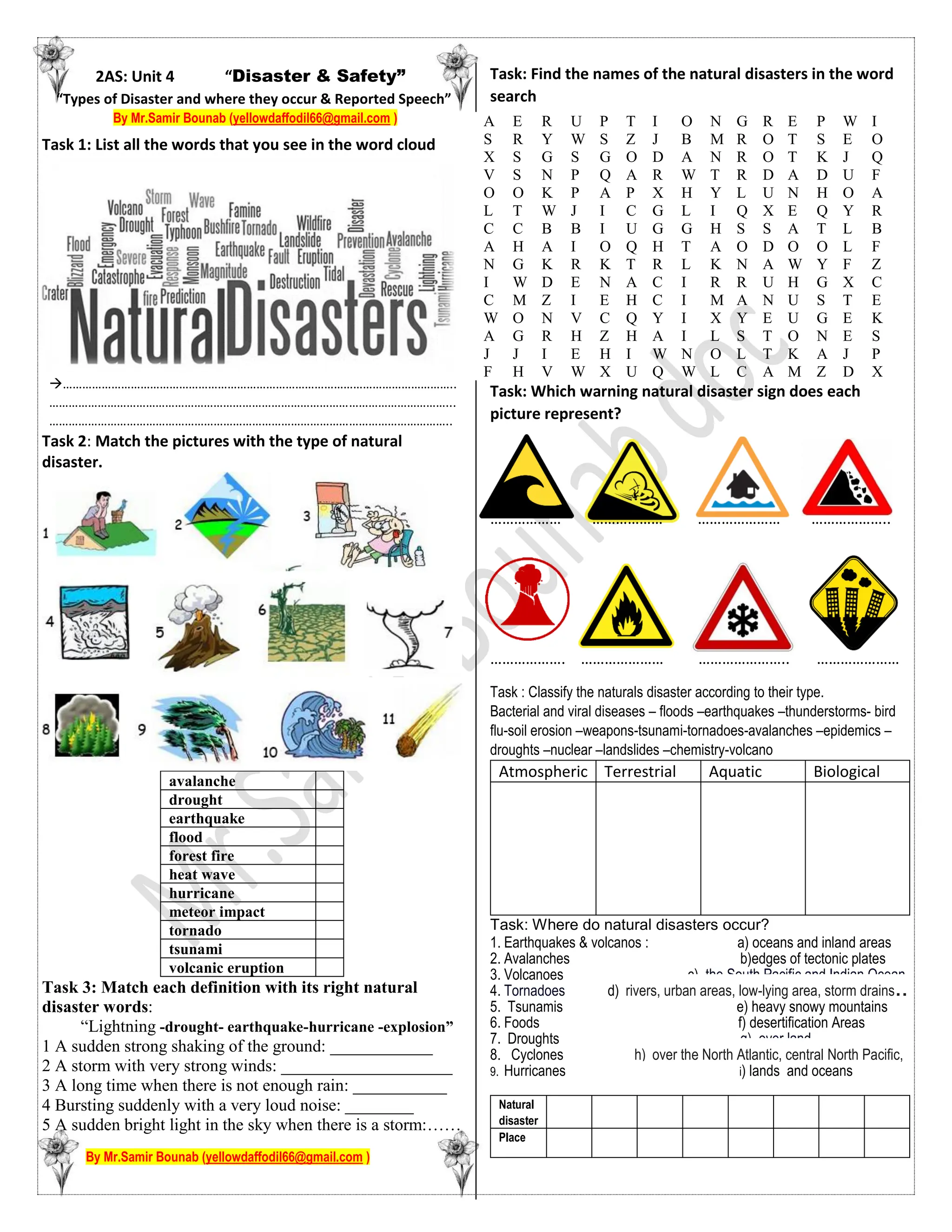
Task 1: List all the words that you see in the word cloud
…………………………………………………………………………………………………………..
……………………………………………………………………………………………………………...
……………………………………………………………………………………………………………..
Task 2: Match the pictures with the type of natural
disaster.
avalanche
drought
earthquake
flood
forest fire
heat wave
hurricane
meteor impact
tornado
tsunami
volcanic eruption
Task 3: Match each definition with its right natural
disaster words:
“Lightning -drought- earthquake-hurricane -explosion”
1 A sudden strong shaking of the ground: ____________
2 A storm with very strong winds: ____________________
3 A long time when there is not enough rain: ___________
4 Bursting suddenly with a very loud noise: ________
5 A sudden bright light in the sky when there is a storm:……
By Mr.Samir Bounab (yellowdaffodil66@gmail.com )
Task: Find the names of the natural disasters in the word
search
Task: Which warning natural disaster sign does each
picture represent?
……………… ……………… ………………… ………………..
………………. ………………… ………………….. …………………
Task : Classify the naturals disaster according to their type.
Bacterial and viral diseases – floods –earthquakes –thunderstorms- bird
flu-soil erosion –weapons-tsunami-tornadoes-avalanches –epidemics –
droughts –nuclear –landslides –chemistry-volcano
Atmospheric Terrestrial Aquatic Biological
Task: Where do natural disasters occur?
1. Earthquakes & volcanos : a) oceans and inland areas
2. Avalanches b)edges of tectonic plates
3. Volcanoes c) the South Pacific and Indian Ocean
4. Tornadoes d) rivers, urban areas, low-lying area, storm drains..
5. Tsunamis e) heavy snowy mountains
6. Foods f) desertification Areas
7. Droughts g) over land
8. Cyclones h) over the North Atlantic, central North Pacific,
9. Hurricanes i) lands and oceans
Natural
disaster
Place
A E R U P T I O N G R E P W I
S R Y W S Z J B M R O T S E O
X S G S G O D A N R O T K J Q
V S N P Q A R W T R D A D U F
O O K P A P X H Y L U N H O A
L T W J I C G L I Q X E Q Y R
C C B B I U G G H S S A T L B
A H A I O Q H T A O D O O L F
N G K R K T R L K N A W Y F Z
I W D E N A C I R R U H G X C
C M Z I E H C I M A N U S T E
W O N V C Q Y I X Y E U G E K
A G R H Z H A I L S T O N E S
J J I E H I W N O L T K A J P
F H V W X U Q W L C A M Z D X
Task 2 – Tell, say or ask.
e.g.: Mary says to Peter she is happy.
1) She _________ him to empty the rubbish.
2) Mother _________ Carl if he needs her help.
3) I _________ her that soup is delicious.
4) Kim _________ where she can park her car.
5) We _________ them not to listen to the music so loudly.
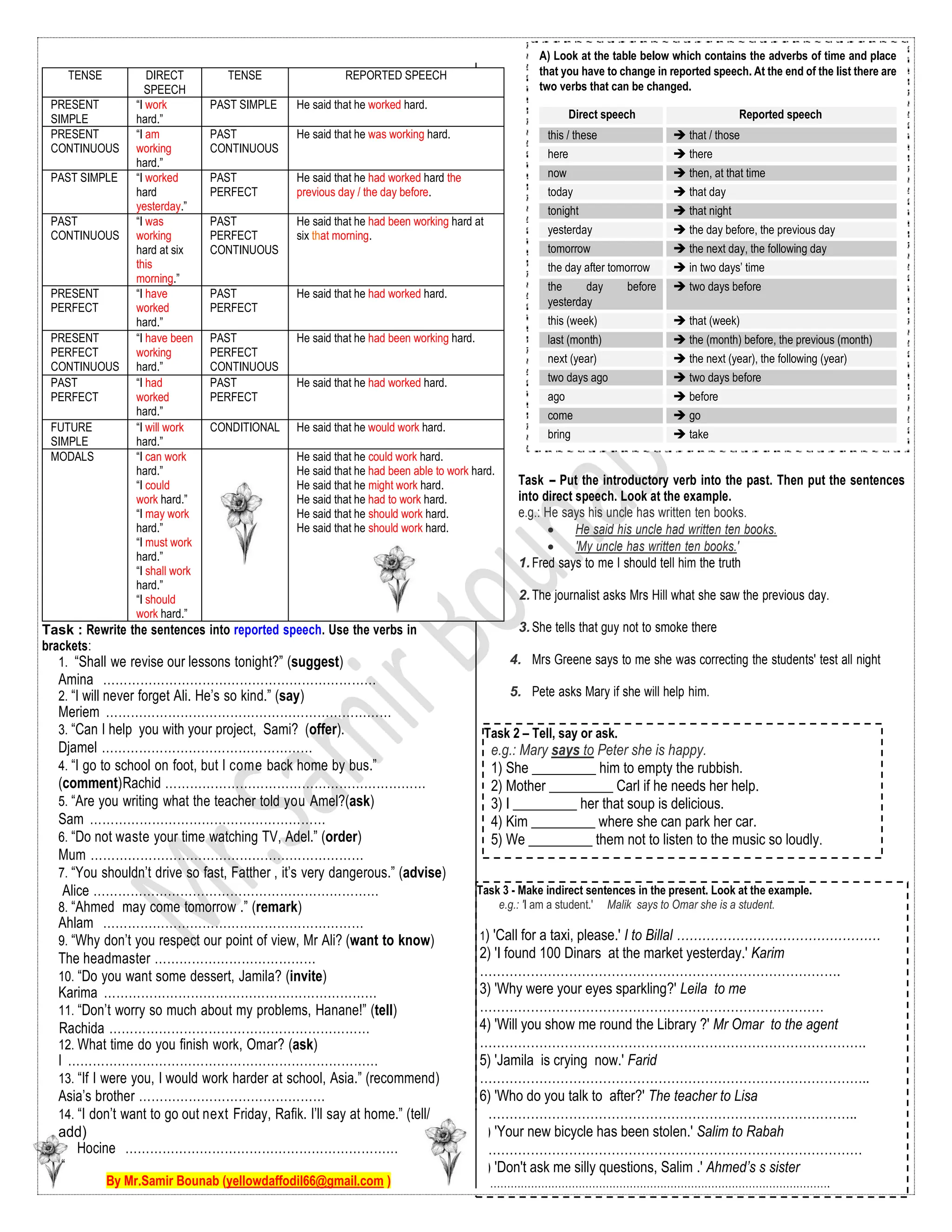
A) Look at the table below which contains the adverbs of time and place
that you have to change in reported speech. At the end of the list there are
two verbs that can be changed.
Direct speech Reported speech
this / these  that / those
here  there
now  then, at that time
today  that day
tonight  that night
yesterday  the day before, the previous day
tomorrow  the next day, the following day
the day after tomorrow  in two days’ time
the day before
yesterday
 two days before
this (week)  that (week)
last (month)  the (month) before, the previous (month)
next (year)  the next (year), the following (year)
two days ago  two days before
ago  before
come  go
bring  take
Task 3 - Make indirect sentences in the present. Look at the example.
e.g.: 'I am a student.' Malik says to Omar she is a student.
1) 'Call for a taxi, please.' I to Billal …………………………………………
2) 'I found 100 Dinars at the market yesterday.' Karim
………………………………………………………………………….
3) 'Why were your eyes sparkling?' Leila to me
………………………………………………………………………
4) 'Will you show me round the Library ?' Mr Omar to the agent
……………………………………………………………………………….
5) 'Jamila is crying now.' Farid
………………………………………………………………………………..
6) 'Who do you talk to after?' The teacher to Lisa
……………………………………………………………………………..
7) 'Your new bicycle has been stolen.' Salim to Rabah
………………………………………………………………………………
8) 'Don't ask me silly questions, Salim .' Ahmed’s s sister
………………………………………………………………………………………….
Task : Rewrite the sentences into reported speech. Use the verbs in
brackets:
1. “Shall we revise our lessons tonight?” (suggest)
Amina …………………………………………………………
2. “I will never forget Ali. He’s so kind.” (say)
Meriem ……………………………………………………………
3. “Can I help you with your project, Sami? (offer).
Djamel ……………………………………………
4. “I go to school on foot, but I come back home by bus.”
(comment)Rachid ………………………………………………………
5. “Are you writing what the teacher told you Amel?(ask)
Sam …………………………………………………
6. “Do not waste your time watching TV, Adel.” (order)
Mum …………………………………………………………
7. “You shouldn’t drive so fast, Fatther , it’s very dangerous.” (advise)
Alice ……………………………………………………………
8. “Ahmed may come tomorrow .” (remark)
Ahlam ………………………………………………………
9. “Why don’t you respect our point of view, Mr Ali? (want to know)
The headmaster …………………………………
10. “Do you want some dessert, Jamila? (invite)
Karima …………………………………………………………
11. “Don’t worry so much about my problems, Hanane!” (tell)
Rachida ………………………………………………………
12. What time do you finish work, Omar? (ask)
I …………………………………………………………………
13. “If I were you, I would work harder at school, Asia.” (recommend)
Asia’s brother ………………………………………
14. “I don’t want to go out next Friday, Rafik. I’ll say at home.” (tell/
add)
Hocine …………………………………………………………
“
By Mr.Samir Bounab (yellowdaffodil66@gmail.com )
Task – Put the introductory verb into the past. Then put the sentences
into direct speech. Look at the example.
e.g.: He says his uncle has written ten books.
 He said his uncle had written ten books.
 'My uncle has written ten books.'
1.Fred says to me I should tell him the truth
2.The journalist asks Mrs Hill what she saw the previous day.
3.She tells that guy not to smoke there
4. Mrs Greene says to me she was correcting the students' test all night
5. Pete asks Mary if she will help him.
TENSE DIRECT
SPEECH
TENSE REPORTED SPEECH
PRESENT
SIMPLE
“I work
hard.”
PAST SIMPLE He said that he worked hard.
PRESENT
CONTINUOUS
“I am
working
hard.”
PAST
CONTINUOUS
He said that he was working hard.
PAST SIMPLE “I worked
hard
yesterday.”
PAST
PERFECT
He said that he had worked hard the
previous day / the day before.
PAST
CONTINUOUS
“I was
working
hard at six
this
morning.”
PAST
PERFECT
CONTINUOUS
He said that he had been working hard at
six that morning.
PRESENT
PERFECT
“I have
worked
hard.”
PAST
PERFECT
He said that he had worked hard.
PRESENT
PERFECT
CONTINUOUS
“I have been
working
hard.”
PAST
PERFECT
CONTINUOUS
He said that he had been working hard.
PAST
PERFECT
“I had
worked
hard.”
PAST
PERFECT
He said that he had worked hard.
FUTURE
SIMPLE
“I will work
hard.”
CONDITIONAL He said that he would work hard.
MODALS “I can work
hard.”
“I could
work hard.”
“I may work
hard.”
“I must work
hard.”
“I shall work
hard.”
“I should
work hard.”
He said that he could work hard.
He said that he had been able to work hard.
He said that he might work hard.
He said that he had to work hard.
He said that he should work hard.

2 AS Types of Disaster and where they occur & Reported Speech.pdf

  • 1.
    2AS: Unit 4“Disaster & Safety” “Types of Disaster and where they occur & Reported Speech” By Mr.Samir Bounab (yellowdaffodil66@gmail.com ) Task 1: List all the words that you see in the word cloud ………………………………………………………………………………………………………….. ……………………………………………………………………………………………………………... …………………………………………………………………………………………………………….. Task 2: Match the pictures with the type of natural disaster. avalanche drought earthquake flood forest fire heat wave hurricane meteor impact tornado tsunami volcanic eruption Task 3: Match each definition with its right natural disaster words: “Lightning -drought- earthquake-hurricane -explosion” 1 A sudden strong shaking of the ground: ____________ 2 A storm with very strong winds: ____________________ 3 A long time when there is not enough rain: ___________ 4 Bursting suddenly with a very loud noise: ________ 5 A sudden bright light in the sky when there is a storm:…… By Mr.Samir Bounab (yellowdaffodil66@gmail.com ) Task: Find the names of the natural disasters in the word search Task: Which warning natural disaster sign does each picture represent? ……………… ……………… ………………… ……………….. ………………. ………………… ………………….. ………………… Task : Classify the naturals disaster according to their type. Bacterial and viral diseases – floods –earthquakes –thunderstorms- bird flu-soil erosion –weapons-tsunami-tornadoes-avalanches –epidemics – droughts –nuclear –landslides –chemistry-volcano Atmospheric Terrestrial Aquatic Biological Task: Where do natural disasters occur? 1. Earthquakes & volcanos : a) oceans and inland areas 2. Avalanches b)edges of tectonic plates 3. Volcanoes c) the South Pacific and Indian Ocean 4. Tornadoes d) rivers, urban areas, low-lying area, storm drains.. 5. Tsunamis e) heavy snowy mountains 6. Foods f) desertification Areas 7. Droughts g) over land 8. Cyclones h) over the North Atlantic, central North Pacific, 9. Hurricanes i) lands and oceans Natural disaster Place A E R U P T I O N G R E P W I S R Y W S Z J B M R O T S E O X S G S G O D A N R O T K J Q V S N P Q A R W T R D A D U F O O K P A P X H Y L U N H O A L T W J I C G L I Q X E Q Y R C C B B I U G G H S S A T L B A H A I O Q H T A O D O O L F N G K R K T R L K N A W Y F Z I W D E N A C I R R U H G X C C M Z I E H C I M A N U S T E W O N V C Q Y I X Y E U G E K A G R H Z H A I L S T O N E S J J I E H I W N O L T K A J P F H V W X U Q W L C A M Z D X
  • 2.
    Task 2 –Tell, say or ask. e.g.: Mary says to Peter she is happy. 1) She _________ him to empty the rubbish. 2) Mother _________ Carl if he needs her help. 3) I _________ her that soup is delicious. 4) Kim _________ where she can park her car. 5) We _________ them not to listen to the music so loudly. A) Look at the table below which contains the adverbs of time and place that you have to change in reported speech. At the end of the list there are two verbs that can be changed. Direct speech Reported speech this / these  that / those here  there now  then, at that time today  that day tonight  that night yesterday  the day before, the previous day tomorrow  the next day, the following day the day after tomorrow  in two days’ time the day before yesterday  two days before this (week)  that (week) last (month)  the (month) before, the previous (month) next (year)  the next (year), the following (year) two days ago  two days before ago  before come  go bring  take Task 3 - Make indirect sentences in the present. Look at the example. e.g.: 'I am a student.' Malik says to Omar she is a student. 1) 'Call for a taxi, please.' I to Billal ………………………………………… 2) 'I found 100 Dinars at the market yesterday.' Karim …………………………………………………………………………. 3) 'Why were your eyes sparkling?' Leila to me ……………………………………………………………………… 4) 'Will you show me round the Library ?' Mr Omar to the agent ………………………………………………………………………………. 5) 'Jamila is crying now.' Farid ……………………………………………………………………………….. 6) 'Who do you talk to after?' The teacher to Lisa …………………………………………………………………………….. 7) 'Your new bicycle has been stolen.' Salim to Rabah ……………………………………………………………………………… 8) 'Don't ask me silly questions, Salim .' Ahmed’s s sister …………………………………………………………………………………………. Task : Rewrite the sentences into reported speech. Use the verbs in brackets: 1. “Shall we revise our lessons tonight?” (suggest) Amina ………………………………………………………… 2. “I will never forget Ali. He’s so kind.” (say) Meriem …………………………………………………………… 3. “Can I help you with your project, Sami? (offer). Djamel …………………………………………… 4. “I go to school on foot, but I come back home by bus.” (comment)Rachid ……………………………………………………… 5. “Are you writing what the teacher told you Amel?(ask) Sam ………………………………………………… 6. “Do not waste your time watching TV, Adel.” (order) Mum ………………………………………………………… 7. “You shouldn’t drive so fast, Fatther , it’s very dangerous.” (advise) Alice …………………………………………………………… 8. “Ahmed may come tomorrow .” (remark) Ahlam ……………………………………………………… 9. “Why don’t you respect our point of view, Mr Ali? (want to know) The headmaster ………………………………… 10. “Do you want some dessert, Jamila? (invite) Karima ………………………………………………………… 11. “Don’t worry so much about my problems, Hanane!” (tell) Rachida ……………………………………………………… 12. What time do you finish work, Omar? (ask) I ………………………………………………………………… 13. “If I were you, I would work harder at school, Asia.” (recommend) Asia’s brother ……………………………………… 14. “I don’t want to go out next Friday, Rafik. I’ll say at home.” (tell/ add) Hocine ………………………………………………………… “ By Mr.Samir Bounab (yellowdaffodil66@gmail.com ) Task – Put the introductory verb into the past. Then put the sentences into direct speech. Look at the example. e.g.: He says his uncle has written ten books.  He said his uncle had written ten books.  'My uncle has written ten books.' 1.Fred says to me I should tell him the truth 2.The journalist asks Mrs Hill what she saw the previous day. 3.She tells that guy not to smoke there 4. Mrs Greene says to me she was correcting the students' test all night 5. Pete asks Mary if she will help him. TENSE DIRECT SPEECH TENSE REPORTED SPEECH PRESENT SIMPLE “I work hard.” PAST SIMPLE He said that he worked hard. PRESENT CONTINUOUS “I am working hard.” PAST CONTINUOUS He said that he was working hard. PAST SIMPLE “I worked hard yesterday.” PAST PERFECT He said that he had worked hard the previous day / the day before. PAST CONTINUOUS “I was working hard at six this morning.” PAST PERFECT CONTINUOUS He said that he had been working hard at six that morning. PRESENT PERFECT “I have worked hard.” PAST PERFECT He said that he had worked hard. PRESENT PERFECT CONTINUOUS “I have been working hard.” PAST PERFECT CONTINUOUS He said that he had been working hard. PAST PERFECT “I had worked hard.” PAST PERFECT He said that he had worked hard. FUTURE SIMPLE “I will work hard.” CONDITIONAL He said that he would work hard. MODALS “I can work hard.” “I could work hard.” “I may work hard.” “I must work hard.” “I shall work hard.” “I should work hard.” He said that he could work hard. He said that he had been able to work hard. He said that he might work hard. He said that he had to work hard. He said that he should work hard. He said that he should work hard.