UNIT 10
Space, unexplained mysteries,
environment
Space,unexplained mysteries,environment
Reading: Curricular cuts: stars, a story,
an article about environment
Listening: Note taking, predicting content
Grammar: Reported speech (statements,
questions, commands), relatives
Vocabulary: Space, solar system, supernatural,
environmental issues
Speaking: An interview about extra-terrestrial creatures
• Abduction (n) - When someone is taken away by force
• Researcher(n) - Somebody who finds information about a
particular subject
• Picture (v) - To imagine
• Strangely (adj)- In an unusual or surprising way
• Disappear(v) - Impossible to see
• Hill (n)- Very small mountain
• Experience(n) - Something that happens to you
• Witness(n) - Somebody who sees something happen
• Debris (n) -The pieces of something that are left behind after
an explosion or accident
• Burn mark(n) - A small area that has been damaged by fire
• Ground (n) - The surface of the earth
• Crash (n) - Accident in which something, usually a vehicle, hits
something else and is damaged/destroyed
• Society (n) - An organisation or a club
• Sighting (n) - When something unusual is seen
• Comet (n)- Bright object with a tail that travels around the sun
• Meteor (n) - A piece of rock or metal that travels through the
space
• Bright (adj) - Having / giving off a lot of light
• Solar system (n) - A system with sun and the planets
surrounding it
• Condition(n) - All the things affecting the way something
happens
• Convinced(adj) - Certain that something is true
• Among (prep) - In the middle of a group of people or things
1. When someone is taken away by force
2. Somebody who finds information about a particular
subject
3. To imagine
4. In an unusual or surprising way
5. Impossible to see
6. Very small mountain
7. Something that happens to you
8. Somebody who sees something happen
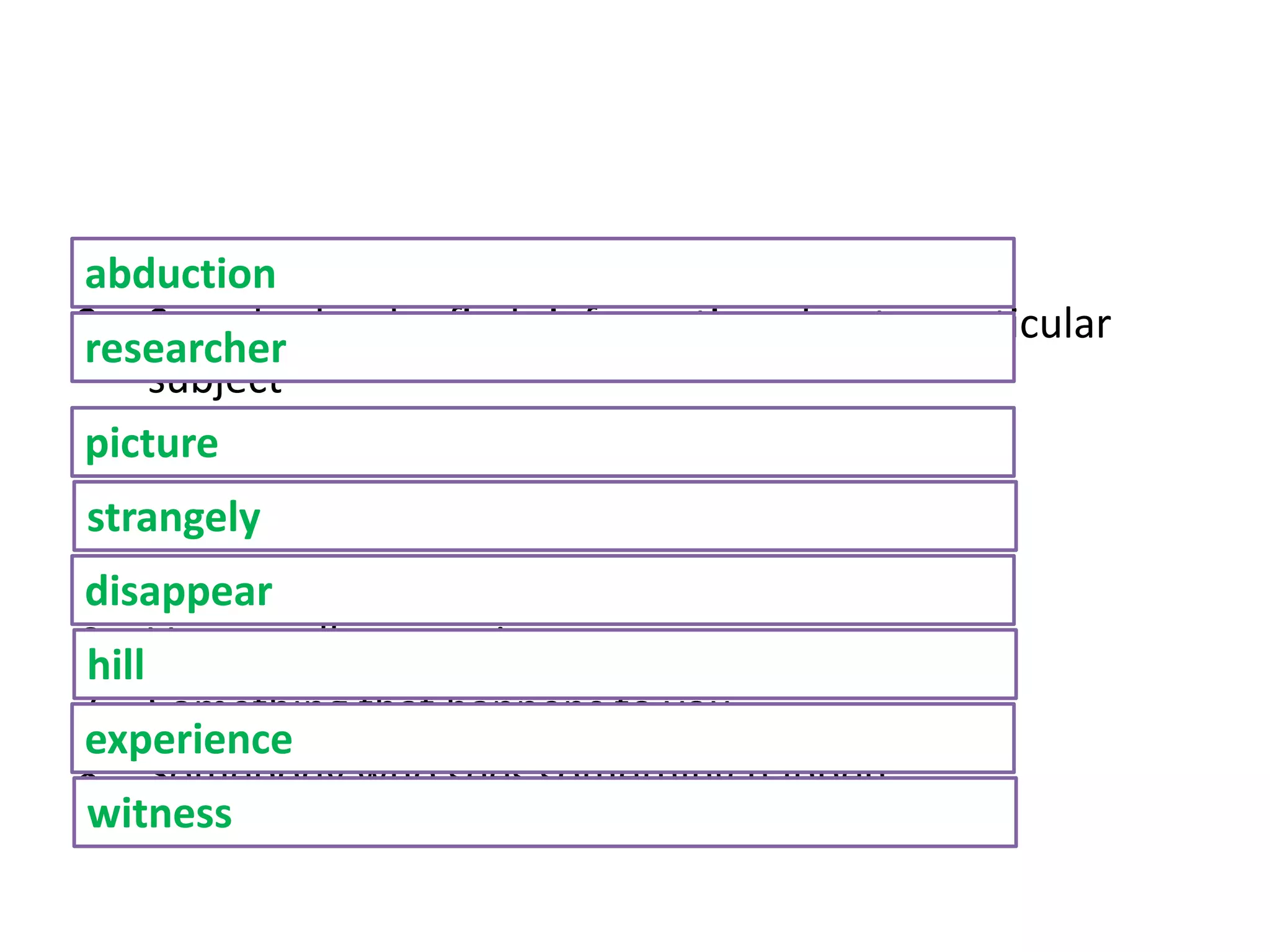
abduction
researcher
picture
strangely
disappear
hill
experience
witness
9. The pieces of something that are left behind after an
explosion or accident
10. A small area that has been damaged by fire
11. The surface of the earth
12. Accident in which something, usually a vehicle, hits
something else and is damaged/destroyed
13. An organisation or a club
14. When something unusual is seen
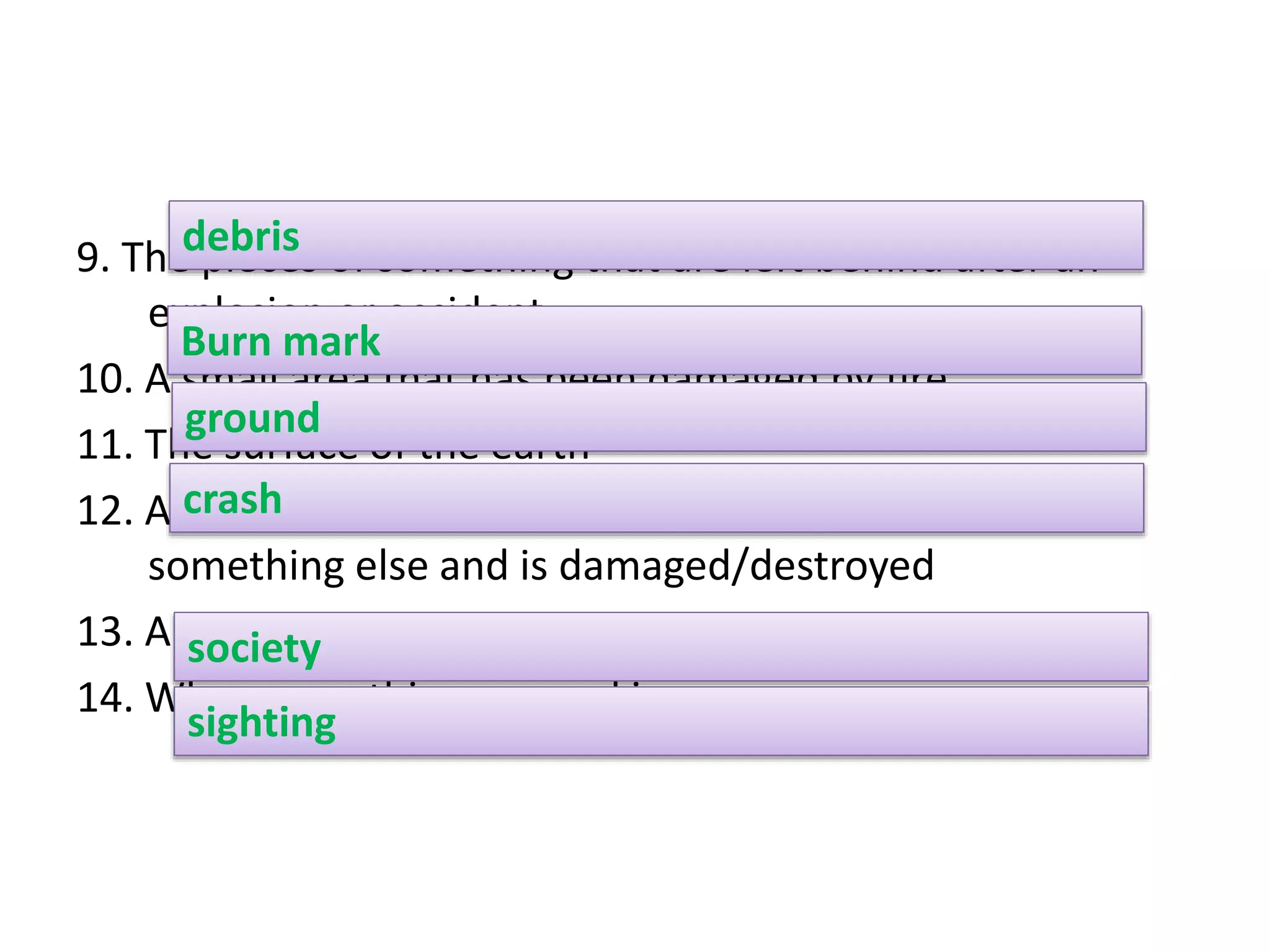
debris
Burn mark
ground
crash
society
sighting
15. Bright object with a tail that travels around the sun
16. A piece of rock or metal that travels through the space
17. Having / giving off a lot of light
18. A system with sun and the planets surrounding it
19. All the things affecting the way something happens
20. Certain that something is true
21. In the middle of a group of people or things
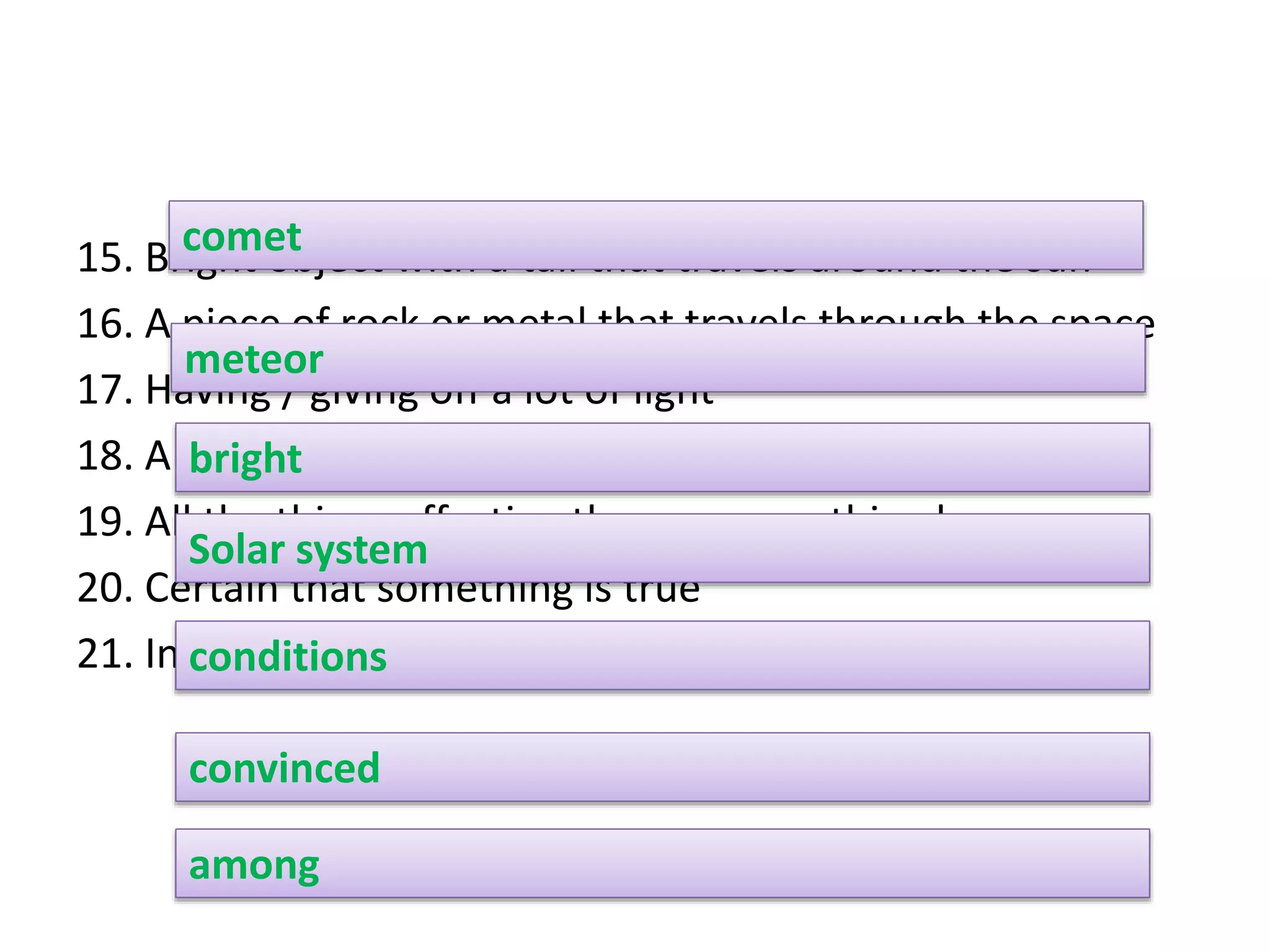
comet
meteor
bright
Solar system
conditions
convinced
among
REPORTED SPEECH
• How we report another person’s words;
• How we restate what someone said
* restate - express again, say again, state a new
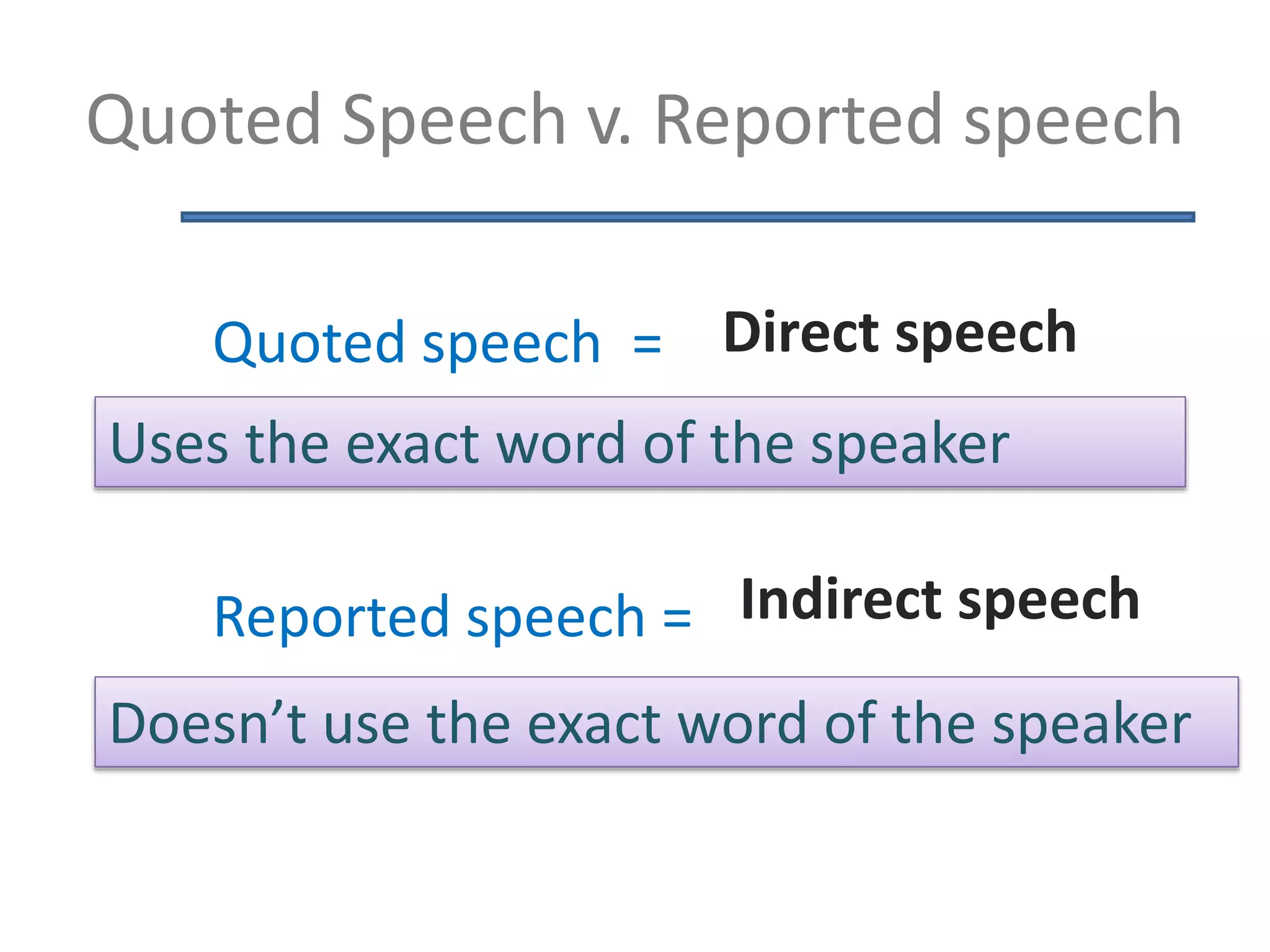
Quoted Speech v. Reported speech
Quoted speech =
Teacher said, “I like birthdays.”
Reported speech =
Teacher said she liked birthdays..
Uses the exact word of the speaker
Doesn’t use the exact word of the speaker
Direct speech
Indirect speech
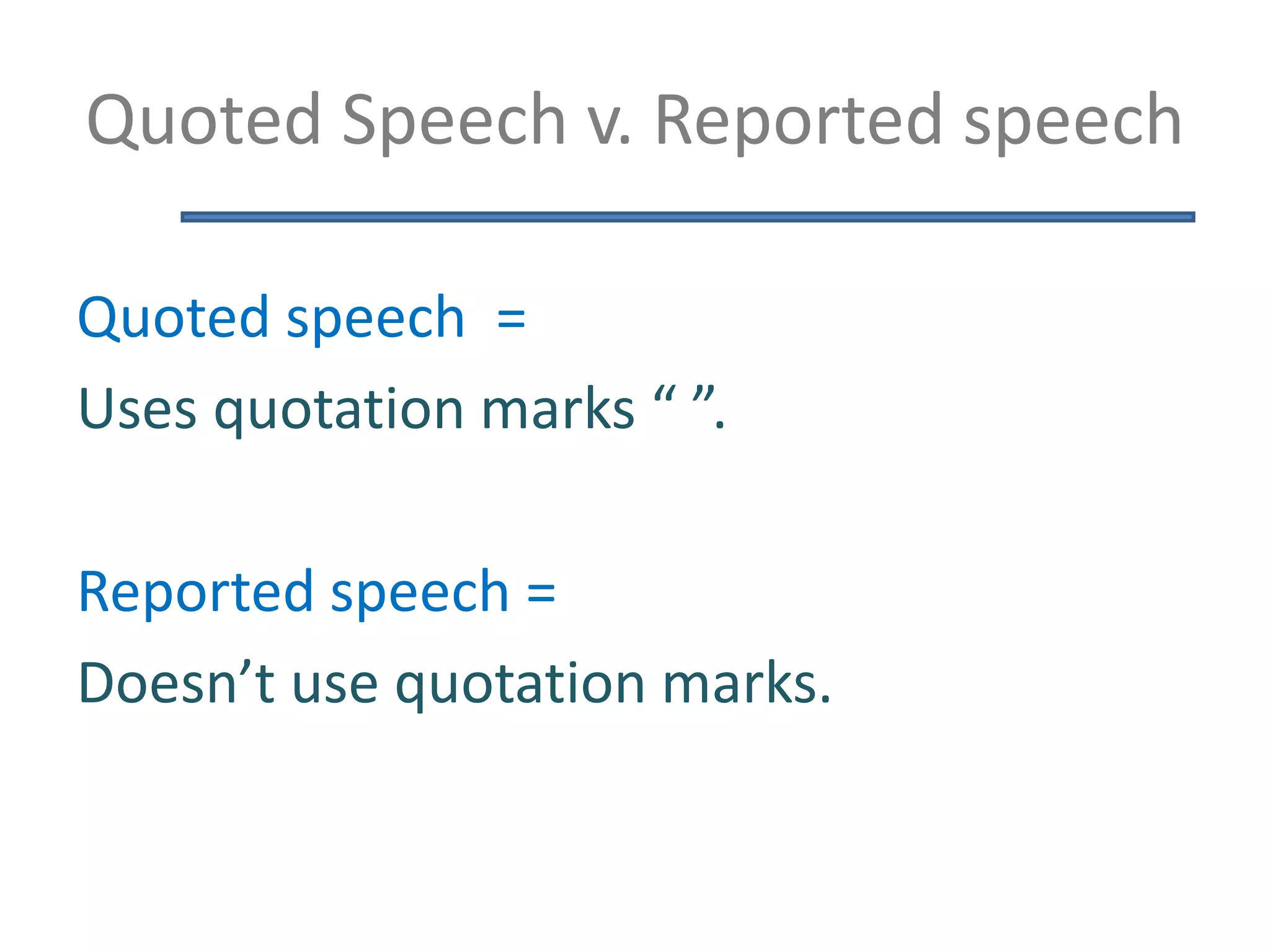
Quoted Speech v. Reported speech
Quoted speech =
Uses quotation marks “ ”.
Reported speech =
Doesn’t use quotation marks.
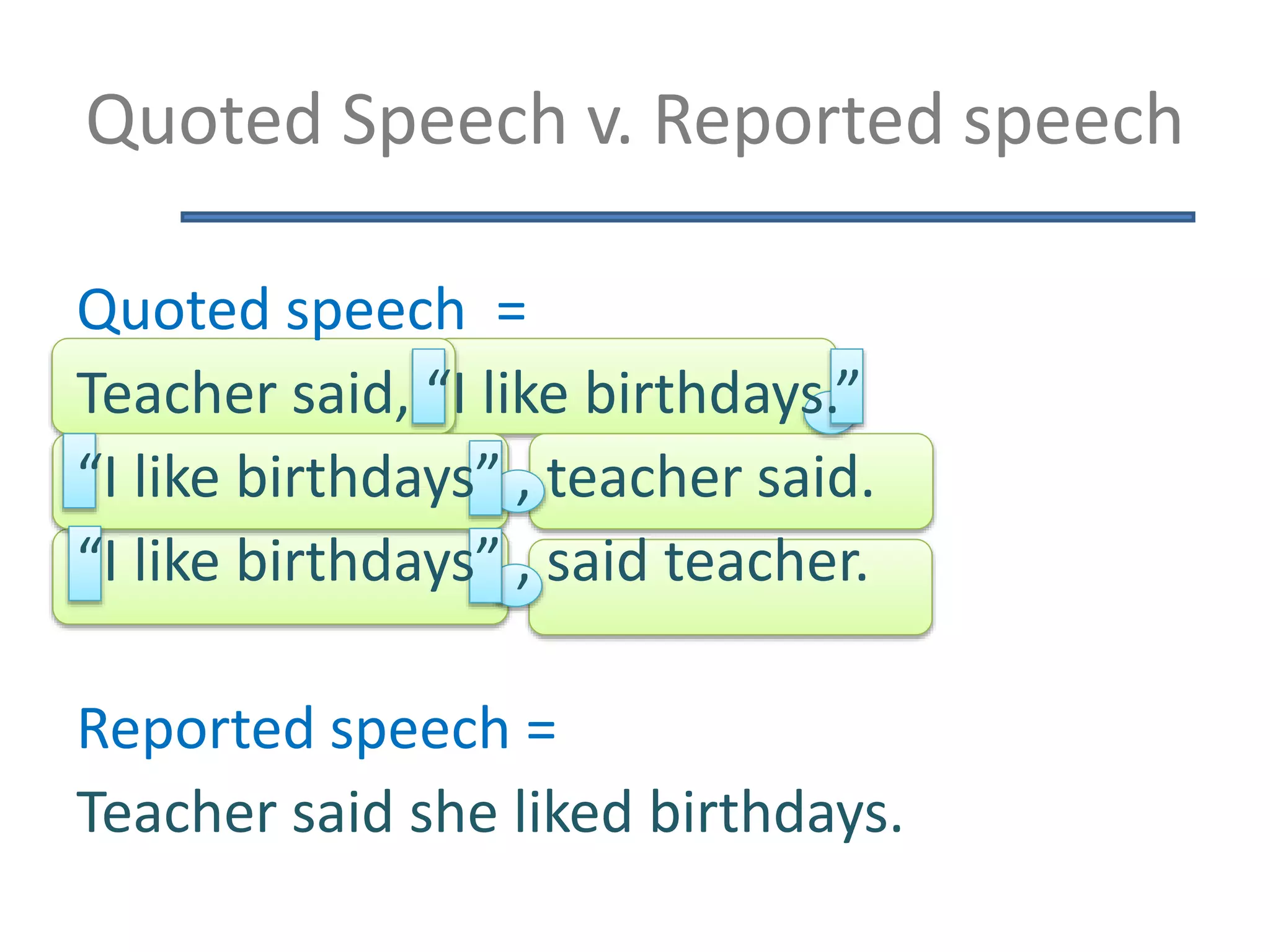
Quoted Speech v. Reported speech
Quoted speech =
Teacher said, “I like birthdays.”
“I like birthdays” , teacher said.
“I like birthdays” , said teacher.
Reported speech =
Teacher said she liked birthdays.
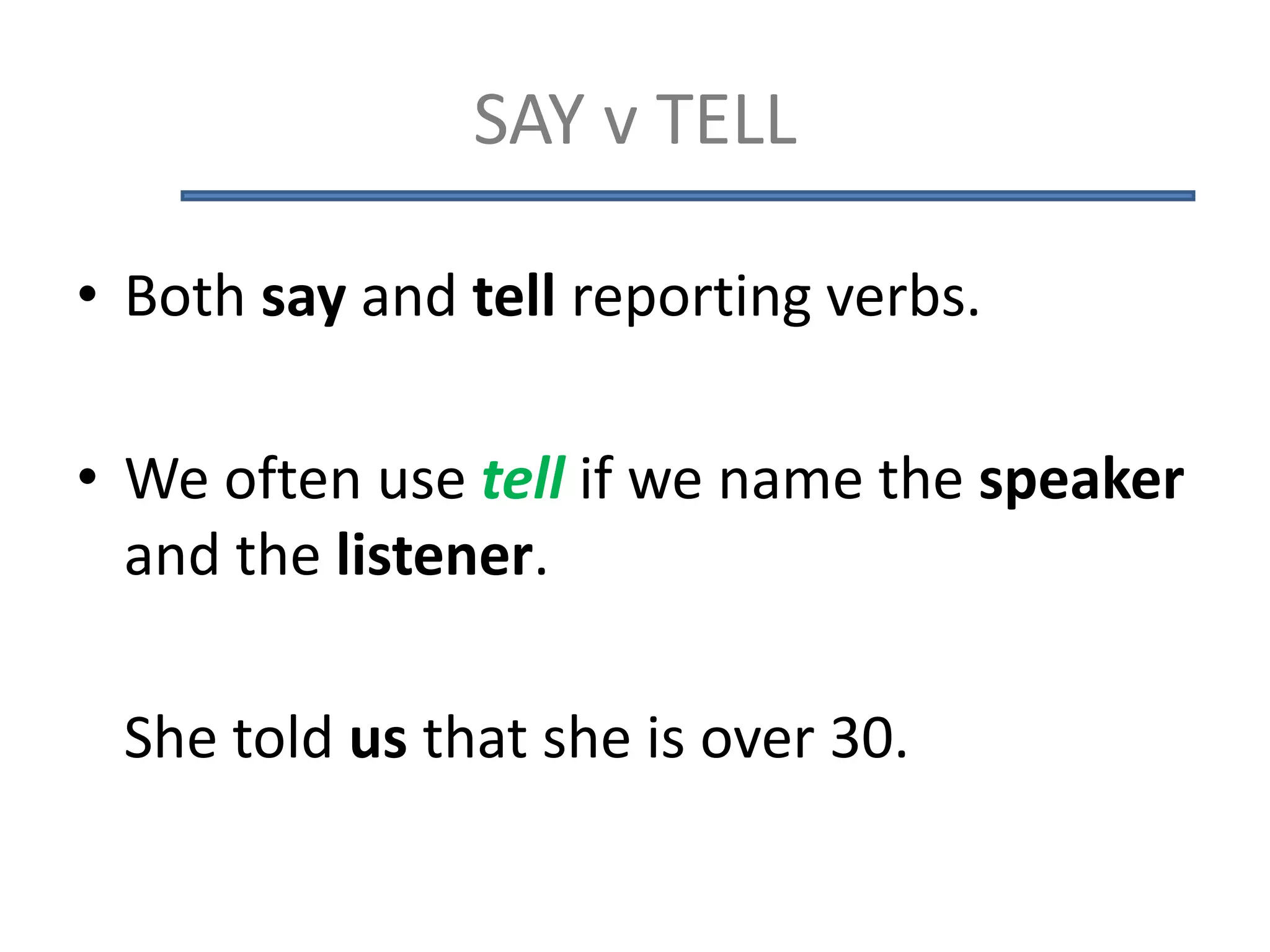
SAY v TELL
• Both say and tell reporting verbs.
• We often use tell if we name the speaker
and the listener.
She told us that she is over 30.
SAY v TELL
We can use say to name the listener, too, but
it’s not as common:
• She said to us she is over 30.
[okay]
• She told us she is over 30.
[More natural]
SAY v TELL
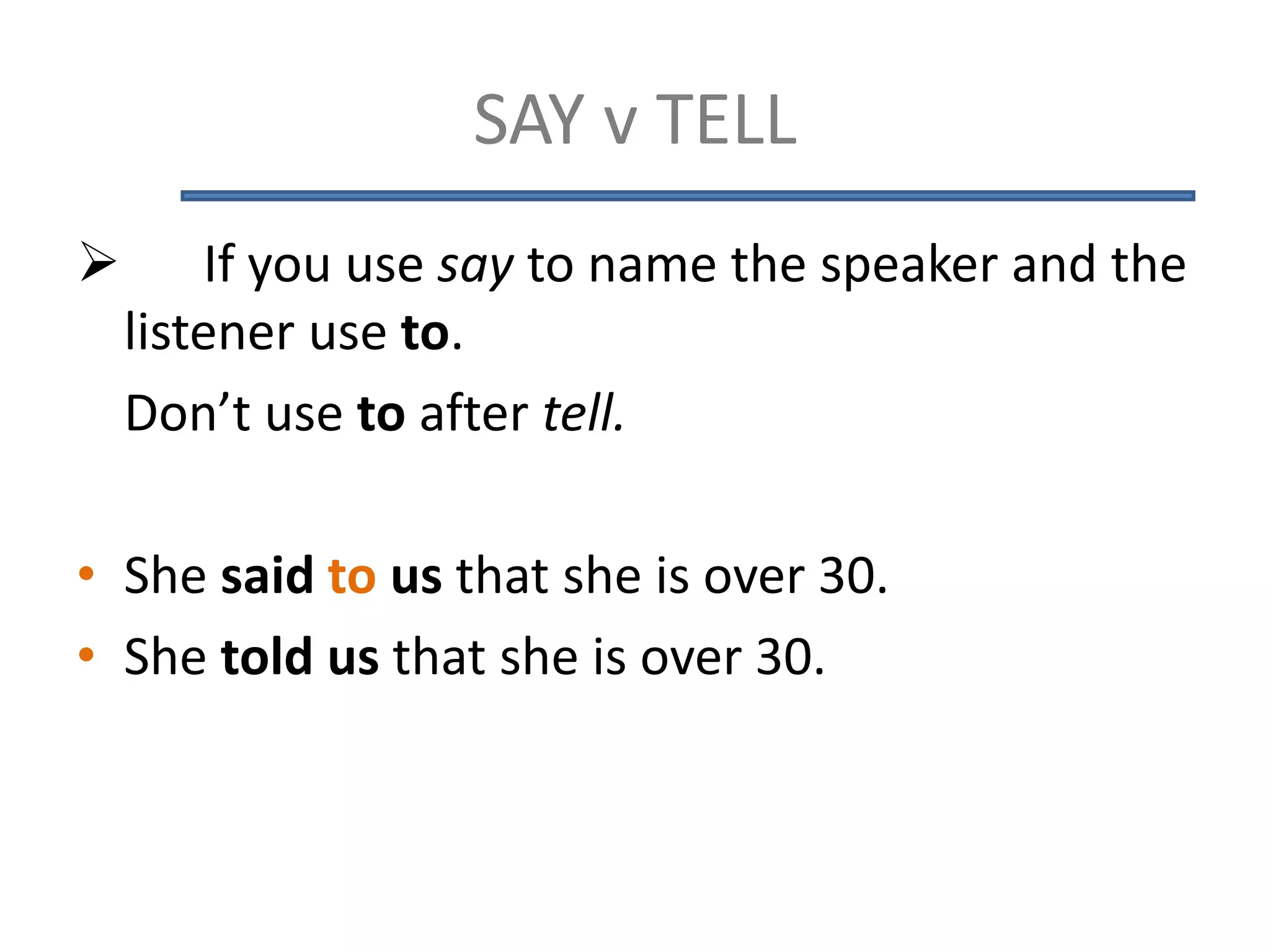
 If you use say to name the speaker and the
listener use to.
Don’t use to after tell.
• She said to us that she is over 30.
• She told us that she is over 30.
SAY v TELL
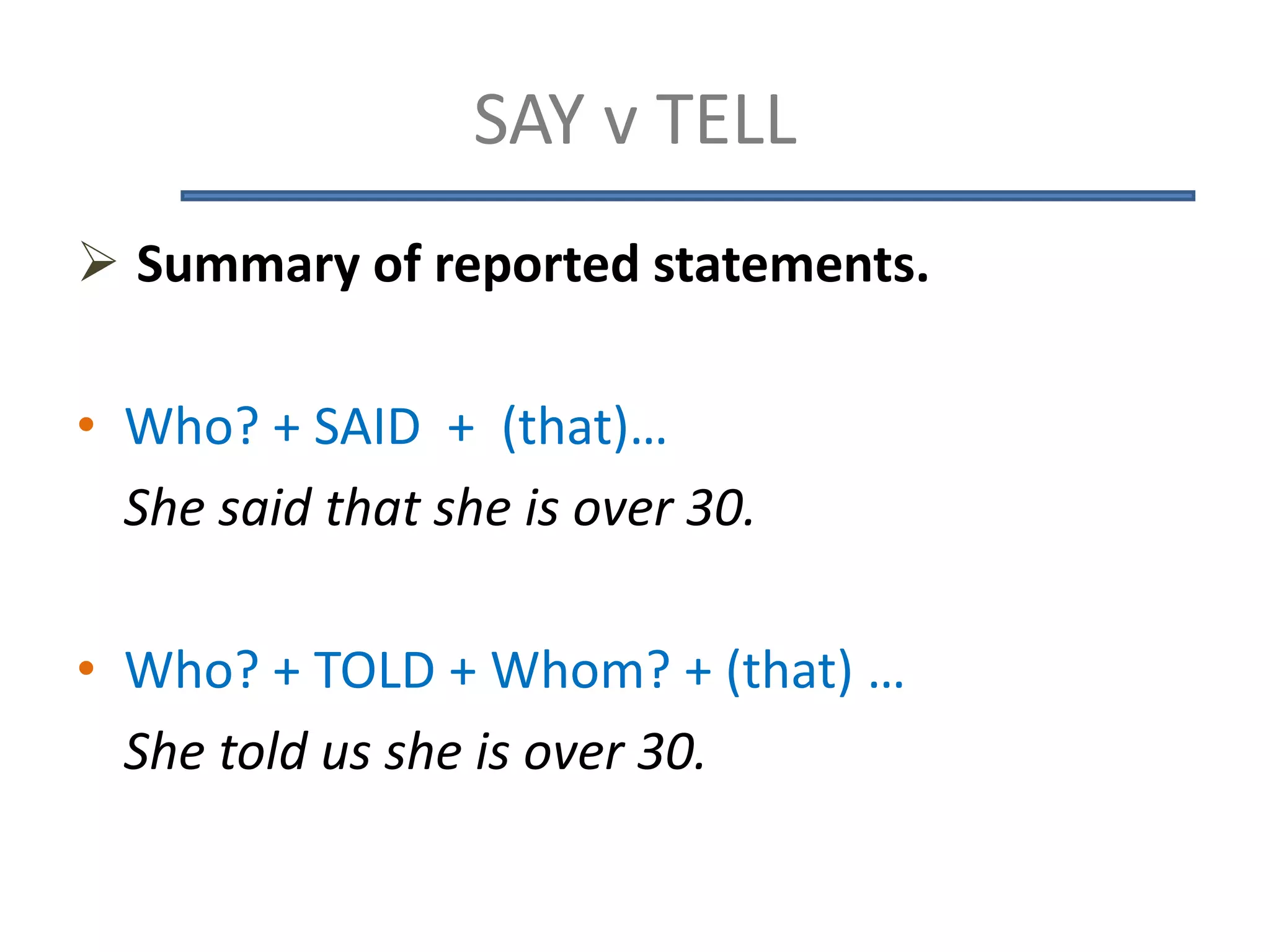
 Summary of reported statements.
• Who? + SAID + (that)…
She said that she is over 30.
• Who? + TOLD + Whom? + (that) …
She told us she is over 30.
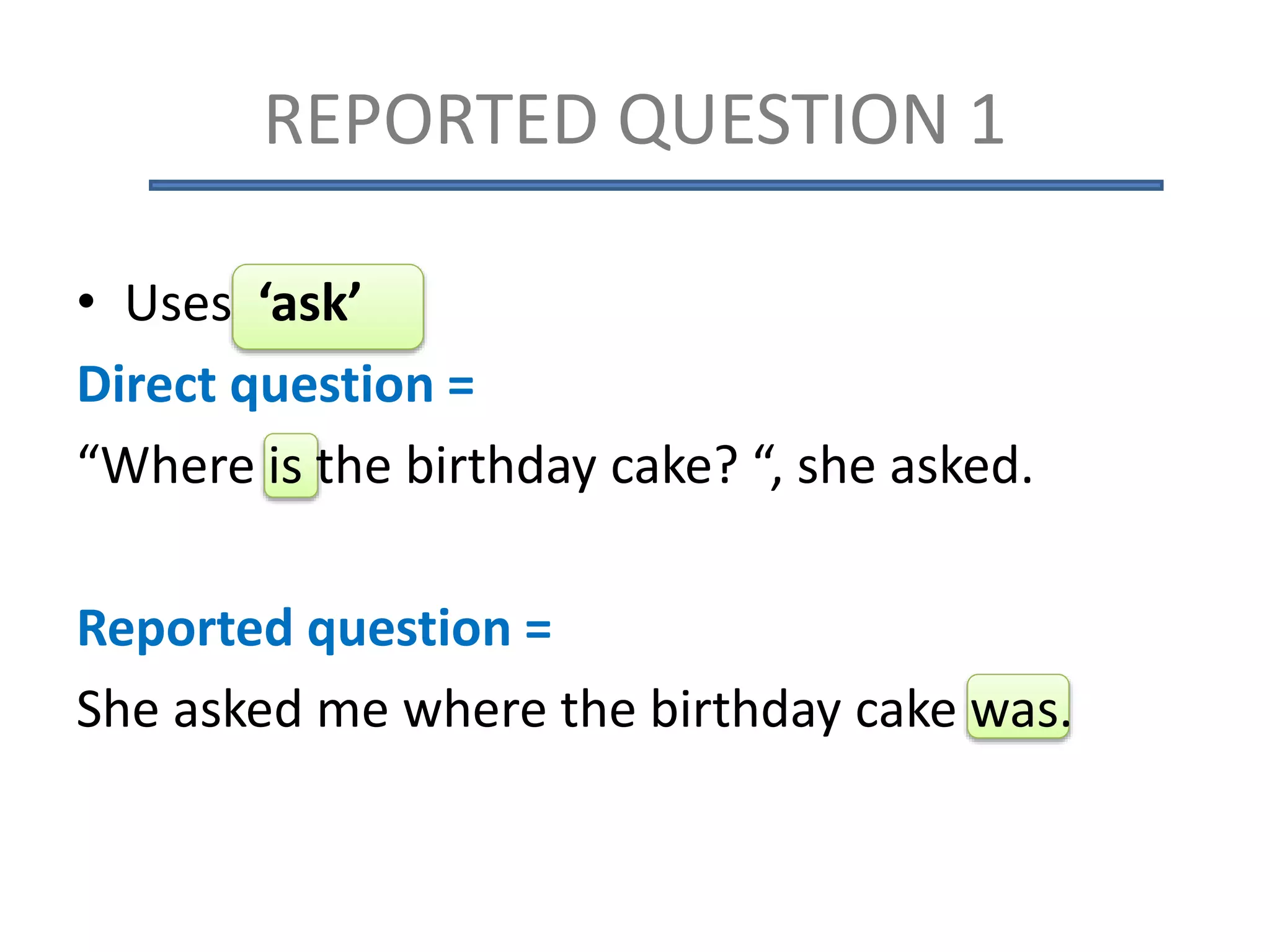
REPORTED QUESTION 1
• Uses ‘ask’
Direct question =
“Where is the birthday cake? “, she asked.
Reported question =
She asked me where the birthday cake was.
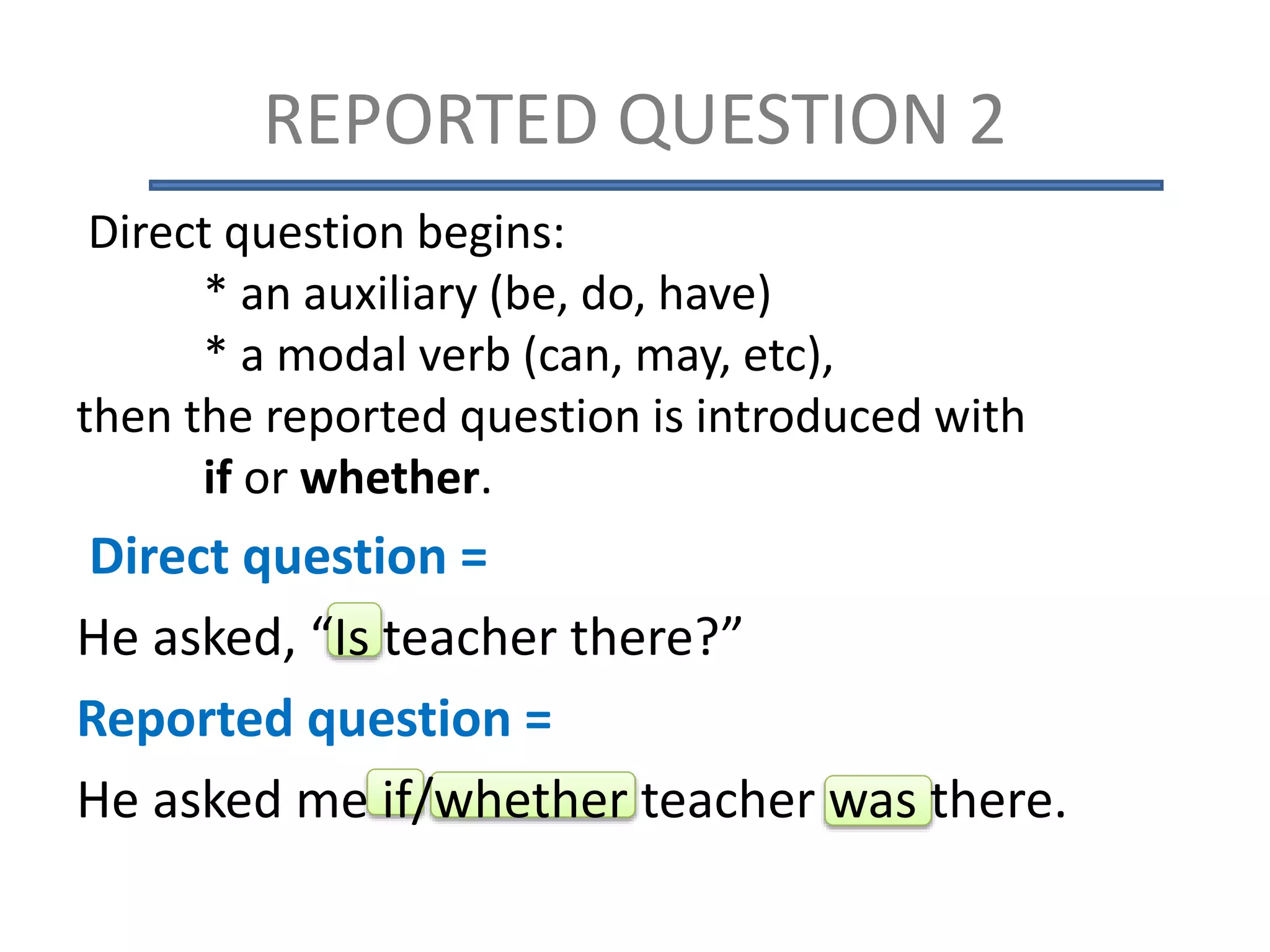
Direct question begins:
* an auxiliary (be, do, have)
* a modal verb (can, may, etc),
then the reported question is introduced with
if or whether.
Direct question =
He asked, “Is teacher there?”
Reported question =
He asked me if/whether teacher was there.
REPORTED QUESTION 2
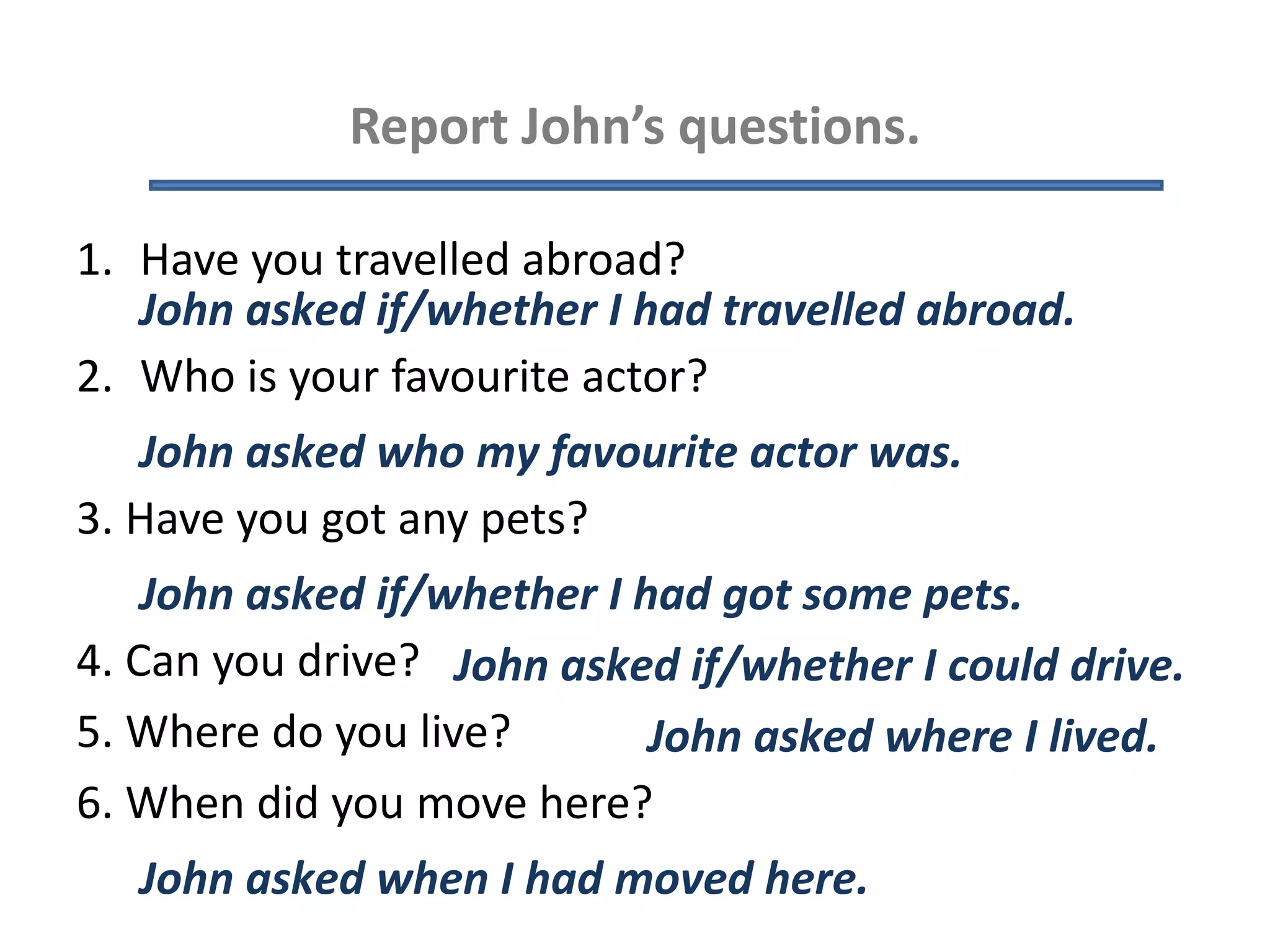
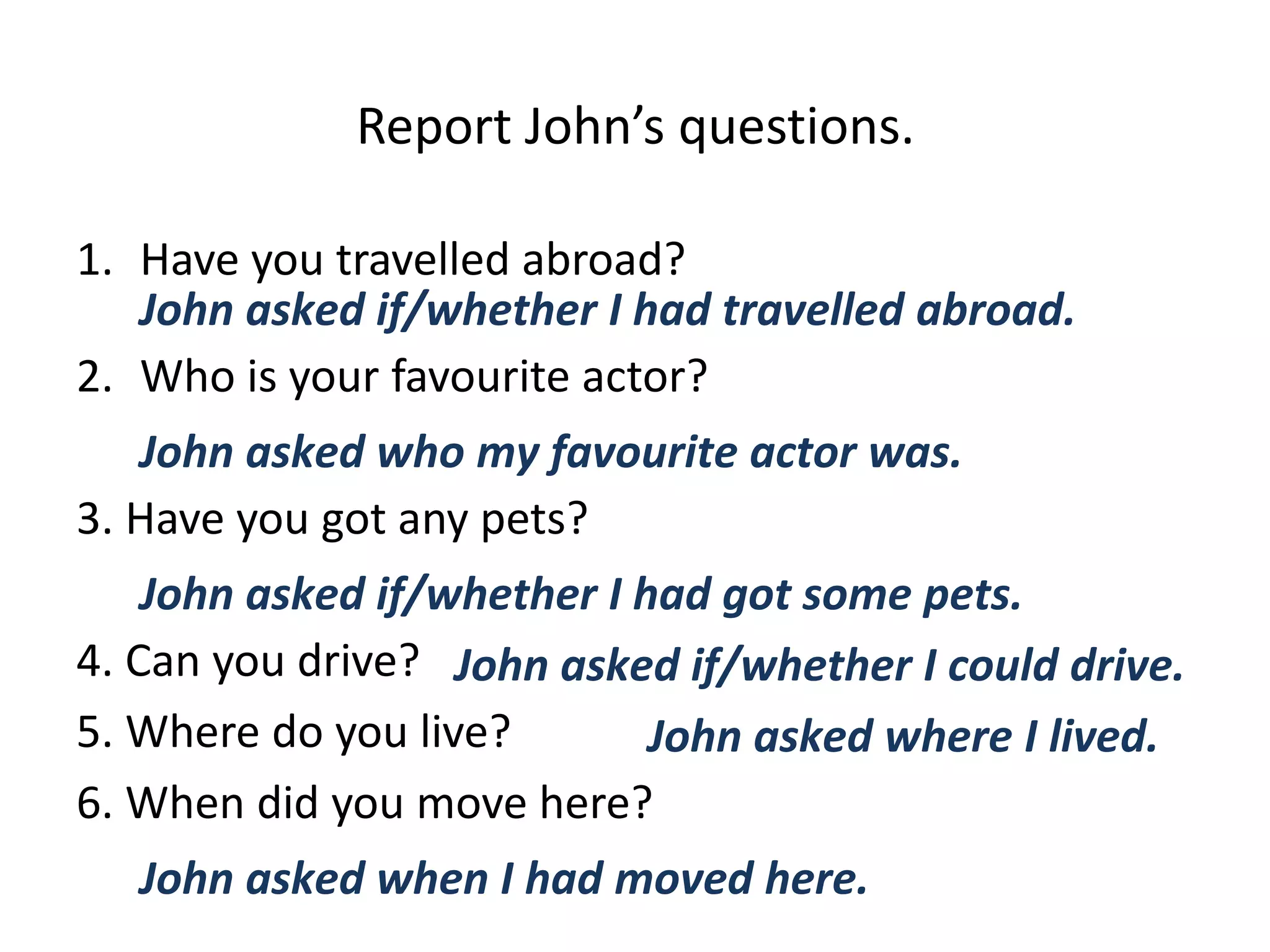
Report John’s questions.
1. Have you travelled abroad?
2. Who is your favourite actor?
3. Have you got any pets?
4. Can you drive?
5. Where do you live?
6. When did you move here?
John asked if/whether I had travelled abroad.
John asked who my favourite actor was.
John asked if/whether I had got some pets.
John asked if/whether I could drive.
John asked where I lived.
John asked when I had moved here.
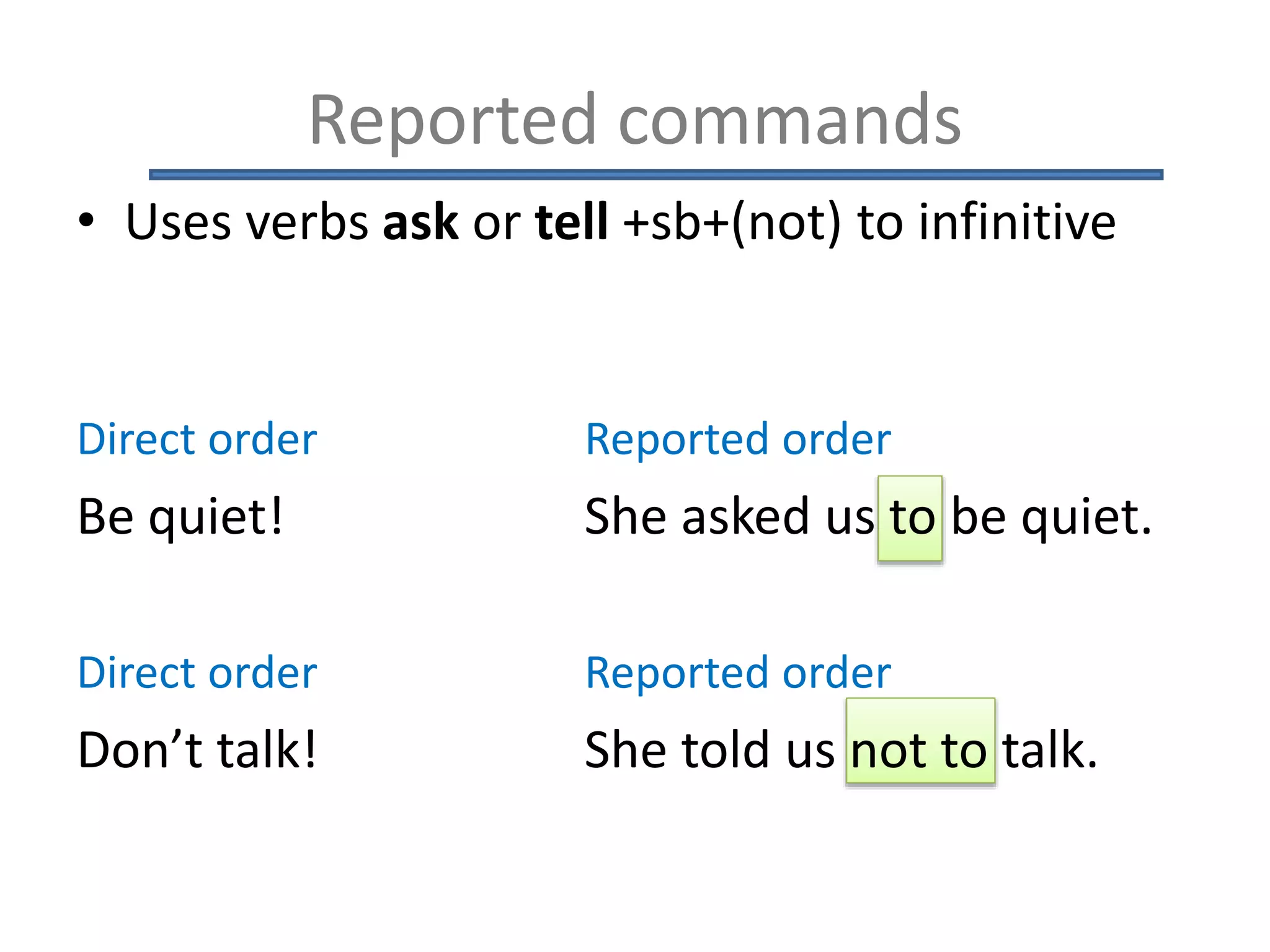
Reported commands
• Uses verbs ask or tell +sb+(not) to infinitive
Direct order Reported order
Be quiet! She asked us to be quiet.
Direct order Reported order
Don’t talk! She told us not to talk.
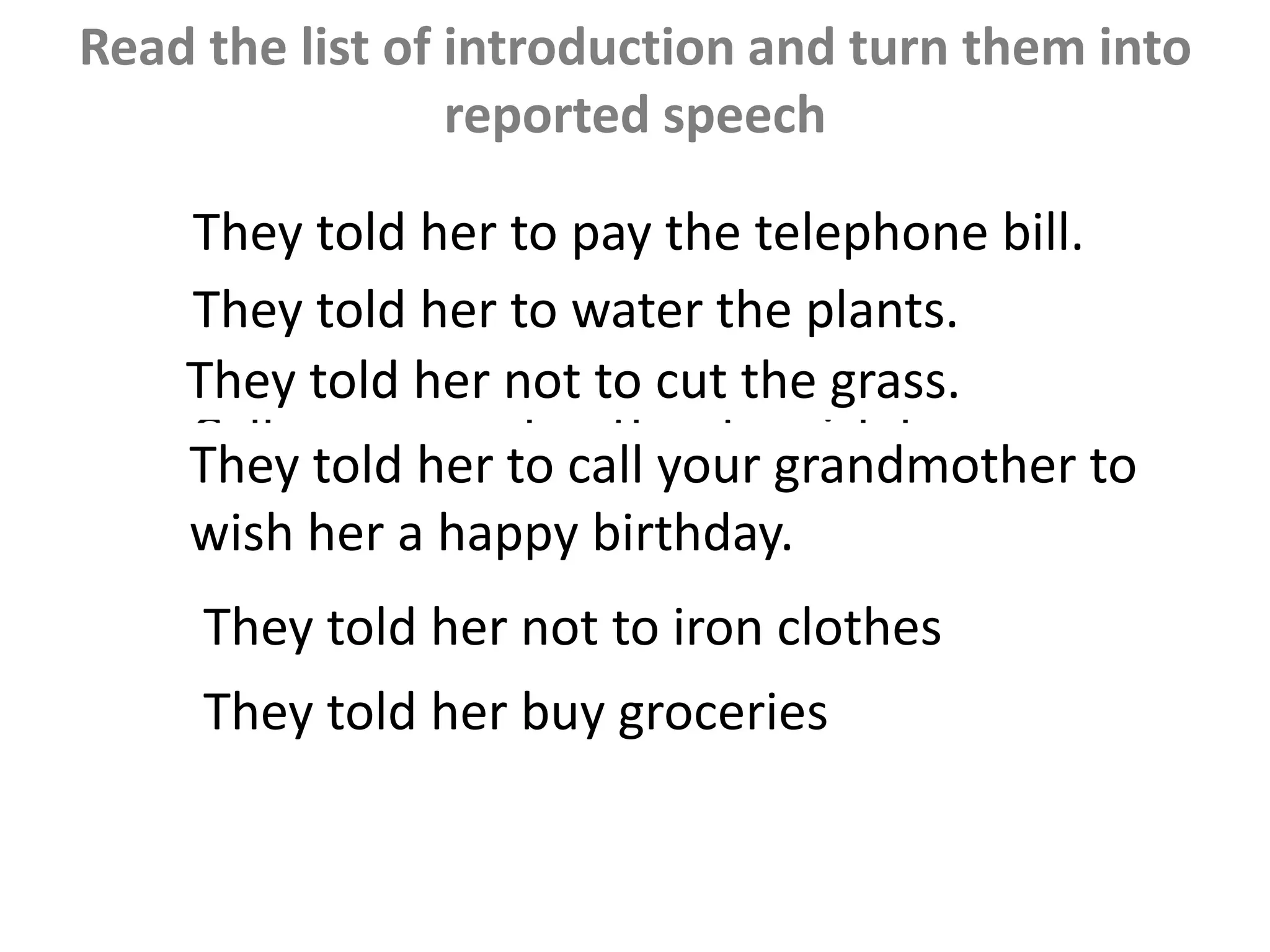
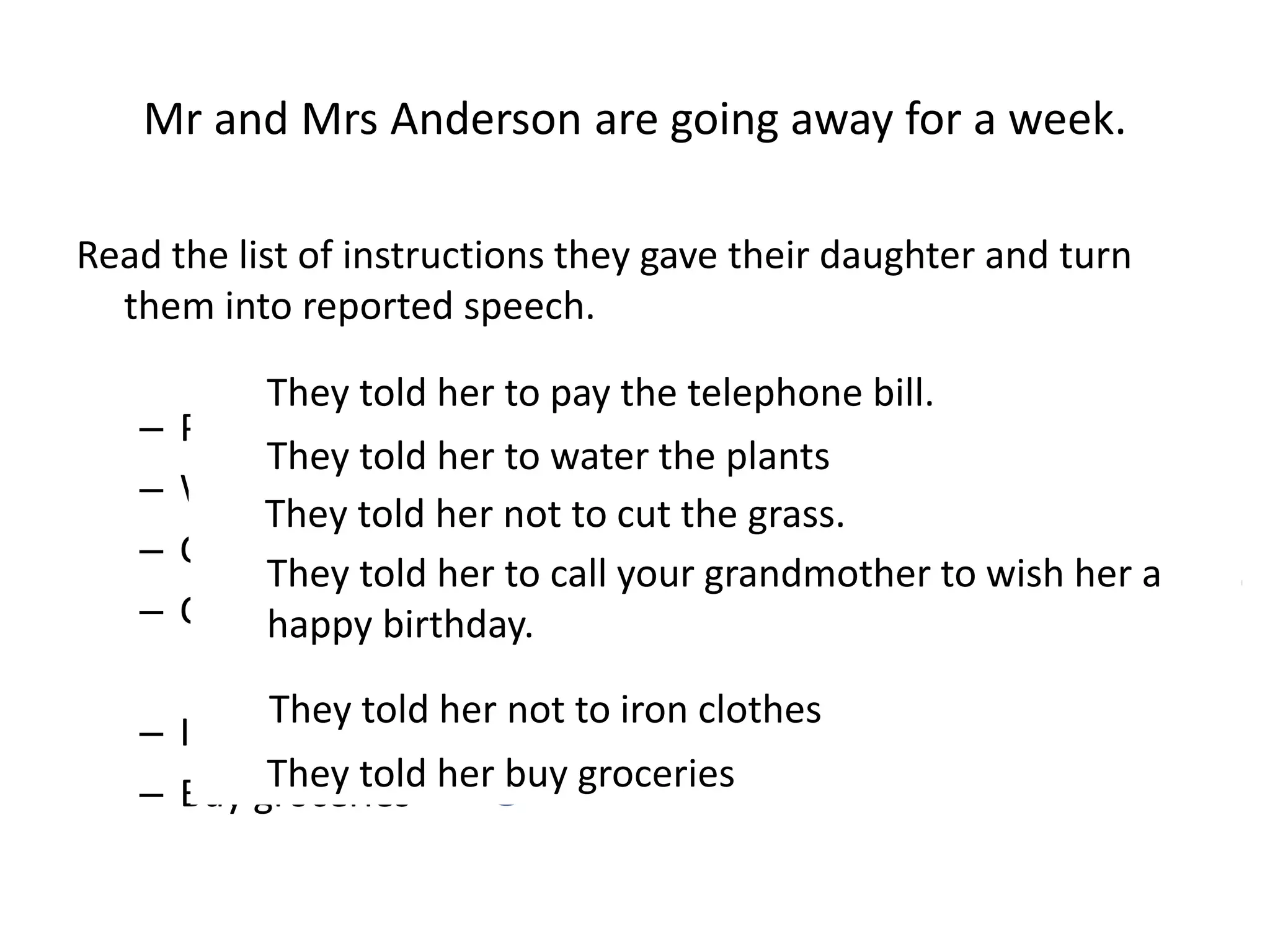
Read the list of introduction and turn them into
reported speech
•Pay the telephone bill 
•Water the plants 
•Cut the grass X
•Call your grandmother to wish her a
happy birthday 
•Iron clothes X
•Buy groceries 
They told her to pay the telephone bill.
They told her not to cut the grass.
They told her to call your grandmother to
wish her a happy birthday.
They told her not to iron clothes
They told her buy groceries
They told her to water the plants.
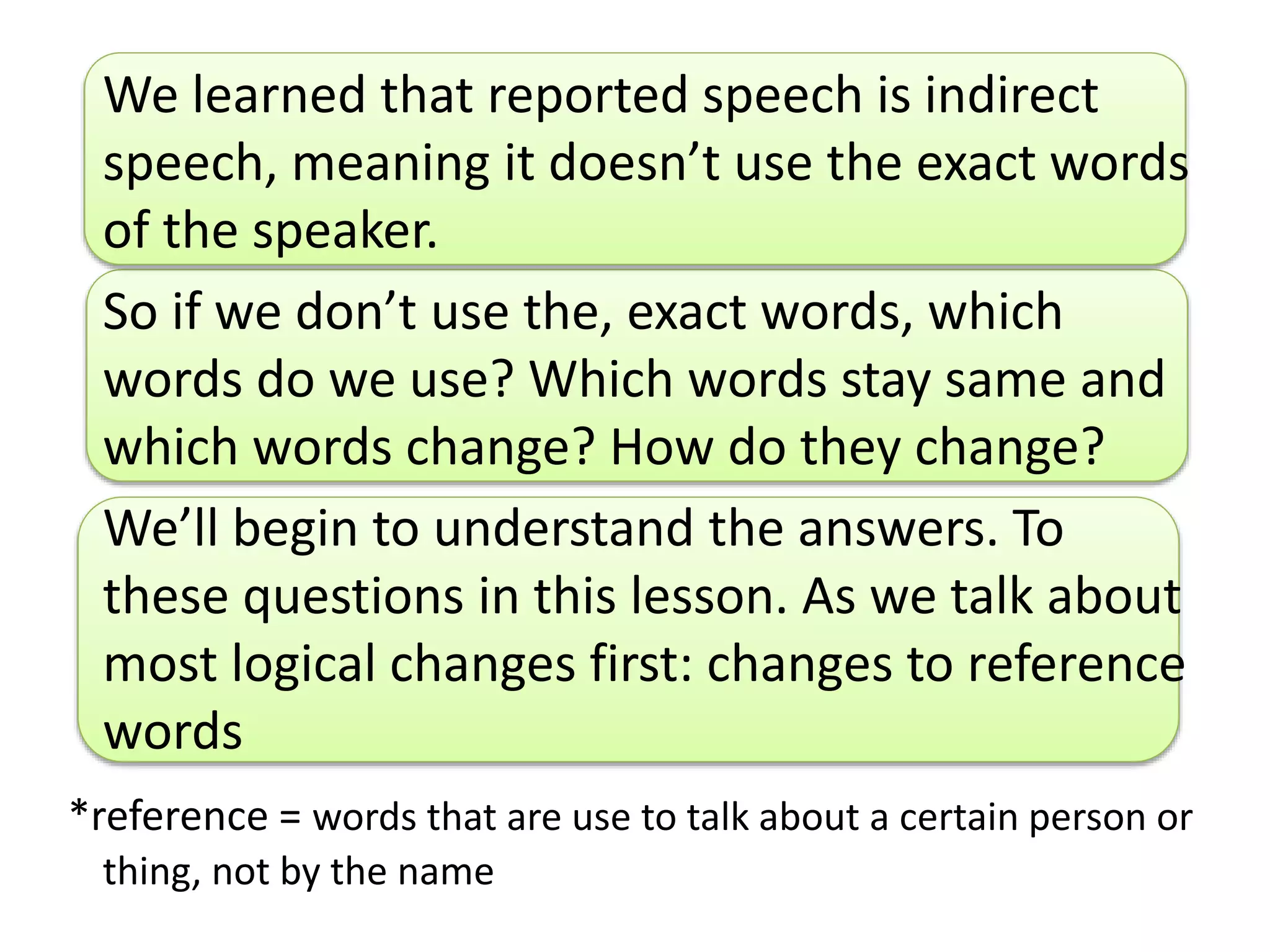
We learned that reported speech is indirect
speech, meaning it doesn’t use the exact words
of the speaker.
So if we don’t use the, exact words, which
words do we use? Which words stay same and
which words change? How do they change?
We’ll begin to understand the answers. To
these questions in this lesson. As we talk about
most logical changes first: changes to reference
words
*reference = words that are use to talk about a certain person or
thing, not by the name
Our focus
What are reference words?
How do we need to change in the reported
speech?
Reference words
= words that are use to talk about a certain
person or thing, not by the name
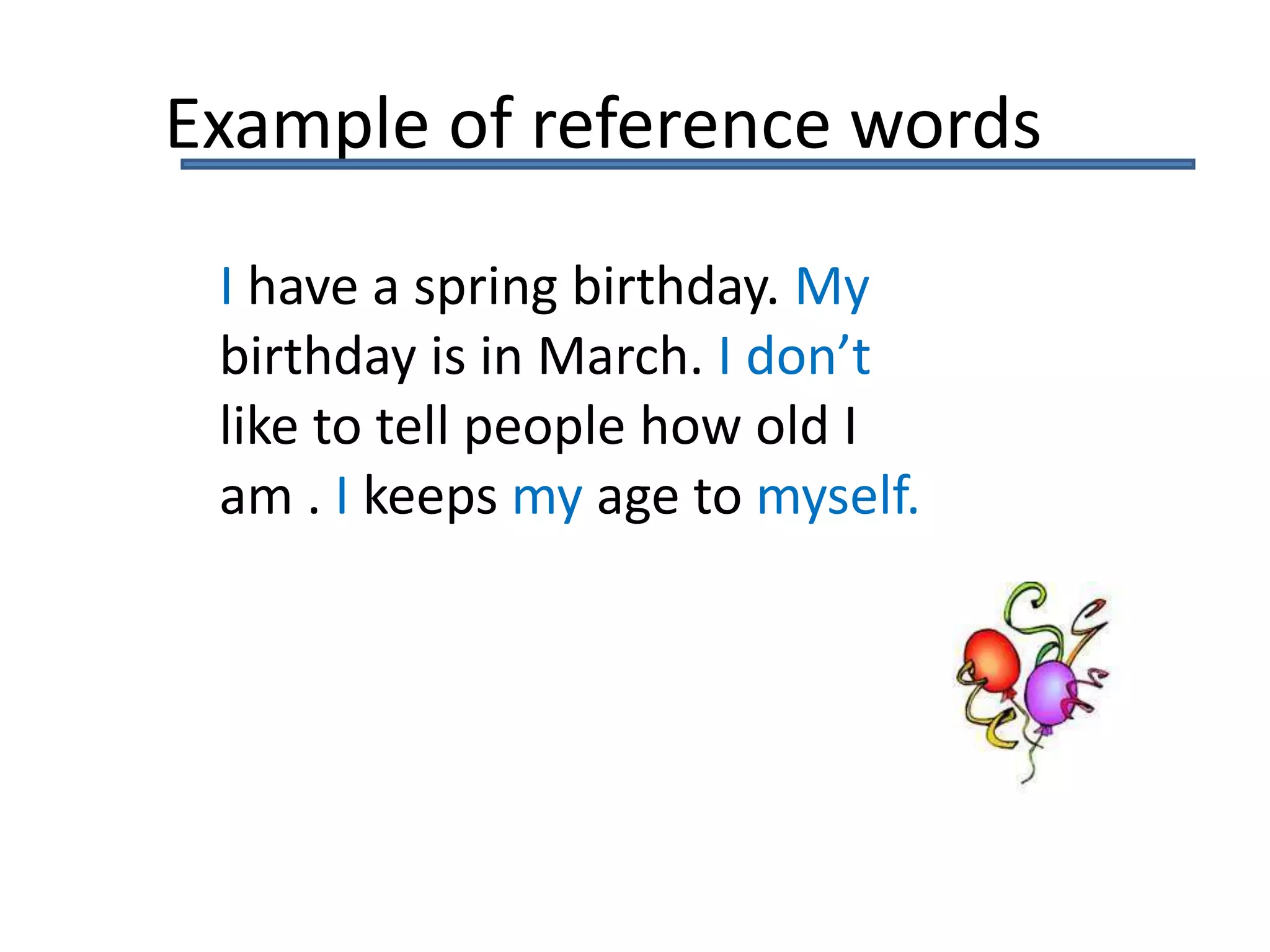
I have a spring birthday. My
birthday is in March. I don’t
like to tell people how old I
am . I keeps my age to myself.
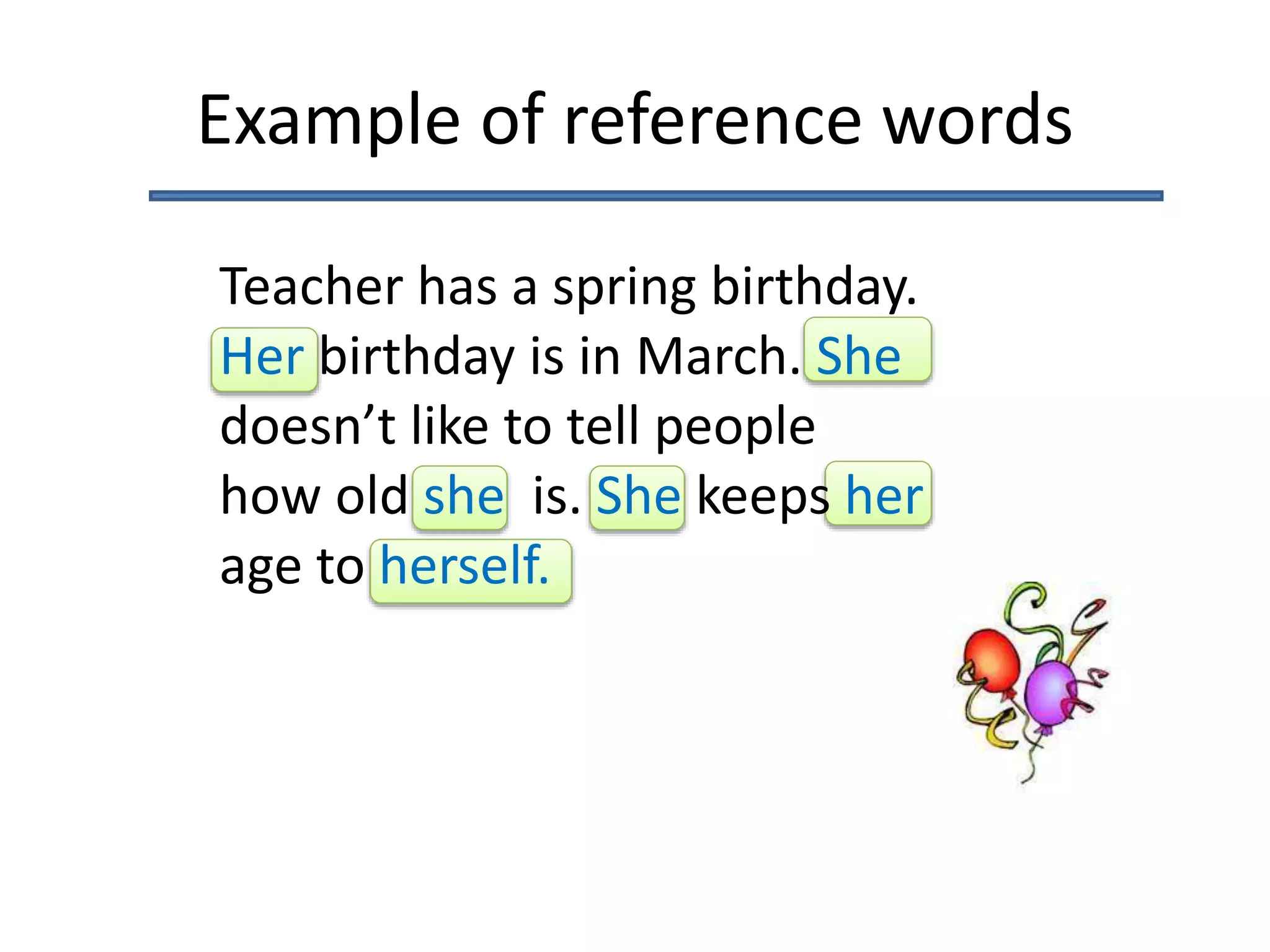
Example of reference words
Teacher has a spring birthday.
Her birthday is in March. She
doesn’t like to tell people
how old she is. She keeps her
age to herself.
Types of reference words
o Pronoun (Who?, Whom?)
I, you, me, him, myself….
o Possessive adjectives ( Whose?)
My, your, his, our….
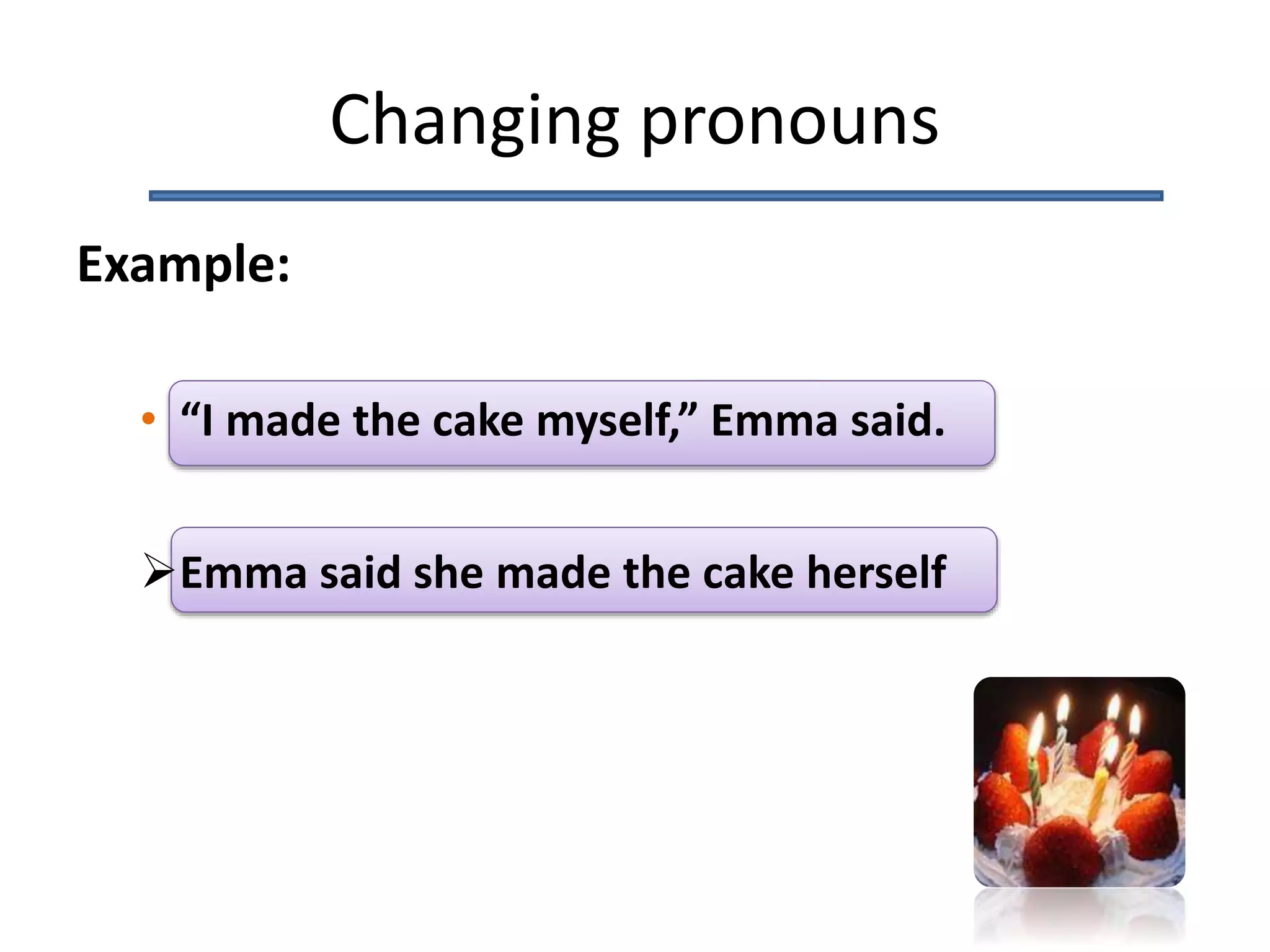
Changing pronouns
Example:
• “I made the cake myself,” Emma said.
Emma said she made the cake herself
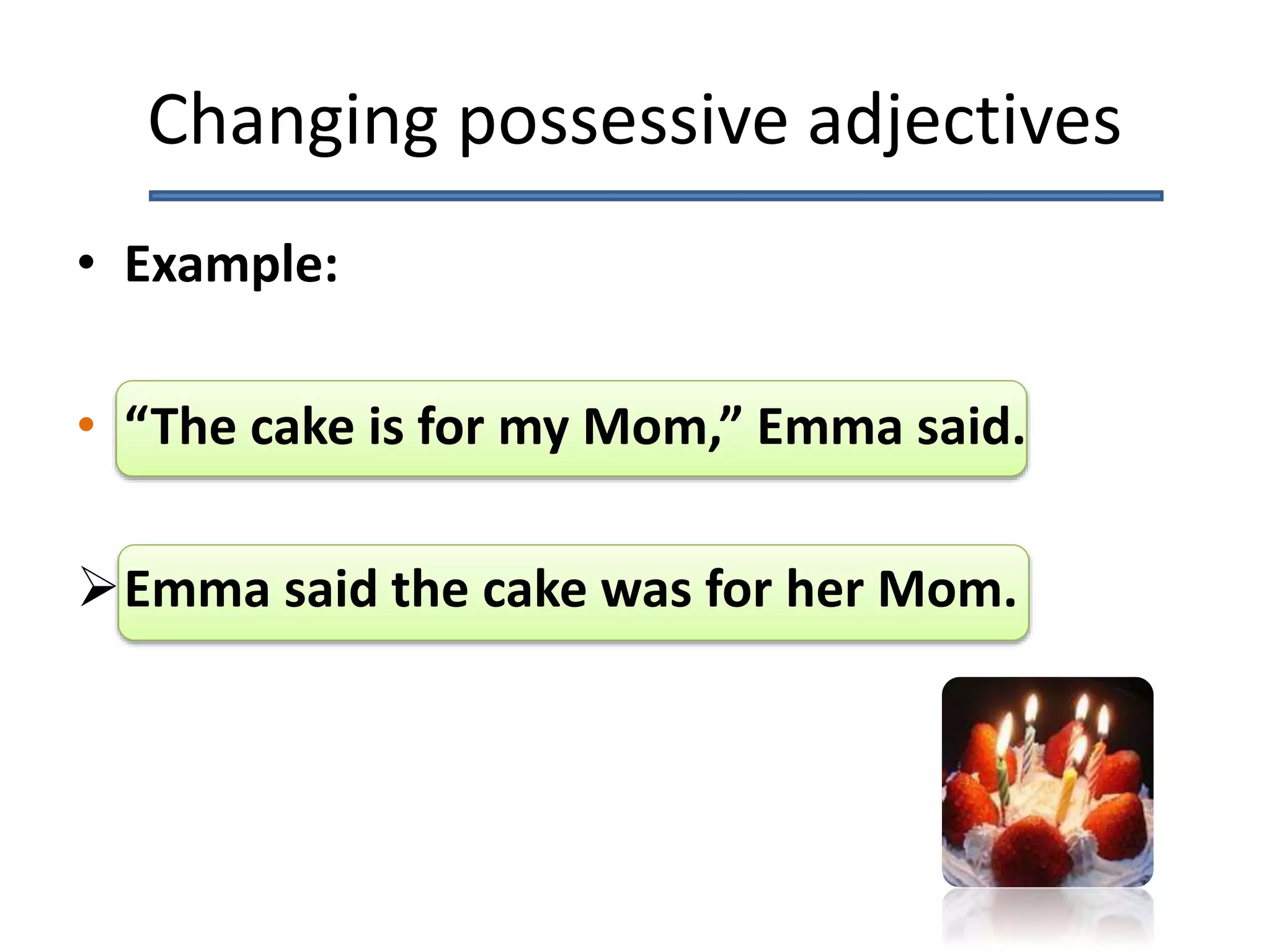
Changing possessive adjectives
• Example:
• “The cake is for my Mom,” Emma said.
Emma said the cake was for her Mom.
Exercise 1
Complete the changes for each reported
statement.
o “My birthday is in May,” said Bileg.
o Bileg said ______birthday was in May.his(Whose?)
o 1. Tom said, “It’s my mother’s birthday , so
I’m taking her out to dinner.”
o Tom told us it was ____ mother’s birthday ,
so _____ was taking her out to dinner.
o 2. Steve and Lisa said “, We’ll bring some wine
to the party.”
o Steve and Lisa said _____would bring some
wine to the party.
his
he
they
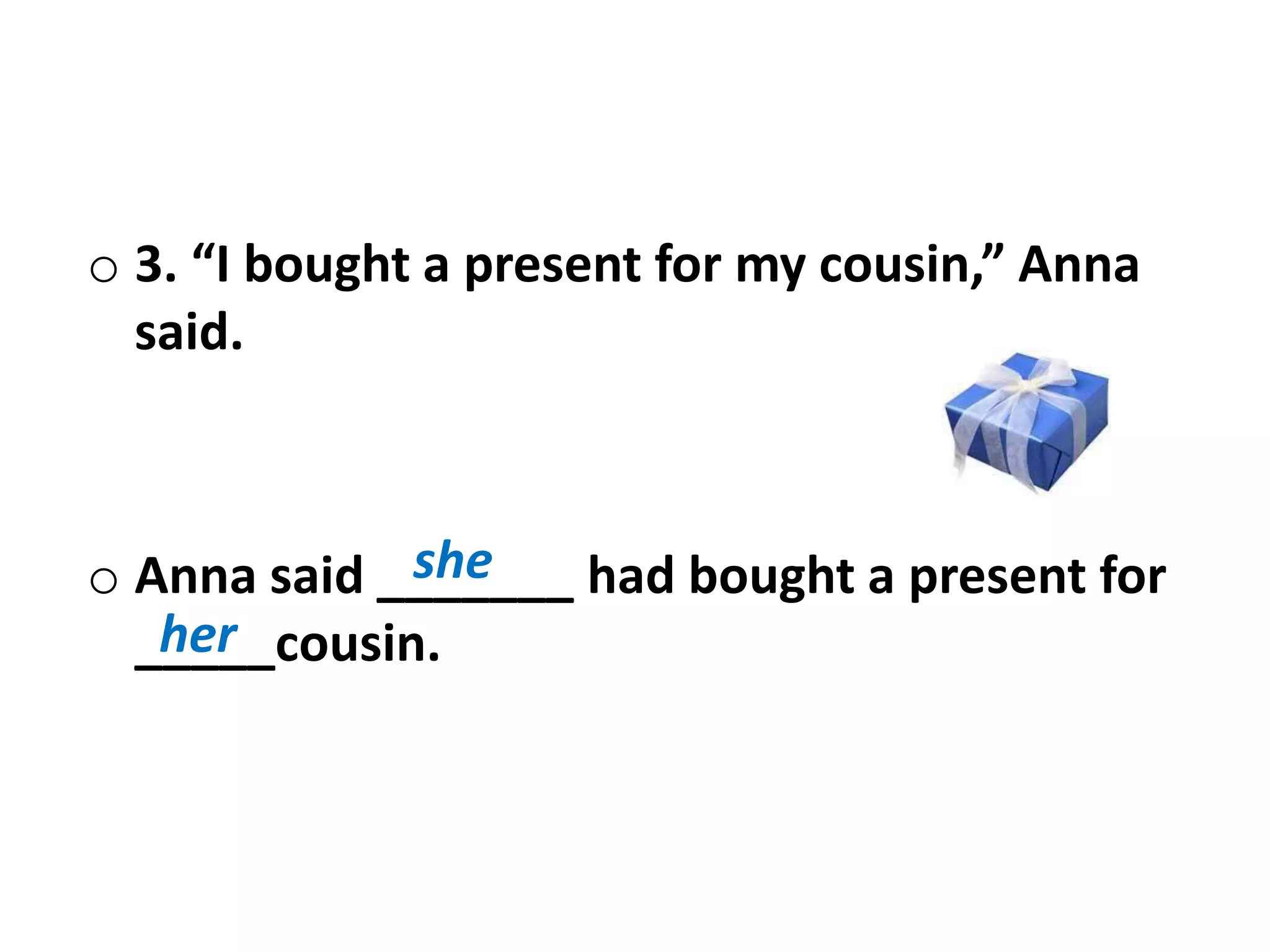
o 3. “I bought a present for my cousin,” Anna
said.
o Anna said _______ had bought a present for
_____cousin.
she
her
Careful!
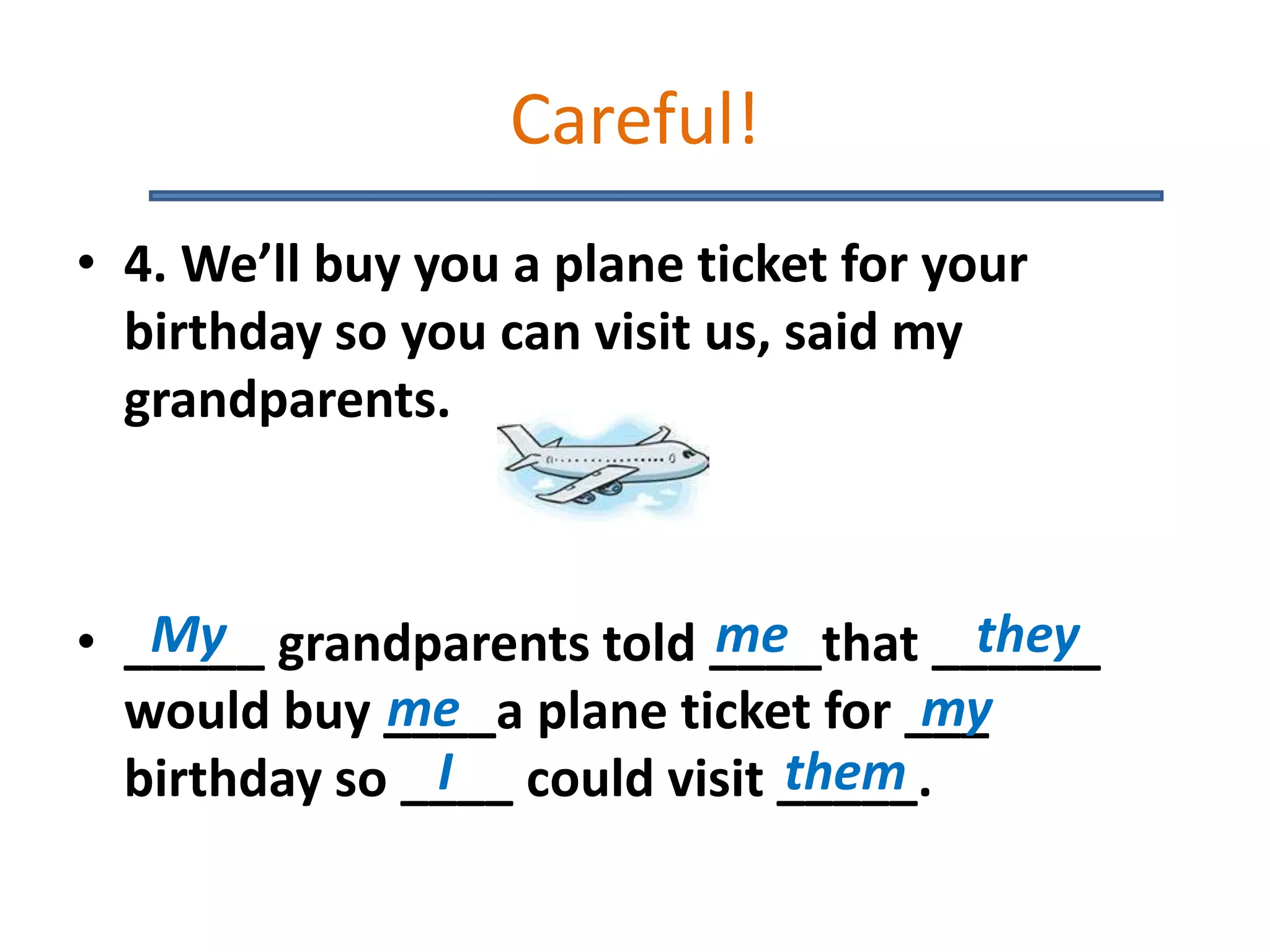
• 4. We’ll buy you a plane ticket for your
birthday so you can visit us, said my
grandparents.
• _____ grandparents told ____that ______
would buy ____a plane ticket for ___
birthday so ____ could visit _____.
My me they
my
I them
me
Okay so we’ve talked about changing pronouns
and possessive adjectives.
There is another group of reference words that we
need to address.
Those are words that refer to time and place.
Let’s talk about those now.
OTHER
REFERENCE WORDS
Time and Place
Changing time and place words
• Much time can pass between when
words are said and when words are
reported. The place where words are
spoken and place where words are
reported can also be different. That’s
why reference words for time and place
change in reported speech.
Changing Time Words
• Example:
• “There’s a big party tonight,” said Julie
[Saturday]
Julie said there was a big party last night.
[Sunday]
Julie said there was a big party that night.
[a few weeks later]
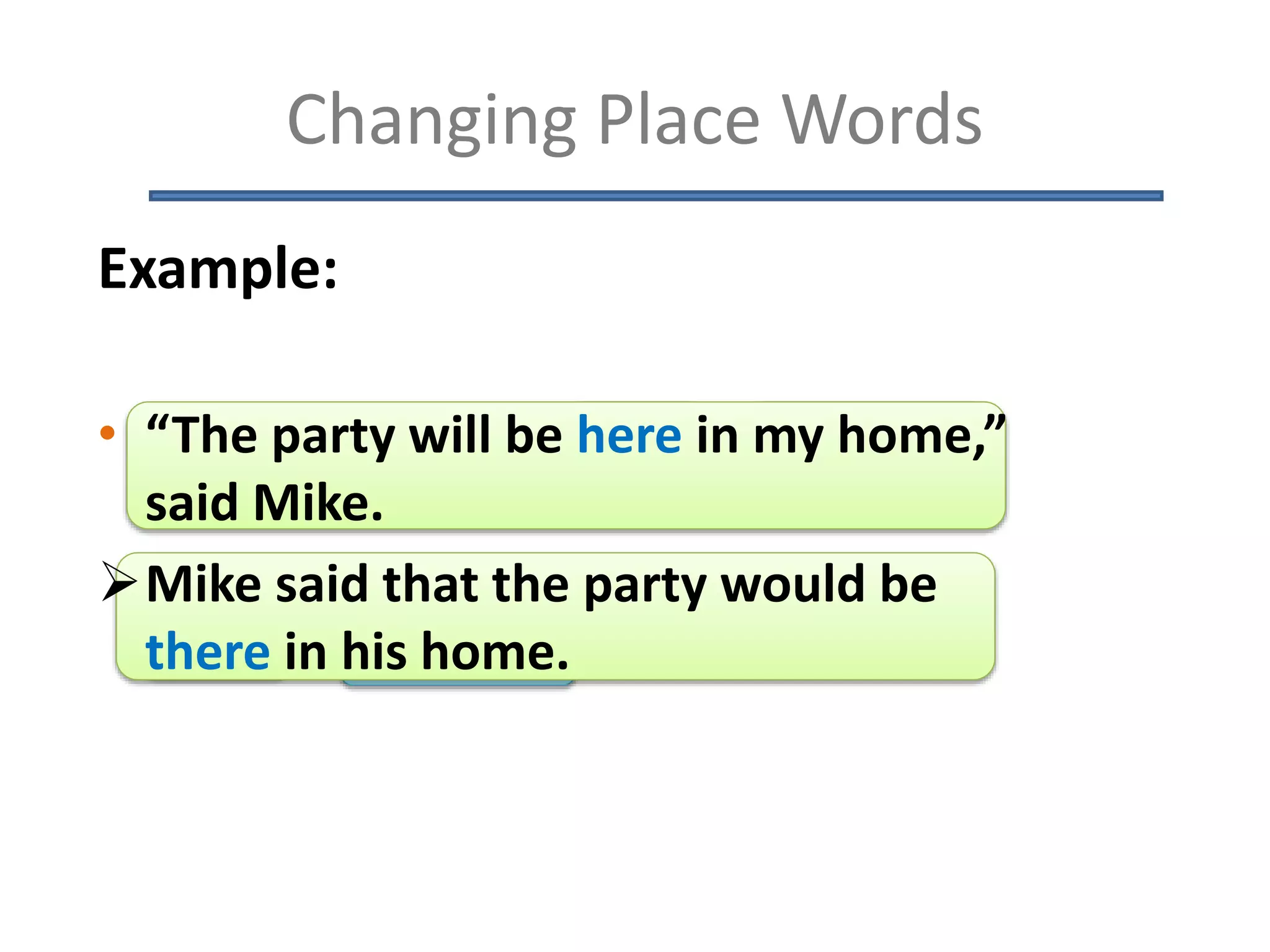
Changing Place Words
Example:
• “The party will be here in my home,”
said Mike.
Mike said that the party would be
there in his home.
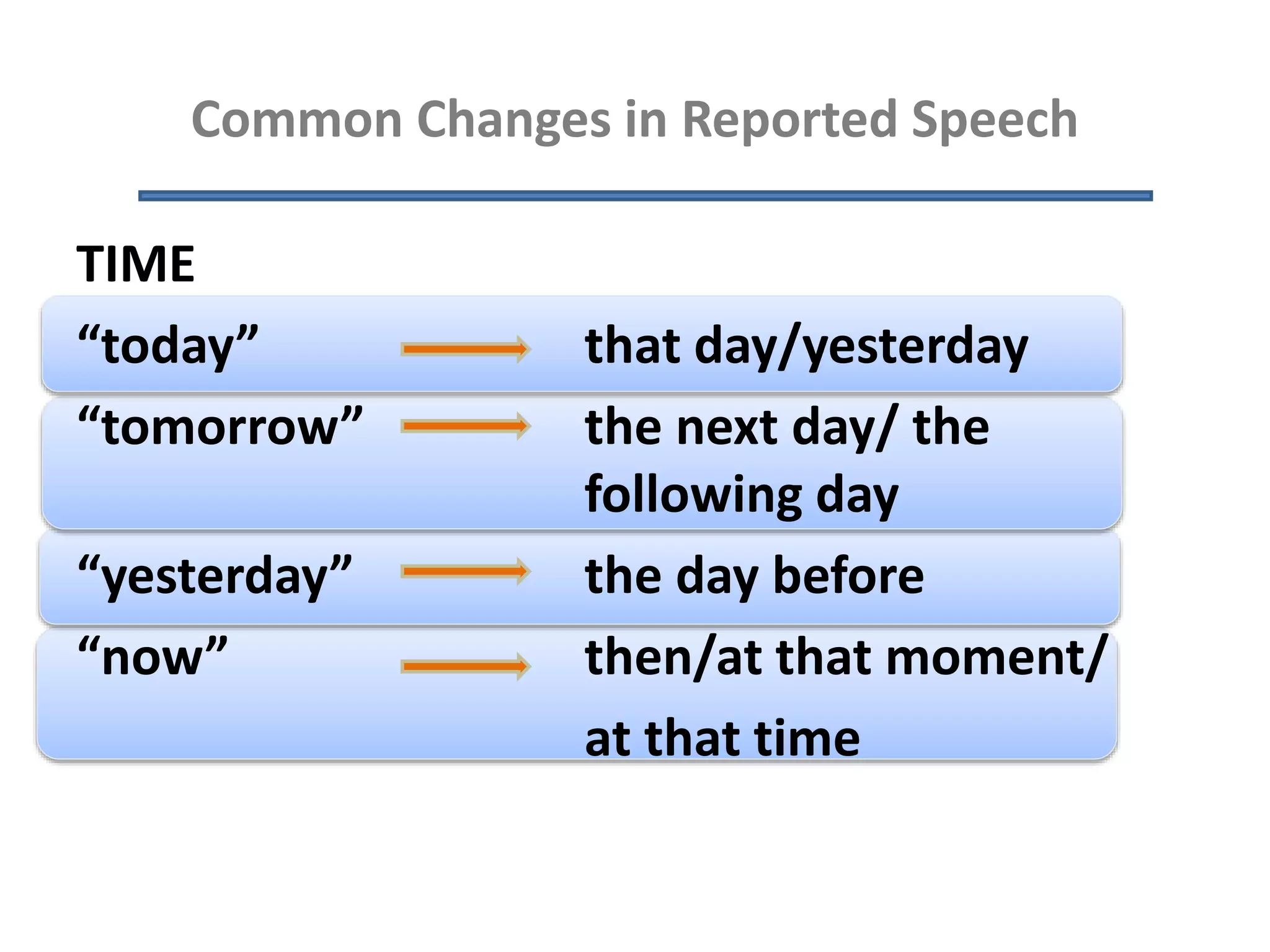
Common Changes in Reported Speech
TIME
“today” that day/yesterday
“tomorrow” the next day/ the
following day
“yesterday” the day before
“now” then/at that moment/
at that time
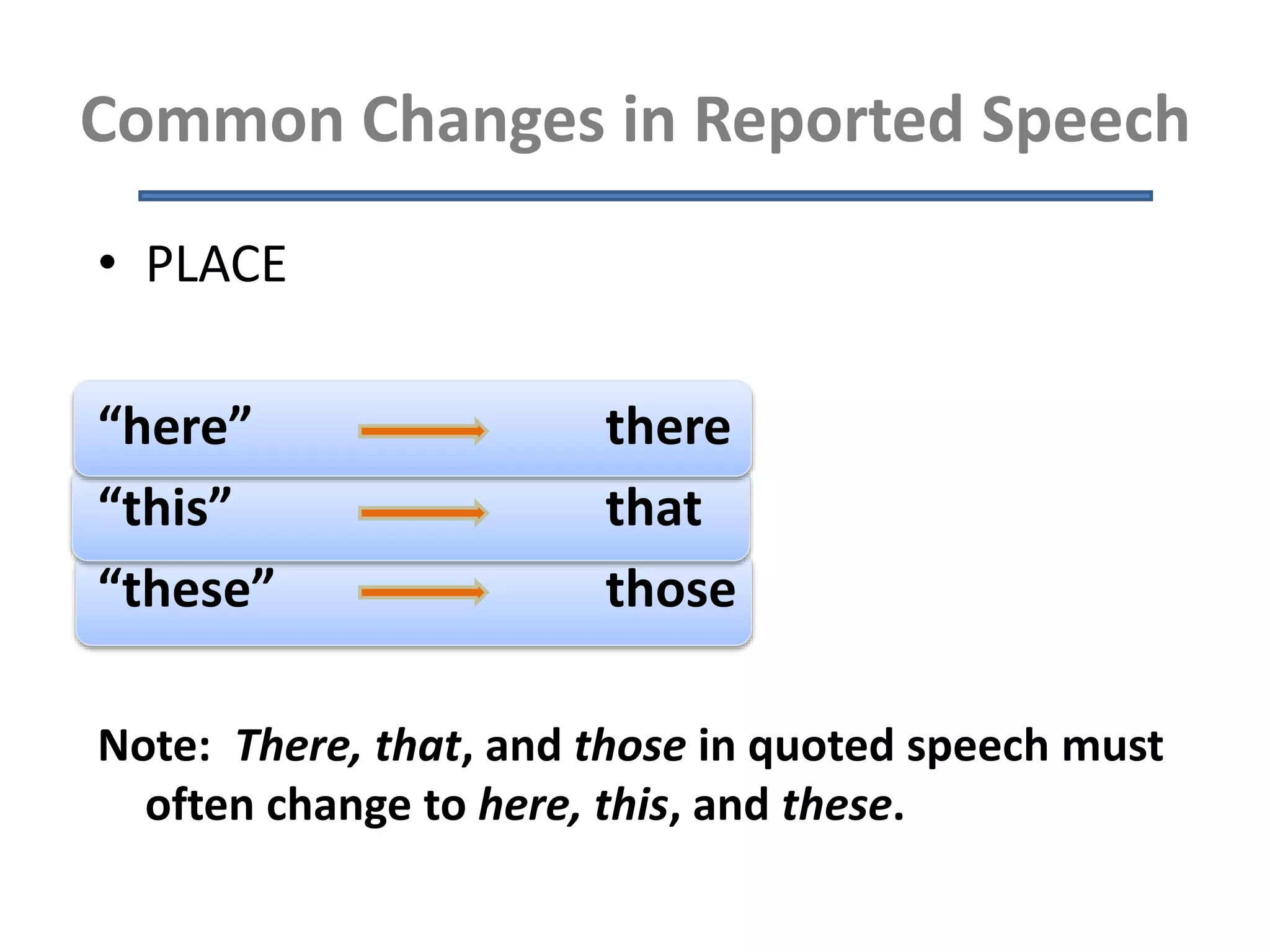
Common Changes in Reported Speech
• PLACE
“here” there
“this” that
“these” those
Note: There, that, and those in quoted speech must
often change to here, this, and these.
Exercise 2
Complete the changes for each
reported statement.
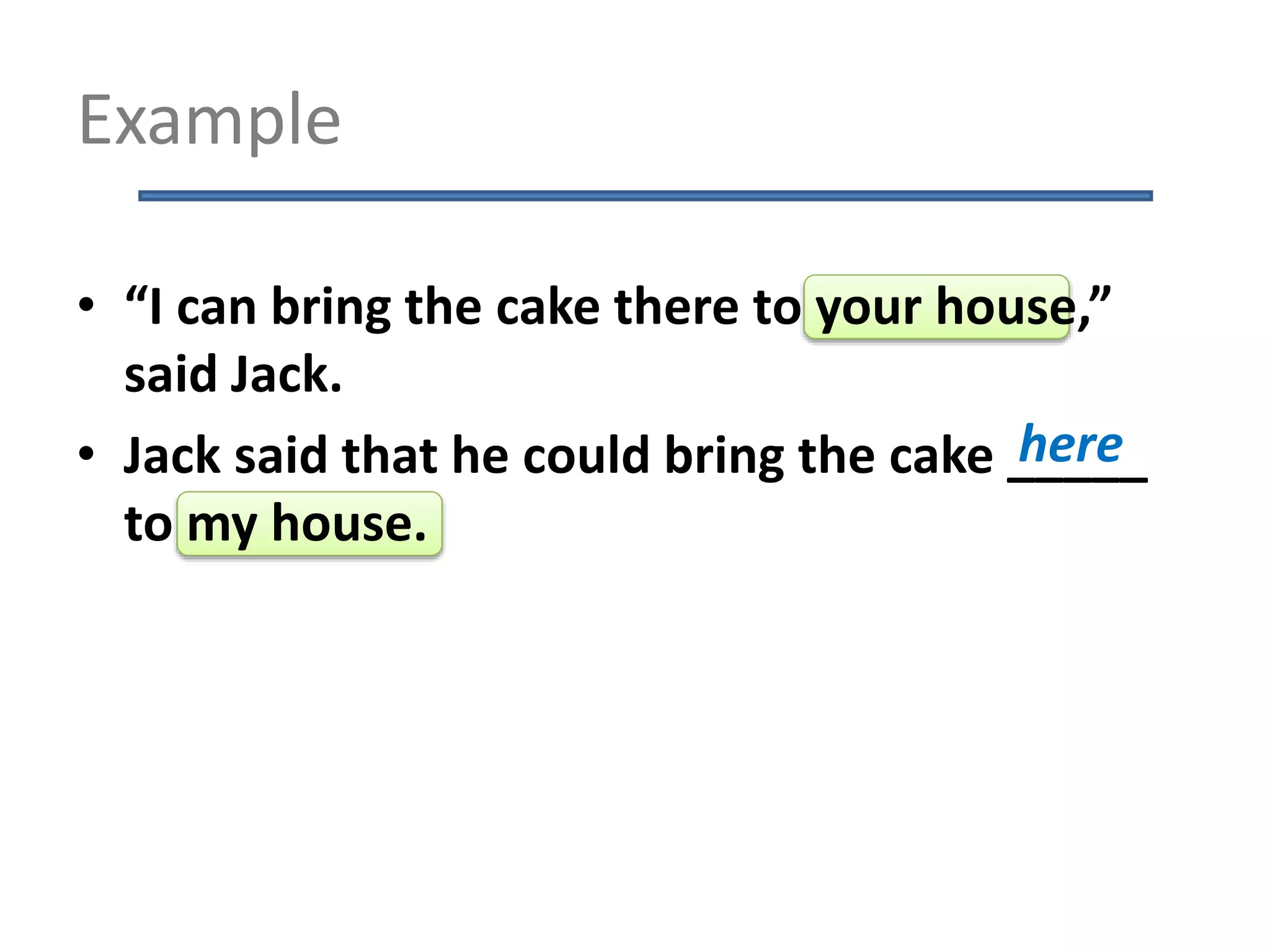
• “I can bring the cake there to your house,”
said Jack.
• Jack said that he could bring the cake _____
to my house.
here
Example
• “I’ll buy balloons tomorrow,” said Wendy.
• Wendy said she would buy balloons
_____________ .
• [a week later]
the next day
Also: following day
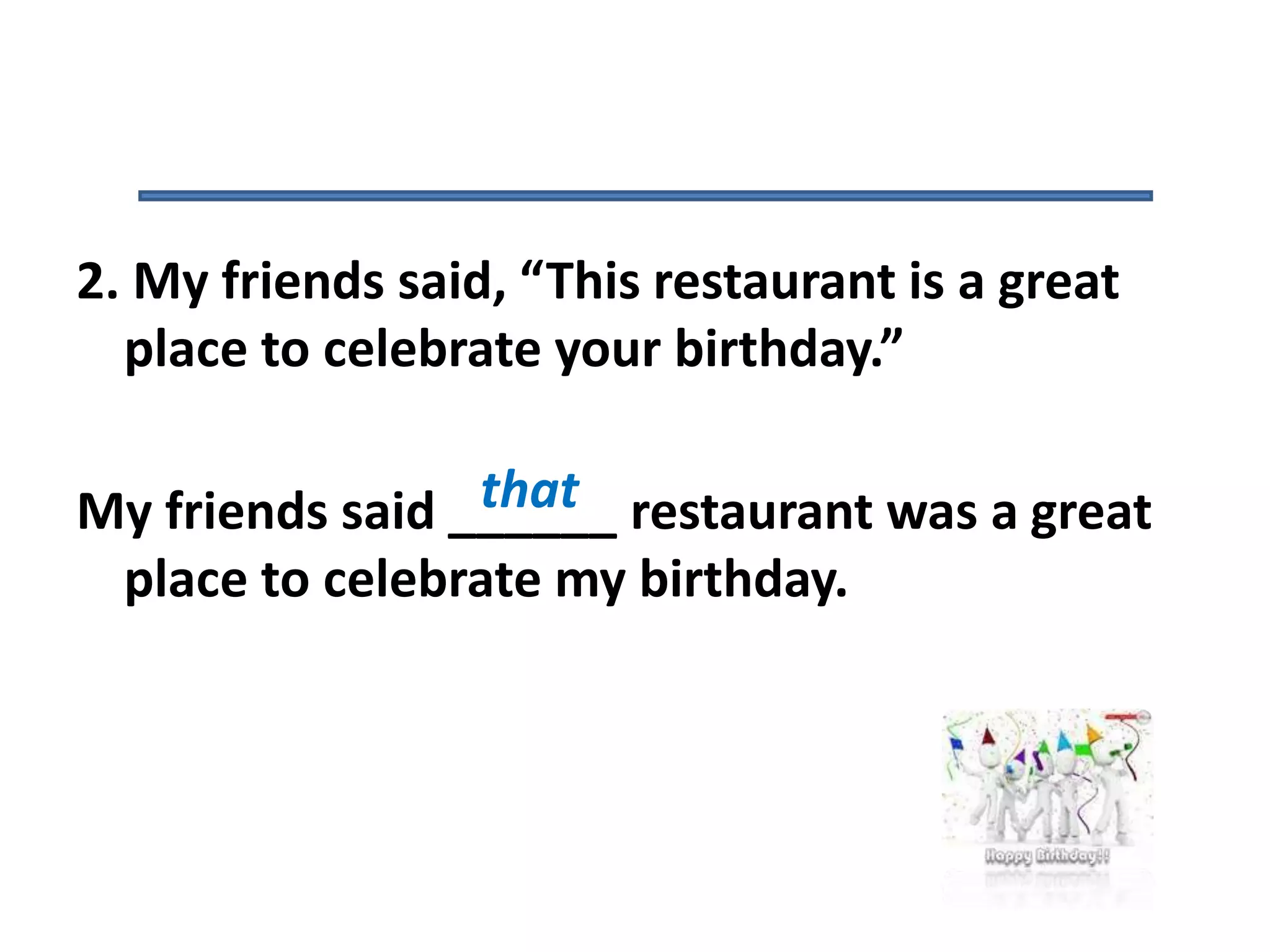
2. My friends said, “This restaurant is a great
place to celebrate your birthday.”
My friends said ______ restaurant was a great
place to celebrate my birthday.
that
• 3. “I didn’t see you at the party yesterday,”
Drake said.
• Drake said he hadn’t seen me at the party
________ .
[a week later]
the day before
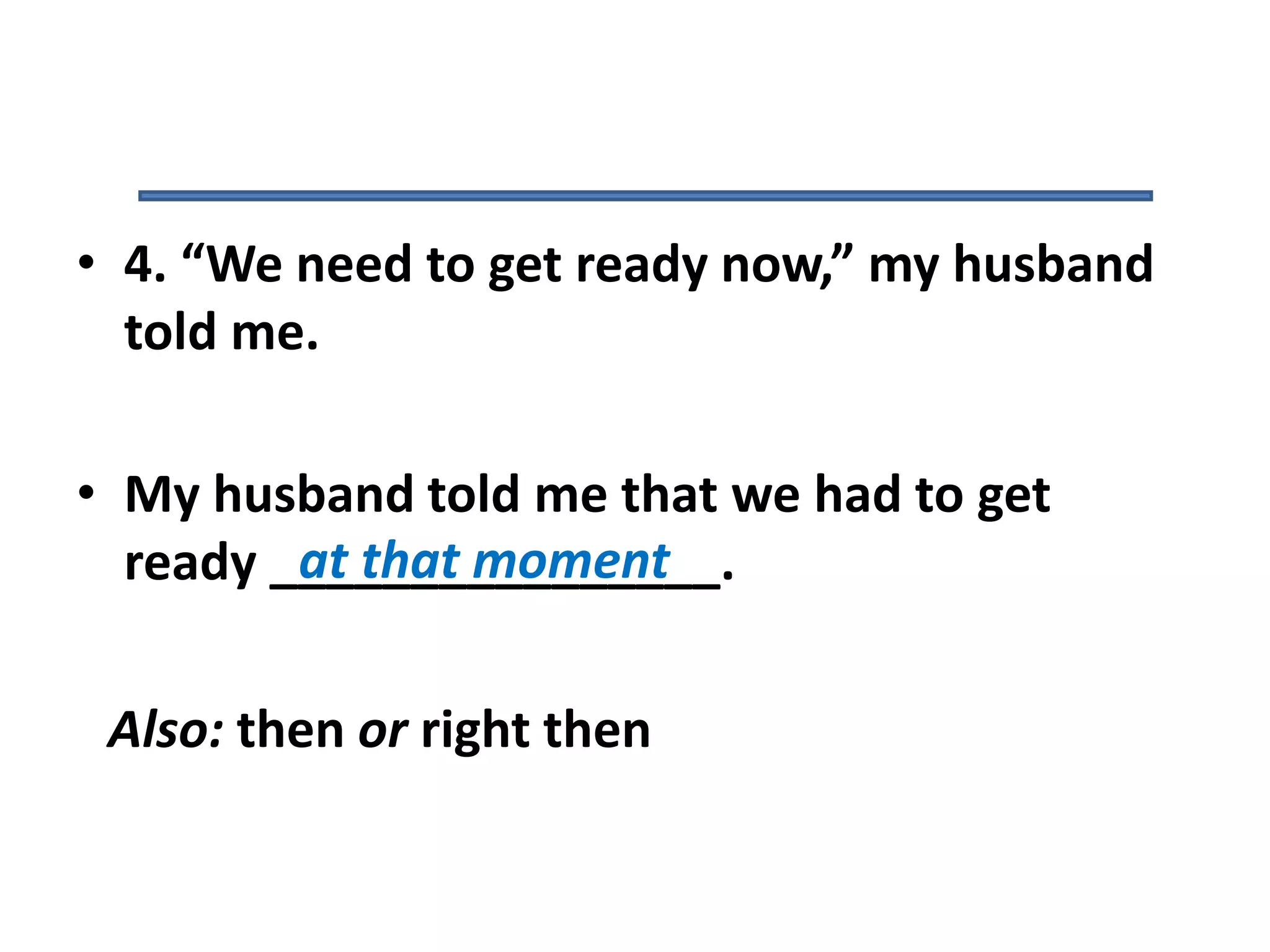
• 4. “We need to get ready now,” my husband
told me.
• My husband told me that we had to get
ready ________________.at that moment
Also: then or right then
Reported speech
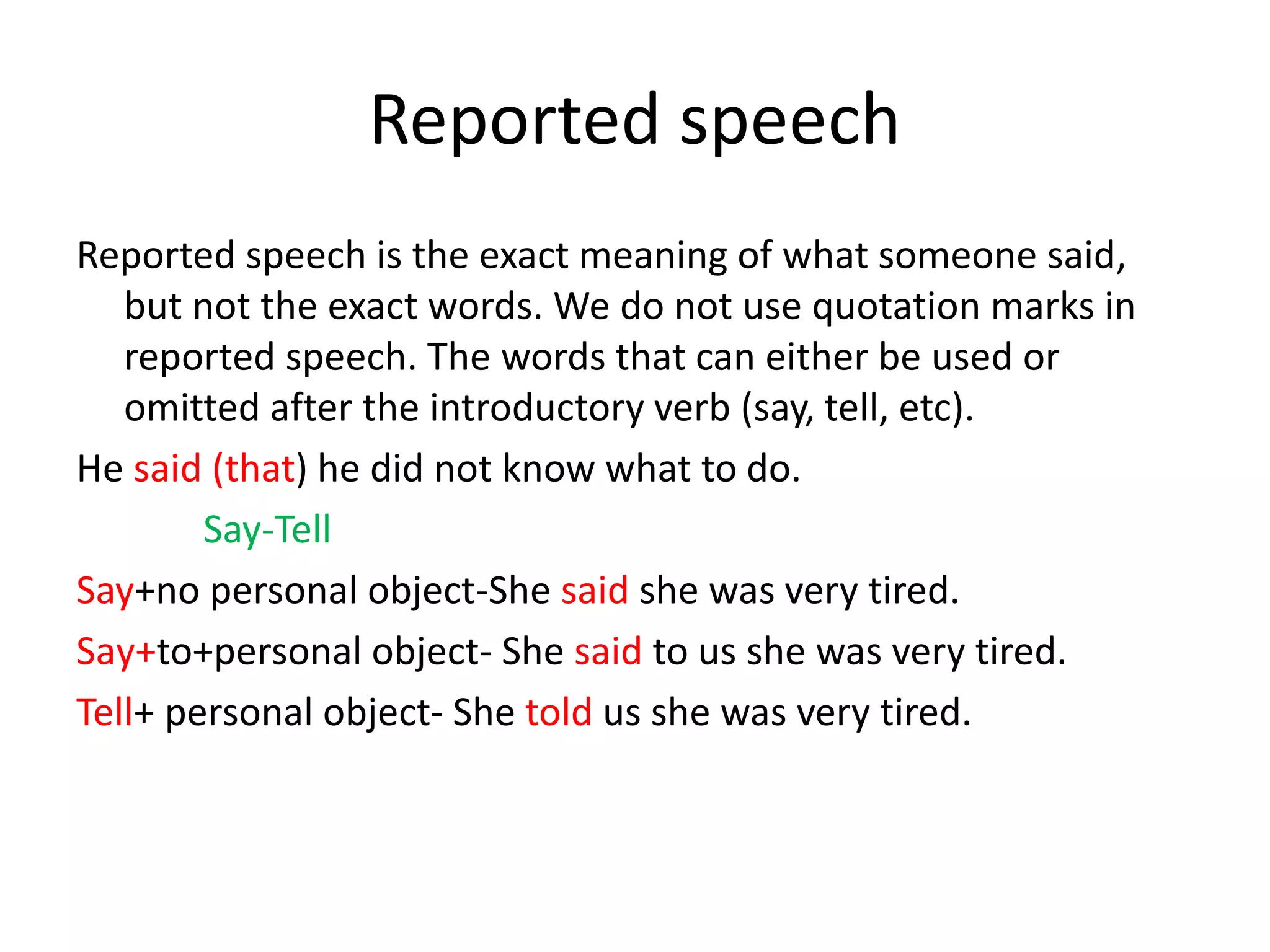
Reported speech is the exact meaning of what someone said,
but not the exact words. We do not use quotation marks in
reported speech. The words that can either be used or
omitted after the introductory verb (say, tell, etc).
He said (that) he did not know what to do.
Say-Tell
Say+no personal object-She said she was very tired.
Saу+to+personal object- She said to us she was very tired.
Tell+ personal object- She told us she was very tired.
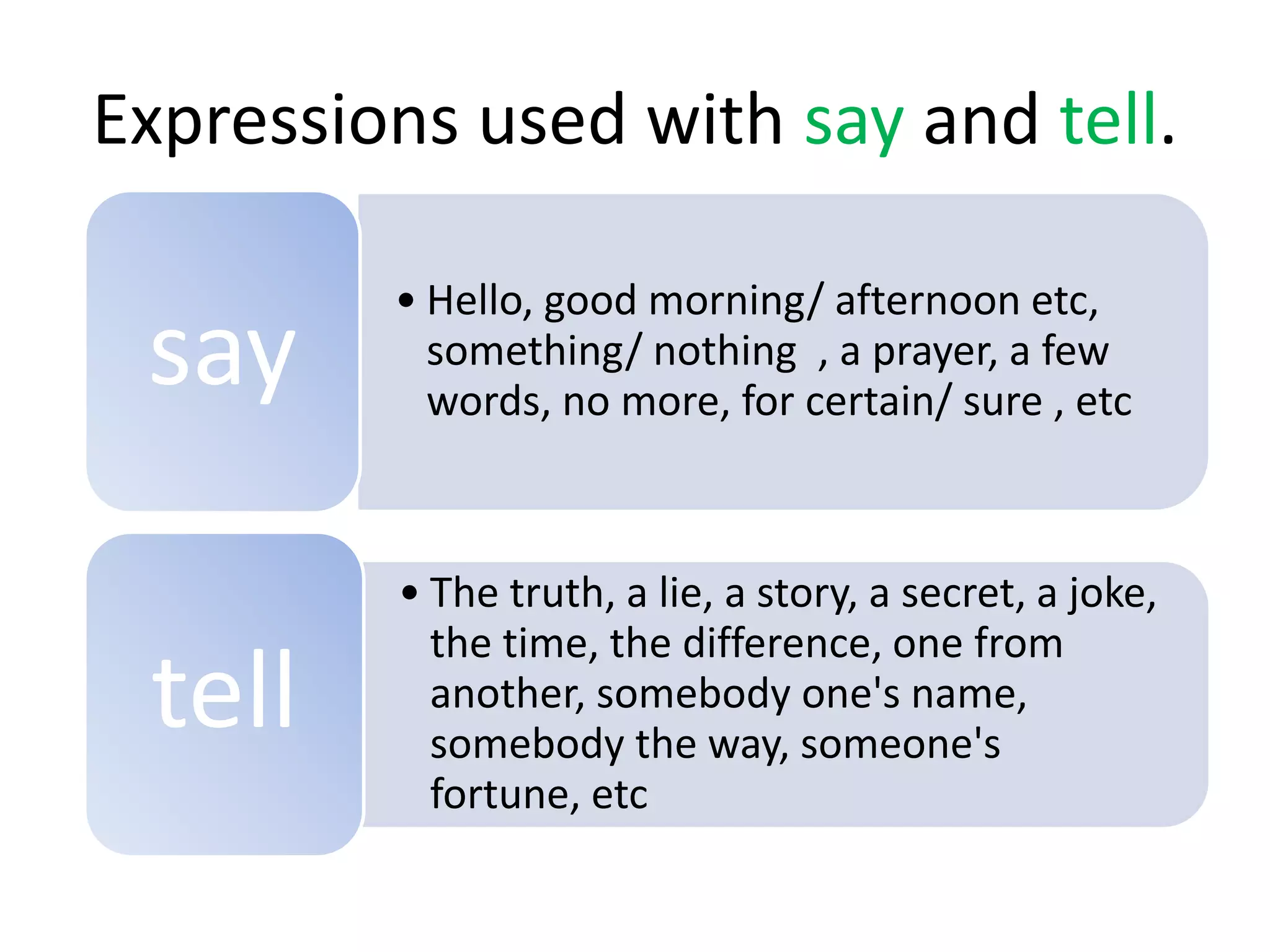
Expressions used with say and tell.
• Hello, good morning/ afternoon etc,
something/ nothing , a prayer, a few
words, no more, for certain/ sure , etc
say
• The truth, a lie, a story, a secret, a joke,
the time, the difference, one from
another, somebody one's name,
somebody the way, someone's
fortune, etc
tell
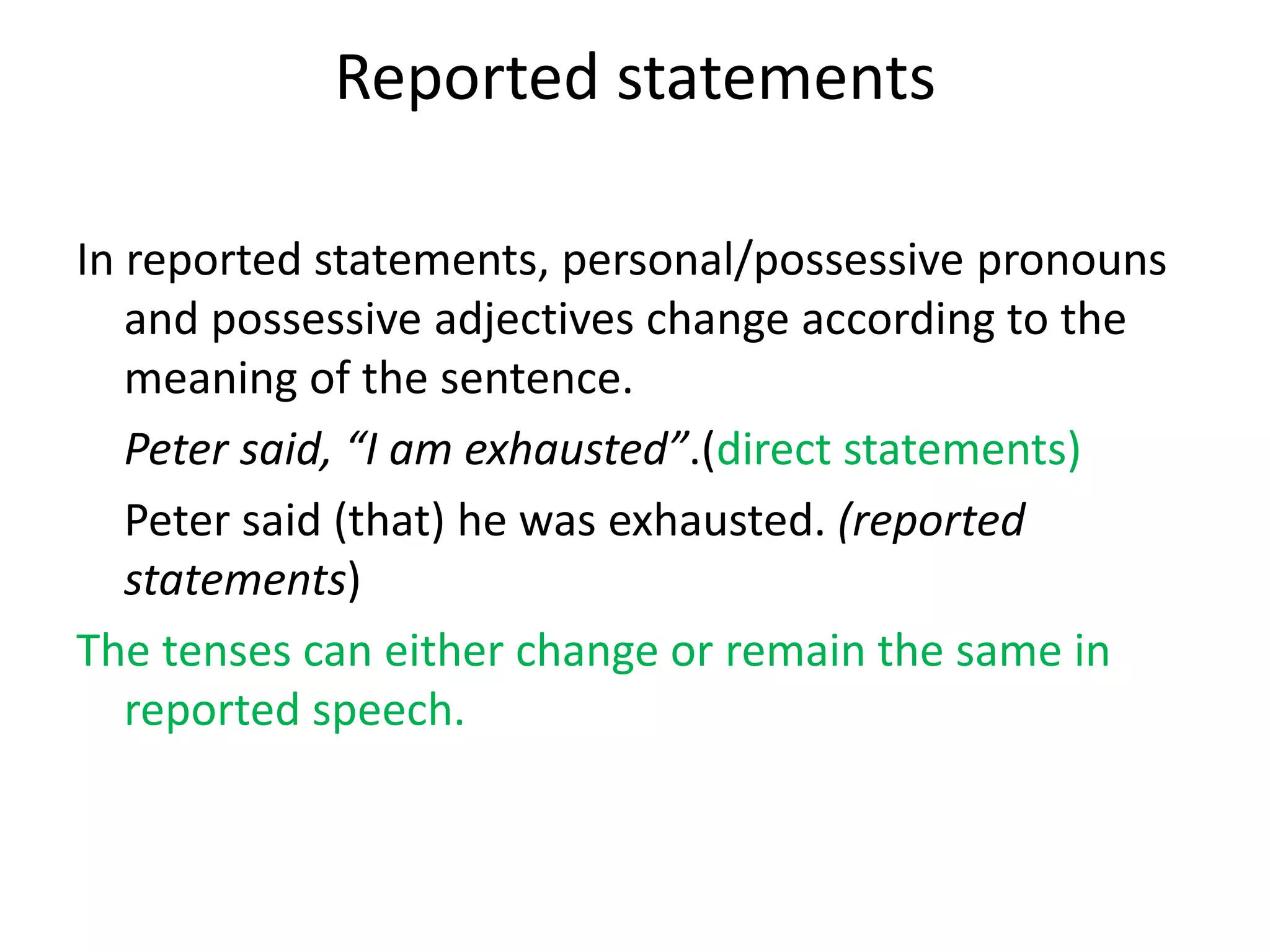
Reported statements
In reported statements, personal/possessive pronouns
and possessive adjectives change according to the
meaning of the sentence.
Peter said, “I am exhausted”.(direct statements)
Peter said (that) he was exhausted. (reported
statements)
The tenses can either change or remain the same in
reported speech.
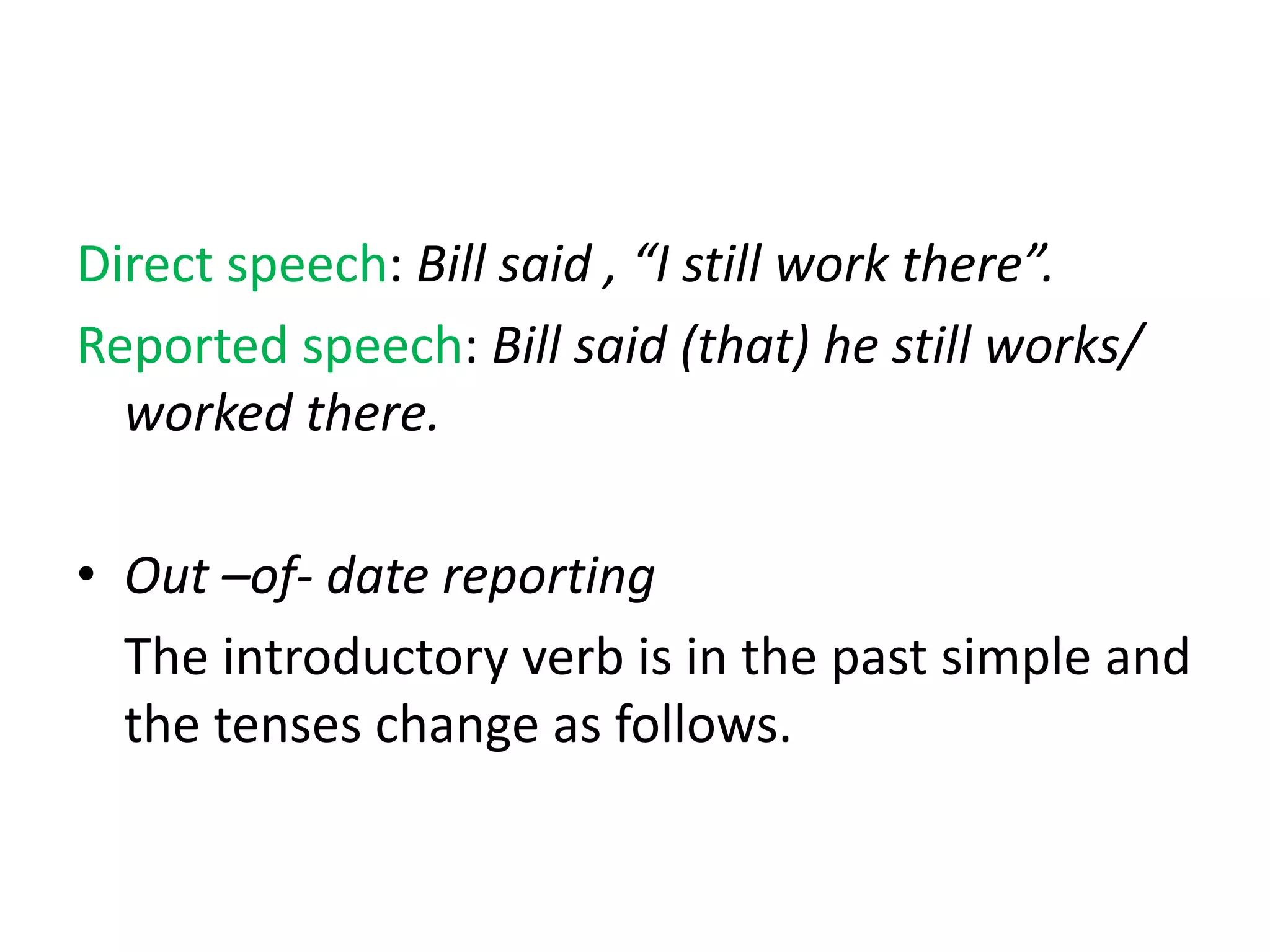
Direct speech: Bill said , “I still work there”.
Reported speech: Bill said (that) he still works/
worked there.
• Out –of- date reporting
The introductory verb is in the past simple and
the tenses change as follows.
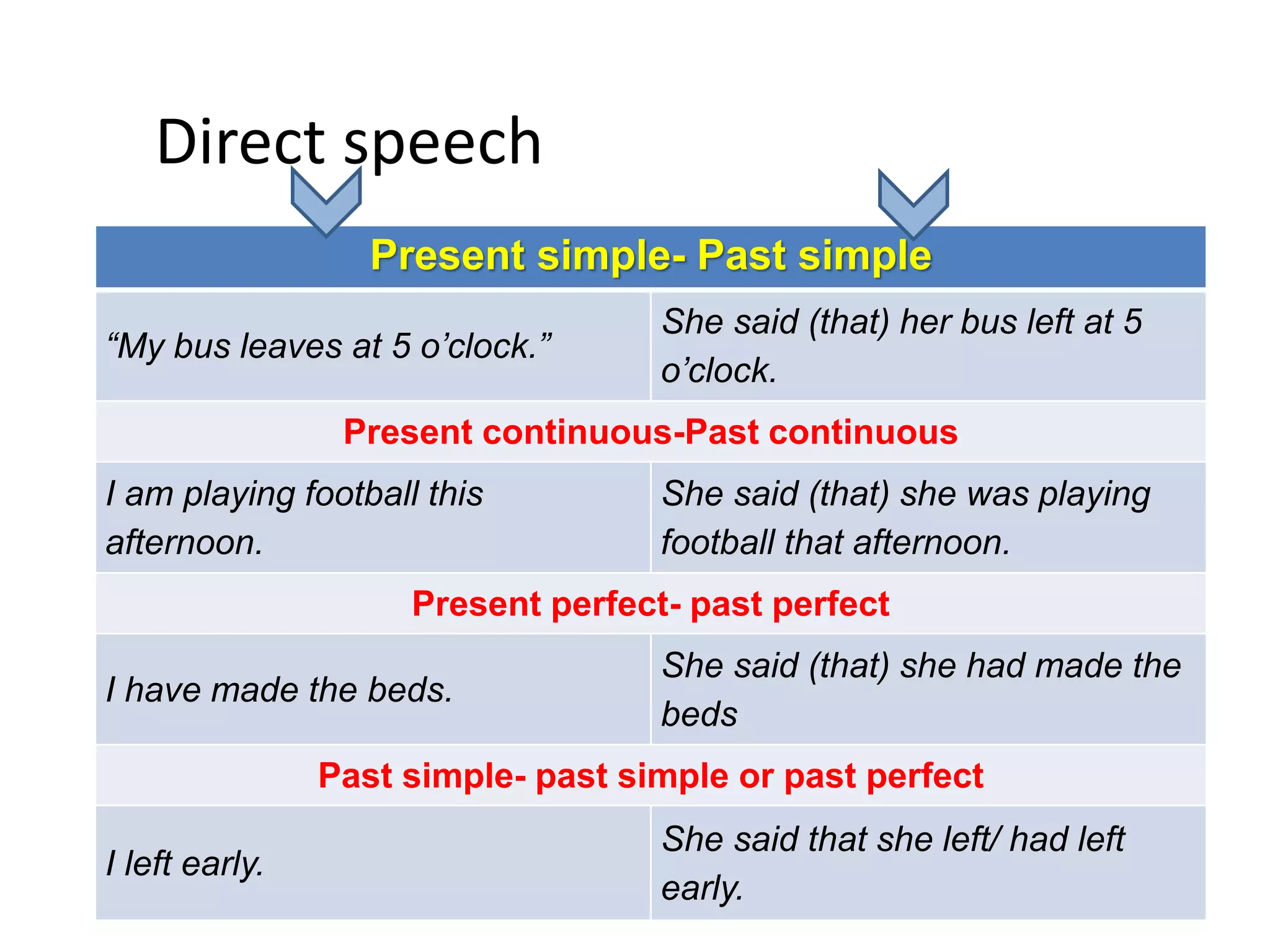
Direct speech
Present simple- Past simple
“My bus leaves at 5 o’clock.”
She said (that) her bus left at 5
o’clock.
Present continuous-Past continuous
I am playing football this
afternoon.
She said (that) she was playing
football that afternoon.
Present perfect- past perfect
I have made the beds.
She said (that) she had made the
beds
Past simple- past simple or past perfect
I left early.
She said that she left/ had left
early.
Reported speech
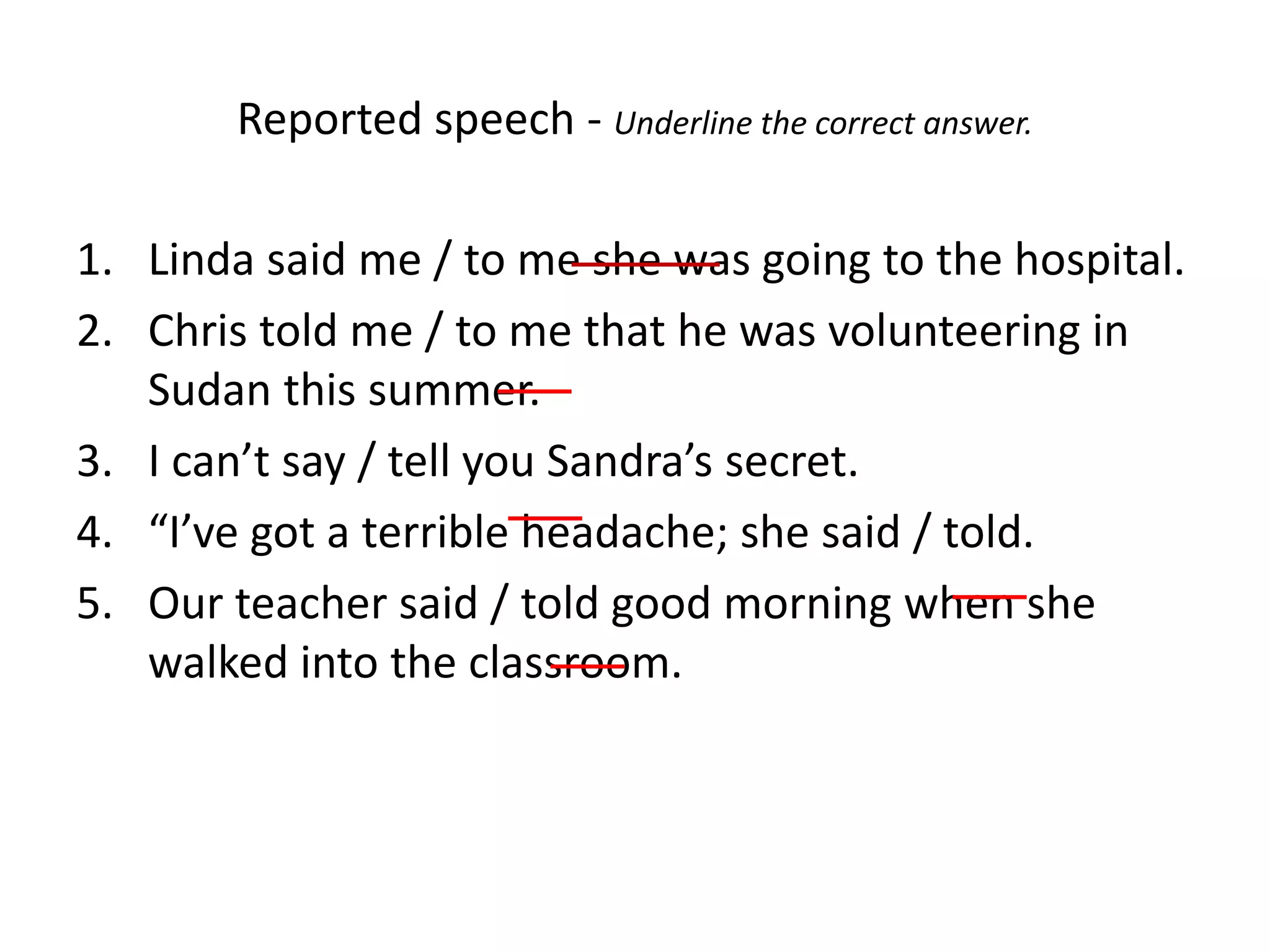
Reported speech - Underline the correct answer.
1. Linda said me / to me she was going to the hospital.
2. Chris told me / to me that he was volunteering in
Sudan this summer.
3. I can’t say / tell you Sandra’s secret.
4. “I’ve got a terrible headache; she said / told.
5. Our teacher said / told good morning when she
walked into the classroom.
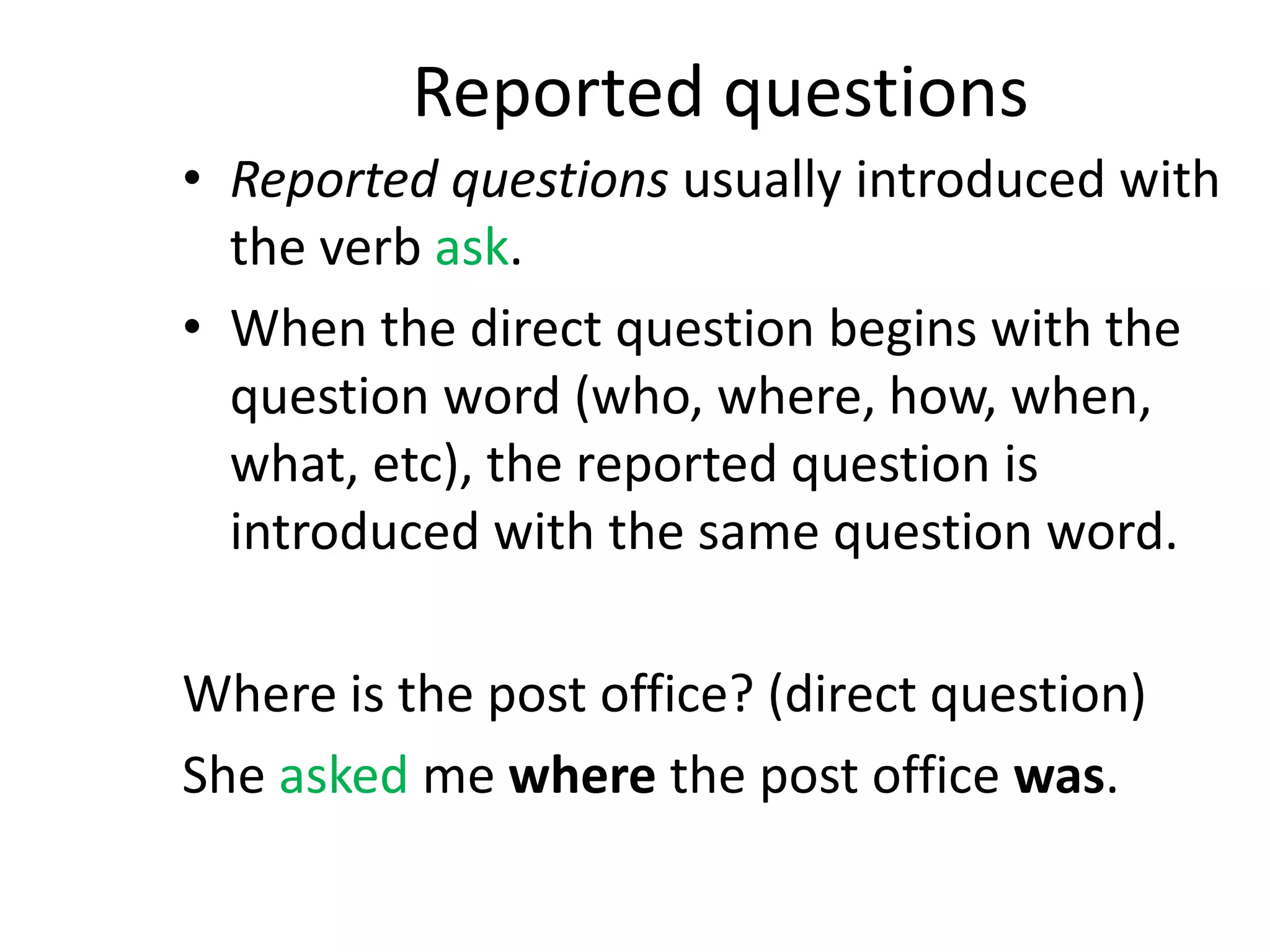
Reported questions
• Reported questions usually introduced with
the verb ask.
• When the direct question begins with the
question word (who, where, how, when,
what, etc), the reported question is
introduced with the same question word.
Where is the post office? (direct question)
She asked me where the post office was.
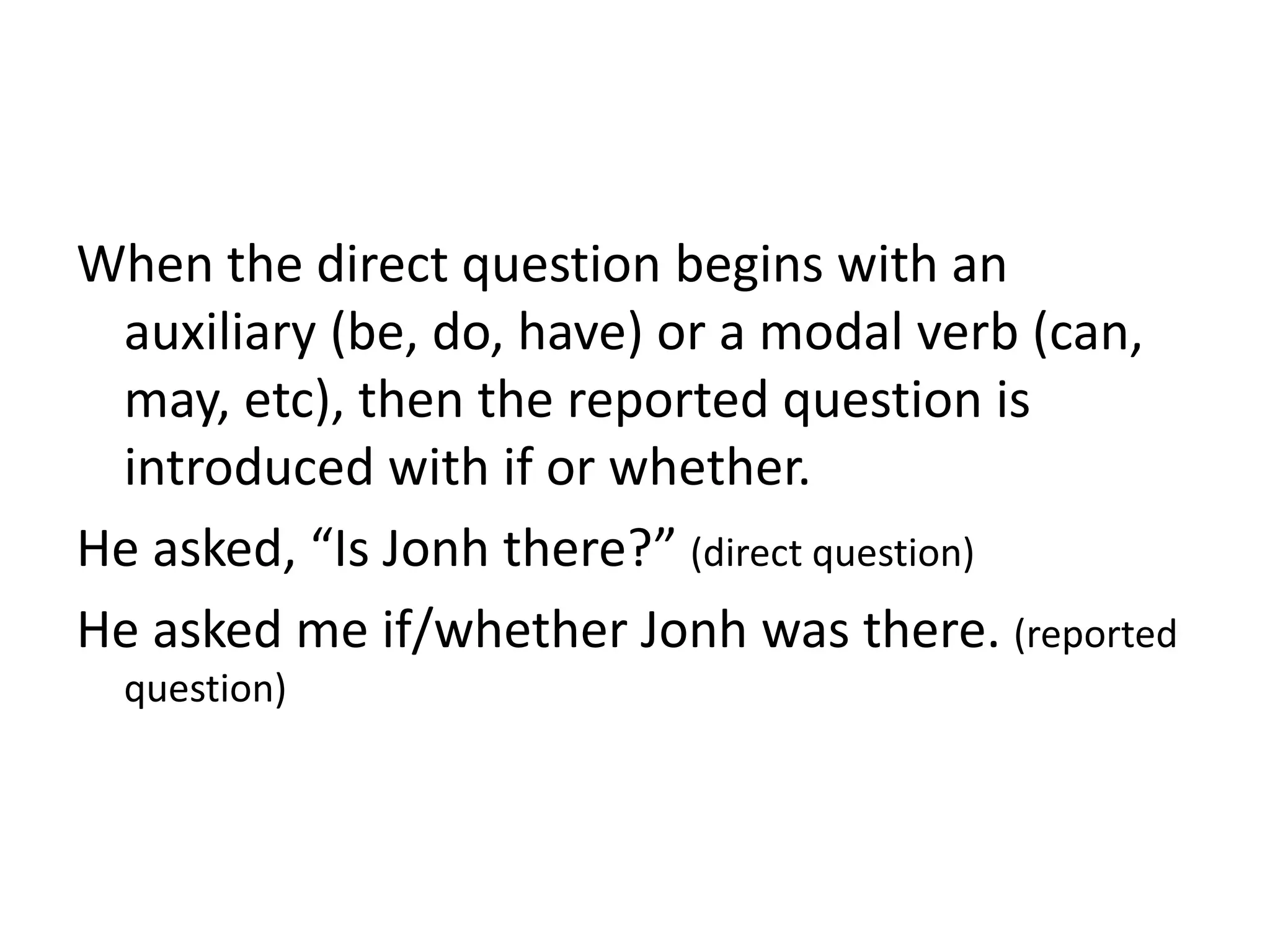
When the direct question begins with an
auxiliary (be, do, have) or a modal verb (can,
may, etc), then the reported question is
introduced with if or whether.
He asked, “Is Jonh there?” (direct question)
He asked me if/whether Jonh was there. (reported
question)
Report John’s questions.
1. Have you travelled abroad?
2. Who is your favourite actor?
3. Have you got any pets?
4. Can you drive?
5. Where do you live?
6. When did you move here?
John asked if/whether I had travelled abroad.
John asked who my favourite actor was.
John asked if/whether I had got some pets.
John asked if/whether I could drive.
John asked where I lived.
John asked when I had moved here.
Mr and Mrs Anderson are going away for a week.
Read the list of instructions they gave their daughter and turn
them into reported speech.
– Pay the telephone bill
– Water the plants
– Cut the grass X
– Call your grandmother to wish her a happy birthday
– Iron clothes X
– Buy groceries
They told her to pay the telephone bill.
They told her to water the plants
They told her not to cut the grass.
They told her to call your grandmother to wish her a
happy birthday.
They told her not to iron clothes
They told her buy groceries
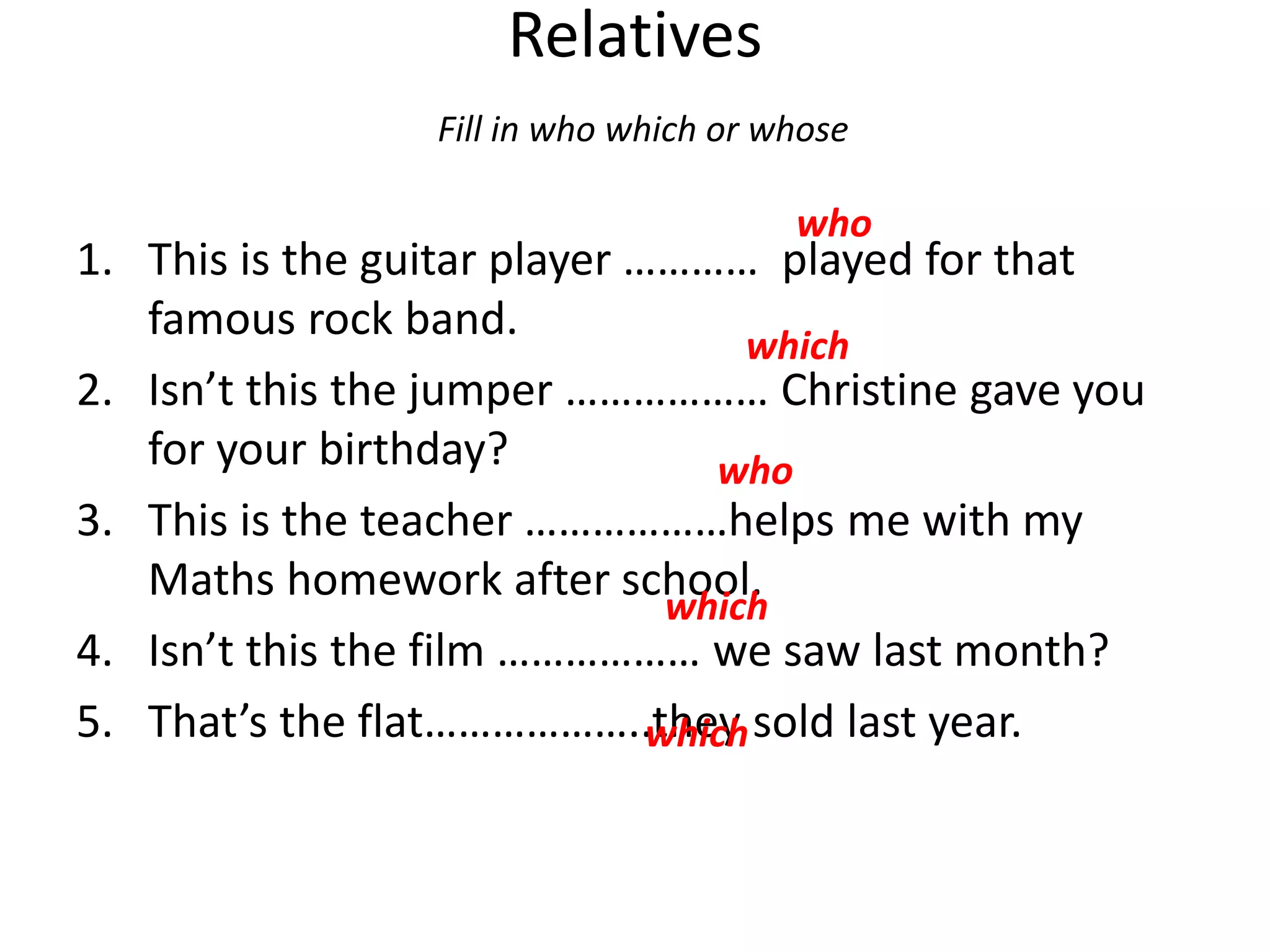
Relatives
Fill in who which or whose
1. This is the guitar player ………… played for that
famous rock band.
2. Isn’t this the jumper ……………… Christine gave you
for your birthday?
3. This is the teacher ………………helps me with my
Maths homework after school.
4. Isn’t this the film ……………… we saw last month?
5. That’s the flat………………..they sold last year.
who
which
who
which
which
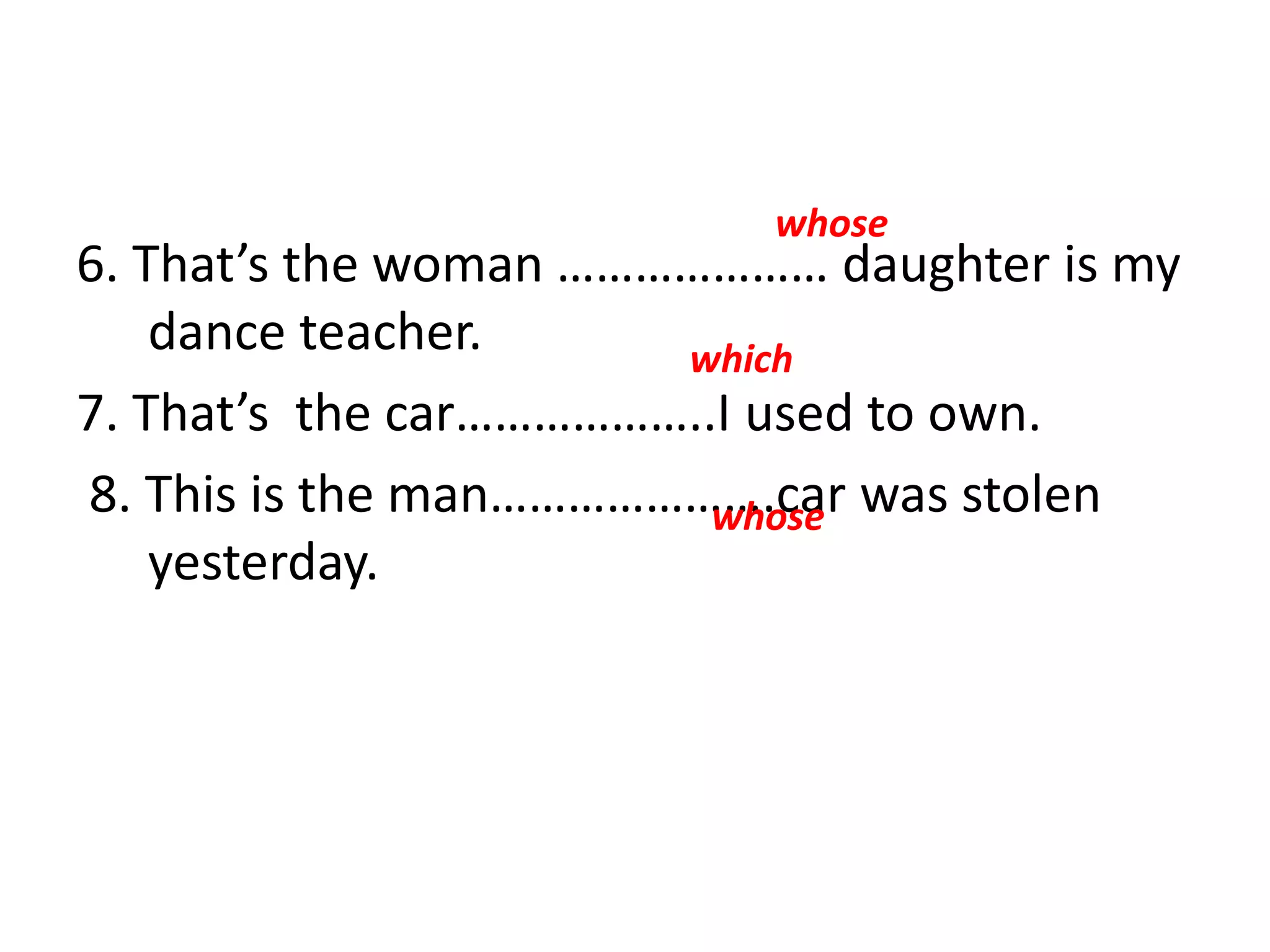
6. That’s the woman ………………… daughter is my
dance teacher.
7. That’s the car………………..I used to own.
8. This is the man………………….car was stolen
yesterday.
whose
which
whose
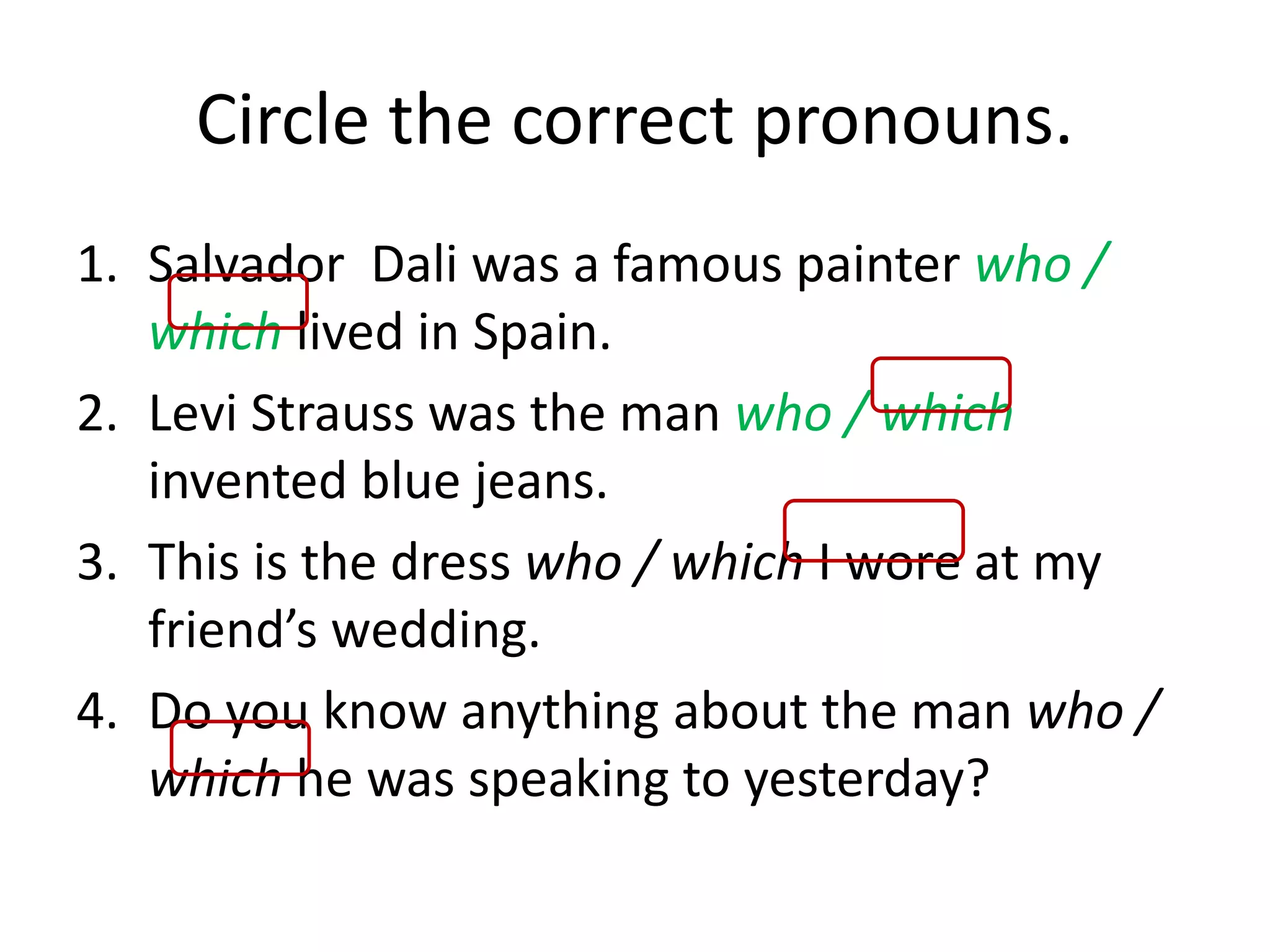
Circle the correct pronouns.
1. Salvador Dali was a famous painter who /
which lived in Spain.
2. Levi Strauss was the man who / which
invented blue jeans.
3. This is the dress who / which I wore at my
friend’s wedding.
4. Do you know anything about the man who /
which he was speaking to yesterday?
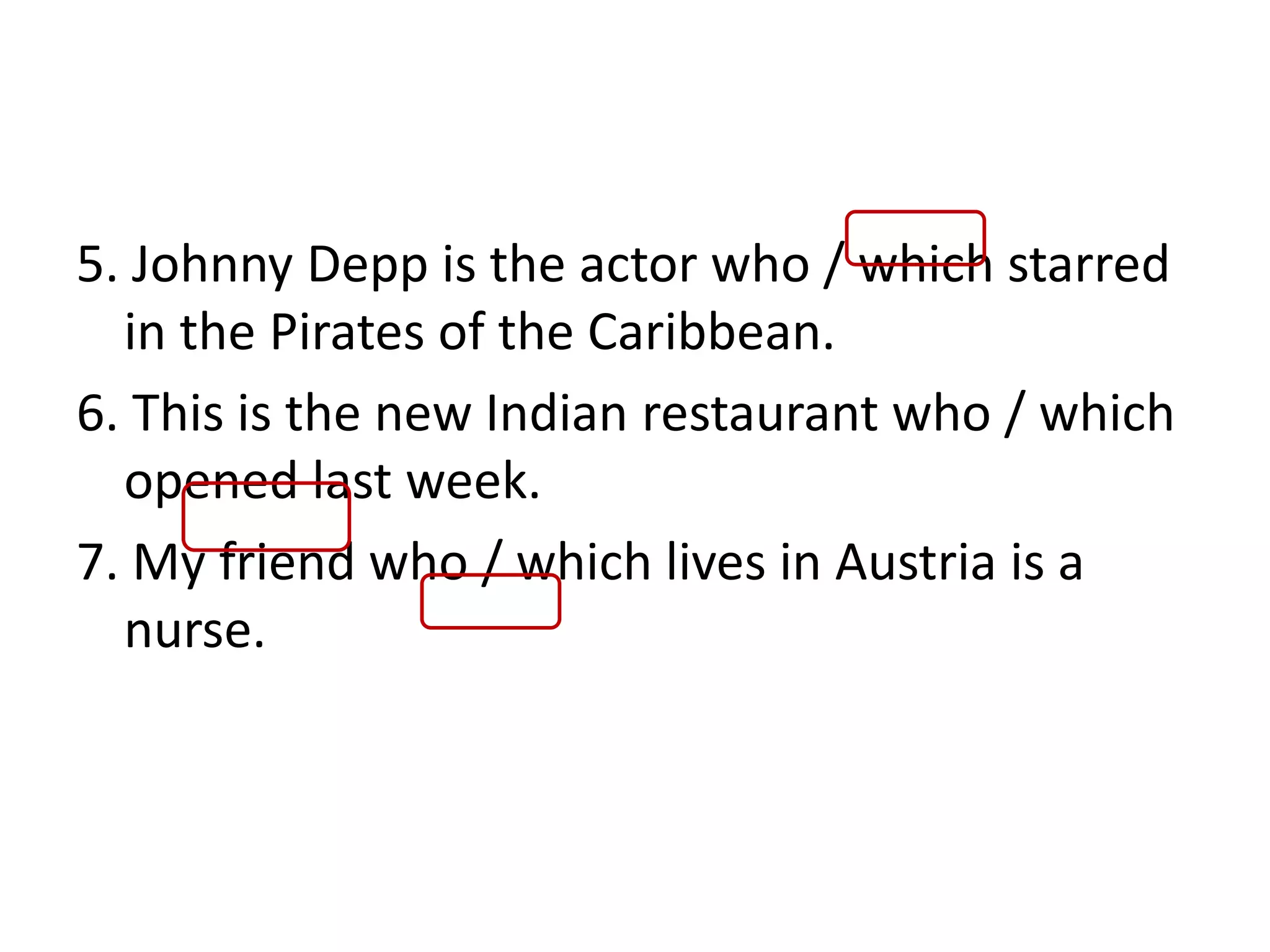
5. Johnny Depp is the actor who / which starred
in the Pirates of the Caribbean.
6. This is the new Indian restaurant who / which
opened last week.
7. My friend who / which lives in Austria is a
nurse.
Unit 10

Unit 10

  • 1.
    UNIT 10 Space, unexplainedmysteries, environment
  • 2.
    Space,unexplained mysteries,environment Reading: Curricularcuts: stars, a story, an article about environment Listening: Note taking, predicting content Grammar: Reported speech (statements, questions, commands), relatives Vocabulary: Space, solar system, supernatural, environmental issues Speaking: An interview about extra-terrestrial creatures
  • 3.
    • Abduction (n)- When someone is taken away by force • Researcher(n) - Somebody who finds information about a particular subject • Picture (v) - To imagine • Strangely (adj)- In an unusual or surprising way • Disappear(v) - Impossible to see • Hill (n)- Very small mountain • Experience(n) - Something that happens to you • Witness(n) - Somebody who sees something happen
  • 4.
    • Debris (n)-The pieces of something that are left behind after an explosion or accident • Burn mark(n) - A small area that has been damaged by fire • Ground (n) - The surface of the earth • Crash (n) - Accident in which something, usually a vehicle, hits something else and is damaged/destroyed • Society (n) - An organisation or a club • Sighting (n) - When something unusual is seen
  • 5.
    • Comet (n)-Bright object with a tail that travels around the sun • Meteor (n) - A piece of rock or metal that travels through the space • Bright (adj) - Having / giving off a lot of light • Solar system (n) - A system with sun and the planets surrounding it • Condition(n) - All the things affecting the way something happens • Convinced(adj) - Certain that something is true • Among (prep) - In the middle of a group of people or things
  • 6.
    1. When someoneis taken away by force 2. Somebody who finds information about a particular subject 3. To imagine 4. In an unusual or surprising way 5. Impossible to see 6. Very small mountain 7. Something that happens to you 8. Somebody who sees something happen abduction researcher picture strangely disappear hill experience witness
  • 7.
    9. The piecesof something that are left behind after an explosion or accident 10. A small area that has been damaged by fire 11. The surface of the earth 12. Accident in which something, usually a vehicle, hits something else and is damaged/destroyed 13. An organisation or a club 14. When something unusual is seen debris Burn mark ground crash society sighting
  • 8.
    15. Bright objectwith a tail that travels around the sun 16. A piece of rock or metal that travels through the space 17. Having / giving off a lot of light 18. A system with sun and the planets surrounding it 19. All the things affecting the way something happens 20. Certain that something is true 21. In the middle of a group of people or things comet meteor bright Solar system conditions convinced among
  • 9.
    REPORTED SPEECH • Howwe report another person’s words; • How we restate what someone said * restate - express again, say again, state a new
  • 10.
    Quoted Speech v.Reported speech Quoted speech = Teacher said, “I like birthdays.” Reported speech = Teacher said she liked birthdays.. Uses the exact word of the speaker Doesn’t use the exact word of the speaker Direct speech Indirect speech
  • 11.
    Quoted Speech v.Reported speech Quoted speech = Uses quotation marks “ ”. Reported speech = Doesn’t use quotation marks.
  • 12.
    Quoted Speech v.Reported speech Quoted speech = Teacher said, “I like birthdays.” “I like birthdays” , teacher said. “I like birthdays” , said teacher. Reported speech = Teacher said she liked birthdays.
  • 13.
    SAY v TELL •Both say and tell reporting verbs. • We often use tell if we name the speaker and the listener. She told us that she is over 30.
  • 14.
    SAY v TELL Wecan use say to name the listener, too, but it’s not as common: • She said to us she is over 30. [okay] • She told us she is over 30. [More natural]
  • 15.
    SAY v TELL If you use say to name the speaker and the listener use to. Don’t use to after tell. • She said to us that she is over 30. • She told us that she is over 30.
  • 16.
    SAY v TELL Summary of reported statements. • Who? + SAID + (that)… She said that she is over 30. • Who? + TOLD + Whom? + (that) … She told us she is over 30.
  • 18.
    REPORTED QUESTION 1 •Uses ‘ask’ Direct question = “Where is the birthday cake? “, she asked. Reported question = She asked me where the birthday cake was.
  • 19.
    Direct question begins: *an auxiliary (be, do, have) * a modal verb (can, may, etc), then the reported question is introduced with if or whether. Direct question = He asked, “Is teacher there?” Reported question = He asked me if/whether teacher was there. REPORTED QUESTION 2
  • 20.
    Report John’s questions. 1.Have you travelled abroad? 2. Who is your favourite actor? 3. Have you got any pets? 4. Can you drive? 5. Where do you live? 6. When did you move here? John asked if/whether I had travelled abroad. John asked who my favourite actor was. John asked if/whether I had got some pets. John asked if/whether I could drive. John asked where I lived. John asked when I had moved here.
  • 21.
    Reported commands • Usesverbs ask or tell +sb+(not) to infinitive Direct order Reported order Be quiet! She asked us to be quiet. Direct order Reported order Don’t talk! She told us not to talk.
  • 22.
    Read the listof introduction and turn them into reported speech •Pay the telephone bill  •Water the plants  •Cut the grass X •Call your grandmother to wish her a happy birthday  •Iron clothes X •Buy groceries  They told her to pay the telephone bill. They told her not to cut the grass. They told her to call your grandmother to wish her a happy birthday. They told her not to iron clothes They told her buy groceries They told her to water the plants.
  • 23.
    We learned thatreported speech is indirect speech, meaning it doesn’t use the exact words of the speaker. So if we don’t use the, exact words, which words do we use? Which words stay same and which words change? How do they change? We’ll begin to understand the answers. To these questions in this lesson. As we talk about most logical changes first: changes to reference words *reference = words that are use to talk about a certain person or thing, not by the name
  • 24.
    Our focus What arereference words? How do we need to change in the reported speech? Reference words = words that are use to talk about a certain person or thing, not by the name
  • 25.
    I have aspring birthday. My birthday is in March. I don’t like to tell people how old I am . I keeps my age to myself. Example of reference words
  • 26.
    Example of referencewords Teacher has a spring birthday. Her birthday is in March. She doesn’t like to tell people how old she is. She keeps her age to herself.
  • 27.
    Types of referencewords o Pronoun (Who?, Whom?) I, you, me, him, myself…. o Possessive adjectives ( Whose?) My, your, his, our….
  • 28.
    Changing pronouns Example: • “Imade the cake myself,” Emma said. Emma said she made the cake herself
  • 29.
    Changing possessive adjectives •Example: • “The cake is for my Mom,” Emma said. Emma said the cake was for her Mom.
  • 30.
    Exercise 1 Complete thechanges for each reported statement. o “My birthday is in May,” said Bileg. o Bileg said ______birthday was in May.his(Whose?)
  • 31.
    o 1. Tomsaid, “It’s my mother’s birthday , so I’m taking her out to dinner.” o Tom told us it was ____ mother’s birthday , so _____ was taking her out to dinner. o 2. Steve and Lisa said “, We’ll bring some wine to the party.” o Steve and Lisa said _____would bring some wine to the party. his he they
  • 32.
    o 3. “Ibought a present for my cousin,” Anna said. o Anna said _______ had bought a present for _____cousin. she her
  • 33.
    Careful! • 4. We’llbuy you a plane ticket for your birthday so you can visit us, said my grandparents. • _____ grandparents told ____that ______ would buy ____a plane ticket for ___ birthday so ____ could visit _____. My me they my I them me
  • 34.
    Okay so we’vetalked about changing pronouns and possessive adjectives. There is another group of reference words that we need to address. Those are words that refer to time and place. Let’s talk about those now.
  • 35.
  • 36.
    Changing time andplace words • Much time can pass between when words are said and when words are reported. The place where words are spoken and place where words are reported can also be different. That’s why reference words for time and place change in reported speech.
  • 37.
    Changing Time Words •Example: • “There’s a big party tonight,” said Julie [Saturday] Julie said there was a big party last night. [Sunday] Julie said there was a big party that night. [a few weeks later]
  • 38.
    Changing Place Words Example: •“The party will be here in my home,” said Mike. Mike said that the party would be there in his home.
  • 39.
    Common Changes inReported Speech TIME “today” that day/yesterday “tomorrow” the next day/ the following day “yesterday” the day before “now” then/at that moment/ at that time
  • 40.
    Common Changes inReported Speech • PLACE “here” there “this” that “these” those Note: There, that, and those in quoted speech must often change to here, this, and these.
  • 41.
    Exercise 2 Complete thechanges for each reported statement.
  • 42.
    • “I canbring the cake there to your house,” said Jack. • Jack said that he could bring the cake _____ to my house. here Example
  • 43.
    • “I’ll buyballoons tomorrow,” said Wendy. • Wendy said she would buy balloons _____________ . • [a week later] the next day Also: following day
  • 44.
    2. My friendssaid, “This restaurant is a great place to celebrate your birthday.” My friends said ______ restaurant was a great place to celebrate my birthday. that
  • 45.
    • 3. “Ididn’t see you at the party yesterday,” Drake said. • Drake said he hadn’t seen me at the party ________ . [a week later] the day before
  • 46.
    • 4. “Weneed to get ready now,” my husband told me. • My husband told me that we had to get ready ________________.at that moment Also: then or right then
  • 47.
    Reported speech Reported speechis the exact meaning of what someone said, but not the exact words. We do not use quotation marks in reported speech. The words that can either be used or omitted after the introductory verb (say, tell, etc). He said (that) he did not know what to do. Say-Tell Say+no personal object-She said she was very tired. Saу+to+personal object- She said to us she was very tired. Tell+ personal object- She told us she was very tired.
  • 48.
    Expressions used withsay and tell. • Hello, good morning/ afternoon etc, something/ nothing , a prayer, a few words, no more, for certain/ sure , etc say • The truth, a lie, a story, a secret, a joke, the time, the difference, one from another, somebody one's name, somebody the way, someone's fortune, etc tell
  • 49.
    Reported statements In reportedstatements, personal/possessive pronouns and possessive adjectives change according to the meaning of the sentence. Peter said, “I am exhausted”.(direct statements) Peter said (that) he was exhausted. (reported statements) The tenses can either change or remain the same in reported speech.
  • 50.
    Direct speech: Billsaid , “I still work there”. Reported speech: Bill said (that) he still works/ worked there. • Out –of- date reporting The introductory verb is in the past simple and the tenses change as follows.
  • 51.
    Direct speech Present simple-Past simple “My bus leaves at 5 o’clock.” She said (that) her bus left at 5 o’clock. Present continuous-Past continuous I am playing football this afternoon. She said (that) she was playing football that afternoon. Present perfect- past perfect I have made the beds. She said (that) she had made the beds Past simple- past simple or past perfect I left early. She said that she left/ had left early. Reported speech
  • 52.
    Reported speech -Underline the correct answer. 1. Linda said me / to me she was going to the hospital. 2. Chris told me / to me that he was volunteering in Sudan this summer. 3. I can’t say / tell you Sandra’s secret. 4. “I’ve got a terrible headache; she said / told. 5. Our teacher said / told good morning when she walked into the classroom.
  • 53.
    Reported questions • Reportedquestions usually introduced with the verb ask. • When the direct question begins with the question word (who, where, how, when, what, etc), the reported question is introduced with the same question word. Where is the post office? (direct question) She asked me where the post office was.
  • 54.
    When the directquestion begins with an auxiliary (be, do, have) or a modal verb (can, may, etc), then the reported question is introduced with if or whether. He asked, “Is Jonh there?” (direct question) He asked me if/whether Jonh was there. (reported question)
  • 55.
    Report John’s questions. 1.Have you travelled abroad? 2. Who is your favourite actor? 3. Have you got any pets? 4. Can you drive? 5. Where do you live? 6. When did you move here? John asked if/whether I had travelled abroad. John asked who my favourite actor was. John asked if/whether I had got some pets. John asked if/whether I could drive. John asked where I lived. John asked when I had moved here.
  • 57.
    Mr and MrsAnderson are going away for a week. Read the list of instructions they gave their daughter and turn them into reported speech. – Pay the telephone bill – Water the plants – Cut the grass X – Call your grandmother to wish her a happy birthday – Iron clothes X – Buy groceries They told her to pay the telephone bill. They told her to water the plants They told her not to cut the grass. They told her to call your grandmother to wish her a happy birthday. They told her not to iron clothes They told her buy groceries
  • 59.
    Relatives Fill in whowhich or whose 1. This is the guitar player ………… played for that famous rock band. 2. Isn’t this the jumper ……………… Christine gave you for your birthday? 3. This is the teacher ………………helps me with my Maths homework after school. 4. Isn’t this the film ……………… we saw last month? 5. That’s the flat………………..they sold last year. who which who which which
  • 60.
    6. That’s thewoman ………………… daughter is my dance teacher. 7. That’s the car………………..I used to own. 8. This is the man………………….car was stolen yesterday. whose which whose
  • 61.
    Circle the correctpronouns. 1. Salvador Dali was a famous painter who / which lived in Spain. 2. Levi Strauss was the man who / which invented blue jeans. 3. This is the dress who / which I wore at my friend’s wedding. 4. Do you know anything about the man who / which he was speaking to yesterday?
  • 62.
    5. Johnny Deppis the actor who / which starred in the Pirates of the Caribbean. 6. This is the new Indian restaurant who / which opened last week. 7. My friend who / which lives in Austria is a nurse.