Unit 5
NATURAL DISASTERS
INTRODUCTION
Watch the video and say what it is about and if you knew about this previously
https://www.youtube.com/watch?v=hoPdnexdLmo
PAGES 50 - 51
SPEAKING
●PAGE 51-A AND B
REVIEW
REPORTED SPEECH
●https://wordwall.net/es/resource/5353281/reported-speech
Report the news headlines
Reported speech
We often have to report what people
have said. When we do this, we need
to consider various things.
Let’s look at:
1. Tense change in reported speech.
2. Changing pronouns in reported speech.
3. Changes with time and place words.
4. Reported questions and word order.
Tense changes…
Tense changes in reported speech
In reported speech, the main verb usually moves back one tense in the past.
Look at these examples and work out what
tense is being used in the bold sections.
example direct speech reported speech
She said she had an appointment that day.
Tom told me he was getting married the following June.
Jayne told Adam he could play out until 8pm.
Francesca said she would be home that night.
Diana told me she was going to visit her brother the following
day.
Now look at the direct speech for
each example. What tenses are used?
past simple
past continuous
could
would
was/were going to
present simple
present continuous
can
will
am/is/are going to
Notice how the tenses
change from direct to
reported speech.
“I have an appointment today.”
“I am getting married next June.”
“You can play out until 8pm.”
“I will be home tonight.”
“I am going to visit my brother tomorrow.”
Tense changes in reported speech
In reported speech, the main verb usually moves back on tense in the past.
example direct speech reported speech
She said she had an appointment that day. present simple past simple
Tom told me he was getting married the following June. present continuous past continuous
Jayne told Adam he could play out until 8pm. can could
Francesca said she would be home that night. will would
Diana told me she was going to visit her brother the following
day.
am/is/are going to was/were going to
Think of these changes as one
step back in time. Look at the
time line… will/can
present
simple
past
simple
past
perfect
would/could
Let’s consider… pronoun change
You have to give us
the money soon so
we can book the
tickets.
Jude told me we had
to give them the
money soon so they
could book the
tickets.
Ok. I’ll give it
to her tonight
at our Spanish
class.
Later that day…
Often it is necessary to change the
pronouns and possessive adjectives in
reported speech, so that we know
exactly who is being referred to. Look
at the conversation above.
Time and place
word changes…
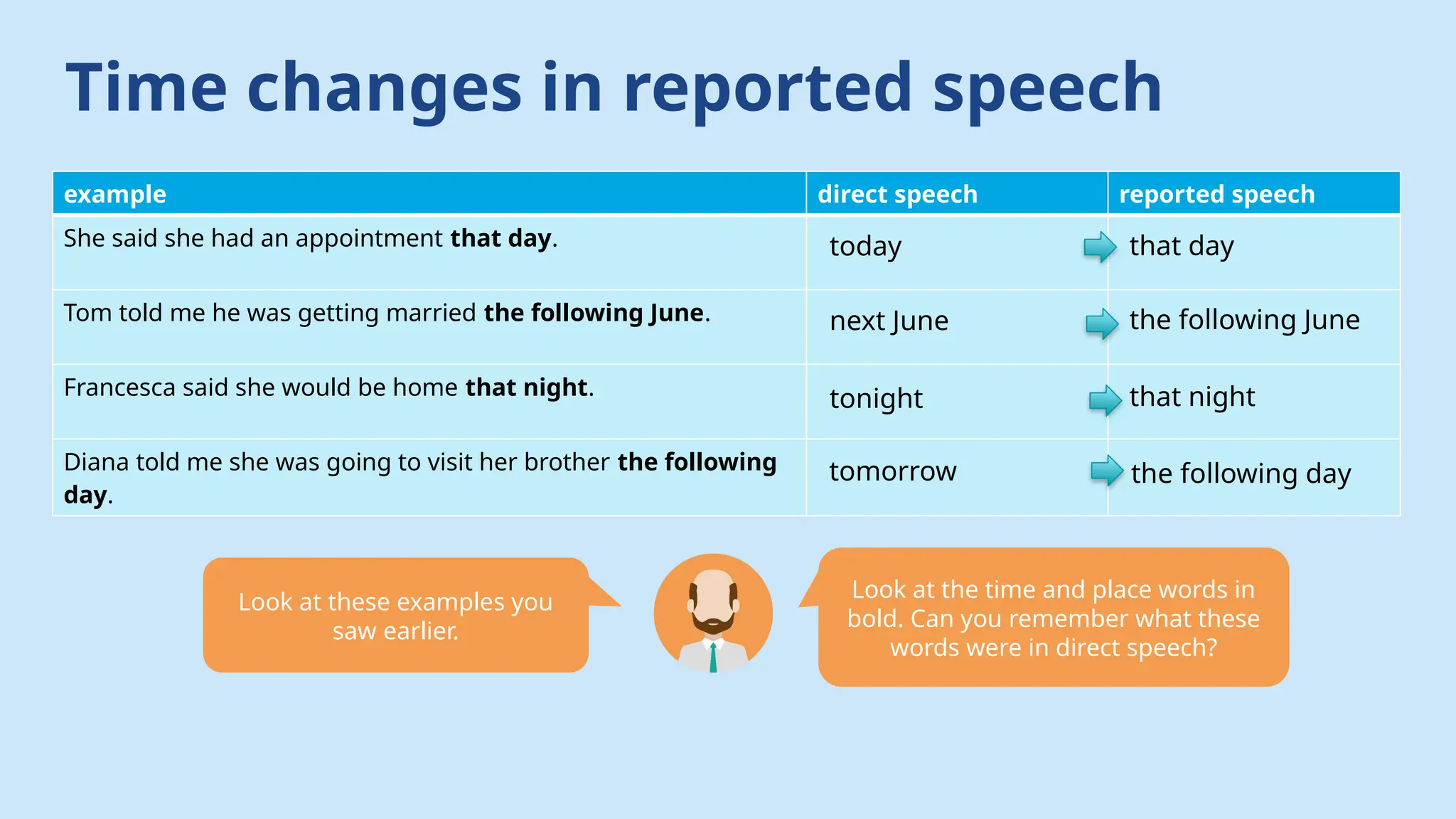
Time changes in reported speech
example direct speech reported speech
She said she had an appointment that day.
Tom told me he was getting married the following June.
Francesca said she would be home that night.
Diana told me she was going to visit her brother the following
day.
that day
the following June
that night
the following day
today
next June
tonight
tomorrow
Look at these examples you
saw earlier.
Look at the time and place words in
bold. Can you remember what these
words were in direct speech?
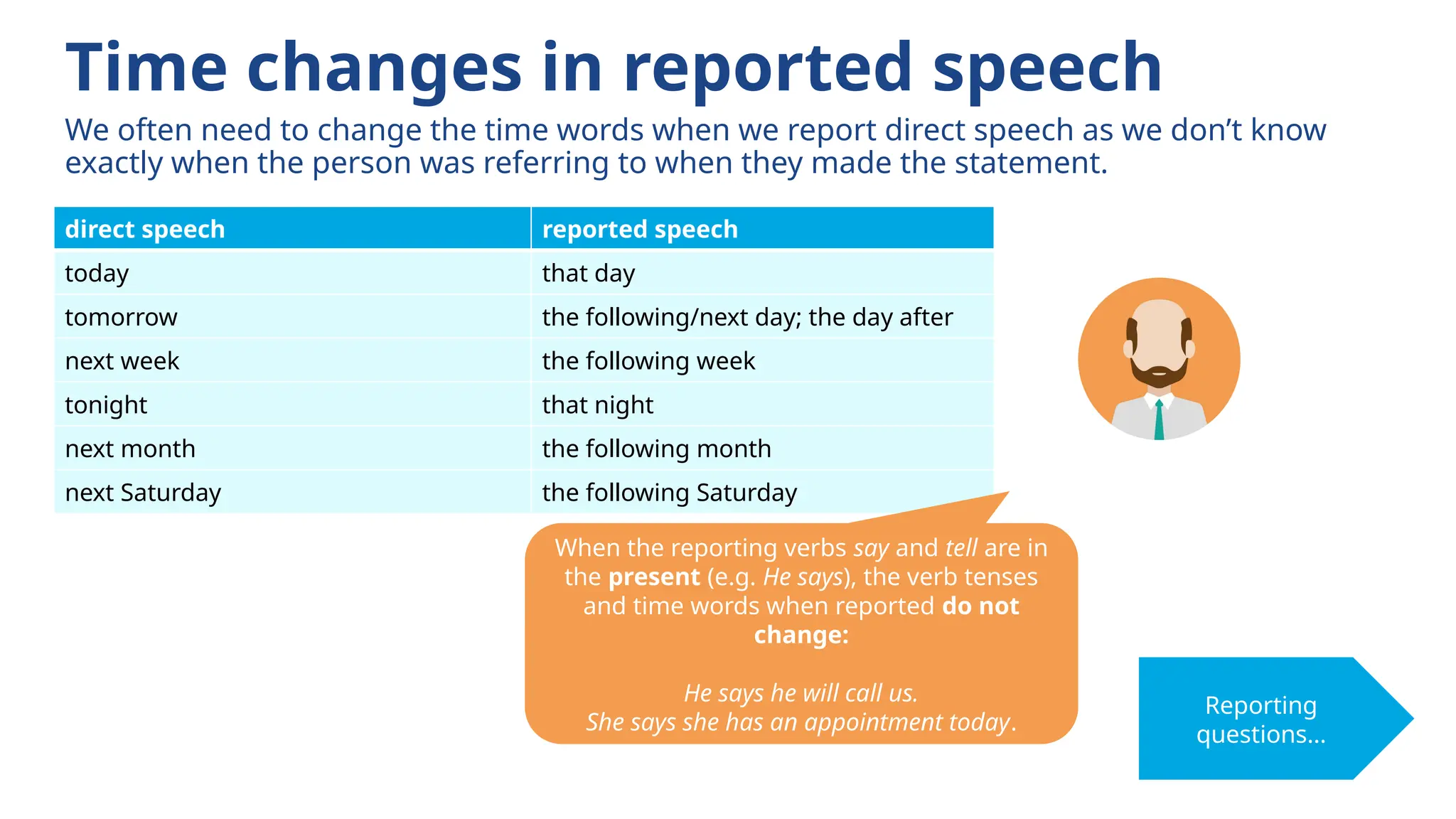
Time changes in reported speech
direct speech reported speech
today that day
tomorrow the following/next day; the day after
next week the following week
tonight that night
next month the following month
next Saturday the following Saturday
We often need to change the time words when we report direct speech as we don’t know
exactly when the person was referring to when they made the statement.
Reporting
questions…
When the reporting verbs say and tell are in
the present (e.g. He says), the verb tenses
and time words when reported do not
change:
He says he will call us.
She says she has an appointment today.
Reporting questions
Where does Lewis live?
He asked me where Lewis
lived.
Do you speak another language?
What will you do?
Is Marta going to come tomorrow? A week later
He asked me if I spoke
another language.
He asked me what I would
do.
He asked me if Marta was going the
following day.
Look at the direct
questions (in green)
and the reported
questions (in purple)
and complete the
gaps in word order of
reported questions in
the table with these
words.
open question with a question
word (wh- questions)
closed yes/no questions with no
question word
asked + (object pronoun) asked + (object pronoun)
……………………………
subject
conjugated verb
……………………………
subject
conjugated verb
if/whether
question word
Reporting questions
Where does Lewis
live?
Do you speak another
language?
What will you do? Is Marta going to come
tomorrow?
open question with a question word (wh- questions) closed yes/no questions with no question word
asked + (object) question word subject verb
He asked (me) where Lewis lived.
asked + (object) if/whether subject verb
He asked (me) if I spoke…
He asked me where
he lived.
He asked me what I
would do.
He asked me if I
spoke another
language.
He asked me if Marta
was going the following
day.
Notice how the word order here is
like a positive sentence. There is no
auxiliary verb (do/does).
The tenses and
time words change
in the same way as
the statements.
Let’s practise!
1. Sophie asked, “What time is the party tonight?”
2. Francine asked me, “Does Tom write books for a living?”
3. James said, “Mark is moving house next Friday.”
4. Robert said, “Tina can give you the book tomorrow.”
5. Leticia and John said, “We will tidy up.”
6. Larry asked, “What time is the flight leaving next week?”
Practice activities
Change the direct speech into reported speech.
Sophie asked (me) what time the party was that night.
Francine asked (me) if/whether Tom wrote books for a living.
James said (that) Mark was moving house the following Friday.
Robert said (that) Tina could give me/us the book the following day/the day after.
Leticia and John said (that) they would tidy up.
Larry asked (me) what time the flight was leaving the following week.

REPORTED SPEECH-ideas for teachers .pptx

  • 1.
  • 2.
    INTRODUCTION Watch the videoand say what it is about and if you knew about this previously https://www.youtube.com/watch?v=hoPdnexdLmo
  • 3.
  • 4.
  • 5.
  • 6.
    Report the newsheadlines
  • 7.
  • 8.
    We often haveto report what people have said. When we do this, we need to consider various things. Let’s look at: 1. Tense change in reported speech. 2. Changing pronouns in reported speech. 3. Changes with time and place words. 4. Reported questions and word order. Tense changes…
  • 9.
    Tense changes inreported speech In reported speech, the main verb usually moves back one tense in the past. Look at these examples and work out what tense is being used in the bold sections. example direct speech reported speech She said she had an appointment that day. Tom told me he was getting married the following June. Jayne told Adam he could play out until 8pm. Francesca said she would be home that night. Diana told me she was going to visit her brother the following day. Now look at the direct speech for each example. What tenses are used? past simple past continuous could would was/were going to present simple present continuous can will am/is/are going to Notice how the tenses change from direct to reported speech. “I have an appointment today.” “I am getting married next June.” “You can play out until 8pm.” “I will be home tonight.” “I am going to visit my brother tomorrow.”
  • 10.
    Tense changes inreported speech In reported speech, the main verb usually moves back on tense in the past. example direct speech reported speech She said she had an appointment that day. present simple past simple Tom told me he was getting married the following June. present continuous past continuous Jayne told Adam he could play out until 8pm. can could Francesca said she would be home that night. will would Diana told me she was going to visit her brother the following day. am/is/are going to was/were going to Think of these changes as one step back in time. Look at the time line… will/can present simple past simple past perfect would/could
  • 11.
    Let’s consider… pronounchange You have to give us the money soon so we can book the tickets. Jude told me we had to give them the money soon so they could book the tickets. Ok. I’ll give it to her tonight at our Spanish class. Later that day… Often it is necessary to change the pronouns and possessive adjectives in reported speech, so that we know exactly who is being referred to. Look at the conversation above. Time and place word changes…
  • 12.
    Time changes inreported speech example direct speech reported speech She said she had an appointment that day. Tom told me he was getting married the following June. Francesca said she would be home that night. Diana told me she was going to visit her brother the following day. that day the following June that night the following day today next June tonight tomorrow Look at these examples you saw earlier. Look at the time and place words in bold. Can you remember what these words were in direct speech?
  • 13.
    Time changes inreported speech direct speech reported speech today that day tomorrow the following/next day; the day after next week the following week tonight that night next month the following month next Saturday the following Saturday We often need to change the time words when we report direct speech as we don’t know exactly when the person was referring to when they made the statement. Reporting questions… When the reporting verbs say and tell are in the present (e.g. He says), the verb tenses and time words when reported do not change: He says he will call us. She says she has an appointment today.
  • 14.
    Reporting questions Where doesLewis live? He asked me where Lewis lived. Do you speak another language? What will you do? Is Marta going to come tomorrow? A week later He asked me if I spoke another language. He asked me what I would do. He asked me if Marta was going the following day. Look at the direct questions (in green) and the reported questions (in purple) and complete the gaps in word order of reported questions in the table with these words. open question with a question word (wh- questions) closed yes/no questions with no question word asked + (object pronoun) asked + (object pronoun) …………………………… subject conjugated verb …………………………… subject conjugated verb if/whether question word
  • 15.
    Reporting questions Where doesLewis live? Do you speak another language? What will you do? Is Marta going to come tomorrow? open question with a question word (wh- questions) closed yes/no questions with no question word asked + (object) question word subject verb He asked (me) where Lewis lived. asked + (object) if/whether subject verb He asked (me) if I spoke… He asked me where he lived. He asked me what I would do. He asked me if I spoke another language. He asked me if Marta was going the following day. Notice how the word order here is like a positive sentence. There is no auxiliary verb (do/does). The tenses and time words change in the same way as the statements. Let’s practise!
  • 16.
    1. Sophie asked,“What time is the party tonight?” 2. Francine asked me, “Does Tom write books for a living?” 3. James said, “Mark is moving house next Friday.” 4. Robert said, “Tina can give you the book tomorrow.” 5. Leticia and John said, “We will tidy up.” 6. Larry asked, “What time is the flight leaving next week?” Practice activities Change the direct speech into reported speech. Sophie asked (me) what time the party was that night. Francine asked (me) if/whether Tom wrote books for a living. James said (that) Mark was moving house the following Friday. Robert said (that) Tina could give me/us the book the following day/the day after. Leticia and John said (that) they would tidy up. Larry asked (me) what time the flight was leaving the following week.