創新思考與管理
2-1-53
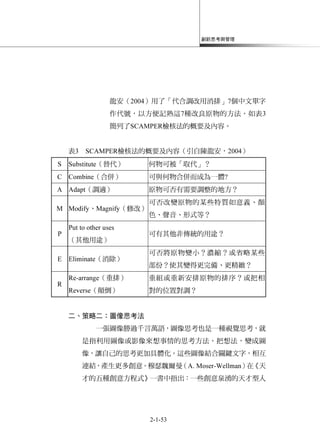
龍安(2004)用了「代合調改用消排」7個中文單字
作代號,以方便記熟這7種改良原物的方法。如表3
簡列了SCAMPER檢核法的概要及內容。
表3 SCAMPER檢核法的概要及內容(引自陳龍安,2004)
S Substitute(替代)何物可被「取代」?
C Combine(合併) 可與何物合併而成為一體?
A Adapt(調適) 原物可否有需要調整的地方?
M Modify、Magnify(修改)可否改變原物的某些特質如意義、顏
色、聲音、形式等?
P
Put to other uses
(其他用途) 可有其他非傳統的用途?
E Eliminate(消除) 可否將原物變小?濃縮?或省略某些
部份?使其變得更完備、更精緻?
R
Re-arrange(重排)
Reverse(顛倒)
重組或重新安排原物的排序?或把相
對的位置對調?
二、策略二:圖像思考法
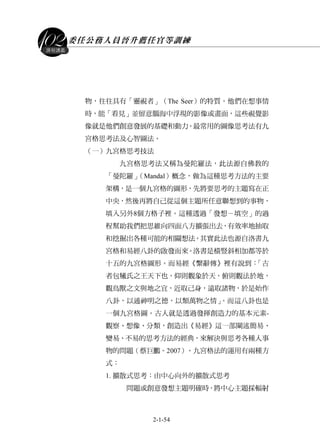
一張圖像勝過千言萬語,圖像思考也是一種視覺思考,就
是指利用圖像或影像來想事情的思考方法。把想法,變成圖
像,讓自己的思考更加具體化。這些圖像結合關鍵文字,相互
連結,產生更多創意。穆瑟魏爾曼(A. Moser-Wellman)在《天
才的五種創意方程式》一書中指出:一些創意泉湧的天才型人
委任公務人員晉升薦任官等訓練
2-1-72
課程講義
VeryMuch。
16. 顏和正譯(2011)X創新:企業逆轉勝的創新獲利密碼,亞當‧理查
森(Adam Richardson)著,InnovationX: Why a Company's Toughest
Problems are its Greatest Advantage,繆思出版社,臺北。
17. 華特.艾維斯漢姆(2008),德國AIM創新管理(張淑惠、林崇偉譯),
臺北,中國生產力中心(原著出版於2003)。
18. 奇普‧希思、丹‧希思(2011),改變,好容易,陳松筠譯,臺北,
大塊文化。(原著出版於2011)
19.Switch, How to Change Things when Change is Hard,Chip Heath & Dan
Heath(創意黏力學作者),大塊文化, 2010
20. 吳榮貴、林玲煥、吳朝升、王克尹2010,臺灣各港務局建立創新管理
機制與創新指標之研究,交通部運輸研究所。
21. Adams R., Bessant J. and Phelps R. (2006). Innovation Management
Measures: A Review, International Management Review, Volume 8,
No.1, pp21-47.
22. Csikzentimihalyi, M. (1999). Creativity: Flow and thepsychology of
discoveryand invention. New York: HarperCollins.
23. Drucker, Peter F. (1964). Managing for Results, New York, Harper &
Row, 1964.
24. Drucker, Peter F. (1964). Innovation and Entrepreneurship: Practice and
Principle, Collins.
25. Drucker, Peter F. (2002). The Discipline of Innovation, Best of HBR,
August, 2002, pp. 95-103
26. Guilford, J. P. (1977). Way beyond the IQ. Buffalo, NY: Creative
73.
創新思考與管理
2-1-73
Education Foundation.
27. Osborn,A.F. (1953, 1963). Applied imagination (3 rd ed)
28. Luecke R. and Katz R. (2003). Managing Creativity and Innovation,
Boston, MA, Harvard Business School Press
參考網站:
1. http://wiki.mbalib.com/
2. http://tieba.baidu.com/f?kz=1009112693
3. http://blog.sina.com.cn/u/2709109344
4. http://3q.club.tw/