OGILVIE’S SYNDROME
Dr. Paritosh kumar.
Definition:-
• Ogilvie’s syndrome also known as Acute colonic pseudo-obstruction
• It is disorder characterized by gross dilatation of the cecum and the
right hemicolon ( although ocassionally extending to the rectum) in
the absence of an anatomic lesion that obstruct the flow of intestinal
contents.
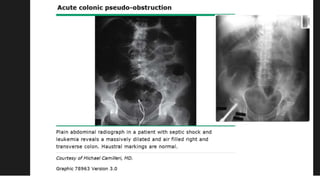
• Characterized by dilatation of the cecum ( 12 cm) and right colon on
abdominal X-ray.
• It is sometimes referred as acute megacolon.
• It was first described by Sir William Heneage Ogilvie in 1948
Aetiology
• Causes of acute colonic pseudo obstruction is multifactorial
• 3 most common factors are:-
• trauma (non-operative).
• infection (pneumonia, sepsis most common) .
• Cardiac diseases (myocardial infarction, heart failure) .
• Other condition which commonly associated with ACPO are
• obstetric or gynaecologic disease.
• abdominal/pelvic surgery.
• neurological (Parkinson disease, spinal cord injury, multiple
sclerosis, Alzheimer disease) ,
• orthopaedic surgery.
Aetiology cont……
• Old age.
• Electrolyte imbalance.
• Hyponatremia, Hypokalemia,Hypocalcemia,Hypomagnesemia
• Miscellaneous medical conditions.
• cancer,
• respiratory failure
• renal failure
• Miscellaneous surgical conditions.
• Urologic
• thoracic
• neurosurgery
• cardiothoracic surgery
Aetiology cont…
• Medications
• narcotics/opioids
• tricyclic antidepressants
• Phenothiazines
• Antiparkinsonian drugs.
• Anaesthetic agents.
• Several cases in the literature are associated with Caesarean section
(even without bowel injury), normal vaginal delivery, and spinal anaesthesia used
during childbirth or surgery.
• Chemotherapy especially vincristine, all trans retinoic acid and methotrexate
used in the treatment of variety of malignancies.
Pathophysiology
• Exact mechanism of acute colonic pseudo obstruction is not known.
• Some studies shows it is due to increase in sympathetic activity and
other shows it is due to decrease in parasympathetic activity. The
most accepted theory is imbalance in the regulation of colonic motor
activity by the autonomic nervous system.
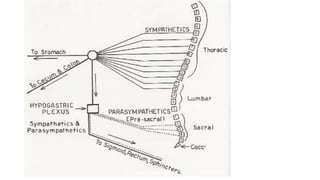
• Sympathetic supply: Lower 6 thoracic nerve supply right colon and
lumbar segment L1 to L3 supply left colon.
• Parasympathetic supply: Vagus nerve supply upper GI upto splenic
flexure and sacral parasympathetic ( S2-S5) supply left colon, sigmoid
and rectum.
Clinical features.
• Age : over 60 years.
• Sex : Male> Female ( > 1.5:1)
• Nausea/vomiting
• Abdominal pain
• Abdominal distension.
• Constipation.
• Physical examination:
• Fever
• Abdomen distended.
• Abdomen non-tender/tender.
• Tympanic note on percussion.
• Bowel sounds were typically present.
Diagnosis:-
• Laboratory evaluation:
• There are no pathognomonic laboratory findings in patients with acute colonic
pseudo-obstruction
• leucocytosis
• metabolic abnormalities:-hypokalemia, hypocalcemia, and hypomagnesemia.
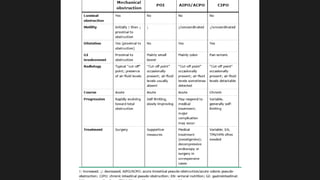
• Imaging : Abdominal X ray shows a dilated colon.
• CT scan is useful to differentiate it from mechanical obstruction.
• Water soluble contrast enema, should be done in all suspected
patients.
• Helps in differentiating between mechanical obstruction and pseudo
obstruction..
• Most useful investigation
• Colonoscopy: advantage that it can be used for treatment.
• Disadvantages of risk of distending the colon.
Differential diagnosis….
• MESENTERIC ISCHEMIA
• COLON CANCER
• CONSTIPATION
• DIVERTICULITIS
• HIRSCHPRUNGS DISEASE
• TOCXIC MEGACOLON
• PSEUDOMEMBRANOUS COLITIS
• INTESTINAL PERFORATION
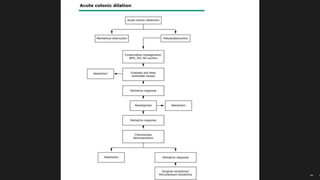
Treatment :-
• Objective:-
relief of discomfort and avoidance of perforation or ischemia,
which are associated with mortality
• Treatment divided into
• Supportive care and removal of precipitants
• Pharmacologic agent
• Decompression
• Surgery
Treatment cont…
• Supportive care and removal of precipitants:
It should be continued for 24 to 48 hr provided there is no pain or extreme(>12)
colonic distension.
• Nasogastric decompression.
• Replacement of extracellular fluid deficit.
• Correction of electrolyte abnormalities.
• All medication inhibiting bowel motility such as opiates, should be stopped.
• Insert a rectal tube and attach to gravity drainage.
• Treat underlying reversible diseases, like infection or congestive heart failure.
• Enemas can be given, but it increases the chances of perforation.
• Patients response is monitored by serial abdominal examination and
radiography (every 12 to 24 hours) to measure the
colonic diameter and determine which patients need colonoscopic decompre
ssion or surgery.
Treatment cont….
• Pharmacologic agents
• Neostigmine: an acetyl cholinesterase inhibitor,
• 2 mg given over 3 min. The resolution of condition is indicated within 10
min of administration by passage of stool and flatus by patient.
• Decompression in response to neostigmine has been achieved in
80 to 100 percent of patients.
• S/e: Bradycardia, so atropine should be available at bedside.
• cramping pain in abdomen, nausea vomiting, salivation.
• Erythromycin: binds to motilin receptor on intestine and stimulates the
smooth muscles contraction. i.v. 250 mg in 250 ml NS 8 hrly for 3 days or
250 mg QID orally for10 days.
• Methylnaltrexone: used in treatment of ACPO syndrome associated with
opioid use.
Treatment cont….
• Sympathetic blocked: by epidural anaesthesia.
• Decompression: the role of decompression pseudoobstruction is
controversial. Success rate varies from 69 to 90 %. It includes
• Endoscopic decompression with or without placement of
decompression tube.
• Percutaneous tube cecostomy/colostomy:
• More invasive, require combined endoscopic and radiologic
procedure.
• Reserved for those who fail initial endoscopic decompression.
• Require monitoring of patient for local infection or bleeding.
• Surgery: considered when other treatment fails and those who
present with features suggestive of peritonitis or perforation.
Treatment cont….
• The type of operation depends upon findings at surgery.
• In the absences of any perforation or ischemia- loop colostomy .
• Any areas of perforation or ischemia:- must be resected which usually
requires right colectomy, or total colectomy or ileostomy and mucous
fistula.
Complication
• It includes: -
• Ischemia
• Perforation
• Most common site Caecum.( 3 to 40 %)
• Associated with mortality 40 to 50 %
• Predictor of perforation – caecum diameter >14cm, delay in colonic decompression, and
old age.
• volvulus.
• Recurrence rate: 40%.
1.OGILVIE SYNDROME.pptx

1.OGILVIE SYNDROME.pptx

  • 1.
  • 2.
    Definition:- • Ogilvie’s syndromealso known as Acute colonic pseudo-obstruction • It is disorder characterized by gross dilatation of the cecum and the right hemicolon ( although ocassionally extending to the rectum) in the absence of an anatomic lesion that obstruct the flow of intestinal contents. • Characterized by dilatation of the cecum ( 12 cm) and right colon on abdominal X-ray. • It is sometimes referred as acute megacolon. • It was first described by Sir William Heneage Ogilvie in 1948
  • 3.
    Aetiology • Causes ofacute colonic pseudo obstruction is multifactorial • 3 most common factors are:- • trauma (non-operative). • infection (pneumonia, sepsis most common) . • Cardiac diseases (myocardial infarction, heart failure) . • Other condition which commonly associated with ACPO are • obstetric or gynaecologic disease. • abdominal/pelvic surgery. • neurological (Parkinson disease, spinal cord injury, multiple sclerosis, Alzheimer disease) , • orthopaedic surgery.
  • 4.
    Aetiology cont…… • Oldage. • Electrolyte imbalance. • Hyponatremia, Hypokalemia,Hypocalcemia,Hypomagnesemia • Miscellaneous medical conditions. • cancer, • respiratory failure • renal failure • Miscellaneous surgical conditions. • Urologic • thoracic • neurosurgery • cardiothoracic surgery
  • 5.
    Aetiology cont… • Medications •narcotics/opioids • tricyclic antidepressants • Phenothiazines • Antiparkinsonian drugs. • Anaesthetic agents. • Several cases in the literature are associated with Caesarean section (even without bowel injury), normal vaginal delivery, and spinal anaesthesia used during childbirth or surgery. • Chemotherapy especially vincristine, all trans retinoic acid and methotrexate used in the treatment of variety of malignancies.
  • 6.
    Pathophysiology • Exact mechanismof acute colonic pseudo obstruction is not known. • Some studies shows it is due to increase in sympathetic activity and other shows it is due to decrease in parasympathetic activity. The most accepted theory is imbalance in the regulation of colonic motor activity by the autonomic nervous system. • Sympathetic supply: Lower 6 thoracic nerve supply right colon and lumbar segment L1 to L3 supply left colon. • Parasympathetic supply: Vagus nerve supply upper GI upto splenic flexure and sacral parasympathetic ( S2-S5) supply left colon, sigmoid and rectum.
  • 8.
    Clinical features. • Age: over 60 years. • Sex : Male> Female ( > 1.5:1) • Nausea/vomiting • Abdominal pain • Abdominal distension. • Constipation. • Physical examination: • Fever • Abdomen distended. • Abdomen non-tender/tender. • Tympanic note on percussion. • Bowel sounds were typically present.
  • 9.
    Diagnosis:- • Laboratory evaluation: •There are no pathognomonic laboratory findings in patients with acute colonic pseudo-obstruction • leucocytosis • metabolic abnormalities:-hypokalemia, hypocalcemia, and hypomagnesemia. • Imaging : Abdominal X ray shows a dilated colon. • CT scan is useful to differentiate it from mechanical obstruction. • Water soluble contrast enema, should be done in all suspected patients. • Helps in differentiating between mechanical obstruction and pseudo obstruction.. • Most useful investigation • Colonoscopy: advantage that it can be used for treatment. • Disadvantages of risk of distending the colon.
  • 11.
    Differential diagnosis…. • MESENTERICISCHEMIA • COLON CANCER • CONSTIPATION • DIVERTICULITIS • HIRSCHPRUNGS DISEASE • TOCXIC MEGACOLON • PSEUDOMEMBRANOUS COLITIS • INTESTINAL PERFORATION
  • 12.
    Treatment :- • Objective:- reliefof discomfort and avoidance of perforation or ischemia, which are associated with mortality • Treatment divided into • Supportive care and removal of precipitants • Pharmacologic agent • Decompression • Surgery
  • 13.
    Treatment cont… • Supportivecare and removal of precipitants: It should be continued for 24 to 48 hr provided there is no pain or extreme(>12) colonic distension. • Nasogastric decompression. • Replacement of extracellular fluid deficit. • Correction of electrolyte abnormalities. • All medication inhibiting bowel motility such as opiates, should be stopped. • Insert a rectal tube and attach to gravity drainage. • Treat underlying reversible diseases, like infection or congestive heart failure. • Enemas can be given, but it increases the chances of perforation. • Patients response is monitored by serial abdominal examination and radiography (every 12 to 24 hours) to measure the colonic diameter and determine which patients need colonoscopic decompre ssion or surgery.
  • 14.
    Treatment cont…. • Pharmacologicagents • Neostigmine: an acetyl cholinesterase inhibitor, • 2 mg given over 3 min. The resolution of condition is indicated within 10 min of administration by passage of stool and flatus by patient. • Decompression in response to neostigmine has been achieved in 80 to 100 percent of patients. • S/e: Bradycardia, so atropine should be available at bedside. • cramping pain in abdomen, nausea vomiting, salivation. • Erythromycin: binds to motilin receptor on intestine and stimulates the smooth muscles contraction. i.v. 250 mg in 250 ml NS 8 hrly for 3 days or 250 mg QID orally for10 days. • Methylnaltrexone: used in treatment of ACPO syndrome associated with opioid use.
  • 15.
    Treatment cont…. • Sympatheticblocked: by epidural anaesthesia. • Decompression: the role of decompression pseudoobstruction is controversial. Success rate varies from 69 to 90 %. It includes • Endoscopic decompression with or without placement of decompression tube. • Percutaneous tube cecostomy/colostomy: • More invasive, require combined endoscopic and radiologic procedure. • Reserved for those who fail initial endoscopic decompression. • Require monitoring of patient for local infection or bleeding. • Surgery: considered when other treatment fails and those who present with features suggestive of peritonitis or perforation.
  • 16.
    Treatment cont…. • Thetype of operation depends upon findings at surgery. • In the absences of any perforation or ischemia- loop colostomy . • Any areas of perforation or ischemia:- must be resected which usually requires right colectomy, or total colectomy or ileostomy and mucous fistula.
  • 18.
    Complication • It includes:- • Ischemia • Perforation • Most common site Caecum.( 3 to 40 %) • Associated with mortality 40 to 50 % • Predictor of perforation – caecum diameter >14cm, delay in colonic decompression, and old age. • volvulus. • Recurrence rate: 40%.