P R E P A R E D B Y
M E H W I S H J A M I L
Intestinal obstruction
Objectives
At the of this lecture students will be able to:
 Define intestinal obstructions.
 Explain pathophysiology of intestinal obstruction.
 Explain risk factors of intestinal obstruction.
 Enlist sign and symptom of intestinal obstruction.
 Explain complications of intestinal obstruction.
 Describe assessment and diagnostic findings of intestinal
obstructions.
 Explain medical and surgical interventions of intestinal
obstruction.
Definition
Intestinal obstruction exists when
blockage prevents the normal flow of intestinal
contents through the intestinal tract.
Introduction
Two types of processes can impede this flow:
• Mechanical obstruction: An intraluminal obstruction
or a mural obstruction from pressure on the intestinal
wall occurs.
 Examples are:
intussusception, polypoid tumors and neoplasms,
stenosis, strictures, adhesions, hernias, and abscesses.
Conti…
• Functional obstruction:
The intestinal musculature cannot propel the
contents along the bowel.
 Examples are :
amyloidosis, muscular dystrophy, endocrine disorders
such as diabetes mellitus, or neurologic disorders such as
Parkinson’s disease.
 The blockage also can be temporary and the result of the
manipulation of the bowel during surgery.
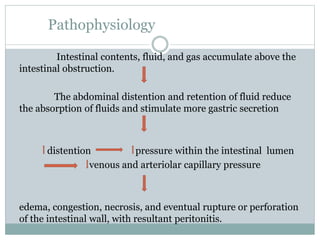
Pathophysiology
Intestinal contents, fluid, and gas accumulate above the
intestinal obstruction.
The abdominal distention and retention of fluid reduce
the absorption of fluids and stimulate more gastric secretion
distention pressure within the intestinal lumen
venous and arteriolar capillary pressure
edema, congestion, necrosis, and eventual rupture or perforation
of the intestinal wall, with resultant peritonitis.
Causes
 Mechanical obstructions are when something physically
blocks your intestine. In the small intestine, this can be due
to:
• adhesions, which are made of fibrous tissue that can
develop after any abdominal or pelvic surgery or after
severe inflammation
• volvulus, or twisting of the intestines
• intussusception, a “telescoping,” or pushing, of one
segment of intestine into the next section
• malformations of the intestine, often in newborns, but can
also occur in children and teens
• tumors within your small intestine
Conti…
• tumors within your small intestine
• gallstones, although they rarely cause obstructions
• swallowed objects, especially in children
• hernias, which involve a portion of your intestine pushing
outside the muscle or tissue in your body or into another
part of your body
• inflammatory bowel disease, such as Crohn’s disease
Conti…
 Causes for an ileus include:
• abdominal or pelvic surgery
• infections, such as gastroenteritis or appendicitis
• some medications, including opioid pain medications
• electrolyte imbalances
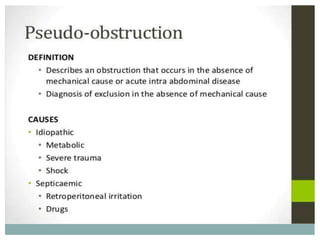
 Intestinal pseudo-obstruction can be caused by:
• Parkinson’s disease, multiple sclerosis, and other nerve and
muscle disorders
• Hirschsprung’s disease, a disorder in which there’s a lack of
nerves in sections of the large intestine
• disorders that cause nerve injury, such as diabetes mellitus
• hypothyroidism, or an underactive thyroid gland
Sign and Symptom
• severe bloating
• abdominal pain The initial symptom is usually crampy pain that
is wavelike and colicky.
• decreased appetite
• nausea
• Vomiting If the obstruction is complete, the peristaltic waves
initially become extremely vigorous and eventually assume a
reverse direction, with the intestinal contents propelled toward
the mouth instead of toward the rectum.
• inability to pass gas or stool
• constipation
• diarrhea
• severe abdominal cramps
• abdominal swelling
Conti…
 First, the patient vomits the stomach contents, then the bile
stained contents of the duodenum and the jejunum, and
finally, with each paroxysm of pain, the darker, fecal-like
contents of the ileum.
 The signs of dehydration become evident:
 intense thirst
 drowsiness
 generalized malaise
 aching
 a parched tongue
 mucous membranes
Complications
 Treatment is essential to reduce complications such as:
• dehydration
• electrolyte imbalances
• perforation, or a hole that forms in your intestines, which leads to
infections
• kidney failure
 If the obstruction is preventing blood from getting to a segment of
intestine, this can lead to:
• infection
• tissue death
• intestinal perforation
• sepsis, a life threatening blood infection
• multiple organ failure
• death
Assessment and Diagnosis
 Abdominal x-ray and CT findings include abnormal
quantities of gas, fluid, or both in the intestines.
 Laboratory studies (i.e., electrolyte studies and a complete
blood cell count) reveal a picture of dehydration, loss of
plasma volume, and possible infection
• colonoscopy, a flexible tube with a light that your doctor
uses to look at your large intestine
• enema with contrast
Medical Management
 Decompression of the bowel through a nasogastric tube
 Surgery
• antibiotics to reduce infection
• anti-nausea medicines to keep you from vomiting
• pain relievers
Nursing Interventions
 Nursing management of the nonsurgical patient with a
small bowel obstruction includes maintaining the function
of the nasogastric tube, assessing and measuring the
nasogastric output, assessing for fluid and electrolyte
imbalance, monitoring nutritional status, and assessing
improvement.
 The nurse reports discrepancies in intake and output,
worsening of pain or abdominal distention, and increased
nasogastric output.
 If the patient’s condition does not improve, the nurse
prepares him or her for surgery. Nursing care of the patient
after surgical repair of a small bowel obstruction is similar
to that for other abdominal surgeries.
Large Bowel Obstruction
large bowel obstruction results in an
accumulation of intestinal contents, fluid, and gas
proximal to the obstruction. It can lead to severe
distention and perforation unless some gas and fluid
can flow back through the ileal valve.
Conti…
 Large bowel obstruction, even if complete, may be
undramatic if the blood supply to the colon is not
disturbed.
 if the blood supply is cut off, intestinal strangulation and
necrosis occur; this condition is life-threatening.
 In the large intestine, dehydration occurs more slowly than
in the small intestine because the colon can absorb its fluid
contents and can distend to a size considerably beyond its
normal full capacity.
causes / Sign and Symptom
 Adenocarcinoid tumors
 diverticulitis. Sigmoid volvulus and cecal volvulus
 Sign and Symptom:
 In patients with obstruction in the sigmoid colon or the rectum,
constipation may be the only symptom for months.
 shape of the stool is altered
 Blood loss in the stool may result in iron deficiency anemia.
 weakness
 weight loss
 anorexia
 Abdominal distention
 Crampy lower abdominal pain
 fecal vomiting develops
Diagnostic Findings
 Abdominal x-ray and abdominal CT or MRI findings
reveal a distended colon and pinpoint the site of the
obstruction.
 Barium studies are contraindicated.
Medical Treatment
 Restoration of intravascular volume
 correction of electrolyte abnormalities
 nasogastric aspiration and decompression
 Colonoscopy
 Cecostomy
 A rectal tube may be used to decompress an area that is
lower in the bowel.
 surgical resection
 temporary or permanent colostomy
 ileoanal anastomosis
Nursing Intervention
 The nurse’s role is to monitor the patient for symptoms that
indicate that the intestinal obstruction is worsening and to
provide emotional support and comfort.
 The nurse administers IV fluids and electrolytes as
prescribed.
 If the patient’s condition does not respond to nonsurgical
treatment, the nurse prepares the patient for surgery.
 This preparation includes preoperative teaching as the
patient’s condition indicates.
 After surgery, general abdominal wound care and routine
postoperative nursing care are provided.
Intestinal obstruction

Intestinal obstruction

  • 1.
    P R EP A R E D B Y M E H W I S H J A M I L Intestinal obstruction
  • 2.
    Objectives At the ofthis lecture students will be able to:  Define intestinal obstructions.  Explain pathophysiology of intestinal obstruction.  Explain risk factors of intestinal obstruction.  Enlist sign and symptom of intestinal obstruction.  Explain complications of intestinal obstruction.  Describe assessment and diagnostic findings of intestinal obstructions.  Explain medical and surgical interventions of intestinal obstruction.
  • 3.
    Definition Intestinal obstruction existswhen blockage prevents the normal flow of intestinal contents through the intestinal tract.
  • 4.
    Introduction Two types ofprocesses can impede this flow: • Mechanical obstruction: An intraluminal obstruction or a mural obstruction from pressure on the intestinal wall occurs.  Examples are: intussusception, polypoid tumors and neoplasms, stenosis, strictures, adhesions, hernias, and abscesses.
  • 5.
    Conti… • Functional obstruction: Theintestinal musculature cannot propel the contents along the bowel.  Examples are : amyloidosis, muscular dystrophy, endocrine disorders such as diabetes mellitus, or neurologic disorders such as Parkinson’s disease.  The blockage also can be temporary and the result of the manipulation of the bowel during surgery.
  • 7.
    Pathophysiology Intestinal contents, fluid,and gas accumulate above the intestinal obstruction. The abdominal distention and retention of fluid reduce the absorption of fluids and stimulate more gastric secretion distention pressure within the intestinal lumen venous and arteriolar capillary pressure edema, congestion, necrosis, and eventual rupture or perforation of the intestinal wall, with resultant peritonitis.
  • 8.
    Causes  Mechanical obstructionsare when something physically blocks your intestine. In the small intestine, this can be due to: • adhesions, which are made of fibrous tissue that can develop after any abdominal or pelvic surgery or after severe inflammation • volvulus, or twisting of the intestines • intussusception, a “telescoping,” or pushing, of one segment of intestine into the next section • malformations of the intestine, often in newborns, but can also occur in children and teens • tumors within your small intestine
  • 9.
    Conti… • tumors withinyour small intestine • gallstones, although they rarely cause obstructions • swallowed objects, especially in children • hernias, which involve a portion of your intestine pushing outside the muscle or tissue in your body or into another part of your body • inflammatory bowel disease, such as Crohn’s disease
  • 10.
    Conti…  Causes foran ileus include: • abdominal or pelvic surgery • infections, such as gastroenteritis or appendicitis • some medications, including opioid pain medications • electrolyte imbalances  Intestinal pseudo-obstruction can be caused by: • Parkinson’s disease, multiple sclerosis, and other nerve and muscle disorders • Hirschsprung’s disease, a disorder in which there’s a lack of nerves in sections of the large intestine • disorders that cause nerve injury, such as diabetes mellitus • hypothyroidism, or an underactive thyroid gland
  • 11.
    Sign and Symptom •severe bloating • abdominal pain The initial symptom is usually crampy pain that is wavelike and colicky. • decreased appetite • nausea • Vomiting If the obstruction is complete, the peristaltic waves initially become extremely vigorous and eventually assume a reverse direction, with the intestinal contents propelled toward the mouth instead of toward the rectum. • inability to pass gas or stool • constipation • diarrhea • severe abdominal cramps • abdominal swelling
  • 12.
    Conti…  First, thepatient vomits the stomach contents, then the bile stained contents of the duodenum and the jejunum, and finally, with each paroxysm of pain, the darker, fecal-like contents of the ileum.  The signs of dehydration become evident:  intense thirst  drowsiness  generalized malaise  aching  a parched tongue  mucous membranes
  • 13.
    Complications  Treatment isessential to reduce complications such as: • dehydration • electrolyte imbalances • perforation, or a hole that forms in your intestines, which leads to infections • kidney failure  If the obstruction is preventing blood from getting to a segment of intestine, this can lead to: • infection • tissue death • intestinal perforation • sepsis, a life threatening blood infection • multiple organ failure • death
  • 14.
    Assessment and Diagnosis Abdominal x-ray and CT findings include abnormal quantities of gas, fluid, or both in the intestines.  Laboratory studies (i.e., electrolyte studies and a complete blood cell count) reveal a picture of dehydration, loss of plasma volume, and possible infection • colonoscopy, a flexible tube with a light that your doctor uses to look at your large intestine • enema with contrast
  • 15.
    Medical Management  Decompressionof the bowel through a nasogastric tube  Surgery • antibiotics to reduce infection • anti-nausea medicines to keep you from vomiting • pain relievers
  • 17.
    Nursing Interventions  Nursingmanagement of the nonsurgical patient with a small bowel obstruction includes maintaining the function of the nasogastric tube, assessing and measuring the nasogastric output, assessing for fluid and electrolyte imbalance, monitoring nutritional status, and assessing improvement.  The nurse reports discrepancies in intake and output, worsening of pain or abdominal distention, and increased nasogastric output.  If the patient’s condition does not improve, the nurse prepares him or her for surgery. Nursing care of the patient after surgical repair of a small bowel obstruction is similar to that for other abdominal surgeries.
  • 18.
    Large Bowel Obstruction largebowel obstruction results in an accumulation of intestinal contents, fluid, and gas proximal to the obstruction. It can lead to severe distention and perforation unless some gas and fluid can flow back through the ileal valve.
  • 19.
    Conti…  Large bowelobstruction, even if complete, may be undramatic if the blood supply to the colon is not disturbed.  if the blood supply is cut off, intestinal strangulation and necrosis occur; this condition is life-threatening.  In the large intestine, dehydration occurs more slowly than in the small intestine because the colon can absorb its fluid contents and can distend to a size considerably beyond its normal full capacity.
  • 20.
    causes / Signand Symptom  Adenocarcinoid tumors  diverticulitis. Sigmoid volvulus and cecal volvulus  Sign and Symptom:  In patients with obstruction in the sigmoid colon or the rectum, constipation may be the only symptom for months.  shape of the stool is altered  Blood loss in the stool may result in iron deficiency anemia.  weakness  weight loss  anorexia  Abdominal distention  Crampy lower abdominal pain  fecal vomiting develops
  • 22.
    Diagnostic Findings  Abdominalx-ray and abdominal CT or MRI findings reveal a distended colon and pinpoint the site of the obstruction.  Barium studies are contraindicated.
  • 23.
    Medical Treatment  Restorationof intravascular volume  correction of electrolyte abnormalities  nasogastric aspiration and decompression  Colonoscopy  Cecostomy  A rectal tube may be used to decompress an area that is lower in the bowel.  surgical resection  temporary or permanent colostomy  ileoanal anastomosis
  • 24.
    Nursing Intervention  Thenurse’s role is to monitor the patient for symptoms that indicate that the intestinal obstruction is worsening and to provide emotional support and comfort.  The nurse administers IV fluids and electrolytes as prescribed.  If the patient’s condition does not respond to nonsurgical treatment, the nurse prepares the patient for surgery.  This preparation includes preoperative teaching as the patient’s condition indicates.  After surgery, general abdominal wound care and routine postoperative nursing care are provided.