Short Bowel Syndrome By Doctor Saleem
Definition  Short bowel syndrome is defined as presence of less than 200 cm of residual small bowel in adults. It is clinically defined by Malabsorption, diarrhea, steatorrhea, Fluid and electrolyte disturbances and malnutrition. Final etiological factor is the functional or anatomic loss of extensive segments of small intestine so that absorptive capacity is severely compromised.
Contd Anatomically TPN dependence persists in pt who have 100 cm of residual small bowl without functioning colon. And 60cm with functioning colon. Among infants weaning from TPN has been achieved even with 10cm of residual small gut.
Factors affecting TPN dependence In addition to residual small bowel length other factors are:- Presence of colon because it can absorb large amount of fluid and electrolytes. And absorption of short chain fatty acids. 2. Intact ileocecal valve It delays the transit of chyme from  small intestine to colon.Thereby
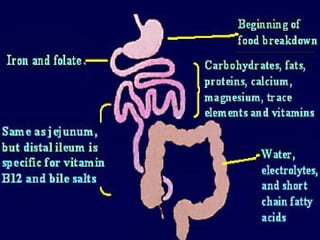
Contd Increasing the time of contact of nutrient with absorptive small bowel mucosa. 3. Healthy small bowel has more absorptive capacity than diseased small bowel. 4.Resection of jejunum is better tolerated than ileum because ileum is associated with bile salt and vitamin B12 absorption.
Eitiology Adults:- Crohn Disease acute mesenteric ischemia Trauma Malignancy TB
Peadiatrics Intestinal Atresia Volvulus Necrotizing enterocolitis Meconium peritonitis
Functional Chronic intestinal obstruction Refractory sprue Radiation enteritis Congenital villus atrophy
Pathophysiology
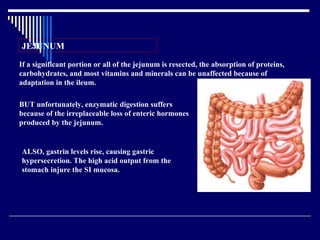
If a significant portion or all of the jejunum is resected, the absorption of proteins, carbohydrates, and most vitamins and minerals can be unaffected because of adaptation in the ileum.   BUT unfortunately, enzymatic digestion suffers because of the irreplaceable loss of enteric hormones produced by the jejunum.   ALSO, gastrin levels rise, causing gastric hypersecretion. The high acid output from the stomach injure the SI mucosa.   JEJUNUM
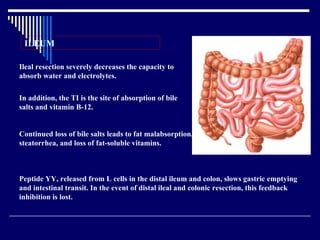
In addition, the TI is the site of absorption of bile salts and vitamin B-12.   Continued loss of bile salts leads to fat malabsorption, steatorrhea, and loss of fat-soluble vitamins.   Ileal resection severely decreases the capacity to absorb water and electrolytes.   ILEUM   Peptide YY, released from L cells in the distal ileum and colon, slows gastric emptying and intestinal transit. In the event of distal ileal and colonic resection, this feedback inhibition is lost.
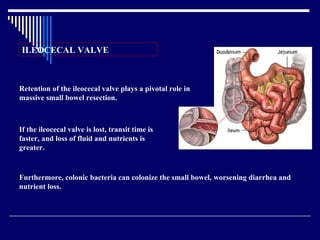
Retention of the ileocecal valve plays a pivotal role in massive small bowel resection.   If the ileocecal valve is lost, transit time is faster, and loss of fluid and nutrients is greater.   Furthermore, colonic bacteria can colonize the small bowel, worsening diarrhea and nutrient loss.   ILEOCECAL VALVE
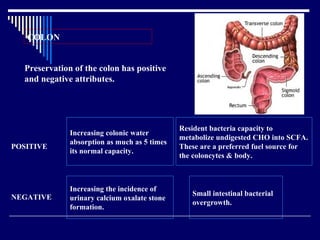
Preservation of the colon has positive and negative attributes.   Increasing colonic water absorption as much as 5 times its normal capacity.   Resident bacteria capacity to metabolize undigested CHO into SCFA. These are a preferred fuel source for the coloncytes & body. Increasing the incidence of urinary calcium oxalate stone formation.   Small intestinal bacterial overgrowth.   COLON NEGATIVE POSITIVE
Phases Of SBS Acute Phase Starts immediately after bowl resection and lasts for 1-3 months. ostomy output greater than 5 liters per day Life threatning dehydration and electrolyte imbalances. Extremely poor absorption of all nutrients Development of hypergastrenemia and hyperbilirubinemia.
Adaptation phase Begins 48 hours after resection and last up to 1-2 years. 90% adaptation occurs during this phase Enterocyte, villus hyperplasia and increased crypt depth ocurrs resulting in increased absorptive area. Luminal nutrition is essential for adaptation and should be initiated as early as possible. Parenteral nutrition is essential through out this period.
Maintenance phase  Absorptive capacity is maximum during this phase  Nutritional metabolic homeostasis can be achieved with oral feeding.
Clinical Features History of several intestinal resections as in crohn disease or major vascular event like midgut volvulus or embulus to superior mesenteric vessel. Diarrhea is almost constant finding (with or without steatorrhea) Significant wt loss, lethargy and fatigue Dehydration ,protein calorie malnutrition, and loss of critical vitamins and minerals
Physical examination Patients with significant protein and calorie malnutrition present with temporal wasting, loss of digital muscle mass and edema. Skin is dry and flaky. In children poor growth occurs. Signs of vitamin and mineral deficiency appear.
Management Fluid and electrolyte balance Nutrition Most patients require TPN at least initially. Enteral feeding should be gradually introduced once ileus has resolved. Macro and micronutrients  Drugs ; PPI,  Antimotilty agents
Medication malabsorption could occur, therefore, increased doses of orally administered medication is required.
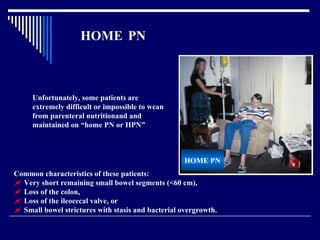
HOME  PN Unfortunately, some patients are extremely difficult or impossible to wean from parenteral nutritionand and maintained on “home PN or HPN”   HOME PN Common characteristics of these patients:     Very short remaining small bowel segments (<60 cm),    Loss of the colon,    Loss of the ileocecal valve, or    Small bowel strictures with stasis and bacterial overgrowth.
Phamacological bowel compensation For enhancing bowel adaptation Growth hormone at 0.03-0.13 S/c for 4weeks Parenteral or enteral glutamine High carbohydrate diet 55-60% of total calories
Surgical Therapy Non Transplant Surgery Among patients with stomas, intestinal continuity should be restored whenever possible to capitalize on absorptive capacity of all residual gut. Non transplant surgeries are designed to improve the absorption ,associated with unclear efficacy and substantial morbidity and therefore should not be applied routinley.
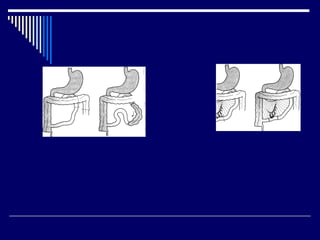
Contd Goal of these operations is to slow intestinal transit time and increasing intestinal length.  Operations for slow transit time include segmental reversal of small bowel, interposition segment of colon between segments of small intestine, construction of small intestinal valves.
 
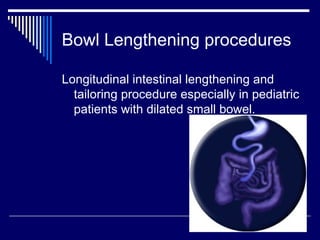
Bowl Lengthening procedures Longitudinal intestinal lengthening and tailoring procedure especially in pediatric patients with dilated small bowel.
Serial Transverse Enteroplasty (STEP)  NEW SURGERY  described just three years ago, can both lengthen and taper the small intestine in some patients.   During the procedure, a short segment of the intestine is carefully cut and reshaped into a longer, thinner segment. The longer, thinner intestine is thought to function more efficiently and lead to better absorption of food.
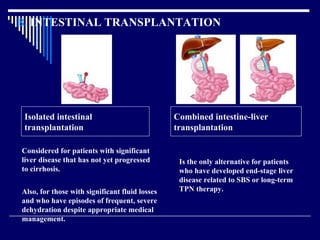
Combined intestine-liver transplantation Isolated intestinal transplantation Is the only alternative for patients who have developed end-stage liver disease related to SBS or long-term TPN therapy.   Considered for patients with significant liver disease that has not yet progressed to cirrhosis.  B.  INTESTINAL TRANSPLANTATION Also, for those with significant fluid losses and who have episodes of frequent, severe dehydration despite appropriate medical management.
THANK YOU

Short Bowel Syndrome

  • 1.
    Short Bowel SyndromeBy Doctor Saleem
  • 2.
    Definition Shortbowel syndrome is defined as presence of less than 200 cm of residual small bowel in adults. It is clinically defined by Malabsorption, diarrhea, steatorrhea, Fluid and electrolyte disturbances and malnutrition. Final etiological factor is the functional or anatomic loss of extensive segments of small intestine so that absorptive capacity is severely compromised.
  • 3.
    Contd Anatomically TPNdependence persists in pt who have 100 cm of residual small bowl without functioning colon. And 60cm with functioning colon. Among infants weaning from TPN has been achieved even with 10cm of residual small gut.
  • 4.
    Factors affecting TPNdependence In addition to residual small bowel length other factors are:- Presence of colon because it can absorb large amount of fluid and electrolytes. And absorption of short chain fatty acids. 2. Intact ileocecal valve It delays the transit of chyme from small intestine to colon.Thereby
  • 5.
    Contd Increasing thetime of contact of nutrient with absorptive small bowel mucosa. 3. Healthy small bowel has more absorptive capacity than diseased small bowel. 4.Resection of jejunum is better tolerated than ileum because ileum is associated with bile salt and vitamin B12 absorption.
  • 6.
    Eitiology Adults:- CrohnDisease acute mesenteric ischemia Trauma Malignancy TB
  • 7.
    Peadiatrics Intestinal AtresiaVolvulus Necrotizing enterocolitis Meconium peritonitis
  • 8.
    Functional Chronic intestinalobstruction Refractory sprue Radiation enteritis Congenital villus atrophy
  • 9.
  • 10.
    If a significantportion or all of the jejunum is resected, the absorption of proteins, carbohydrates, and most vitamins and minerals can be unaffected because of adaptation in the ileum. BUT unfortunately, enzymatic digestion suffers because of the irreplaceable loss of enteric hormones produced by the jejunum. ALSO, gastrin levels rise, causing gastric hypersecretion. The high acid output from the stomach injure the SI mucosa. JEJUNUM
  • 11.
    In addition, theTI is the site of absorption of bile salts and vitamin B-12. Continued loss of bile salts leads to fat malabsorption, steatorrhea, and loss of fat-soluble vitamins. Ileal resection severely decreases the capacity to absorb water and electrolytes. ILEUM Peptide YY, released from L cells in the distal ileum and colon, slows gastric emptying and intestinal transit. In the event of distal ileal and colonic resection, this feedback inhibition is lost.
  • 12.
    Retention of theileocecal valve plays a pivotal role in massive small bowel resection. If the ileocecal valve is lost, transit time is faster, and loss of fluid and nutrients is greater. Furthermore, colonic bacteria can colonize the small bowel, worsening diarrhea and nutrient loss. ILEOCECAL VALVE
  • 13.
    Preservation of thecolon has positive and negative attributes. Increasing colonic water absorption as much as 5 times its normal capacity. Resident bacteria capacity to metabolize undigested CHO into SCFA. These are a preferred fuel source for the coloncytes & body. Increasing the incidence of urinary calcium oxalate stone formation. Small intestinal bacterial overgrowth. COLON NEGATIVE POSITIVE
  • 14.
    Phases Of SBSAcute Phase Starts immediately after bowl resection and lasts for 1-3 months. ostomy output greater than 5 liters per day Life threatning dehydration and electrolyte imbalances. Extremely poor absorption of all nutrients Development of hypergastrenemia and hyperbilirubinemia.
  • 15.
    Adaptation phase Begins48 hours after resection and last up to 1-2 years. 90% adaptation occurs during this phase Enterocyte, villus hyperplasia and increased crypt depth ocurrs resulting in increased absorptive area. Luminal nutrition is essential for adaptation and should be initiated as early as possible. Parenteral nutrition is essential through out this period.
  • 16.
    Maintenance phase Absorptive capacity is maximum during this phase Nutritional metabolic homeostasis can be achieved with oral feeding.
  • 17.
    Clinical Features Historyof several intestinal resections as in crohn disease or major vascular event like midgut volvulus or embulus to superior mesenteric vessel. Diarrhea is almost constant finding (with or without steatorrhea) Significant wt loss, lethargy and fatigue Dehydration ,protein calorie malnutrition, and loss of critical vitamins and minerals
  • 18.
    Physical examination Patientswith significant protein and calorie malnutrition present with temporal wasting, loss of digital muscle mass and edema. Skin is dry and flaky. In children poor growth occurs. Signs of vitamin and mineral deficiency appear.
  • 19.
    Management Fluid andelectrolyte balance Nutrition Most patients require TPN at least initially. Enteral feeding should be gradually introduced once ileus has resolved. Macro and micronutrients Drugs ; PPI, Antimotilty agents
  • 20.
    Medication malabsorption couldoccur, therefore, increased doses of orally administered medication is required.
  • 21.
    HOME PNUnfortunately, some patients are extremely difficult or impossible to wean from parenteral nutritionand and maintained on “home PN or HPN” HOME PN Common characteristics of these patients:  Very short remaining small bowel segments (<60 cm),  Loss of the colon,  Loss of the ileocecal valve, or  Small bowel strictures with stasis and bacterial overgrowth.
  • 22.
    Phamacological bowel compensationFor enhancing bowel adaptation Growth hormone at 0.03-0.13 S/c for 4weeks Parenteral or enteral glutamine High carbohydrate diet 55-60% of total calories
  • 23.
    Surgical Therapy NonTransplant Surgery Among patients with stomas, intestinal continuity should be restored whenever possible to capitalize on absorptive capacity of all residual gut. Non transplant surgeries are designed to improve the absorption ,associated with unclear efficacy and substantial morbidity and therefore should not be applied routinley.
  • 24.
    Contd Goal ofthese operations is to slow intestinal transit time and increasing intestinal length. Operations for slow transit time include segmental reversal of small bowel, interposition segment of colon between segments of small intestine, construction of small intestinal valves.
  • 25.
  • 26.
    Bowl Lengthening proceduresLongitudinal intestinal lengthening and tailoring procedure especially in pediatric patients with dilated small bowel.
  • 27.
    Serial Transverse Enteroplasty(STEP) NEW SURGERY described just three years ago, can both lengthen and taper the small intestine in some patients. During the procedure, a short segment of the intestine is carefully cut and reshaped into a longer, thinner segment. The longer, thinner intestine is thought to function more efficiently and lead to better absorption of food.
  • 28.
    Combined intestine-liver transplantationIsolated intestinal transplantation Is the only alternative for patients who have developed end-stage liver disease related to SBS or long-term TPN therapy. Considered for patients with significant liver disease that has not yet progressed to cirrhosis. B. INTESTINAL TRANSPLANTATION Also, for those with significant fluid losses and who have episodes of frequent, severe dehydration despite appropriate medical management.
  • 29.