Introduction to Human
Anatomy
.
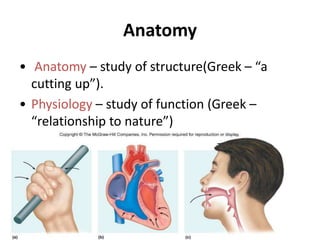
Anatomy
• Anatomy – study of structure(Greek – “a
cutting up”).
• Physiology – study of function (Greek –
“relationship to nature”)
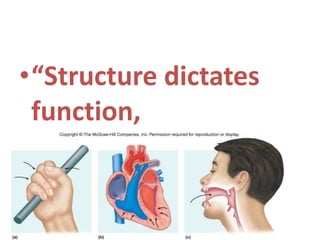
•“Structure dictates
function,
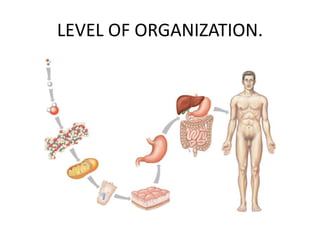
LEVEL OF ORGANIZATION.
Definition of anatomy
• Study of structure.
• The study of anatomy is divided into
(i)Macroscopic anatomy-gross
(ii)Microscopic anatomy
Definition of anatomy.
• Gross anatomy is the study of structures that
can, when suitably presented or dissected, be
seen by unaided vision with the naked eye.
• Microscopic anatomy is the study of
structures on a microscopic scale, including
histology (the study of tissues) and cytology
(the study of cells).
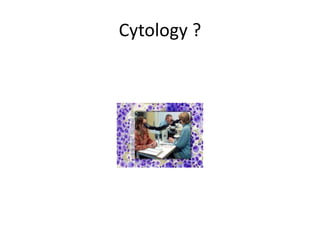
Cytology ?
Cytology ?
• Cytology, the study of cells as
fundamental units of living
things. The earliest phase of
cytology began with the English
scientist Robert Hooke’s
microscopic investigations of cork
in 1665.
Histology
• Is the study of the microscopic anatomy of
cells and tissues of plants and animals.
• It is commonly performed by examining cells
and tissues by sectioning and staining,
followed by examination under a light
microscope or electron microscope.
Cell biology
• Is a scientific discipline that studies cells –
their physiological properties, their structure,
the organelles they contain, interactions with
their environment, their life cycle, division and
death.
• This is done both on a microscopic and
molecular level.
Cell biology
• Cell biology research encompasses both the
great diversity of single-celled organisms like
bacteria and protozoa, as well as the many
specialized cells in multicellular organisms
such as humans, plants, and sponges.
• The cell is the basic structural, functional and
biological unit of all known living organisms.
Cells are the smallest unit of life that is
classified as a living things.
Summary
• Cell
• Tissue
• Organ
• Systems
• Organism
ANATOMY+PHYSIOLOGY
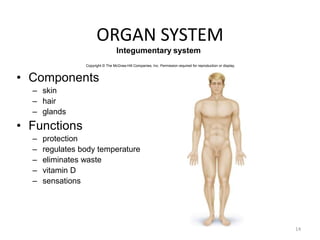
ORGAN SYSTEM
14
Integumentary system
Copyright © The McGraw-Hill Companies, Inc. Permission required for reproduction or display.
• Components
– skin
– hair
– glands
• Functions
– protection
– regulates body temperature
– eliminates waste
– vitamin D
– sensations
Organ Systems
15
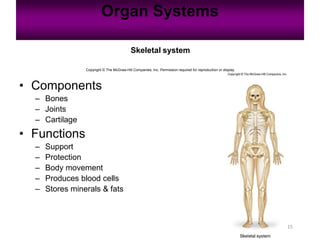
Skeletal system
Copyright © The McGraw-Hill Companies, Inc. Permission required for reproduction or display.
• Components
– Bones
– Joints
– Cartilage
• Functions
– Support
– Protection
– Body movement
– Produces blood cells
– Stores minerals & fats
16
Organ Systems
Copyright © The McGraw-Hill Companies, Inc. Permission required for reproduction or display.
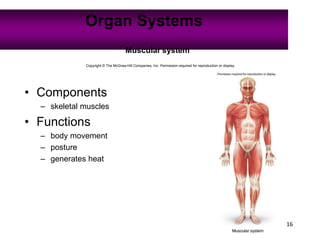
Muscular system
• Components
– skeletal muscles
• Functions
– body movement
– posture
– generates heat
Organ Systems
17
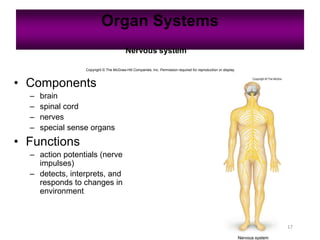
Nervous system
Copyright © The McGraw-Hill Companies, Inc. Permission required for reproduction or display.
• Components
– brain
– spinal cord
– nerves
– special sense organs
• Functions
– action potentials (nerve
impulses)
– detects, interprets, and
responds to changes in
environment
18
Organ Systems
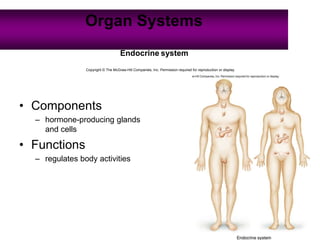
Endocrine system
Copyright © The McGraw-Hill Companies, Inc. Permission required for reproduction or display.
• Components
– hormone-producing glands
and cells
• Functions
– regulates body activities
Organ Systems
19
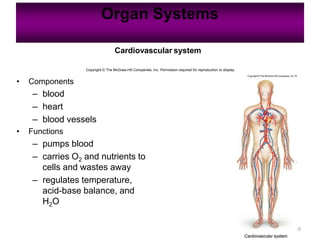
Cardiovascular system
Copyright © The McGraw-Hill Companies, Inc. Permission required for reproduction or display.
• Components
– blood
– heart
– blood vessels
• Functions
– pumps blood
– carries O2 and nutrients to
cells and wastes away
– regulates temperature,
acid-base balance, and
H2O
20
Organ Systems
Copyright © The McGraw-Hill Companies, Inc. Permission required for reproduction or display.
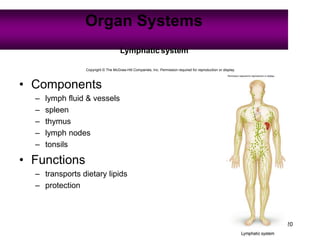
Lymphatic system
• Components
– lymph fluid & vessels
– spleen
– thymus
– lymph nodes
– tonsils
• Functions
– transports dietary lipids
– protection
Organ Systems
21
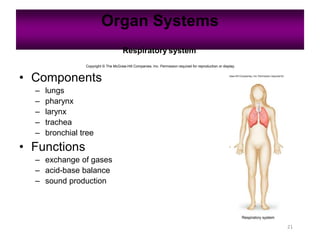
Respiratory system
Copyright © The McGraw-Hill Companies, Inc. Permission required for reproduction or display.
• Components
– lungs
– pharynx
– larynx
– trachea
– bronchial tree
• Functions
– exchange of gases
– acid-base balance
– sound production
22
Organ Systems
Copyright © The McGraw-Hill Companies, Inc. Permission required for reproduction or display.
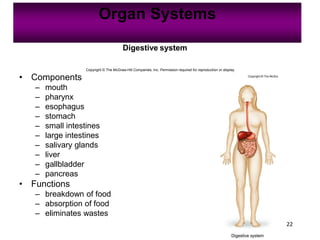
Digestive system
• Components
– mouth
– pharynx
– esophagus
– stomach
– small intestines
– large intestines
– salivary glands
– liver
– gallbladder
– pancreas
• Functions
– breakdown of food
– absorption of food
– eliminates wastes
23
Organ Systems
Copyright © The McGraw-Hill Companies, Inc. Permission required for reproduction or display.
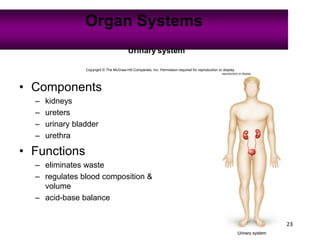
Urinary system
• Components
– kidneys
– ureters
– urinary bladder
– urethra
• Functions
– eliminates waste
– regulates blood composition &
volume
– acid-base balance
Organ Systems
24
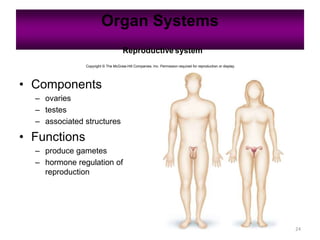
Reproductive system
Copyright © The McGraw-Hill Companies, Inc. Permission required for reproduction or display.
• Components
– ovaries
– testes
– associated structures
• Functions
– produce gametes
– hormone regulation of
reproduction
NEXT SAGA
DIGESTIVE AND RESPIRATORY SYSTEM
• Digestive system(alimentary tract and
accessory organs)
• Basic structures of the elementary canal
(mouth, salivary glands, pharynx, oesophagus,
stomach, small intestine, large
intestine(colon),rectum and anal cal).

1.introduction to human anatomy

  • 1.
  • 2.
    Anatomy • Anatomy –study of structure(Greek – “a cutting up”). • Physiology – study of function (Greek – “relationship to nature”)
  • 3.
  • 4.
  • 5.
    Definition of anatomy •Study of structure. • The study of anatomy is divided into (i)Macroscopic anatomy-gross (ii)Microscopic anatomy
  • 6.
    Definition of anatomy. •Gross anatomy is the study of structures that can, when suitably presented or dissected, be seen by unaided vision with the naked eye. • Microscopic anatomy is the study of structures on a microscopic scale, including histology (the study of tissues) and cytology (the study of cells).
  • 7.
  • 8.
    Cytology ? • Cytology,the study of cells as fundamental units of living things. The earliest phase of cytology began with the English scientist Robert Hooke’s microscopic investigations of cork in 1665.
  • 9.
    Histology • Is thestudy of the microscopic anatomy of cells and tissues of plants and animals. • It is commonly performed by examining cells and tissues by sectioning and staining, followed by examination under a light microscope or electron microscope.
  • 10.
    Cell biology • Isa scientific discipline that studies cells – their physiological properties, their structure, the organelles they contain, interactions with their environment, their life cycle, division and death. • This is done both on a microscopic and molecular level.
  • 11.
    Cell biology • Cellbiology research encompasses both the great diversity of single-celled organisms like bacteria and protozoa, as well as the many specialized cells in multicellular organisms such as humans, plants, and sponges. • The cell is the basic structural, functional and biological unit of all known living organisms. Cells are the smallest unit of life that is classified as a living things.
  • 12.
    Summary • Cell • Tissue •Organ • Systems • Organism
  • 13.
  • 14.
    ORGAN SYSTEM 14 Integumentary system Copyright© The McGraw-Hill Companies, Inc. Permission required for reproduction or display. • Components – skin – hair – glands • Functions – protection – regulates body temperature – eliminates waste – vitamin D – sensations
  • 15.
    Organ Systems 15 Skeletal system Copyright© The McGraw-Hill Companies, Inc. Permission required for reproduction or display. • Components – Bones – Joints – Cartilage • Functions – Support – Protection – Body movement – Produces blood cells – Stores minerals & fats
  • 16.
    16 Organ Systems Copyright ©The McGraw-Hill Companies, Inc. Permission required for reproduction or display. Muscular system • Components – skeletal muscles • Functions – body movement – posture – generates heat
  • 17.
    Organ Systems 17 Nervous system Copyright© The McGraw-Hill Companies, Inc. Permission required for reproduction or display. • Components – brain – spinal cord – nerves – special sense organs • Functions – action potentials (nerve impulses) – detects, interprets, and responds to changes in environment
  • 18.
    18 Organ Systems Endocrine system Copyright© The McGraw-Hill Companies, Inc. Permission required for reproduction or display. • Components – hormone-producing glands and cells • Functions – regulates body activities
  • 19.
    Organ Systems 19 Cardiovascular system Copyright© The McGraw-Hill Companies, Inc. Permission required for reproduction or display. • Components – blood – heart – blood vessels • Functions – pumps blood – carries O2 and nutrients to cells and wastes away – regulates temperature, acid-base balance, and H2O
  • 20.
    20 Organ Systems Copyright ©The McGraw-Hill Companies, Inc. Permission required for reproduction or display. Lymphatic system • Components – lymph fluid & vessels – spleen – thymus – lymph nodes – tonsils • Functions – transports dietary lipids – protection
  • 21.
    Organ Systems 21 Respiratory system Copyright© The McGraw-Hill Companies, Inc. Permission required for reproduction or display. • Components – lungs – pharynx – larynx – trachea – bronchial tree • Functions – exchange of gases – acid-base balance – sound production
  • 22.
    22 Organ Systems Copyright ©The McGraw-Hill Companies, Inc. Permission required for reproduction or display. Digestive system • Components – mouth – pharynx – esophagus – stomach – small intestines – large intestines – salivary glands – liver – gallbladder – pancreas • Functions – breakdown of food – absorption of food – eliminates wastes
  • 23.
    23 Organ Systems Copyright ©The McGraw-Hill Companies, Inc. Permission required for reproduction or display. Urinary system • Components – kidneys – ureters – urinary bladder – urethra • Functions – eliminates waste – regulates blood composition & volume – acid-base balance
  • 24.
    Organ Systems 24 Reproductive system Copyright© The McGraw-Hill Companies, Inc. Permission required for reproduction or display. • Components – ovaries – testes – associated structures • Functions – produce gametes – hormone regulation of reproduction
  • 25.
    NEXT SAGA DIGESTIVE ANDRESPIRATORY SYSTEM • Digestive system(alimentary tract and accessory organs) • Basic structures of the elementary canal (mouth, salivary glands, pharynx, oesophagus, stomach, small intestine, large intestine(colon),rectum and anal cal).