Understanding Verilog Blocking
and Non
and Non-
-blocking Assignments
blocking Assignments
International Cadence
User Group Conference
September 11, 1996
September 11, 1996
presented by
presented by
Stuart Sutherland
Stuart Sutherland
Sutherland HDL Consulting
About the Presenter
About the Presenter
Stuart Sutherland has over 8 years of experience using Verilog w
Stuart Sutherland has over 8 years of experience using Verilog with a variety of software tools. He
ith a variety of software tools. He
holds a BS degree in Computer Science, with an emphasis on Elect
holds a BS degree in Computer Science, with an emphasis on Electronic Engineering, and has
ronic Engineering, and has
worked as a design engineer in the defense industry, and as an A
worked as a design engineer in the defense industry, and as an Applications Engineer for Gateway
pplications Engineer for Gateway
Design Automation (the originator of Verilog) and Cadence Design
Design Automation (the originator of Verilog) and Cadence Design Systems. Mr. Sutherland has
Systems. Mr. Sutherland has
been providing Verilog HDL consulting services since 1991. As a
been providing Verilog HDL consulting services since 1991. As a consultant, he has been actively
consultant, he has been actively
involved in using the Verilog
involved in using the Verilog langiage
langiage with a many different of software tools for the design of
with a many different of software tools for the design of
ASICs
ASICs and systems. He is a member of the IEEE 1364 standards committ
and systems. He is a member of the IEEE 1364 standards committee and has been involved
ee and has been involved
in the specification and testing of Verilog simulation products
in the specification and testing of Verilog simulation products from several EDA vendors, including
from several EDA vendors, including
the Intergraph
the Intergraph-
-VeriBest
VeriBest VeriBest
VeriBest simulator, the Mentor
simulator, the Mentor QuickHDL
QuickHDL simulator, and the Frontline
simulator, and the Frontline
CycleDrive
CycleDrive cycle based simulator. In addition to Verilog design
cycle based simulator. In addition to Verilog design consutlting
consutlting, Mr. Sutherland
, Mr. Sutherland
provides expert on
provides expert on-
-site Verilog training on the Verilog HDL language and
site Verilog training on the Verilog HDL language and Programing
Programing Language
Language
Interface. Mr. Sutherland is the author and publisher of the po
Interface. Mr. Sutherland is the author and publisher of the popular
pular “Verilog IEEE 1364 Quick
“Verilog IEEE 1364 Quick
Reference Guide”
Reference Guide” and the
and the “Verilog IEEE 1364 PLI Quick Reference Guide”
“Verilog IEEE 1364 PLI Quick Reference Guide”.
.
Please
Please conact
conact Mr. Sutherland with any questions about this material!
Mr. Sutherland with any questions about this material!
phone: (503) 692
phone: (503) 692-
-0898
0898
fax: (503) 692
fax: (503) 692-
-1512
1512
e
e-
-mail:
mail: stuart
stuart@
@sutherland
sutherland.com
.com
Sutherland HDL Consulting
Verilog Consulting and Training Services
22805 SW 92
22805 SW 92nd
nd
Place
Place
Tualatin, OR 97062 USA
The material in this presentation is copyrighted by Sutherland H
The material in this presentation is copyrighted by Sutherland HDL Consulting,
DL Consulting,
Tualatin, Oregon. The presentation is printed with permission a
Tualatin, Oregon. The presentation is printed with permission as part of the
s part of the
proceedings of the 1996 International Cadence User Group Confere
proceedings of the 1996 International Cadence User Group Conference. All rights
nce. All rights
are reserved. No material from this presentation may be duplica
are reserved. No material from this presentation may be duplicated or transmitted by
ted or transmitted by
any means or in any form without the express written permission
any means or in any form without the express written permission of Sutherland HDL
of Sutherland HDL
Consulting.
Consulting.
copyright notice
copyright notice
Sutherland HDL Consulting
22805 SW 92
22805 SW 92
nd
nd
Place
Place
Tualatin, OR 97062 USA
phone: (503) 692
phone: (503) 692-
-0898
0898
fax: (503) 692
fax: (503) 692-
-1512
1512
e
e-
-mail: info@
mail: info@sutherland
sutherland.com
.com
©
©1996
1996
4
4
Sutherland
Sutherland
Sutherland
H
H
H
D
D
D L
L
L
Objectives
Objectives
Objectives
➤
➤ The primary objective is to understand:
The primary objective is to understand:
What type of hardware is represented
by blocking and non
by blocking and non-
-blocking
blocking
assignments?
assignments?
➤
➤ The material presented is a subset of an advanced Verilog
The material presented is a subset of an advanced Verilog
HDL training course
HDL training course
5
5
Sutherland
Sutherland
Sutherland
H
H
H
D
D
D L
L
L
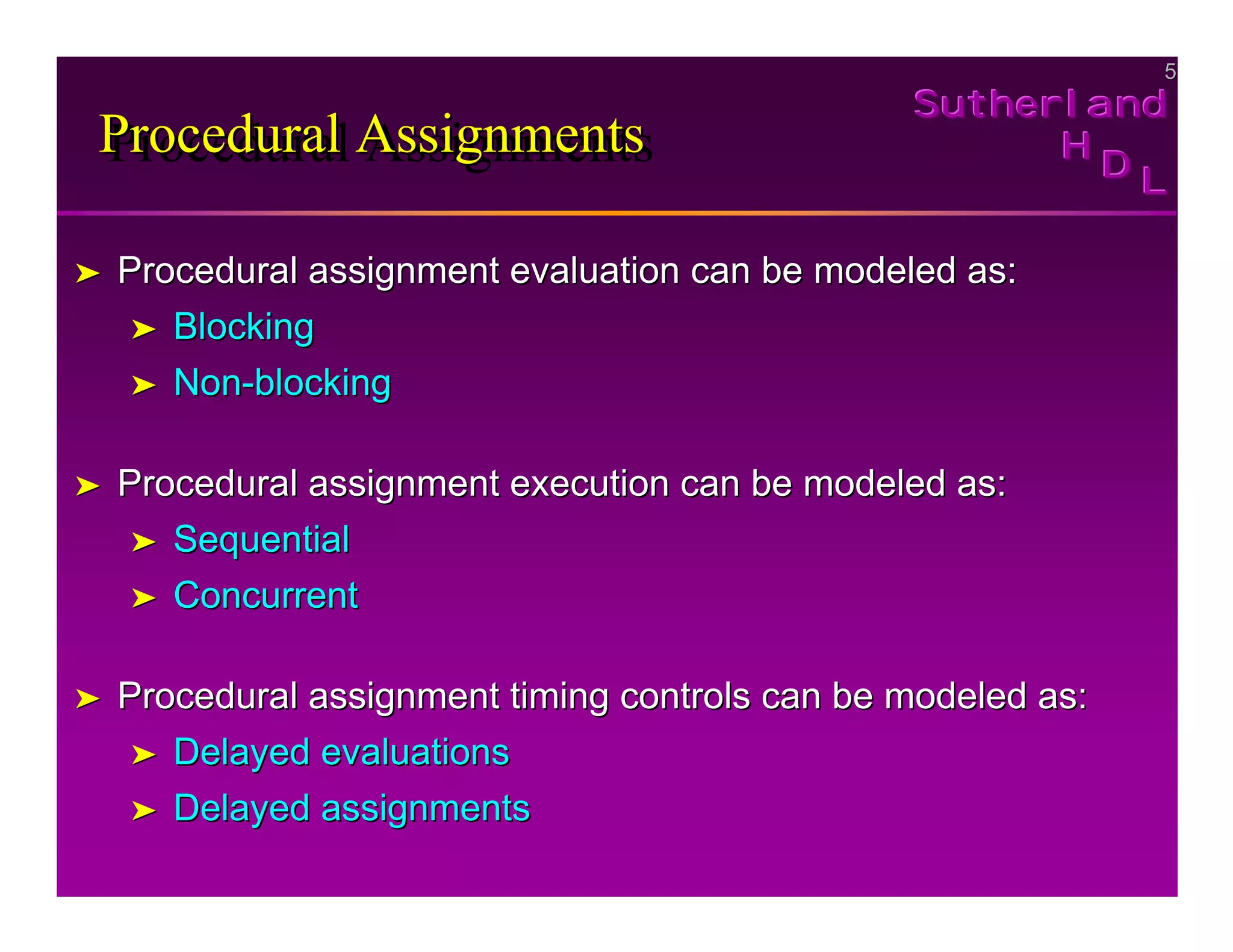
Procedural Assignments
➤
➤ Procedural assignment evaluation can be modeled as:
Procedural assignment evaluation can be modeled as:
➤
➤ Blocking
Blocking
➤
➤ Non
Non-
-blocking
blocking
➤
➤ Procedural assignment execution can be modeled as:
Procedural assignment execution can be modeled as:
➤
➤ Sequential
Sequential
➤
➤ Concurrent
Concurrent
➤
➤ Procedural assignment timing controls can be modeled as:
Procedural assignment timing controls can be modeled as:
➤
➤ Delayed evaluations
Delayed evaluations
➤
➤ Delayed assignments
Delayed assignments
6
6
Sutherland
Sutherland
Sutherland
H
H
H
D
D
D L
L
L
Blocking
Procedural Assignments
Blocking
Blocking
Procedural Assignments
➤
➤ The
The =
= token represents a
token represents a blocking
blocking procedural assignment
procedural assignment
➤
➤ Evaluated and assigned in a single step
Evaluated and assigned in a single step
➤
➤ Execution flow within the procedure is blocked until the
Execution flow within the procedure is blocked until the
assignment is completed
➤
➤ Evaluations of concurrent statements in the same time step
Evaluations of concurrent statements in the same time step
are blocked until the assignment is completed
These examples will
These examples will not
not work
work 
 Why not?
Why not?
//swap bytes in word
always @(posedge clk)
begin
word[15:8] = word[ 7:0];
word[ 7:0] = word[15:8];
end
//swap bytes in word
always @(posedge clk)
begin
word[15:8] = word[ 7:0];
word[ 7:0] = word[15:8];
end
//swap bytes in word
always @(posedge clk)
fork
word[15:8] = word[ 7:0];
word[ 7:0] = word[15:8];
join
//swap bytes in word
always @(posedge clk)
fork
word[15:8] = word[ 7:0];
word[ 7:0] = word[15:8];
join
7
7
Sutherland
Sutherland
Sutherland
H
H
H
D
D
D L
L
L
Non-Blocking
Procedural Assignments
Non
Non-
-Blocking
Blocking
Procedural Assignments
➤
➤ The
The <=
<= token represents a
token represents a non
non-
-blocking
blocking assignment
assignment
➤
➤ Evaluated and assigned in two steps:
Evaluated and assigned in two steps:
①
① The right
The right-
-hand side is evaluated immediately
hand side is evaluated immediately
②
② The assignment to the left
The assignment to the left-
-hand side is postponed until
hand side is postponed until
other evaluations in the current time step are completed
➤
➤ Execution flow within the procedure continues until a
Execution flow within the procedure continues until a
timing control is encountered (flow is not blocked)
These examples will work
These examples will work 
 Why?
Why?
//swap bytes in word
always @(posedge clk)
begin
word[15:8] <= word[ 7:0];
word[ 7:0] <= word[15:8];
end
//swap bytes in word
always @(posedge clk)
begin
word[15:8] <= word[ 7:0];
word[ 7:0] <= word[15:8];
end
//swap bytes in word
always @(posedge clk)
fork
word[15:8] <= word[ 7:0];
word[ 7:0] <= word[15:8];
join
//swap bytes in word
always @(posedge clk)
fork
word[15:8] <= word[ 7:0];
word[ 7:0] <= word[15:8];
join
8
8
Sutherland
Sutherland
Sutherland
H
H
H
D
D
D L
L
L
Representing
Simulation Time as Queues
Representing
Representing
Simulation Time as Queues
➤
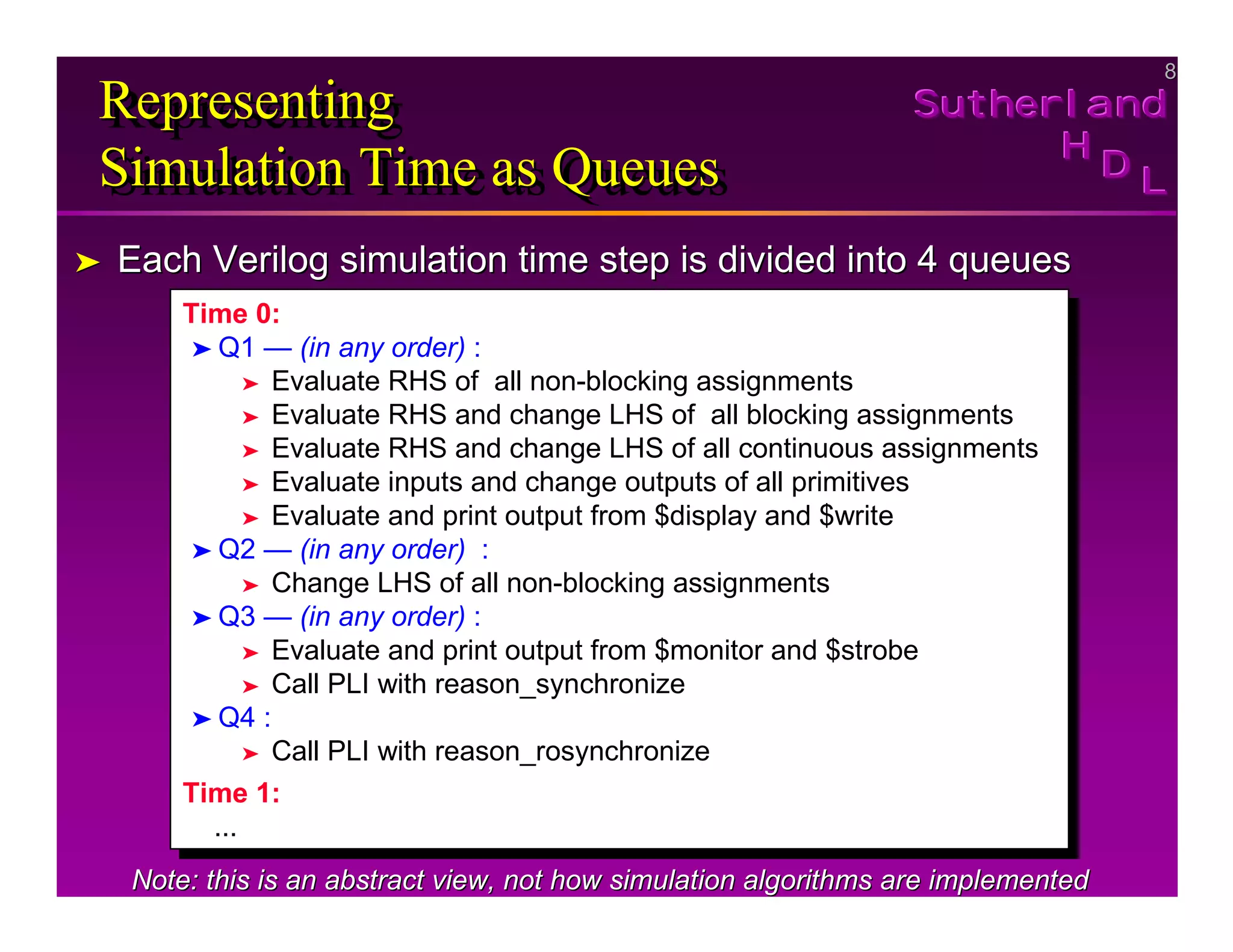
➤ Each Verilog simulation time step is divided into 4 queues
Each Verilog simulation time step is divided into 4 queues
Note: this is an abstract view, not how simulation algorithms ar
Note: this is an abstract view, not how simulation algorithms are implemented
e implemented
Time 0:
➤ Q1 — (in any order) :
➤ Evaluate RHS of all non-blocking assignments
➤ Evaluate RHS and change LHS of all blocking assignments
➤ Evaluate RHS and change LHS of all continuous assignments
➤ Evaluate inputs and change outputs of all primitives
➤ Evaluate and print output from $display and $write
➤ Q2 — (in any order) :
➤ Change LHS of all non-blocking assignments
➤ Q3 — (in any order) :
➤ Evaluate and print output from $monitor and $strobe
➤ Call PLI with reason_synchronize
➤ Q4 :
➤ Call PLI with reason_rosynchronize
Time 1:
...
Time 0:
➤ Q1 — (in any order) :
➤ Evaluate RHS of all non-blocking assignments
➤ Evaluate RHS and change LHS of all blocking assignments
➤ Evaluate RHS and change LHS of all continuous assignments
➤ Evaluate inputs and change outputs of all primitives
➤ Evaluate and print output from $display and $write
➤ Q2 — (in any order) :
➤ Change LHS of all non-blocking assignments
➤ Q3 — (in any order) :
➤ Evaluate and print output from $monitor and $strobe
➤ Call PLI with reason_synchronize
➤ Q4 :
➤ Call PLI with reason_rosynchronize
Time 1:
...
9
9
Sutherland
Sutherland
Sutherland
H
H
H
D
D
D L
L
L
Sequential
Procedural Assignments
Sequential
Sequential
Procedural Assignments
➤
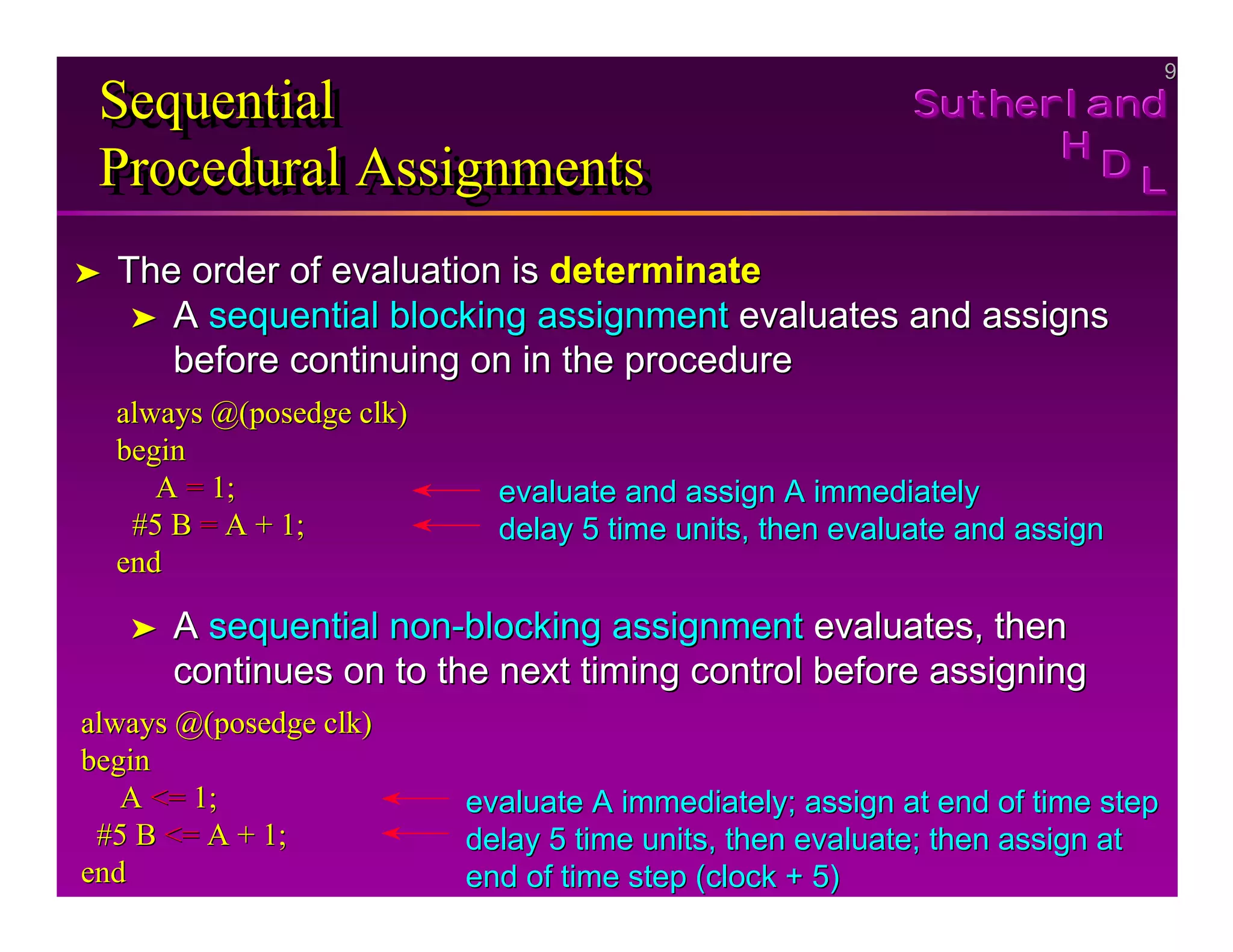
➤ The order of evaluation is
The order of evaluation is determinate
determinate
➤
➤ A
A sequential blocking assignment
sequential blocking assignment evaluates and assigns
evaluates and assigns
before continuing on in the procedure
always @(
always @(posedge clk
posedge clk)
)
begin
begin
A
A =
= 1;
1;
#5 B
#5 B =
= A + 1;
A + 1;
end
end
evaluate and assign A immediately
delay 5 time units, then evaluate and assign
➤
➤ A
A sequential non
sequential non-
-blocking assignment
blocking assignment evaluates, then
evaluates, then
continues on to the next timing control before assigning
always @(
always @(posedge clk
posedge clk)
)
begin
begin
A
A <=
<= 1;
1;
#5 B
#5 B <=
<= A + 1;
A + 1;
end
end
evaluate A immediately; assign at end of time step
delay 5 time units, then evaluate; then assign at
end of time step (clock + 5)
10
10
Sutherland
Sutherland
Sutherland
H
H
H
D
D
D L
L
L
Concurrent
Procedural Assignments
Concurrent
Concurrent
Procedural Assignments
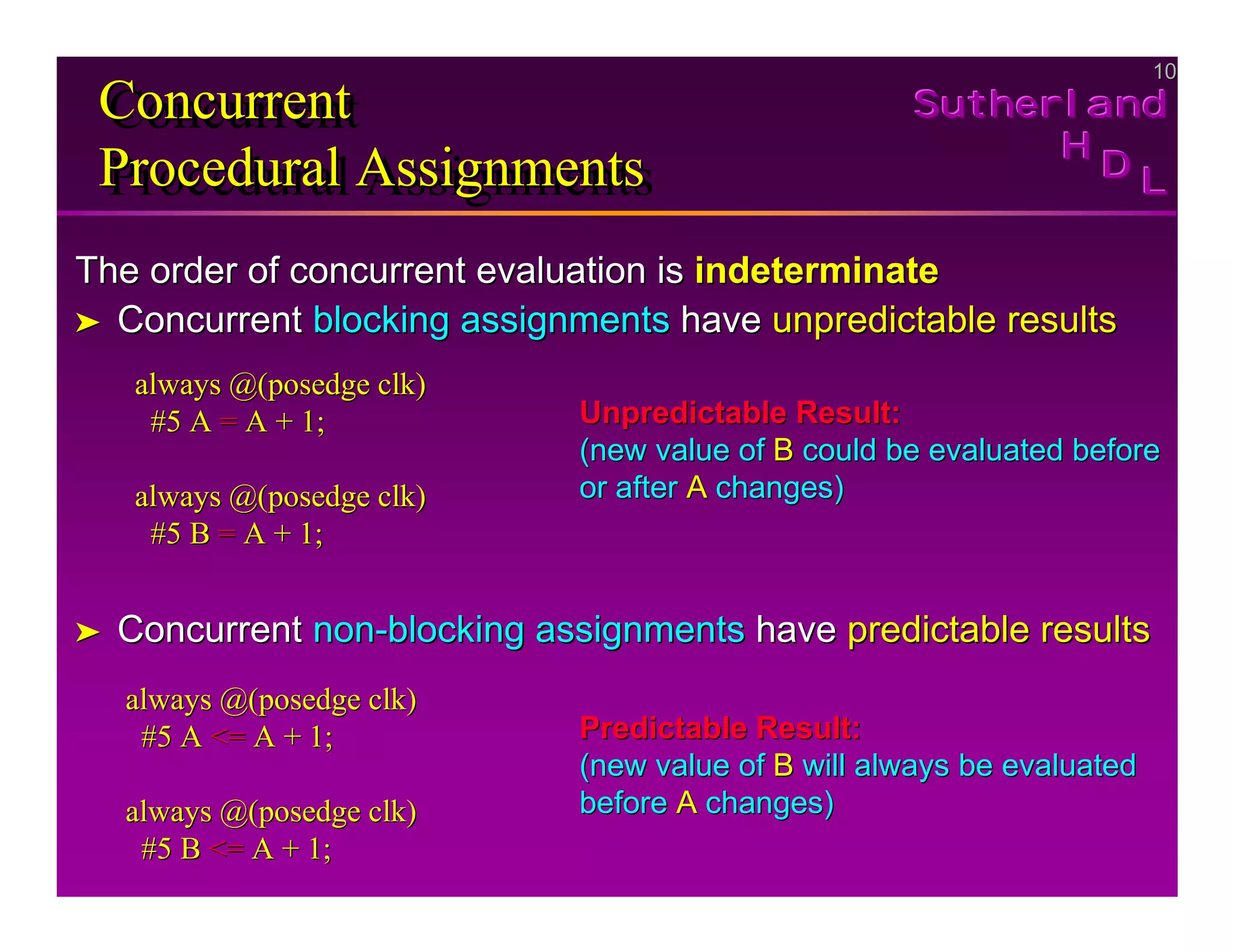
The order of concurrent evaluation is
The order of concurrent evaluation is indeterminate
indeterminate
➤
➤ Concurrent
Concurrent blocking assignments
blocking assignments have
have unpredictable results
unpredictable results
always @(
always @(posedge clk
posedge clk)
)
#5 A
#5 A =
= A + 1;
A + 1;
always @(
always @(posedge clk
posedge clk)
)
#5 B
#5 B =
= A + 1;
A + 1;
Unpredictable Result:
(new value of
(new value of B
B could be evaluated before
could be evaluated before
or after
or after A
A changes)
changes)
➤
➤ Concurrent
Concurrent non
non-
-blocking assignments
blocking assignments have
have predictable results
predictable results
always @(
always @(posedge clk
posedge clk)
)
#5 A
#5 A <=
<= A + 1;
A + 1;
always @(
always @(posedge clk
posedge clk)
)
#5 B
#5 B <=
<= A + 1;
A + 1;
Predictable Result:
Predictable Result:
(new value of
(new value of B
B will always be evaluated
will always be evaluated
before
before A
A changes)
changes)
11
11
Sutherland
Sutherland
Sutherland
H
H
H
D
D
D L
L
L
Delayed Evaluation
Procedural Assignments
Delayed Evaluation
Delayed Evaluation
Procedural Assignments
➤
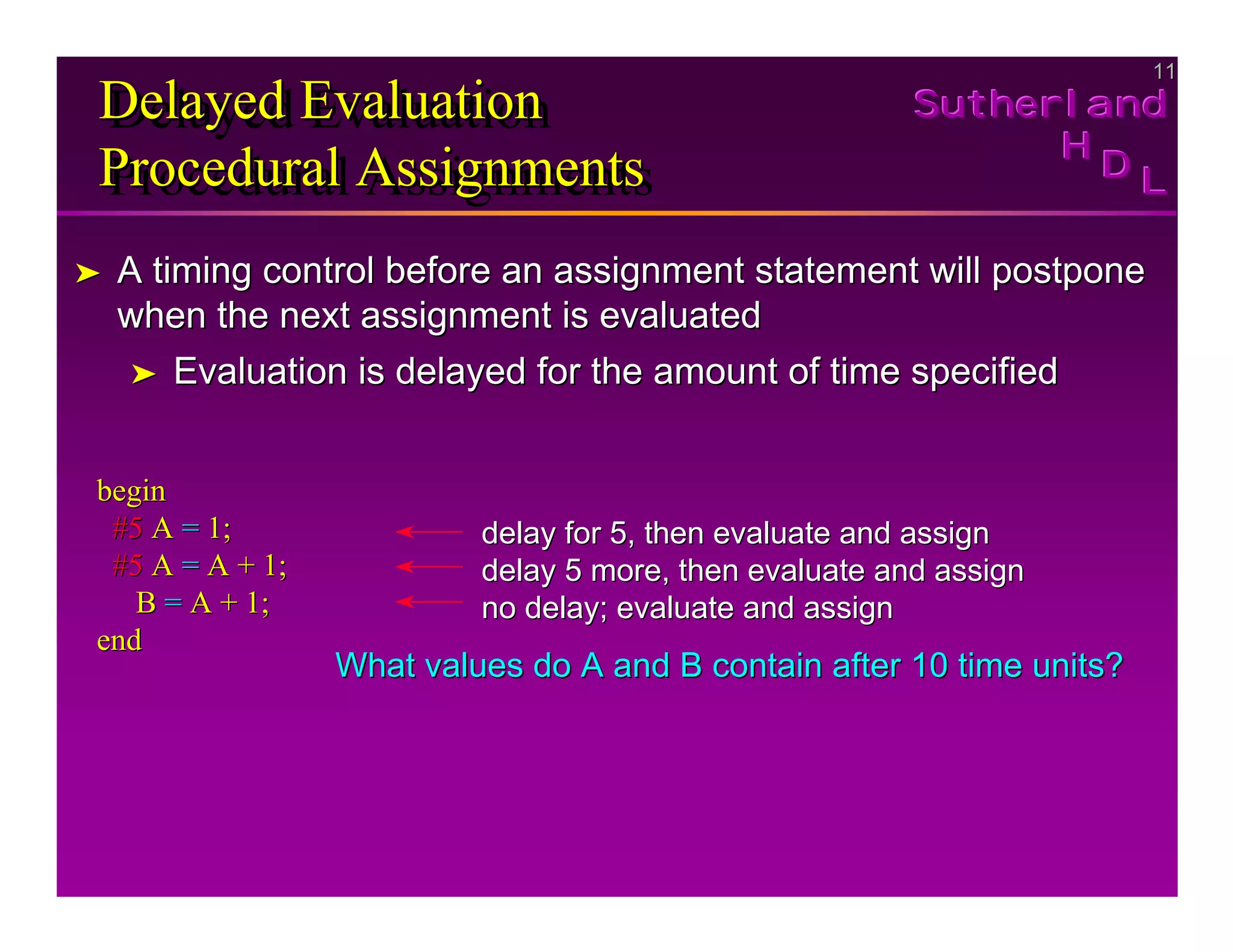
➤ A timing control before an assignment statement will postpone
A timing control before an assignment statement will postpone
when the next assignment is evaluated
➤
➤ Evaluation is delayed for the amount of time specified
Evaluation is delayed for the amount of time specified
begin
begin
#5
#5 A
A =
= 1;
1;
#5
#5 A
A =
= A + 1;
A + 1;
B
B =
= A + 1;
A + 1;
end
end
delay for 5, then evaluate and assign
delay 5 more, then evaluate and assign
no delay; evaluate and assign
What values do A and B contain after 10 time units?
12
12
Sutherland
Sutherland
Sutherland
H
H
H
D
D
D L
L
L
Delayed Assignment
Procedural Assignments
Delayed Assignment
Delayed Assignment
Procedural Assignments
➤
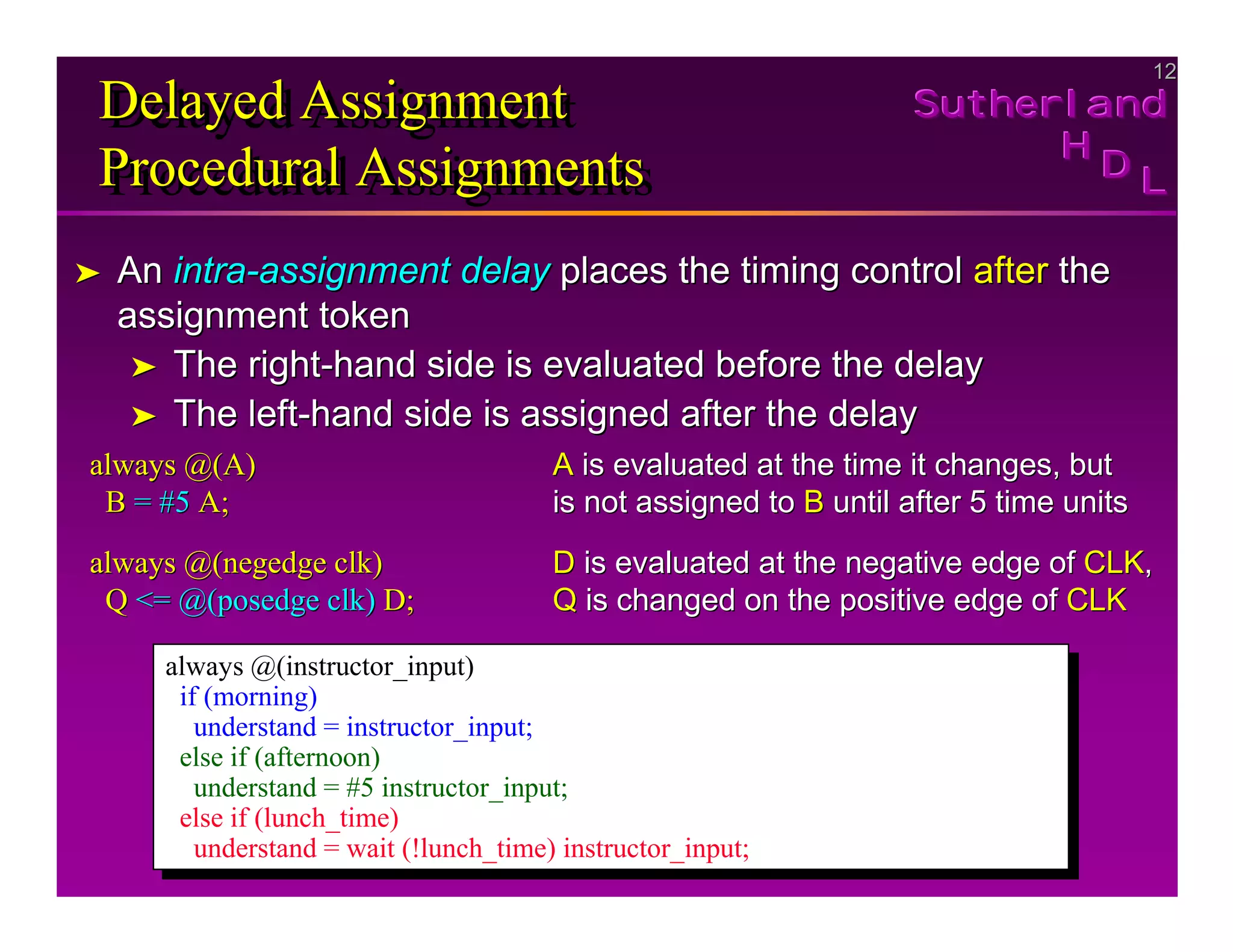
➤ An
An intra
intra-
-assignment delay
assignment delay places the timing control
places the timing control after
after the
the
assignment token
assignment token
➤
➤ The right
The right-
-hand side is evaluated before the delay
hand side is evaluated before the delay
➤
➤ The left
The left-
-hand side is assigned after the delay
hand side is assigned after the delay
always @(A)
always @(A)
B
B =
= #5
#5 A;
A;
A
A is evaluated at the time it changes, but
is evaluated at the time it changes, but
is not assigned to
is not assigned to B
B until after 5 time units
until after 5 time units
always @(
always @(negedge clk
negedge clk)
)
Q
Q <=
<= @(
@(posedge clk
posedge clk)
) D;
D;
D
D is evaluated at the negative edge of
is evaluated at the negative edge of CLK
CLK,
,
Q
Q is changed on the positive edge of
is changed on the positive edge of CLK
CLK
always @(instructor_input)
if (morning)
understand = instructor_input;
else if (afternoon)
understand = #5 instructor_input;
else if (lunch_time)
understand = wait (!lunch_time) instructor_input;
always @(instructor_input)
if (morning)
understand = instructor_input;
else if (afternoon)
understand = #5 instructor_input;
else if (lunch_time)
understand = wait (!lunch_time) instructor_input;
13
13
Sutherland
Sutherland
Sutherland
H
H
H
D
D
D L
L
L
Intra-Assignment Delays
With Repeat Loops
Intra
Intra-
-Assignment Delays
Assignment Delays
With Repeat Loops
With Repeat Loops
➤
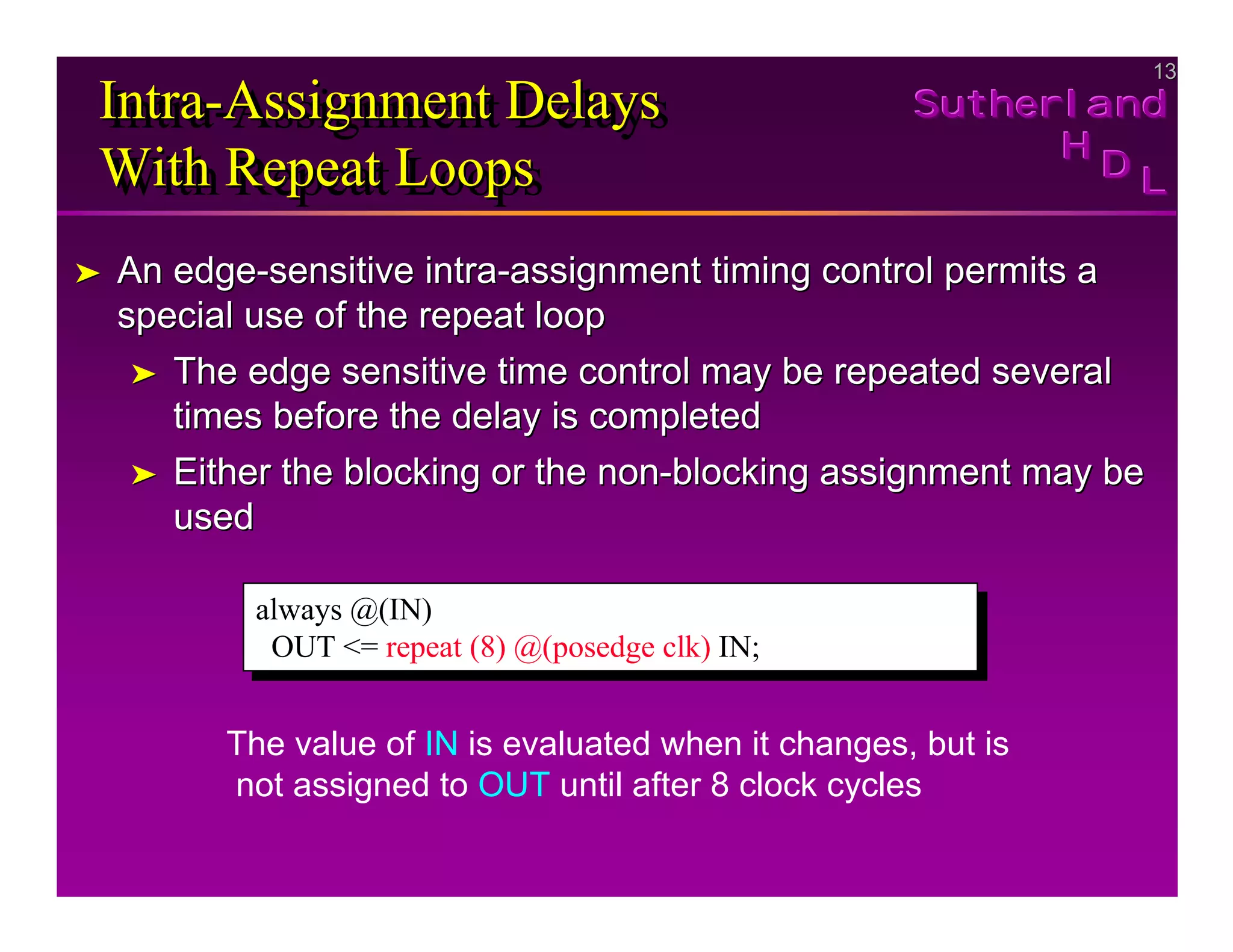
➤ An edge
An edge-
-sensitive intra
sensitive intra-
-assignment timing control permits a
assignment timing control permits a
special use of the repeat loop
➤
➤ The edge sensitive time control may be repeated several
The edge sensitive time control may be repeated several
times before the delay is completed
➤
➤ Either the blocking or the non
Either the blocking or the non-
-blocking assignment may be
blocking assignment may be
used
used
always @(IN)
OUT <= repeat (8) @(posedge clk) IN;
always @(IN)
OUT <= repeat (8) @(posedge clk) IN;
The value of IN is evaluated when it changes, but is
not assigned to OUT until after 8 clock cycles
14
14
Sutherland
Sutherland
Sutherland
H
H
H
D
D
D L
L
L
Choosing the
Correct Procedural Assignment
Choosing the
Choosing the
Correct Procedural Assignment
➤
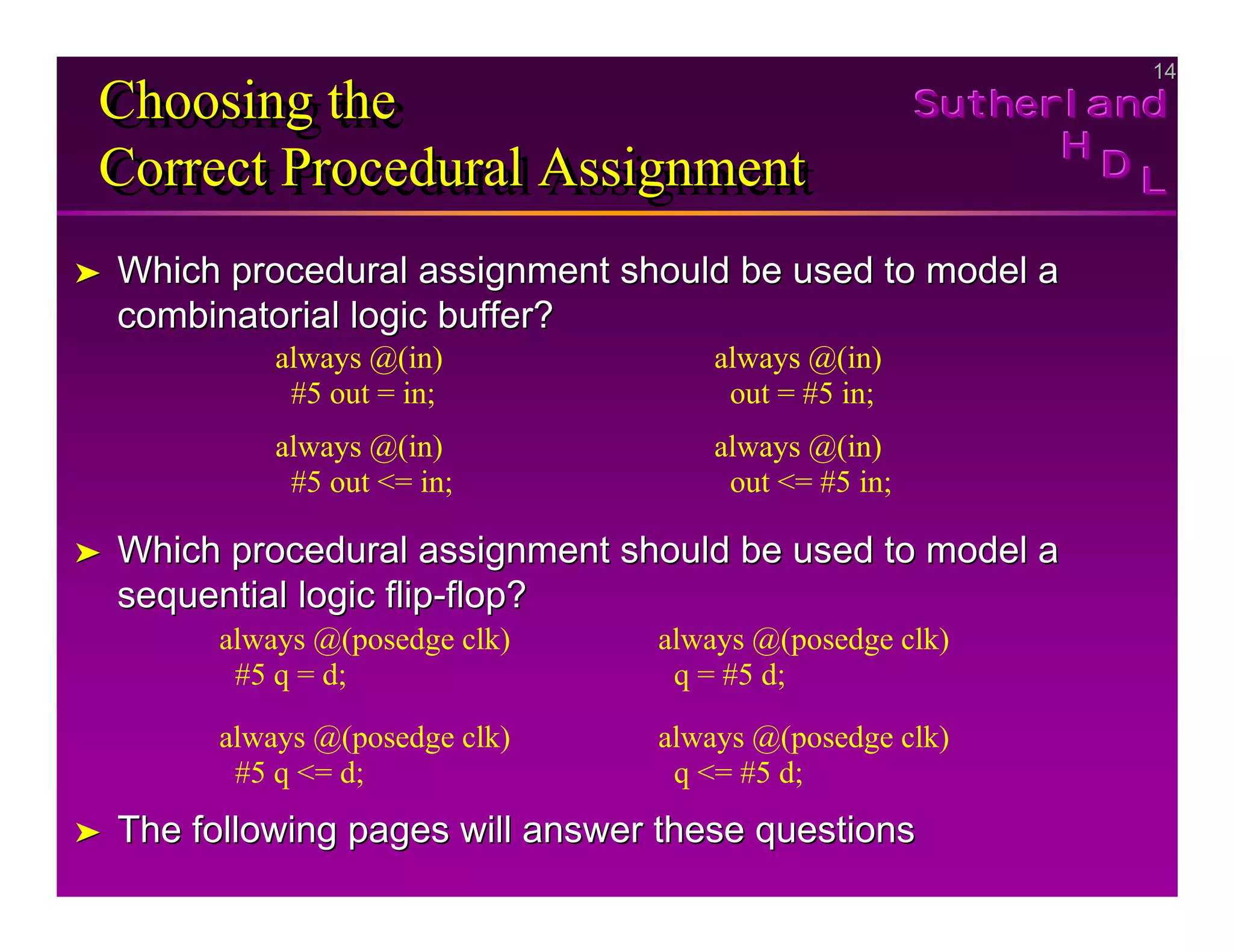
➤ Which procedural assignment should be used to model a
Which procedural assignment should be used to model a
combinatorial logic buffer?
➤
➤ Which procedural assignment should be used to model a
Which procedural assignment should be used to model a
sequential logic flip
sequential logic flip-
-flop?
flop?
➤
➤ The following pages will answer these questions
The following pages will answer these questions
always @(in)
#5 out = in;
always @(in)
#5 out <= in;
always @(in)
out = #5 in;
always @(in)
out <= #5 in;
always @(posedge clk)
#5 q = d;
always @(posedge clk)
#5 q <= d;
always @(posedge clk)
q = #5 d;
always @(posedge clk)
q <= #5 d;
15
15
Sutherland
Sutherland
Sutherland
H
H
H
D
D
D L
L
L
Transition
Propagation Methods
Transition
Transition
Propagation Methods
Propagation Methods
➤
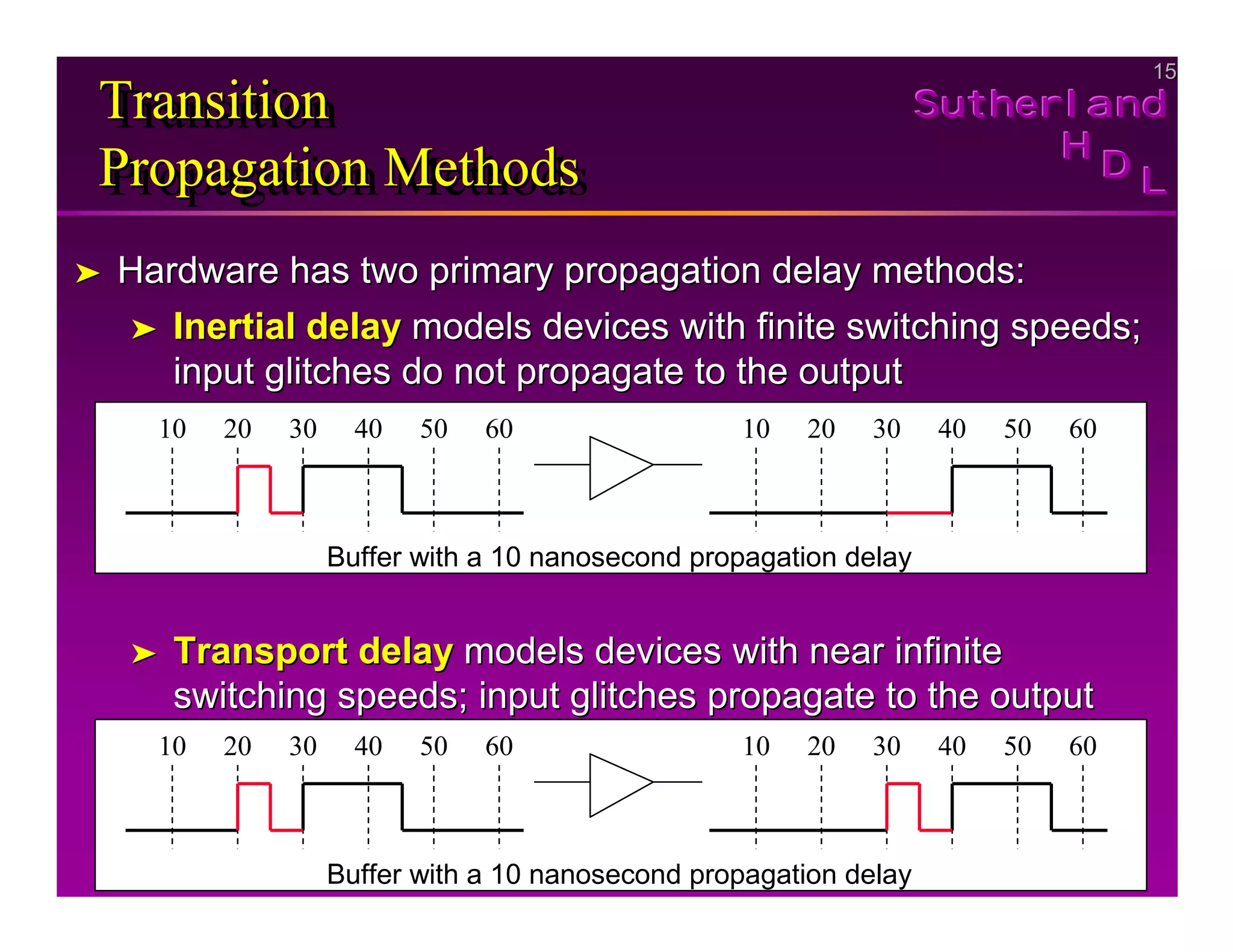
➤ Hardware has two primary propagation delay methods:
Hardware has two primary propagation delay methods:
➤
➤ Inertial delay
Inertial delay models devices with finite switching speeds;
models devices with finite switching speeds;
input glitches do not propagate to the output
➤
➤ Transport delay
Transport delay models devices with near infinite
models devices with near infinite
switching speeds; input glitches propagate to the output
20 60
50
40
30
10 20 60
50
40
30
10
Buffer with a 10 nanosecond propagation delay
20 60
50
40
30
10 20 60
50
40
30
10
Buffer with a 10 nanosecond propagation delay
16
16
Sutherland
Sutherland
Sutherland
H
H
H
D
D
D L
L
L
Combinational Logic
Procedural Assignments
Combinational Logic
Combinational Logic
Procedural Assignments
➤
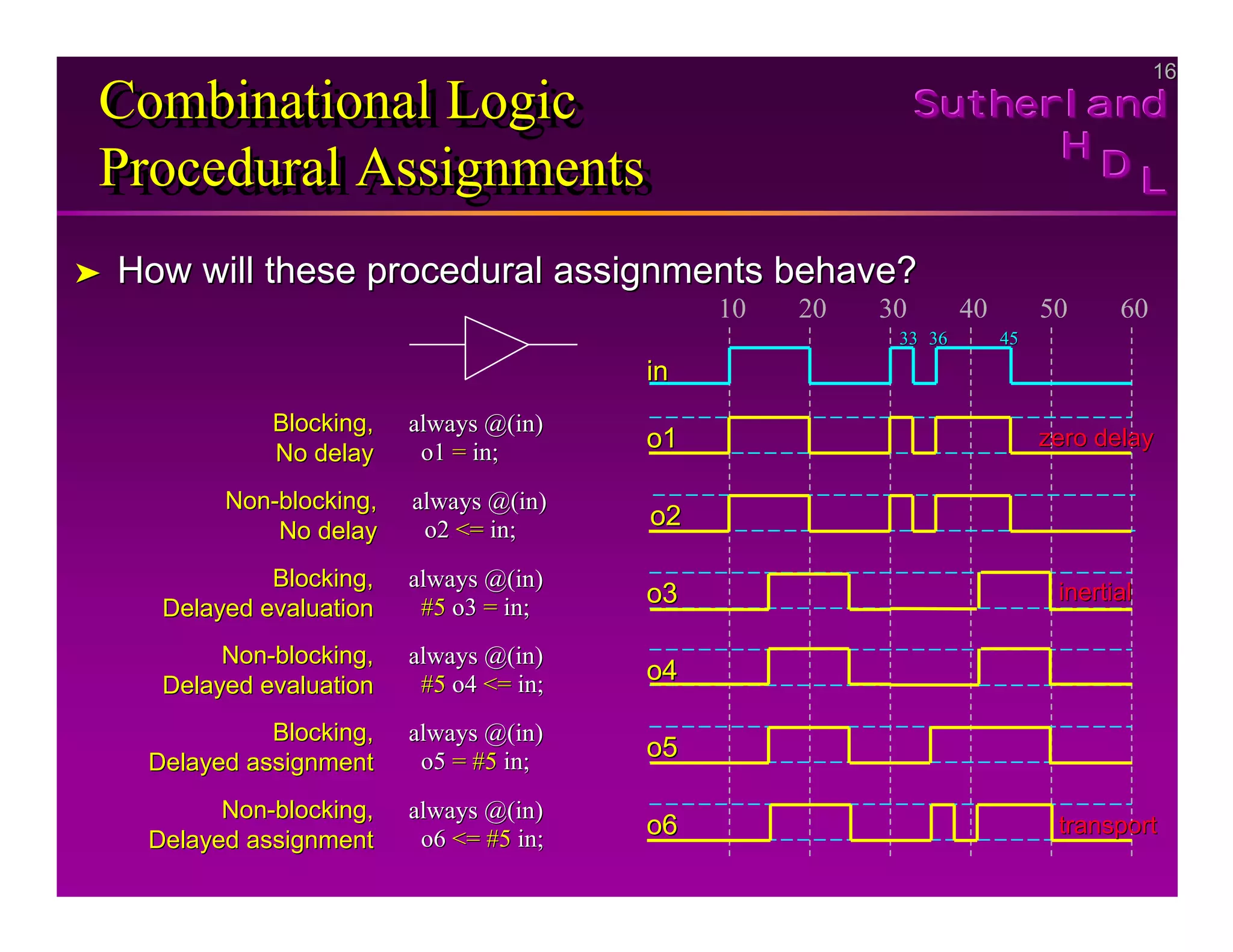
➤ How will these procedural assignments behave?
How will these procedural assignments behave?
20 60
50
40
30
10
in
in
33
33 36
36 45
45
always @(in)
always @(in)
o1
o1 =
= in;
in;
Blocking,
Blocking,
No delay
No delay
always @(in)
always @(in)
o2
o2 <=
<= in;
in;
Non
Non-
-blocking,
blocking,
No delay
No delay
always @(in)
always @(in)
#5
#5 o3
o3 =
= in;
in;
Blocking,
Blocking,
Delayed evaluation
Delayed evaluation
o1
o1
o2
o2
o3
o3
o4
o4
o5
o5
o6
o6
always @(in)
always @(in)
#5
#5 o4
o4 <=
<= in;
in;
Non
Non-
-blocking,
blocking,
Delayed evaluation
Delayed evaluation
always @(in)
always @(in)
o5
o5 = #5
= #5 in;
in;
Blocking,
Blocking,
Delayed assignment
Delayed assignment
always @(in)
always @(in)
o6
o6 <= #5
<= #5 in;
in;
Non
Non-
-blocking,
blocking,
Delayed assignment
Delayed assignment
zero delay
zero delay
inertial
inertial
transport
transport
17
17
Sutherland
Sutherland
Sutherland
H
H
H
D
D
D L
L
L
Sequential Logic
Procedural Assignments
Sequential Logic
Sequential Logic
Procedural Assignments
➤
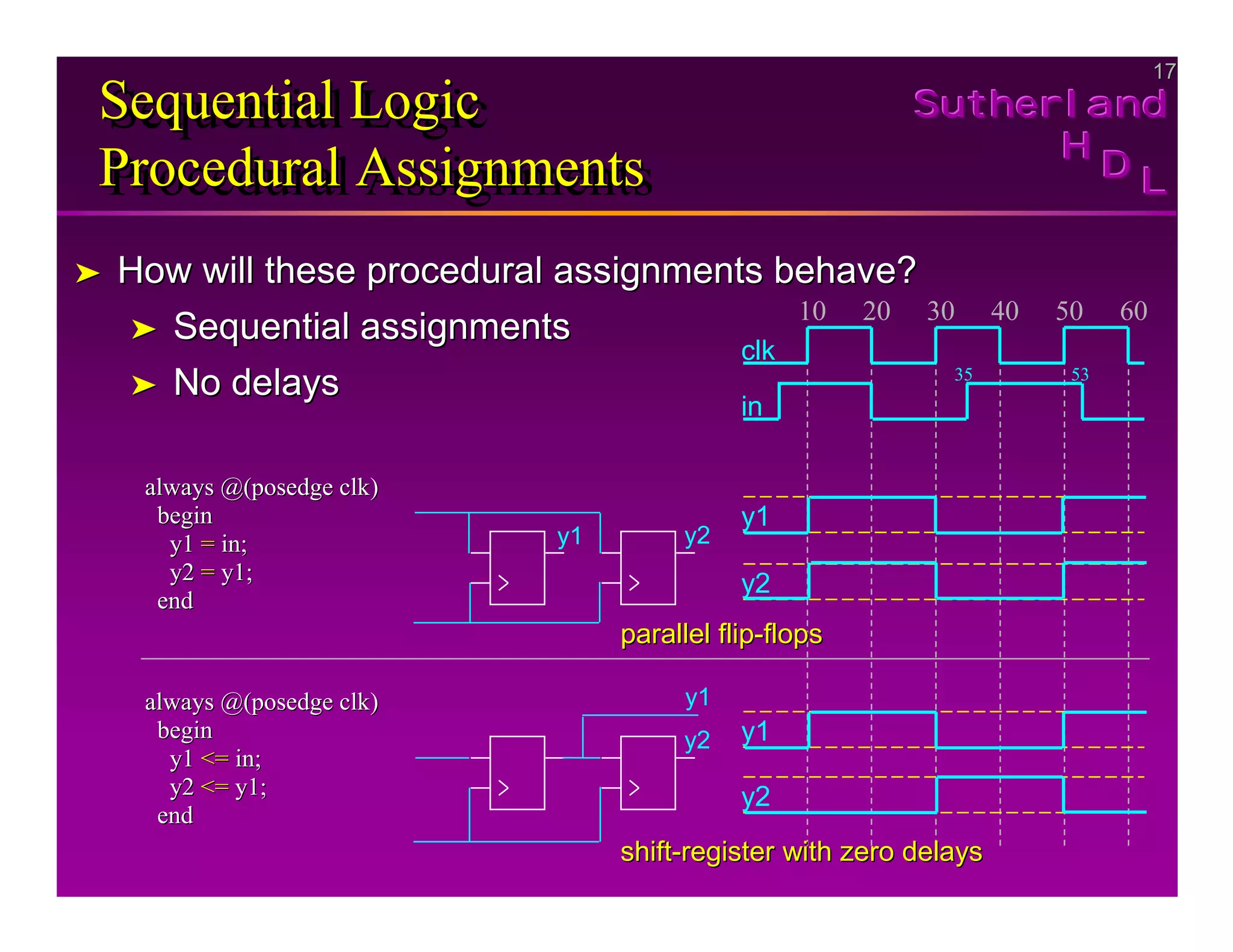
➤ How will these procedural assignments behave?
How will these procedural assignments behave?
➤
➤ Sequential assignments
Sequential assignments
➤
➤ No delays
No delays
20 60
50
40
30
10
clk
always @(
always @(posedge clk
posedge clk)
)
begin
begin
y1
y1 =
= in;
in;
y2
y2 =
= y1;
y1;
end
end
always @(
always @(posedge clk
posedge clk)
)
begin
begin
y1
y1 <=
<= in;
in;
y2
y2 <=
<= y1;
y1;
end
end
in
35 53
y2
y1
y1
y2
y2
y1
parallel flip
parallel flip-
-flops
flops
y1
y2
shift
shift-
-register with zero delays
register with zero delays
18
18
Sutherland
Sutherland
Sutherland
H
H
H
D
D
D L
L
L
Sequential Logic
Procedural Assignments
Sequential Logic
Sequential Logic
Procedural Assignments
➤
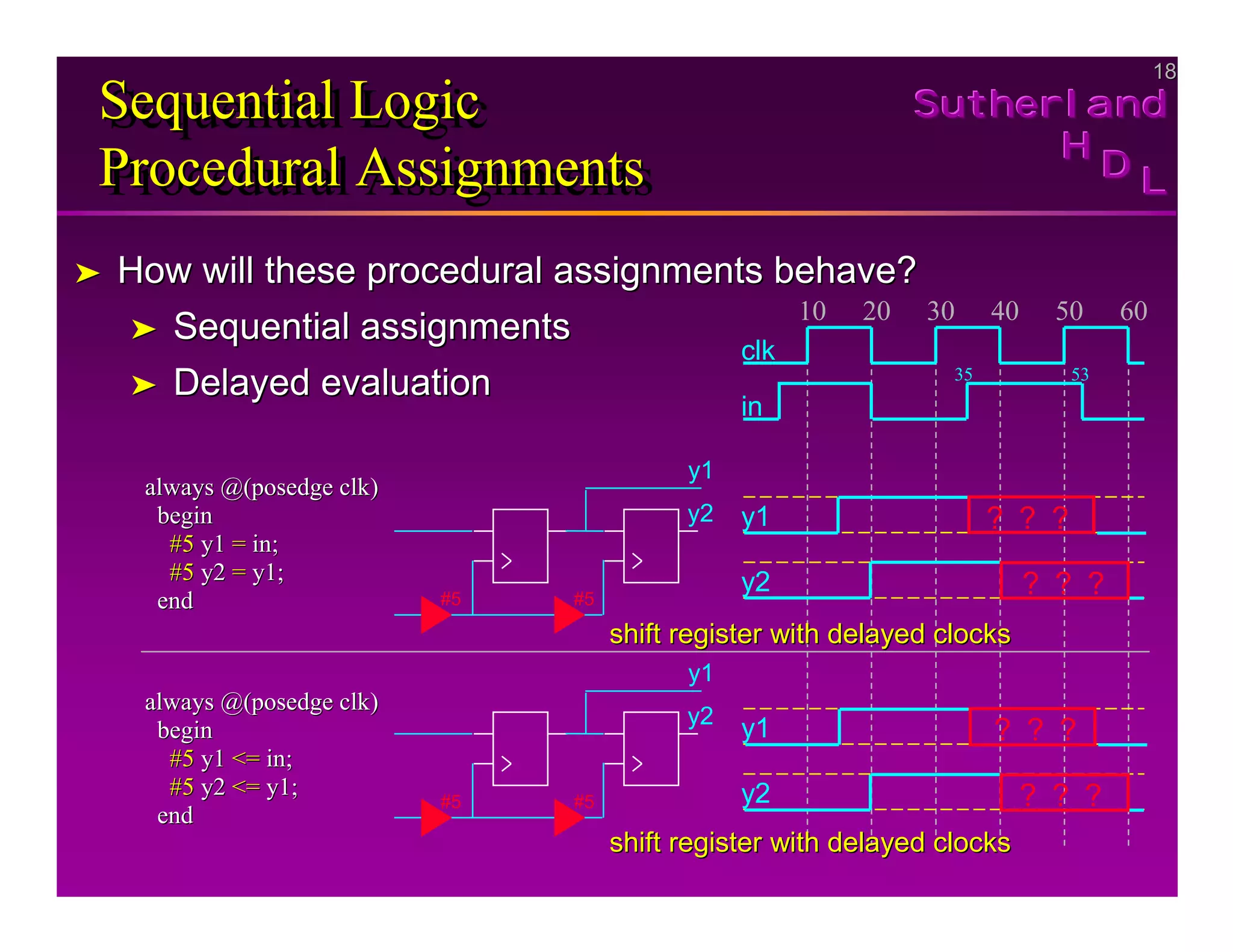
➤ How will these procedural assignments behave?
How will these procedural assignments behave?
➤
➤ Sequential assignments
Sequential assignments
➤
➤ Delayed evaluation
Delayed evaluation
20 60
50
40
30
10
clk
always @(
always @(posedge clk
posedge clk)
)
begin
begin
#5
#5 y1
y1 =
= in;
in;
#5
#5 y2
y2 =
= y1;
y1;
end
end
always @(
always @(posedge clk
posedge clk)
)
begin
begin
#5
#5 y1
y1 <=
<= in;
in;
#5
#5 y2
y2 <=
<= y1;
y1;
end
end
in
35 53
y2
y1
y1
y2
? ? ?
? ? ?
y1
y2
#5
#5
shift register with delayed clocks
? ? ?
? ? ?
y1
y2
#5
#5
shift register with delayed clocks
19
19
Sutherland
Sutherland
Sutherland
H
H
H
D
D
D L
L
L
Sequential Logic
Procedural Assignments
Sequential Logic
Sequential Logic
Procedural Assignments
➤
➤ How will these procedural assignments behave?
How will these procedural assignments behave?
➤
➤ Sequential assignments
Sequential assignments
➤
➤ Delayed assignment
Delayed assignment
20 60
50
40
30
10
clk
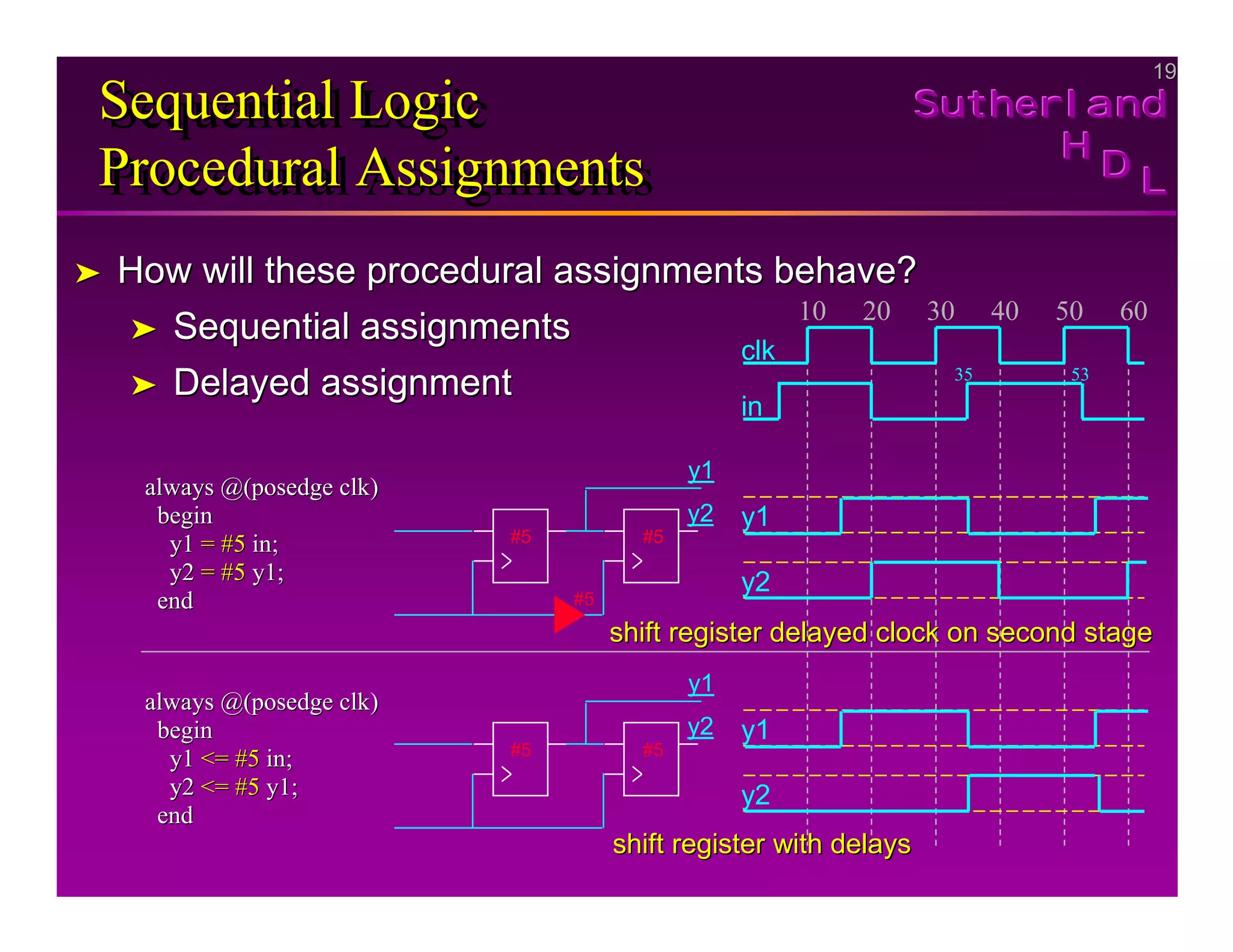
always @(
always @(posedge clk
posedge clk)
)
begin
begin
y1
y1 = #5
= #5 in;
in;
y2
y2 = #5
= #5 y1;
y1;
end
end
always @(
always @(posedge clk
posedge clk)
)
begin
begin
y1
y1 <= #5
<= #5 in;
in;
y2
y2 <= #5
<= #5 y1;
y1;
end
end
y1
y2
y1
y2
in
35 53
shift register delayed clock on second stage
y1
y2
#5
#5 #5
y1
y2
#5 #5
shift register with delays
20
20
Sutherland
Sutherland
Sutherland
H
H
H
D
D
D L
L
L
Sequential Logic
Procedural Assignments
Sequential Logic
Sequential Logic
Procedural Assignments
➤
➤ How will these procedural assignments behave?
How will these procedural assignments behave?
➤
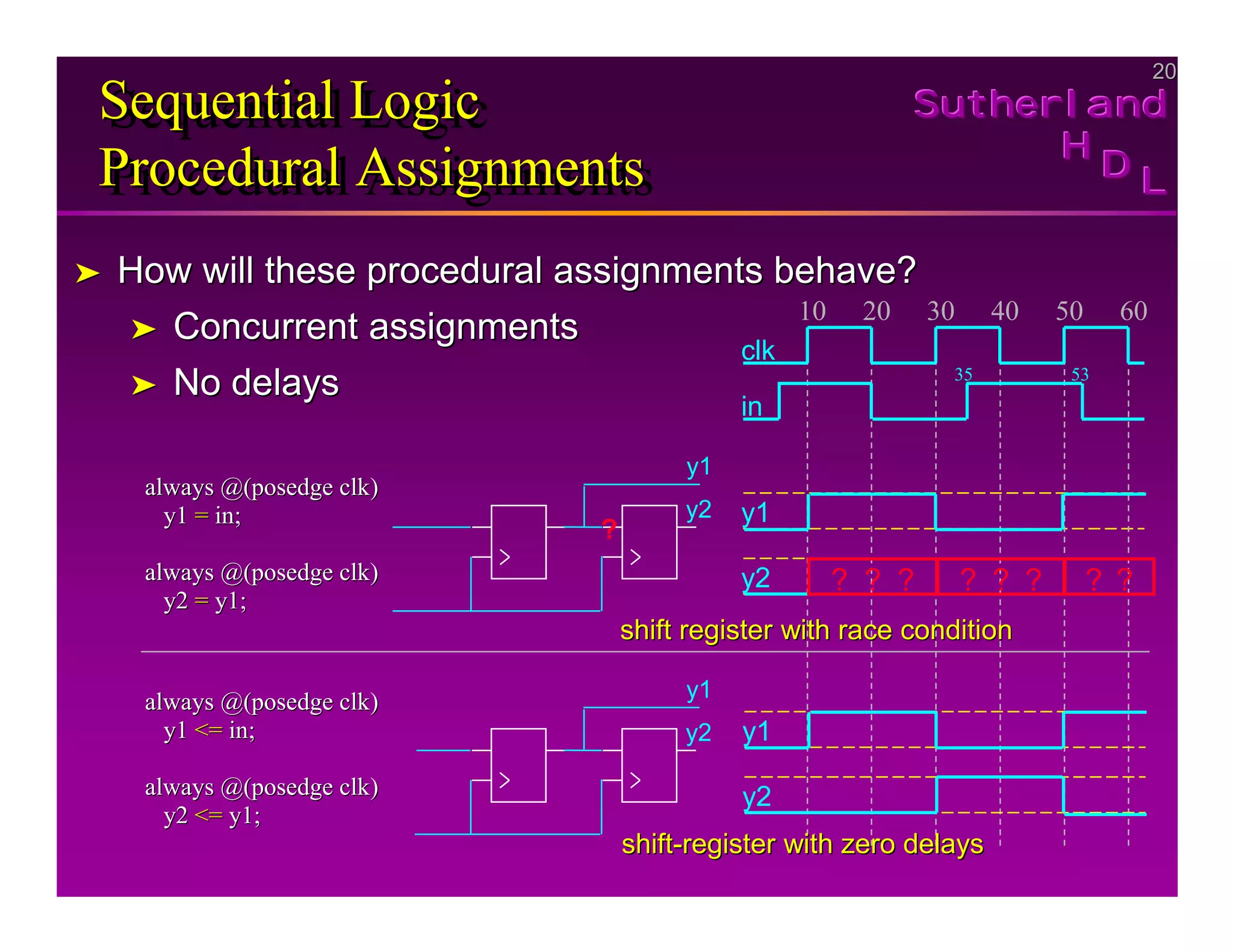
➤ Concurrent assignments
Concurrent assignments
➤
➤ No delays
No delays
y1
y2
20 60
50
40
30
10
clk
always @(
always @(posedge clk
posedge clk)
)
y1
y1 =
= in;
in;
always @(
always @(posedge clk
posedge clk)
)
y2
y2 =
= y1;
y1;
y1
y2
always @(
always @(posedge clk
posedge clk)
)
y1
y1 <=
<= in;
in;
always @(
always @(posedge clk
posedge clk)
)
y2
y2 <=
<= y1;
y1;
in
35 53
? ? ? ? ? ? ? ?
y1
y2
?
shift register with race condition
y1
y2
shift
shift-
-register with zero delays
register with zero delays
21
21
Sutherland
Sutherland
Sutherland
H
H
H
D
D
D L
L
L
y2
y1
Sequential Logic
Procedural Assignments
Sequential Logic
Sequential Logic
Procedural Assignments
➤
➤ How will these procedural assignments behave?
How will these procedural assignments behave?
➤
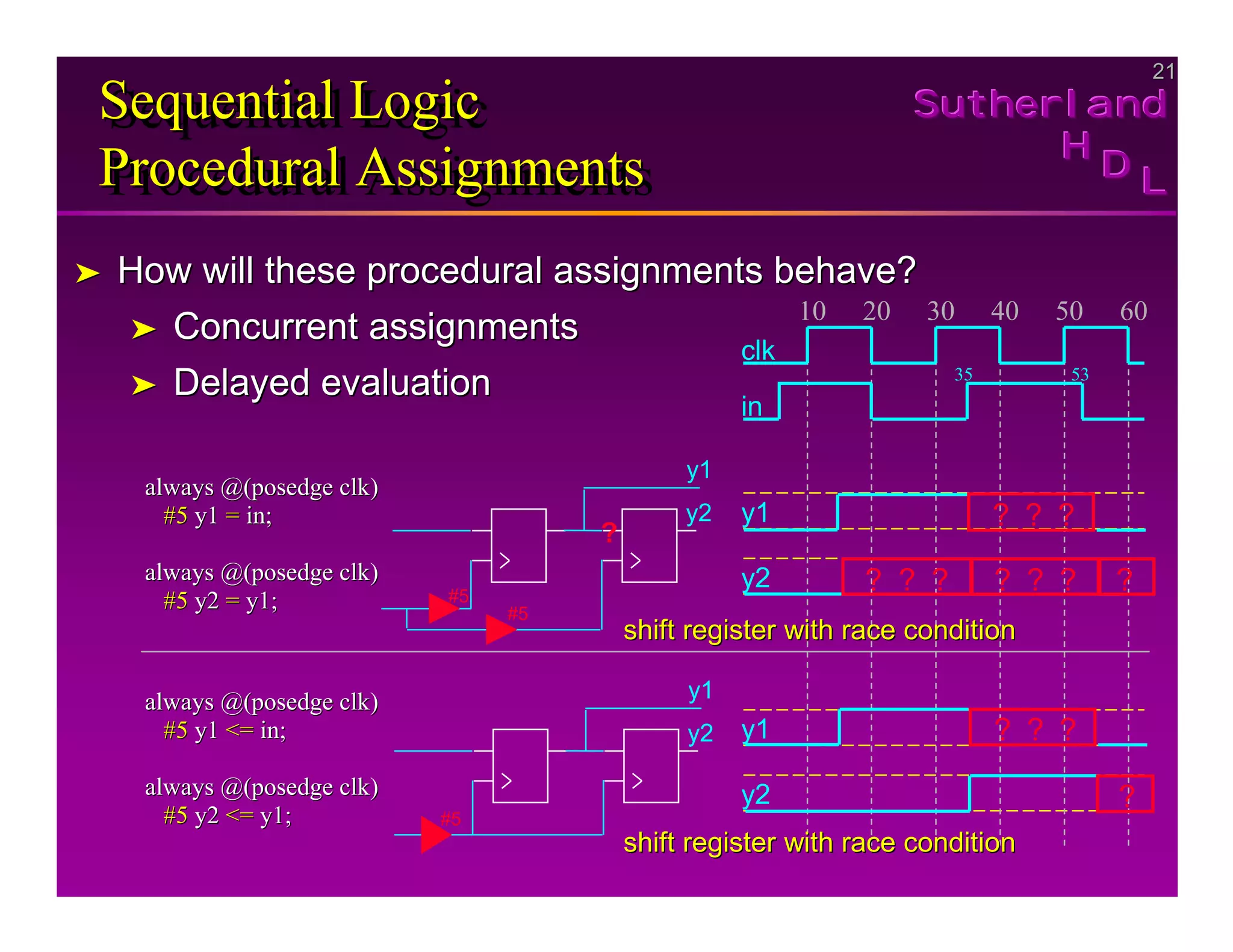
➤ Concurrent assignments
Concurrent assignments
➤
➤ Delayed evaluation
Delayed evaluation
20 60
50
40
30
10
clk
always @(
always @(posedge clk
posedge clk)
)
#5
#5 y1
y1 =
= in;
in;
always @(
always @(posedge clk
posedge clk)
)
#5
#5 y2
y2 =
= y1;
y1;
always @(
always @(posedge clk
posedge clk)
)
#5
#5 y1
y1 <=
<= in;
in;
always @(
always @(posedge clk
posedge clk)
)
#5
#5 y2
y2 <=
<= y1;
y1;
in
35 53
y1
y2 ? ? ?
? ? ?
? ? ? ?
shift register with race condition
y1
y2
?
#5
#5
? ? ?
?
y1
y2
#5
shift register with race condition
22
22
Sutherland
Sutherland
Sutherland
H
H
H
D
D
D L
L
L
Sequential Logic
Procedural Assignments
Sequential Logic
Sequential Logic
Procedural Assignments
➤
➤ How will these procedural assignments behave?
How will these procedural assignments behave?
➤
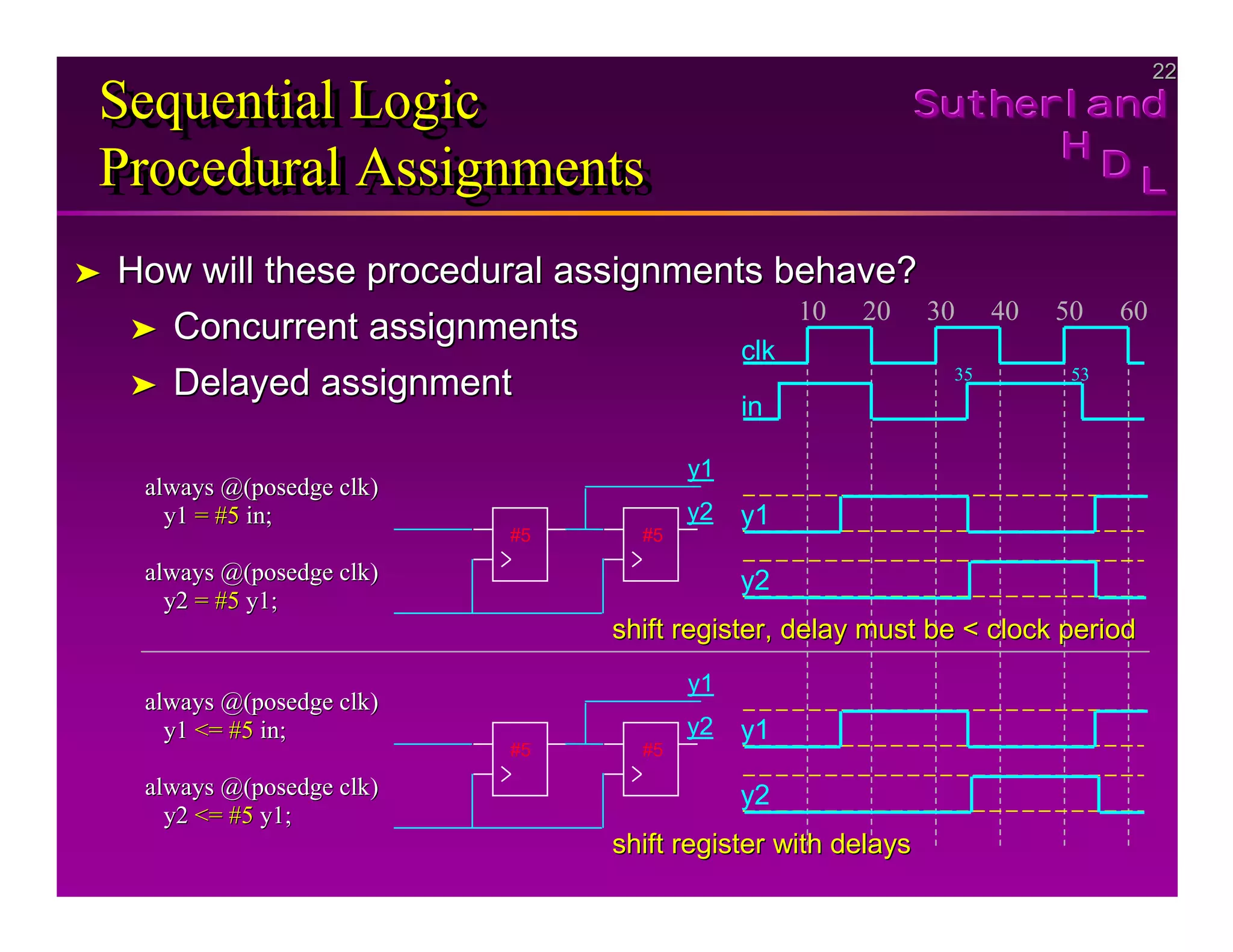
➤ Concurrent assignments
Concurrent assignments
➤
➤ Delayed assignment
Delayed assignment
20 60
50
40
30
10
clk
always @(
always @(posedge clk
posedge clk)
)
y1
y1 = #5
= #5 in;
in;
always @(
always @(posedge clk
posedge clk)
)
y2
y2 = #5
= #5 y1;
y1;
always @(
always @(posedge clk
posedge clk)
)
y1
y1 <= #5
<= #5 in;
in;
always @(
always @(posedge clk
posedge clk)
)
y2
y2 <= #5
<= #5 y1;
y1;
in
35 53
y1
y2
y1
y2
y1
y2
#5 #5
shift register, delay must be < clock period
y1
y2
#5 #5
shift register with delays
23
23
Sutherland
Sutherland
Sutherland
H
H
H
D
D
D L
L
L
Rules of Thumb for
Procedural Assignments
Rules of Thumb for
Rules of Thumb for
Procedural Assignments
➤
➤ Combinational Logic:
Combinational Logic:
➤
➤ No delays:
No delays: Use blocking assignments (
Use blocking assignments ( a = b;
a = b; )
)
➤
➤ Inertial delays:
Inertial delays: Use delayed evaluation blocking
Use delayed evaluation blocking
assignments (
assignments ( #5 a = b;
#5 a = b; )
)
➤
➤ Transport delays:
Transport delays: Use delayed assignment non
Use delayed assignment non-
-blocking
blocking
assignments (
assignments ( a <= #5 b;
a <= #5 b; )
)
➤
➤ Sequential Logic:
Sequential Logic:
➤
➤ No delays:
No delays: Use non
Use non-
-blocking assignments (
blocking assignments ( q <= d;
q <= d; )
)
➤
➤ With delays:
With delays: Use delayed assignment non
Use delayed assignment non-
-blocking
blocking
assignments (
assignments ( q <= #5 d;
q <= #5 d; )
)
24
24
Sutherland
Sutherland
Sutherland
H
H
H
D
D
D L
L
L
An Exception to Non-blocking
Assignments in Sequential Logic
An Exception to Non
An Exception to Non-
-blocking
blocking
Assignments in Sequential Logic
➤
➤ Do
Do not
not use a non
use a non-
-blocking assignment if another statement in
blocking assignment if another statement in
the procedure requires the new value in the same time step
begin
#5 A <= 1;
#5 A <= A + 1;
B <= A + 1;
end
What values do A and B contain
after 10 time units?
What values do A and B contain
after 10 time units?
always @(posedge clk)
begin
case (state)
`STOP: next_state <= `GO;
`GO: next_state <= `STOP;
endcase
state <= next_state;
end
Assume state and next_state
are `STOP at the first clock,
what is state:
- At the 2nd clock?
- At the 3rd clock?
- At the 4th clock?
- At the 5th clock?
Assume state and next_state
are `STOP at the first clock,
what is state:
- At the 2nd clock?
- At the 3rd clock?
- At the 4th clock?
- At the 5th clock?
A is 2
A is 2 B is 2
B is 2
`STOP
`STOP
`GO
`GO
`GO
`GO
`STOP
`STOP
25
25
Sutherland
Sutherland
Sutherland
H
H
H
D
D
D L
L
L
Exercise 3:
Procedural Assignments
Exercise 3:
Exercise 3:
Procedural Assignments
➤
➤ Write a procedure for an adder (combinational logic) that
Write a procedure for an adder (combinational logic) that
assigns C the sum of A plus B with a 7ns propagation delay.
➤
➤ Write the procedure(s) for a 4
Write the procedure(s) for a 4-
-bit wide shift register (positive
bit wide shift register (positive
edge triggered) of clock and has a 4ns propagation delay.
always @(A or B)
#7 C = A + B;
always @(A or B)
#7 C = A + B;
always @(posedge clk)
begin
y1 <= #4 in;
y2 <= #4 y1;
y3 <= #4 y2;
out <= #4 y3;
end
always @(posedge clk)
begin
y1 <= #4 in;
y2 <= #4 y1;
y3 <= #4 y2;
out <= #4 y3;
end
always @(posedge clk)
y1 <= #4 in;
always @(posedge clk)
y2 <= #4 y1;
always @(posedge clk)
y3 <= #4 y2;
always @(posedge clk)
out <= #4 y3;
always @(posedge clk)
y1 <= #4 in;
always @(posedge clk)
y2 <= #4 y1;
always @(posedge clk)
y3 <= #4 y2;
always @(posedge clk)
out <= #4 y3;
26
26
Sutherland
Sutherland
Sutherland
H
H
H
D
D
D L
L
L
Exercise 3 (continued):
Procedural Assignments
Exercise 3 (continued):
Procedural Assignments
➤
➤ Write a Verilog procedure for a “black box” ALU pipeline that
Write a Verilog procedure for a “black box” ALU pipeline that
takes 8 clock cycles to execute an instruction. The pipeline
triggers on the positive edge of clock. The “black box” is
represented as call to a function named ALU with inputs A, B
and OPCODE.
and OPCODE.
always @(posedge clk)
alu_out <= repeat(7) @(posedge clk) ALU(A,B,OPCODE);
always @(posedge clk)
alu_out <= repeat(7) @(posedge clk) ALU(A,B,OPCODE);
How many Verilog
statements does it
take to model an
eight stage pipeline?

1996-CUG-presentation_nonblocking_assigns.pdf

  • 1.
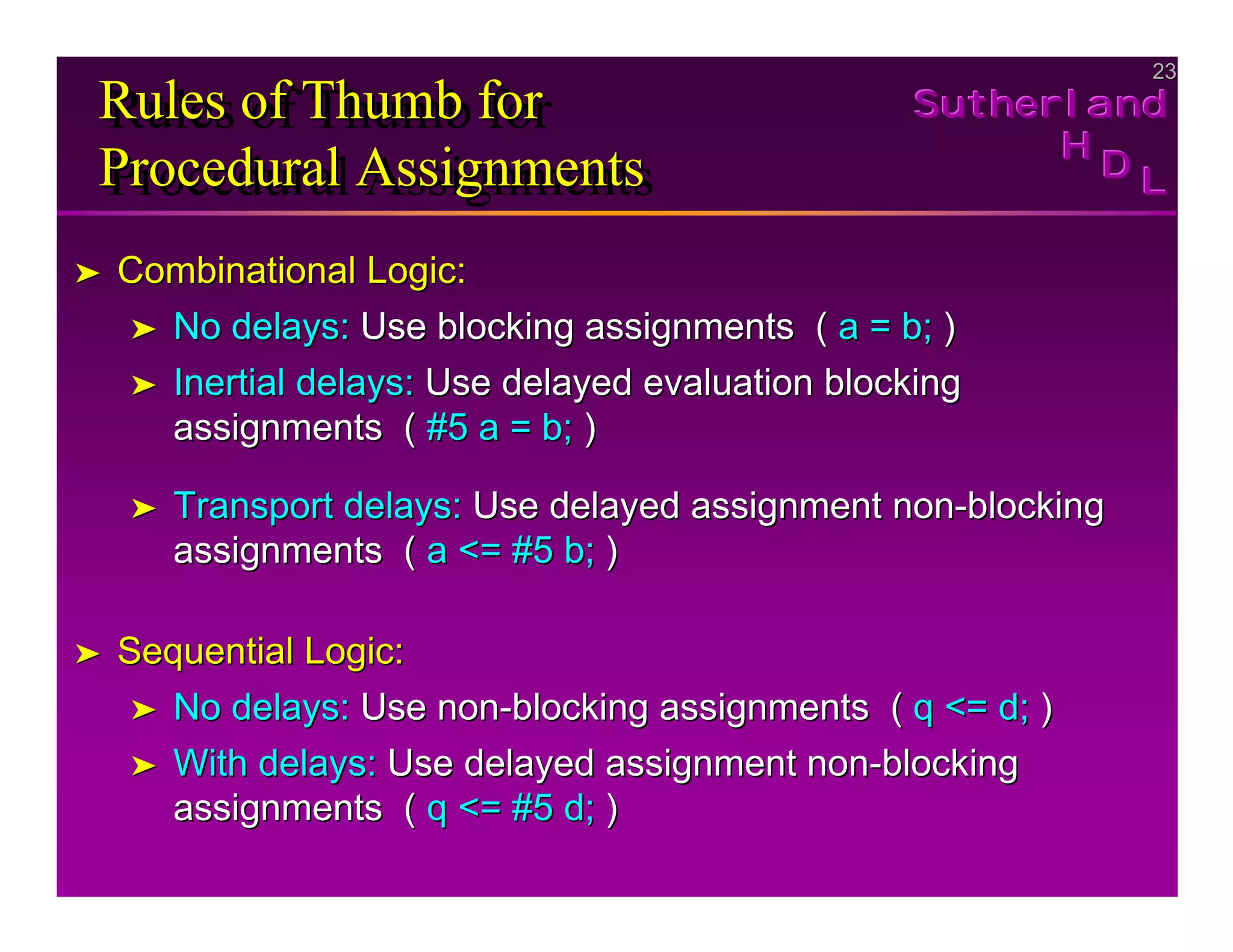
    Understanding Verilog Blocking UnderstandingVerilog Blocking and Non and Non- -blocking Assignments blocking Assignments International Cadence International Cadence User Group Conference User Group Conference September 11, 1996 September 11, 1996 presented by presented by Stuart Sutherland Stuart Sutherland Sutherland HDL Consulting Sutherland HDL Consulting
  • 2.
    About the Presenter Aboutthe Presenter Stuart Sutherland has over 8 years of experience using Verilog w Stuart Sutherland has over 8 years of experience using Verilog with a variety of software tools. He ith a variety of software tools. He holds a BS degree in Computer Science, with an emphasis on Elect holds a BS degree in Computer Science, with an emphasis on Electronic Engineering, and has ronic Engineering, and has worked as a design engineer in the defense industry, and as an A worked as a design engineer in the defense industry, and as an Applications Engineer for Gateway pplications Engineer for Gateway Design Automation (the originator of Verilog) and Cadence Design Design Automation (the originator of Verilog) and Cadence Design Systems. Mr. Sutherland has Systems. Mr. Sutherland has been providing Verilog HDL consulting services since 1991. As a been providing Verilog HDL consulting services since 1991. As a consultant, he has been actively consultant, he has been actively involved in using the Verilog involved in using the Verilog langiage langiage with a many different of software tools for the design of with a many different of software tools for the design of ASICs ASICs and systems. He is a member of the IEEE 1364 standards committ and systems. He is a member of the IEEE 1364 standards committee and has been involved ee and has been involved in the specification and testing of Verilog simulation products in the specification and testing of Verilog simulation products from several EDA vendors, including from several EDA vendors, including the Intergraph the Intergraph- -VeriBest VeriBest VeriBest VeriBest simulator, the Mentor simulator, the Mentor QuickHDL QuickHDL simulator, and the Frontline simulator, and the Frontline CycleDrive CycleDrive cycle based simulator. In addition to Verilog design cycle based simulator. In addition to Verilog design consutlting consutlting, Mr. Sutherland , Mr. Sutherland provides expert on provides expert on- -site Verilog training on the Verilog HDL language and site Verilog training on the Verilog HDL language and Programing Programing Language Language Interface. Mr. Sutherland is the author and publisher of the po Interface. Mr. Sutherland is the author and publisher of the popular pular “Verilog IEEE 1364 Quick “Verilog IEEE 1364 Quick Reference Guide” Reference Guide” and the and the “Verilog IEEE 1364 PLI Quick Reference Guide” “Verilog IEEE 1364 PLI Quick Reference Guide”. . Please Please conact conact Mr. Sutherland with any questions about this material! Mr. Sutherland with any questions about this material! phone: (503) 692 phone: (503) 692- -0898 0898 fax: (503) 692 fax: (503) 692- -1512 1512 e e- -mail: mail: stuart stuart@ @sutherland sutherland.com .com Sutherland HDL Consulting Sutherland HDL Consulting Verilog Consulting and Training Services Verilog Consulting and Training Services 22805 SW 92 22805 SW 92nd nd Place Place Tualatin, OR 97062 USA Tualatin, OR 97062 USA
  • 3.
    The material inthis presentation is copyrighted by Sutherland H The material in this presentation is copyrighted by Sutherland HDL Consulting, DL Consulting, Tualatin, Oregon. The presentation is printed with permission a Tualatin, Oregon. The presentation is printed with permission as part of the s part of the proceedings of the 1996 International Cadence User Group Confere proceedings of the 1996 International Cadence User Group Conference. All rights nce. All rights are reserved. No material from this presentation may be duplica are reserved. No material from this presentation may be duplicated or transmitted by ted or transmitted by any means or in any form without the express written permission any means or in any form without the express written permission of Sutherland HDL of Sutherland HDL Consulting. Consulting. copyright notice copyright notice Sutherland HDL Consulting Sutherland HDL Consulting 22805 SW 92 22805 SW 92 nd nd Place Place Tualatin, OR 97062 USA Tualatin, OR 97062 USA phone: (503) 692 phone: (503) 692- -0898 0898 fax: (503) 692 fax: (503) 692- -1512 1512 e e- -mail: info@ mail: info@sutherland sutherland.com .com © ©1996 1996
  • 4.
    4 4 Sutherland Sutherland Sutherland H H H D D D L L L Objectives Objectives Objectives ➤ ➤ Theprimary objective is to understand: The primary objective is to understand: What type of hardware is represented What type of hardware is represented by blocking and non by blocking and non- -blocking blocking assignments? assignments? ➤ ➤ The material presented is a subset of an advanced Verilog The material presented is a subset of an advanced Verilog HDL training course HDL training course
  • 5.
    5 5 Sutherland Sutherland Sutherland H H H D D D L L L Procedural Assignments ProceduralAssignments Procedural Assignments ➤ ➤ Procedural assignment evaluation can be modeled as: Procedural assignment evaluation can be modeled as: ➤ ➤ Blocking Blocking ➤ ➤ Non Non- -blocking blocking ➤ ➤ Procedural assignment execution can be modeled as: Procedural assignment execution can be modeled as: ➤ ➤ Sequential Sequential ➤ ➤ Concurrent Concurrent ➤ ➤ Procedural assignment timing controls can be modeled as: Procedural assignment timing controls can be modeled as: ➤ ➤ Delayed evaluations Delayed evaluations ➤ ➤ Delayed assignments Delayed assignments
  • 6.
    6 6 Sutherland Sutherland Sutherland H H H D D D L L L Blocking Procedural Assignments Blocking Blocking ProceduralAssignments Procedural Assignments ➤ ➤ The The = = token represents a token represents a blocking blocking procedural assignment procedural assignment ➤ ➤ Evaluated and assigned in a single step Evaluated and assigned in a single step ➤ ➤ Execution flow within the procedure is blocked until the Execution flow within the procedure is blocked until the assignment is completed assignment is completed ➤ ➤ Evaluations of concurrent statements in the same time step Evaluations of concurrent statements in the same time step are blocked until the assignment is completed are blocked until the assignment is completed These examples will These examples will not not work work   Why not? Why not? //swap bytes in word always @(posedge clk) begin word[15:8] = word[ 7:0]; word[ 7:0] = word[15:8]; end //swap bytes in word always @(posedge clk) begin word[15:8] = word[ 7:0]; word[ 7:0] = word[15:8]; end //swap bytes in word always @(posedge clk) fork word[15:8] = word[ 7:0]; word[ 7:0] = word[15:8]; join //swap bytes in word always @(posedge clk) fork word[15:8] = word[ 7:0]; word[ 7:0] = word[15:8]; join
  • 7.
    7 7 Sutherland Sutherland Sutherland H H H D D D L L L Non-Blocking Procedural Assignments Non Non- -Blocking Blocking ProceduralAssignments Procedural Assignments ➤ ➤ The The <= <= token represents a token represents a non non- -blocking blocking assignment assignment ➤ ➤ Evaluated and assigned in two steps: Evaluated and assigned in two steps: ① ① The right The right- -hand side is evaluated immediately hand side is evaluated immediately ② ② The assignment to the left The assignment to the left- -hand side is postponed until hand side is postponed until other evaluations in the current time step are completed other evaluations in the current time step are completed ➤ ➤ Execution flow within the procedure continues until a Execution flow within the procedure continues until a timing control is encountered (flow is not blocked) timing control is encountered (flow is not blocked) These examples will work These examples will work   Why? Why? //swap bytes in word always @(posedge clk) begin word[15:8] <= word[ 7:0]; word[ 7:0] <= word[15:8]; end //swap bytes in word always @(posedge clk) begin word[15:8] <= word[ 7:0]; word[ 7:0] <= word[15:8]; end //swap bytes in word always @(posedge clk) fork word[15:8] <= word[ 7:0]; word[ 7:0] <= word[15:8]; join //swap bytes in word always @(posedge clk) fork word[15:8] <= word[ 7:0]; word[ 7:0] <= word[15:8]; join
  • 8.
    8 8 Sutherland Sutherland Sutherland H H H D D D L L L Representing Simulation Timeas Queues Representing Representing Simulation Time as Queues Simulation Time as Queues ➤ ➤ Each Verilog simulation time step is divided into 4 queues Each Verilog simulation time step is divided into 4 queues Note: this is an abstract view, not how simulation algorithms ar Note: this is an abstract view, not how simulation algorithms are implemented e implemented Time 0: ➤ Q1 — (in any order) : ➤ Evaluate RHS of all non-blocking assignments ➤ Evaluate RHS and change LHS of all blocking assignments ➤ Evaluate RHS and change LHS of all continuous assignments ➤ Evaluate inputs and change outputs of all primitives ➤ Evaluate and print output from $display and $write ➤ Q2 — (in any order) : ➤ Change LHS of all non-blocking assignments ➤ Q3 — (in any order) : ➤ Evaluate and print output from $monitor and $strobe ➤ Call PLI with reason_synchronize ➤ Q4 : ➤ Call PLI with reason_rosynchronize Time 1: ... Time 0: ➤ Q1 — (in any order) : ➤ Evaluate RHS of all non-blocking assignments ➤ Evaluate RHS and change LHS of all blocking assignments ➤ Evaluate RHS and change LHS of all continuous assignments ➤ Evaluate inputs and change outputs of all primitives ➤ Evaluate and print output from $display and $write ➤ Q2 — (in any order) : ➤ Change LHS of all non-blocking assignments ➤ Q3 — (in any order) : ➤ Evaluate and print output from $monitor and $strobe ➤ Call PLI with reason_synchronize ➤ Q4 : ➤ Call PLI with reason_rosynchronize Time 1: ...
  • 9.
    9 9 Sutherland Sutherland Sutherland H H H D D D L L L Sequential Procedural Assignments Sequential Sequential ProceduralAssignments Procedural Assignments ➤ ➤ The order of evaluation is The order of evaluation is determinate determinate ➤ ➤ A A sequential blocking assignment sequential blocking assignment evaluates and assigns evaluates and assigns before continuing on in the procedure before continuing on in the procedure always @( always @(posedge clk posedge clk) ) begin begin A A = = 1; 1; #5 B #5 B = = A + 1; A + 1; end end evaluate and assign A immediately evaluate and assign A immediately delay 5 time units, then evaluate and assign delay 5 time units, then evaluate and assign ➤ ➤ A A sequential non sequential non- -blocking assignment blocking assignment evaluates, then evaluates, then continues on to the next timing control before assigning continues on to the next timing control before assigning always @( always @(posedge clk posedge clk) ) begin begin A A <= <= 1; 1; #5 B #5 B <= <= A + 1; A + 1; end end evaluate A immediately; assign at end of time step evaluate A immediately; assign at end of time step delay 5 time units, then evaluate; then assign at delay 5 time units, then evaluate; then assign at end of time step (clock + 5) end of time step (clock + 5)
  • 10.
    10 10 Sutherland Sutherland Sutherland H H H D D D L L L Concurrent Procedural Assignments Concurrent Concurrent ProceduralAssignments Procedural Assignments The order of concurrent evaluation is The order of concurrent evaluation is indeterminate indeterminate ➤ ➤ Concurrent Concurrent blocking assignments blocking assignments have have unpredictable results unpredictable results always @( always @(posedge clk posedge clk) ) #5 A #5 A = = A + 1; A + 1; always @( always @(posedge clk posedge clk) ) #5 B #5 B = = A + 1; A + 1; Unpredictable Result: Unpredictable Result: (new value of (new value of B B could be evaluated before could be evaluated before or after or after A A changes) changes) ➤ ➤ Concurrent Concurrent non non- -blocking assignments blocking assignments have have predictable results predictable results always @( always @(posedge clk posedge clk) ) #5 A #5 A <= <= A + 1; A + 1; always @( always @(posedge clk posedge clk) ) #5 B #5 B <= <= A + 1; A + 1; Predictable Result: Predictable Result: (new value of (new value of B B will always be evaluated will always be evaluated before before A A changes) changes)
  • 11.
    11 11 Sutherland Sutherland Sutherland H H H D D D L L L Delayed Evaluation ProceduralAssignments Delayed Evaluation Delayed Evaluation Procedural Assignments Procedural Assignments ➤ ➤ A timing control before an assignment statement will postpone A timing control before an assignment statement will postpone when the next assignment is evaluated when the next assignment is evaluated ➤ ➤ Evaluation is delayed for the amount of time specified Evaluation is delayed for the amount of time specified begin begin #5 #5 A A = = 1; 1; #5 #5 A A = = A + 1; A + 1; B B = = A + 1; A + 1; end end delay for 5, then evaluate and assign delay for 5, then evaluate and assign delay 5 more, then evaluate and assign delay 5 more, then evaluate and assign no delay; evaluate and assign no delay; evaluate and assign What values do A and B contain after 10 time units? What values do A and B contain after 10 time units?
  • 12.
    12 12 Sutherland Sutherland Sutherland H H H D D D L L L Delayed Assignment ProceduralAssignments Delayed Assignment Delayed Assignment Procedural Assignments Procedural Assignments ➤ ➤ An An intra intra- -assignment delay assignment delay places the timing control places the timing control after after the the assignment token assignment token ➤ ➤ The right The right- -hand side is evaluated before the delay hand side is evaluated before the delay ➤ ➤ The left The left- -hand side is assigned after the delay hand side is assigned after the delay always @(A) always @(A) B B = = #5 #5 A; A; A A is evaluated at the time it changes, but is evaluated at the time it changes, but is not assigned to is not assigned to B B until after 5 time units until after 5 time units always @( always @(negedge clk negedge clk) ) Q Q <= <= @( @(posedge clk posedge clk) ) D; D; D D is evaluated at the negative edge of is evaluated at the negative edge of CLK CLK, , Q Q is changed on the positive edge of is changed on the positive edge of CLK CLK always @(instructor_input) if (morning) understand = instructor_input; else if (afternoon) understand = #5 instructor_input; else if (lunch_time) understand = wait (!lunch_time) instructor_input; always @(instructor_input) if (morning) understand = instructor_input; else if (afternoon) understand = #5 instructor_input; else if (lunch_time) understand = wait (!lunch_time) instructor_input;
  • 13.
    13 13 Sutherland Sutherland Sutherland H H H D D D L L L Intra-Assignment Delays WithRepeat Loops Intra Intra- -Assignment Delays Assignment Delays With Repeat Loops With Repeat Loops ➤ ➤ An edge An edge- -sensitive intra sensitive intra- -assignment timing control permits a assignment timing control permits a special use of the repeat loop special use of the repeat loop ➤ ➤ The edge sensitive time control may be repeated several The edge sensitive time control may be repeated several times before the delay is completed times before the delay is completed ➤ ➤ Either the blocking or the non Either the blocking or the non- -blocking assignment may be blocking assignment may be used used always @(IN) OUT <= repeat (8) @(posedge clk) IN; always @(IN) OUT <= repeat (8) @(posedge clk) IN; The value of IN is evaluated when it changes, but is not assigned to OUT until after 8 clock cycles
  • 14.
    14 14 Sutherland Sutherland Sutherland H H H D D D L L L Choosing the CorrectProcedural Assignment Choosing the Choosing the Correct Procedural Assignment Correct Procedural Assignment ➤ ➤ Which procedural assignment should be used to model a Which procedural assignment should be used to model a combinatorial logic buffer? combinatorial logic buffer? ➤ ➤ Which procedural assignment should be used to model a Which procedural assignment should be used to model a sequential logic flip sequential logic flip- -flop? flop? ➤ ➤ The following pages will answer these questions The following pages will answer these questions always @(in) #5 out = in; always @(in) #5 out <= in; always @(in) out = #5 in; always @(in) out <= #5 in; always @(posedge clk) #5 q = d; always @(posedge clk) #5 q <= d; always @(posedge clk) q = #5 d; always @(posedge clk) q <= #5 d;
  • 15.
    15 15 Sutherland Sutherland Sutherland H H H D D D L L L Transition Propagation Methods Transition Transition PropagationMethods Propagation Methods ➤ ➤ Hardware has two primary propagation delay methods: Hardware has two primary propagation delay methods: ➤ ➤ Inertial delay Inertial delay models devices with finite switching speeds; models devices with finite switching speeds; input glitches do not propagate to the output input glitches do not propagate to the output ➤ ➤ Transport delay Transport delay models devices with near infinite models devices with near infinite switching speeds; input glitches propagate to the output switching speeds; input glitches propagate to the output 20 60 50 40 30 10 20 60 50 40 30 10 Buffer with a 10 nanosecond propagation delay 20 60 50 40 30 10 20 60 50 40 30 10 Buffer with a 10 nanosecond propagation delay
  • 16.
    16 16 Sutherland Sutherland Sutherland H H H D D D L L L Combinational Logic ProceduralAssignments Combinational Logic Combinational Logic Procedural Assignments Procedural Assignments ➤ ➤ How will these procedural assignments behave? How will these procedural assignments behave? 20 60 50 40 30 10 in in 33 33 36 36 45 45 always @(in) always @(in) o1 o1 = = in; in; Blocking, Blocking, No delay No delay always @(in) always @(in) o2 o2 <= <= in; in; Non Non- -blocking, blocking, No delay No delay always @(in) always @(in) #5 #5 o3 o3 = = in; in; Blocking, Blocking, Delayed evaluation Delayed evaluation o1 o1 o2 o2 o3 o3 o4 o4 o5 o5 o6 o6 always @(in) always @(in) #5 #5 o4 o4 <= <= in; in; Non Non- -blocking, blocking, Delayed evaluation Delayed evaluation always @(in) always @(in) o5 o5 = #5 = #5 in; in; Blocking, Blocking, Delayed assignment Delayed assignment always @(in) always @(in) o6 o6 <= #5 <= #5 in; in; Non Non- -blocking, blocking, Delayed assignment Delayed assignment zero delay zero delay inertial inertial transport transport
  • 17.
    17 17 Sutherland Sutherland Sutherland H H H D D D L L L Sequential Logic ProceduralAssignments Sequential Logic Sequential Logic Procedural Assignments Procedural Assignments ➤ ➤ How will these procedural assignments behave? How will these procedural assignments behave? ➤ ➤ Sequential assignments Sequential assignments ➤ ➤ No delays No delays 20 60 50 40 30 10 clk always @( always @(posedge clk posedge clk) ) begin begin y1 y1 = = in; in; y2 y2 = = y1; y1; end end always @( always @(posedge clk posedge clk) ) begin begin y1 y1 <= <= in; in; y2 y2 <= <= y1; y1; end end in 35 53 y2 y1 y1 y2 y2 y1 parallel flip parallel flip- -flops flops y1 y2 shift shift- -register with zero delays register with zero delays
  • 18.
    18 18 Sutherland Sutherland Sutherland H H H D D D L L L Sequential Logic ProceduralAssignments Sequential Logic Sequential Logic Procedural Assignments Procedural Assignments ➤ ➤ How will these procedural assignments behave? How will these procedural assignments behave? ➤ ➤ Sequential assignments Sequential assignments ➤ ➤ Delayed evaluation Delayed evaluation 20 60 50 40 30 10 clk always @( always @(posedge clk posedge clk) ) begin begin #5 #5 y1 y1 = = in; in; #5 #5 y2 y2 = = y1; y1; end end always @( always @(posedge clk posedge clk) ) begin begin #5 #5 y1 y1 <= <= in; in; #5 #5 y2 y2 <= <= y1; y1; end end in 35 53 y2 y1 y1 y2 ? ? ? ? ? ? y1 y2 #5 #5 shift register with delayed clocks shift register with delayed clocks ? ? ? ? ? ? y1 y2 #5 #5 shift register with delayed clocks shift register with delayed clocks
  • 19.
    19 19 Sutherland Sutherland Sutherland H H H D D D L L L Sequential Logic ProceduralAssignments Sequential Logic Sequential Logic Procedural Assignments Procedural Assignments ➤ ➤ How will these procedural assignments behave? How will these procedural assignments behave? ➤ ➤ Sequential assignments Sequential assignments ➤ ➤ Delayed assignment Delayed assignment 20 60 50 40 30 10 clk always @( always @(posedge clk posedge clk) ) begin begin y1 y1 = #5 = #5 in; in; y2 y2 = #5 = #5 y1; y1; end end always @( always @(posedge clk posedge clk) ) begin begin y1 y1 <= #5 <= #5 in; in; y2 y2 <= #5 <= #5 y1; y1; end end y1 y2 y1 y2 in 35 53 shift register delayed clock on second stage shift register delayed clock on second stage y1 y2 #5 #5 #5 y1 y2 #5 #5 shift register with delays shift register with delays
  • 20.
    20 20 Sutherland Sutherland Sutherland H H H D D D L L L Sequential Logic ProceduralAssignments Sequential Logic Sequential Logic Procedural Assignments Procedural Assignments ➤ ➤ How will these procedural assignments behave? How will these procedural assignments behave? ➤ ➤ Concurrent assignments Concurrent assignments ➤ ➤ No delays No delays y1 y2 20 60 50 40 30 10 clk always @( always @(posedge clk posedge clk) ) y1 y1 = = in; in; always @( always @(posedge clk posedge clk) ) y2 y2 = = y1; y1; y1 y2 always @( always @(posedge clk posedge clk) ) y1 y1 <= <= in; in; always @( always @(posedge clk posedge clk) ) y2 y2 <= <= y1; y1; in 35 53 ? ? ? ? ? ? ? ? y1 y2 ? shift register with race condition shift register with race condition y1 y2 shift shift- -register with zero delays register with zero delays
  • 21.
    21 21 Sutherland Sutherland Sutherland H H H D D D L L L y2 y1 Sequential Logic ProceduralAssignments Sequential Logic Sequential Logic Procedural Assignments Procedural Assignments ➤ ➤ How will these procedural assignments behave? How will these procedural assignments behave? ➤ ➤ Concurrent assignments Concurrent assignments ➤ ➤ Delayed evaluation Delayed evaluation 20 60 50 40 30 10 clk always @( always @(posedge clk posedge clk) ) #5 #5 y1 y1 = = in; in; always @( always @(posedge clk posedge clk) ) #5 #5 y2 y2 = = y1; y1; always @( always @(posedge clk posedge clk) ) #5 #5 y1 y1 <= <= in; in; always @( always @(posedge clk posedge clk) ) #5 #5 y2 y2 <= <= y1; y1; in 35 53 y1 y2 ? ? ? ? ? ? ? ? ? ? shift register with race condition shift register with race condition y1 y2 ? #5 #5 ? ? ? ? y1 y2 #5 shift register with race condition shift register with race condition
  • 22.
    22 22 Sutherland Sutherland Sutherland H H H D D D L L L Sequential Logic ProceduralAssignments Sequential Logic Sequential Logic Procedural Assignments Procedural Assignments ➤ ➤ How will these procedural assignments behave? How will these procedural assignments behave? ➤ ➤ Concurrent assignments Concurrent assignments ➤ ➤ Delayed assignment Delayed assignment 20 60 50 40 30 10 clk always @( always @(posedge clk posedge clk) ) y1 y1 = #5 = #5 in; in; always @( always @(posedge clk posedge clk) ) y2 y2 = #5 = #5 y1; y1; always @( always @(posedge clk posedge clk) ) y1 y1 <= #5 <= #5 in; in; always @( always @(posedge clk posedge clk) ) y2 y2 <= #5 <= #5 y1; y1; in 35 53 y1 y2 y1 y2 y1 y2 #5 #5 shift register, delay must be < clock period shift register, delay must be < clock period y1 y2 #5 #5 shift register with delays shift register with delays
  • 23.
    23 23 Sutherland Sutherland Sutherland H H H D D D L L L Rules ofThumb for Procedural Assignments Rules of Thumb for Rules of Thumb for Procedural Assignments Procedural Assignments ➤ ➤ Combinational Logic: Combinational Logic: ➤ ➤ No delays: No delays: Use blocking assignments ( Use blocking assignments ( a = b; a = b; ) ) ➤ ➤ Inertial delays: Inertial delays: Use delayed evaluation blocking Use delayed evaluation blocking assignments ( assignments ( #5 a = b; #5 a = b; ) ) ➤ ➤ Transport delays: Transport delays: Use delayed assignment non Use delayed assignment non- -blocking blocking assignments ( assignments ( a <= #5 b; a <= #5 b; ) ) ➤ ➤ Sequential Logic: Sequential Logic: ➤ ➤ No delays: No delays: Use non Use non- -blocking assignments ( blocking assignments ( q <= d; q <= d; ) ) ➤ ➤ With delays: With delays: Use delayed assignment non Use delayed assignment non- -blocking blocking assignments ( assignments ( q <= #5 d; q <= #5 d; ) )
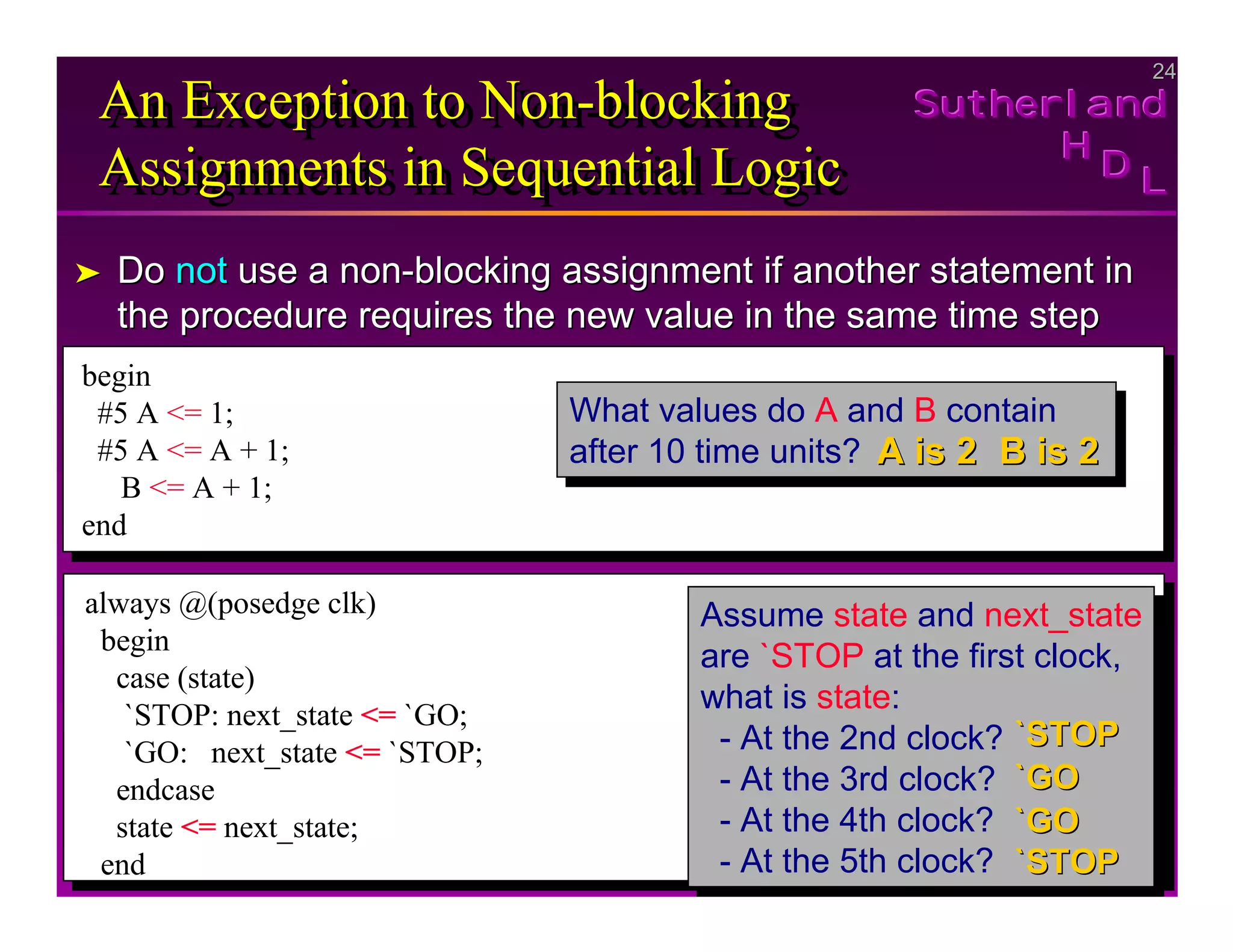
  • 24.
    24 24 Sutherland Sutherland Sutherland H H H D D D L L L An Exceptionto Non-blocking Assignments in Sequential Logic An Exception to Non An Exception to Non- -blocking blocking Assignments in Sequential Logic Assignments in Sequential Logic ➤ ➤ Do Do not not use a non use a non- -blocking assignment if another statement in blocking assignment if another statement in the procedure requires the new value in the same time step the procedure requires the new value in the same time step begin #5 A <= 1; #5 A <= A + 1; B <= A + 1; end What values do A and B contain after 10 time units? What values do A and B contain after 10 time units? always @(posedge clk) begin case (state) `STOP: next_state <= `GO; `GO: next_state <= `STOP; endcase state <= next_state; end Assume state and next_state are `STOP at the first clock, what is state: - At the 2nd clock? - At the 3rd clock? - At the 4th clock? - At the 5th clock? Assume state and next_state are `STOP at the first clock, what is state: - At the 2nd clock? - At the 3rd clock? - At the 4th clock? - At the 5th clock? A is 2 A is 2 B is 2 B is 2 `STOP `STOP `GO `GO `GO `GO `STOP `STOP
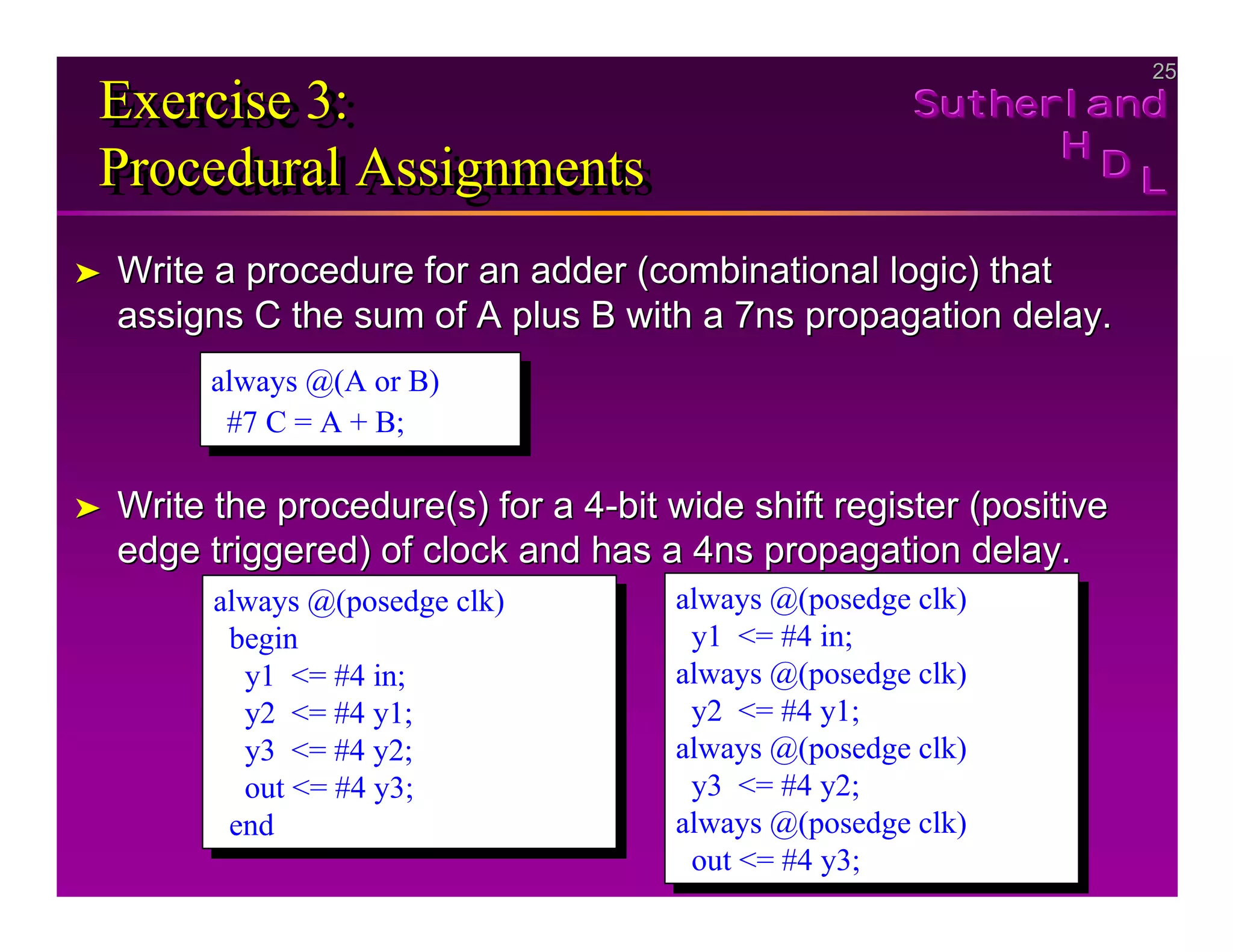
  • 25.
    25 25 Sutherland Sutherland Sutherland H H H D D D L L L Exercise 3: ProceduralAssignments Exercise 3: Exercise 3: Procedural Assignments Procedural Assignments ➤ ➤ Write a procedure for an adder (combinational logic) that Write a procedure for an adder (combinational logic) that assigns C the sum of A plus B with a 7ns propagation delay. assigns C the sum of A plus B with a 7ns propagation delay. ➤ ➤ Write the procedure(s) for a 4 Write the procedure(s) for a 4- -bit wide shift register (positive bit wide shift register (positive edge triggered) of clock and has a 4ns propagation delay. edge triggered) of clock and has a 4ns propagation delay. always @(A or B) #7 C = A + B; always @(A or B) #7 C = A + B; always @(posedge clk) begin y1 <= #4 in; y2 <= #4 y1; y3 <= #4 y2; out <= #4 y3; end always @(posedge clk) begin y1 <= #4 in; y2 <= #4 y1; y3 <= #4 y2; out <= #4 y3; end always @(posedge clk) y1 <= #4 in; always @(posedge clk) y2 <= #4 y1; always @(posedge clk) y3 <= #4 y2; always @(posedge clk) out <= #4 y3; always @(posedge clk) y1 <= #4 in; always @(posedge clk) y2 <= #4 y1; always @(posedge clk) y3 <= #4 y2; always @(posedge clk) out <= #4 y3;
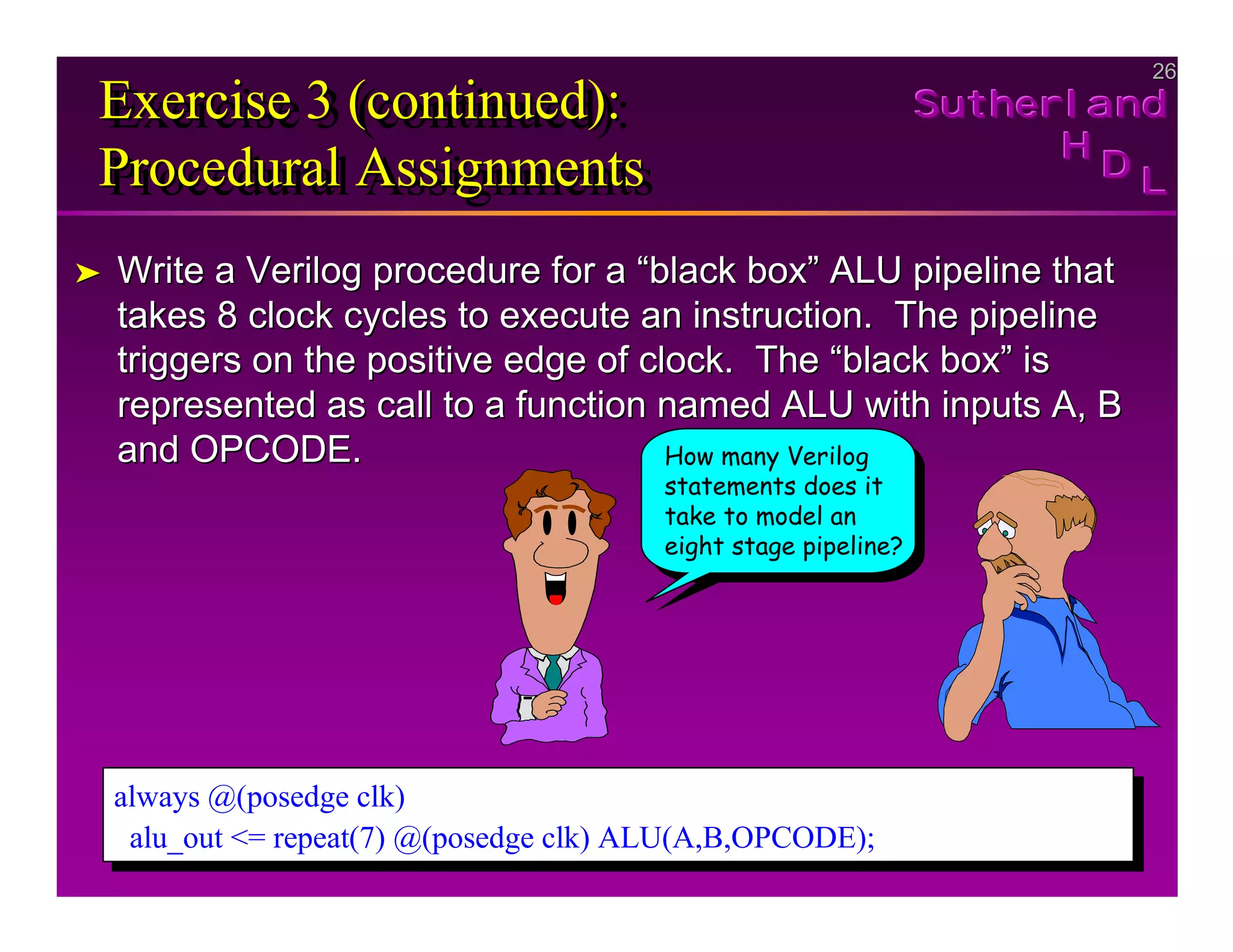
  • 26.
    26 26 Sutherland Sutherland Sutherland H H H D D D L L L Exercise 3(continued): Procedural Assignments Exercise 3 (continued): Exercise 3 (continued): Procedural Assignments Procedural Assignments ➤ ➤ Write a Verilog procedure for a “black box” ALU pipeline that Write a Verilog procedure for a “black box” ALU pipeline that takes 8 clock cycles to execute an instruction. The pipeline takes 8 clock cycles to execute an instruction. The pipeline triggers on the positive edge of clock. The “black box” is triggers on the positive edge of clock. The “black box” is represented as call to a function named ALU with inputs A, B represented as call to a function named ALU with inputs A, B and OPCODE. and OPCODE. always @(posedge clk) alu_out <= repeat(7) @(posedge clk) ALU(A,B,OPCODE); always @(posedge clk) alu_out <= repeat(7) @(posedge clk) ALU(A,B,OPCODE); How many Verilog statements does it take to model an eight stage pipeline?