Basic MOS Device Physics
Chapter 1
Basic MOS Device Physics
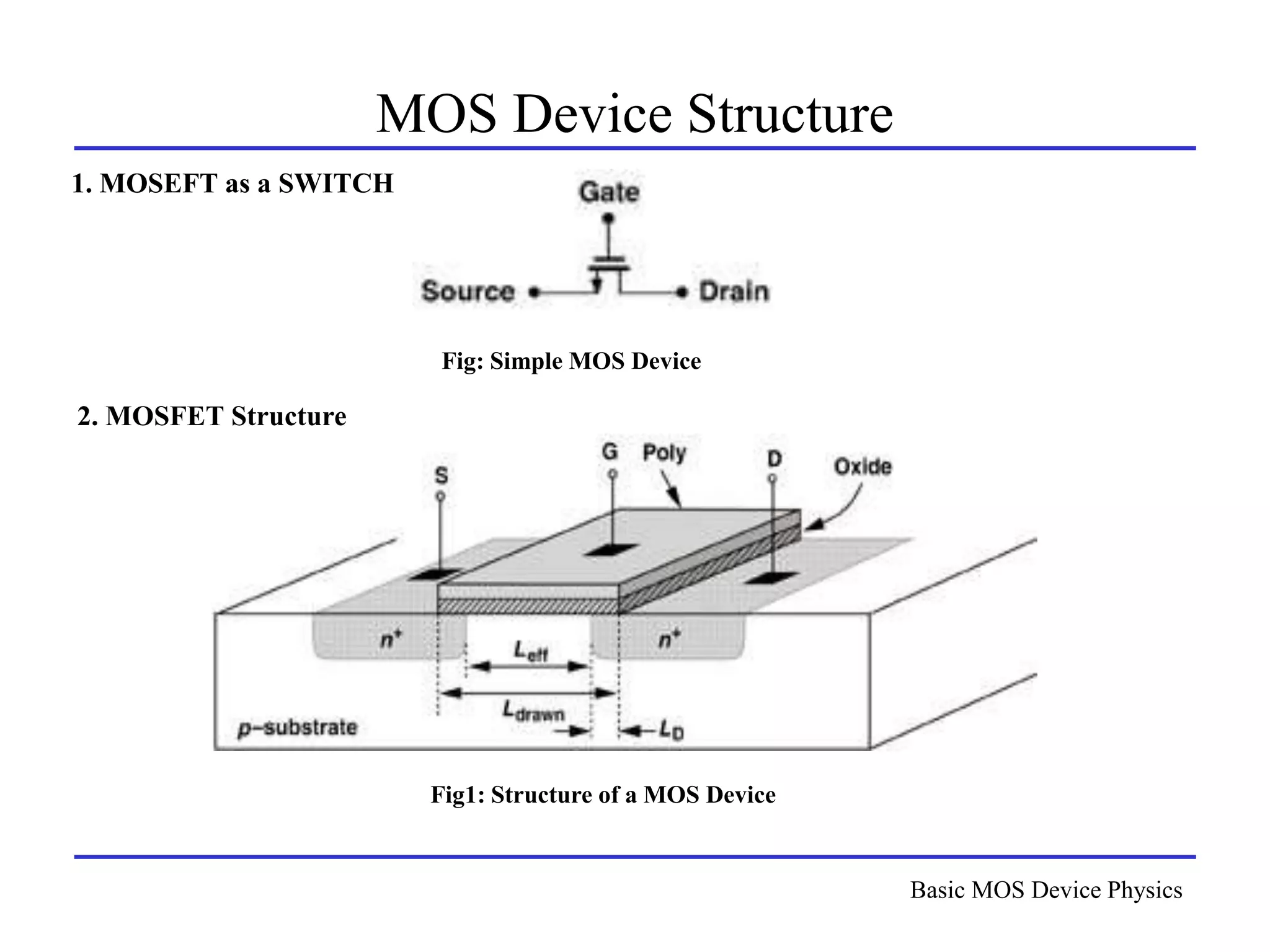
MOS Device Structure
Fig: Simple MOS Device
1. MOSEFT as a SWITCH
2. MOSFET Structure
Fig1: Structure of a MOS Device
Basic MOS Device Physics
NMOS and PMOS with Well
Fig2: (a): Simple PMOS device and (b): PMOS inside an n-well
Basic MOS Device Physics
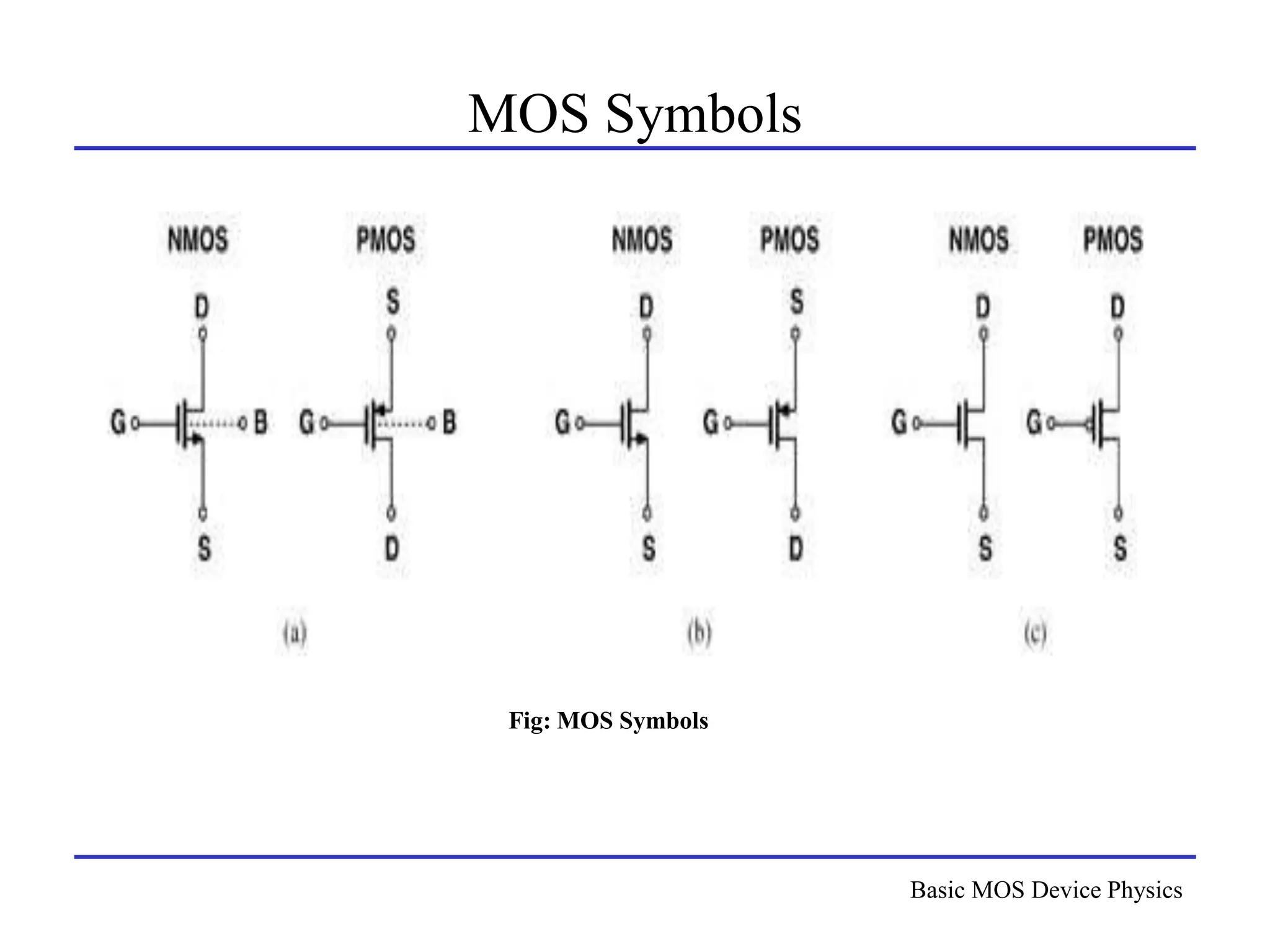
MOS Symbols
Fig: MOS Symbols
Basic MOS Device Physics
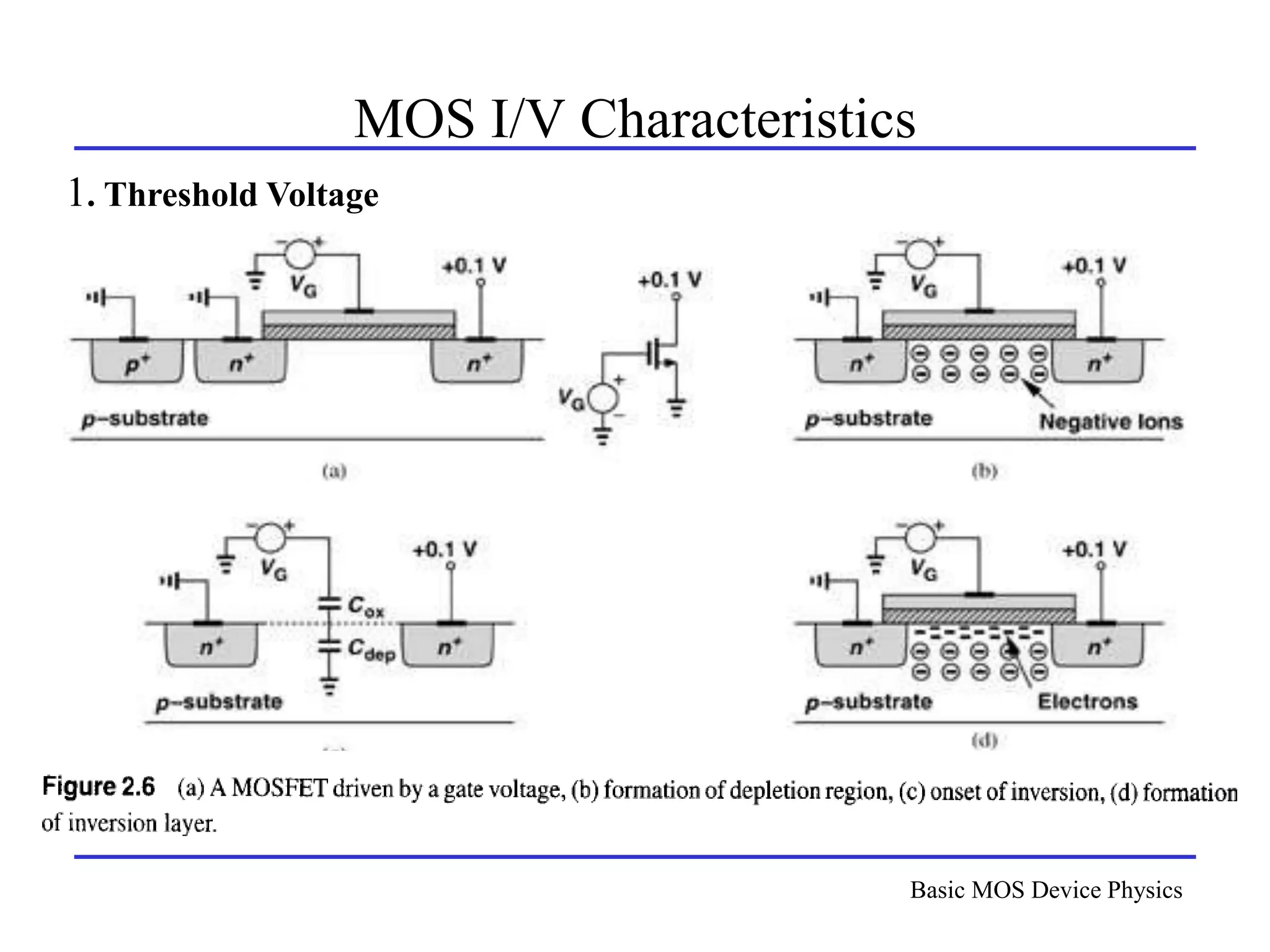
MOS I/V Characteristics
1. Threshold Voltage
Derivation of I/V Characteristics
)
1
(






  v
Q
I d
Basic MOS Device Physics
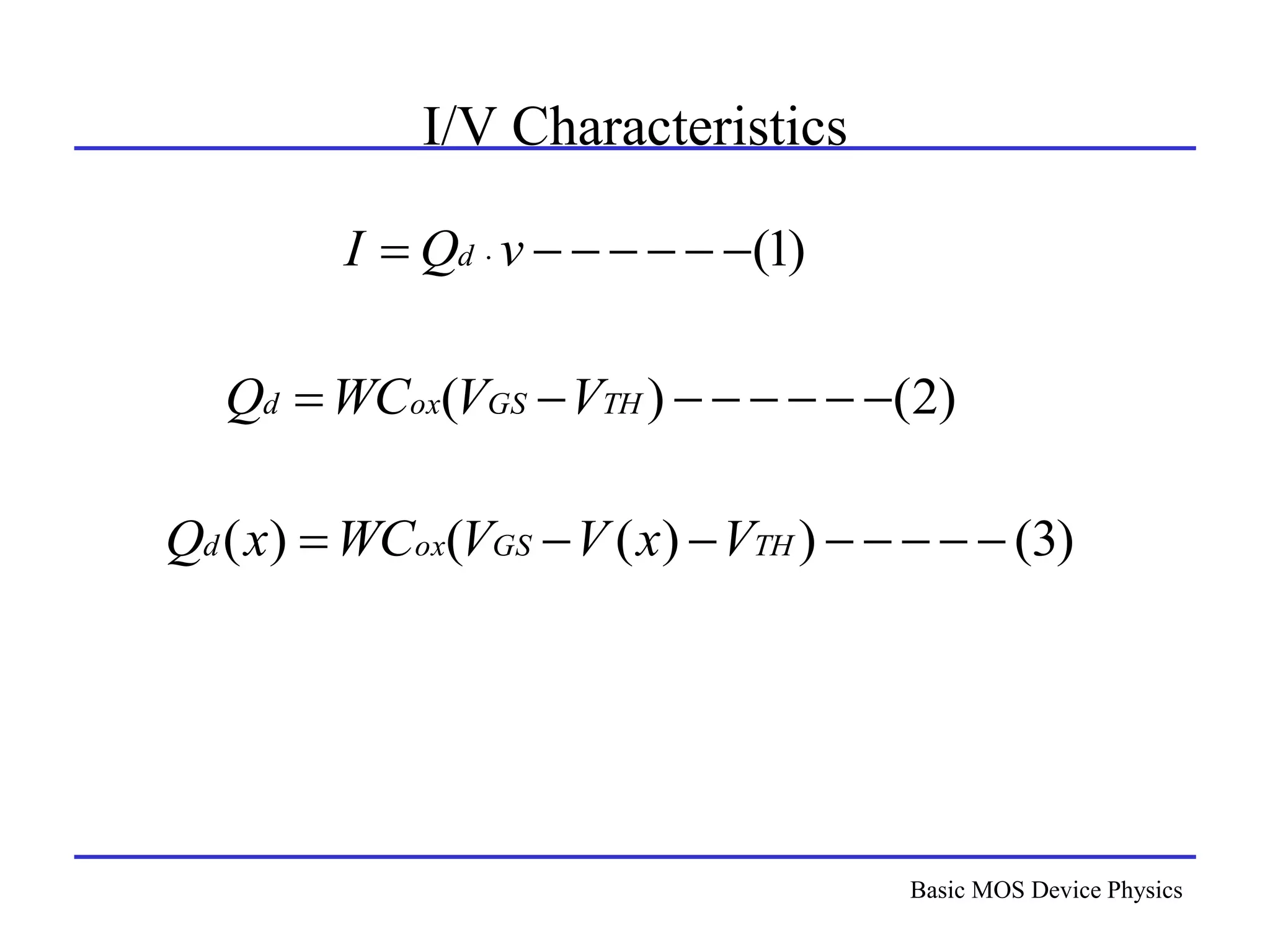
I/V Characteristics
Basic MOS Device Physics
I/V Characteristics
)
2
(
)
( 






 TH
GS
ox
d V
V
WC
Q
)
1
(






  v
Q
I d
)
3
(
)
)
(
(
)
( 






 TH
GS
ox
d V
x
V
V
WC
x
Q
Basic MOS Device Physics
I/V Characteristics (cont.)
)
4
(
]
)
(
[ 






 v
V
x
V
V
WC
I TH
GS
ox
D
)
6
(
]
)
(
[
0
0






 
 

VDS
V
TH
GS
n
ox
L
x
D dV
V
x
V
V
WC
dx
I 
Given v  E and E(x)  
dV (x)
dx
)
5
(
)
(
]
)
(
[ 







dx
x
dV
V
x
V
V
WC
I n
TH
GS
ox
D 
)
7
(
]
2
1
)
[( 2






 DS
DS
TH
GS
L
W
ox
n
D V
V
V
V
C
I 
From eq(1) the current is given by
Using Boundary conditions V(0)=0 and V(L)=Vds
Basic MOS Device Physics
I/V Characteristics (cont.)
ID  nCox
W
L
[(VGS  VTH)VDS 
1
2
VDS
2
]
Basic MOS Device Physics
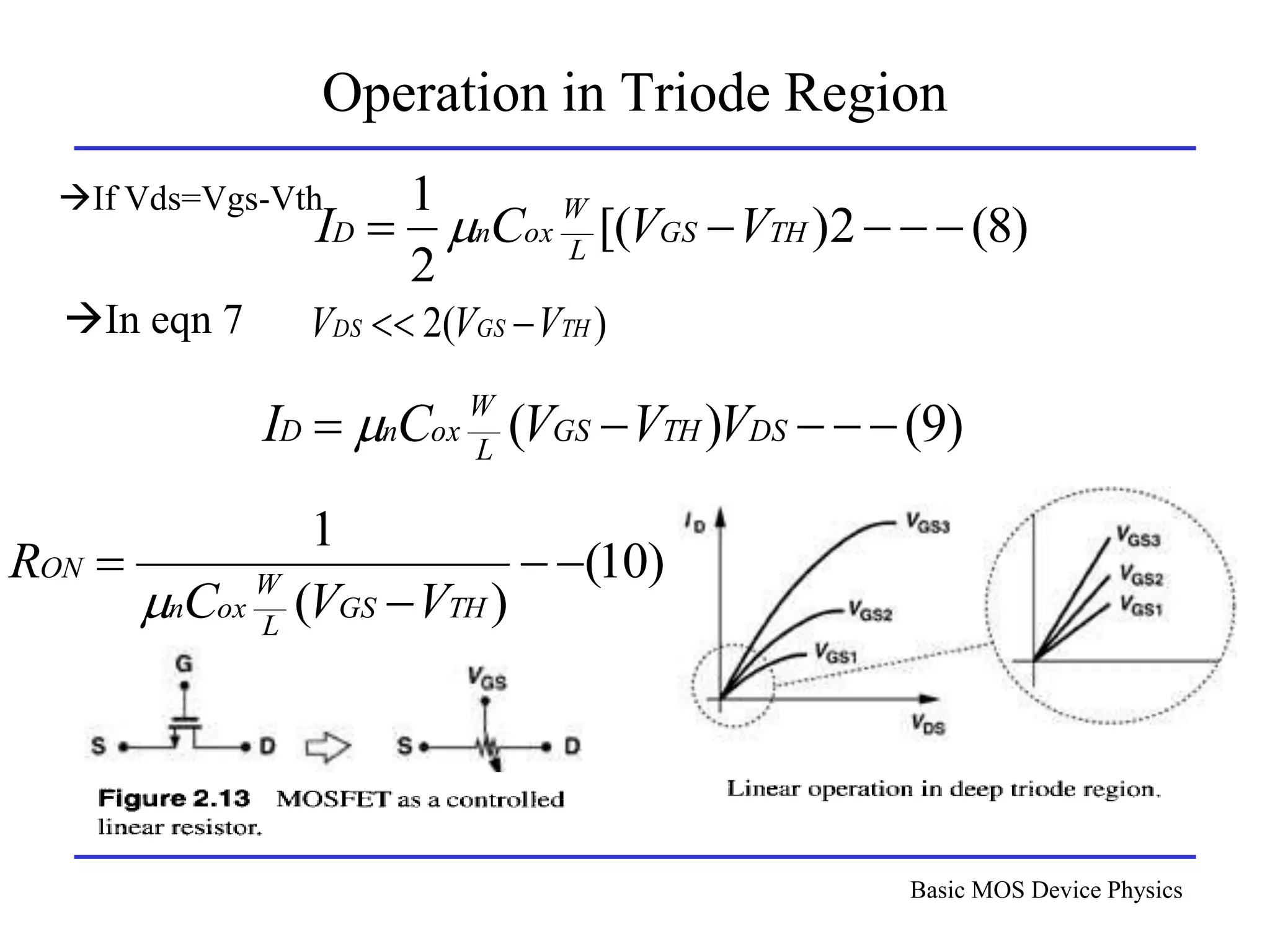
Operation in Triode Region
)
8
(
2
)
[(
2
1




 TH
GS
L
W
ox
n
D V
V
C
I 
)
9
(
)
( 



 DS
TH
GS
L
W
ox
n
D V
V
V
C
I 
)
10
(
)
(
1




TH
GS
L
W
ox
n
ON
V
V
C
R

If Vds=Vgs-Vth
)
(
2 TH
GS
DS V
V
V 

In eqn 7
Basic MOS Device Physics
Operation in Active (Saturation) Region
11
)
)
(
(
)
( 






 TH
GS
ox
d V
x
V
V
WC
x
Q
Using Boundary conditions for saturated device
)
12
(
]
)
(
[
0
0






 
 

VDS
V
TH
GS
n
ox
L
x
D dV
V
x
V
V
WC
dx
I 
)
13
(
]
)
(
[
0
0






 





VTH
VGS
V
TH
GS
n
ox
L
x
D dV
V
x
V
V
WC
dx
I 
Limits of left hand side from eqn (12) x=0 to x=L’ and right
hand side frrom V(x)=0 to V(x)=Vgs- Vth
Basic MOS Device Physics
Active Region (cont.)
)
14
(
)
( 



 
DS
TH
GS
L
W
ox
n
D V
V
V
C
I 
Basic MOS Device Physics
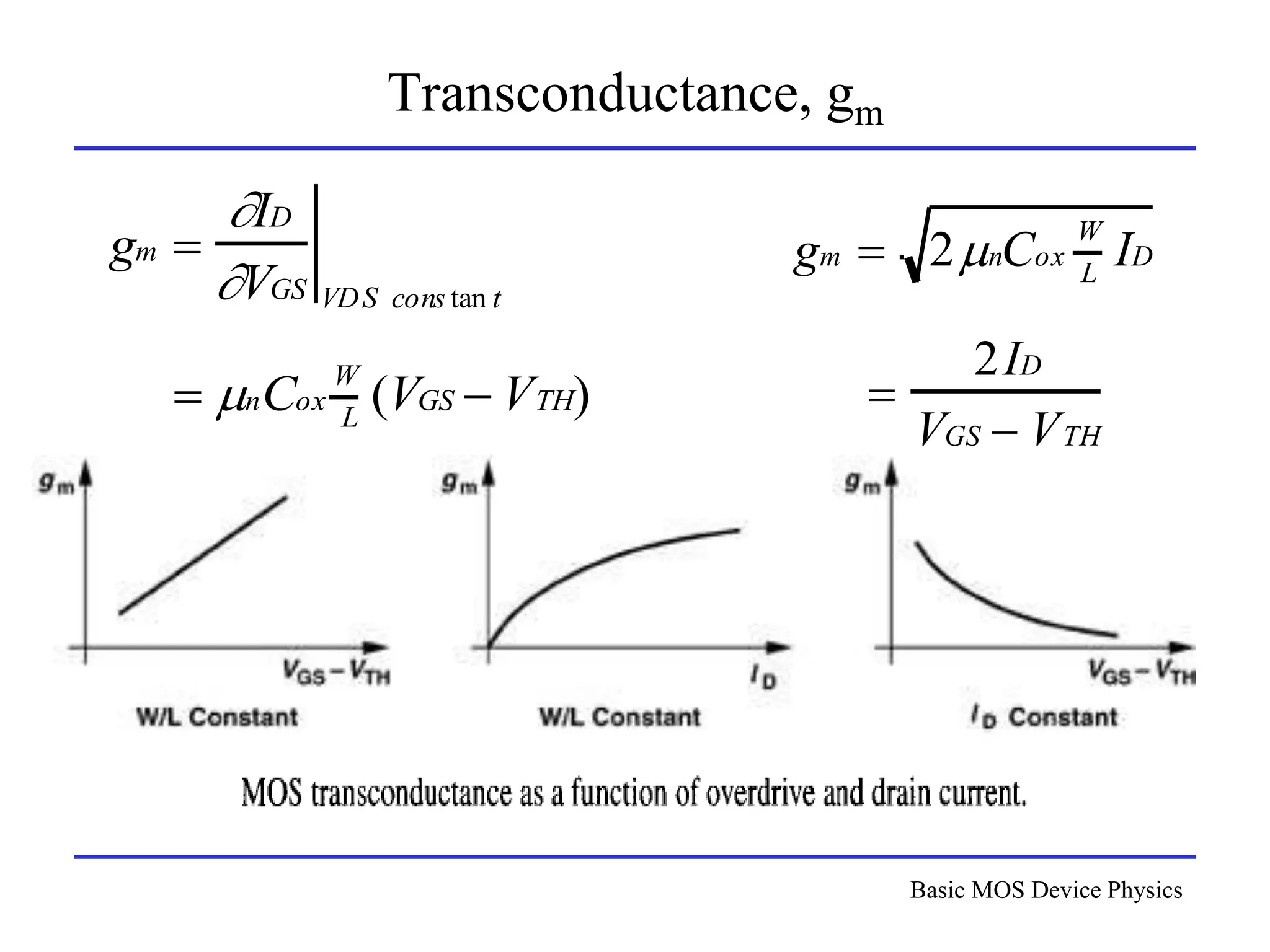
Transconductance, gm
gm 
ID
VGS VDS cons tan t
 nCox
W
L
(VGS  VTH)
gm  2nCox
W
L
ID

2ID
VGS  VTH
Basic MOS Device Physics
Triode and Active Region Transition
Active Active
Basic MOS Device Physics
Second Order effects
1.Body Effect
Basic MOS Device Physics
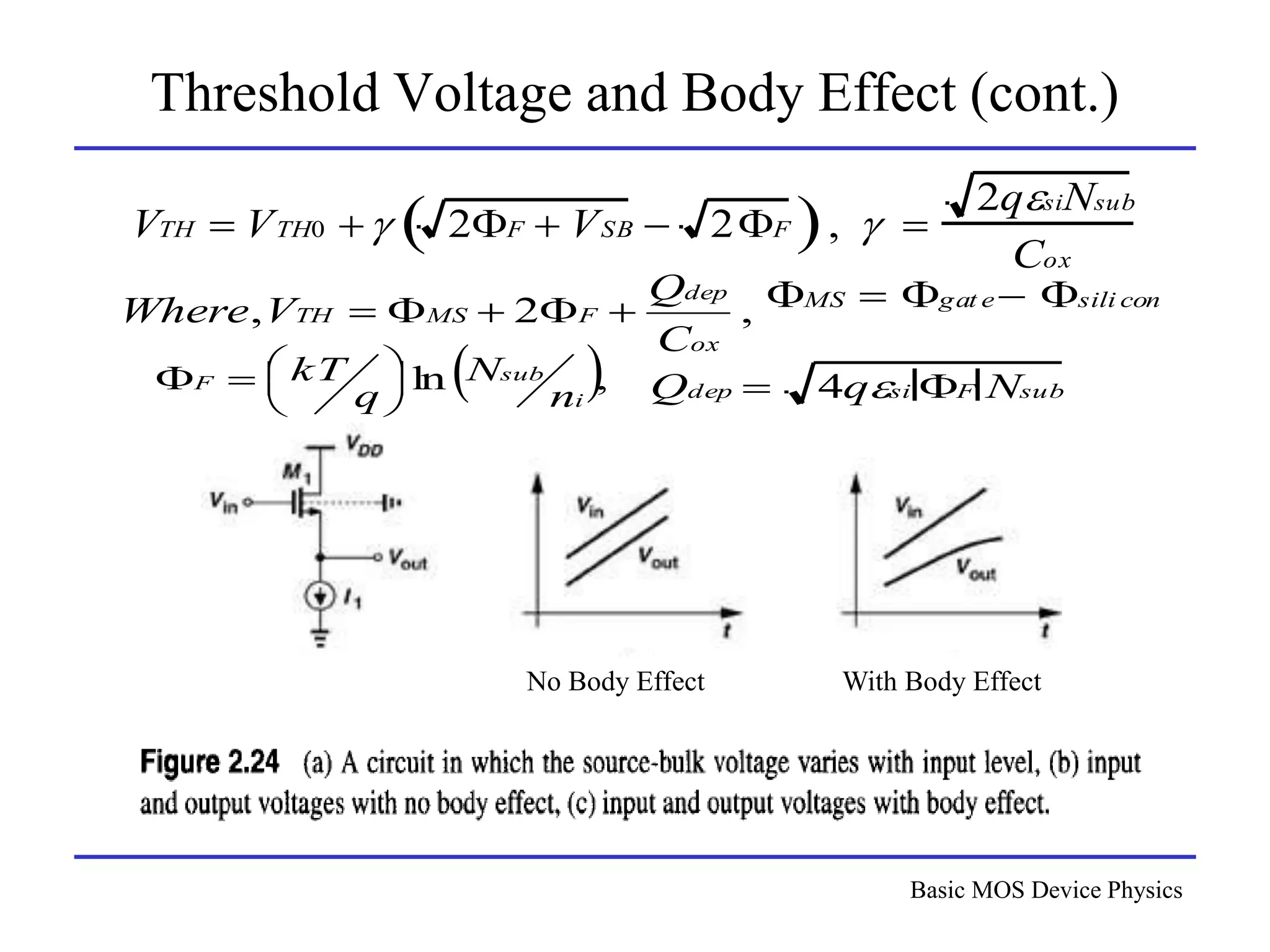
Threshold Voltage and Body Effect (cont.)
VTH  VTH0  2F  VSB  2F
 ,  
2qsiNsub
Cox
No Body Effect With Body Effect
,
2
,
ox
dep
F
MS
TH
C
Q
V
Where 



 MS  gat e  sili con
 ,
ln
i
sub
F
n
N
q
kT 






 Qdep  4qsi F Nsub
Basic MOS Device Physics
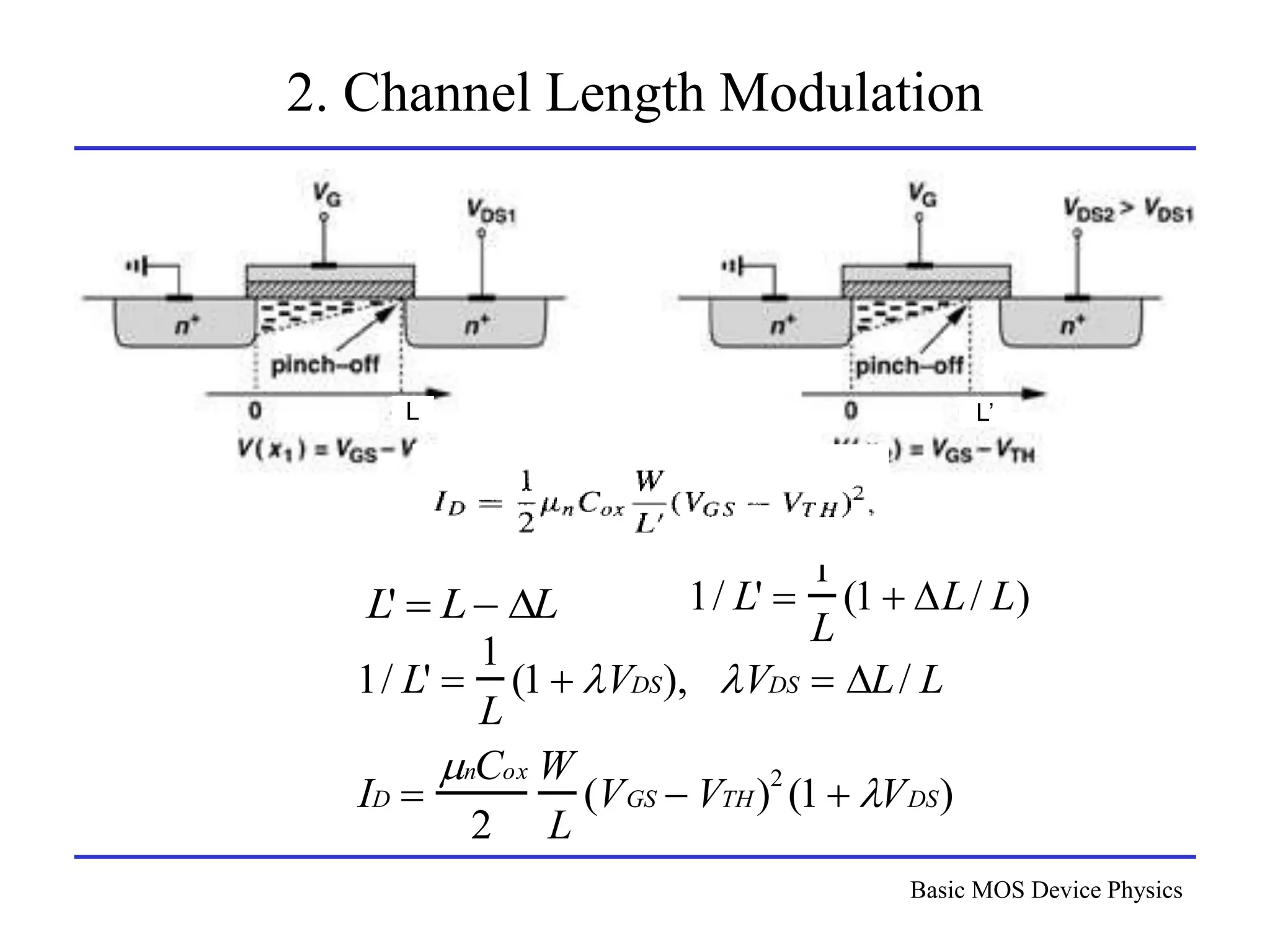
2. Channel Length Modulation
L'  L L 1/ L' 
1
L
(1  L/ L)
1/ L' 
1
L
(1  VDS), VDS  L/ L
ID 
nCox
2
W
L
(VGS  VTH)2
(1  VDS)
L L’
Basic MOS Device Physics
Channel Length Modulation (cont.)
gm  nCox
W
L
(VGS  VTH)(1  VDS)
gm 
2nCox W
LID
(1  VDS)
gm 
2ID
VGS  VTH
, (unchanged)
Basic MOS Device Physics
3. Subthreshold Conduction
ID  I0 exp
VGS
 kT
q






Basic MOS Device Physics
MOS Layout
Basic MOS Device Physics
MOS Device Capacitances
Basic MOS Device Physics
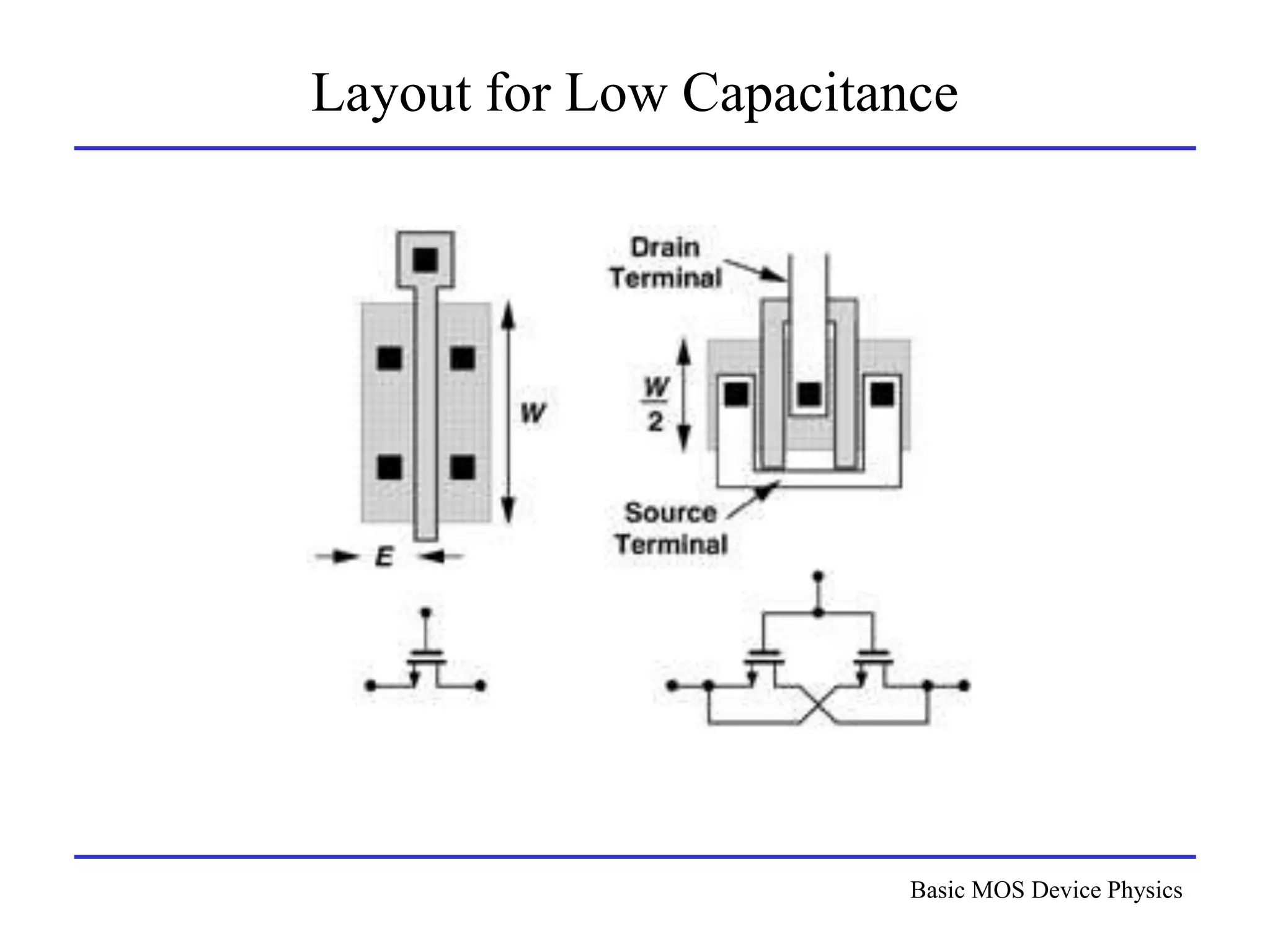
Layout for Low Capacitance
Basic MOS Device Physics
G-S and G-D Capacitance
Different regions of MOS device capacitance
Basic MOS Device Physics
2. MOS Small Signal Models
Basic MOS Device Physics
Bulk Transconductance, gmb
gmb 
ID
VBS

nCox
2
W
L
(VGS  VTH)
VTH
VBS




gmb  gm

2 2F VSB
 gm
Also,
VTH
VBS

VTH
VSB
 

2
(2F  VSB)1/ 2
ro 
VDS
ID

1
ID /VDS

1
nCox
2
W
L
(VGS  VTH)2


1
ID
Basic MOS Device Physics
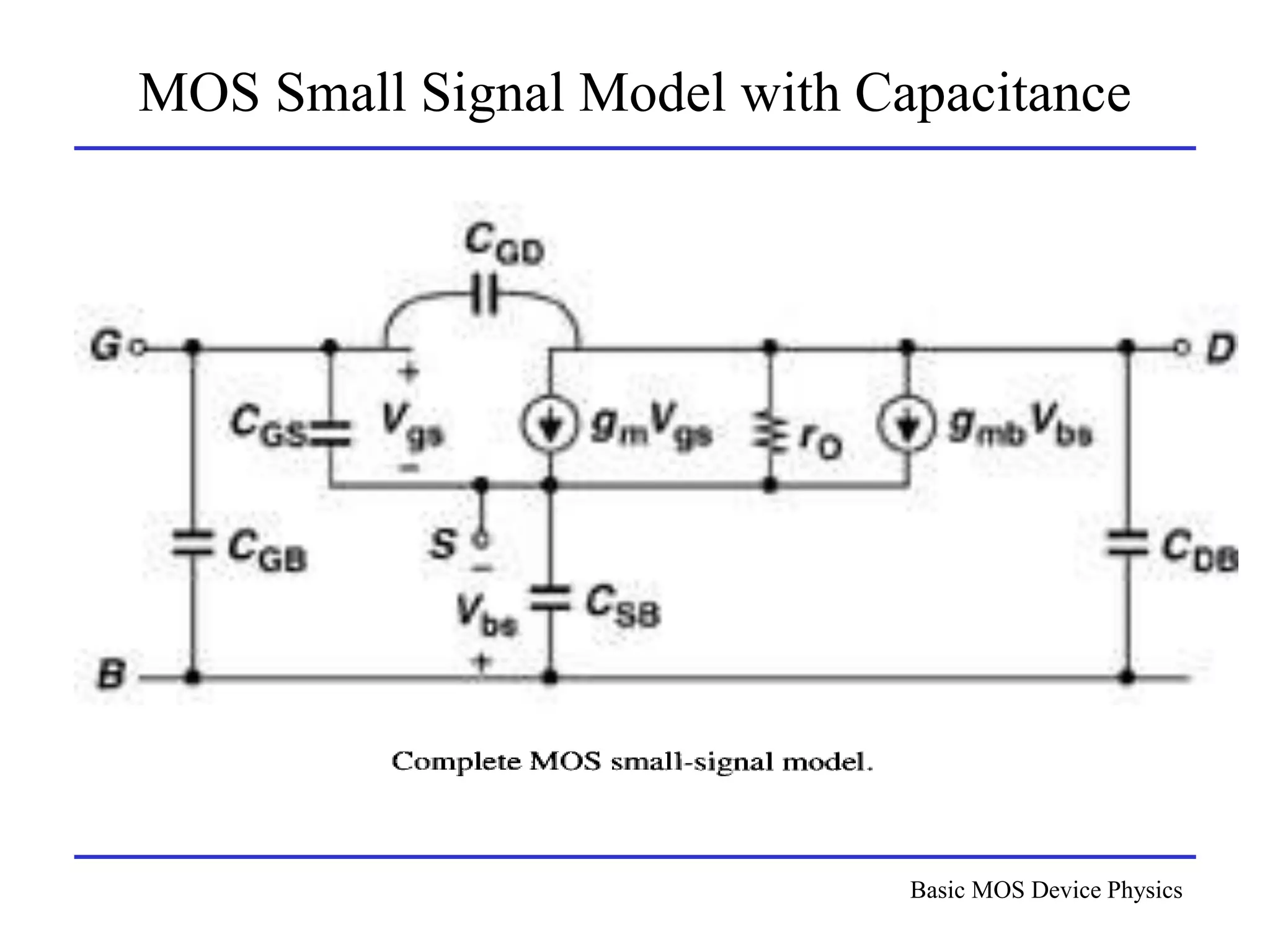
MOS Small Signal Model with Capacitance
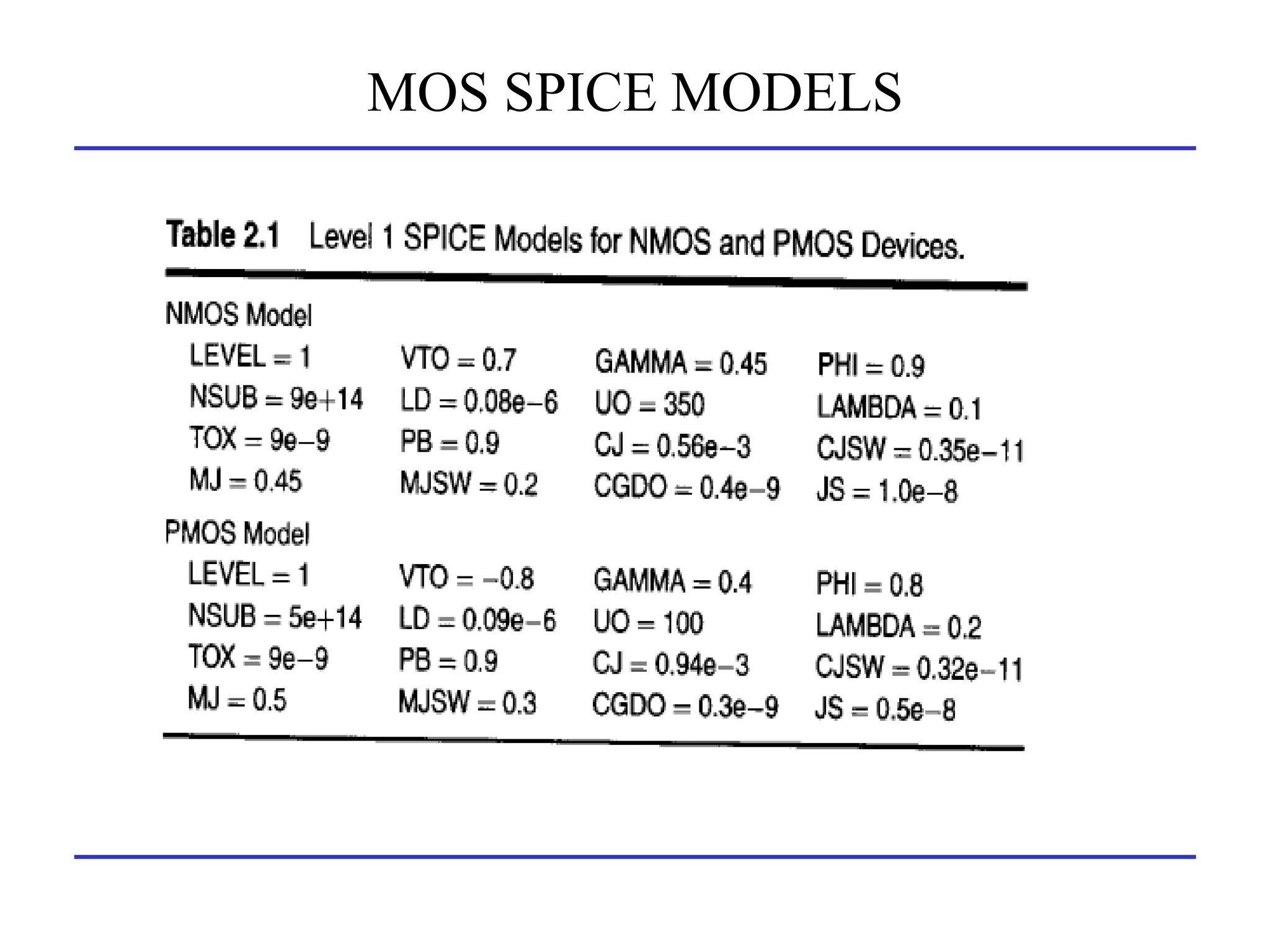
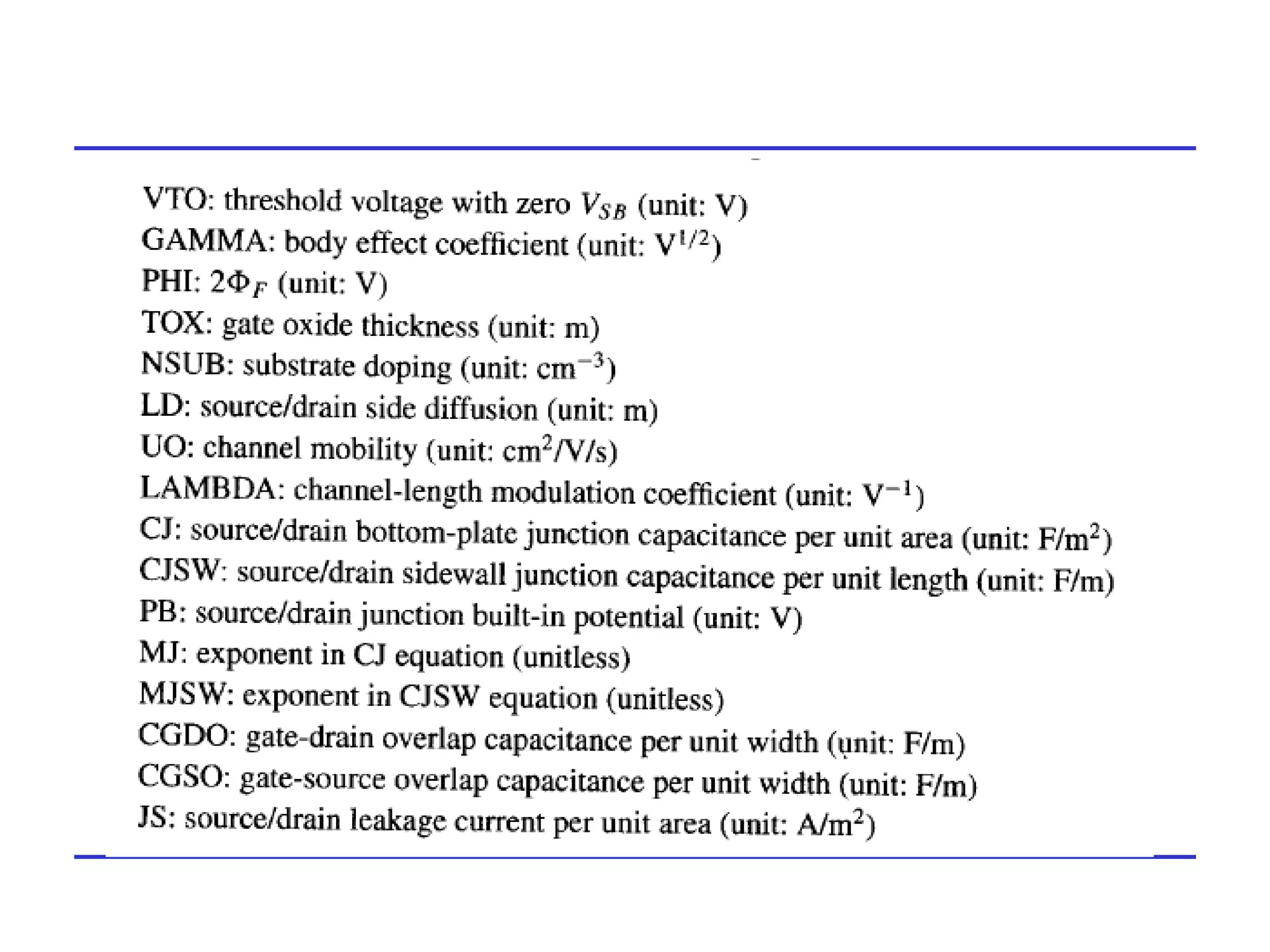
MOS SPICE MODELS
Unit1 ch-01.ppt

Unit1 ch-01.ppt

  • 1.
    Basic MOS DevicePhysics Chapter 1 Basic MOS Device Physics
  • 2.
    Basic MOS DevicePhysics MOS Device Structure Fig: Simple MOS Device 1. MOSEFT as a SWITCH 2. MOSFET Structure Fig1: Structure of a MOS Device
  • 3.
    Basic MOS DevicePhysics NMOS and PMOS with Well Fig2: (a): Simple PMOS device and (b): PMOS inside an n-well
  • 4.
    Basic MOS DevicePhysics MOS Symbols Fig: MOS Symbols
  • 5.
    Basic MOS DevicePhysics MOS I/V Characteristics 1. Threshold Voltage
  • 6.
    Derivation of I/VCharacteristics ) 1 (         v Q I d
  • 7.
    Basic MOS DevicePhysics I/V Characteristics
  • 8.
    Basic MOS DevicePhysics I/V Characteristics ) 2 ( ) (         TH GS ox d V V WC Q ) 1 (         v Q I d ) 3 ( ) ) ( ( ) (         TH GS ox d V x V V WC x Q
  • 9.
    Basic MOS DevicePhysics I/V Characteristics (cont.) ) 4 ( ] ) ( [         v V x V V WC I TH GS ox D ) 6 ( ] ) ( [ 0 0            VDS V TH GS n ox L x D dV V x V V WC dx I  Given v  E and E(x)   dV (x) dx ) 5 ( ) ( ] ) ( [         dx x dV V x V V WC I n TH GS ox D  ) 7 ( ] 2 1 ) [( 2        DS DS TH GS L W ox n D V V V V C I  From eq(1) the current is given by Using Boundary conditions V(0)=0 and V(L)=Vds
  • 10.
    Basic MOS DevicePhysics I/V Characteristics (cont.) ID  nCox W L [(VGS  VTH)VDS  1 2 VDS 2 ]
  • 11.
    Basic MOS DevicePhysics Operation in Triode Region ) 8 ( 2 ) [( 2 1      TH GS L W ox n D V V C I  ) 9 ( ) (      DS TH GS L W ox n D V V V C I  ) 10 ( ) ( 1     TH GS L W ox n ON V V C R  If Vds=Vgs-Vth ) ( 2 TH GS DS V V V   In eqn 7
  • 12.
    Basic MOS DevicePhysics Operation in Active (Saturation) Region
  • 13.
    11 ) ) ( ( ) (         TH GS ox dV x V V WC x Q Using Boundary conditions for saturated device ) 12 ( ] ) ( [ 0 0            VDS V TH GS n ox L x D dV V x V V WC dx I  ) 13 ( ] ) ( [ 0 0              VTH VGS V TH GS n ox L x D dV V x V V WC dx I  Limits of left hand side from eqn (12) x=0 to x=L’ and right hand side frrom V(x)=0 to V(x)=Vgs- Vth
  • 14.
    Basic MOS DevicePhysics Active Region (cont.) ) 14 ( ) (       DS TH GS L W ox n D V V V C I 
  • 15.
    Basic MOS DevicePhysics Transconductance, gm gm  ID VGS VDS cons tan t  nCox W L (VGS  VTH) gm  2nCox W L ID  2ID VGS  VTH
  • 16.
    Basic MOS DevicePhysics Triode and Active Region Transition Active Active
  • 17.
    Basic MOS DevicePhysics Second Order effects 1.Body Effect
  • 18.
    Basic MOS DevicePhysics Threshold Voltage and Body Effect (cont.) VTH  VTH0  2F  VSB  2F  ,   2qsiNsub Cox No Body Effect With Body Effect , 2 , ox dep F MS TH C Q V Where      MS  gat e  sili con  , ln i sub F n N q kT         Qdep  4qsi F Nsub
  • 19.
    Basic MOS DevicePhysics 2. Channel Length Modulation L'  L L 1/ L'  1 L (1  L/ L) 1/ L'  1 L (1  VDS), VDS  L/ L ID  nCox 2 W L (VGS  VTH)2 (1  VDS) L L’
  • 20.
    Basic MOS DevicePhysics Channel Length Modulation (cont.) gm  nCox W L (VGS  VTH)(1  VDS) gm  2nCox W LID (1  VDS) gm  2ID VGS  VTH , (unchanged)
  • 21.
    Basic MOS DevicePhysics 3. Subthreshold Conduction ID  I0 exp VGS  kT q      
  • 22.
    Basic MOS DevicePhysics MOS Layout
  • 23.
    Basic MOS DevicePhysics MOS Device Capacitances
  • 24.
    Basic MOS DevicePhysics Layout for Low Capacitance
  • 25.
    Basic MOS DevicePhysics G-S and G-D Capacitance Different regions of MOS device capacitance
  • 26.
    Basic MOS DevicePhysics 2. MOS Small Signal Models
  • 27.
    Basic MOS DevicePhysics Bulk Transconductance, gmb gmb  ID VBS  nCox 2 W L (VGS  VTH) VTH VBS     gmb  gm  2 2F VSB  gm Also, VTH VBS  VTH VSB    2 (2F  VSB)1/ 2 ro  VDS ID  1 ID /VDS  1 nCox 2 W L (VGS  VTH)2   1 ID
  • 28.
    Basic MOS DevicePhysics MOS Small Signal Model with Capacitance
  • 29.