CS 295: ModernSystems
GPU Computing Introduction
Sang-Woo Jun
Spring 2019
2.
Graphic Processing –Some History
1990s: Real-time 3D rendering for video games were becoming common
o Doom, Quake, Descent, … (Nostalgia!)
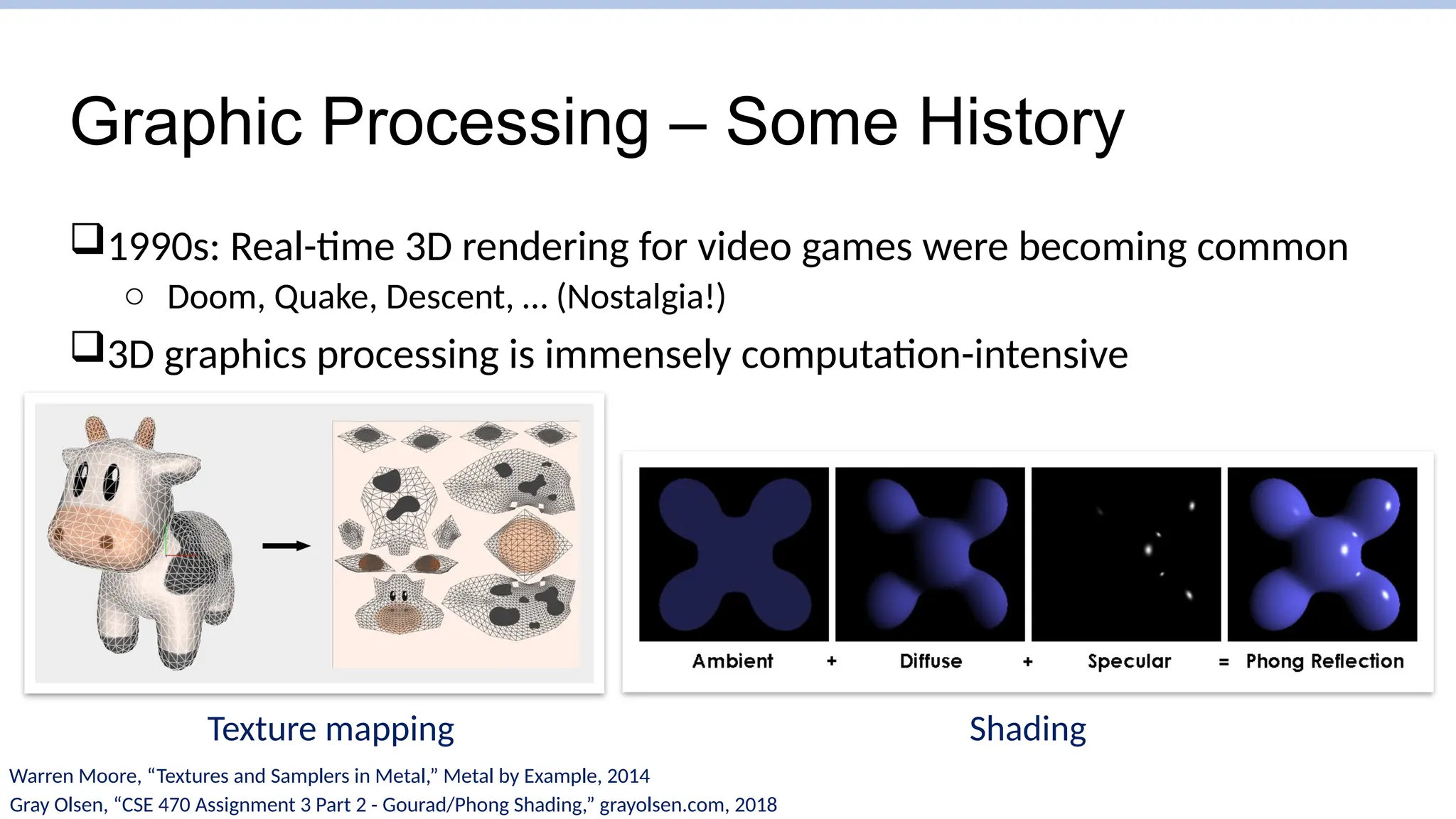
3D graphics processing is immensely computation-intensive
Texture mapping
Warren Moore, “Textures and Samplers in Metal,” Metal by Example, 2014
Shading
Gray Olsen, “CSE 470 Assignment 3 Part 2 - Gourad/Phong Shading,” grayolsen.com, 2018
3.
Graphic Processing –Some History
Before 3D accelerators (GPUs) were common
CPUs had to do all graphics computation, while maintaining framerate!
o Many tricks were played
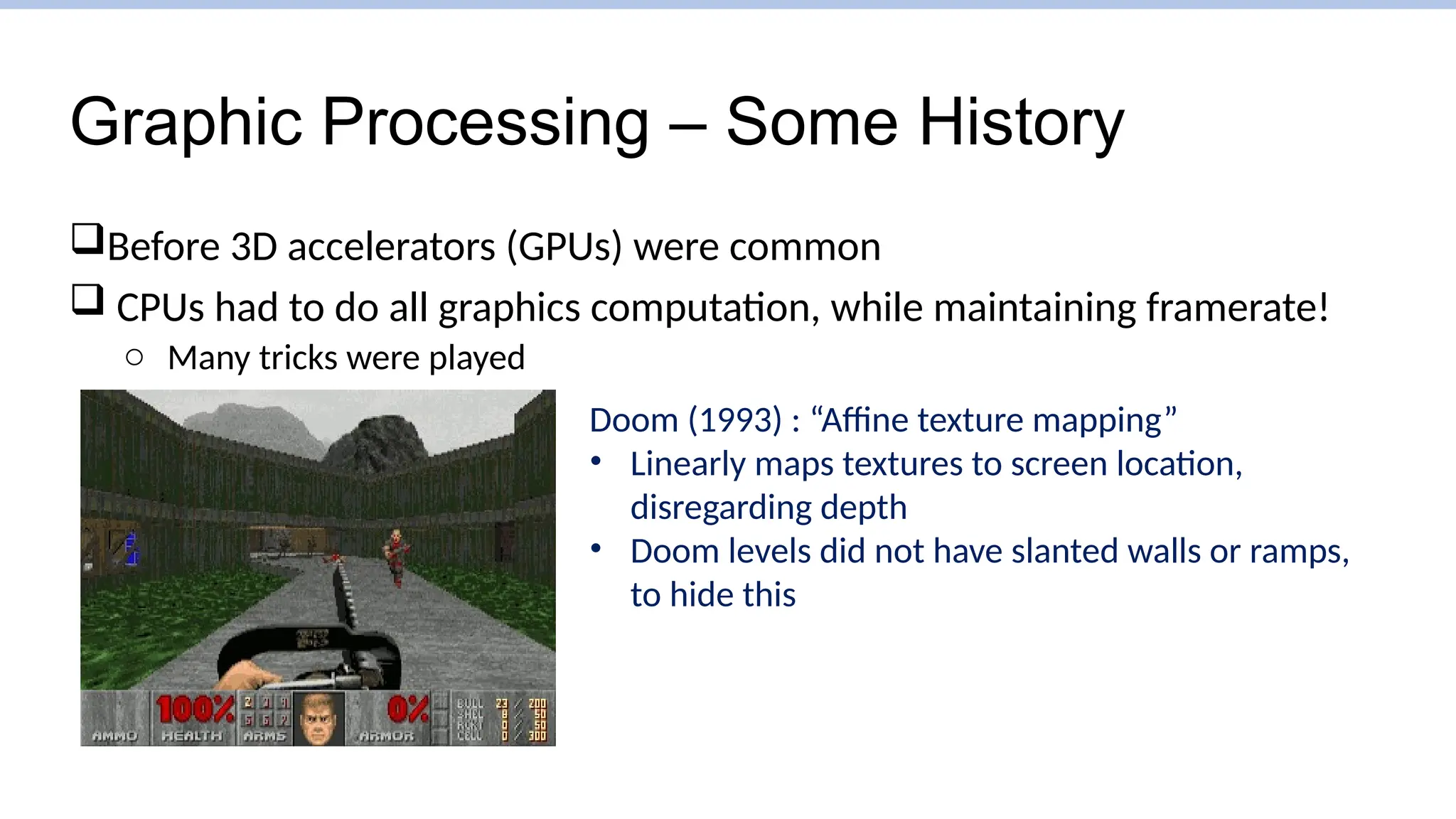
Doom (1993) : “Affine texture mapping”
• Linearly maps textures to screen location,
disregarding depth
• Doom levels did not have slanted walls or ramps,
to hide this
4.
Graphic Processing –Some History
Before 3D accelerators (GPUs) were common
CPUs had to do all graphics computation, while maintaining framerate!
o Many tricks were played
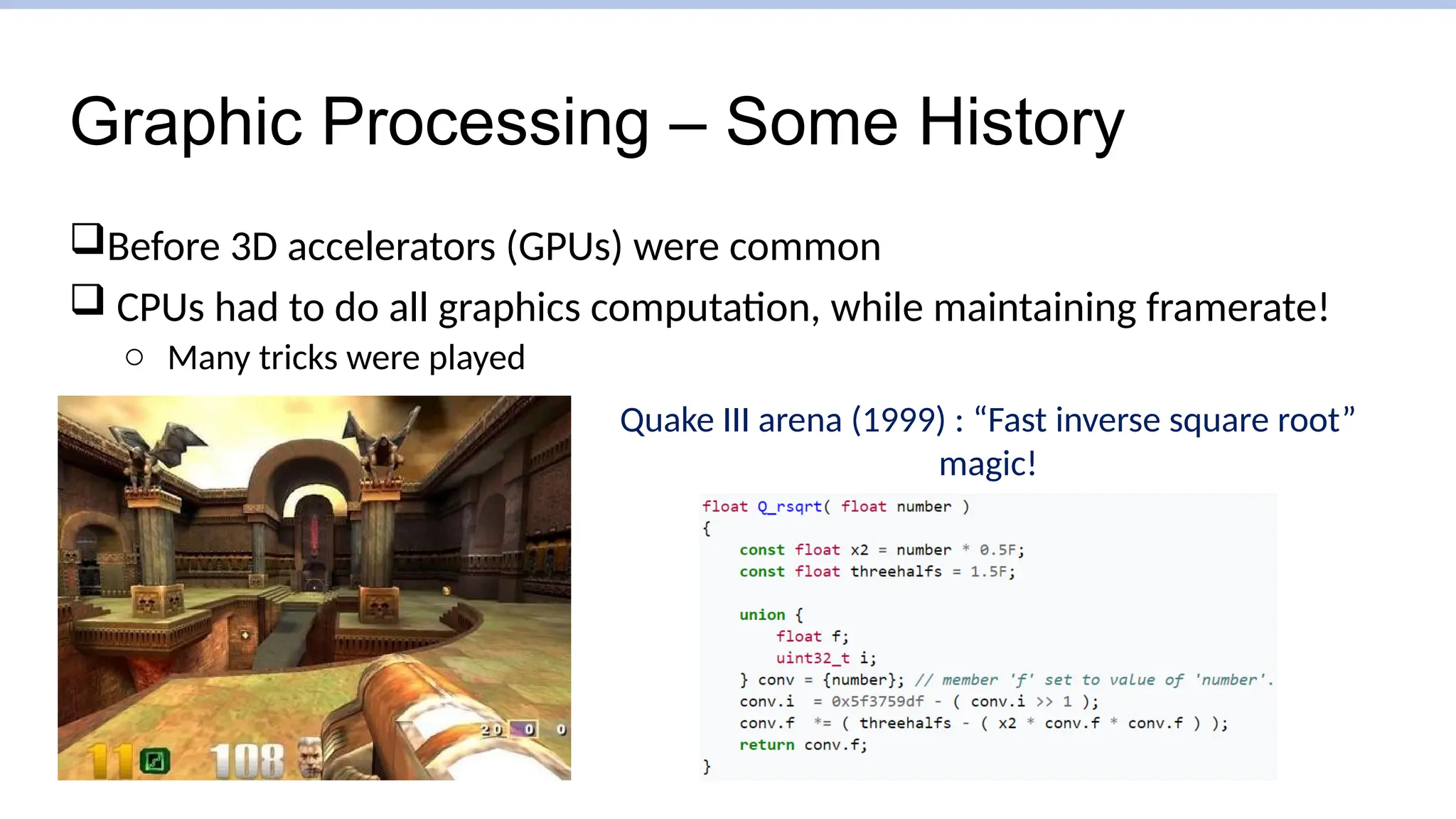
Quake III arena (1999) : “Fast inverse square root”
magic!
5.
Introduction of 3DAccelerator Cards
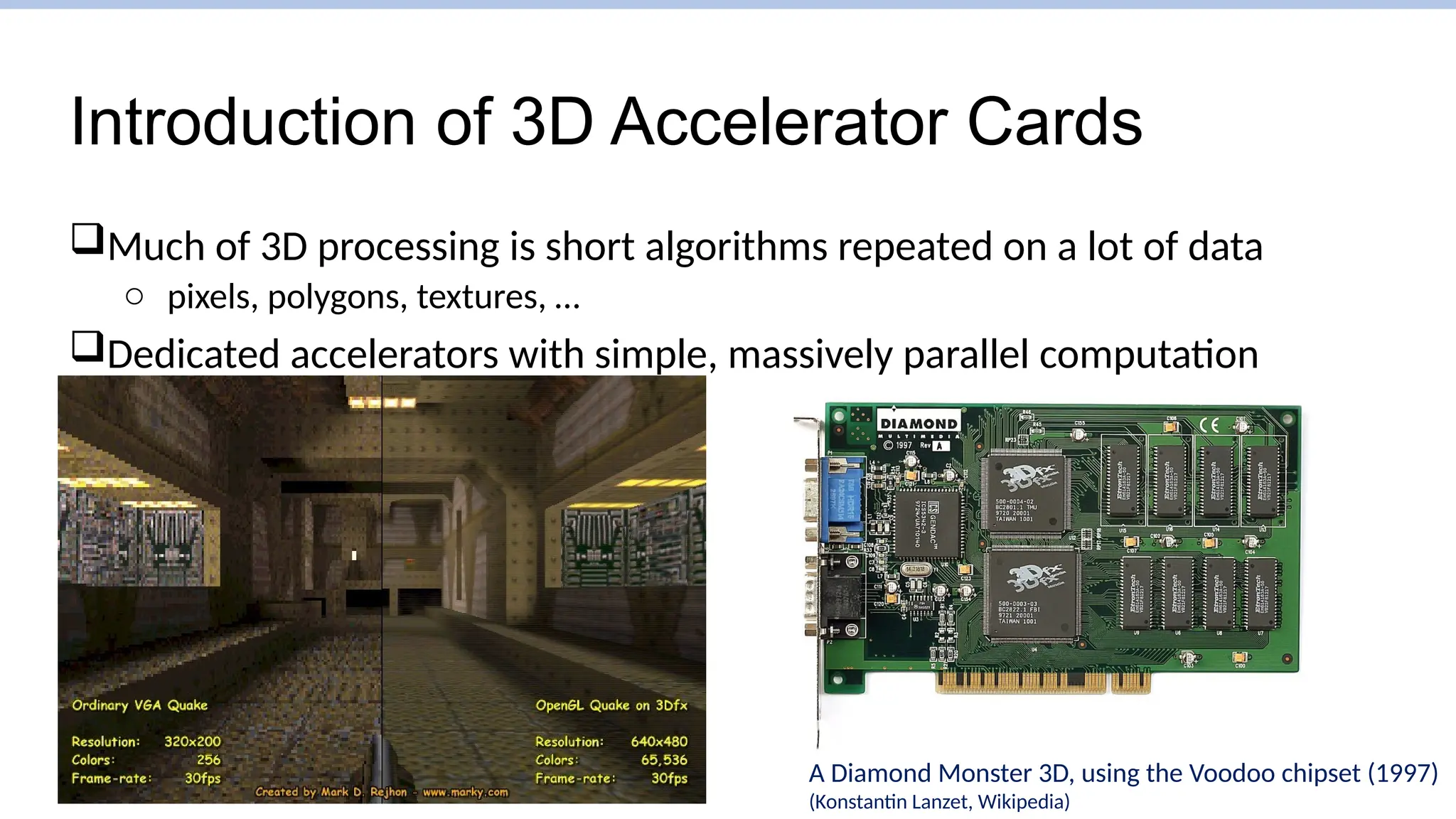
Much of 3D processing is short algorithms repeated on a lot of data
o pixels, polygons, textures, …
Dedicated accelerators with simple, massively parallel computation
A Diamond Monster 3D, using the Voodoo chipset (1997)
(Konstantin Lanzet, Wikipedia)
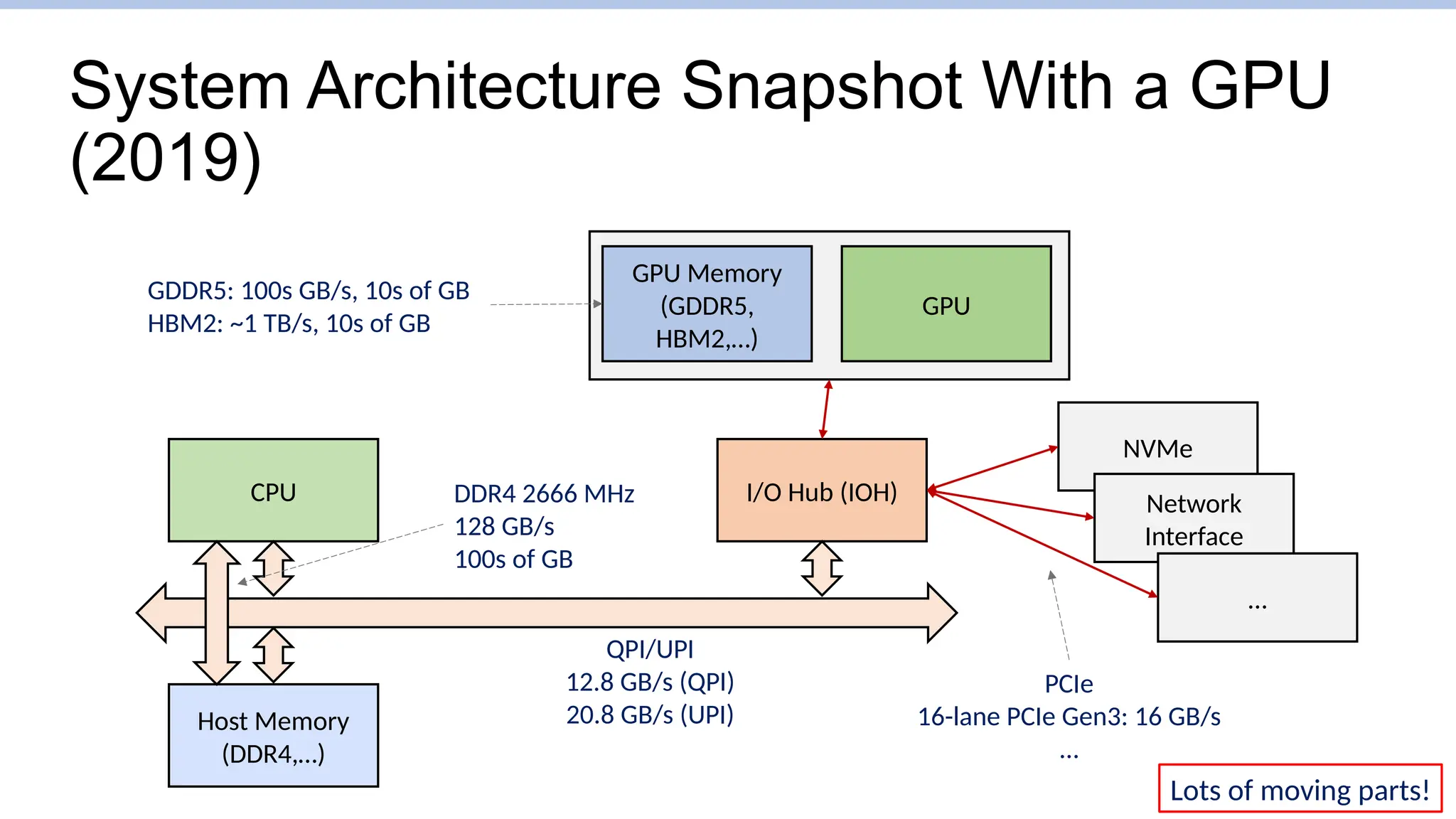
System Architecture SnapshotWith a GPU
(2019)
CPU
GPU
GPU Memory
(GDDR5,
HBM2,…)
Host Memory
(DDR4,…)
I/O Hub (IOH)
NVMe
Network
Interface
…
QPI/UPI
12.8 GB/s (QPI)
20.8 GB/s (UPI)
PCIe
16-lane PCIe Gen3: 16 GB/s
…
DDR4 2666 MHz
128 GB/s
100s of GB
GDDR5: 100s GB/s, 10s of GB
HBM2: ~1 TB/s, 10s of GB
Lots of moving parts!
9.
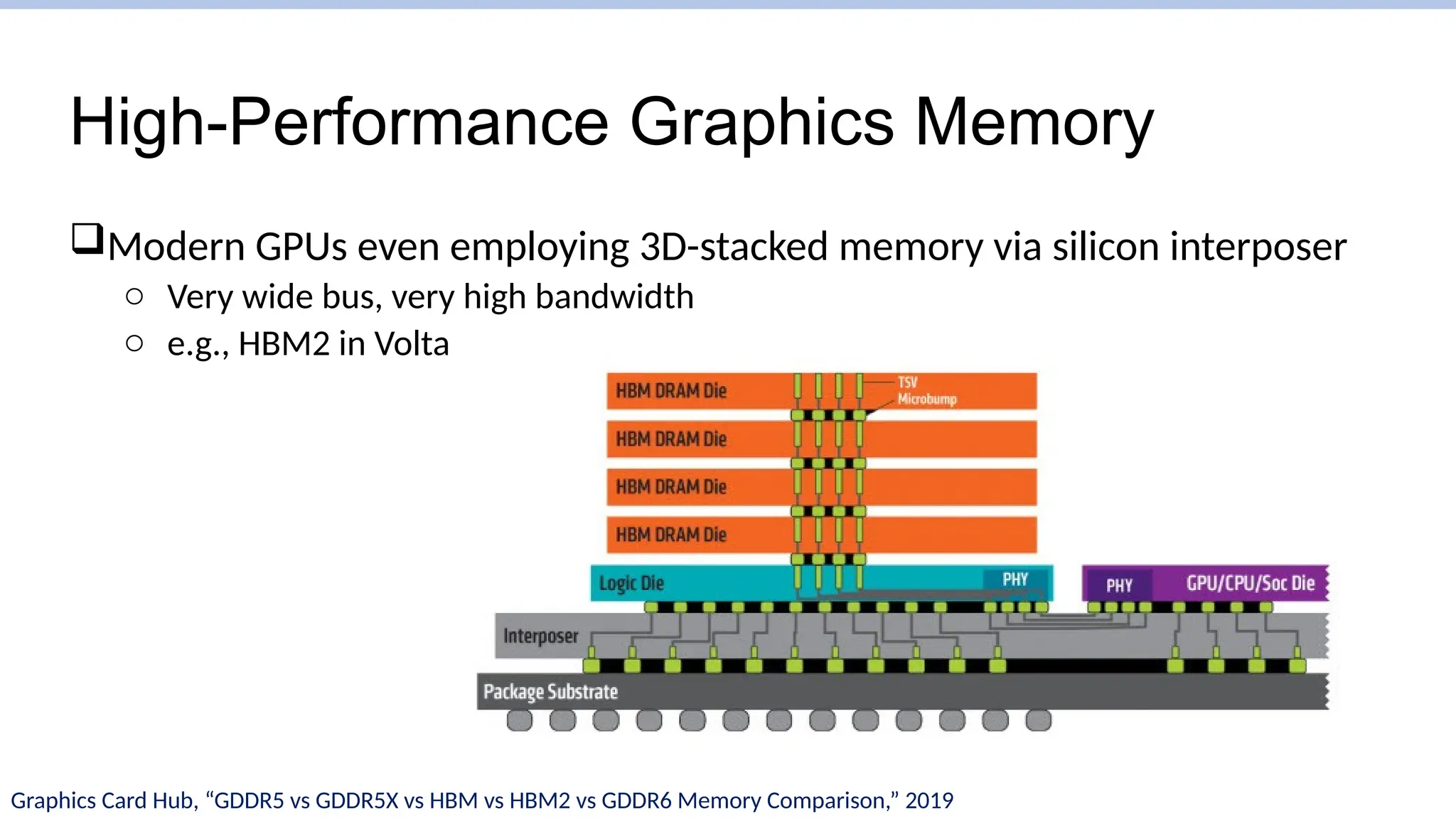
High-Performance Graphics Memory
ModernGPUs even employing 3D-stacked memory via silicon interposer
o Very wide bus, very high bandwidth
o e.g., HBM2 in Volta
Graphics Card Hub, “GDDR5 vs GDDR5X vs HBM vs HBM2 vs GDDR6 Memory Comparison,” 2019
10.
Massively Parallel ArchitectureFor
Massively Parallel Workloads!
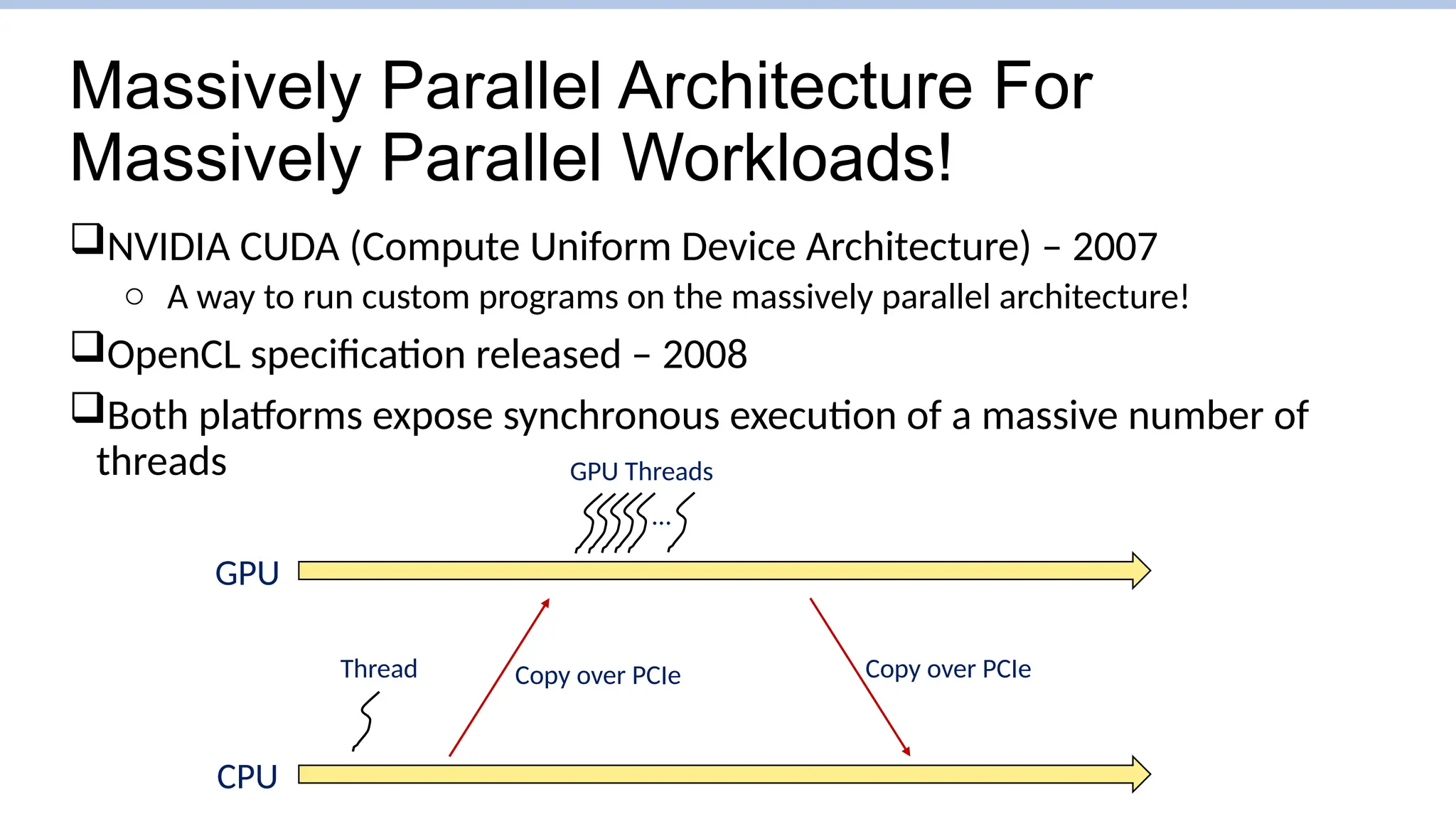
NVIDIA CUDA (Compute Uniform Device Architecture) – 2007
o A way to run custom programs on the massively parallel architecture!
OpenCL specification released – 2008
Both platforms expose synchronous execution of a massive number of
threads
CPU
GPU
Thread
…
GPU Threads
Copy over PCIe Copy over PCIe
11.
CUDA Execution Abstraction
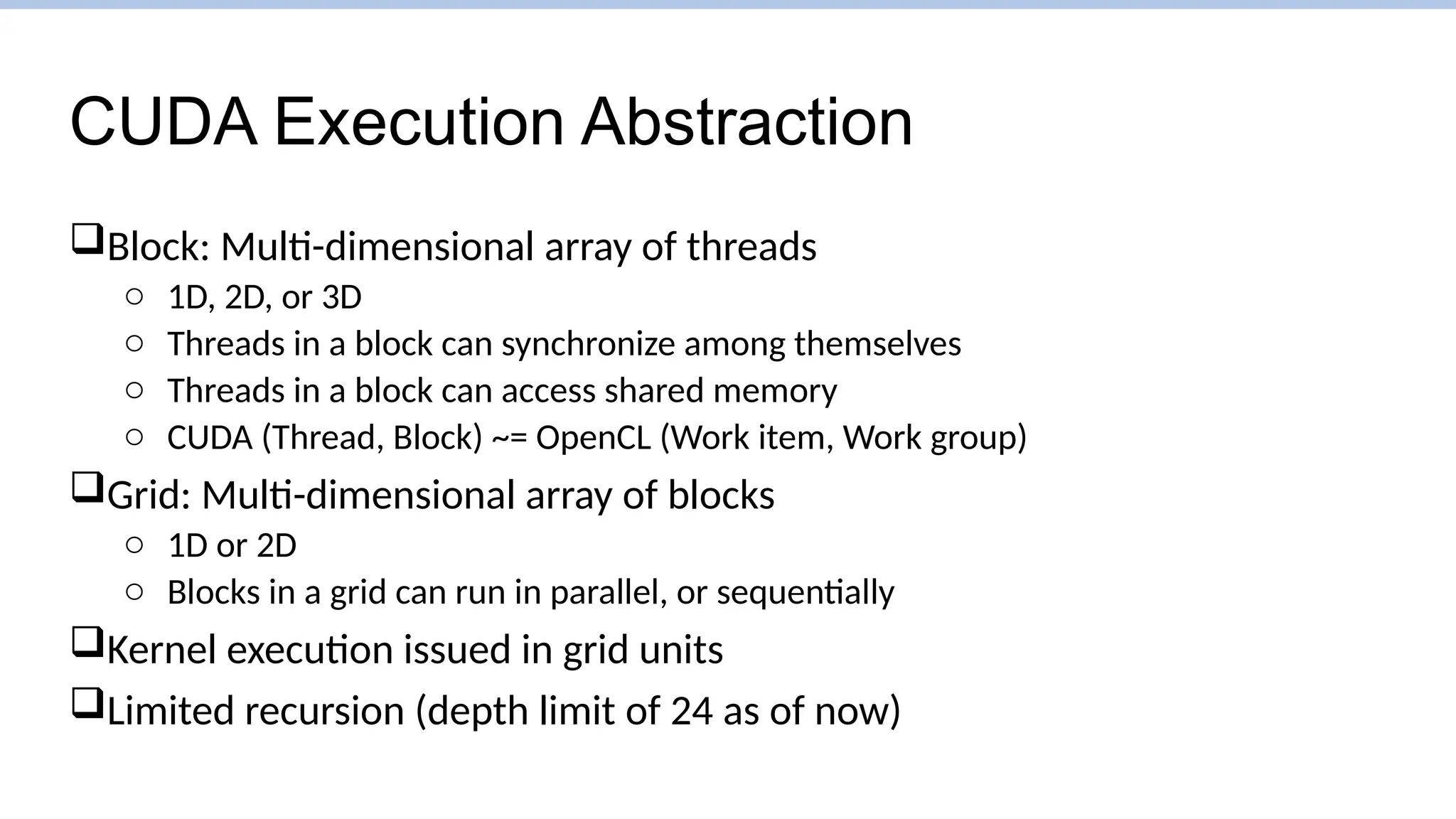
Block:Multi-dimensional array of threads
o 1D, 2D, or 3D
o Threads in a block can synchronize among themselves
o Threads in a block can access shared memory
o CUDA (Thread, Block) ~= OpenCL (Work item, Work group)
Grid: Multi-dimensional array of blocks
o 1D or 2D
o Blocks in a grid can run in parallel, or sequentially
Kernel execution issued in grid units
Limited recursion (depth limit of 24 as of now)
12.
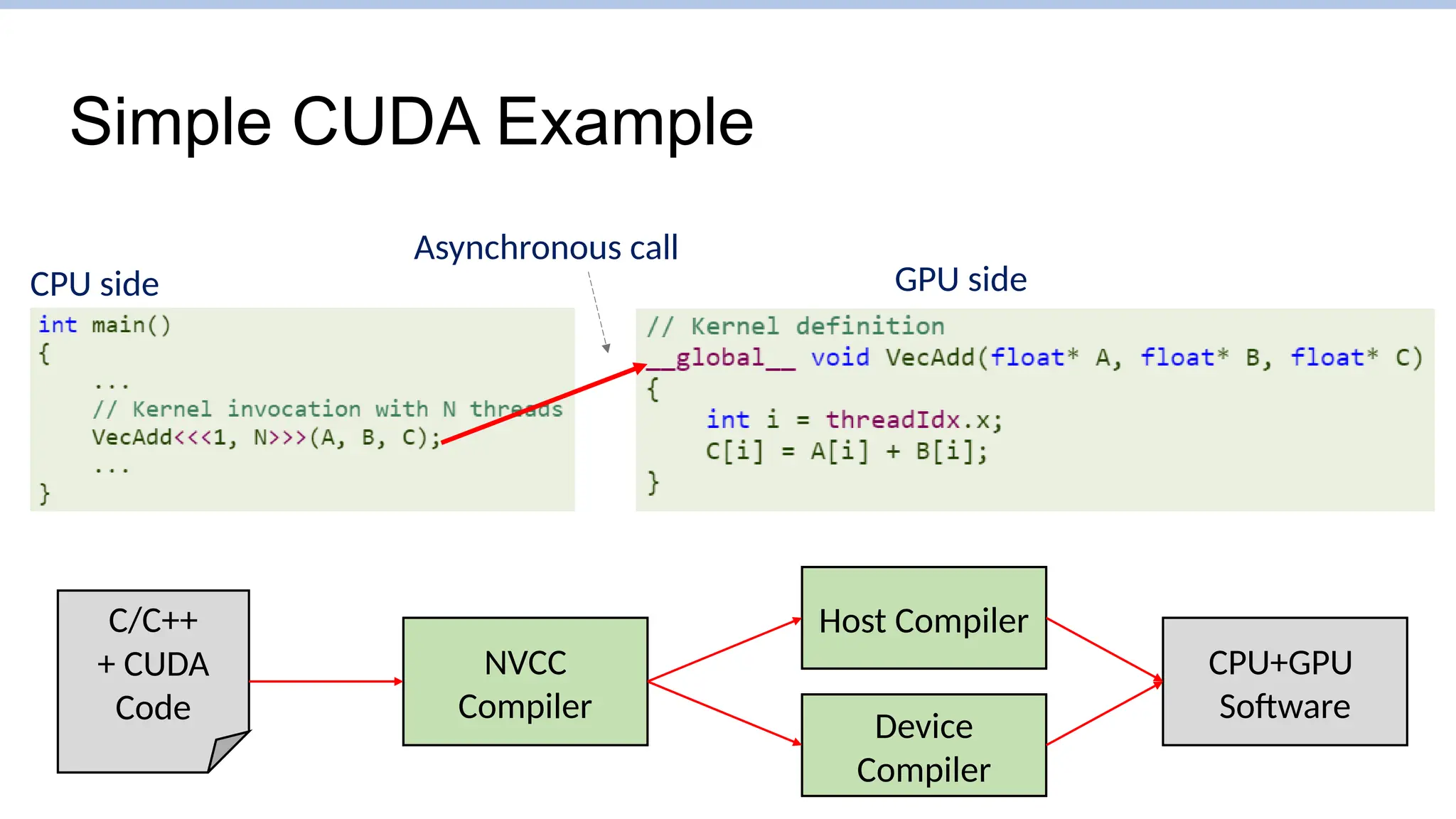
Simple CUDA Example
Asynchronouscall
NVCC
Compiler
Host Compiler
Device
Compiler
CPU+GPU
Software
C/C++
+ CUDA
Code
CPU side GPU side
13.
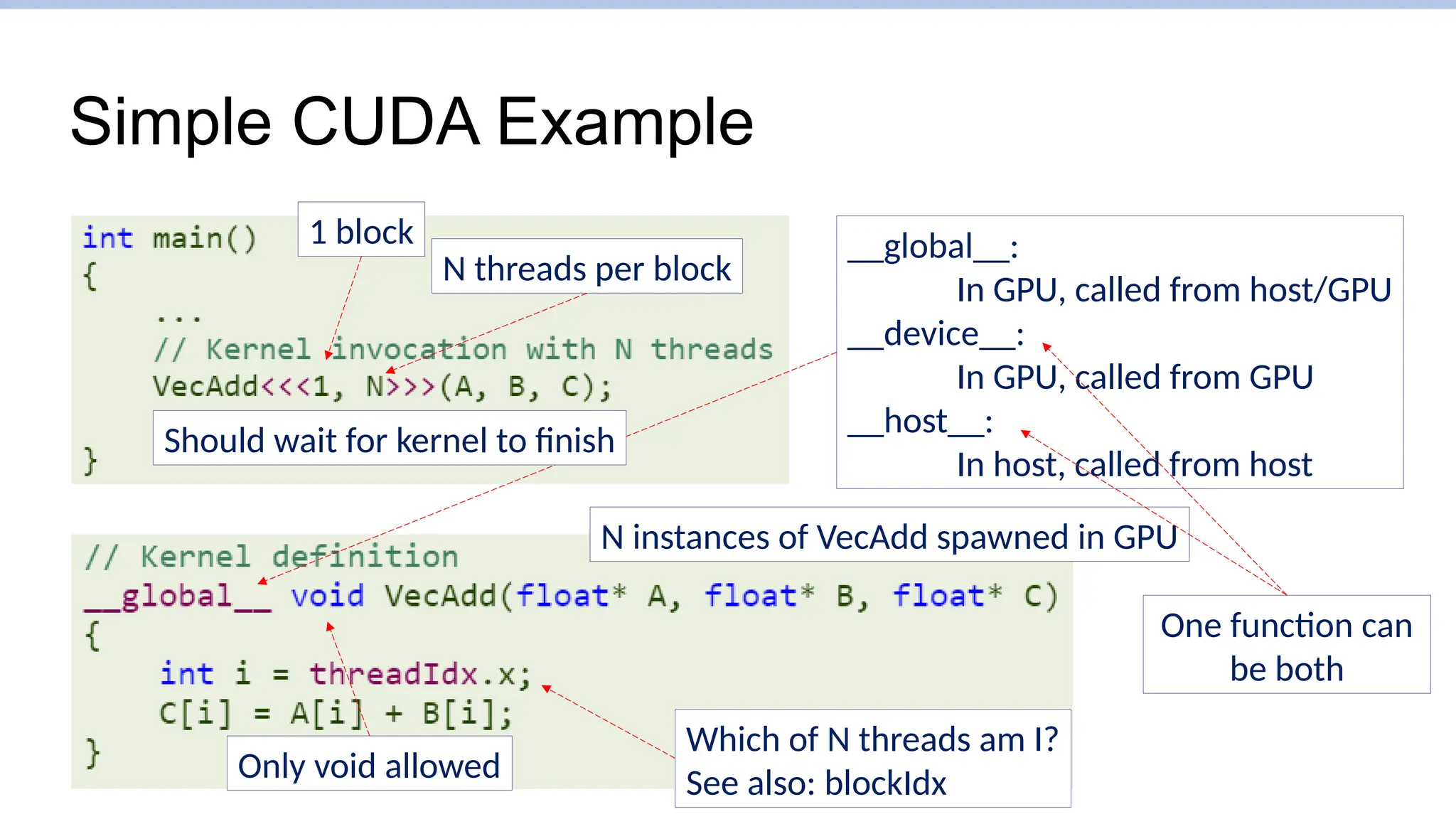
Simple CUDA Example
1block
N threads per block
Which of N threads am I?
See also: blockIdx
__global__:
In GPU, called from host/GPU
__device__:
In GPU, called from GPU
__host__:
In host, called from host
N instances of VecAdd spawned in GPU
Should wait for kernel to finish
One function can
be both
Only void allowed
14.
More Complex Example:
PictureBlurring
Slides from NVIDIA/UIUC Accelerated Computing Teaching Kit
Another end-to-end example
https://devblogs.nvidia.com/even-easier-introduction-cuda/
Great! Now we know how to use GPUs – Bye?
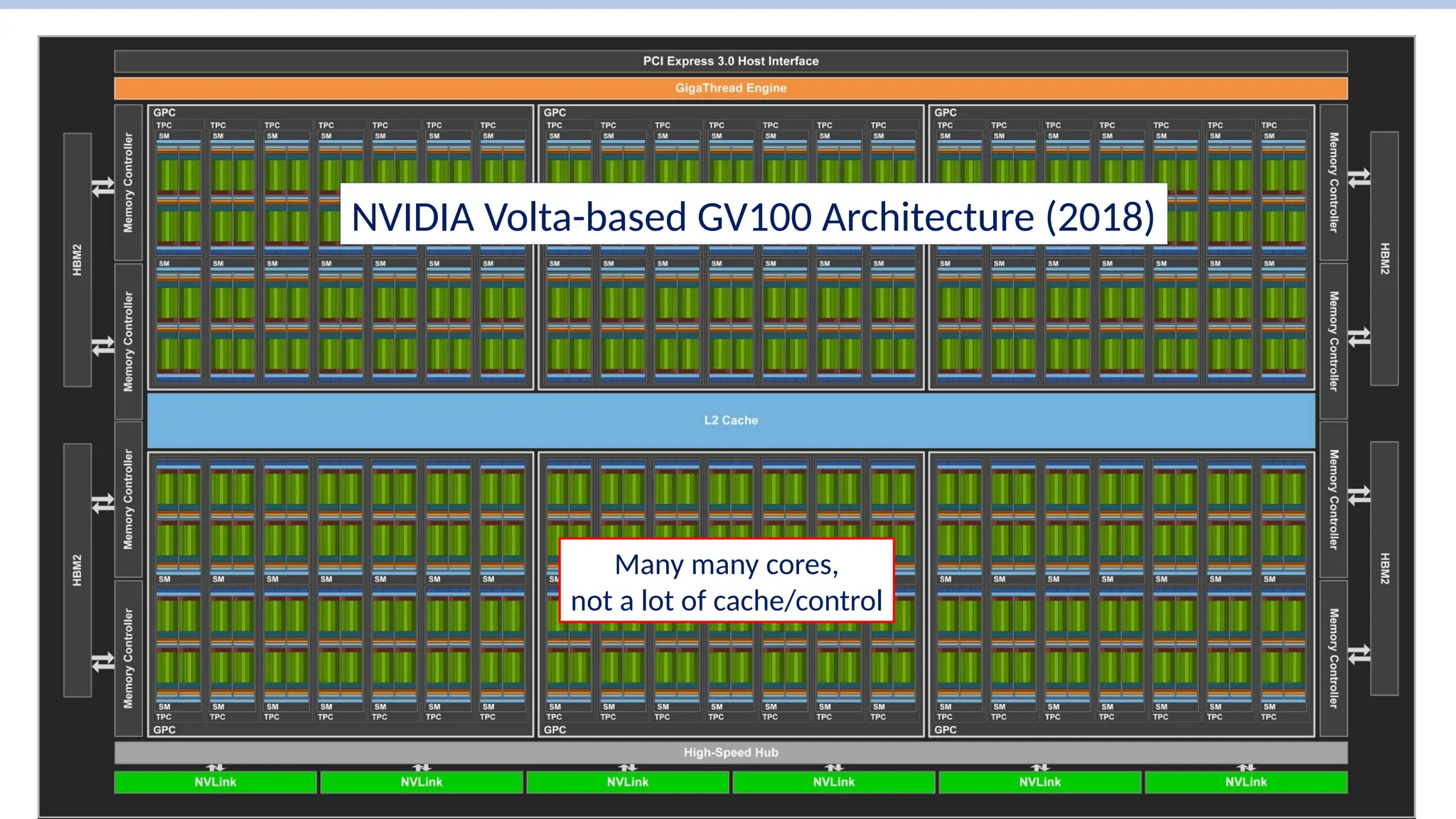
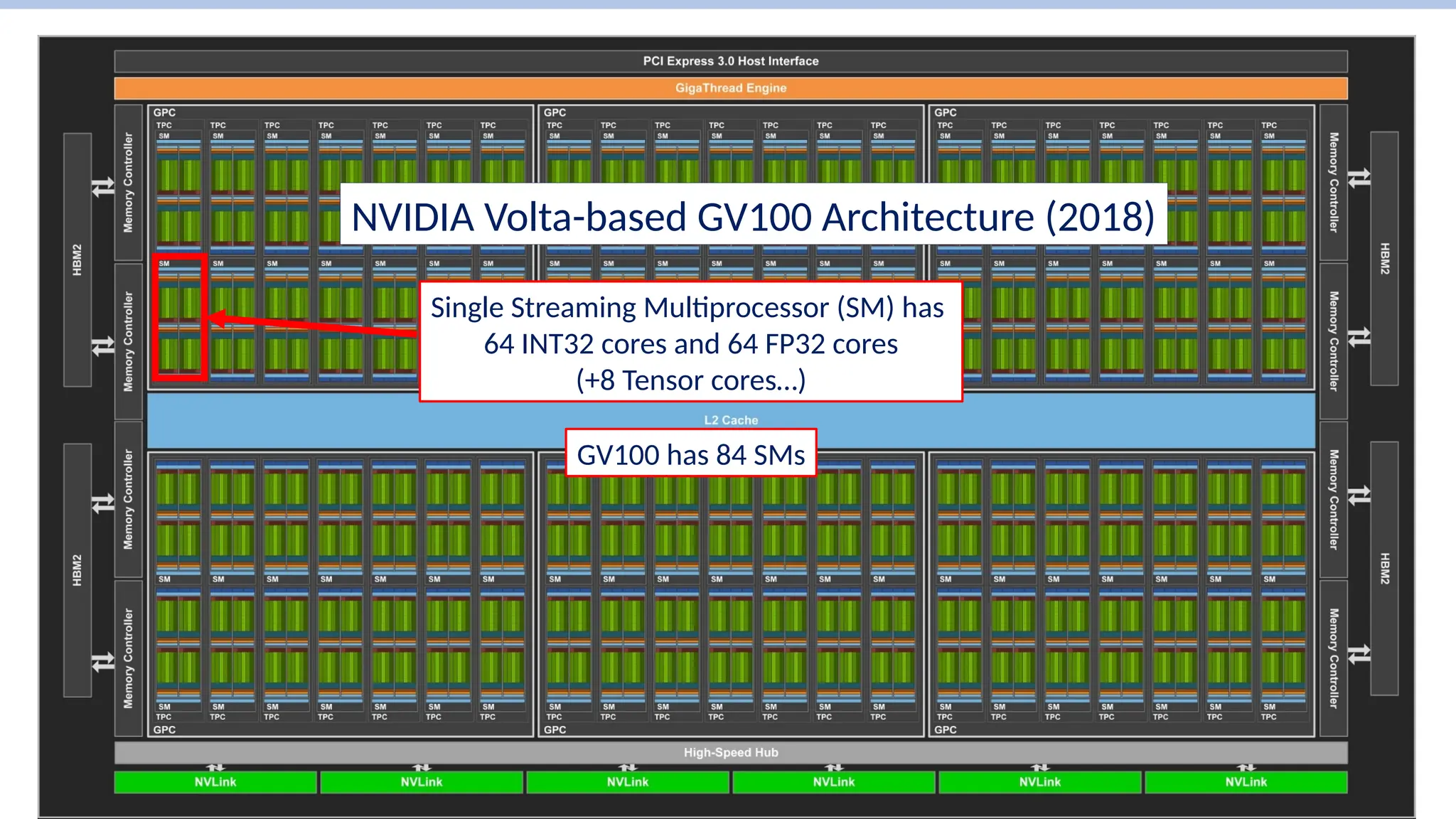
NVIDIA Volta-based GV100Architecture (2018)
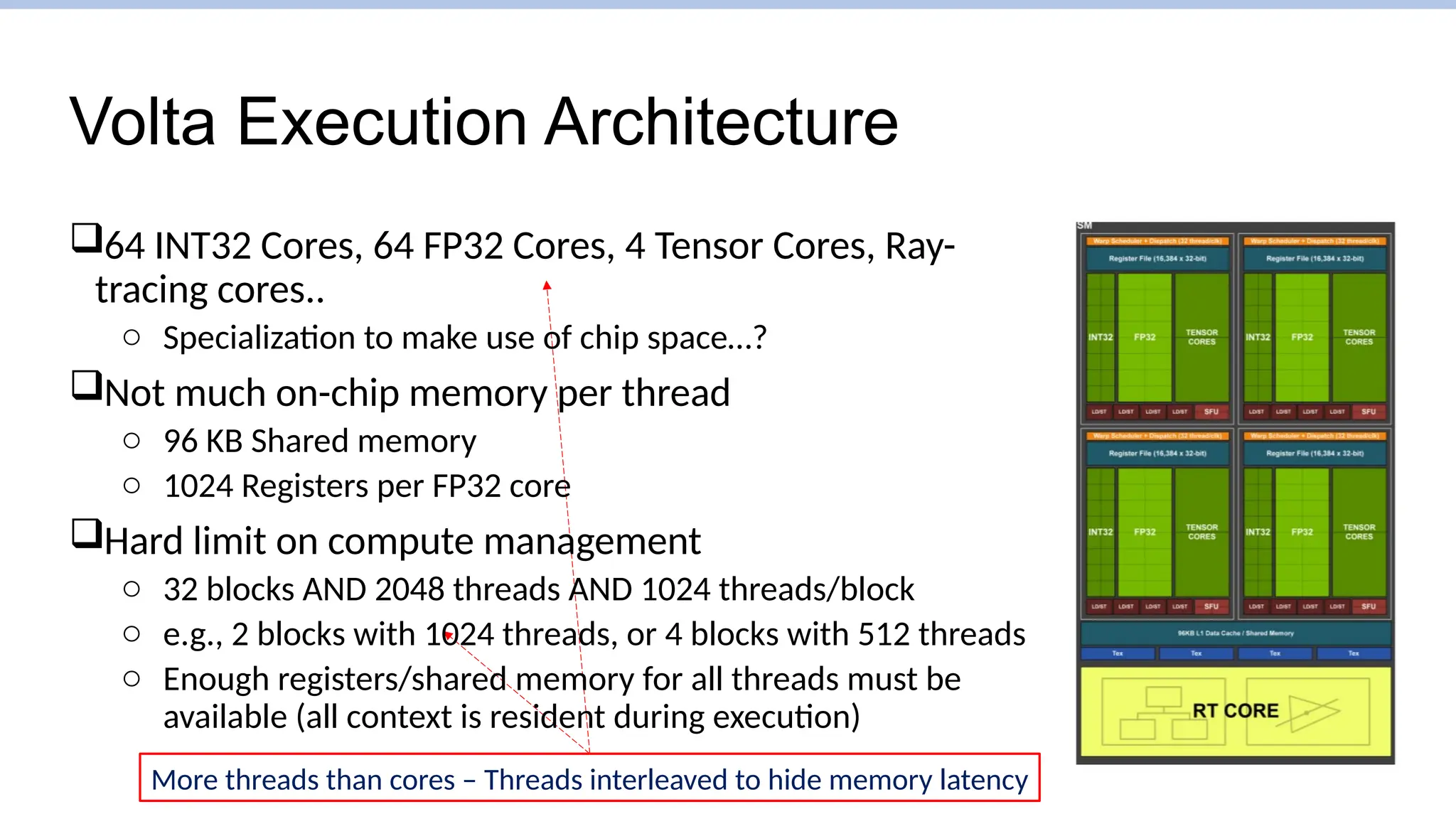
Single Streaming Multiprocessor (SM) has
64 INT32 cores and 64 FP32 cores
(+8 Tensor cores…)
GV100 has 84 SMs
17.
Volta Execution Architecture
64INT32 Cores, 64 FP32 Cores, 4 Tensor Cores, Ray-
tracing cores..
o Specialization to make use of chip space…?
Not much on-chip memory per thread
o 96 KB Shared memory
o 1024 Registers per FP32 core
Hard limit on compute management
o 32 blocks AND 2048 threads AND 1024 threads/block
o e.g., 2 blocks with 1024 threads, or 4 blocks with 512 threads
o Enough registers/shared memory for all threads must be
available (all context is resident during execution)
More threads than cores – Threads interleaved to hide memory latency
18.
Resource Balancing Details
Howmany threads in a block?
Too small: 4x4 window == 16 threads
o 128 blocks to fill 2048 thread/SM
o SM only supports 32 blocks -> only 512 threads used
• SM has only 64 cores… does it matter? Sometimes!
Too large: 32x48 window == 1536 threads
o Threads do not fit in a block!
Too large: 1024 threads using more than 64 registers
Limitations vary across platforms (Fermi, Pascal, Volta, …)
19.
Warp Scheduling Unit
Threadsin a block are executed in 32-thread “warp” unit
o Not part of language specs, just architecture specifics
o A warp is SIMD – Same PC, same instructions executed on every core
What happens when there is a conditional statement?
o Prefix operations, or control divergence
o More on this later!
Warps have been 32-threads so far, but may change in the future
20.
Memory Architecture Caveats
Sharedmemory peculiarities
o Small amount (e.g., 96 KB/SM for Volta) shared across all threads
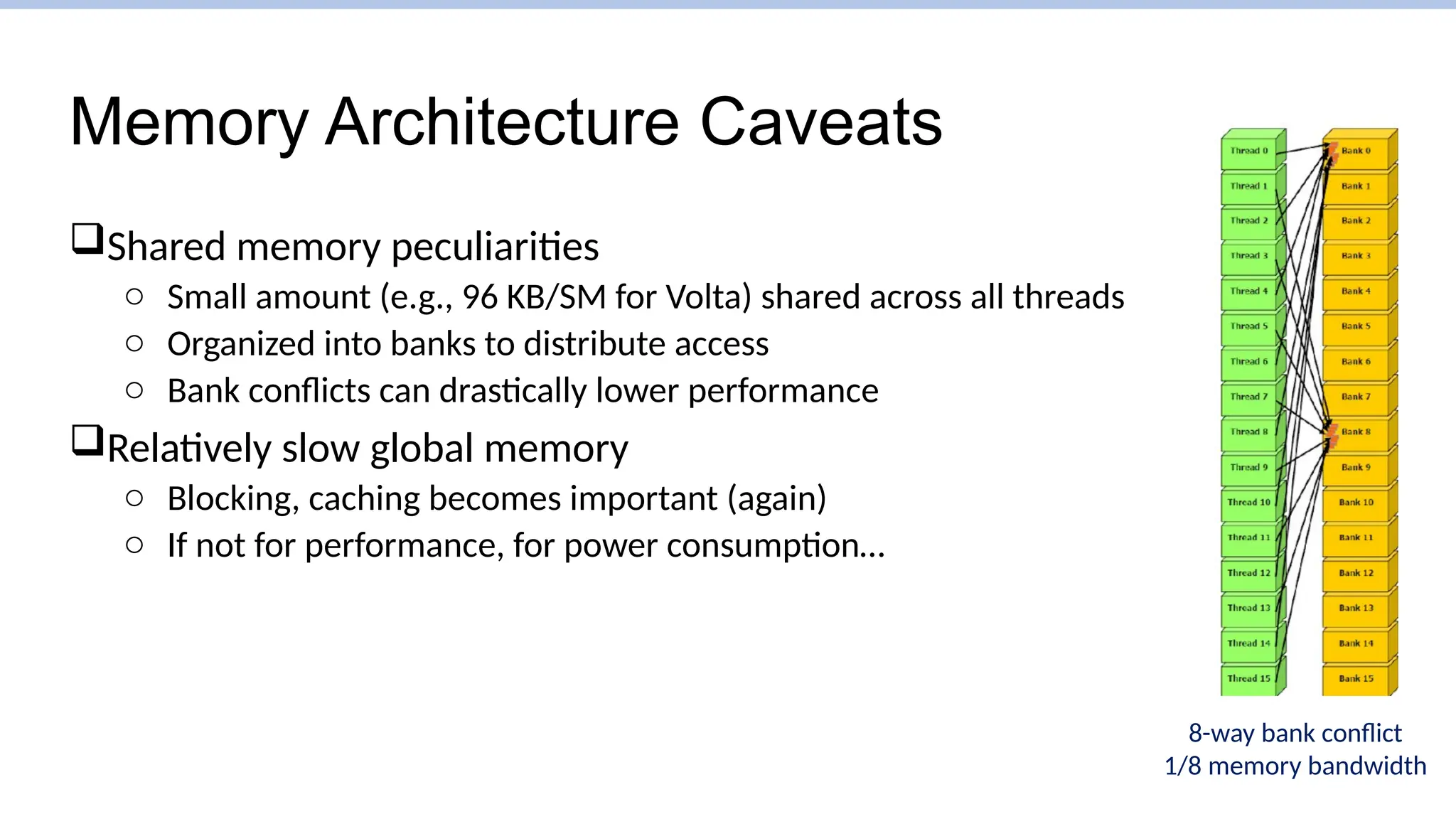
o Organized into banks to distribute access
o Bank conflicts can drastically lower performance
Relatively slow global memory
o Blocking, caching becomes important (again)
o If not for performance, for power consumption…
8-way bank conflict
1/8 memory bandwidth